
Master the Practice AWS Exam with a Strategic Study Plan
Master Your AWS Certification Journey with a Strategic Practice Exam Plan
High-quality practice exams are the most effective tools for AWS certification preparation. These tests do more than quiz your memory; they simulate the actual testing environment to move your skills from theory into timed application. MindMesh Academy recognizes that exam success depends on your ability to apply technical knowledge under pressure. Using these simulations builds the stamina and focus required to pass with confidence on your first attempt.
Why a Practice AWS Exam Is Your Most Critical Study Tool
Let's be direct. Modern AWS certification exams, much like those for PMP, Azure, or ITIL, have changed. They no longer rely on simple recall questions like "What is the function of this service?" Today, you face complex scenarios that demand real problem-solving skills, critical thinking, and the ability to pick the most efficient solution from several correct-looking options. This is where a high-quality practice test shows its essential worth.
Watching hours of video lectures or reading technical whitepapers provides a basic starting point, but it can create a false sense of security. Passive learning often feels like you are making progress, but that feeling of mastery can fail you when you meet a difficult, multi-part scenario under the pressure of a timer. A rigorous practice exam cuts through this uncertainty. It acts as a diagnostic tool to find the knowledge gaps and weak spots you likely missed during your initial reading.
Moving Beyond Simple Memorization
Treat a practice exam like a mandatory sparring session before a main event. For candidates preparing for the AWS Certified Solutions Architect - Associate or a professional-level credential, these tests allow you to sharpen your skills in a controlled setting. You can see exactly where you need to focus your energy. The goal is not merely to hit a passing percentage on the simulator. Instead, you should turn each attempt into a specific plan for your next study session. This iterative process is how you build practical cloud skills that last, instead of just memorizing facts for a day.
This focus on applied knowledge is necessary because the market for cloud talent is crowded. As of January 2025, there are more than 1.42 million active AWS Certifications held by over 1.05 million people (verify current statistics on the official AWS site). To stand out in this competitive field, you must show you can do more than pass a test. You have to prove you can solve real-world architectural problems effectively.
The Real Value of Simulation
A high-quality practice AWS exam is much more than a simple quiz; it is a full-scale dress rehearsal. It helps you build the mental endurance needed for a test that lasts several hours. You learn how to pace yourself so you don't run out of time on the final questions. You also get used to the specific phrasing and style AWS uses in its questions. This is your chance to learn how to ignore "distractor" answers and find the key details in long scenario descriptions. To get the most realistic experience, using advanced study applications provides the simulations and detailed analytics you need to stay ahead.
Your first score on a practice exam is only a starting point. The real learning happens during the thorough review process. Exploring the logic behind every correct and incorrect answer is how you build a solid understanding of the material.
Integrating these tests into your routine from the first day creates a strong feedback loop. This method stops you from wasting time on topics you already know. You can instead put your effort into the specific areas where you are struggling. This is how you study smarter. To learn more about how to use these tools effectively, see our guide on AWS practice tests.
Crafting Your AWS Study Blueprint
Generic study plans often result in wasted effort. To succeed on your AWS exam, you need a schedule customized to your specific learning profile. This strategy builds on your strengths and addresses your weaknesses directly. The most effective method for this is a personalized study blueprint. Your initial practice AWS exam is the key tool to making this strategy work.
The process begins with an honest self-assessment: a full-length practice exam. You should take this test under conditions that mirror the actual testing environment. Do not worry about your initial score. The main goal is not to pass on your first attempt. Instead, you are looking for a clear, data-driven snapshot of your current knowledge. This assessment establishes your baseline.
Find Your Starting Point: Assess Your Baseline Performance
Once you finish the baseline test and review the results, the strategic work starts. Your overall percentage is just a surface-level indicator. The real value is found in the domain-level breakdown. Every AWS certification follows a structure of specific domains, such as Design High-Performing Architectures or Secure Architectures. Each domain carries a different weight in the final score.
Carefully compare your performance in each domain against the weightings in the official exam guide. For example, if you score 60% in a domain that represents 30% of the exam, but hit 90% in a domain that only counts for 10%, you have found a gap. Study time is a finite resource. This analysis shows you exactly where to put your energy to get the biggest increase in your score. You should prioritize the high-weight areas where you are currently underperforming to maximize your progress.
The purpose of a baseline practice exam is not to measure immediate success; it is to uncover opportunities for growth. Every low score in a heavily weighted domain acts as a signal, directing your energy to where it matters most for your final result.
The following diagram illustrates how to move from just reading information to mastering the material through targeted application.
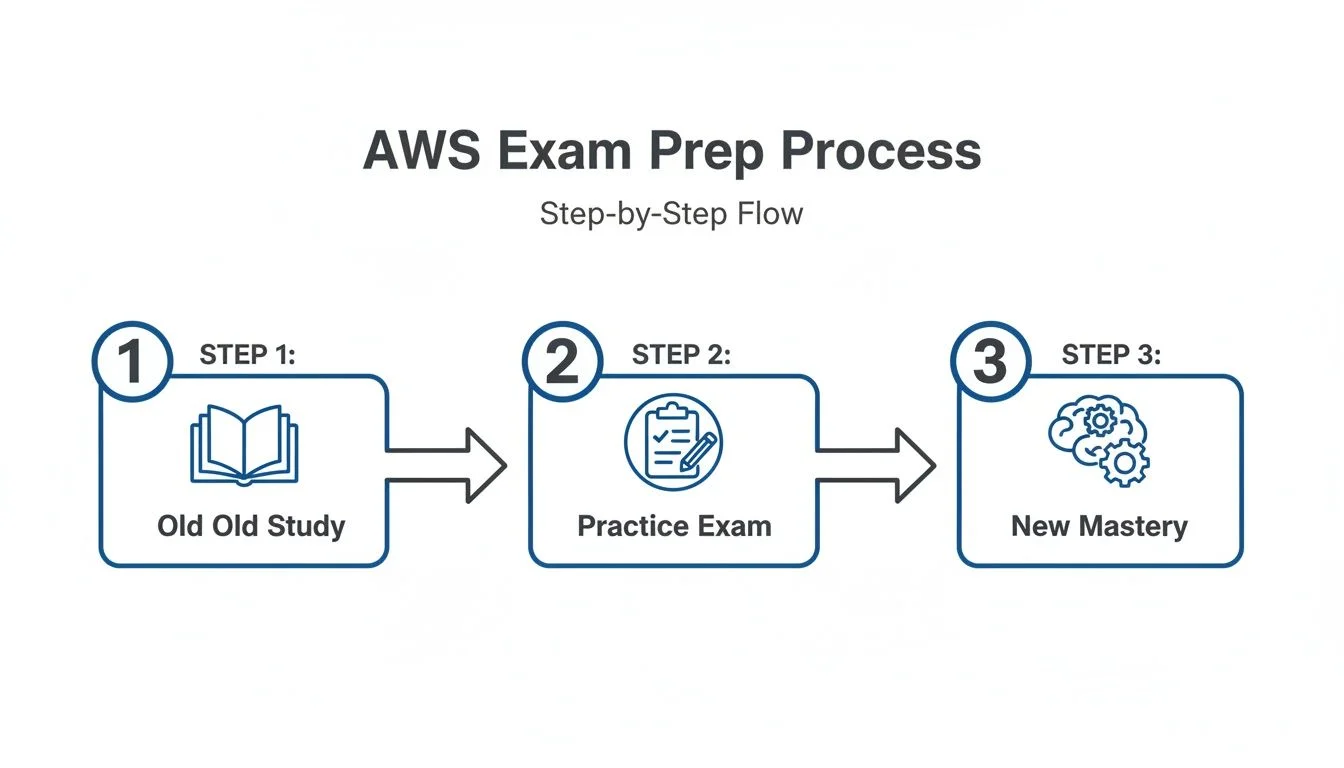
This model highlights a change in strategy. Instead of studying everything broadly, you use a practice exam as a diagnostic tool. This helps you build a focused and efficient path toward mastery of the subject matter.
Build Your Weekly Study Schedule
Once you identify your weak areas, you can create a dynamic weekly study schedule. A good plan does more than just require reading a book. It mixes different ways of learning to help you gain practical knowledge. A balanced structure distributes your time across four main activities.
A Look at a Balanced Week:
- Targeted Theory Review (40%): Spend focused blocks of time on the domains and services where your baseline test showed lower scores. If your initial practice exam highlighted weaknesses in networking, use this time to study VPCs, Direct Connect, and Transit Gateways. Focus on how these components connect to build a secure environment.
- Hands-On Labs (30%): Theory remains abstract until you apply it. Use platforms like AWS Skill Builder or detailed labs to get real experience. If you are not sure about database recovery, do not simply read about Amazon RDS Multi-AZ. Log into the console and perform a manual failover in a lab environment. Seeing the service react to your changes improves your memory of the process.
- Practice Questions (20%): Keep your momentum by working through small sets of practice questions. These should focus on the topics you are studying that week. This reinforces what you learned and helps you get used to the specific phrasing of AWS questions. You will learn how to identify the correct service when the exam provides multiple similar options.
- Spaced Repetition and Review (10%): Spend a small amount of time each week reviewing topics from previous sessions. This stops you from forgetting what you already learned. It ensures the information stays in your long-term memory, which is vital for passing the exam and using these skills later in your career.
If your baseline exam showed that you struggle with migration services—a common issue in Professional-level exams—your schedule should change immediately. You would prioritize labs involving AWS Migration Hub and Application Migration Service. You would then follow up with practice questions specifically about migration. This targeted method is much more effective than reading a whole study guide again.
This part of your preparation is just one piece of the puzzle. For a broader view, you can read our detailed guide on how to get AWS certification. This resource explains the path from basic concepts to passing your exam. Your blueprint is not a static document. It should change as you take more practice tests and gain confidence as you approach the testing date.
Analyzing Your Practice Exam Results Like An Expert
Finishing a full-length practice AWS exam is a major milestone in your preparation. It takes focus and endurance to sit through dozens of complex scenarios. However, the score you see on the final screen is only a preliminary metric. The most effective learning happens when you move past the percentage and examine your results with a critical eye. This analytical phase allows you to transform every missed question into a specific improvement in your knowledge base.
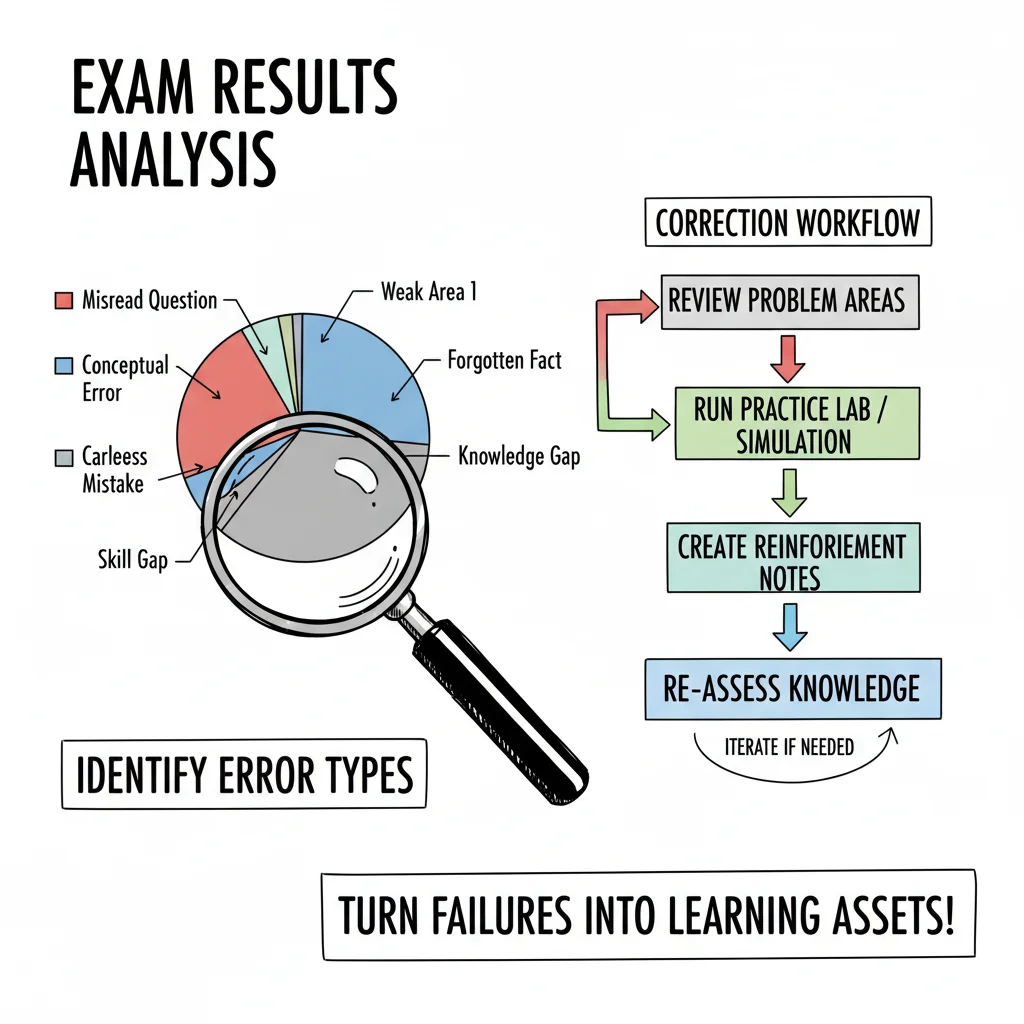
You must resist the urge to look at your score and immediately jump into the next test. Instead, treat your results as a technical data set that highlights exactly where your logic failed. The first step is to categorize every incorrect answer. You are not just looking for the right answer; you are looking for the reason you chose the wrong one. Identifying the root cause of an error allows you to fix the underlying problem rather than just memorizing a specific fact.
Deconstructing Your Mistakes
Systematically grouping your errors is the best way to see patterns in your thinking. A mistake caused by misinterpreting a sentence requires a different fix than a mistake caused by not knowing a service's limitations. If you know the service but misread the requirement, you need to work on your testing technique. If you have never heard of the service mentioned in the correct answer, you have a knowledge gap that requires more reading or lab time.
Your mistakes will generally fall into one of these four categories:
- Misread Question: You had the technical knowledge to answer correctly but missed a restrictive keyword. AWS frequently uses qualifiers like "most cost-effective," "least operational overhead," "highly available," or the word "NOT." If a question asks for the "least operational overhead" and you choose a self-managed EC2 database over a managed Amazon RDS instance, you have made a strategy error.
- Conceptual Gap: You did not understand the fundamental way a service functions or how it compares to another. A common example is the confusion between Amazon SQS and Amazon Kinesis. If you cannot explain when to use a message queue versus a data stream, you cannot accurately solve architectural problems. This also applies to understanding the nuances of S3 storage classes, such as the retrieval times for Glacier Flexible Retrieval versus Glacier Deep Archive.
- Forgotten Fact: You understand the concept but cannot recall a specific technical detail under the pressure of the clock. This often involves specific API names, service limits, or configuration requirements. You might know that an Application Load Balancer works at Layer 7, but you might forget which specific header it uses to track the original IP address of a client.
- Educated Guess Failed: You successfully eliminated two clearly incorrect options but struggled to choose between the remaining two. This is common in the AWS Certified Solutions Architect exams. Often, both remaining choices are technically possible, but one is "better" based on the specific constraints (cost, speed, or complexity) provided in the prompt.
By tracking these errors in a spreadsheet, you can see if a specific trend emerges. If 30% of your errors are "Misread Questions," you must force yourself to slow down and physically or mentally check off the requirements before selecting an answer. If conceptual gaps are the main problem, you should return to the AWS whitepapers and spend more time in the management console. For more details on how these assessments help your preparation, see our guide on what a practice exam is.
Mapping Practice Exam Errors to Study Strategies
Identifying why you made a mistake is only the first step. You must then match that error with a specific method to fix it. Aimless reading of the documentation is rarely the best use of your time. Instead, use the following table to connect your error types with the most effective study methods available through MindMesh Academy.
| Error Type | Description | Recommended MindMesh Academy Strategy |
|---|---|---|
| Misread Question | You missed a key word like "NOT," "most," or "least" and solved for a different requirement. | Focus on Timed Question Sets. Practice identifying and highlighting the primary constraint (cost vs. performance) first. |
| Conceptual Gap | You misunderstood the core function of a service or its primary use case (e.g., SQS vs. Kinesis). | Use Hands-On Labs and Review Labs. Building the architecture makes the differences between decoupling and streaming clear. |
| Forgotten Fact | You could not recall a specific limit or configuration detail like EC2 instance types or S3 pricing. | Use Spaced Repetition Flashcards. These help you commit specific technical details to long-term memory through repetition. |
| Educated Guess Failed | You narrowed the choices to two but could not identify the subtle technical difference between them. | Review the Detailed Answer Explanations. Focus on why the "distractor" was technically inferior to the correct choice. |
Using this targeted approach helps you move from general review to precise technical remediation. This ensures that every hour you spend studying is directly addressing a verified weakness in your exam performance.
Dissecting Answer Explanations
After categorizing an error, you must read the full explanation for that question. A high-quality practice exam provides more than just the letter of the correct answer. It explains the logic of the correct choice and provides a technical breakdown of why every other option was incorrect.
This is where you build true expertise. Understanding why an answer is wrong is often more useful than knowing why it is right. It teaches you to recognize "distractors"—options that look plausible but fail to meet a specific requirement. These explanations help you understand the trade-offs between different AWS services, such as the cost implications of using a NAT Gateway versus a VPC Endpoint.
A detailed answer explanation acts as a focused lesson. It turns a single missed question into a chance to learn about three or four related services at once, preparing you for variations of that question on the actual exam.
Consider a scenario where you are asked about the most secure way to connect an on-premises data center to an S3 bucket. If you chose a NAT Gateway, the explanation will clarify that a NAT Gateway is designed for outbound internet traffic from a private subnet. It will then explain why an Interface VPC Endpoint or a Gateway VPC Endpoint is the correct choice for keeping traffic on the AWS private network. This reinforces your knowledge of both networking and security domains simultaneously.
Turning Errors Into Actionable Study Tasks
The final step is to turn your mistakes into a list of specific tasks. General goals like "learn more about security" do not work well. Your tasks must be concrete and measurable. This turns your practice exam data into a personalized study plan.
Look at your error analysis and create a to-do list like the following:
- Mistake: Confused the features of AWS Shield Standard and AWS Shield Advanced.
- Task: Review the DDoS protection documentation. Create a table that compares the two based on cost, Layer 7 protection, and the 24/7 access to the Shield Response Team (SRT).
- Mistake: Chose an incorrect EC2 instance family for a high-performance database.
- Task: Visit the EC2 instance types page. List the primary use cases for the R (Memory Optimized), C (Compute Optimized), and M (General Purpose) families. Write down one specific scenario where a C-family instance would be a poor choice compared to an R-family instance.
- Mistake: Failed a question because you missed a "most cost-effective" requirement.
- Task: Take a 10-question practice quiz. For every question, identify the "constraint" (e.g., "minimize spend" or "maximum availability") and write it down before looking at any of the multiple-choice options.
This data-driven method takes the guesswork out of your study sessions. You are no longer wondering what to review next. Your performance on the practice exam provides a clear map of exactly which technical areas and testing habits need your attention before you schedule the official test. Use this process to build your knowledge until you can pass with confidence.
Mastering Complex Scenarios and Exam Pacing
Modern AWS certification exams present a unique challenge that many candidates underestimate. The days of simple multiple-choice questions focusing on basic recall are over. Current assessments are carefully designed to reflect the messy, often unclear situations cloud architects and developers face in their daily work. You will encounter long, multi-part scenarios that require sharp analysis and quick decision-making. Your strategy for breaking these questions down matters just as much as your technical skills.
This shift in exam style is intentional. Scenario-based testing mirrors the actual expectations of a cloud professional. Companies want experts who can balance conflicting goals and make smart choices with limited data. They aren't looking for people who merely memorized service limits or simple definitions. You can see these trends and how they affect the industry by looking at the official AWS certification FAQ.
The goal when taking a practice AWS exam—and the actual test—is to learn how to filter through large blocks of text. You need to ignore irrelevant fluff and find the core issue. This is a skill you build through repeated, focused effort during your study sessions.
Deconstructing the Scenario Question
Seeing a massive paragraph on your screen can feel overwhelming. Do not let it rattle you. Instead, use a repeatable system. My top recommendation is to read the final sentence first.
This is effective because that last sentence usually contains the actual question. It defines the goal, such as "Which solution provides the highest availability?" or "How can the company reduce costs most effectively?" Often, the three paragraphs before that sentence are just context that might not even change the answer.
Knowing the objective from the start changes how you process every detail that follows. You can scan the setup with a specific target in mind, looking for constraints and requirements that influence that one goal. This prevents your brain from trying to solve five different problems at once.
Consider this practical example:
You see a question about a company running a complex, three-tier application with high traffic. Instead of getting lost in the database engine details or the specific caching layers mentioned in the first two paragraphs, you jump to the end. You read: "The CIO has mandated that the new architecture must minimize operational overhead above all else."
Now you have a filter. As you read the scenario from the top, your brain looks for ways to remove manual work. You aren't just reading; you are hunting for indicators of managed services.
- Database Management: A mention of "patching servers" makes you think of Amazon RDS or Aurora immediately because they handle the heavy lifting of maintenance.
- Container Orchestration: A section on "scaling clusters" points you toward AWS Fargate rather than self-managed EC2 nodes, which require more manual intervention.
- Manual Tasks: Any mention of "manual scaling" is a clear sign that you need to find an Auto Scaling solution to meet the goal of low overhead.
This change in perspective turns you from a passive reader into a focused investigator. You stop trying to understand the whole story and start looking for the clues that solve the specific problem.
Finding the Signal in the Noise
AWS exams are famous for using "distractors." These are details that are technically true about AWS services but have nothing to do with the problem at hand. For instance, a question might mention that a company uses a specific encryption standard. While that is a fact, if the question is asking about network throughput, the encryption type is just noise. You must train yourself to identify these and toss them aside.
The secret to handling complex scenario questions is not knowing every tiny detail of every service. It is identifying the one or two main constraints that let you throw out three of the four possible answers. You need to spot the specific words that define the priority. Use these terms as your indicators:
- Cost: Look for phrases like "most cost-effective," "minimize spending," "avoid upfront costs," or "lowest TCO."
- Performance: Watch for "lowest latency," "high throughput," "millisecond response," or "fastest processing."
- Resilience: Identify "disaster recovery," "fault-tolerant," "highly available," or "Multi-AZ/Region."
- Operations: Focus on "least operational overhead," "fully managed," "serverless," or "automate deployment."
- Security: Search for "encryption at rest," "least privileged access," or "meet compliance requirements."
Use these phrases as a lens. If a question asks for a "cost-effective" solution, a high-performance, expensive Multi-Region setup is likely the wrong choice, even if it is a "better" architecture from a technical standpoint. Always answer the question being asked, not the question you think they should have asked.
Developing Your Exam Pacing Strategy
Managing your time is a skill you can only build with practice. A typical AWS exam, like the AWS Cloud Practitioner (CLF-C02) or the Solutions Architect Associate (SAA-03), gives you about 65-75 questions to answer in a 3-hour window. This averages out to roughly 2-3 minutes per question.
Some questions are quick and take 30 seconds. Others will eat up five minutes because of their complexity. You have to find a rhythm. Use the flag for review button, but use it carefully. Don't flag every question where you feel a bit of doubt. Use it only when you have narrowed the choices to two but cannot decide. Pick the one that seems best, flag it, and move on immediately.
This keeps you from getting stuck and wasting time on a single difficult problem. Often, you will find that coming back to a question with 20 minutes left on the clock gives you the clarity you lacked an hour ago. Sometimes, a later question might even jog your memory about a previous one.
While taking practice tests, check your progress against the clock at specific intervals. At the 60-minute mark, you should have finished roughly one-third of the exam. If you are behind, you need to increase your reading speed. If you are way ahead, you might be rushing and should slow down to avoid making silly mistakes. Adjusting your speed during practice ensures you stay calm during the real exam. This level of preparation turns the timer from a source of stress into a tool for success.
Your Final Week Pre-Exam Readiness Checklist
The seven days before your test are for reinforcement, not cramming. This week is the final stretch where you focus on solidifying what you already know and building the confidence needed to succeed. You have already put in the difficult hours of study. Now is the time to refine your approach rather than panicking about new material.
View this period as a recovery phase after intense training. Your goal is to strengthen your memory and handle the administrative side of the exam. This allows you to walk into the testing center feeling calm and ready for the task ahead.
Take One Last Full-Length Practice Exam
About five to seven days before your scheduled appointment, set aside a block of time for one final, full-length AWS practice exam. This is not a study session to learn new facts. It is a dry run for the actual event. You want to recreate the testing experience as closely as possible to prepare your mind for the pressure.
Treat this final practice run exactly like the real exam:
- Follow the clock strictly. Do not pause the timer or give yourself extra minutes. This is your chance to practice your pacing and build the stamina required for a long exam.
- Eliminate all distractions. Turn off your phone and close any extra tabs on your computer. Find a quiet, empty space where you will not be interrupted. Replicating the focused environment of a testing center is a key part of your preparation.
- Use the interface features. Practice flagging questions that seem difficult or time-consuming. Get comfortable making an educated guess and moving on, knowing you can check those questions later if you have time left.
The goal of this run-through is to build memory and focus. After you finish, look over the questions you got wrong, but do not spend hours in excessive research. This final test is about confirming your current knowledge and getting used to the way questions are phrased under pressure.
Targeted Review Without the Burnout
Your study sessions during these last few days should be short and specific. Put away the long guides and thick books. Instead, use your previous practice test results to find specific areas where you still feel uncertain.
This is not the time to learn an entirely new AWS service or architectural pattern. Focus on quick reviews of specific facts, service limits, or configurations that you find difficult to remember. You are fixing small gaps in your knowledge, not trying to build a new foundation.
I suggest making a short "personal cheat sheet" that lists your own specific trouble spots. This might include the specific use cases for different S3 storage classes, the differences between EC2 instance families, or the specific features of various database services. Look at this sheet for 15-20 minutes (verify study duration with your current schedule) each day. This light but consistent review keeps the details fresh in your mind without causing mental exhaustion.
It is helpful to stop all active studying 24 to 48 hours (verify timeframe) before your exam. Give your brain time to rest and organize the information you have learned. Going into the exam with a fresh mind is often more effective than trying to memorize one last fact on the morning of the test.
Nail Down the Logistics and Your Mindset
Handling the logistical details early prevents stress that can hurt your score. Sorting out your schedule and requirements early will help you focus entirely on the technical questions.
Your Essential Pre-Exam Checklist:
- Check the schedule: Confirm your exam date, the exact time, and the location. If you are taking the exam online, read through the technical requirements again to make sure your computer and room are ready for the proctoring software.
- Check your identification: Make sure you have the correct forms of ID ready. Check the expiration dates and ensure the name matches your exam registration exactly. Searching for an ID on the morning of the exam creates unnecessary stress.
- Get enough sleep: Make sure you get 7-9 hours (verify health guidelines) of rest each night leading up to the test. Mental clarity depends on being well-rested, so prioritize your sleep schedule.
- Plan the day: Map out the drive to the testing center and account for potential traffic. If you are testing at home, clear your desk the night before. Plan a light meal that will give you energy without making you feel sluggish during the session.
This certification represents a major step in your career. Standard AWS exam prices range from $100 to $300 USD (verify current pricing on the vendor site). While this is an expense, it is a small one when you look at the potential results. Professionals who hold Associate-level AWS certifications often earn annual salaries between $110,000 and $140,000 (verify salary data with current industry reports). Paying the fee and putting in the time is a smart career move. You can find more details on how AWS certification costs correlate with salary potential to see the long-term benefits of this credential.
It is normal to feel some nerves on the day of the exam. Use that energy to stay focused on the screen. If you feel overwhelmed, take a few slow breaths to reset. Trust the preparation you have done and the hours you have put in. You are well-prepared to pass with confidence.
Frequently Asked Questions About AWS Practice Exams
As you prepare for an AWS certification, questions about practice exams will naturally arise. While these tests are a critical part of the process, it is easy to get lost in conflicting advice. Let’s look at the most common questions from IT professionals and students to clarify the best approach.
One of the first questions people ask is, "How many practice tests do I need to take?" While there is no single magic number, the best results usually come from taking between three and five full-length, high-quality practice exams.
This range gives you a baseline for your starting point, offers a way to measure your progress, and acts as a rehearsal before the actual test day. If you take fewer than three, you might not see enough variety in how AWS words its questions. If you take more than five or six, you risk burnout or simply repeating the same concepts without gaining new insights. The number of tests you take matters less than how you review them. Taking ten exams without studying your mistakes is a poor use of time. You will learn more by taking just three and breaking down every single question you missed. Spend twice as much time reviewing an exam as you spent taking it. Closely analyzing your errors is the only way to ensure you do not repeat them on the day that counts.
What Score Should I Aim for on Practice Exams?
This is a common and important concern. AWS does not publish its exact passing scores for every exam version, but the consensus among certified professionals is that you should aim for 85-90% on reputable practice tests before you book your appointment.
Why aim so high? Good practice exams often feature questions more difficult than those on the real test. They test edge cases and specific details to ensure you have no blind spots in your knowledge. Scoring well above the likely passing mark creates a safety margin. This helps you handle exam-day nerves, strange question wording, and the difficult questions that always appear. If you walk into the testing center knowing you can hit 90% on a tough simulation, you will be less likely to panic when you hit a difficult patch of questions in the first fifteen minutes.
If you are scoring around 75%, you are moving in the right direction, but you are not ready yet. This score shows you need to spend more time on your weak areas. Getting to 85% or higher builds the confidence you need to pass the actual exam.
Consider a student preparing for the AWS Certified Solutions Architect - Professional exam. If they score 78% on a tough practice test, and the real exam requires roughly 750 out of 1000 (75%), they might feel ready. However, that 78% suggests they still struggle with specific high-level topics. They might need more work on migration strategies using AWS Application Migration Service or advanced networking with AWS Direct Connect and Transit Gateway before they are ready for a professional-level test. A score of 750 (verify current passing scores on the AWS certification site) is the typical bar, but a 3% margin is too slim for comfort.
How Do I Avoid Just Memorizing Questions?
Memorization is a trap. It is easy to take the same test over and over until you recognize the questions. You might think you have mastered the material when you have actually just memorized the answers. This creates a false sense of security that fails you on the real exam. When the real test changes the wording or uses a different service name, a person who memorized the answer will get confused.
To avoid this and actually learn the concepts, use these methods:
- Use a large, varied question bank. A platform with many questions ensures you see new scenarios instead of the same ones repeatedly. Look for banks that have at least 300 to 500 questions for the Associate exams and more for Professional levels.
- Focus on the "why." For every question—whether you got it right or wrong—explain to yourself why the right answer is correct and why the other options are wrong. This is the process of elimination. If you can explain why three answers are incorrect, you have a much better chance of finding the right one on the real exam. This moves you from memorizing to understanding.
- Build your own scenarios. If you see a question about Amazon RDS Multi-AZ failover, stop and change the scenario. Ask yourself what would happen if the goal was read scaling instead of high availability. What if the database was Aurora instead of RDS? How would that change the backup strategy? This active learning makes the concepts stick in your long-term memory.
By looking at the material this way, you build expertise. You will be able to handle any question the exam presents, even if it uses a scenario you have never seen before. It turns a stressful test into a logical exercise.
Official AWS Materials Versus Third-Party Exams
People often ask if they should use official AWS materials or third-party tests. The best answer is to use both. They serve different roles in your study plan, and using them together provides a complete view of what to expect.
The official AWS practice questions on AWS Skill Builder are excellent. The same people who write the actual exams create these, so the tone and structure match the real test. This includes the use of "distractor" answers that look correct but are technically wrong based on a small detail. The downside is that the free question pool is often small and the explanations can be brief. You might get a 20-question set that tells you which answer is right but does not explain why the others are wrong.
Third-party providers fill this gap. They offer:
- Large question banks for more practice across different topics. These often include 6 or 7 full-length exams that you can rotate through to avoid seeing the same questions too often.
- Detailed explanations that explain why every choice is right or wrong. These explanations often include links to official AWS documentation, helping you learn the logic and the technical details at the same time.
- Performance analytics that show your scores by domain. If you are doing well in "Security" but failing "Cost Optimization," these tools will show you exactly where to focus your study time. This prevents you from wasting hours on topics you already know.
The best plan is to use both. Start with high-quality third-party exams to build your knowledge and find your weak spots. Spend the bulk of your study time here. As your exam date gets closer—perhaps in the final week—use the official AWS materials to get used to the specific phrasing of the real test. This two-part strategy gives you the best chance of success.
For a clear path through your study, look at our AWS Cloud Practitioner Study Guide.
Stop guessing and start learning. MindMesh Academy offers curated practice exams, analytics, and tools to help you pass your AWS certification with confidence. View our complete prep materials and start your path to success today at AWS Cloud Practitioner Practice Exams.

Written by
Alvin Varughese
Founder, MindMesh Academy
Alvin Varughese is the founder of MindMesh Academy and an enterprise architecture leader. An electrical engineer by training, he moved from factory automation in South Africa to cloud architecture at GE Appliances and Humana (Fortune 50), and holds 20 professional certifications including AWS Solutions Architect Professional, Azure DevOps Engineer Expert, and Microsoft Agentic AI Business Solutions Architect. He built MindMesh Academy after interviewing too many highly certified candidates who couldn't answer basic questions: the goal is prep that makes you better at the job, not just able to pass the exam.