
Ace Your AWS Exam with Top AWS Practice Tests
Certifications validate expertise for IT professionals seeking career growth. Preparing for an AWS, Azure, PMP, or ITIL credential requires you to master the exam format alongside the technical content. At MindMesh Academy, we treat practice tests as high-impact tools that simulate the actual testing environment rather than optional study aids. Integrating these tests into a study plan often determines if a candidate succeeds or falls short. These resources function as a dress rehearsal. They help you identify knowledge gaps, manage strict time limits, and build the mental stamina needed for exam day. Use them to prepare thoroughly and pass with confidence on your first attempt.
Why Practice Tests Are Your Secret Weapon for AWS Certs
Attempting a professional certification exam without simulation is like running a marathon without training. For AWS exams, the hurdles are specific: complex scenario-based questions, tight time limits, and a massive list of services. Practice tests provide more than a simple knowledge check. They act as a training ground where you apply abstract ideas to practical problems. These tests help you see how AWS concepts function in real-world settings. This skill is vital for exams like the AWS Solutions Architect Associate or the situational questions found in the PMP exam.
Your Initial Diagnostic: The Foundation of Success
Your first practice test has one main job: it is a diagnostic tool. Do not worry about your score at this stage. The value of this first attempt is the honest look it provides at your current skills. This benchmark changes a vague study plan into a high-impact roadmap that targets your specific needs. It is the same reason a doctor runs tests before suggesting a treatment. By identifying what you do not know early on, you save yourself from hours of aimless reading.
From Guessing to a Targeted Strategy
Without an objective assessment, your study time becomes inefficient. You might spend weeks on topics you already know while ignoring areas where you are weak. A high-quality practice test removes this guesswork. It gives you immediate clarity on where to focus.
For example, you might find that your knowledge of AWS S3 storage tiers is excellent, but your understanding of Amazon Virtual Private Cloud (VPC) networking or Identity and Access Management (IAM) is lacking. If you are pursuing an Azure certification, you might see that you understand Azure Active Directory well, but Azure Kubernetes Service (AKS) requires more effort. This precision allows you to spend your time where it matters.
AWS holds a 31% global market share in the cloud sector. Because of this, earning a credential like the AWS Solutions Architect or Developer Associate is a major career move. Practice tests bridge the gap between reading a study guide and proving you have the skills required for a professional credential. They turn theoretical knowledge into the practical ability needed to pass.
Reflection Prompt: Think about your own study habits. Have you ever spent too much time on topics you already knew well? How might a diagnostic test change that?
Build Your Mental Endurance
Mastering the content is only part of the challenge. You also need the mental stamina to finish the test. The 90-minute AWS Cloud Practitioner exam and the 4-hour PMP certification test both require intense focus. You must learn to manage your time so you do not get stuck on one hard question while the clock runs out. Practicing under these conditions helps you handle the pressure of the ticking clock.
Every mock exam makes the real testing environment feel more normal. By the time you sit for the official certification, the interface, the timing, and the question styles will feel familiar. This allows you to stay calm and focus entirely on the questions. For those starting their path in the cloud, our thorough guide on the best AWS Cloud Practitioner practice exams for 2025 is an excellent place to start preparing for the current CLF-C02 exam.
How Practice Tests Fit Into Your Study Plan
Using practice tests at the right time is a strategic move. Instead of taking them all at once, space them out to maximize their impact on your learning. This helps you move from just memorizing facts to actually applying them.
| Study Phase | Primary Goal of Practice Test |
|---|---|
| Beginning | Diagnostic Assessment: Establish a knowledge baseline and find gaps across all exam domains. Ignore the score and look for weak spots. |
| Middle | Progress Tracking: Check how much you have learned and reinforce new concepts. Use the results to fix your study plan. |
| Final Weeks | Exam Simulation: Recreate the actual testing environment with strict time limits. Polish your time management and build confidence. |
This phased approach changes how you learn. It moves you from passive reading to active problem-solving. This method is a proven way to pass AWS certifications and other difficult exams like the PMP or ITIL Foundation. Using these tools correctly ensures you are ready for the technical questions and the pressure of exam day.
Choosing the Right AWS Practice Test
Selecting a practice test is a critical step in your study plan. The market offers many options, ranging from official certification materials provided by organizations like AWS, Microsoft, or PMI, to various third-party platforms. Choosing a test that does not meet high standards can lead to a false sense of security. In some cases, low-quality materials might include outdated information or topics that are no longer relevant to the current version of the exam. This is a common trap for students who prioritize price over content accuracy.
High-quality practice tests share several specific traits. The questions must accurately match the style, difficulty, and context of the actual exam. This is vital for scenario-based questions common in AWS and Azure certifications, or the ethical case studies found in PMP exams. The most important feature of a superior practice test is the explanation provided for each answer. A good resource does more than just show you the correct option. It explains why that choice is right and clarifies why the other options are wrong. This specific reasoning helps you learn from your mistakes and understand the logic behind the technology.
Core Evaluation Criteria
To ensure your study time is effective, use a strict selection process. Choose providers that update their question banks to match the most recent AWS exam blueprints or the current standards for Azure, PMP, or ITIL certifications. Look for recent reviews from other students that mention accuracy and current content. A practice test that was useful last year might be unhelpful now if the exam objectives have changed significantly.
Effective practice exams are a vital part of any certification strategy. For example, the AWS Certified Cloud Practitioner (CLF-C02) requires a firm understanding of basic cloud concepts. Taking several practice exams helps solidify this knowledge before you sit for the test. To better understand the strategy behind this preparation, check out the official insights on AWS certifications and see how these exams fit into your professional goals.
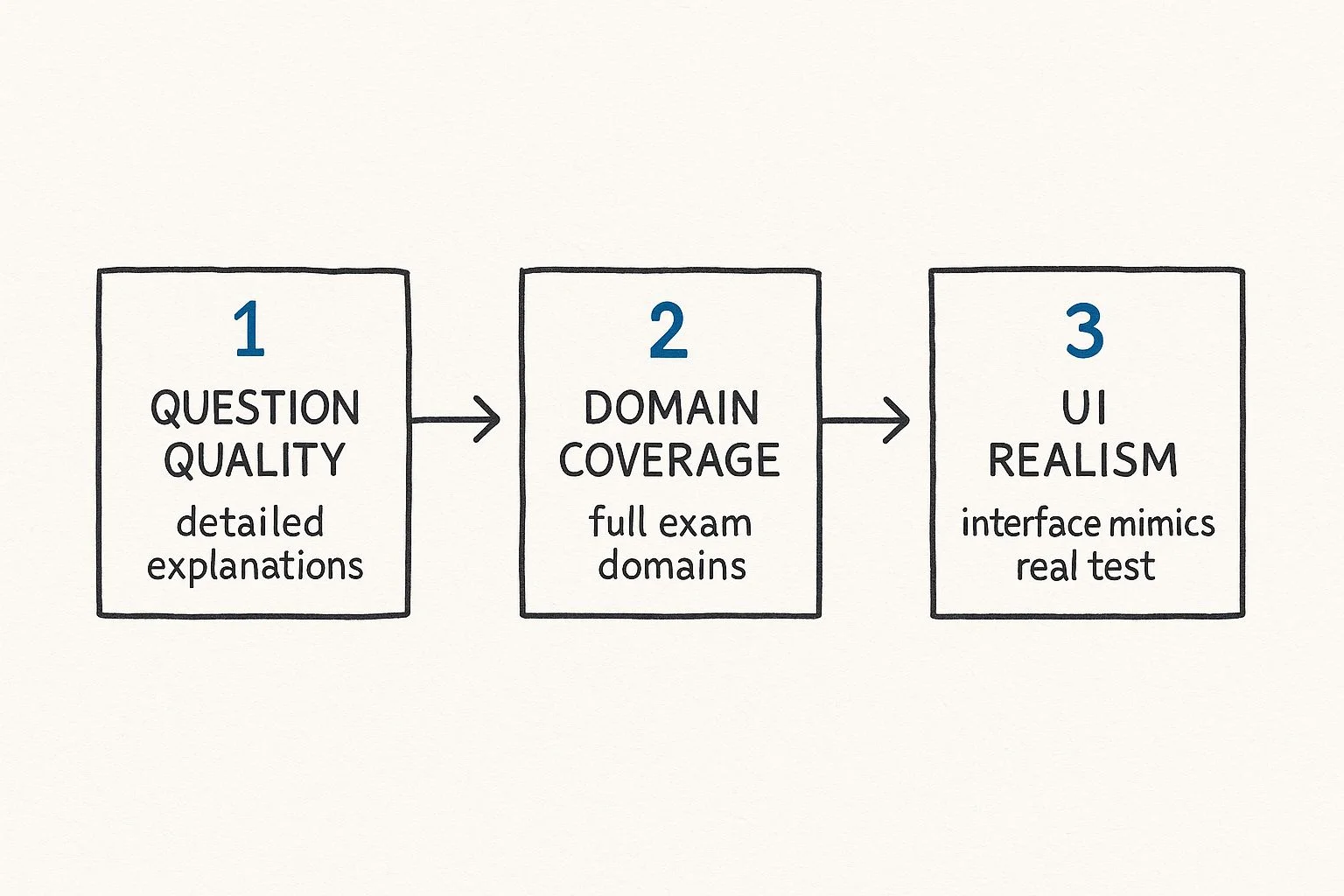
Consider these three essential factors when evaluating any practice test:

- Question Quality: Are the questions clear and representative of the actual exam's difficulty? They should test your understanding of core concepts rather than your ability to memorize specific phrases.
- Domain Coverage: Does the test include all the topics and domains mentioned in the official exam blueprint? A good practice test identifies your weak areas across the entire set of objectives so you know exactly what to review.
- UI Realism: Does the test interface look and feel like the one you will use on exam day? Being familiar with the layout, the flagging feature, and the countdown timer can help you stay calm.
A provider that meets these three requirements offers the most realistic simulation of the certification experience.
Finding Reliable Providers
Finding trustworthy providers requires research. Start with official materials from the certification body itself. For AWS, use the official practice exams found on Skill Builder. If you are studying for Azure, use Microsoft Learn. For PMP, use the official resources from PMI. These sources provide the most accurate look at the actual exam format.
After checking official resources, look for third-party providers known for difficult content and detailed analytics. Seek out platforms that provide domain-specific scoring and show how your performance changes over time. These features help you track your progress and decide when you are ready for the actual test.
Pro Tip: The Power of Interface Familiarity Do not ignore the benefit of a realistic user interface. A platform that mimics the actual exam environment—including the navigation and timer—is extremely helpful. Getting used to this setup before your test date helps reduce anxiety. It allows you to focus your full attention on the questions rather than trying to figure out how the software works.
How to Build Your Practice Test Strategy

Approaching practice tests without a plan is like building a cloud infrastructure without an architecture diagram. You might finish eventually, but you will waste time and run into avoidable problems. To get the most out of practice exams for AWS, Azure, or ITIL certifications, you need a strategy that changes as you learn. This method turns passive testing into a focused way to improve. Instead of just checking boxes, you are building a feedback loop that shows exactly where to spend your energy and time.
The best way to start is by taking a full-length exam before you start your main study blocks. This first attempt creates a baseline. As discussed, do not worry about the score at this stage; the goal is to see exactly what you already know and where your knowledge gaps are. Think of it like a network scan. You need to see where the holes are before you can fix them. This initial test helps you build a study plan that focuses on your weakest domains from the very first day, saving you hours of reviewing material you already understand.
The Phased Approach to Practice
With a baseline established, you can build a study routine that uses different types of tests for different goals. The key is to match the test to your current level of understanding at each phase.
- Reinforcement Quizzes: After you finish a specific module—such as AWS S3 storage classes, IAM policies, or Azure Virtual Networks—take a short quiz on that topic. This quick check confirms you understood the material and stops misunderstandings from taking root. It is much easier to fix a small error now than to unlearn a concept several weeks later. These quizzes act as a bridge between reading a whitepaper and applying that knowledge to a scenario.
- Mid-Point Mock Exams: A few weeks into your study schedule, take another full-length practice exam. Treat this as a status report. It shows how much you have improved and identifies which topics are still causing trouble. If you find your scores are stagnant in a specific area like VPC peering or database migration, you can shift your focus to those specific areas during the final weeks of preparation. This prevents you from getting overconfident in areas you already know well.
A strong strategy requires understanding core principles. For example, knowing different authentication methods is vital when you face questions about securing AWS resources. You need to be clear on Federated Identities and OAuth 2.0 to pass these sections. This interconnected knowledge often makes the difference between passing and failing. For more details, look at our guide on how to prepare for AWS certification.
Simulating the Real Exam Experience
During the final 1-2 weeks before your exam date, your strategy should shift significantly. You are no longer trying to learn brand-new concepts. Instead, you are refining what you know, building the mental stamina to sit for a long period, and perfecting your pace. This is when you should take full-length, timed mock exams under the same conditions you will face on test day.
By simulating the environment, you remove stressful variables. You learn when to flag a question and move on versus when to spend an extra minute calculating a solution. This phase is about building the habit of testing. You want the act of taking the exam to feel like a routine task so your brain can focus entirely on the technical details.
Critical Guideline: Treat every practice exam like the actual certification test. Do not look at your notes. Do not search for answers online. Do not take extra breaks or check your phone. You want to train your brain to perform under pressure. If you do this, the testing center will feel familiar, and you will be well-prepared to focus entirely on the questions rather than the timer or the environment.
Mastering the Post-Test Review: Your Path to Improvement
Finishing an AWS practice test is only the start of your work. The real learning happens after you press the submit button. Simply checking your final score and moving to the next exam is a major mistake that many people make during their certification prep. You gain the most useful information by analyzing your results in detail. You must find the specific reasons for every wrong answer and even look closely at why you got certain questions right.
This review process turns a basic score into a functional study plan that addresses your specific needs. The goal is to do more than just spot your mistakes. You need to understand the logic behind those errors so you can fix the specific knowledge gap. Success in the IT industry often depends on how well you handle this phase. It is what separates the candidates who truly understand cloud architecture from those who are just hoping to pass by luck.
Build a Knowledge Gap Tracker
A helpful tool for this review is a Knowledge Gap Tracker. You can build this using a spreadsheet, a physical notebook, or a digital notes app. Use this space to record every question you missed during your practice sessions. This is an active learning method that forces you to face your weak points directly. It helps you keep information in your memory much better than just reading a textbook or watching videos over and over.
This organized method speeds up your progress toward your certification goals. Set up your tracker with these specific columns to keep your notes organized:
- Question Summary: Write a short note on the topic being tested. Examples include "Optimizing AWS Lambda cold starts," "PMP process group interaction," or "Azure AD Connect synchronization issues."
- Selected Answer & Reasoning: Record the option you picked and why you thought it was correct at the time. This reveals flaws in your logic or places where you misunderstood a service.
- Correct Answer & Explanation: Note the right choice and a summary of the explanation provided by the practice test.
- Core Topic or Service: List the specific area that needs more study. This might be Amazon S3 Glacier, VPC Endpoints, Azure AD Conditional Access, or ITIL Continual Service Improvement.
- Official Documentation Link: Add a direct link to the AWS documentation, Microsoft Learn article, PMI PMBOK section, or ITIL text for further research later.
Over time, this tracker becomes a custom guide for your exam. It shows you exactly where to spend your limited study time. For a more detailed framework on this process, look at our guide on identifying and addressing knowledge gaps.
Don't Just Focus on the Red X's
Many candidates ignore the questions they got right, but this is a mistake. It is easy to see a green checkmark and assume you know the topic perfectly. You must be honest with yourself during this part of the review. Ask if you chose the answer because you understood the concept or because you made a lucky guess from a 50/50 probability.
Critical Self-Assessment: If you cannot explain exactly why your answer is right and why every other choice is wrong, you have not mastered the topic yet.
Reviewing your correct answers makes your knowledge more stable and permanent. It turns a lucky guess into a reliable win on the real exam. This builds the conceptual understanding you need for the complex scenarios found in exams like the AWS Solutions Architect or Azure Administrator.
Whether you got the question right or wrong, take one last step: go to the official source. Do not rely only on the summary provided by the practice test. Read the official AWS documentation, the Microsoft Learn module, or the PMBOK guide. This habit connects theory to actual work. It builds the expertise you need for both the certification and your career in technology.
Common Mistakes to Avoid With AWS Practice Tests
Taking practice exams is one thing, but using them effectively is quite another. Many IT professionals fall into traps that slow their progress rather than helping it.
The most frequent error is rote memorization of specific question-and-answer pairs. You might become skilled at recognizing questions from one specific test bank, but this surface-level familiarity skips over the actual technical understanding. This builds a shaky sense of confidence that breaks when you face a rephrased scenario on the actual AWS, Azure, or PMP exam. Certification tests measure how you apply knowledge to a problem, not how well you remember a specific sentence from a study guide. If you find yourself answering before you finish reading the prompt, you are likely memorizing rather than learning.
Another issue is test fatigue. Running through multiple exams without taking breaks or setting aside time for review leads to burnout. It also produces diminishing returns. You don't learn while answering the questions; the actual improvement happens during the analysis of your results. If you don't look at the principles behind the answers, you are just clicking buttons. Dedicated review time is where you connect the dots between the theory you read and the practical application the exam requires.
Don't Put All Your Eggs in One Basket
Using only one source for practice tests creates a narrow view of the subject matter. Every provider has a different style and focuses on different details or phrasing. If you only use one source, the actual exam's specific wording might catch you off guard.
To prepare for the unpredictable nature of official exams—like the AWS Certified Solutions Architect, Azure DevOps Engineer, or ITIL Foundation—you must use different resources. Mixing high-quality materials exposes you to various formats and different ways to apply concepts. This builds a flexible understanding of the technology. These tests are essential for professionals looking to confirm their skills. AWS updates its certifications often to match real-world roles. For example, the new AWS Certified CloudOps Engineer – Associate exam targets those managing workloads. Knowing the value of these credentials is vital for your career path.
Indicator of Readiness: A good practice test must challenge you and push the limits of what you know. If you always score 100% with no effort, take it as a warning. The material might be too simple or outdated. Look for harder and more current resources to ensure you are ready for the actual testing environment.
Common Questions About AWS Practice Tests
As IT professionals look for better ways to prepare for AWS certifications, several common questions often arise regarding how to use practice exams correctly. Answering these concerns directly can help you study more efficiently and build the confidence you need to succeed on the day of the actual test.
How Many Practice Tests Should I Really Take?
Candidates frequently ask if there is a specific number of exams they must complete to be ready. While there is no single number that works for everyone (check current recommendations on the AWS site), a strategy used by many successful IT professionals involves taking 3 to 5 high-quality, full-length practice exams. The focus must always remain on the quality of the questions and your strategy for using them, rather than simply trying to finish as many questions as possible.
Instead of rushing through several tests in the final hours before your appointment, space them out over your last two or three weeks of study. This approach allows you to track your progress over time and reinforces the concepts you have already learned. It also helps you identify specific technical areas that still require more attention. This method creates a helpful loop of testing, reviewing your mistakes, and performing targeted studying. This process builds a stronger knowledge base than just repeating facts from memory.
What's a "Good Enough" Score to Pass?
Many students want to know the exact score they should achieve on a practice test before they feel ready for the real thing. Official passing scores for AWS exams, as well as certifications like Azure or PMP, can change and are not always made public by the providers. However, a reliable benchmark for students is to target a score of 85-90% or higher on reputable practice exams (verify current passing thresholds on the vendor website).
Why should you aim for a score that is much higher than the actual passing mark? This gap acts as a safety net. It helps you handle stress during the test and prepares you for questions that use different phrasing than you expected. Certification bodies also occasionally include difficult questions to test new material. Reaching this percentage consistently shows that you have a firm grasp of the core concepts. It suggests you can apply your knowledge in different scenarios rather than just remembering answers to specific questions.
Key Perspective: The real point of a practice test is not just to see a high score on the screen. The true value comes from how these tests show you exactly where your knowledge is weak. They turn your blind spots into specific tasks for your study plan. Because of this, a low score on your first attempt is not a failure. It serves as a detailed guide that shows you exactly what you need to study next.
Are Free AWS Practice Tests Worth My Time?
The debate between using free or paid practice tests is constant. While free tests might work for a quick check on a single, specific topic, you should be careful. Many free resources found online are outdated, too simple, or contain technical errors. Because AWS updates its services so frequently, questions that were accurate a year ago may now be incorrect.
If you build your entire study plan around these free materials, you run a high risk of encountering topics on the exam that you haven't seen before. While you focus on AWS services, gaining a broader view of how these services are sold and managed through platforms like managed cloud hosting platforms like Cloudways can provide helpful context for how cloud resources work in the real world.
Our advice is to prioritize official AWS resources or materials from trusted providers for the main part of your preparation. Invest in paid practice exams known for being current and providing clear explanations for every answer. Use free tests only as an extra resource to supplement your learning, not as the main part of your plan.
Are you ready to stop guessing and truly master your chosen certification? MindMesh Academy offers organized practice tests and evidence-based study plans designed to help IT professionals like you achieve certification with confidence. Improve your preparation and secure your career advantage. Start today at AWS Cloud Practitioner Practice Exams.
Ready to Get Certified?
Prepare with expert-curated study guides, practice exams, and spaced repetition flashcards at MindMesh Academy to pass with confidence:

Written by
Alvin Varughese
Founder, MindMesh Academy
Alvin Varughese is the founder of MindMesh Academy and holds 20 professional certifications including Microsoft Agentic AI Business Solutions Architect, AWS Solutions Architect Professional, and Azure DevOps Engineer Expert. He's held senior engineering and architecture roles at Humana (Fortune 50) and GE Appliances. He built MindMesh Academy to share the study methods and first-principles approach that helped him pass each exam.