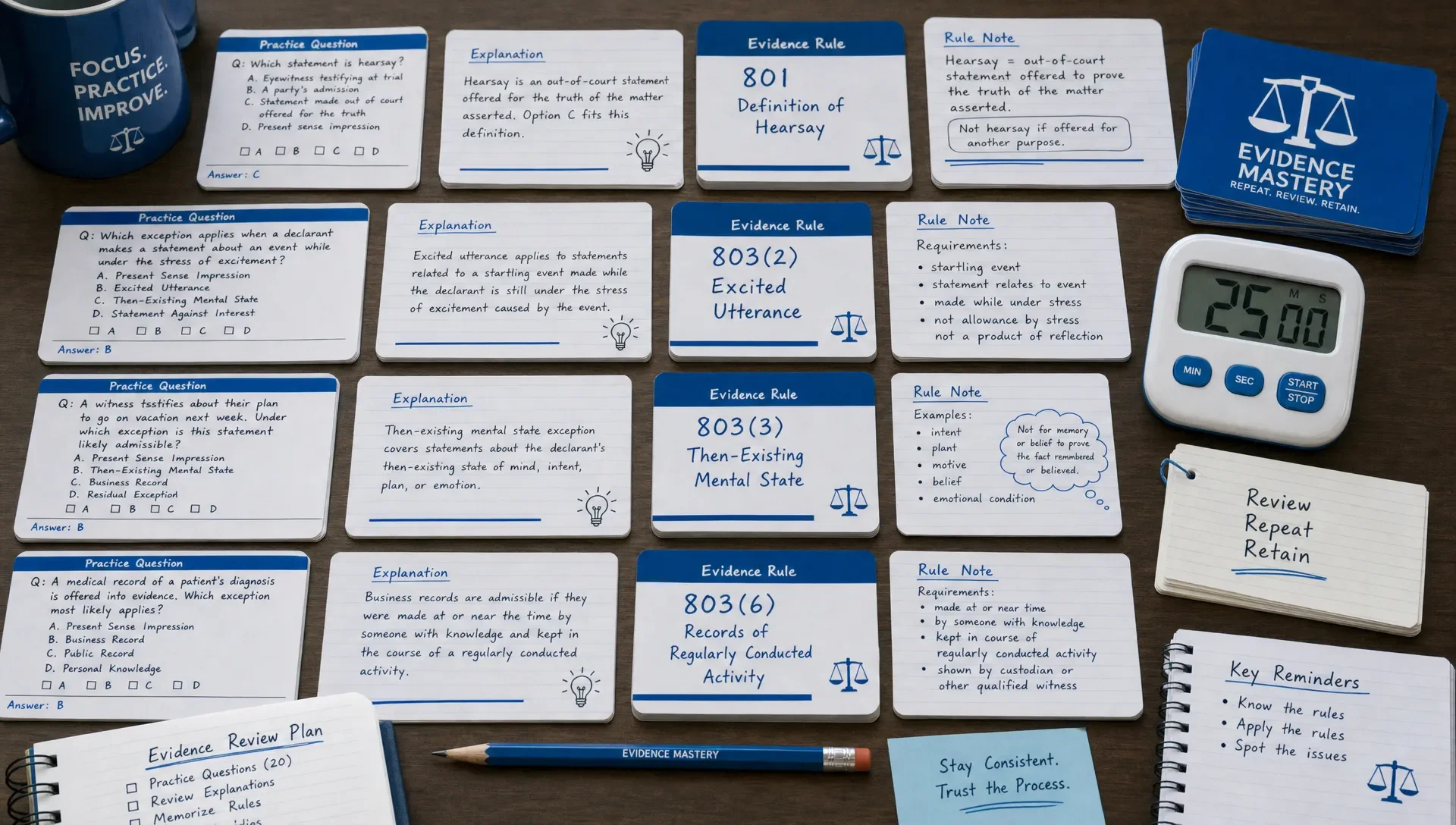
Practice Answer Reviews That Teach Better Reasoning
Practice Answer Reviews That Teach Better Reasoning
A practice answer review should do more than tell you whether A, B, C, or D was right. After each question, your job is to rebuild the reasoning that led to your choice, identify where that reasoning broke, and create a better decision rule for the next similar scenario. That's how practice questions become instruction, not just scoring.
Use this routine immediately after each question: record your confidence before reading the explanation, name the clue that mattered most, compare every option, and write one follow-up action. This approach works for AWS, Azure, CompTIA, Cisco, PMI, and other certification exams because they rarely test isolated facts. They test judgment under constraints.
What Better Answer Reviews Should Teach You
Most weak reviews stop at identifying the correct option. Strong reviews teach three things: what the question was really asking, why the tempting distractor was wrong, and what principle applies beyond that one item.
A good review note is short, but it has to capture the core reason. If your note only says you forgot encryption or need to study routing, it won't help much when the same idea appears in a new scenario. A better note turns the missed idea into a reusable rule.
| Weak review note | Stronger reasoning note | Why it helps next time |
|---|---|---|
| I missed the storage question. | When the scenario says infrequent access and retrieval delay is acceptable, prioritize archival storage over standard object storage. | It connects the clue to the decision. |
| I forgot port numbers. | I chose the database port because I focused on the service name, not the protocol being requested. | It identifies the attention error. |
| I guessed between two answers. | Both answers improved security, but only one addressed identity-based access control. | It separates good from best. |
| I need to study project risk. | The question asked for a response after risk occurred, so I should think issue management, not risk planning. | It maps timing to the concept. |
For a broader routine on reviewing complete practice sets, pair this article with MindMesh Academy's guide to how to review every answer in practice exam questions. Here, we're going deeper on the reasoning inside a single answer review.
A Practice Answer Review Workflow for Better Reasoning
The best workflow is simple enough to repeat when you're tired. If it takes 10 minutes per question, you'll avoid it. If it takes 90 seconds and produces a clear next step, you'll use it consistently.
Research supports this approach. Dunlosky et al.'s review in Psychological Science in the Public Interest rated practice testing and distributed practice as high-utility learning techniques. The Institute of Education Sciences also recommends quizzing, spacing study, and asking explanatory questions. Answer review is where those ideas meet.
Capture Your First Reason Before Reading the Explanation
Before you open the explanation, write one sentence about why you chose your answer. Don't clean it up. You want your real reasoning, not the polished version you create after seeing the correct choice.
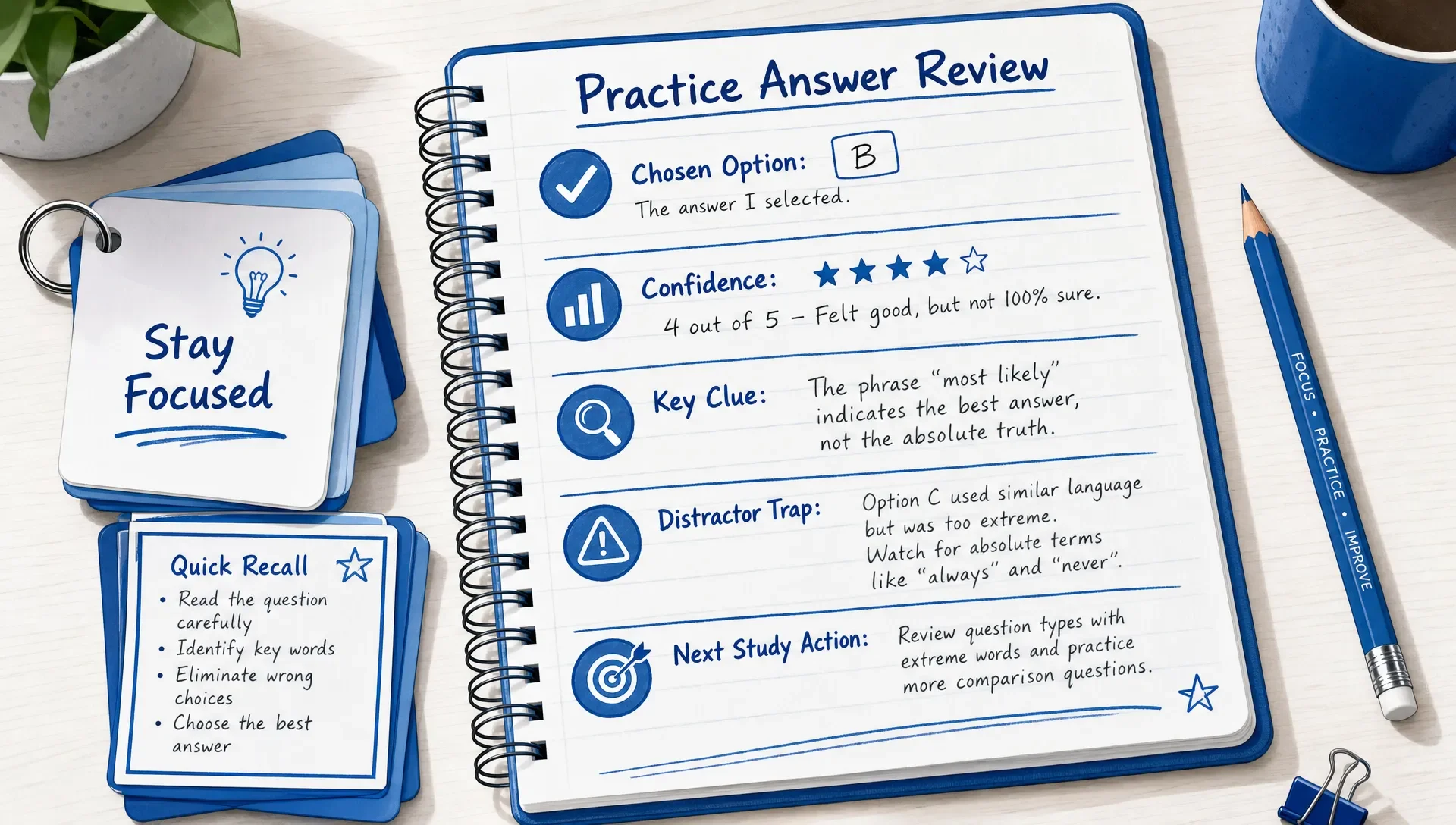
Use a compact format: chosen answer, confidence level, main clue, and main uncertainty. For example: C, medium confidence, selected because the question mentioned audit logs, unsure whether managed keys or local encryption fits better.
That note gives you something to compare against the explanation. Without it, you may think you understood more than you did.
Compare Every Option, Not Only the Correct One
A practice answer review should treat wrong options as teaching material. Certification exams use distractors for a reason. They often represent a half-right idea, a common misunderstanding, or an answer that solves the wrong part of the scenario.
Ask one direct question for each option: what would need to be true for this answer to be correct? This keeps you from labeling choices as stupid or obvious. Many distractors become correct when one condition changes.
Rewrite the Rule in Conditional Form
Your final note should usually start with if, when, or unless. Conditional rules force you to connect a clue to an action.
Examples include: when the question asks for lowest administrative overhead, favor managed services unless the scenario requires custom control. If the issue already happened, handle it as an issue, not a risk. When an answer improves confidentiality but the question asks for availability, reject it unless it also protects uptime.
How to Diagnose Why an Answer Choice Looked Right
Wrong answers aren't all equal. Some come from missing knowledge. Others come from reading too fast, overvaluing a keyword, or choosing a technically true answer that doesn't solve the scenario.
Use this table to classify misses quickly.
| Error type | What happened | Review question to ask |
|---|---|---|
| Concept gap | You didn't know the service, command, process, or definition. | What official objective does this belong to? |
| Keyword trap | You matched one word instead of the full scenario. | Which sentence changed the correct answer? |
| Scope mismatch | The answer solved a nearby problem, not the asked problem. | What exact outcome did the question request? |
| Best-answer conflict | More than one option seemed valid. | Which answer satisfies the most constraints with the least assumption? |
| Timing error | You confused before, during, and after actions. | Is this planning, execution, monitoring, or response? |
| Confidence error | You were sure but wrong. | What rule did I trust that failed here? |
The confidence error is especially valuable. Overconfident misses reveal rules you need to update, not just facts you need to memorize.
How to Review Correct Answers Without Wasting Time
Correct answers still deserve review, but not all of them deserve the same effort. If you were certain, fast, and able to explain the answer, move on after a quick confirmation. If you guessed correctly or needed too long, review it like a miss.
A practice answer that you guessed correctly is still unstable knowledge. Treat it as a warning, not a win. Your score may look fine, but the same concept could fail on exam day when the wording changes.
| Correct answer situation | How much to review | Best follow-up |
|---|---|---|
| Fast and confident | 15 to 30 seconds | Confirm the explanation and move on. |
| Correct but slow | 1 to 2 minutes | Write the decision rule and drill similar items. |
| Correct by elimination | 2 minutes | Learn why the right answer is right, not only why others are wrong. |
| Correct guess | 2 to 3 minutes | Mark for retest and add a flashcard or study note. |
| Correct but overcomplicated | 1 minute | Rewrite the simplest clue that should have led you there. |
This is also where readiness tracking matters. If you keep getting a topic right but only after long hesitation, you may understand it but not yet have exam-speed fluency.
How to Use Practice Answer Notes With Exam Objectives
Exam objectives keep your review honest. Instead of writing vague notes like "study networking," attach each miss to the vendor's objective language whenever possible. Official exam pages and guides define the skills being tested, such as the AWS Certification exam guides and CompTIA certification objectives.
For example, if you're preparing for cloud fundamentals, use the AWS Certified Cloud Practitioner practice exam to connect answer explanations back to domains and task areas. If you're preparing for security roles, the CompTIA Security+ practice exam can help you turn missed questions into topic-focused practice instead of random rereading.
The key is to avoid orphan notes. Every answer review should point to one of these destinations: an objective to reread, a flashcard to schedule, a weak topic to drill, or a scenario pattern to retest.
How to Turn Reviews Into Follow-Up Practice
A review isn't finished when you understand the explanation. It's finished when you decide what to do next.
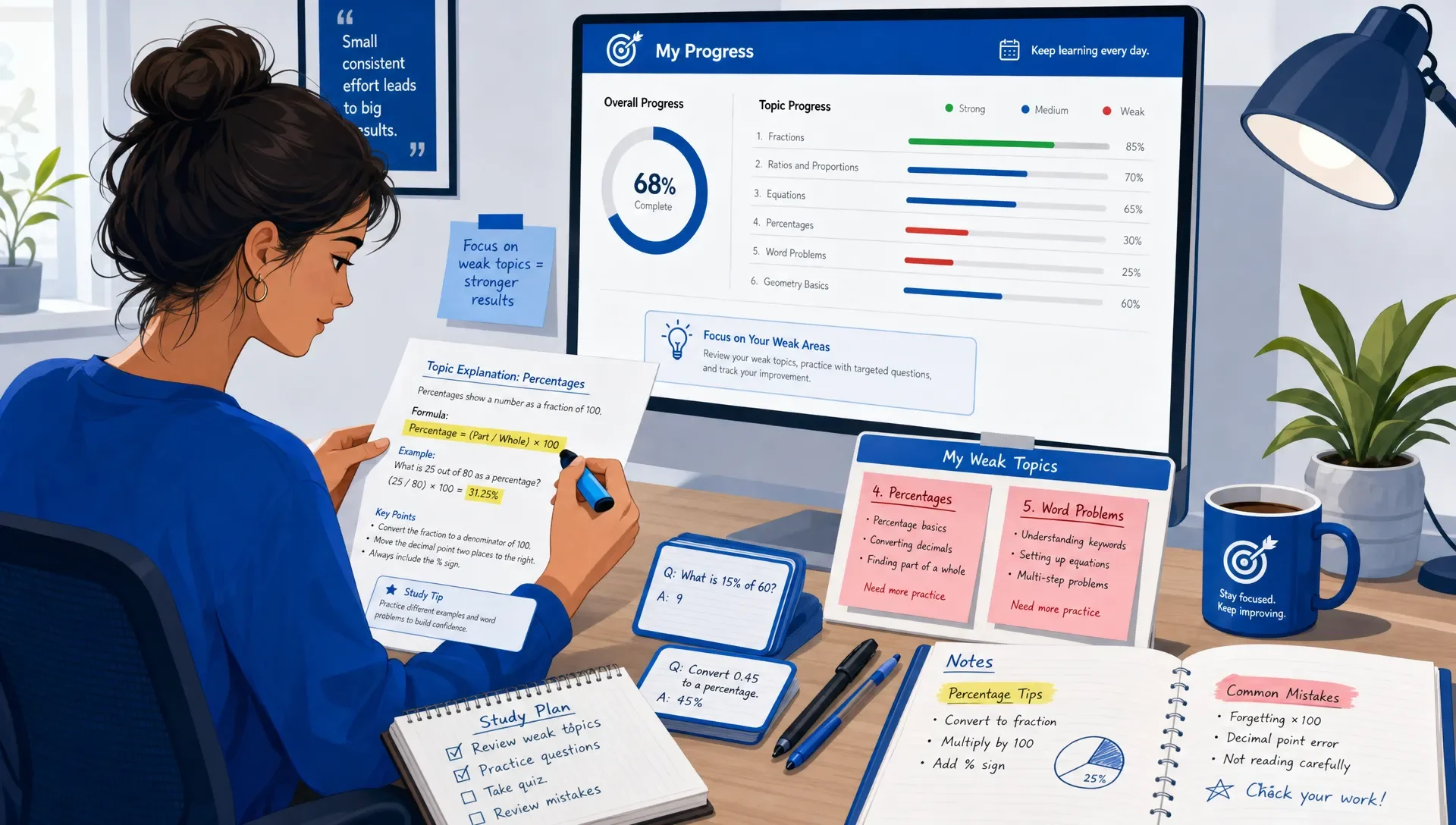
MindMesh Academy supports this kind of loop with objective-based study guides, practice questions with explanations, flashcards with spaced repetition, adaptive weakness-based practice, and readiness tracking. That matters because your next study step should come from evidence, not mood.
Use this simple conversion table after each review session.
| What your review found | Next study action | Example |
|---|---|---|
| You didn't know the concept | Read the matching study guide objective. | Review shared responsibility before more cloud security questions. |
| You knew it but couldn't recall it | Make or review a flashcard. | Add the definition and a short scenario clue. |
| You fell for a distractor | Drill similar questions later. | Practice best-answer questions on access control. |
| You ran out of time | Practice with shorter review intervals. | Do 10 timed questions and review immediately after. |
| You missed a performance-based format | Work similar task-based items. | Practice interpreting logs, diagrams, or configuration snippets. |
For project-management learners, scenario wording can be especially subtle. A PMP practice exam review should pay close attention to timing, stakeholder role, and whether the question asks what to do first, next, or best.
Example of a Practice Answer Review That Improves Reasoning
Here is a short example using an original cloud-security style scenario.
Scenario: An application stores sensitive customer records. The team needs centralized control over encryption keys and a way to audit key usage. Which solution best fits the requirement?
A weak review might say: I picked local encryption, but managed keys were right. Need to study encryption.
That note is too broad. It doesn't explain why local encryption was tempting or why managed keys matched the scenario better.
A stronger review would say: I focused on encryption itself, but the question asked for centralized key control and auditability. Local encryption can protect data, but it doesn't automatically solve centralized key management or usage logging. When a scenario mentions audit of key usage, look for a managed key service with access control and logs.
That version teaches a transferable rule. It also identifies the distractor: local encryption wasn't nonsense, it was incomplete. This is the level of review that improves reasoning.
If you want more help avoiding memorization while using large question sets, MindMesh Academy's article on question bank tactics that build real understanding pairs well with this method.
Signs Your Answer Reviews Are Working
Your score is one signal, but it isn't the only one. Better reasoning shows up in how you handle unfamiliar wording.
Look for these signs across several study sessions:
- You can explain why each wrong option is wrong without rereading the full explanation.
- Your confidence ratings become more accurate.
- You miss fewer questions from the same objective.
- You can name the clue that decides between two close options.
- Your review notes become shorter because your rules are clearer.
A practice answer process is working when you become less dependent on recognizing the exact question. The goal is to recognize the pattern, objective, and constraint behind it.
Frequently Asked Questions
How long should I spend reviewing one practice question? Aim for 1 to 3 minutes per question. Prioritize guesses, overconfident misses, or choices with two close options. Briefly confirm explanations for confident correct answers.
Should I review answers I got right? Yes, selectively. If you were fast, confident, and correct, just confirm the explanation. If you guessed or used elimination without full understanding, review it as thoroughly as a wrong answer.
What should I write in a practice answer note? Include the key clue, your mistake or uncertainty, and a reusable rule. Keep it concise so you'll actually review it.
How do I avoid memorizing the question bank? Delay retakes, shuffle questions, explain your reasoning before checking the answer, and focus on why incorrect choices are wrong. If you only remember the answer letter, your review isn't complete.
Can this method help with performance-based questions? Yes. For performance-based questions, review the task, constraints, order of operations, and any evidence you overlooked. The same reasoning review applies, focusing on analyzing steps instead of only answer choices.
How do I know I'm ready for the real exam? Look beyond your raw score. Readiness means consistent performance by topic, accurate confidence ratings, fewer repeated misses, and the ability to explain answers in your own words under timed conditions.
Make Each Review Create the Next Study Step
Better exam prep isn't about more questions for their own sake. It's about getting better feedback from each question you answer.
MindMesh Academy helps you connect that loop with objective-based study guides, practice questions and explanations, spaced-repetition flashcards, and adaptive weakness-based practice. To build a strong foundation for your next certification, use your study sessions to review fewer answers more carefully, then let those reviews decide what you practice next. To get started, you can explore our AWS Certified Cloud Practitioner study guide today.

Written by
Alvin Varughese
Founder, MindMesh Academy
Alvin Varughese is the founder of MindMesh Academy and an enterprise architecture leader. An electrical engineer by training, he moved from factory automation in South Africa to cloud architecture at GE Appliances and Humana (Fortune 50), and holds 20 professional certifications including AWS Solutions Architect Professional, Azure DevOps Engineer Expert, and Microsoft Agentic AI Business Solutions Architect. He built MindMesh Academy after interviewing too many highly certified candidates who couldn't answer basic questions: the goal is prep that makes you better at the job, not just able to pass the exam.