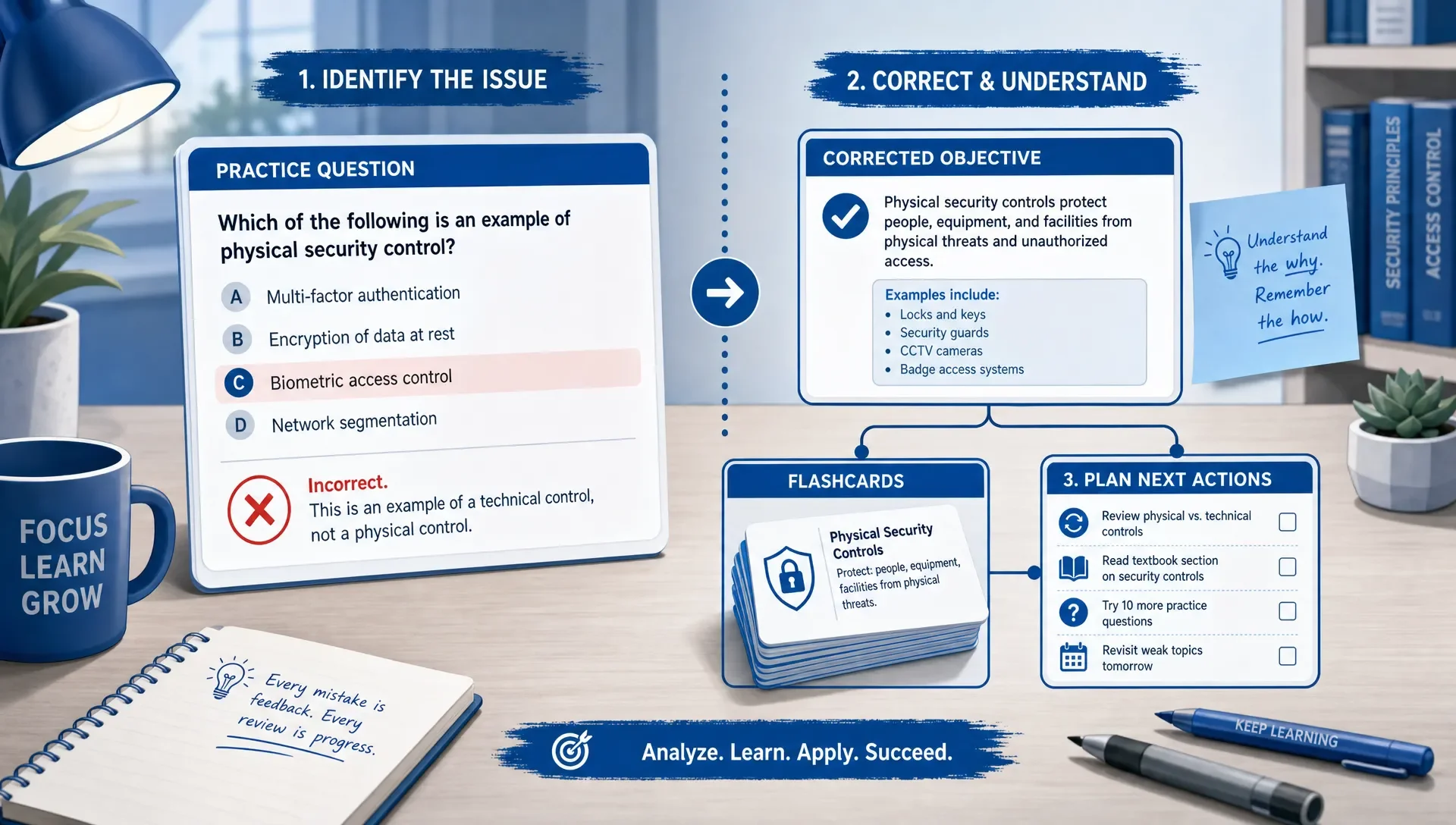
Practice A+ Exam Mistakes Beginners Keep Making
Fix Common CompTIA A+ Practice Exam Mistakes
If your CompTIA A+ practice exam scores are stuck, don't just take another test and hope for a higher number. The fastest path to improvement often comes from changing how you practice. This means taking questions closed-book, tracking why you missed each one, drilling weak objectives, and retesting only after you've closed specific knowledge gaps.
Beginners often treat practice tests like simple score predictors. They're far more useful as diagnostic tools. A low score shows you where your troubleshooting process falters, while a high score only truly matters if you earned it under exam-like conditions and can explain why the wrong choices are incorrect.
What the Practice CompTIA A+ Exam Really Measures
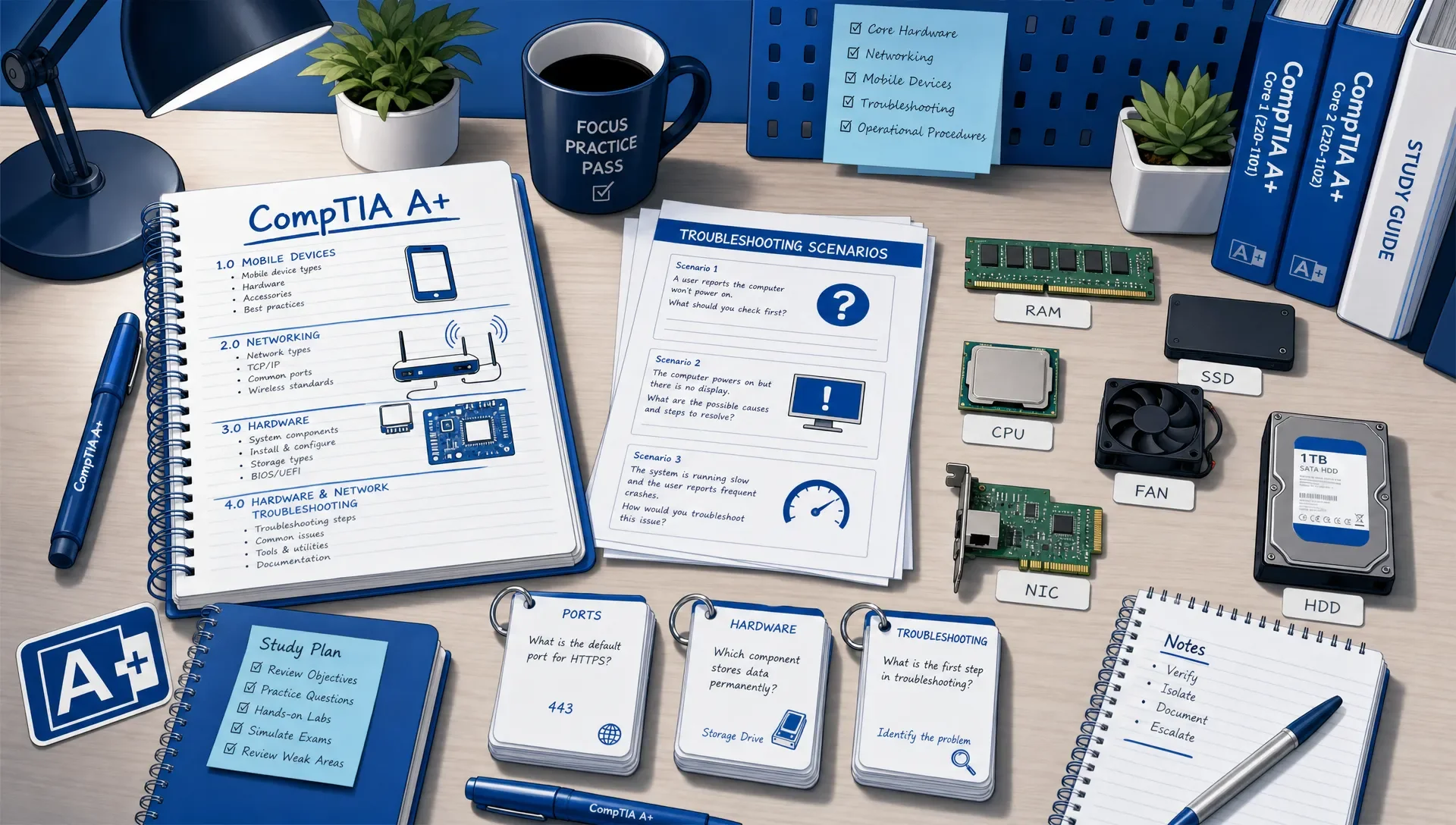
CompTIA A+ isn't merely a vocabulary test. According to CompTIA's A+ certification overview, the certification covers essential areas like hardware, operating systems, networking, security, software troubleshooting, and operational procedures. This means a good practice A+ exam tests both your recall and your judgment.
The actual exam also includes performance-based questions, or PBQs. For these, you'll apply your knowledge in a simulated task. Beginners who only drill multiple-choice questions can feel ready, then freeze when a scenario asks them to configure, match, sequence, or troubleshoot.
A better goal isn't, "I've seen this question before." Instead, aim for, "I can identify the problem, eliminate unsafe or irrelevant options, and choose the best next step." For a deeper look at this mindset, MindMesh Academy's guide on what the CompTIA A+ certification test really measures explains why scenario thinking matters more than memorizing isolated facts.
Practice CompTIA A+ Exam Mistakes Beginners Make Most Often
Most beginner mistakes follow a clear pattern: the learner feels productive but isn't precise enough to actually improve. Use this table as a quick self-check before your next study session.
| Beginner mistake | What it looks like | Better practice habit |
|---|---|---|
| Treating Core 1 and Core 2 as one exam | You study hardware, security, OS, and networking in one pile | Separate your practice by exam and objective domain |
| Retaking the same test too soon | Your score rises because you remember wording | Drill weak topics before retesting |
| Reviewing only missed questions | You ignore lucky guesses | Review low-confidence correct answers too |
| Skipping PBQs | You save performance tasks for the final week | Practice PBQ-style questions early and often |
| Practicing open-book | You build recognition, not recall | Answer first, then check notes during review |
| Ignoring timing | You know answers but run out of time | Practice pacing in small timed sets |
| Studying all topics equally | You spend the same time on strong and weak areas | Use score data to target weak objectives |
Mistake 1: Treating Core 1 and Core 2 Like One Big Test
CompTIA A+ involves two separate exams, Core 1 and Core 2, and beginners often blur them together. This creates messy practice data. If you miss questions on printer troubleshooting, mobile device hardware, account permissions, and malware response in the same session, you might know your score but still won't know what specific area needs work.
First, separate your preparation by exam. Core 1 typically covers hardware, networking, mobile devices, virtualization, cloud computing, and troubleshooting. Core 2 focuses more on operating systems, security, software troubleshooting, and operational procedures.
If you're building your Core 1 readiness, start with a targeted CompTIA A+ Core 1 practice exam so your results map cleanly to the right objectives. When you shift into operating systems, security, and support procedures, use a separate CompTIA A+ Core 2 practice exam instead of mixing everything together.
This single change makes reviewing far easier. You won't just say, "I'm weak at A+." You'll say, "I need more Core 1 networking troubleshooting practice" or "I need more Core 2 security practice." That level of specificity is what truly boosts scores.
Mistake 2: Taking Too Many Full Tests Too Early
Full-length practice exams are useful, but beginners often use them too soon and too frequently. If you haven't learned the exam objectives yet, a full exam becomes a long guessing session. You waste time, drain confidence, and gather data that's too broad to act on.
Early in your study plan, short, topic-based sets are usually more effective. A 15-question networking set or a 20-question Windows troubleshooting set gives clearer feedback than a full mixed exam when you're still learning.
Use full practice exams when you need to test how well you integrate knowledge. This is where you check whether you can switch between domains, handle tricky wording, and maintain focus under pressure. Before that, practice should feel more like targeted repair work.
Mistake 3: Reviewing Only the Questions You Got Wrong
This habit is particularly damaging because it hides lucky guesses. A correct answer doesn't always mean you fully understood the concept. Sometimes you eliminated one option, guessed between two, and happened to pick the right one.
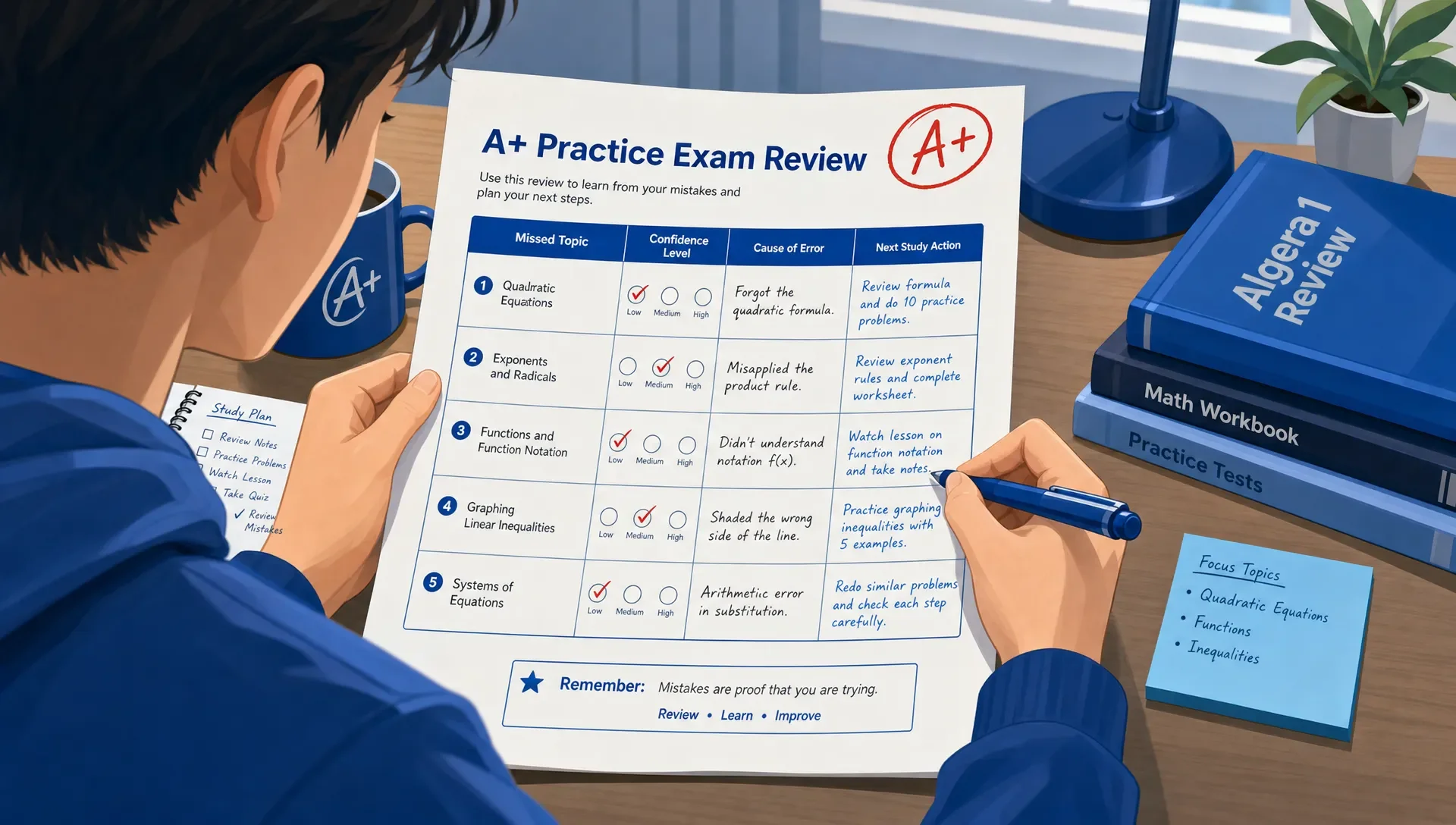
After every practice session, sort your answers into three groups: correct and confident, correct but uncertain, and incorrect. The second group deserves almost as much attention as the third. These are the questions most likely to cause trouble under real exam pressure.
Research on retrieval practice supports this approach. In a well-known study published in Science, Roediger and Karpicke found that testing improved long-term retention more effectively than repeated studying in the conditions they examined (primary source). The key point for A+ preparation is simple: you learn more when you actively retrieve, check, and correct your thinking than when you passively reread notes.
Mistake 4: Memorizing Question Wording Instead of Troubleshooting Logic
If you repeat the same practice CompTIA A+ exam several times in a week, your score might improve for the wrong reason. You start recognizing sentences, not truly solving problems. This can feel encouraging, but it often falls apart when the actual exam asks about the same concept using different wording.
To prevent memorization from misleading you, force yourself to explain the logic before reading the explanation. Ask: What is the user reporting? What changed recently? What's the safest first step? Which option fixes the root cause instead of just the symptom?
For instance, don't memorize that a specific printer question has "restart the print spooler" as the answer. Instead, learn when spooler issues are likely, how they differ from driver problems, and when hardware checks make more sense. That way, you can handle new scenarios rather than relying on familiar phrasing.
Mistake 5: Skipping Performance-Based Questions Until the End
PBQs can feel uncomfortable because they're less predictable than multiple-choice questions. That's precisely why beginners postpone them. The problem is that PBQs test the kind of applied thinking CompTIA A+ expects from entry-level IT support professionals.
You don't need to master every PBQ format on day one. But you do need to practice applied tasks early enough that they stop feeling strange. Work on matching symptoms to causes, arranging troubleshooting steps, identifying ports or components, and making configuration decisions from a scenario.
When reviewing PBQs, don't only check whether you completed the task correctly. Review your process. Did you rush past a detail? Did you overlook a constraint? Did you choose a technically possible option that wasn't the best first action? PBQ improvement typically comes from better reading and sequencing, not just more memorized facts.
Mistake 6: Ignoring Exam Timing Until Your Final Week
Timing problems are rarely about reading speed alone. They're usually caused by indecision. Beginners spend too long debating two choices because they don't have a repeatable elimination process.
Practice pacing in smaller sets before you attempt full exam timing. For example, take 20 questions under a strict time limit, flag anything uncertain, and move on. Afterward, review whether your slowest questions were caused by weak knowledge, confusing wording, or overthinking.
If timing is already affecting your score, use MindMesh Academy's dedicated guide to A+ certification exam timing tips to build a pacing strategy before your next full practice test.
Mistake 7: Studying Every Topic Equally After You Have Data
At the beginning, broad study makes sense. But once you've taken practice tests, studying everything equally becomes inefficient. Your score report is telling you exactly where your next hour of study should go.
If you're scoring high in hardware but low in networking, another general review session won't help much. Spend your next study block on subnetting basics, Wi-Fi standards, network troubleshooting tools, or common port usage, depending on what your missed questions reveal.
This is where readiness tracking becomes essential. MindMesh Academy helps you with connected study workflows, including practice questions with explanations, flashcards with spaced repetition, adaptive weakness-based practice, and progress tracking by topic. Used correctly, this stops you from studying what you already know while ignoring the objective that's pulling your score down.
How to Review a Practice CompTIA A+ Exam the Right Way
The review session is where most of the learning actually happens. If you finish a test, glance at the score, and move on, you're leaving the best data unused.
A strong review should answer four questions for every missed or uncertain item:
- What objective or skill did this question test?
- Why is the correct answer the best answer?
- Why are the other options wrong or less appropriate?
- What will I do differently when I see a similar scenario?
Don't turn every mistake into a giant note. Keep your review short and actionable. A useful note might say, "Review laser printer imaging process" or "Practice Windows permission scenarios." A weak note says, "Study printers" or "Know security better." The more specific the note, the easier it is to fix the issue.
For a more detailed review workflow, use this guide on how to review an exam practice test the right way alongside your next A+ session.
How to Tell If Your Practice CompTIA A+ Exam Score Is Reliable
A practice score is only useful if the conditions were honest. Beginners often inflate scores without realizing it. They might pause the timer, look up answers, retake the same questions too soon, or count questions they guessed correctly as fully mastered.
Use the table below before deciding you're exam-ready.
| Score condition | Reliable or risky? | What it means |
|---|---|---|
| First attempt, closed-book, timed | Reliable | Good indicator of current readiness |
| Retake after reviewing explanations only | Risky | May reflect answer memory more than mastery |
| Open-book practice | Useful for learning, not prediction | Good for study, weak for readiness scoring |
| High score with many low-confidence answers | Risky | You may be one wording change away from missing them |
| Consistent scores across fresh question sets | More reliable | Suggests broader understanding |
A good readiness signal is consistency. If you can perform well across new question sets, explain your reasoning, handle PBQ-style tasks, and finish without rushing, your score means more than one high retake result.
A Simple Weekly Plan to Fix Practice CompTIA A+ Exam Mistakes
If your recent score disappointed you, don't reset your entire study plan. Instead, try a one-week correction cycle.
| Day | Practice focus | Review goal |
|---|---|---|
| Day 1 | Take a timed topic set in your weakest domain | Identify the top 2 error causes |
| Day 2 | Study the related exam objectives and explanations | Rewrite weak notes into specific tasks |
| Day 3 | Use flashcards for key terms, ports, commands, or processes | Strengthen recall without looking at notes |
| Day 4 | Complete PBQ-style practice for the same domain | Improve sequencing and applied thinking |
| Day 5 | Take a fresh mixed set with timing | Check whether the weak domain improved under pressure |
| Day 6 | Review uncertain correct answers and missed questions | Separate knowledge gaps from reading errors |
| Day 7 | Restudy only the remaining weak objectives | Decide whether you're ready for another full practice exam |
This cycle works because it connects diagnosis, study, retrieval, and retesting. You're not just doing more questions. You're using each question to decide the next best action.
Frequently Asked Questions
How many practice CompTIA A+ exams should I take before the real exam? There isn't one perfect number. Take enough to demonstrate consistent performance across fresh question sets, not just enough to memorize one exam bank. Many learners benefit from short topic sets early, then full mixed exams closer to test day.
Is it bad to retake the same practice CompTIA A+ exam? Retakes can help if you wait long enough and use them to confirm improvement. Retaking too soon is risky because you may remember wording instead of applying the core concept.
Should I study Core 1 and Core 2 at the same time? You can, but beginners usually get clearer results by separating them. Separate practice makes it easier to see whether your weak areas are in hardware and networking (Core 1) or in operating systems, security, and procedures (Core 2).
What should I do after failing a practice CompTIA A+ exam? Review every missed and low-confidence question. Map each one to an objective and create a short drill plan. Don't immediately take another full test unless you've addressed at least some of the underlying causes.
Are PBQs more important than multiple-choice questions? Both matter. PBQs are important because they test applied skills and scenario judgment. If you skip them during practice, your score may not reflect your true readiness.
When should I switch from studying to practice exams? Start using short practice sets early, even while you're still learning. Save full timed exams for later, when you've covered enough objectives to make the score meaningful.
Build Practice Habits That Show Real Readiness
Common CompTIA A+ beginner mistakes are fixable. The key is to stop treating practice exams as one-time score reports and start using them as a feedback system. Separate Core 1 from Core 2, practice closed-book, review uncertain answers, work on PBQs, and let weak objectives guide your next study block.
MindMesh Academy can help you make that process more structured. Our expert-reviewed practice questions come with detailed explanations, and our performance tracking helps you identify and focus on weak areas. If you're preparing for CompTIA A+, take the next step towards exam success by trying our CompTIA A+ Core 1 practice exam.

Written by
Alvin Varughese
Founder, MindMesh Academy
Alvin Varughese is the founder of MindMesh Academy and an enterprise architecture leader. An electrical engineer by training, he moved from factory automation in South Africa to cloud architecture at GE Appliances and Humana (Fortune 50), and holds 20 professional certifications including AWS Solutions Architect Professional, Azure DevOps Engineer Expert, and Microsoft Agentic AI Business Solutions Architect. He built MindMesh Academy after interviewing too many highly certified candidates who couldn't answer basic questions: the goal is prep that makes you better at the job, not just able to pass the exam.