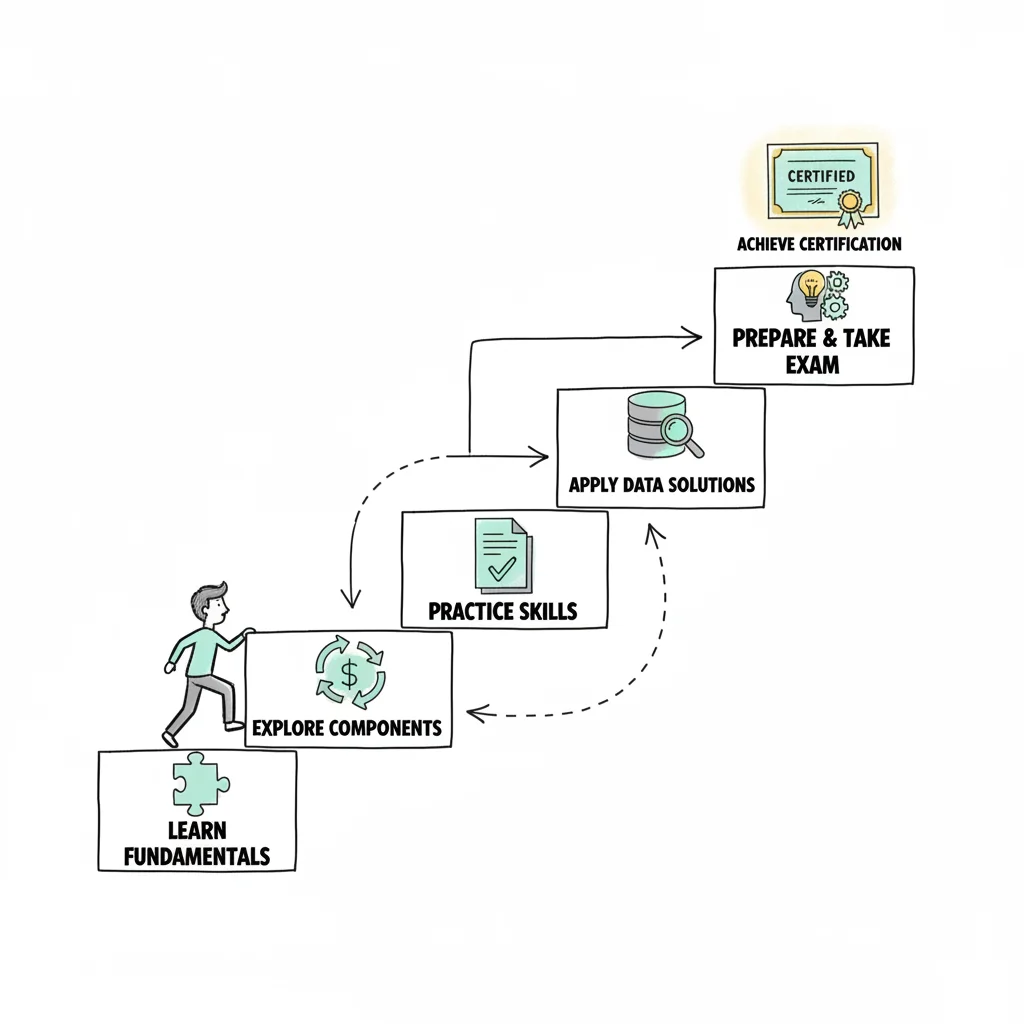
Your Guide to Power Platform Certification in 2026
Your Guide to Power Platform Certification in 2026: Advancing Your IT Career
A Microsoft Power Platform certification validates your skills using low-code tools like Power Apps, Power Automate, and Power BI. This credential proves you can build business solutions and automate workflows. It shows you can turn raw data into insights that drive decisions. This certification places you on a similar professional footing as those with an AWS Certified Solutions Architect or a PMP credential. It signals to hiring managers that you possess the practical experience required to solve real business problems. In a field where roles change quickly, this specialization provides an edge for promotions. This guide explains how these exams work and why they matter for your career. By focusing on current requirements, you can prepare to show your mastery of the Microsoft stack.
Your 2026 Power Platform Certification Roadmap
Choosing a certification path is about more than just passing an exam; it is a strategic move to define your professional future. A Power Platform certification provides a clear method to verify your technical skills and differentiate yourself in a competitive employment market. This roadmap offers the structure needed to move from a beginner to a recognized expert in low-code development and business process automation.
These credentials are far more than digital badges for a professional profile. They provide objective evidence of your ability to solve difficult business challenges. When a hiring manager sees a certification on your resume, they see confirmation that you can build functional applications, automate repetitive tasks, and analyze data without requiring extensive traditional coding. These skills directly improve operational efficiency and are becoming standard requirements for modern business roles across many industries.
Understanding the Certification Levels
Microsoft organizes the Power Platform path into three distinct tiers. This structure allows you to start at a level that matches your current technical background while providing a clear track for advancement as your professional responsibilities grow.
- Fundamentals (e.g., PL-900): This serves as the entry point for students, business users, or IT professionals new to low-code tools. The exam covers the core capabilities of the platform, the business benefits of automation, and basic security models. This certification is a useful foundation for any professional career involving Microsoft cloud services, similar to the AWS Certified Cloud Practitioner or Azure Fundamentals exams. It ensures you understand the basic logic of the platform before you begin building complex systems.
- Associate (e.g., PL-100, PL-200, PL-300, PL-400): These role-based certifications target professionals who use these tools in their daily work. The PL-100 is designed for "App Makers" who solve business problems for their own departments, while the PL-200 is for functional consultants who configure solutions for external clients. These exams verify your ability to execute specific technical tasks and meet industry standards, much like an Azure Administrator Associate certification. They prove you can move beyond simple templates to create tailored solutions for specific organizational needs.
- Expert (e.g., PL-600): This level is intended for solution architects and senior consultants who oversee large-scale deployments. To earn an expert certification, you must demonstrate that you can design and implement sophisticated solutions that span multiple environments and integrate with external data sources. It requires a broad view of how Power Apps, Power Automate, and Power BI work together under a unified governance strategy. This level usually requires passing an associate-level exam, such as PL-200 or PL-400, first to prove underlying technical competence.
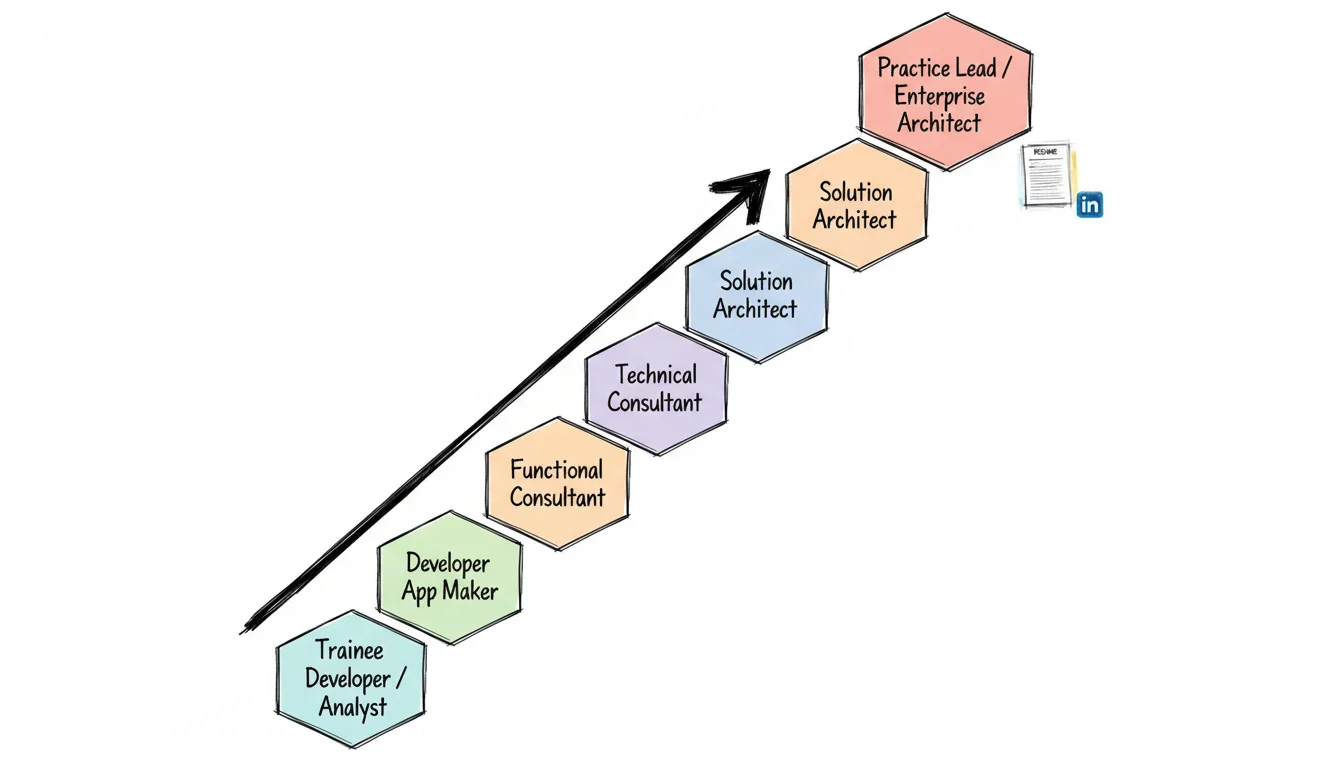
The progression follows a logical career path: you master the basics, specialize in a specific role, and eventually gain the broad oversight necessary to lead enterprise projects. This step-by-step approach ensures that you build a solid technical base before attempting to manage the complexity of an entire organization's automation strategy.
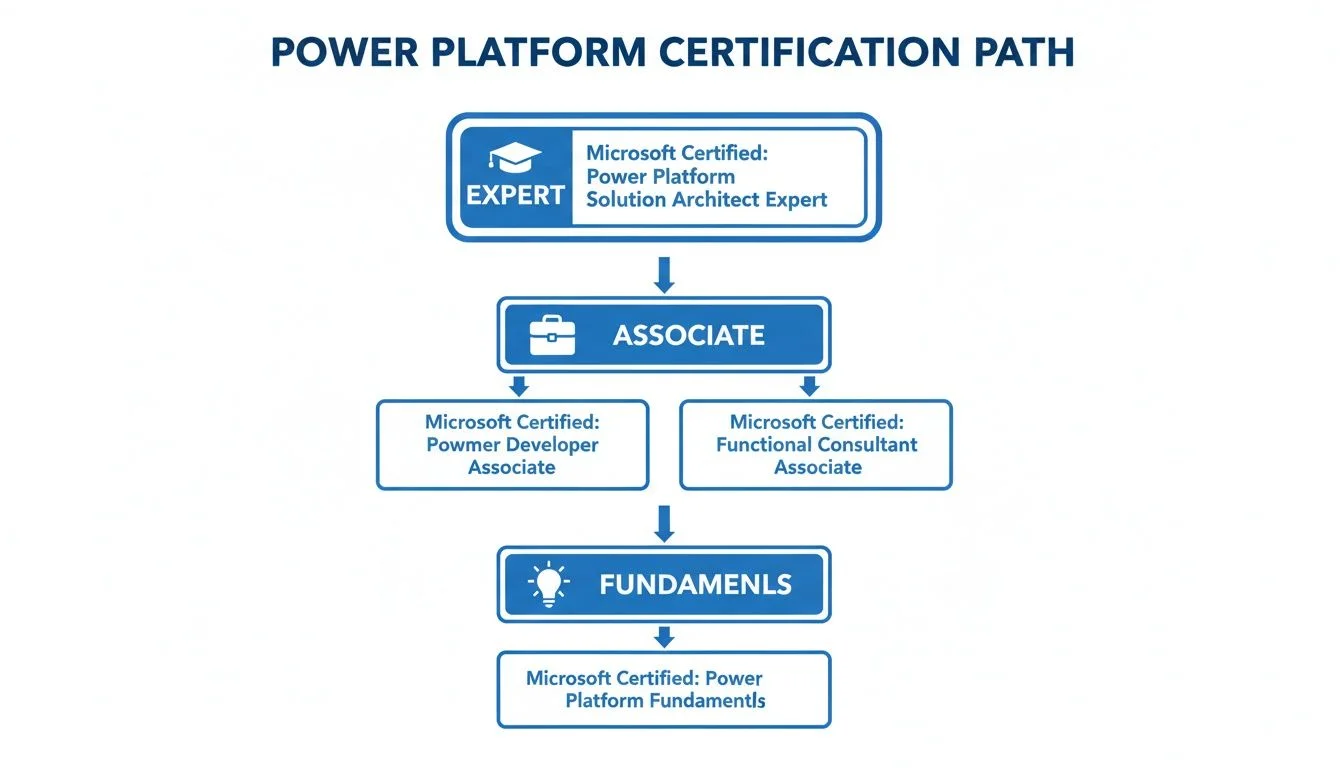
By following this tiered approach, you ensure your education keeps pace with the demands of your current job while preparing you for future leadership or specialized technical roles in the automation space.
Power Platform Certification Paths at a Glance
The following table outlines the primary certifications available, who should take them, and what specific skills each exam measures. Use this as a reference to match your current experience with the right credential.
| Certification | Exam Code | Target Audience | Core Skills Validated |
|---|---|---|---|
| Power Platform Fundamentals | PL-900 | Beginners, business users, students | Understanding the business value of Power Platform components. |
| Power Platform App Maker Associate | PL-100 | "Citizen developers," business analysts | Building low-code apps with Power Apps, Dataverse, and Power Automate. |
| Power Platform Developer Associate | PL-400 | Pro developers, technical consultants | Extending the platform with custom code, connectors, and PCF controls. |
| Power BI Data Analyst Associate | PL-300 | Data professionals, BI analysts | Data modeling, visualization, and analysis with Power BI. |
| Power Platform Functional Consultant Associate | PL-200 | Functional consultants, power users | Configuring solutions using the full suite of Power Platform tools. |
| Power Platform Solution Architect Expert | PL-600 | Solution Architects, Senior Consultants | Designing and implementing complex Power Platform solutions. |
This breakdown helps you avoid spending time on exams that do not align with your professional goals. It ensures that every hour you spend studying contributes to a specific career outcome.
Why This Matters in 2026
In the current professional environment, Microsoft is focusing heavily on integrating generative AI into the Power Platform. Tools like Copilot are now central to the development process. The Power Platform Fundamentals (PL-900) remains the most popular starting point because it introduces these AI concepts at a basic level. Industry data shows that 60-70% of learners choose the PL-900 as their first step before they move into more specialized areas like data analysis or professional development.
At the same time, the Power Platform Developer Associate (PL-400) is seeing increased demand. Companies want technical experts who can go beyond low-code to build high-performance, AI-driven applications that integrate with existing corporate infrastructure. Understanding the shift toward AI-assisted development is critical for anyone wanting to remain competitive. To see how these changes affect the broader certification environment, you can check the 2026 Microsoft certification guide.
Crucial Insight: Power Platform certifications are quickly moving from being an optional advantage to a standard requirement. Currently, these credentials are listed as prerequisites for 40-50% of mid-level developer and automation engineer roles at Fortune 500 companies. This trend shows the growing reliance on certified professionals to manage critical business automation.
As you plan your study schedule, remember that these certifications are connected. Success in one area often provides the technical context needed to succeed in the next. To learn more about these exams and how MindMesh Academy supports your goals, visit our detailed guide to the certifications we cover.
Choosing Your Core Power Platform Certification
Selecting which Power Platform certification to earn first is a major career decision. With several distinct options available, you must align your choice with your current skills, professional background, and future goals. This initial choice will influence your learning path and your professional growth for years to come.
We will look at the primary entry points into the Power Platform suite: PL-900, PL-200, and PL-400. Each exam targets a specific professional profile and tests a unique set of technical and strategic skills.
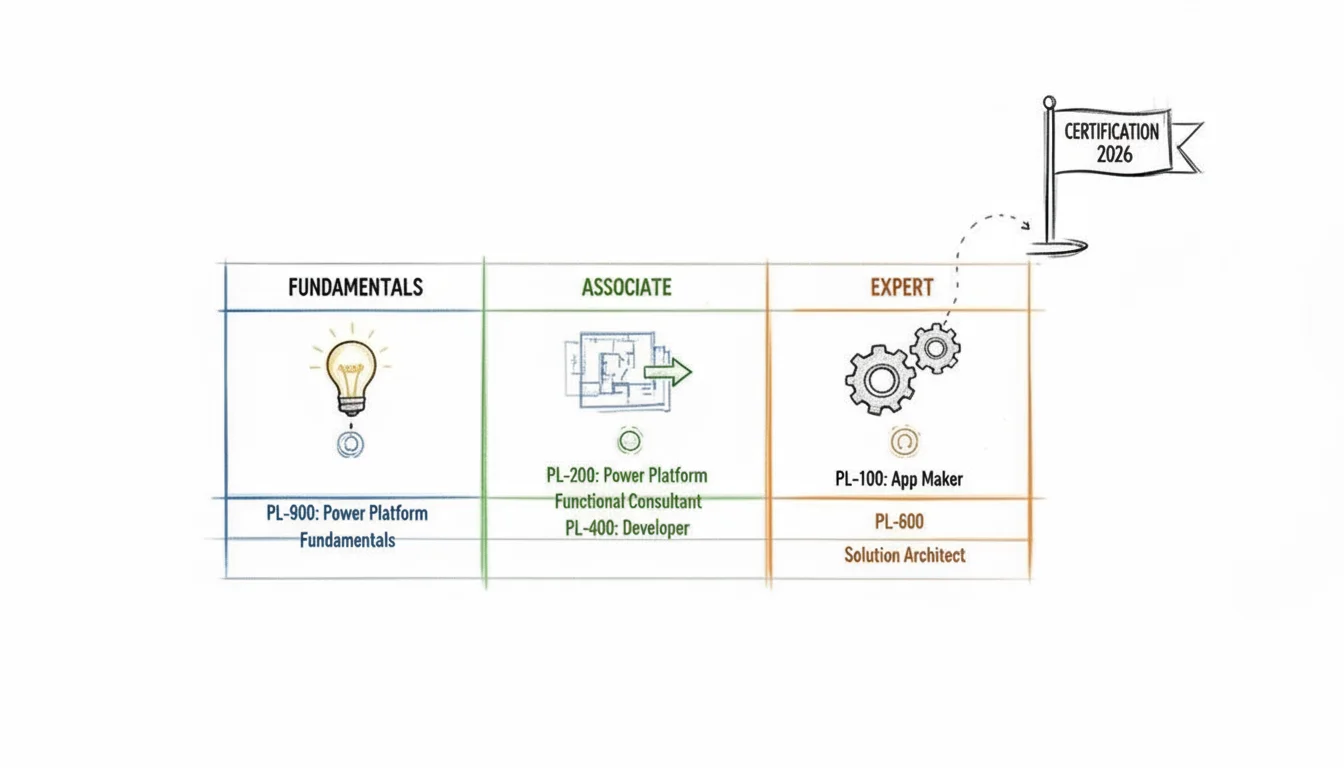
PL-900 Power Platform Fundamentals: The Foundational Gateway
The PL-900: Power Platform Fundamentals certification is your entry point. It provides a broad, high-level overview of the platform without exploring every technical detail. Its main purpose is to prove that you understand the business value and the basic capabilities of the core tools.
This certification works well for these groups:
- Business Users: People who want to use these tools to improve their daily productivity and make their work operations more efficient.
- Managers and Decision-Makers: Professionals who need a strategic understanding of how the platform drives business improvement and digital change.
- Aspiring IT Professionals: People looking for a recognized credential to start their career, similar to how an entry-level worker might use the CompTIA A+ (220-1201/220-1202) (verify current exam codes on the vendor site) for general IT or a ScrumMaster certification for agile projects.
The exam focuses on the "what" and "why" of the tools. You will not have to build complex solutions from scratch. You must explain the functions of Power Apps, Power Automate, and Power BI. You should also understand how Power Virtual Agents and Dataverse fit into the system. Earning this certification is a solid first step. Industry data shows that professionals with the PL-900 earn an average global salary of approximately $90,413 (verify current salary data on industry sites like Payscale or LinkedIn).
Reflection Prompt: Think about your current job and your goals. Does understanding the business value of the Power Platform help you more right now, or do you need a certification that focuses on building specific apps?
PL-200 Power Platform Functional Consultant: The Solution Implementer
If you prefer building solutions, the PL-200: Power Platform Functional Consultant Associate is the logical next step. While the PL-900 covers basic concepts, the PL-200 focuses on applying these tools to solve real business problems. This exam is more practical and requires you to understand how to configure the software to meet specific needs.
A Functional Consultant acts as a bridge between business stakeholders and technical teams. They listen to business requirements and then design and configure solutions. They use the platform's standard features and user interface rather than writing custom code. This role is similar to a Business Analyst in a traditional software project, but the consultant also has the skills to build the solution they designed.
Key Takeaway: The PL-200 is for professionals who work with stakeholders to define requirements and then build solutions using configuration, model-driven apps, canvas apps, and Power Automate flows. This is different from a developer role that focuses on writing code.
This certification requires you to understand Dataverse deeply. You must know how to build both model-driven and canvas applications and how to use Power Automate for cloud flows. It is a significant step up from the fundamentals exam. It covers the gap between knowing what a tool does and knowing how to make it solve a problem for a company. If this path interests you, you might also look at Azure certification paths to see how these skills work within the broader cloud environment.
PL-400 Power Platform Developer: The Custom Extension Expert
For IT professionals who enjoy coding and extending software, the PL-400: Power Platform Developer Associate is the standard. This credential is for developers who write custom code to make the platform do things that are not possible with standard features. It is the most technical exam among the core certifications.
If we compare roles, the Functional Consultant is like an architect who uses standard parts to build a house. The Developer is the specialist who can build entirely new parts. When a company needs a feature that is not in the standard catalog—such as a specific integration with an old legacy system or a unique interface control—the Developer writes the code to build it.
The PL-400 exam tests your ability to perform several tasks:
- Develop custom connectors: Use the PCF (Power Apps Component Framework) to add new functionality to an app.
- Implement JavaScript: Create active and fast user experiences within the applications.
- Utilize C#: Build complex logic on the server using plug-ins and custom workflow activities.
- Apply ALM practices: Use DevOps principles to manage and deploy solutions across different environments.
Recent updates to the PL-400 exam focus more on using AI copilots and modern DevOps methods. This reflects how the industry is changing. Companies want developers who can build apps that scale and use artificial intelligence. The global average salary for this role is around $89,327 (verify current pricing and salary data on the vendor or industry sites). This certification puts you at the center of both low-code and professional-code development. These skills are very valuable in modern business environments.
Building Your Personalized Study Plan
Success in a Power Platform certification exam requires more than memorizing facts; you need a strategy. A solid study plan separates those who feel overwhelmed from those who walk into the testing center ready. It functions as a roadmap, breaking down the large goal of certification into smaller, achievable daily tasks. If you do not have a plan, you might spend too much time on easy topics and run out of time for the hard ones.
The first step is setting a realistic timeline. Are you looking at a 30, 60, or 90-day window? Your intensity and method will change based on this choice. Shorter timelines require high focus, while longer ones allow for more practical application and repetition. Be honest about the time you can give to study each day. Real-world work and life often get in the way, and steady, moderate work usually beats sporadic cramming. If you miss a day, do not try to make it all up in one long block. Instead, add fifteen minutes to your sessions for the next week to get back on track.
Choosing Your Timeline
Think about your current workload before picking a date. Consistency is the most important factor in retaining technical information. If you can only spare thirty minutes a day, do not try to force a 30-day schedule. Pick the path that fits your life.
- The 30-Day Sprint (Aggressive): This path works best if you already have significant Power Platform experience. You should plan for 1-2 hours of daily study (verify your availability against this requirement) to review familiar topics and fix weaknesses. Because the exam date is close, you should take a practice test in the first week to see exactly where you need to focus.
- The 60-Day Pace (Optimal): Most candidates find this duration provides the best balance. By studying for 45-60 minutes per day (verify your availability against this requirement), you can cover every exam topic, get plenty of hands-on practice, and avoid burning out. This pace allows you to spend a full week on a single topic, such as Power BI integration, ensuring you understand how it connects with the rest of the platform.
- The 90-Day Marathon (Extended Preparation): This is the right choice if you have little prior knowledge or a very busy schedule. A steady 30-45 minutes each day (verify your availability against this requirement) allows you to build knowledge slowly and gives you time to understand difficult concepts. This schedule is great for people who are learning the Power Platform while also working a full-time job that does not involve these tools daily.
Mapping the Official Exam Syllabus
Do not start studying without reading the official Microsoft "skills measured" document for your exam. This document is the same blueprint used by the people who write the test. It lists every topic you will face and the percentage weight of each section. This is like the PMP Exam Content Outline or the AWS Certification Exam Guides, which are necessary for targeted study. If you skip this step, you are guessing what might be on the test.
Strategic Directive: Map every point in the official syllabus to your study materials. Create a checklist and mark off each objective as you learn it. This ensures you cover everything and spend your time where it counts most.
For example, if the syllabus says "Create and manage Power Automate flows" is 20-25% (verify current weighting on the official Microsoft exam page) of the exam, spend about a quarter of your study time there. This data-driven approach stops you from spending too much time on small topics while ignoring heavy sections. If "Configure security settings" is only 5%, you should not spend two weeks on it. For more study tips, see our guide on the best study methods for exams.
Setting Up Your Practice Environment
Book knowledge is not enough for Power Platform exams. These tests check your practical skills. Hands-on experience is mandatory. You need to build the intuition required to solve problems as they happen. You will be asked questions that require you to know which button to click or which menu to open in the interface. You cannot learn that from a textbook alone.
You need a sandbox to build, break, and fix things without risking real data. Use the following steps to set up your practice environment:
- Sign Up for a Developer Plan: Microsoft provides a free Power Apps Developer Plan. This gives you a personal environment with features like Dataverse so you can build and test apps as much as you want. This environment does not expire as long as you use it, making it a better long-term tool than a standard trial.
- Explore Trial Environments: If you need features not in the developer plan, use 30-day trials for Dynamics 365 applications (verify trial terms on the Microsoft site). This helps when practicing integrations for exams like the PL-200. Be sure to set a reminder to cancel or export your work before the 30 days end.
- Use Guided Labs: Start with tutorials. Microsoft Learn and other training sites offer labs that walk you through building canvas apps, cloud flows, or model-driven apps. These labs give you a set goal and the steps to reach it, which helps you learn the standard way Microsoft expects things to be done.
- Start a Personal Project: After you learn the basics, build something of your own. Automate a chore, track a hobby, or build a tool for a small business. You will run into the same problems during this build that you will see on the exam. When you have to fix an error in a logic expression you wrote yourself, the lesson sticks much better than when you just follow a tutorial.
Hands-on work is the best way to turn theory into actual skill. This prepares you for both the certification exam and your actual work.
How MindMesh Academy Accelerates Your Learning
A well-structured study plan acts as a map, but the quality of your tools determines the speed at which you reach your goal. The specific resources you use dictate your confidence level during the exam. A scientific approach to learning, like the one used by MindMesh Academy, changes the way you prepare for a Power Platform certification.
Methods that rely on passive reading or rote memorization are usually inefficient. Modern learning science offers better ways to handle information that match how the human brain actually works. By using these techniques, you stop wasting time on concepts you already understand. This allows you to focus your energy on the specific areas that require more work. This targeted effort ensures that every hour you spend studying has the maximum possible impact on your final score.
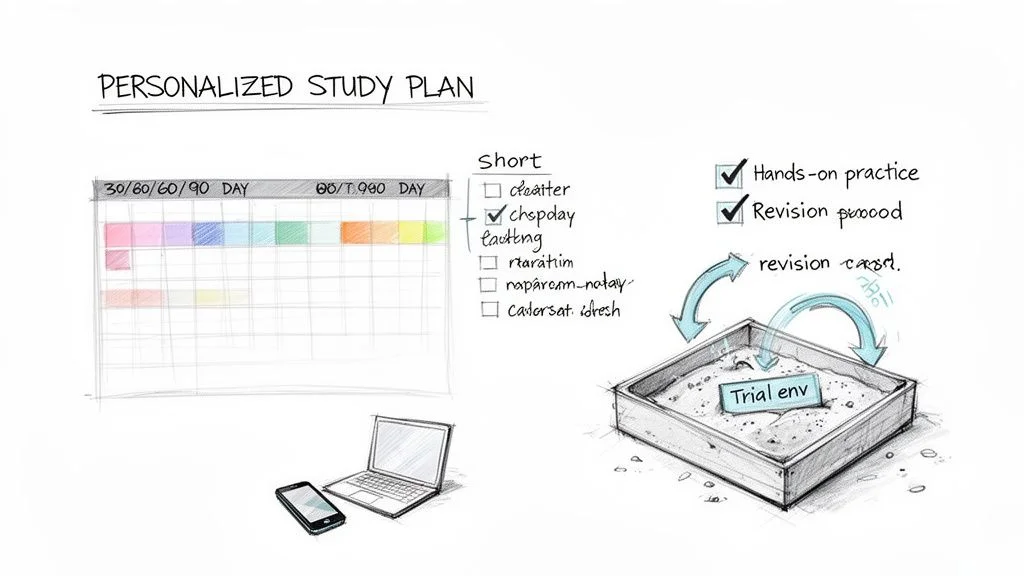
Study Smarter with Adaptive Learning
Think of an adaptive platform as a personal tutor who finds your knowledge gaps and fixes your curriculum in real time. Instead of forcing every student to follow the same rigid path, an adaptive platform changes based on your performance. It tracks your answers and adjusts the difficulty and topic frequency as you progress.
For example, you might get every question about creating canvas apps right but struggle with configuring Dataverse security roles. MindMesh Academy's platform sees this pattern immediately. It will not keep showing you the canvas app material you have already mastered. Instead, it will show you more practice questions, detailed technical explanations, and specific resources about Dataverse security. It continues this focus until your scores in that area improve. This data-driven feedback loop ensures that your study time stays productive. You focus on the topics that need the most attention, which is the fastest way to get ready for your test.
Master Concepts with Spaced Repetition
Many people cram for an exam, pass it, and then forget the material a few days later. This is a common problem because the information never moves from short-term memory into long-term memory. The solution to this problem is a technique called spaced repetition. This method is based on scientific research regarding how humans retain data over long periods.
This technique works by introducing a new concept and then asking you to review it at specific, increasing intervals. You might see a topic again after a few hours, then again after two days, then a week later. Each time you try to recall the information, your brain has to work harder. This effort strengthens the memory.
Analogy: This process is like building physical muscle. Each review acts as a repetition in the gym. Over time, that mental muscle becomes strong enough to recall complex Power Fx functions or specific ALM processes without hesitation.
For a certification as detailed as the Power Platform, you must remember hundreds of different facts and procedures. Spaced repetition provides a major advantage. It turns simple memorization into a deep understanding that stays with you even under the high pressure of the testing center.
Visualize Your Progress and Build Confidence
Being ready for an exam is not just about the number of hours you spend reading. It is about having the data to prove you are ready. A detailed progress dashboard serves as a command center for your study sessions. It removes the guesswork and shows you exactly where you stand.
At MindMesh Academy, the dashboard provides a clear report card of your performance across every exam objective. You can see your status through three main views:
- Your overall readiness score: This is a percentage that shows your current level of preparation based on your practice scores.
- Performance by topic: This view breaks down domains like "Power Automate flows" or "Dataverse security" so you know where you are strong and where you need more practice.
- Your progress over time: This graph shows how your scores improve as you study, which helps you stay motivated as the exam date gets closer.
This feature does more than just track numbers; it makes your hard work visible. Seeing your scores climb higher every day is a powerful motivator. It turns a large, difficult goal into a series of small wins. This build-up of success gives you the self-assurance you need to walk into the exam and pass with confidence.
Avoiding Common Exam Day Mistakes
It is a frustrating and common situation: a highly skilled candidate who spent weeks studying fails their Power Platform exam. This outcome rarely happens because the person lacked technical knowledge. Instead, it usually happens because they fell into high-pressure traps during the testing session. Technical expertise is only half of the requirement for success.
Think of the exam as a strategic event that tests your ability to perform under a strict time limit. While your knowledge allows you to compete, your test-taking strategy determines if you pass. We will look at the common errors that cause candidates to fail and provide the specific techniques you need to avoid them.
Misinterpreting Question Formats
A surprising number of points are lost because candidates do not follow the specific instructions within a question. Microsoft uses several different question types, and understanding what each format requires is a vital step in your preparation. This issue is not unique to Power Platform; it is a hurdle in many IT certifications, including those from CompTIA or AWS.
Pay close attention to these specific phrases:
- "Select the best answer": This phrase indicates that multiple options might technically work. However, you must choose the one that is most efficient, cost-effective, or appropriate for the specific context provided. You are looking for the most professional solution, not just any solution that functions.
- "Select all that apply": These are multiple-response questions where you must identify every correct option. In most cases, if you miss one correct answer or pick one incorrect answer, you receive zero points for the entire question. Microsoft exams rarely offer partial credit for these items.
- "Arrange in the correct order": These sequencing tasks test your knowledge of specific administrative or development workflows. If you get even one step out of place, the entire answer is marked wrong. These require you to visualize the actual steps you would take in the Power Platform admin center or maker portal.
Expert Tip: Try a specific test-taking method: read the very last sentence of the question before reading the rest of the text. This sentence usually contains the actual instruction, such as "Which three actions should you perform in sequence?" Knowing the specific goal helps you filter the information in the long paragraph that usually comes before it. This is similar to how a project manager might scan a scenario for constraints when preparing for a PMP exam.
Falling Behind on Time
The clock is your biggest enemy in the testing center. Poor time management is the #1 reason for failure among qualified candidates. Many people spend far too much time on a single difficult question and then have to rush through the final 10 or 15 questions. Rushing leads to simple mistakes that could have been avoided with a steadier pace.
Golden Rule: Do not let a single hard question ruin your chance of passing. If you do not know the answer after a minute or two, make an educated guess, flag it for later, and move on. Your time is a finite resource that you must manage with care.
To manage your time effectively, follow this plan:
- Establish Your Pace: Before you start the first question, look at the total time and the number of questions. If you have 100 minutes for 50 questions (verify the specific time limit and question count on your exam notification), you have exactly 2 minutes for each one. Keep this number in mind as a mental benchmark throughout the test.
- Utilize the 'Flag for Review' Feature: Every Microsoft exam interface has a way to flag a question. If you are not 100% sure of your answer within your two-minute window, pick the best option you can see, flag it, and move forward. If you have time left at the very end of the exam, you can return to these flagged items for a second look.
- Strategize Case Studies: You will likely see at least one case study. These provide a long description of a company's business needs, existing systems, and problems. The most efficient way to handle these is to read the full scenario once to get the big picture. Then, answer all the questions related to that case study in a row. This prevents you from having to re-read the long scenario for every single question.
Deconstructing Complex Questions
Scenario questions are not just about facts; they test your ability to solve problems like a consultant or solution architect. These questions often include extra details that are true but have nothing to do with the actual problem you need to solve. You must learn to separate the useful signals from the noise.
Start by finding the primary business goal. What is the one thing the company must achieve? After that, look for specific constraints. These might include:
- Budget limits (e.g., "the solution must use the least expensive licensing").
- Security requirements (e.g., "data must be encrypted at rest").
- Compliance rules (e.g., following GDPR or HIPAA regulations).
- Technical limits (e.g., "must integrate with an existing on-premises SQL database").
Once you know the goal and the constraints, use the process of elimination. Cross out any answers that are clearly wrong or that violate one of the constraints. For example, if a constraint says the solution must be low-code, you can eliminate any answer that requires custom C# plugins. This technique often leaves you with only two possible answers, which significantly improves your chances of being correct. By using this analytical approach alongside your technical knowledge, you can approach the exam with confidence and demonstrate your skills effectively.
What a Power Platform Certification Really Means for Your Career
Earning a certification is more than just passing a test. It serves as a verified endorsement of your ability to perform in a fast-moving job market. Consider it a third-party confirmation that you have the skills to do the work. When a hiring manager sees a certification badge, they immediately understand that you can build the intelligent automation and low-code applications that businesses need right now.
This is not a minor resume update. It can change the types of professional opportunities available to you. Holding a certification often acts as a key to roles where you might otherwise be overlooked. It provides a clear signal of competence in a field where practical skill is everything.
Unlocking New Job Titles
The specific Power Platform exam you pass determines which specialized roles you can target. That credential on your resume tells a clear story about your expertise and what you can contribute to a team.
- PL-200 Functional Consultant: This role positions you as a professional who can bridge the gap between business needs and technical setup. You become a candidate for roles such as Business Analyst, Power Platform Consultant, or Solutions Analyst. In these positions, you are responsible for turning business problems into functional solutions.
- PL-400 Developer Associate: This certification puts you on the path to becoming a Power Platform Developer or Technical Consultant. You might even find work as a specialized AI Developer within the Microsoft environment. You are the person companies call for custom code, complex integrations, and extending the platform beyond its standard features.
- PL-600 Solution Architect Expert: This confirms that you are ready for high-level strategy and big-picture planning. You will be a top candidate for senior roles like Power Platform Solution Architect or Enterprise Architect. Your work will involve designing and leading large deployments across an entire company rather than just building individual apps.
Your influence can reach past the IT department. If you build effective Power Automate workflows for non-technical teams, you help the whole company use technology better. This ability to work across departments increases your professional value significantly.
The Impact on Your Salary and Job Security
Data shows that certifications help your pay. Reports consistently show that certified professionals in fields like AWS or Azure earn more than those without them. Even the foundational Power Platform Fundamentals (PL-900) can help your career. Professionals with this credential report an average global salary of approximately $90,413 (verify current salary data on vendor or industry sites).
Strategic Advantage: Beyond a pay raise, certifications provide security. When companies want to save money, they look for efficiency. If you can automate processes and build apps that save time, you are an asset. This skill set provides a level of career safety that is hard to find in other roles.
Once you pass your exam, make sure people can see it. Add your certification to the "Licenses & Certifications" section on LinkedIn. Put the official badge on your resume. This makes you easy to find when recruiters search for your specific skills.
Low-code and automation skills are moving from "nice to have" to a requirement for many jobs. By 2026, these will be core skills in almost every industry. Earning your Power Platform certification now puts you ahead of that shift. It marks you as a professional who can help any company build a secure future. Companies are looking for people who can do more with less, and your certification proves you are that person.
Frequently Asked Questions
As you research the various Power Platform certifications, several specific questions often come up. This section provides clear answers to these common concerns so you can organize your study plan with confidence.
Which Certification Is Best For A Beginner?
The PL-900: Microsoft Power Platform Fundamentals is the best starting point for those new to the platform. Microsoft designed this exam to provide a broad view of the entire suite of tools. It covers the core capabilities of Power Apps, Power Automate, Power BI, and Dataverse. You will learn how these applications function together to solve business problems and improve efficiency.
One major advantage of this exam is that it does not require a technical or programming background. It focuses on the business value and the basic logic behind the tools. You should view it as a way to understand the technical environment before you choose a specialized path. It serves a similar role to the Azure Fundamentals (AZ-900) or the ITIL 4 Foundation certifications in other IT tracks. By passing this exam, you prove you understand how low-code solutions can transform traditional business processes.
How Long Does A Power Platform Certification Last?
Validity depends on the level of the certification you earn. For role-based credentials at the Associate and Expert levels—such as the PL-200 Functional Consultant, PL-400 Developer, or PL-600 Solution Architect—your certification remains valid for one year from the day you pass the exam. Microsoft uses this annual cycle to ensure that certified professionals keep up with frequent software updates and new feature releases.
To keep your certification active, you must complete a renewal assessment on the Microsoft Learn platform. This assessment is free, taken online, and becomes available during the six-month window before your certification expires. If you pass this unproctored test, your validity extends for another year.
Important Distinction: The PL-900 Fundamentals certification is different because it does not expire. Once you earn this foundational credential, it remains on your transcript permanently. You do not need to take renewal assessments to maintain your Fundamentals status.
This renewal system helps you stay current. Because the software changes often, regular updates to your knowledge make your credentials more credible to employers who need experts familiar with the latest versions of the tools.
Can I Skip The Fundamentals Exam?
Yes, you can skip it. Microsoft does not list the PL-900 as a strict prerequisite for higher-level exams. If you already have significant experience building apps or managing environments, you can go straight to the PL-200 Functional Consultant or PL-400 Developer Associate exams.
However, most experts suggest taking the PL-900 anyway. Even experienced users often find gaps in their knowledge when they look at the entire platform. Taking the Fundamentals exam ensures you understand the broader context of how Dataverse and Power BI interact with your specific area of expertise. This creates a stronger knowledge base, which makes the advanced material in Associate-level courses easier to grasp.
Are There Formal Prerequisites For The Exams?
Microsoft does not require you to hold any specific degrees or lower certifications before taking Power Platform exams. This policy allows you to choose a certification path that fits your current job role or your future career goals.
For example, a software developer with a background in C# and JavaScript might start directly with the PL-400 Power Platform Developer Associate. While there are no hard requirements, following the suggested path from Fundamentals to Associate is generally more effective. It prepares you for the specific way Microsoft frames exam questions and ensures you are ready for the more complex technical scenarios found in higher-level tests.
Ready to move from preparation to mastery? MindMesh Academy provides adaptive learning paths and spaced repetition techniques to help you learn every objective for your Power Platform certification exam. Track your progress visually and go into your test day knowing you are prepared. Explore our resources today at MindMesh Academy.
Ready to Get Certified?
Prepare with professional study guides, practice exams, and spaced repetition flashcards from MindMesh Academy to pass with confidence. Access resources:

Written by
Alvin Varughese
Founder, MindMesh Academy
Alvin Varughese is the founder of MindMesh Academy and an enterprise architecture leader. An electrical engineer by training, he moved from factory automation in South Africa to cloud architecture at GE Appliances and Humana (Fortune 50), and holds 20 professional certifications including AWS Solutions Architect Professional, Azure DevOps Engineer Expert, and Microsoft Agentic AI Business Solutions Architect. He built MindMesh Academy after interviewing too many highly certified candidates who couldn't answer basic questions: the goal is prep that makes you better at the job, not just able to pass the exam.