Choosing Your PMP Certification Study Material for Exam Success
Starting your PMP preparation often feels overwhelming. Selecting the right PMP certification study material is a critical decision. You do not need a single perfect book or a magic bullet. Instead, you should build a practical learning system using a variety of resources. This guide offers a clear plan for obtaining exactly what you need to prepare for and pass the exam with confidence. Use these steps to find the best tools for your specific needs.
Your Blueprint for PMP Exam Success
The marketplace for PMP study guides, video series, and practice tests is crowded. Without a specific strategy, it is easy to spend money on redundant materials while missing the core resources required for a passing score. You should treat your PMP preparation like a high-priority project. This means setting clear objectives, identifying your resource needs, and drafting a logical plan for execution.
Consider the PMBOK® Guide and the Agile Practice Guide to be your primary technical documentation. These texts outline the official standards, process groups, and principles that the Project Management Institute (PMI) tests. They are the source of truth for the exam content, providing the definitions and frameworks you must know. However, these guides are often dry and technical. Most students find that they need additional tools to help them apply these concepts in a test setting.
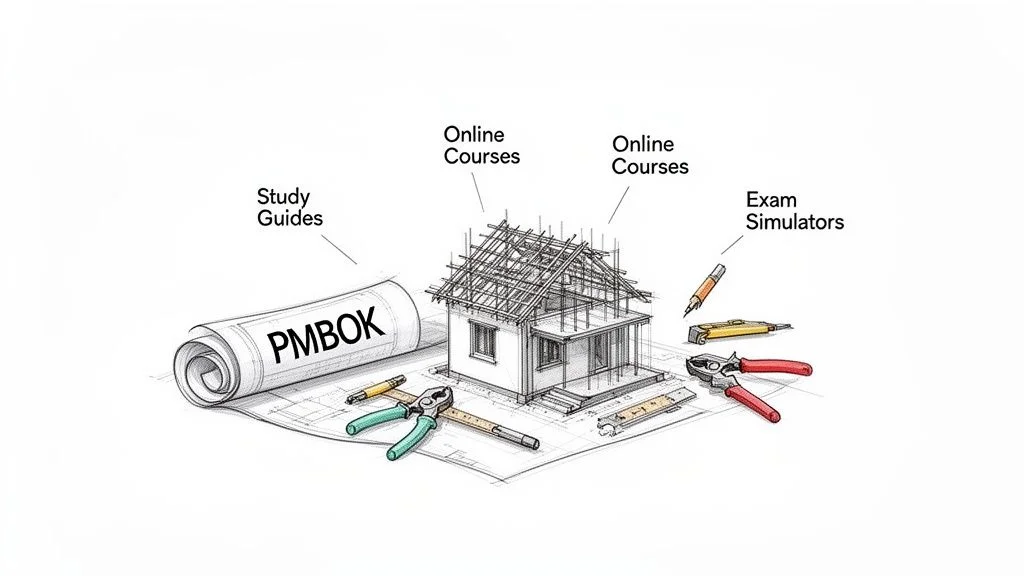 Caption: A well-rounded PMP toolkit includes official guides, thorough study materials, and realistic simulators.
Assembling Your PMP Toolkit
A functional study toolkit relies on several different components that support one another. Each resource serves a specific function. By using them together, you can build your knowledge and improve your exam-day performance.
- Focused Study Guides: These books act as interpreters for the PMBOK® Guide. While the official guide provides the raw theory, a study guide simplifies that information into lessons you can actually use. For example, a quality study guide does not just list the formulas for Earned Value Management (EVM). It explains how to interpret those numbers in a project status report. It uses scenarios to show why a Cost Performance Index (CPI) of 0.8 is a problem that requires immediate attention and perhaps a change in project resource allocation.
- Interactive Online Courses: These programs use video content, interactive quizzes, and practical exercises to make abstract management concepts feel concrete. This is particularly useful if you find it easier to learn by watching and listening rather than just reading. Most of these online programs also fulfill the 35 contact hours of project management education required by PMI to sit for the exam. This requirement is mandatory for your application, so having it built into your study material is efficient.
- Realistic Exam Simulators: This is the tool you use to verify your progress. Simulators put you in a testing environment that matches the actual exam. They require you to answer the type of situational questions that make the PMP difficult. These questions often ask what a project manager should do first when a specific problem occurs. Answering them correctly requires speed and the ability to stay focused for the full length of the test.
To use these tools properly, you must implement effective study strategies for exam success that help you remember facts and apply logic during the test.
The PMP is a globally recognized credential held by more than 1.58 million professionals. There are clear financial reasons to pursue it, as PMI reports that certified project managers can earn 33% more than their non-certified peers. But the exam is hard. With pass rates generally staying under 70%, you must be well-prepared with high-quality materials.
Successful PMP preparation is not about memorizing the PMBOK® Guide word for word. It is about learning the PMI mindset. You must develop the logic to analyze a situational question and choose the answer that follows PMI best practices. This often differs from what you might do at your current job or what your specific company culture dictates.
By selecting the right resources, you create a structure that covers every exam topic. This section of our guide reviews each type of PMP certification study material to help you find the tools that fit your personal learning style. If you need help with your schedule, read our post on building a comprehensive PMP certification study plan.
The Essential PMP Study Resources: Your Complete Toolkit
Building an effective study plan depends on knowing which tools to use and when to use them. Think of this preparation as a project in itself. You would not use a hammer to drive a screw, and you should not use a reference manual as your primary teaching tool. Each piece of PMP study material serves a specific purpose. Mastering the way these tools work together is the most effective way to pass the exam with confidence and precision.
You need a kit that covers theory, application, and testing. Let's break down the core components you will need in your PMP toolkit to ensure you are ready for exam day.
Foundational Texts: The PMBOK® and Agile Practice Guides
We must start with the official guides from the Project Management Institute (PMI). The PMBOK® Guide and the Agile Practice Guide are essential reference texts. They are not narrative books. You should not try to read them from cover to cover like a novel. Doing so is a common mistake that leads to burnout and confusion.
Preparing for the PMP exam by only reading these two guides is like trying to become a professional software architect by reading nothing but API documentation. You might learn the technical specifications, but you will not develop the practical wisdom needed for design or implementation. These guides serve as the final authority on specific terms. Use them to get clarity on a complex concept or to confirm the official PMI definition of a process. They also define the Inputs, Tools & Techniques, and Outputs (ITTOs) that form the structure of traditional project management. They are your source of truth, but they are not your primary way to learn the material.
- Reflection Prompt: Consider how relying only on technical documentation for a certification like the AWS Certified Solutions Architect - Professional (SAP-C02) might leave you unprepared for situational questions. Documentation tells you what a service does, but it rarely tells you which service is best when budget and speed are both high priorities.
The current version of the PMP exam draws heavily from the Agile Practice Guide. Since about half of the exam now covers Agile or Hybrid methodologies, this text is more important than ever. It explains the mindset behind iterative delivery and the specific ceremonies used in frameworks like Scrum or Kanban. Use it as a dictionary for terms like "backlog refinement," "sprint planning," and "retrospectives."
Study Guides: The Expert Translators
This is where your actual learning takes place. A high-quality PMP study guide is a vital asset for any candidate. Books by educators like Rita Mulcahy or Andrew Ramdayal act as expert interpreters. They take the dense, academic language found in the PMBOK® Guide and turn it into lessons that are easy to understand and apply to real life.
An effective study guide succeeds because it focuses on three specific areas:
- Simplifying Complexity: These books use clear analogies and real-world project scenarios. For example, they might explain risk management by comparing it to a common IT project where a server migration might fail. These stories make abstract ideas stick in your memory.
- Providing Context: A good guide explains more than just what a process is. It tells you why that process matters and how it fits into the larger project. It might clarify why "Control Quality" is different from "Manage Quality." It shows how the output of one process becomes the input for the next, which is a key concept for many exam questions.
- Targeting Exam Content: Authors of these guides know the exam patterns. They filter out unnecessary details and focus on the topics most likely to appear on the test. This saves you time and prevents you from over-studying topics that rarely appear in the question pool.
Think of your study guide as your main textbook. You will use this resource to build a solid foundation of knowledge. It bridges the gap between abstract theory and the applied knowledge you need to answer difficult situational questions.
Online PMP Courses: Bringing the Material to Life
A study guide is great for deep reading, but an online course makes the material feel real. For visual or auditory learners, a structured course can change the entire experience of studying. These courses combine video lectures, interactive quizzes, and visual aids like process flow diagrams or formula sheets. This variety helps keep you focused and encourages active learning rather than passive reading.
The best courses offer a clear path from start to finish. They often include community forums where you can ask questions when you are stuck. One major advantage of these courses is that they provide the 35 contact hours of project management education required for the PMP application. When you finish the course, you receive a certificate that serves as proof for PMI if your application is audited.
Online Course Benefits:
- Expert Instruction: You hear the material explained by someone who has helped thousands of students pass.
- Flexible Scheduling: You can watch a twenty-minute video during a lunch break or listen to a lecture while commuting. This is helpful for IT professionals who have demanding schedules and limited free time.
- Structured Progression: Courses break the massive amount of information into small, manageable modules. This prevents you from feeling overwhelmed by the scale of the exam content.
The value of an online course is the "classroom" environment it provides. You get the benefits of a professional teacher and a set roadmap, but you can move at your own pace. This format turns your study time into an active educational experience.
Practice Exams and Simulators: Where Theory Meets Reality
Testing yourself is the most important part of your preparation. However, you must realize that not all practice tools do the same thing. You need to use two different types of testing to be fully prepared.
1. Practice Exams and Question Banks (Topic-Specific): These tools check your memory after you finish a specific chapter or domain. Use them immediately after studying a topic like project scheduling or stakeholder management. They are very effective at showing you exactly where your knowledge is weak. If you keep getting questions wrong about the "Critical Path Method," you know you need to go back to your study guide and review that section.
2. Full-Length Exam Simulators (Holistic): Simulators are more advanced. They do not just test what you know; they teach you how to think like PMI. A quality simulator gives you more than just a pool of questions. It recreates the environment of the real exam. The PMP exam consists of 180 questions that you must finish in 230 minutes. A simulator helps you prepare for that specific pressure.
A simulator is your training ground for several critical skills:
- Time Management: You must learn to answer questions quickly. If you spend three minutes on one difficult question, you will run out of time at the end. Simulators help you find a rhythm so you can finish the test within the time limit.
- Mental Stamina: Concentrating for nearly four hours is physically and mentally draining. You need to practice sitting for the full duration to ensure your brain stays sharp until the final question.
- The "PMI Mindset": This is the most important part of the simulator. Real-world experience can sometimes be a disadvantage on the PMP exam because your company might handle projects differently than the "PMI way." A simulator trains you to choose the best answer according to PMI standards, even if it contradicts your personal professional habits.
- Question Variety: The current exam uses multiple formats, including multiple-choice, drag-and-drop, and "hotspot" questions where you click on a graph. A simulator ensures you are comfortable with all these formats before you walk into the testing center.
Comparison of PMP Study Material Formats
This table breaks down the different formats to help you choose the right mix for your learning style and budget.
| Material Format | Pros | Cons | Ideal Learner |
|---|---|---|---|
| Official Guides | The final source of truth; defines all official terms and processes exactly as they will appear. | Very dense and academic; hard to use for learning new concepts from scratch. | Every candidate uses this as a reference, but it should not be the only book you use. |
| Study Guides | Great for building deep understanding; explains complex ideas using simple, practical language. | Books can be long; requires high self-discipline to read and take notes consistently. | Self-starters who learn best by reading, highlighting, and working through printed exercises. |
| Online Courses | Provides a structured path; uses video and audio to keep you engaged; meets the 35-hour requirement. | Costs vary; you must check the quality of the instructor and the depth of the content before buying. | Visual and auditory learners who want a guided experience that feels like a real classroom. |
| Practice Exams | Good for finding specific gaps in your knowledge; allows you to focus on one topic at a time. | Does not prepare you for the length of the exam or the mental fatigue of a four-hour test. | Students who want to verify they understand a chapter before moving on to the next one. |
| Exam Simulators | Best for building endurance and learning the "PMI Mindset"; shows you exactly what the real test feels like. | Can be frustrating if you try them before you have a strong knowledge base. | Every serious candidate who wants to be ready for the pressure and timing of the actual test day. |
Using a combination of these resources creates a powerful learning system. You can find more details on how to combine these tools in our PMP study guide. By understanding the specific job of each tool, you can build a plan that covers everything from basic terms to the final, high-pressure hours of the exam. Stick to the plan, use the simulators to find your weaknesses, and refer to the official guides when you need a definitive answer. This balanced approach is the most reliable way to prepare.
Crafting Your Winning PMP Study Schedule
Having a great collection of PMP study materials is only the first step toward success. You also need to know how to use them. Think of it this way: a person might have a garage full of professional tools, but without a set of blueprints, they will not be able to build a house that stands up. A well-constructed study schedule serves as your blueprint. It turns your books, videos, and practice exams into a clear path for learning. It provides a sense of direction and helps stop you from feeling like the amount of information is too much to handle.
The real secret to passing the PMP is not just the content you study, but the way you interact with that content. Many students fall into a trap of passive learning. They read chapters multiple times or highlight every other sentence in a textbook. While this makes you feel busy, it often leads to a false sense of mastery. You might recognize a term when you see it on the page, but you cannot apply the concept during a difficult exam question. To truly learn the PMP material, you must engage with it actively. Your schedule should use techniques that build strong memory pathways. These are the connections you will rely on when you are under the pressure of the four-hour exam.
Integrating Smarter Study Techniques
To build a study schedule that produces results, you should use two methods from the science of learning: Spaced Repetition and Active Recall. These are not just trendy terms. They are proven methods for making your study time more efficient and helping you remember what you learn for a longer period.
- Spaced Repetition: This is a way to fight the natural tendency of the brain to forget new information. Instead of studying a topic once and moving on, you revisit it at set intervals. For example, you might study risk management today, then review it again in three days, then one week later, and finally one month later. This repeated exposure tells your brain that the information is important. This moves the data from your short-term memory into your long-term memory.
- Real-world Application: This method is useful for keeping track of specific details across many certifications, such as the service names in AWS CLF-C02 (verify current pricing on the vendor site) or the port numbers in CompTIA Network+ N10-009 (verify current pricing on the vendor site).
- Active Recall: This technique is about pulling information out of your brain rather than trying to push it in. After you finish reading a section on stakeholder management, close your book. Try to write down the main points or explain the concept to someone else. If you can explain it clearly without looking at your notes, you have learned it. Practice questions and flashcards are the best tools for this kind of work.
When you use these two methods together, you create a powerful way to learn. Active recall makes the memory stronger, and spaced repetition ensures that the memory stays with you. Organizing your study plan around these two ideas helps prevent burnout and makes every hour you spend studying more effective.
The process of learning for the PMP follows a logical path. You start by building a base of knowledge, then you move into active learning, and finally, you use practice to make that knowledge permanent.
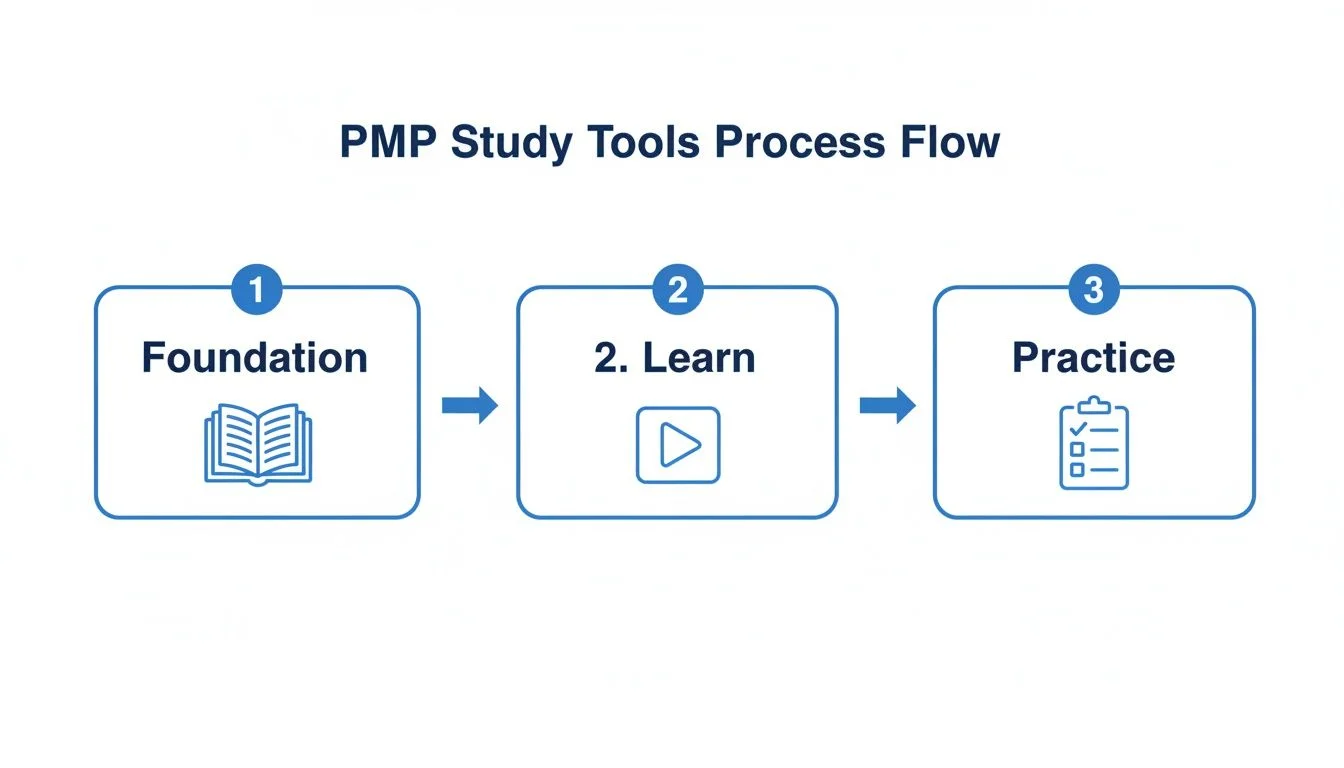 Caption: The cyclical flow of PMP preparation: Build your Foundation, actively Learn, and consistently Practice.
This simple flow—Foundation, Learn, Practice—is the cycle you should follow for every part of your study routine.
Designing Your Study Loop
An effective PMP schedule is more than just a list of dates on a calendar. It is a process designed for constant improvement. You can think of it as a four-step loop: Learn, Practice, Review, and Repeat. You should follow this loop for every knowledge area or exam domain.
- Learn: This first step is where you take in new information. Read a chapter in your study guide or watch a video module from your course. At this stage, your goal is to understand the big ideas. Do not try to memorize every small detail or every single input and output on the first pass. Focus on the "why" and the "how" of the process.
- Practice: As soon as you finish your learning session, test yourself. Take a quiz of 20-30 questions that focus only on that specific topic. This is your first chance to use active recall. It will quickly show you what you understood and what you need to look at again.
- Review: This is the most important part of the loop. Take the time to look at every question you got wrong. Do not just look at the correct answer and move to the next one. Read the explanation to understand why that answer was the best choice. You also need to understand why your own logic was incorrect. This detailed analysis is where you fix your mistakes and improve your understanding of the "PMI way" of thinking.
- Repeat: Take the notes from your review and go back to your books to fix the gaps in your knowledge. Then, put this topic on your schedule to be reviewed again in a week. By following this cycle, you ensure that you are not just memorizing facts, but building a deep understanding of project management.
The goal of your schedule is not to memorize the PMBOK® Guide word for word. The goal is to build a system where you find your weak spots and turn them into strengths, one domain at a time.
A Sample 90-Day PMP Study Plan Framework
For most people, a 90-day plan is the best choice. It is long enough to cover all the material but short enough to keep your momentum going. Here is a general framework that you can change to fit your own work and life schedule.
| Phase | Duration | Weekly Focus |
|---|---|---|
| Phase 1: Foundation Building | Weeks 1-6 | Focus on the Process and People domains. These are the largest parts of the exam. Work through 1-2 knowledge areas every week using the Learn-Practice-Review loop. You should aim for 10-12 hours of study per week. Spend this time reading your guides, watching videos, and taking short quizzes to check your progress. |
| Phase 2: Concept Integration & Application | Weeks 7-10 | Move your focus to the Business Environment domain. This is also the time to start seeing how all the different parts of project management work together. Start taking one full 180-question mock exam every week. You should spend more time reviewing the results of these exams than you spent taking the tests. Look for patterns in the questions you miss. |
| Phase 3: Final Preparation & Exam Readiness | Weeks 11-12 | Increase your effort in the final weeks. Try to do 2-3 full-length practice exams each week. You should do these in a quiet place to simulate the real exam environment. Your focus now is on managing your time and building the mental strength to stay focused for 230 minutes. Use your review sessions to fix any remaining weak spots in your knowledge of the PMI mindset. |
This framework is a template, not a set of rigid rules. You should change it based on how much you already know about project management and how much time you can spend studying each week. If you have years of experience, you might move through the foundation phase faster. If you are new to the formal processes, you may need more time in the first phase. For a more detailed look at how to study, you can read our article on how to pass the PMP exam with proven study tips. The most important things are to have a plan, stick to it, and trust the process of constant review and practice. Passing the exam is about more than just intelligence; it is about having a solid structure for your preparation.
How Modern Platforms Optimize Your PMP Prep
Preparing for the PMP exam used to be a difficult, manual grind. Most candidates spent months juggling heavy textbooks, organizing stacks of physical flashcards, and trying to make sense of various practice tests. You had to act as your own project manager just to build a study schedule and figure out which topics to prioritize. Modern learning platforms have changed this approach. They take all that scattered PMP certification study material and put it into one intelligent system. This system acts like an adaptive tutor that tracks your progress and tells you exactly what to do next.
Instead of showing the same slides to every person, these platforms use data to create a custom experience. The system changes based on how you perform every day. It acts like a navigation tool for your studies. As you answer practice questions, an internal engine looks at your results in real-time. It identifies the topics you have mastered and the specific areas where you struggle. For example, if the software sees you are consistently getting questions about Earned Value Management (EVM) wrong, it will adjust the curriculum. It will show you more targeted questions on cost variance and schedule performance formulas. It might also show you a short micro-lesson to explain the logic again. The system continues to focus on these concepts until you prove you understand them.
This data-driven method removes the confusion from your study routine. You do not have to guess what you should work on when you have an hour of free time. You can spend every minute on your weakest subjects to get the most improvement. This is a major advantage for any student, whether they are preparing for the PMP, an AWS certification, or an Azure exam.
Personalizing Your Study Path with Data
The main benefit of a modern platform is the ability to build a custom study path. This is not a rigid plan where every person starts at the first page of a book and moves forward linearly. Instead, the software creates a plan based on your current knowledge and your pace. Reading a textbook from start to finish is often a slow way to learn because you spend too much time on things you already know. A dynamic system focuses only on what you need to learn right now.
This type of custom preparation is more important now than ever. Current data shows that only 45% of organizations provide accredited project management training to their staff. This means that a large number of project managers are responsible for their own exam success without help from their employers. They have to find their own tools and manage their own time while working full-time jobs. Additionally, the exam content is going to change. In the upcoming July 2026 update, the Business Environment domain is scheduled to expand from 8% to 26% of the total exam content. A static study guide cannot help you prepare for that kind of shift. An adaptive system allows you to handle these changes by focusing your work on the areas with the most weight. This helps you build the competence and the confidence required to pass the exam when you get to the testing center.
Visualizing Progress and Building Confidence
Many platforms, such as MindMesh Academy, use a visual dashboard to show you how you are doing. This dashboard works like a map. It shows your skill level in the three main exam domains: People, Process, and Business Environment. The People domain focuses on the soft skills required to lead a team, while the Process domain covers the technical aspects of managing project work. The Business Environment domain looks at the connection between projects and organizational strategy. Seeing your progress in a visual format makes the hard work feel like it is paying off.
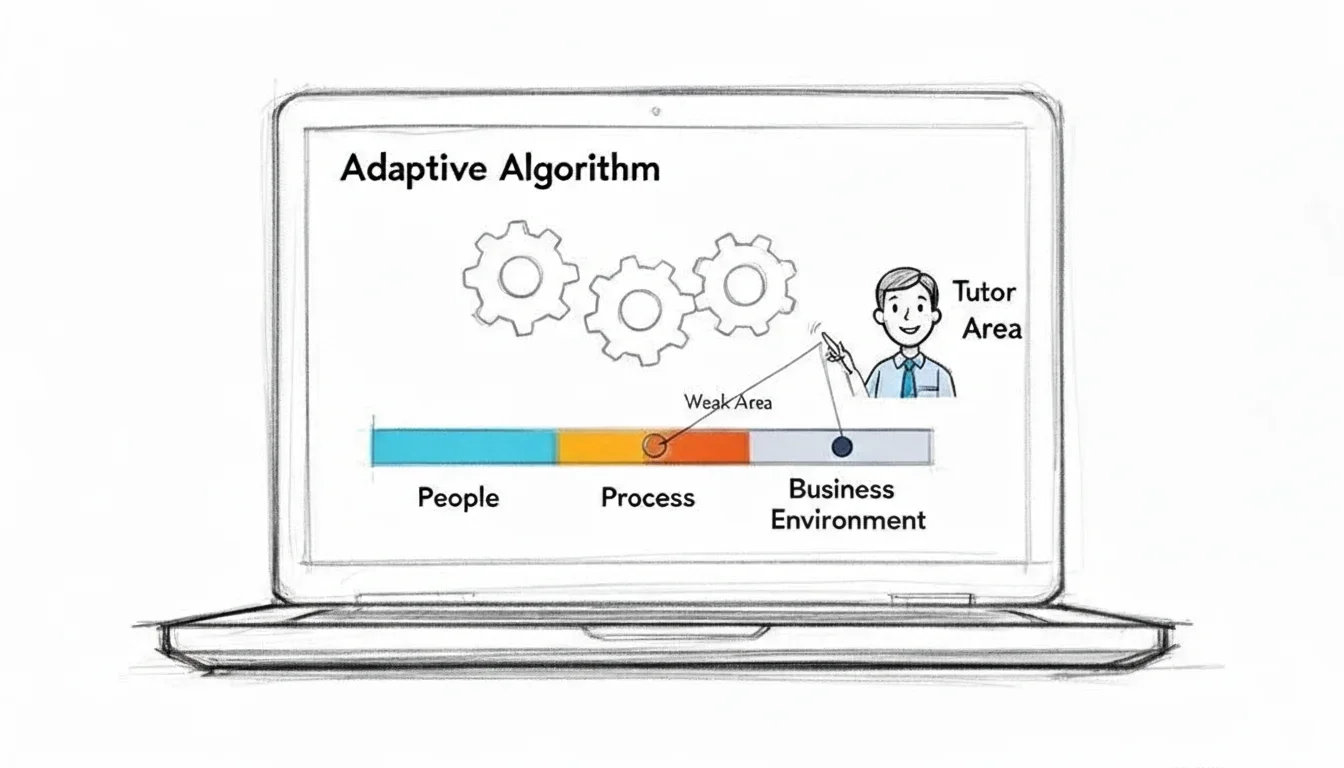 Caption: An adaptive learning platform identifies and targets 'Weak Areas' for personalized study, boosting efficiency and confidence.
It is satisfying to see a score in a hard category move from red to amber and finally to green. This visual feedback gives you a mental lift when you are tired. A red status on the dashboard is not a failure. It is a piece of data that tells you exactly where to put your energy during your next study session. This feedback loop is helpful for keeping up your energy during a long study period. It turns the PMP preparation into a series of small, manageable sprints. You can see the results of your study sessions in the charts immediately. It provides a clear, data-backed answer to the question: "Am I truly ready for the test?"
The value of a modern preparation platform lies in its ability to provide clarity. It shows you exactly where you stand, where you need to go, and the most efficient path to get there, eliminating the anxiety of the unknown during your study period.
Integrating Evidence-Based Learning Methods
The best platforms do not just use algorithms. They build proven learning methods into the core of the system. This means you do not have to manage your own review schedule or plan which topics to revisit. The software handles those tasks for you so you can focus on learning the material.
- Automated Spaced Repetition: The system knows exactly when you last looked at a specific formula or project management process. Right before you are likely to forget the details, the software puts that topic back into a quiz or a review session. This is one of the best ways to build long-term memory. It keeps the information fresh in your mind for the exam without you having to keep track of a calendar or manual log.
- Active Recall Focus: The entire platform is built to make you use your brain. You are not just sitting back and watching a long video or reading a page of text. You are always asked to solve problems and answer questions. This forces your brain to retrieve the information you just learned. This is much more effective than passive reading. It ensures that the knowledge stays with you for a long time and is ready for use during the four-hour exam.
Many tools also use gamification in elearning to make the process more interesting. They use points, achievement levels, and badges to keep you engaged. When you see a leaderboard or earn a badge for a high score in the "Process" domain, it makes the work feel more like a game than a chore. This combined approach ensures that every minute you spend studying is used as effectively as possible. You are not just going through the motions; you are using a system designed to help you pass the current exam with confidence.
Common Pitfalls to Sidestep on Your PMP Journey
Even highly experienced project managers can stumble when pursuing the PMP certification. It is a common trap to fall into. Preparing for this rigorous exam is a marathon, not a sprint. A few small errors in your study strategy can quickly push your progress off course. Identifying these potential hurdles before you begin is the most effective way to keep your preparation steady and productive.
The stakes for this credential are high. By 2027, the global demand for skilled project managers is expected to reach 87.7 million. This creates a significant talent gap across many different industries. However, the PMP exam pass rate often stays below 70%. This reality shows that despite the high demand for project professionals, achieving the certification requires a focused and smart strategy. You can see more of these critical market figures in this detailed statistical report. Avoiding these common traps is a vital first step toward winning your place in this growing field.
Sidestepping Analysis Paralysis
One of the first traps many candidates face is "analysis paralysis." You begin looking for PMP certification study material, and suddenly you are overwhelmed by suggestions. You find dozens of recommendations for different books, online video courses, and exam simulators. The urge to acquire every possible resource is strong, but it often results in a digital folder full of materials that you will never actually use.
This hoarding approach does not help you. Instead of gaining a clear understanding of the core concepts, you end up with fragmented knowledge from too many sources. This same problem can hurt people studying for other technical certifications. For example, those preparing for the CompTIA CySA+ or AWS Certified Security - Specialty often find that focusing on a few high-quality resources is better than trying to read every blog post and book available.
The way to beat analysis paralysis is to commit. Choose one high-quality study guide, one online course that provides the 35 contact hours you need, and one high-end exam simulator. Put your trust in these selections. Use your time to master their content rather than searching for more books.
The Danger of Passive Learning
Reading the PMBOK® Guide from start to finish or watching hours of video without taking notes is not effective. This is passive learning. It often leads to a false sense of security. You might recognize a term like "Work Breakdown Structure" when you see it on a page, but you may not be able to build one or explain its purpose during the actual test. You need to be able to apply these concepts when the exam clock is ticking down.
True learning is active. You have to make your brain do the hard work of retrieving information rather than just absorbing it.
- Explain it Aloud: After you finish a chapter, try to explain the main ideas to someone else. You could even talk to an empty room. Try to teach a concept like "Control Accounts" or the "Critical Path Method" as if you were speaking to a beginner. This forces you to organize your thoughts and speak them clearly.
- Solve the Problems: Do not just look at the answers in the back of the book. Work through every practice problem yourself. Draw out the process flows. Calculate the schedule variance or cost performance index. Doing the work yourself builds the mental strength you need for the exam.
- Embrace Flashcards: This is a classic method because it works well. Use flashcards for definitions, formulas, and ITTOs (Inputs, Tools, Techniques, and Outputs). This forces you to pull facts directly from your memory. This type of active recall is exactly what you must do during the exam to succeed.
Failing to Adopt the PMI Mindset
This is perhaps the biggest reason why veteran project managers fail the PMP. Your years of real-world experience are helpful for your career, but they can be a liability on the exam if they conflict with the "PMI way." The test does not care how your specific company handles projects. It tests your knowledge of project management as it is defined by PMI's global standards and principles.
Most exam questions are situational. They give you a scenario and ask for the "best" next step. You will often see multiple answers that seem correct based on your professional experience. Your task is to pick the answer that a by-the-book project manager would choose. This usually means picking formal processes, documented communication, and strict planning over the quick fixes or informal chats we use in our daily jobs. Approach every practice question as a training session to align your thinking with PMI's principles. This challenge is common in many certifications, including ITIL or vendor-specific tests like those from AWS, where the "official" best practice is what matters most.
Ignoring the Risk of Burnout
Do not create a study plan that you cannot keep up with for several months. Many candidates try to treat the PMP like a short, intense sprint. It is not. This is a long-term project. You must manage your study time with the same care and discipline you would use for a high-priority work assignment.
Pulling all-nighters or skipping your rest days will lead to burnout. When you are burned out, your study sessions become a waste of time. You will show up on exam day feeling tired and unable to focus. This mental fatigue can lead to simple mistakes on questions you actually know how to answer.
Instead, find a pace you can maintain. Plan regular breaks into your week. Make sure you get enough sleep. Give yourself permission to take a day off when you feel stressed. Being mentally sharp and physically rested on test day is just as important as knowing the material. You need that energy to distinguish between a risk register and an issue log during the final hour of the exam. Walking into the test center with confidence and a clear head is a major part of passing with confidence.
Answering Your Top PMP Study Material Questions
*Caption: Essential FAQs about PMP Study Materials and Exam Preparation.*When you begin to organize your PMP preparation plan, you will likely encounter several practical questions. You might wonder about the specific time commitment needed to succeed, the total cost of materials, or what is actually required to pass this difficult test. Clearing up these uncertainties is a vital step toward a productive study routine.
This section answers the most common questions candidates ask about PMP certification study material and general test strategy. This FAQ provides direct answers to help you move forward without hesitation.
How Many Hours Should I Study for The PMP Exam?
The amount of time required to prepare for the PMP is a frequent concern for every candidate. While every person has a different learning pace, data from thousands of successful project managers suggests a clear trend. Most people who pass the exam report spending between 100 and 150 hours on active study.
Your specific needs within this range depend on your professional history. If you have spent years working in a traditional Project Management Office (PMO) that follows the Project Management Institute (PMI) standards closely, you might find the material familiar. In this case, you may only need the lower end of that hour estimate. You likely already understand waterfall phases and formal change control. However, if your experience is mostly in informal settings or strictly agile environments, you will need more time. You must learn the specific PMBOK® Guide processes, the precise terminology used by PMI, and the logic behind their prescribed workflows.
The total number of hours you log is less important than how you use them. Two hours of active problem-solving and critical reading is much better than five hours of looking at a textbook while checking your phone. Effective preparation requires you to engage with the concepts. Do not just track the time you spend sitting at a desk; track the time you spend actually understanding the logic of the questions. Consistency over several weeks is better than trying to cram all 150 hours into a single month.
Is The PMBOK Guide Enough to Pass The PMP Exam?
The answer to this question is a clear no. While the PMBOK® Guide and the Agile Practice Guide are the primary sources of truth for the exam, they are reference manuals. They are not designed to be used as primary teaching tools for a test.
You should view the PMBOK® Guide as a technical dictionary or a standard operating procedure document. It is excellent for checking the formal definition of "risk appetite" or looking up the exact components of a Work Breakdown Structure (WBS). It lists the specific inputs, tools, techniques, and outputs (ITTOs) for processes like "Perform Integrated Change Control." It describes the "what" of project management with great detail.
The PMP exam is not a vocabulary test. It asks how you would respond to a specific problem on a project. It evaluates your ability to apply theoretical rules to complicated and messy scenarios. These questions are often situational and require you to choose the "best" or "next" step in a difficult situation.
The PMBOK® Guide outlines the rules of the project management framework. A professional study guide or an online course shows you how to use those rules to solve problems. These prep materials translate the dense technical language of the guide into practical steps. Relying only on the PMBOK® Guide is a common mistake that leads to frustration. Use the guide as a reference, but rely on a dedicated study tool to learn how to pass the test.
How Much Should I Budget for PMP Study Materials?
The cost of PMP materials varies based on how you prefer to learn. You should choose a budget that fits your schedule and your financial situation. Most candidates choose one of three general paths.
- The Self-Study Route ($200 - $400 - verify current pricing on the vendor site): This is the most affordable way to prepare. It usually involves buying one high-quality study guide and paying for a three-month subscription to an exam simulator. You can find free supplemental help through video tutorials and flashcard apps. This method requires a lot of personal discipline. You are responsible for keeping yourself on track and finding answers when you get stuck.
- The Blended Approach ($400 - $900 - verify current pricing on the vendor site): Most students find this to be the most effective choice. It includes the study guide and simulator from the self-study path but adds an on-demand online course. These courses provide a set schedule of lessons and fulfill the mandatory 35-hour education requirement (verify current requirements on the vendor site). Many of these packages also include their own practice questions and support from instructors.
- The Instructor-Led Boot Camp ($1,500+ - verify current pricing on the vendor site): This is the most expensive and intensive option. These camps happen over a few days or weeks, either in a classroom or via a live video stream. You get direct access to an instructor who can answer questions in real-time. This is a good choice if you have a limited amount of time to study and prefer a structured environment where an expert leads the way.
The best choice depends on how much time you have and how you absorb information. A self-driven learner can pass with the cheapest option, while someone with a busy full-time job might benefit from the structure of a boot camp.
What Score Do I Need to Pass The PMP Exam?
The passing score for the PMP is not a simple percentage. PMI does not publicly disclose a specific numerical passing score or percentage for the exam. When you finish your test, you will not see a number like 78% or 82% on your screen.
Instead, your performance is measured against proficiency levels in three specific areas called domains. Your score report will show how you performed in these categories:
- People (42% of the exam)
- Process (50% of the exam)
- Business Environment (8% of the exam)
For each of these three domains, you will receive one of four ratings: Above Target, Target, Below Target, or Needs Improvement.
PMI uses a secret method to determine if your overall performance is high enough to grant you the certification. However, experienced trainers and successful students agree on a safe goal: you should aim for a "Target" rating in all three categories. It is possible to pass if you get a "Below Target" in one domain, provided your scores in the other domains are high enough to compensate. However, that is a risky position to be in. The best way to ensure you pass with confidence is to study until you consistently hit "Target" or "Above Target" scores on your practice exams. This proves you have a solid grasp of all the principles PMI expects you to know.
Are you ready to stop guessing and start preparing with a proven method? MindMesh Academy integrates effective learning techniques like Spaced Repetition and adaptive testing into a single platform. You can access a customized study path and monitor your progress through a clear dashboard. This helps you walk into the testing center knowing you are ready. Start your work toward PMP certification success today at PMP Practice Exams.

Written by
Alvin Varughese
Founder, MindMesh Academy
Alvin Varughese is the founder of MindMesh Academy and an enterprise architecture leader. An electrical engineer by training, he moved from factory automation in South Africa to cloud architecture at GE Appliances and Humana (Fortune 50), and holds 20 professional certifications including AWS Solutions Architect Professional, Azure DevOps Engineer Expert, and Microsoft Agentic AI Business Solutions Architect. He built MindMesh Academy after interviewing too many highly certified candidates who couldn't answer basic questions: the goal is prep that makes you better at the job, not just able to pass the exam.