
How to Pass the PMP Exam: Quick, Proven Strategies
Mastering the PMP Exam: Proven Strategies for IT Professionals
Passing the Project Management Professional (PMP) exam requires more than memorizing definitions. It demands adopting the strategic mindset of an experienced project leader who can solve problems in real-time. For IT professionals, this means translating management principles into solutions for scenarios like software deployments, infrastructure upgrades, or AWS cloud migrations. The PMP validates your ability to apply management concepts to ambiguous and dynamic situations where stakes are high.
Treat your preparation as a mission-critical project. Success depends on a clear strategy, consistent practice, and a functional understanding of the exam content. This certification proves you can manage modern projects using predictive, agile, and hybrid methodologies. By focusing on how to lead teams and manage processes effectively, you will be well-prepared to meet the rigorous standards set by the Project Management Institute.
Getting to Know the PMP Exam's Core Structure
Before you immerse yourself in study guides and flashcards, gaining a clear understanding of the PMP exam's architecture and underlying philosophy is essential. This foundational insight will be your guide in constructing a study strategy that works for your schedule and prepares you effectively. It is similar to understanding the domain weightings for an AWS Solution Architect or an ITIL Foundation exam, where knowing the distribution of topics helps you prioritize your time.
The PMP exam is a substantial undertaking: 180 questions to be completed within 230 minutes. A common pitfall for many candidates is the belief that simply memorizing the PMBOK® Guide is enough. While the guide remains a useful reference, the current PMP exam is more complex. It tests your competency across three key domains that reflect the actual work of modern project leadership.
Here is a concise overview of the exam's structure, a blueprint to inform every aspect of your preparation.
PMP Exam at a Glance
| Component | Detail |
|---|---|
| Total Questions | 180 (a mix of scored and unscored pretest questions) |
| Exam Duration | 230 minutes (just under 4 hours) |
| Breaks | Two 10-minute breaks (optional) |
| Question Domains | People, Process, and Business Environment |
| Methodologies | About 50% Agile/Hybrid, 50% Predictive |
| Question Types | Multiple-choice, multiple-response, drag-and-drop, hotspot |
Consider this table your strategic overview. Every element of your PMP preparation, from selecting study materials to scheduling practice tests, should align with these core components.
Reflection Prompt: How does understanding the exam structure for the PMP compare to preparing for other technical certifications you've pursued (e.g., Azure Administrator, CompTIA Security+)? What unique challenges does the PMP's focus on situational judgment present?
The Three Core Domains of PMP Expertise
Your entire study regimen should be carefully built around these three foundational pillars. They dictate the nature and scope of every question you will encounter during the test.
- People (42%): This domain focuses on the human element of project management. It covers leadership, team dynamics, and stakeholder engagement. Topics include resolving conflict within a diverse development team and building a cohesive Agile sprint team. You will see questions about managing the expectations of clients and executives. You will also need to know how to enable your team members with the necessary resources and support. This domain covers the vital interpersonal skills of project leadership that are critical in modern IT environments.
- Process (50%): This is the largest domain. It covers the technical mechanics of managing a project from initiation to closure. Expect questions on budgeting for a new software release or developing a realistic schedule for an infrastructure upgrade. You will need to understand how to implement effective risk management strategies for a cybersecurity project. Other topics include ensuring quality control in a data migration and managing scope change in an evolving SaaS product. This is where your understanding of project management lifecycle activities is tested.
- Business Environment (8%): Though the smallest domain, its importance is significant. This section connects your project's activities to the broader strategic goals and operational context of the organization. You will need to understand how projects contribute quantifiable business value. This includes ensuring compliance with regulatory standards such as GDPR or HIPAA in IT deployments. It also covers how to support organizational change initiatives, such as adopting new cloud platforms like Azure or AWS.
Embracing the Hybrid Project World
The PMP exam has evolved. The days when it focused only on traditional, predictive project management are over. Today, fluency in both predictive (waterfall) and adaptive (Agile or hybrid) approaches is essential.
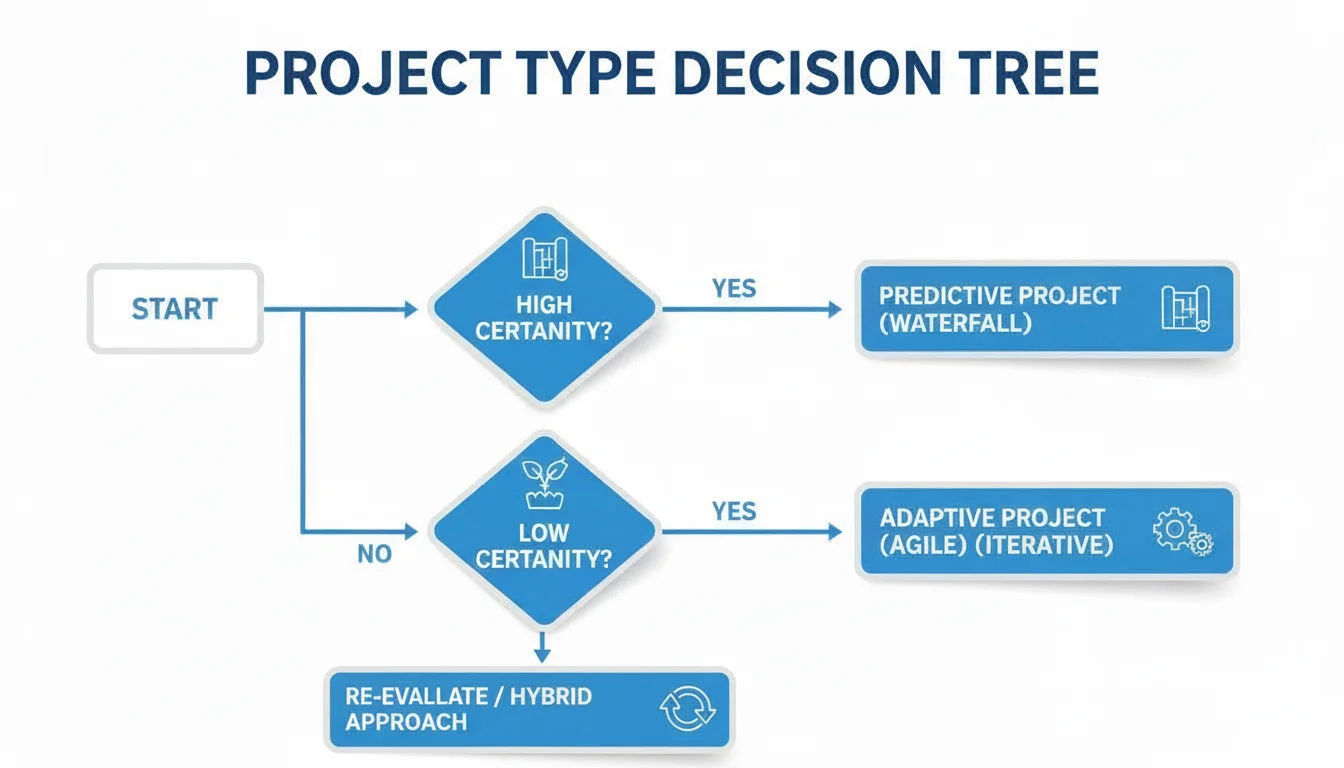
Approximately half of the PMP exam is dedicated to Agile and hybrid concepts. This means your preparation must extend beyond definitions. You must have the ability to select the most appropriate methodology or tool for a specific project scenario. For instance, a question might describe a project with very stable requirements and strict regulatory compliance needs. This signals a predictive approach. Conversely, a scenario with high uncertainty, rapidly changing customer needs, and continuous feedback loops will demand an Agile or hybrid solution. Your ability to interpret these signals is a critical skill for the exam.
The modern PMP exam is not a search for a single correct answer from a textbook. It is about selecting the best possible action within a unique project context that may feel ambiguous. Developing this analytical and adaptive mindset is the key to success.
What to Expect from Questions and Scoring
The PMP exam uses a variety of question types rather than just simple multiple-choice. Be prepared for formats such as multiple-response, where you must select all correct options. You will also see drag-and-drop sequencing, hotspot questions on charts or diagrams, and even fill-in-the-blank questions. This variety ensures your understanding is tested from multiple angles and keeps you focused throughout the long session.
There is one rule to remember for any high-stakes exam: there is no penalty for guessing. You should never leave a question unanswered. If you encounter a challenging question, remove the options that are clearly incorrect and then make an informed guess. Having a 25% chance of being correct is always better than a 0% chance.
The scoring methodology used by PMI is proprietary and uses statistical analysis. This approach means that harder questions may carry more weight in the final calculation. This helps distinguish between surface-level knowledge and deep comprehension of the material. While no official passing score is publicly disclosed, you can use general benchmarks to set your study goals. Resources like MindMesh Academy's insights into the PMP exam passing score provide a useful target for your practice tests. The global pass rate typically stays between 60-70%, which shows why serious preparation is required.
Building Your Personalized PMP Study Plan
No magic bullet exists for passing the PMP exam. Successful candidates do not rely on generic study guides or one-size-fits-all schedules. Instead, they build a personalized plan that fits their professional life, personal commitments, and current knowledge base. Trying to force a rigid, pre-defined schedule into a busy life is a fast track to burnout. You need a plan that moves with you, not one that works against you.
This phase requires you to act as your own project manager. Start with an honest self-assessment of what you already know and identify your specific weaknesses. Look at the Examination Content Outline (ECO) to see which tasks feel unfamiliar. With this clarity, you can establish a realistic timeline that ensures steady progress without making your daily life overwhelming. A good plan treats your study time as a series of work packages, each with a clear start, finish, and deliverable.
Charting Your Timeline and Resources
Your first step is to choose a target exam date. This is not just about picking a random Tuesday on the calendar. It is about reverse-engineering a pace you can maintain over several weeks or months. You might have six weeks to commit to heavy study, or you might need four months to balance the work with family duties and a full-time job. Setting that date transforms a vague desire into a concrete project objective.
Most project managers spend between 100-200 hours preparing for the PMP. How you distribute those hours depends on your availability and learning style. Here is a breakdown of how those hours typically translate into a schedule:
- The Sprint (6-8 weeks): This accelerated path requires 15-20 hours of focused study per week. This is an intense commitment. It works best if you can clear your personal calendar and dedicate your evenings and weekends entirely to the material.
- The Marathon (3-4 months): This is a more sustainable approach for most people. It requires 8-12 hours of study per week. A longer timeline gives complex concepts more time to sink in. It also provides a buffer for the unpredictable demands of work and life.
Once you set the timeline, you must gather your tools. The PMBOK® Guide and the Agile Practice Guide are the primary texts for the exam. They provide the essential technical foundation for the questions you will face. However, these books are often dry and academic. Supplement them with high-quality prep books, video courses, or bootcamps. These resources translate dense, formal language into practical, exam-ready knowledge. MindMesh Academy offers a guide on how to organize these materials in our PMP certification study plan article, which helps IT professionals build effective learning paths.
Structuring Your Study Sessions for Maximum Impact
Do not just block out "study time" on your calendar. Every session needs a specific objective. On Monday, you might focus on the subtle details of risk identification and response planning. On Wednesday, you could shift to understanding servant leadership principles within an Agile framework. This targeted approach works much better than reading thirty pages of a textbook without a goal.
A smart strategy involves mixing your learning methods. You might start by watching a video lesson on a new concept to get the big picture. Then, read the corresponding chapter in your prep book to see the technical details. Finish the session by answering 20-30 practice questions about that specific topic. Using different methods to learn the same concept improves your memory. It is similar to how you might learn to configure a new router by watching a tutorial, reading the documentation, and then actually working in a lab environment.
This diagram shows how you should distribute your study time across the three core domains of the exam.
While Process makes up the largest part of the exam at 50%, the People domain is close behind at 42%. The remaining 8% covers the Business Environment. Do not ignore the "soft skills" of project management. Dealing with stakeholders, managing conflict, and leading teams account for nearly half the questions you will see.
Integrating Practice and Continuous Review
Treat your study plan as a living project document. It is not a fixed, unchangeable blueprint. You must adapt it based on your performance. The best way to adapt is to use a feedback loop driven by practice questions and exam simulators. In the first few weeks, use short quizzes after every chapter to make sure you understand the basic concepts.
Do not wait until the final week of study to take a full-length mock exam. This is a common mistake that leaves no time for corrections. Instead, take your first full simulator test when you are halfway through your plan. This acts as a reality check. It shows you exactly where your weaknesses are while you still have plenty of time to fix them.
After every practice test, whether it is a short quiz or a four-hour simulation, you must conduct a thorough review. Simply looking at your score is not enough. You have to analyze why you missed each question. Did you have a knowledge gap regarding a specific ITTO (Inputs, Tools, Techniques, and Outputs)? Did you misread a situational question and miss a key word? Was it a reasoning error where you knew the concept but applied it the wrong way to the scenario? You might also find that you are losing points because of time pressure. This analysis turns practice into a powerful learning tool. Use these findings to update your study plan and spend more time on the topics that keep giving you trouble. This cycle of study, practice, and adjustment is how you build the confidence to handle any scenario on the actual exam.
Mastering the Concepts That Truly Drive Project Success
If your approach to the PMP exam is rooted in rote memorization of definitions, you will likely face a difficult experience. This exam does not simply test your ability to recite the PMBOK® Guide. Instead, it serves as a rigorous evaluation of your capacity to think and act like a real-world project manager. You must prove you can make decisions that align with established best practices in varied, often high-pressure environments.
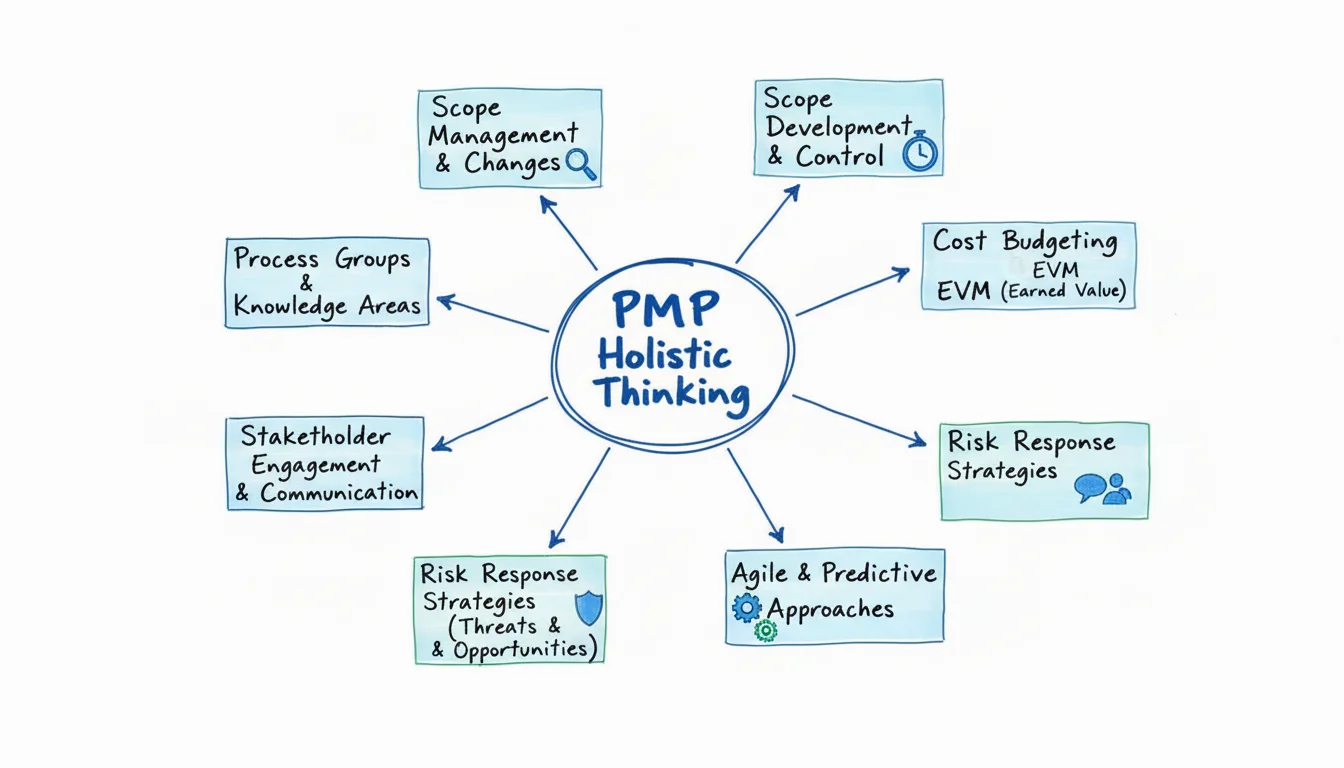
Success requires developing a specific mental framework often called the "PMP mindset." This involves building an integrated system where every project management concept connects to the others. For an IT professional, hearing the term "risk management" should trigger more than just a thought about a risk register. You should immediately connect that risk to how a newly identified security vulnerability might expand your project's scope, delay your software release schedule, or require more budget for mitigation. This integrated, holistic thinking is exactly what the exam's situational questions aim to evaluate. The current exam expects you to see the ripple effects of every change or issue across the entire project lifecycle.
Connecting the Dots Between Methodologies in IT Projects
A large portion of the exam performance depends on your command of predictive (waterfall), Agile, and hybrid approaches. Simply knowing definitions is insufficient. You must understand when and why to apply each one to a specific IT project. This requires a grasp of project characteristics like requirements stability, delivery frequency, and stakeholder involvement.
Many questions will not explicitly state the methodology. Instead, they describe a project situation, and you must discern the framework yourself. For instance, if a scenario describes a project involving a legacy system upgrade with fixed requirements and strict contractual obligations, you should lean towards a predictive mode. Conversely, a scenario with high uncertainty, evolving user requirements for a mobile app, and an emphasis on continuous delivery signals an Agile approach. In the IT sector, you will also encounter hybrid scenarios where you might use waterfall for hardware procurement and Agile for software development. Your ability to interpret these contextual cues is essential for the exam and for professional project success.
Explaining Core Technical Project Management Concepts
Specific topics in project management often prove challenging for candidates. However, these concepts become manageable once you move from memorizing formulas to understanding their practical purpose. Below are two of the most frequently misunderstood areas in the current exam syllabus.
Earned Value Management (EVM)
At its foundation, Earned Value Management (EVM) is an integrated performance measurement technique. It provides a objective way to answer three fundamental questions about project health, whether you are managing a cloud migration or developing an internal tool:
- Planned Value (PV): This represents the authorized budget assigned to the work scheduled to be completed by a specific date. It tells you where you planned to be at this point in the timeline.
- Earned Value (EV): This is the measure of work actually performed expressed in terms of the budget authorized for that work. It represents the value of the tasks you have finished.
- Actual Cost (AC): This is the realized cost incurred for the work performed on an activity during a specific time period. It tells you how much money you actually spent to achieve your current progress.
By comparing these three values, you can diagnose project performance. If your EV is less than your PV, the project is behind schedule. If your AC is higher than your EV, you are over budget. Focus on what these metrics indicate about the project's trajectory rather than just the math. You should also be familiar with the Schedule Performance Index (SPI) and Cost Performance Index (CPI). An index below 1.0 is generally negative, while an index above 1.0 indicates performance is better than planned. Think of yourself as an IT project detective using these metrics as clues to forecast future outcomes and make necessary adjustments.
Critical Path Method (CPM)
The Critical Path Method (CPM) is a simple but powerful logic. Imagine your project as a relay race, such as deploying a new enterprise resource planning (ERP) system. The critical path is the longest sequence of tasks that determines the shortest possible project duration. These tasks have zero "float," meaning they have no flexibility in their timing. If a single task on the critical path is delayed by one day, the entire project completion date shifts by one day.
As a project manager, your primary responsibility is to identify this path and protect it from delays. Understanding this idea is more useful than drawing network diagrams by hand. The PMP exam tests your understanding of what happens when a task on the critical path is delayed or how you can shorten the schedule. You might use "crashing," which involves adding resources to tasks to finish them faster, often increasing costs. Alternatively, you might use "fast-tracking," where you perform tasks in parallel that were originally planned in sequence, which typically increases risk.
The goal is not to turn you into a human calculator. It is to build an intuitive understanding that allows you to analyze a project situation and select the most logical action. This situational judgment distinguishes passing candidates from those who struggle with the exam's logic.
Applying Your Knowledge to Situational Questions
Situational questions make up the majority of the PMP exam. These questions present a project problem or dilemma and offer four plausible answers. You must select the best choice based on PMI's best practices and ethical guidelines. Often, all four choices are things a project manager might actually do, but only one is the correct first or best step according to the methodology.
Consider this IT project example:
- Scenario: You are leading an Agile software development project. During a sprint review, a key stakeholder expresses frustration that a feature they expected is not yet complete. What should you do first?
- Promise the stakeholder that the feature will be prioritized in the very next sprint.
- Review the product backlog with the Product Owner to understand the feature's current ranking and status.
- Explain to the stakeholder that sprint contents are fixed and cannot be altered mid-sprint.
- Schedule a separate meeting with the stakeholder to discuss their updated requirements in detail.
While other options might eventually happen, the best first action is Option 2. In an Agile framework, the product backlog is the single source of truth for project priorities. The Product Owner is responsible for managing this backlog. A project manager making a direct promise (Option 1) violates the Product Owner's authority and Agile principles. Simply dismissing the stakeholder (Option 3) is bad for relationship management, and scheduling a meeting (Option 4) before checking the backlog is inefficient. This example shows how understanding the "why" behind Agile roles and artifacts leads you to the correct answer. You must always look for the option that shows the project manager taking responsibility, following the correct process, and investigating the facts before acting.
Turning Practice Tests into Your Most Powerful Study Tool
Understanding PMP concepts at a high level is only the first step. Being able to apply that knowledge under the pressure of a four-hour, 180-question exam is a much greater challenge. High-quality practice tests are your most effective study tool because they bridge the gap between reading theory and performing in a testing environment.
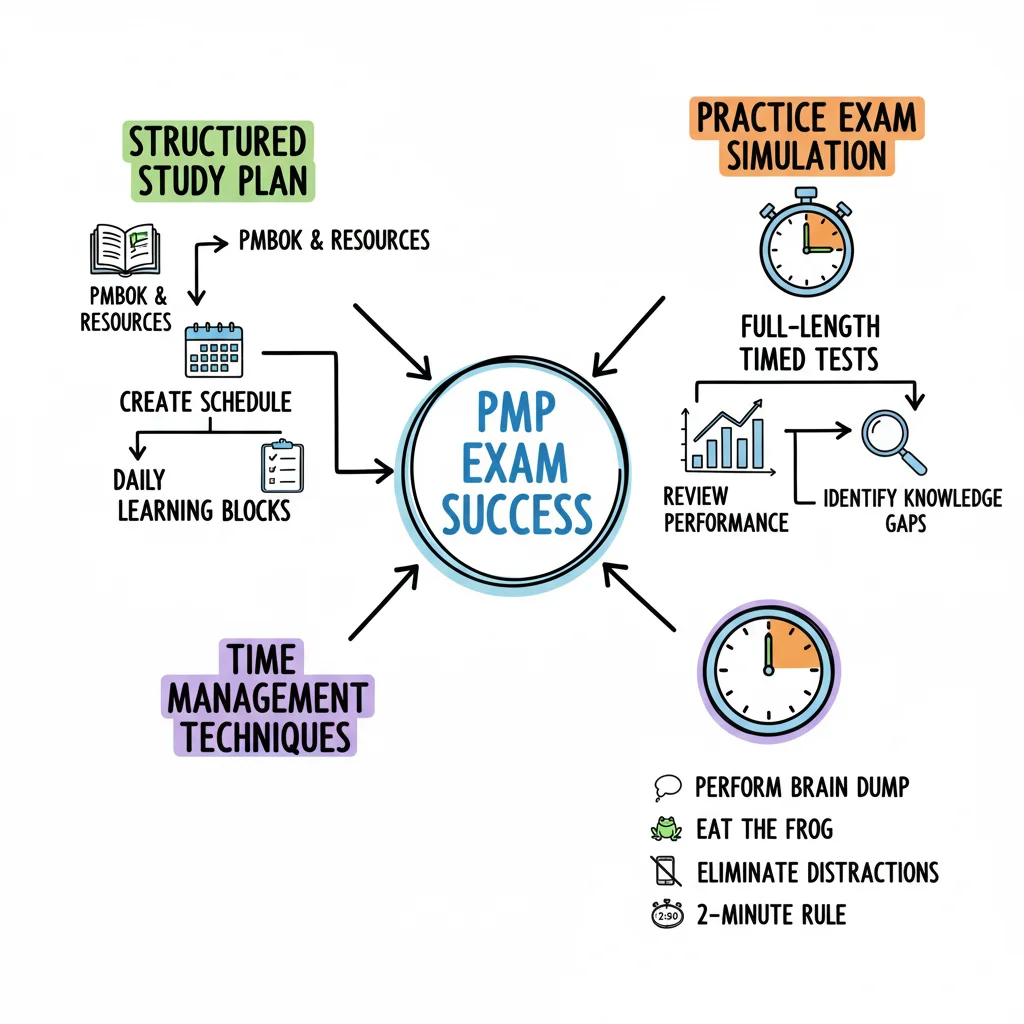
True confidence is not built by reading chapters repeatedly. It is developed by facing hundreds of situational questions that closely match the format and difficulty of the actual PMP exam. While short quizzes are helpful for checking your basic understanding of a topic, serious preparation requires moving to full-length, timed simulations. These tests help you build the mental endurance needed for the real thing.
From Guessing to Strategic Knowing
The purpose of practice is not just to get a high score. It is about building a consistent method for breaking down every question. Many PMP questions are written to be unclear, often giving you two or three answers that seem right. Your goal is to find the "best" answer based on the specific logic that PMI expects from project managers.
Through repetition, you will start to notice the specific keywords that change the entire meaning of a question. Pay close attention to words like "first," "next," "best," "least likely," or "except." For example, a question asking what a project manager should do first is looking for an immediate action or a quick assessment. This is a different answer than what the manager should do next after a process has already begun. This skill is subtle, and you can only master it through dedicated practice and analysis of question stems.
Systematically Analyzing Every Single Answer
Taking a practice test and only looking at your final score is not a good use of your time. The real learning happens after the timer stops during your review. We suggest that you keep a spreadsheet to track every question you answer incorrectly. Also track questions you got right but felt unsure about while answering.
For every wrong answer, act like a detective and find out exactly why you missed it:
- Knowledge Gap? Was there a specific term or process that you did not know? For example, you might realize you do not fully understand the difference between crashing and fast-tracking when you are trying to shorten a project schedule.
- Misinterpretation? Did you read the question too quickly and miss a key detail? Sometimes one small word in a long scenario changes the correct response.
- Reasoning Error? Did you know the concept but fail to apply it correctly to the situation? This is often where students struggle to align their personal experience with the PMP mindset.
- Time Pressure? Did the countdown clock cause you to panic and rush? This often leads to picking an answer before you have fully considered all the options.
Do not just look at the questions you missed. You must also review the questions you answered correctly but found difficult. You need to know that you arrived at the right answer because you understood the logic, not because you got lucky. A lucky guess on a practice test creates a false sense of security that can hurt you on exam day.
This thorough analysis is the best way to find your true weak spots. If you see a pattern of missing questions about risk response or stakeholder engagement, you know exactly where to focus your study time. This targeted approach is much more effective than reading the PMBOK® Guide again without a clear goal. It ensures that every hour of your preparation time directly improves your chances of passing.
Simulating Real Exam Conditions
As you get closer to your test date, you must treat your full-length practice exams with the same seriousness as the actual PMP certification test. This is a vital part of your training. You are not just checking your knowledge; you are training your brain to stay focused for a full 230 minutes.
This means you need to find a quiet place where you will not be interrupted. Put your phone away and do not look up any information while you are taking the test. You should also take the two optional 10-minute breaks at the exact time the simulator offers them. This helps you learn how to manage your energy and how to reset your mind so you can stay sharp through the end of the exam.
To reach this level of readiness, you need access to high-quality questions. For any IT professional ready to start, a reliable PMP practice exam platform will provide the variety of questions and the detailed feedback you need to succeed. The goal is simple: when you enter the testing center, the timing and the pressure should feel familiar, making the real exam feel like just another practice session.
How to Manage Exam Day with Confidence
All your hard work, the late nights, the constant practice questions, and the intensive study of project management concepts lead to this moment. Your results are not just a measure of what you have memorized. Success depends on how well you execute your plan while under pressure.
Think of exam day as the final project in your certification process. Small issues, like a traffic delay or high anxiety, can throw off a candidate who is otherwise ready. This guide provides a clear plan to keep you in control from the moment you wake up until you submit your final answer. Staying calm and following a set routine will help you focus on the questions rather than the environment.
Preparing for a Smooth Start
The night before the exam is for resting, not for intensive study. Trying to learn new material at the last minute often increases stress and leads to fatigue. Your main goal is to arrive at the test center or start your online session with a clear, rested mind. Prepare your materials the evening before to avoid a rushed morning.
Ensure these items are ready:
- Your Identification: You must present a valid, government-issued photo ID. Check the expiration date well in advance. Most importantly, verify that the name on your ID matches the name on your exam registration exactly. Even a small discrepancy can lead to a denied entry.
- Confirmation Email: Keep your appointment confirmation from Pearson VUE available. You can print a hard copy or have the digital version ready on your phone to verify your appointment time and location quickly.
- Logistics: For those testing at a physical location, verify the address on a map and plan your travel. Traffic and parking can be unpredictable. You should aim to arrive at the center at least 30 minutes early to allow time for the check-in process. (Verify current arrival requirements on the vendor site).
Eat a balanced breakfast before you leave. Choose foods high in protein and complex carbohydrates to provide a steady stream of energy. Avoid eating a heavy meal that might make you feel tired or an overly sugary one that could cause an energy crash halfway through the 230-minute session.
Navigating the Exam Environment
You can take the PMP exam at a Pearson VUE testing center or through an online proctored system from your home. Both options have strict security protocols that you must follow. At a physical testing center, you cannot take any personal items into the testing room. You will put your phone, wallet, watch, and notes into a secure locker. The staff will provide you with an erasable notepad or a laminated whiteboard. You can use this for a "brain dump" of formulas or to perform calculations during the test.
If you choose the online proctored option, the security check happens through your webcam. A remote proctor will ask you to show a 360-degree view of your room. Your desk must be completely clear. You cannot have books, extra monitors, or even scrap paper within reach. You will be monitored via video and audio for the entire duration of the exam. If you move out of the camera view or if someone enters the room, the proctor may cancel your exam immediately. Knowing these rules ahead of time helps you avoid unnecessary stress during the check-in.
The PMP is more than a credential. It is a way to enter a global group of project leaders. Earning this certification places you among top professionals. It proves you can lead difficult projects and help organizations meet their goals during major shifts in technology and business.
Mastering Your Time and Energy
The PMP exam is a 230-minute test that requires significant focus. Managing your time is just as vital as understanding the PMBOK guide. The exam includes two optional 10-minute breaks. You should take both of them.
The first break appears after you complete and review question 60. The second break appears after question 120. Once you finish a section and start your break, you cannot go back to those previous questions. Use this time to leave the room, stretch, drink water, and clear your head. Even if you feel like you have plenty of energy, these breaks help prevent mental fatigue in the final hour when the questions may seem more difficult.
If you hit a question that you cannot answer quickly, do not waste five minutes on it. Use the "mark for review" tool and move forward. Your goal is to answer the questions you know first. This builds momentum and ensures you do not run out of time for easier questions at the end of the test. You can return to the marked questions at the end of that specific 60-question block.
Becoming a PMP is a major career milestone. As of 2025, there are approximately 1.58 million PMP certification holders worldwide. Growth in the industry is strong, with projections showing a need for 25 million new project managers by 2030. This credential opens doors in many fields, particularly in the IT sector. Certified managers are often responsible for high-level work; about 59% of these professionals manage between 2 and 5 projects at the same time. This shows how much organizations value the skills you are testing for today.
Effectively Handling Exam Day Nerves
Feeling nervous is a normal part of the testing process. The key is to manage that energy so it does not interfere with your thinking. If you feel yourself starting to panic or rushing through questions, stop for a moment. Close your eyes and take three slow breaths. This simple action resets your heart rate and helps you regain focus. For more ideas on staying steady under pressure, look at these tips for remaining calm in difficult situations.
Trust the hours you spent studying. You have done the work. You have practiced with hundreds of questions and learned the logic of the exam. Go into the testing center with a clear plan and the confidence that you are ready for this challenge. You have the knowledge required to succeed and join the ranks of certified project management professionals.
Answering Your Top PMP Exam Questions for IT Professionals
If you are an IT professional working toward PMP certification, you likely have several questions about the process. We have heard almost every concern from candidates over the years. Providing clear, direct answers is the first step in building an effective study plan. Clearing up these common points of confusion allows you to stop worrying and start the actual work of preparing for the test.
Getting these details settled early in your preparation means you can move from uncertainty to the specific tasks required for success. IT experts often face unique hurdles, such as translating technical scrum roles into the broader project management language used by the Project Management Institute (PMI). By addressing these questions now, you ensure that your study time is spent on high-value activities rather than searching for basic administrative answers.
How Long Should I Really Study for the PMP Exam?
There is no single study timeline that works for every person, but data shows that most successful candidates spend between 100 and 200 hours on preparation. For some, this means a highly concentrated eight-week schedule with several hours of study every night. For others, a four-month timeline that allows for a more balanced approach works better. The specific amount of time you need depends on your current workload, your family commitments, and how much project management experience you already have.
Your background is the biggest factor in determining where you fall on this spectrum. If you have years of experience leading cloud migrations or software development cycles using both waterfall and Agile methods, you might find that you only need the lower end of that hour range. However, if you have spent your career in a purely technical role and are new to formal project management frameworks, you should plan for the full 200 hours. Be honest when you assess your own knowledge. If certain methodologies feel foreign to you, allocate extra time to reach a level of comfort where you can apply those concepts to real-world scenarios. The quality of your materials also plays a part in your efficiency. A structured course helps you move through the curriculum faster than trying to find and verify information on your own. This is the same logic used when preparing for other high-level certifications like the CISSP or the AWS Certified Solutions Architect Professional. Practical experience reduces the time you need to spend on theory, but it does not replace the need for dedicated study.
What Makes a PMP Exam Simulator Truly Worth Using?
An effective PMP exam simulator is not just a list of practice questions. It acts as a training tool designed to mimic the actual testing environment while giving you data-driven feedback on your progress. You should avoid low-quality question banks that only ask you to define terms. The real exam tests your ability to make decisions in difficult situations.
Here is what separates a high-quality simulator from a basic quiz, a standard that is also visible in top-tier prep tools for the Azure Solutions Architect Expert or CompTIA Network+ exams:
- Realistic Situational Questions: The simulator must provide a large bank of questions that reflect the difficulty and length of the actual PMP test. These questions should be based on situational judgment, where you are presented with a problem and must choose the best next step. The exam is not about memorizing the names of processes; it is about knowing how to act when a stakeholder changes their mind or a resource becomes unavailable.
- Detailed, Explanatory Answers: This is a mandatory feature for any simulator. Every answer choice should have an explanation. You need to know why the correct answer is the best choice and why the other three distractors are incorrect according to PMI standards. The most significant learning happens when you identify a flaw in your logic and correct it before the test day.
- Detailed Performance Analytics: A good simulator provides a dashboard that tracks your scores by specific topic. This data allows you to see exactly where you are struggling. If you are scoring high in Agile but failing in resource management, you can adjust your schedule to focus on your weak points. This targeted approach prevents you from wasting time reviewing material you already know well.
What Should I Do If I Fail the PMP Exam?
First, recognize that many people do not pass on their first try. Failing a difficult certification exam is frustrating, but it does not mean you are a bad project manager. Many highly successful PMPs required more than one attempt to clear the test. The best way to handle a failing grade is to treat it as a diagnostic tool rather than a final verdict.
Take a few days to rest and clear your head before you look at your books again. When you are ready, your first step should be to look at the exam performance report provided by PMI. This document is a map of your performance. It tells you how you performed in each domain—People, Process, and Business Environment—using categories like "Target" or "Below Target." Use this data to build a new study plan that focuses almost entirely on the areas where you underperformed. Think of this like debugging a software application. You are using the error logs to find the specific part of the code that failed so you can fix it. Instead of re-reading everything, you are performing a targeted repair of your knowledge gaps.
Failing the PMP exam is not a reflection of your professional worth. It provides a specific, data-driven report, similar to a system error log, that shows you exactly where to improve your strategy and knowledge for your next attempt.
Is the PMBOK Guide Alone Enough to Pass the Exam?
The short answer is no. This is a common mistake that many people make when they start their preparation. The PMBOK® Guide is a vital reference tool, but it is not the only source of information for the test. The exam is actually based on the PMP Exam Content Outline (ECO). The ECO covers a much wider range of topics than any single book.
The current version of the test focuses heavily on Agile and hybrid project management. While the PMBOK® Guide contains some of this information, you also need to study the Agile Practice Guide and other sources to be fully prepared. Most people who pass the exam use a combination of different resources. This usually includes a reputable study guide, a thorough video course or live training session to explain the harder concepts, and a high-quality exam simulator for practice. Using multiple types of media helps reinforce the information and ensures you can handle the variety of questions you will see. This strategy is common for modern IT certifications in cloud computing or cybersecurity, where the official manual is rarely the only thing you need to study. By looking at the material from different angles, you build the confidence needed to handle the pressure of the testing center.
Are you ready to stop guessing and begin your PMP preparation with clear guidance and expert tools? MindMesh Academy offers the study materials, thorough training courses, and realistic practice exams you need to understand these concepts and pass your exam. Explore our full PMP prep courses today.
Ready to Get Certified?
Prepare for the current exam with expert-curated study guides, practice exams, and spaced repetition flashcards at MindMesh Academy:

Written by
Alvin Varughese
Founder, MindMesh Academy
Alvin Varughese is the founder of MindMesh Academy and an enterprise architecture leader. An electrical engineer by training, he moved from factory automation in South Africa to cloud architecture at GE Appliances and Humana (Fortune 50), and holds 20 professional certifications including AWS Solutions Architect Professional, Azure DevOps Engineer Expert, and Microsoft Agentic AI Business Solutions Architect. He built MindMesh Academy after interviewing too many highly certified candidates who couldn't answer basic questions: the goal is prep that makes you better at the job, not just able to pass the exam.