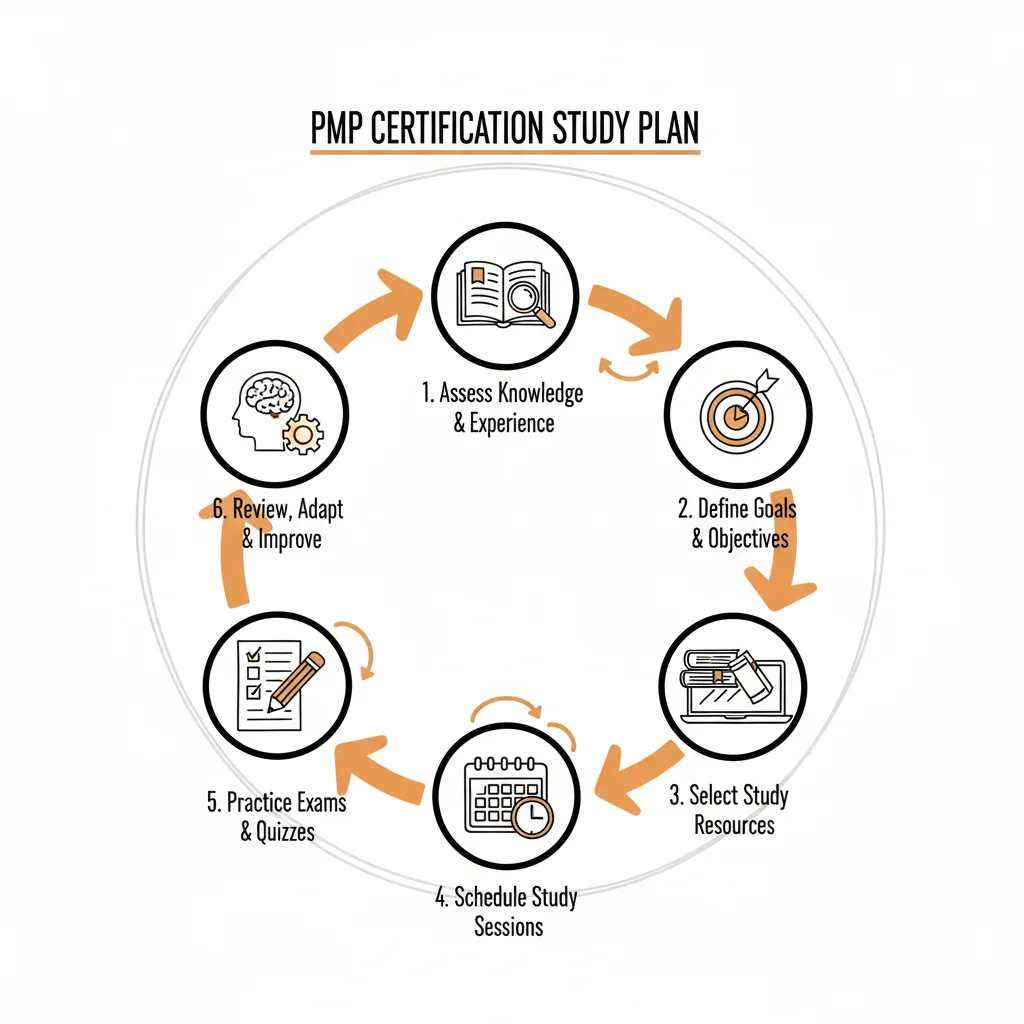
Your PMP Certification Study Plan for Success
Your PMP certification study plan is a strategic blueprint for a critical career milestone. For IT professionals, earning the Project Management Professional (PMP) certification demonstrates clear mastery of project management principles. These skills are essential within complex technology environments. This guide converts your goal of "passing the PMP" into a series of actionable, manageable tasks. It details what to study, when to study it, and how to track your progress effectively. Treat this guide as a project charter for your preparation.
Laying the Groundwork for Your PMP Certification
PMP preparation is like starting a complex IT project. The goal is clear, but the scope can seem heavy at first. Before you pick resources or a test date, you must understand the nature of this certification. Most technical exams reward memorizing facts or specific commands. The PMP validates how you apply management principles to actual situations. It tests critical thinking, problem-solving, and professional judgment—the skills needed for project leadership.
The PMP exam is a major endurance test. You must answer 180 questions in a 230-minute session. Historically, pass rates are reported below 70% (verify current figures on the PMI website). This underscores the rigor of the credential and explains why it holds so much weight. This is not a simple multiple-choice test; it is a serious validation of your professional experience, much like a high-level security or architecture certification.
Adopting the PMP Mindset
Success on the exam requires learning to think like an experienced project manager. This is the "PMP mindset." The exam uses situational questions where several answers seem plausible. Your task is not to recall a process from a book. Instead, you must analyze problems as the person accountable for the project’s success. You have to balance constraints and stakeholder demands while deciding the best move for the project goals. This involves using agile, predictive, or hybrid methods to produce results for your organization.
Reflection Prompt: Consider an IT project you recently managed or worked on. How would a PMP mindset have changed your decision-making during a difficult situation or a conflict with a stakeholder?
This visual shows the scale of the challenge ahead:
 Caption: The PMP exam tests both your knowledge base and your mental stamina over 180 questions in 230 minutes, requiring deep conceptual understanding beyond mere recall.
The image highlights the intensity of the exam environment. Your study plan must help you build both your technical knowledge and the mental strength needed to stay focused for nearly four hours.
Treat your PMP preparation not as a test to be crammed for, but as the first major milestone in advancing your project management career. This perspective transforms study sessions from a chore into a valuable investment.
Getting familiar with concepts like fast track project management early on provides a base for the harder scenarios you will face. When you are ready to get organized, our guide shows you how to build a complete PMP study guide from scratch.
How to Create a Realistic PMP Study Schedule
Generic study templates often fail because your professional and personal life does not follow a standard pattern. Your job, family, and unexpected emergencies do not care about a pre-made schedule. The only PMP certification study plan that works is one that fits into your actual life rather than demanding that your life conform to it. Success comes from building a schedule that pushes you toward the goal while remaining practical enough to avoid total burnout. You need a plan that balances rigor with reality.
The first step is a honest time audit. Look at your past two weeks and account for every hour spent on work, chores, and rest. Be brutal with yourself about how much time you can actually spend studying. It is much more effective to commit to a consistent 5-7 hours every week and meet that target than to aim for an aspirational 20 hours and fail. Compare this to estimating effort for a software sprint. Under-promising and over-delivering builds your confidence. Over-promising leads to missed deadlines, project delays, and a sense of defeat.
 Caption: Put your PMP study blocks into your calendar like any other appointment to keep your routine consistent.
Block Out Your Non-Negotiables
Once you identify your weekly study capacity, open your digital calendar, such as Outlook or Google Calendar. Block out your study sessions exactly as you would a vital sprint planning meeting or a major incident bridge call at work. These slots are not optional suggestions. They are firm appointments with your own career advancement. If you do not schedule them as non-negotiable, other tasks will inevitably fill that space.
Here are strategies IT professionals use to protect their time:
- Morning Power Hours: Try waking up one hour earlier two or three times a week. These early sessions are often the most productive because the world is quiet. You can focus entirely on the material before the daily chaos of emails, Slack notifications, and stand-up meetings begins.
- Lunch and Learn: Your lunch break is a hidden asset. You do not need the entire hour to eat. Use 30 minutes to review flashcards or take a quick practice quiz on your phone. Even listening to a project management podcast while you eat helps keep the terminology fresh in your mind.
- Commute Time Optimization: If you use public transport, use that time for audio lessons or reviewing your digital notes. This turns unproductive downtime into active progress toward your certification. If you drive, listen to exam prep audiobooks instead of the radio.
- Weekend Sprints: Set aside a focused 2-3 hour block on Saturday or Sunday morning. This is the time for intensive study on difficult topics like Earned Value Management or for taking a full practice exam. Longer blocks help you simulate the actual exam environment, which is vital for building the mental stamina required for the four-hour test.
Set Your Exam Date by Working Backward
Knowing your weekly study capacity allows you to calculate a realistic exam date. Most successful candidates typically need between 70 and 85 hours of focused self-study. Remember that this time is in addition to the 35 contact hours required for the PMP application. Do not count your initial training hours toward your final review time.
Look at the project math. If you can commit to 7 hours per week, you are looking at a 10-12 week study window. This three-month timeline is a common and manageable target for busy IT professionals. If your schedule is more demanding and you can only manage 5 hours a week, you should plan for a 4-month schedule. This simple calculation transforms a vague goal into a concrete project plan with a firm deadline.
A major part of this process involves identifying your current knowledge gaps from the beginning. A personal skills gap analysis helps you spend more time on topics you struggle with and less on those you already know. To understand how to structure this, see our guide on creating a training needs assessment template. Knowing your weaknesses early prevents you from wasting time on familiar concepts.
The goal is to establish a rhythm. Consistency beats a weekend of cramming every time, especially for an exam with as much breadth as the PMP. A steady, planned approach builds momentum and helps the information move into your long-term memory.
Sample PMP Study Plan Timelines
This table illustrates how different weekly commitments shape your study timeline. Use these examples to visualize your own path forward.
| Study Timeline | Weekly Hours | Focus Area per Week | Ideal For |
|---|---|---|---|
| 12-Week Sprint | 8-10 Hours | Cover one knowledge area or domain, plus one full set of practice questions. | Professionals who can dedicate weeknights and a solid weekend block. This pace is similar to an intensive coding bootcamp. |
| 6-Month Marathon | 4-5 Hours | Focus on one major topic or process group, followed by short quizzes. | Individuals with heavy work or family commitments who need a slower, more deliberate pace. This is like a phased software rollout. |
Reflection Prompt: Which of these timelines aligns with your current professional and personal commitments? How might you adjust your existing schedule to make room for these study blocks?
Review these options and choose the path that feels right for your life. The most effective PMP certification study plan is the one you can follow every single week without fail. That unwavering consistency is what will get you across the finish line and help you earn your credentials.
Choosing PMP Study Resources That Actually Work
With your study schedule mapped out, the next step is gathering your study tools. This is where many candidates, especially those accustomed to finding their own technical documentation, often lose their way. It is easy to feel buried by the volume of books and videos available online. Many of these resources are out of date, fail to match the current exam, or simply do not work.
Your goal is not to collect every book ever written on the subject. Instead, you should select a tight, effective set of tools that align with the current PMP exam format. Treat this selection like choosing a software stack for a major project: quality and relevance are more important than how many tools you have.
View this as a strategic investment in your professional future. Data shows that PMP holders earn 16% to 23% more on average than their uncertified colleagues. When you look at it that way, a study investment between $2,555 to $3,305 (verify current pricing on the vendor site) is a logical move for your career growth. You can find more details about project management career statistics to see how these numbers look over a decade of work.
Start with the Official Source Material
Before you spend a dollar, look at the official documents from the Project Management Institute (PMI). These are your primary sources of truth. However, you must know how to use them without wasting time.
-
The PMBOK® Guide: Many students try to read this from the first page to the last. Avoid doing this. Treat the PMBOK® Guide as an encyclopedia or a technical reference document rather than a textbook. It is dense and heavy on processes. Its purpose is for looking up specific terms or clarifying the "what" of a project management concept. Use it only when your main study guide points to it or when you need more detail on a topic that is confusing you.
-
The Exam Content Outline (ECO): This is the most important document for your preparation. The ECO acts as your map for the entire exam. It breaks the test down into three domains: People, Process, and Business Environment. It lists the specific tasks and enablers you will be tested on. Every resource you buy must align with the current ECO. The latest version emphasizes agile and hybrid methods, which reflects how IT projects are actually managed today.
A frequent error is studying only the PMBOK® Guide. The PMP exam is no longer a simple test of that book's contents; it is a test of the ECO. Your entire plan must center on this distinction. An architect focuses on the requirements of the building, not just the building code manual.
Build Your Core Study Toolkit
Using the official PMI documents as your reference, you will need a few specific resources designed to teach the material and prepare you for the testing environment.
Top-Rated Prep Books A high-quality prep book should be your main teacher. These books take the abstract ideas from PMI and turn them into lessons you can actually understand. They offer practical applications and clear language. Look for authors who have a long history in the PMP field. Always check that you have the most recent edition. A solid book provides the structure you need, offering clear explanations and practice questions that help you check your understanding as you go.
Interactive Online Courses For IT professionals, an interactive online course is almost mandatory. This is the fastest way to get your required 35 contact hours of project management education. A good course provides a clear path through the material using video lessons and practical exercises. Many also include a community where you can talk to other students. The best courses do more than read slides; they use real-world examples and case studies to help the concepts stick. This prepares you for the situational questions you will face on the exam.
The Power of Simulation Exams
If you only buy one extra resource, choose a high-quality exam simulator. You need this to pass. While books and videos provide knowledge, practice exams prepare you for the actual experience of the test. You can think of this as a load test for your mental endurance.
Simulators are essential for three main reasons:
- Build Stamina: The PMP is a 230-minute test. That is a long time to stay sharp. Taking full-length practice exams helps your brain handle the cognitive load. It teaches you how to manage your time so you do not run out of minutes before you run out of questions.
- Diagnose Weaknesses: A simulator provides a score report that acts like a debugger for your study plan. It shows you which domains—People, Process, or Business Environment—need more work. This allows you to spend your time where it will help your score the most.
- Master the Question Style: PMP questions are famously difficult. They often describe a situation and ask what you should do next. Usually, multiple answers look correct at first glance. You must learn to choose the best option based on PMI methods. Simulators are the only way to see enough of these questions to recognize the patterns and respond correctly.
The PMP exam also includes two 10-minute breaks. Using a simulator allows you to practice when to take these breaks and how to reset your focus afterward. This mental discipline is just as important as knowing the definitions of project terms.
You do not need a massive pile of books to succeed. A strong prep book or online course, the official PMI documents, and a professional-grade exam simulator form the foundation you need. This three-part approach is the most effective way to handle your PMP certification study plan and walk into the testing center with confidence. Focus on these core tools, and you will avoid the confusion that comes from having too many conflicting sources. Consistency with a few high-quality resources is the best path to passing the exam on your first attempt.
Mastering Your Study Sessions with Proven Techniques
 Caption: Actively engaging with PMP concepts through mind maps and visual aids transforms abstract information into interconnected, memorable knowledge.
Your study schedule and a strong set of resources provide a reliable foundation. However, real learning occurs during your individual study sessions. Simply reading the PMBOK® Guide or watching videos will not be enough for an exam that tests your ability to apply concepts to real-world scenarios. To pass the PMP, you must move away from passive reading and toward active involvement. You have to force your brain to struggle with the material and apply it to actual project situations. This shift helps you move from recognizing a term to understanding how it functions within a project. This is the exact skill the current exam evaluates.
Break Down Complex Topics with the Feynman Technique
Many PMP topics are complex and can be frustrating to learn. For example, Earned Value Management (EVM) involves formulas that often cause confusion if you just look at them on a page. Staring at these calculations for an hour usually leads to a headache rather than clarity. Instead, try the Feynman Technique.
The method is simple. Try explaining a concept out loud in your own words. Imagine you are teaching a coworker who has no project management experience. If you struggle to find the right words or rely on technical jargon to hide a lack of clarity, you have found a gap in your knowledge. Use that moment as a signal to return to your study materials and fix that specific point. Once you understand it better, try the explanation again. This active recall process is highly effective for learning. It works well for any technical topic, such as explaining how a database replication strategy functions or describing a specific cloud networking setup to a stakeholder.
Visualize Connections with Mind Maps
The PMP framework is not just a list of 49 separate processes to memorize. It is a logical system where inputs, tools, techniques, and outputs (ITTOs) flow from one stage to the next. This is where mind mapping becomes an effective tool for visualizing how different parts of a project work together.
Start by putting a central concept, like "Risk Management," in the middle of a large page or a digital canvas. Draw branches for its specific processes, such as Plan Risk Management, Identify Risks, and Perform Qualitative Risk Analysis. From those branches, add the key inputs, such as the project charter or stakeholder register. Then include the tools used and the resulting outputs, like the risk register and risk report. This visual approach shows how a risk you identify early in the project becomes a factor in many other activities later on. It turns a dry list from a book into a logical flowchart that is much easier to remember when you are under pressure during the exam. This method is similar to how technical architects map out system dependencies and data flows.
Maintain Focus with Timeboxing: The Pomodoro Technique
Long study sessions usually lead to mental exhaustion rather than better results. If you want to keep your focus sharp and your productivity high, use the Pomodoro Technique to break up your study time into manageable pieces.
Follow this specific rhythm:
- Study one PMP topic for exactly 25 minutes. Turn off all notifications and avoid any distractions. Treat this time with the same level of focus you would give to a critical system failure at work.
- Take a 5-minute break. Walk away from your desk. Get some water or stretch. Do not look at your phone or do anything that requires mental effort.
- Repeat this cycle four times.
- After your fourth 25-minute session, take a longer break of 15 to 30 minutes.
This approach prevents mental burnout, sharpens your concentration, and keeps your mind from wandering toward distractions. It is an effective way to turn a long, intimidating three-hour study block into a collection of short, highly productive sprints.
Your goal is not to see how many pages you can read in a night. The goal is to build a functional understanding of the material. Active learning techniques require you to work harder, but they ensure the information stays in your memory for the long term.
Spaced repetition serves as another helpful tool in your study routine. This method involves reviewing specific information at set intervals that get longer over time to improve how well you remember the material. It is a scientifically supported way to move facts into your long-term memory. You can think of it as being similar to caching data that needs to be accessed quickly. By using these active and smart study methods within your PMP certification study plan, you will ensure that every minute you spend studying is used effectively.
Gauging Your Readiness and Gearing Up for Exam Day
You have put in the study hours, stuck to your schedule, and the PMP concepts are starting to make sense. Now you face the most critical question: how do you know if you are actually ready for the test? This final stage of your preparation is not about absorbing fresh chapters of information. Instead, you must shift your focus toward a cycle of review, performance tracking, and specific final prep.
Practice exams are the most effective tool you have at this stage. Do not expect to get every answer right on your first attempt. The goal of that first full-length mock exam is to gather data and find your baseline. It is very common for a first score to be lower than expected, and that is acceptable. The real value is found in the detailed score report that follows the test.
A high-quality simulator will provide a specific breakdown of how you performed in the three primary domains: People, Process, and Business Environment. Use this report as a guide to find your strengths and your gaps. If you are missing questions about procurement or resource management but doing well with risk, you know where to spend your remaining hours. This targeted approach is much more effective than just reading the PMBOK® Guide again. It allows you to fix specific weaknesses before they cost you points on the actual exam.
The Final Two-Week Sprint
When you are about fourteen days away from your exam appointment, change your strategy. You should be done learning new concepts by this point. Your focus must now be on reinforcement and simulation.
Follow this plan for your final days of study:
- Review Weak Spots: Set aside time every day to go over your notes, flashcards, and any mind maps you have created. Give extra attention to the weak areas that your practice tests identified.
- Build Your Stamina: Complete at least two or three more full-length, timed practice exams. This is a physical and mental challenge as much as an academic one. You need to train yourself to stay focused for the entire 230-minute exam.
- Analyze Every Answer: After each mock test, review every single question. Do not just look at the ones you missed; look at the ones you got right too. You need to understand why the correct answer was considered the best choice by PMI standards. Just as importantly, you need to see why the other options were incorrect. This helps you understand the specific logic and situational reasoning PMI expects from project managers.
Use your final practice tests to simulate the real exam environment as closely as possible. Find a quiet room where you will not be interrupted, track your time strictly, and take your breaks exactly when the exam allows them. This is a dress rehearsal. It helps you build the comfort and confidence needed to handle the pressure on the day of the test.
Nailing the Logistics and Your Mindset
The last part of your plan involves logistics and your mental state. Do not let a small technical or scheduling mistake get in the way of your hard work. You must understand the specific rules for your testing format, regardless of if you go to a center or test from home.
If you are using a physical test center, consider doing a trial run a few days before. Check the traffic during the time of day you will be traveling and find the exact building and room. This removes a major source of stress on the morning of the exam. If you are taking the exam online, run the system checks on your computer multiple times. Make sure your desk is clear, your lighting is sufficient, and your internet connection is stable to meet the proctoring requirements. Turn off any background applications that might interfere with the testing software.
The day before your exam should be for light review only. Do not try to cram new information at the last minute. Focus on eating a healthy meal, preparing your identification, and getting a full night of sleep. You want to walk into the exam feeling calm and ready. You have done the work and followed the plan; now you just need to show what you know.
Got PMP Study Questions? We've Got Answers.
When you start mapping out your path to PMP certification, you will likely have many questions. This is a standard part of the process. IT professionals often face a flood of conflicting advice online, which makes it easy to feel stuck. We want to clarify the most common inquiries people have when building a PMP certification study plan.
Getting direct answers to these questions provides the certainty you need to stay on track. These insights come from working with thousands of project managers who have navigated this process to successfully earn their credentials.
How Many Hours Should I Really Study for the PMP Exam?
The 35 contact hours required by the Project Management Institute are a prerequisite for your application, but they do not represent your entire preparation. You should view those hours as the baseline requirement to enter the system. The actual work involves concentrated study beyond that initial training. Most successful candidates find they need to spend an additional 70-120 hours on focused self-study to be ready for the test.
The total number of hours you spend is less important than how you use them. Consistency produces better results than sheer volume. You will likely retain more information by studying for 90 minutes five days a week than you would by trying to survive a single 10-hour session on a Sunday. Your personal history in project management, your experience with Agile methods, and your familiarity with standardized testing will all influence your timeline. Track your progress weekly and adjust your schedule based on how well you understand the concepts, rather than just watching the clock.
Can I Pass by Just Reading the PMBOK Guide?
The short answer is no. While the PMBOK Guide is an essential reference, it was never meant to be used as a primary textbook for exam preparation. It is written as a technical standard or an encyclopedia of processes. Using it as your only study tool is an inefficient way to prepare for a modern certification test. It is excellent for looking up specific definitions, inputs, or outputs, but it does not teach you how to pass the exam.
The current version of the test follows the Exam Content Outline (ECO). This outline covers a variety of situational scenarios, agile principles, and hybrid project management approaches that the PMBOK Guide does not explain in a practical format. You will face questions that require you to apply project management logic to complex problems, much like an IT professional applies specific architectural patterns to solve a system failure.
You should build your study plan around materials created specifically to address the ECO. A dedicated prep course or a current study manual should serve as your primary source of truth. Keep the PMBOK Guide nearby to clarify technical terms or to look deeper into a specific process if you feel confused. Relying on the guide as a cover-to-cover study manual is a common mistake that often leads to frustration.
What’s a Realistic Score to Aim for on Practice Exams?
Do not be discouraged if your first practice scores are lower than you expected. This is a regular part of the learning cycle. Many people start with scores in the 60s when they begin their preparation. These early diagnostic tests serve one main purpose: they show you exactly where your knowledge gaps are so you can fix them.
You want to see a steady increase in your performance over several weeks. As you work through your study plan, aim for a consistent score of 75-80% on full-length mock exams. If you can reach this range across multiple tests from different reputable sources, you have likely mastered the material. High scores on these simulators also prove that you have the stamina required for the actual 180-question, 230-minute exam. Once you hit those marks, you can schedule your test with confidence.
At MindMesh Academy, we help IT professionals reach their certification goals. We offer the structure, expert advice, and realistic practice questions you need to execute a successful PMP certification study plan. Our materials help you understand how to apply project management concepts in real-world scenarios so you are ready for exam day. Start your preparation with us today!
Ready to Get Certified?
Prepare for the PMP using practice exams, expert-curated study guides, and spaced repetition flashcards at MindMesh Academy:

Written by
Alvin Varughese
Founder, MindMesh Academy
Alvin Varughese is the founder of MindMesh Academy and an enterprise architecture leader. An electrical engineer by training, he moved from factory automation in South Africa to cloud architecture at GE Appliances and Humana (Fortune 50), and holds 20 professional certifications including AWS Solutions Architect Professional, Azure DevOps Engineer Expert, and Microsoft Agentic AI Business Solutions Architect. He built MindMesh Academy after interviewing too many highly certified candidates who couldn't answer basic questions: the goal is prep that makes you better at the job, not just able to pass the exam.