
One Day Exam Preparation Plan for Your Final Review
One Day Exam Preparation Plan for Your Final Review
Use a single day for exam prep to check what you recall, fix a few high-value gaps, and finish with enough time to sleep. Start with your exam objectives, recent practice results, and appointment confirmation. Don't begin by opening a new course or rereading every chapter.
This plan covers the day before your certification exam, not a complete certification curriculum squeezed into 24 hours. You'll work through a short diagnostic, targeted repairs, and a fresh readiness check, then stop. If you only have part of the day available, keep that sequence and shorten the blocks.
What Can You Realistically Achieve in One Day?
A final review works best when you've already studied the material. Your goal is to make familiar knowledge easier to retrieve and identify mistakes you can still correct. For example, you might be confusing two services or overlooking a question's constraint.
If entire exam domains are unfamiliar, a busy schedule won't turn that into reliable readiness. Check the provider's current rescheduling policy before its deadline passes. Then, decide whether taking the exam still makes sense.
Keep your materials narrow: the current exam outline, one trusted question source, and your existing notes. Switching between unfamiliar resources makes it harder to tell whether you're learning something useful or following someone else's priorities.
Also, confirm that your materials match the exam you're actually taking. For instance, the official AWS Certified Cloud Practitioner page provides access to its exam guide and preparation information.
A Practical One Day Exam Preparation Schedule
The sample schedule below includes about five and a half hours of review and administration, with breaks and lunch between blocks. The durations are planning suggestions, not strict requirements. Shift the start time to fit your routine, but don't push the finish into your normal sleep window.
| Time | Task | What you should produce |
|---|---|---|
| 8:30-9:00 | Confirm objectives and choose priorities | Two or three specific gaps to check |
| 9:00-10:00 | Complete a short diagnostic and review it | A list of wrong and uncertain answers |
| 10:15-11:15 | Repair the most useful gap | A closed-book explanation and a fresh application |
| 11:30-12:15 | Practice scenarios or task-based questions | A repeatable way to work through the format |
| 13:00-14:00 | Take a fresh mixed set and review it | Evidence of what improved and what didn't |
| 14:15-15:00 | Retrieve key facts and decisions from memory | A compact final-review sheet |
| 15:00-15:30 | Confirm test-day logistics | An appointment and setup checklist |
Use the gaps between sessions for food, movement, and time away from the material. Don't fill every break with flashcards. The schedule needs room for reviewing answers, not just completing more questions.
Treat one day exam preparation as a sequence with deliverables rather than an obligation to study until bedtime. If a task finishes early, move forward or take a longer break. If it runs late, reduce its scope instead of borrowing time from the evening.
How to Turn Your First Practice Set Into Review Tasks
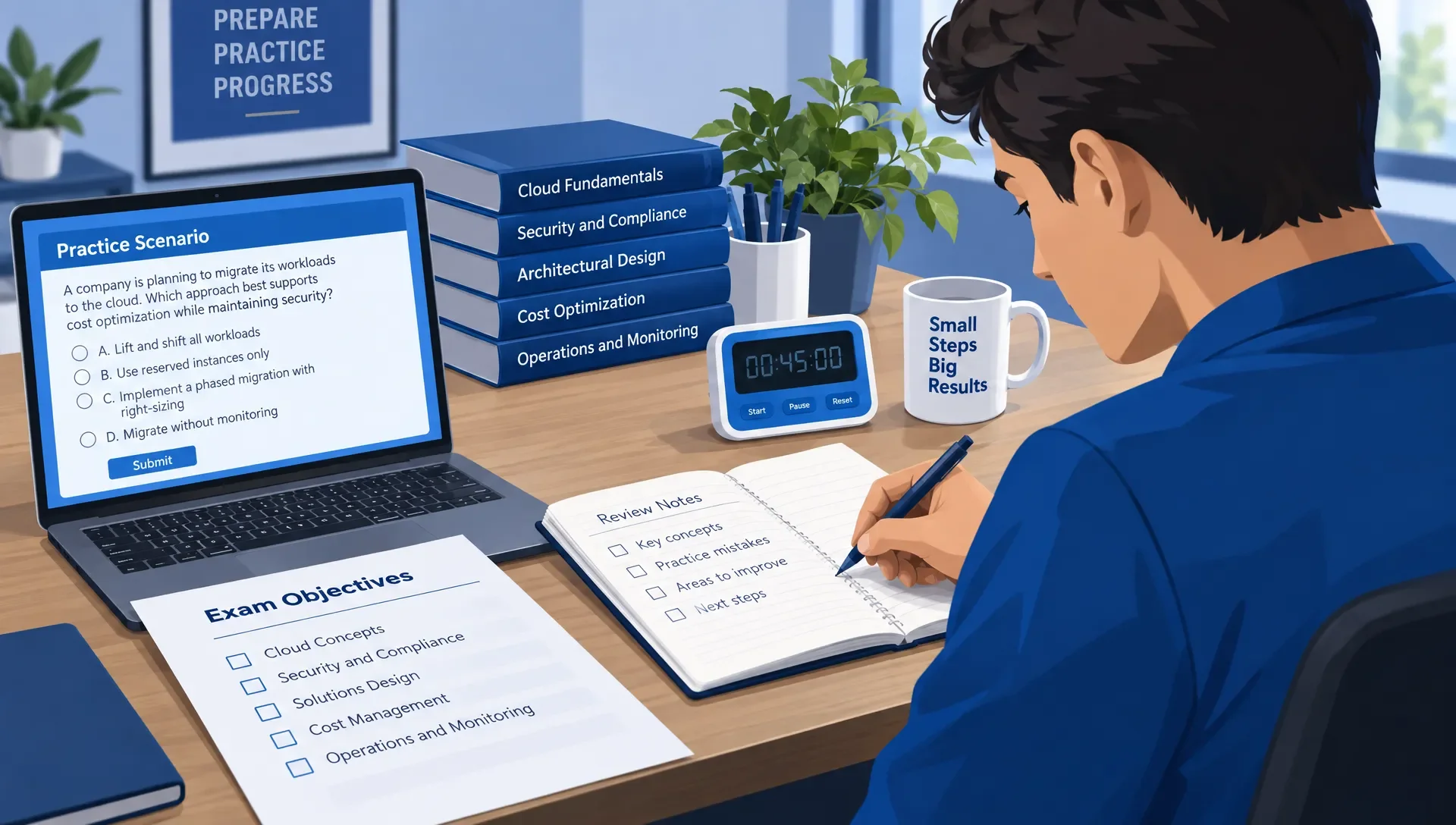
Use a Short Diagnostic, Not an Exhausting Mock Exam
Choose a manageable set that samples several domains and leaves enough time to examine your reasoning. For this schedule, roughly 20-30 questions can be a practical starting point, depending on question length. This isn't enough to establish full exam readiness by itself.
Answer without notes. Mark any item where you guessed, narrowed the options without understanding the distinction, or took much longer than expected. A correct guess still belongs in your review queue.
For AWS fundamentals, a resource such as the AWS Certified Cloud Practitioner practice exam can provide practice questions and explanations. Use those explanations to examine your reasoning, not to memorize the answer position.
Convert Uncertainty Into a Specific Task
Write each useful finding as a small action. For example, "Explain when to use an object store instead of a managed database" is actionable; "Review cloud storage" is too broad.
Choose tasks that match the current objectives and that you can realistically improve today. A distinction you've nearly mastered is usually a more workable final-day task than an advanced topic you've never studied.
For one day exam preparation, limit your active repair queue to two or three tasks at a time. Record other gaps, but don't let each new uncertainty interrupt the block you're completing.
If reviewing explanations becomes passive, use this approach to reviewing every answer in practice exam questions to check why your choice worked or failed.
How to Review a Weak Topic Without Rereading Everything
Retrieve First, Then Check the Explanation
Close your notes and explain the topic in your own words. State what it does, when you'd choose it, and which requirement would rule it out. Then open the relevant explanation and correct the missing or inaccurate parts.
The Institute of Education Sciences practice guide on organizing instruction and study recommends quizzing that requires active retrieval. In this plan, that means attempting an answer before checking the material, rather than repeatedly looking at an explanation that already feels familiar.
An objective-aligned resource such as the AZ-900 Microsoft Azure Fundamentals study guide can keep an Azure review focused. Open the section you need, resolve the gap, and return to practice.
Apply the Idea to a Different Example
After checking the explanation, answer a fresh question or create a short scenario with a different constraint. For a networking objective, that might mean working through a new subnet example. For project management, it might mean deciding what action fits a changed stakeholder situation.
The useful output of one day exam preparation isn't a page you've highlighted. It's a decision you can explain without looking. If you still can't do that after the block, record the unresolved point and decide whether another attempt deserves the remaining time.
How to Use Your Second Practice Set to Check Progress
Use fresh questions where possible. Repeating the same items immediately after reading their explanations can make recognition look like understanding.
Set a time limit appropriate to your exam's format. Don't assume that every item deserves equal time. A long scenario or task-based item may need more attention than a short knowledge question. Practice moving on when you're stuck, but use only navigation options your actual exam permits.
Review the second set for three things: whether the original mistakes returned, whether you can explain correct answers, and whether your pacing remains workable. Don't treat a single percentage as a universal pass prediction. Practice sets differ in coverage and difficulty, and their scores may not map to the provider's scoring system.
This checkpoint keeps one day exam preparation from becoming an endless loop of questions. If the targeted errors are resolved, move to the final recall block. If they persist, spend one short block on the underlying distinction rather than restarting a full mock exam.
For performance-based questions, use the format as well as the facts. Read the instructions, identify the requested outcome, and check your completed work against that outcome. Don't invent a navigation strategy based on a different certification's interface.
What to Do When You Find a New Weak Area Late in the Day
A late discovery doesn't automatically deserve the rest of your afternoon. First, determine whether it's an objective you recognize, an obscure detail, or a broad missing foundation.
If it's a familiar objective with one missing distinction, make a short correction and test it once more. If it's a broad gap, record it honestly. Starting a long lesson at this point may crowd out review of material you're otherwise ready to use.
Keep your final sheet small enough to review without searching through it. Include decisions, easily confused terms, and a few prompts that require you to generate an answer. The guide to turning study sheets into quick reviews can help you trim notes you already have.
A sensible one day exam preparation plan includes a stopping rule: when a gap needs a substantial new lesson, it belongs in a readiness decision, not an expanding last-minute checklist.
When to Stop Studying and Check Exam Logistics
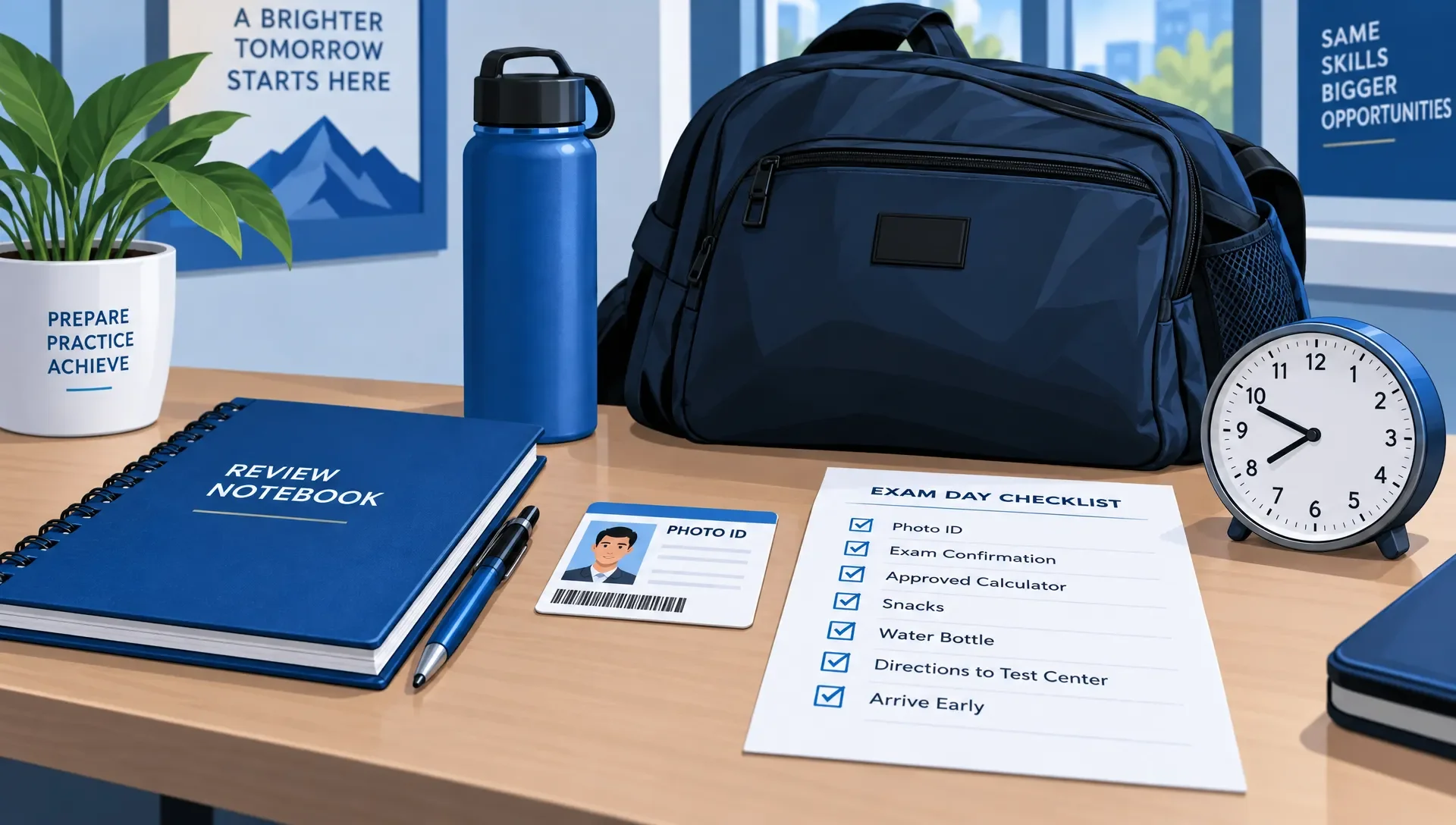
Finish the demanding work before your evening wind-down. Set tomorrow's departure or check-in time, prepare what you need, and leave the review sheet somewhere accessible.
Use your appointment confirmation and the testing provider's current instructions to verify:
- The exam date, time, time zone, and delivery method.
- The required identification and name-matching rules.
- The test-center route or online system-check requirements.
- The rules for your workspace, personal items, and permitted materials.
- The check-in window and support contact for appointment problems.
For an online exam, test the required setup early enough to resolve a problem. For a test center, check the route and allow time for the stated arrival requirements. Don't assume policies are identical across providers.
Protect sleep rather than using the night as an overflow study session. The CDC's sleep guidance recommends seven or more hours for adults ages 18-60, with age-specific recommendations for other groups.
The evening portion of one day exam preparation should be brief: review a few prompts if useful, put the materials away, and follow your usual bedtime routine.
What to Review on the Morning of the Exam
Use a brief recall check, not another diagnostic. Look at your final sheet's prompts and explain the answers from memory. Correct a small omission, then stop. Don't open a new bank of questions that could introduce unrelated doubts minutes before check-in.
Eat and drink according to your normal routine, follow the appointment instructions, and arrive or log in with the required lead time. If anxiety makes a familiar fact feel inaccessible, pause and return to the question's stated requirements rather than rushing toward the first recognizable option.
Once the exam starts, follow its actual instructions for timing, navigation, and review. Your practice-day workflow supports those rules; it doesn't replace them.
Frequently Asked Questions
Can I pass a certification exam after studying for only one day? It depends on your existing knowledge and the exam. One day exam preparation is most useful as a final review after earlier study or relevant experience. It isn't a reliable substitute for learning unfamiliar domains, especially when the exam requires applied skills.
Should I take a full practice exam the day before? Only if you'll still have time to review it and recover before bedtime. If you've already completed full-length practice, a shorter fresh set may give you more useful information without consuming the entire day.
How many hours should I study during my final review? This sample plan uses about five and a half hours, including logistics. That's a planning choice, not a required amount. Shorten it if fatigue prevents you from explaining answers or working accurately.
What should I do if my practice score is still low? Check whether mistakes cluster around a few fixable distinctions or reveal broad missing knowledge. Review unresolved objectives and the provider's rescheduling rules. Don't assume another attempt at the same questions proves you're ready.
Should I memorize answers or use exam dumps? No. Practice explaining why an answer fits the scenario and why the alternatives don't. Unauthorized exam content can violate certification rules, and recognizing a memorized answer doesn't establish that you understand the objective.
Start Your Final Review With One Clear Task
Choose the first diagnostic and write down your stopping time before you begin. MindMesh Academy offers tools like detailed explanations for practice questions and topic progress tracking to help you keep your review focused on specific gaps. Get started by taking the AZ-900 Microsoft Azure Fundamentals practice exam to gauge your readiness.
Use one day exam preparation to make a few important decisions clearer, not to finish every available resource. End with evidence of what you understand, an honest view of what's unresolved, and a confirmed plan for getting to the exam.

Written by
Alvin Varughese
Founder, MindMesh Academy
Alvin Varughese is the founder of MindMesh Academy and an enterprise architecture leader. An electrical engineer by training, he moved from factory automation in South Africa to cloud architecture at GE Appliances and Humana (Fortune 50), and holds 20 professional certifications including AWS Solutions Architect Professional, Azure DevOps Engineer Expert, and Microsoft Agentic AI Business Solutions Architect. He built MindMesh Academy after interviewing too many highly certified candidates who couldn't answer basic questions: the goal is prep that makes you better at the job, not just able to pass the exam.