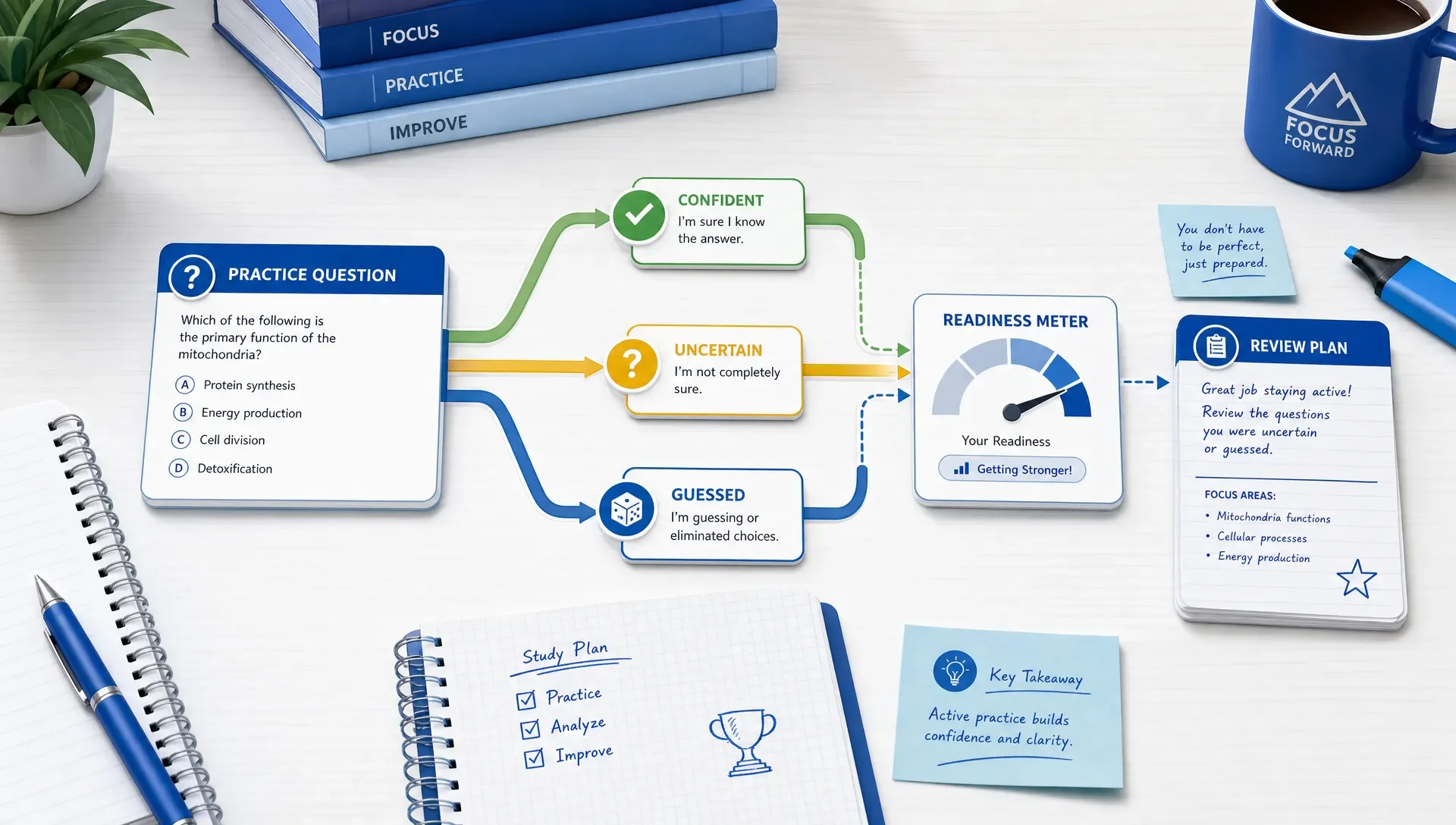
Multiple-Choice Practice Tests Without Guessing
Multiple-Choice Practice Tests Without Guessing
If your score improves only when you make lucky picks, your practice data is lying to you. A multiple-choice practice test should tell you what you can retrieve, explain, and apply under exam-like pressure, not how often you can win a coin flip between two attractive answers.
Use this rule from the start: every answer needs a reason before you select it. If you can't explain why the correct option is correct and why the closest distractor is wrong, mark the item as uncertain, even if you got it right. That one habit turns practice tests into a real readiness tool.
Why Guessing Makes Multiple-Choice Practice Test Scores Misleading
Guessing feels harmless during practice because nobody sees the result but you. The problem is that guessed-correct questions inflate your score, hide weak objectives, and encourage recognition instead of recall.
Recognition is when an answer looks familiar once you see it. Recall is when you can bring the concept to mind before the options help you. Certification exams usually reward recall plus application: you need to identify the requirement, notice constraints, and choose the best answer among distractors that are technically plausible.
That's why a raw score alone isn't enough. An 82 percent score with 15 lucky correct answers isn't the same as an 82 percent score with confident reasoning on nearly every item. One means you're ready to refine timing. The other means you still have hidden gaps.
Retrieval practice is powerful because it forces you to pull knowledge from memory before feedback. In a peer-reviewed experiment published in Science, Karpicke and Roediger found that repeated retrieval improved long-term retention more than repeated study in the learning task they tested. The Institute of Education Sciences also recommends quizzing and spacing study over time as part of effective learning practice.
A no-guessing approach keeps those benefits intact. You still answer questions, but you separate knowledge from luck.
Use a Confidence Marking System Before You Check Answers
Before you submit any practice test, mark each question with a confidence level. Don't wait until after you see the answer, because feedback changes your memory of how certain you were.
A simple three-mark system works well:
- Green: You can explain the answer and eliminate the distractors with clear reasoning.
- Yellow: You narrowed it down with some evidence, but part of your reasoning felt incomplete.
- Red: You guessed, relied on wording patterns, or picked what sounded familiar.
The goal isn't to avoid red marks. The goal is to see them. Red and yellow questions are your real study plan, especially when they cluster around the same objective.
| Confidence mark | What it means | How to count it | What to do next |
|---|---|---|---|
| Green correct | You knew it and could explain it | Count toward readiness | Review briefly, then move on |
| Yellow correct | You were partly unsure | Count as a weak pass | Review the objective and explanation |
| Red correct | You guessed correctly | Do not count as mastered | Treat like a missed question |
| Yellow or red wrong | Your reasoning broke down | Count as a weakness | Rebuild the concept, then retest later |
| Green wrong | You were confidently incorrect | Highest priority | Find the misconception immediately |
Confidently incorrect answers deserve special attention. They reveal a wrong mental model, not just a missing fact. If you ignore them, they tend to repeat.
How to Answer Multiple-Choice Questions Without Guessing
Most guessing starts because the learner reads the options too soon. The answer choices pull your attention toward familiar words, and familiar words can feel like knowledge. Slow down just enough to create your own answer path first.
Read the stem and predict the tested objective
Before looking for the answer, ask what objective the question is testing. In a cloud exam, the stem might test shared responsibility, identity access, network design, or cost controls. In Security+, it might test attack types, controls, cryptography, or incident response.
You don't need the exact domain label every time, but you should know the concept area. If you can't name the topic, you're more likely to choose based on surface clues.
Restate the requirement in plain language
Long scenario questions often include extra detail. Restate the actual task in one sentence: "The company needs the most cost-effective storage class for rarely accessed data" or "The administrator needs the control that prevents unauthorized physical access."
This reduces guessing because you're choosing against a requirement, not against a vibe.
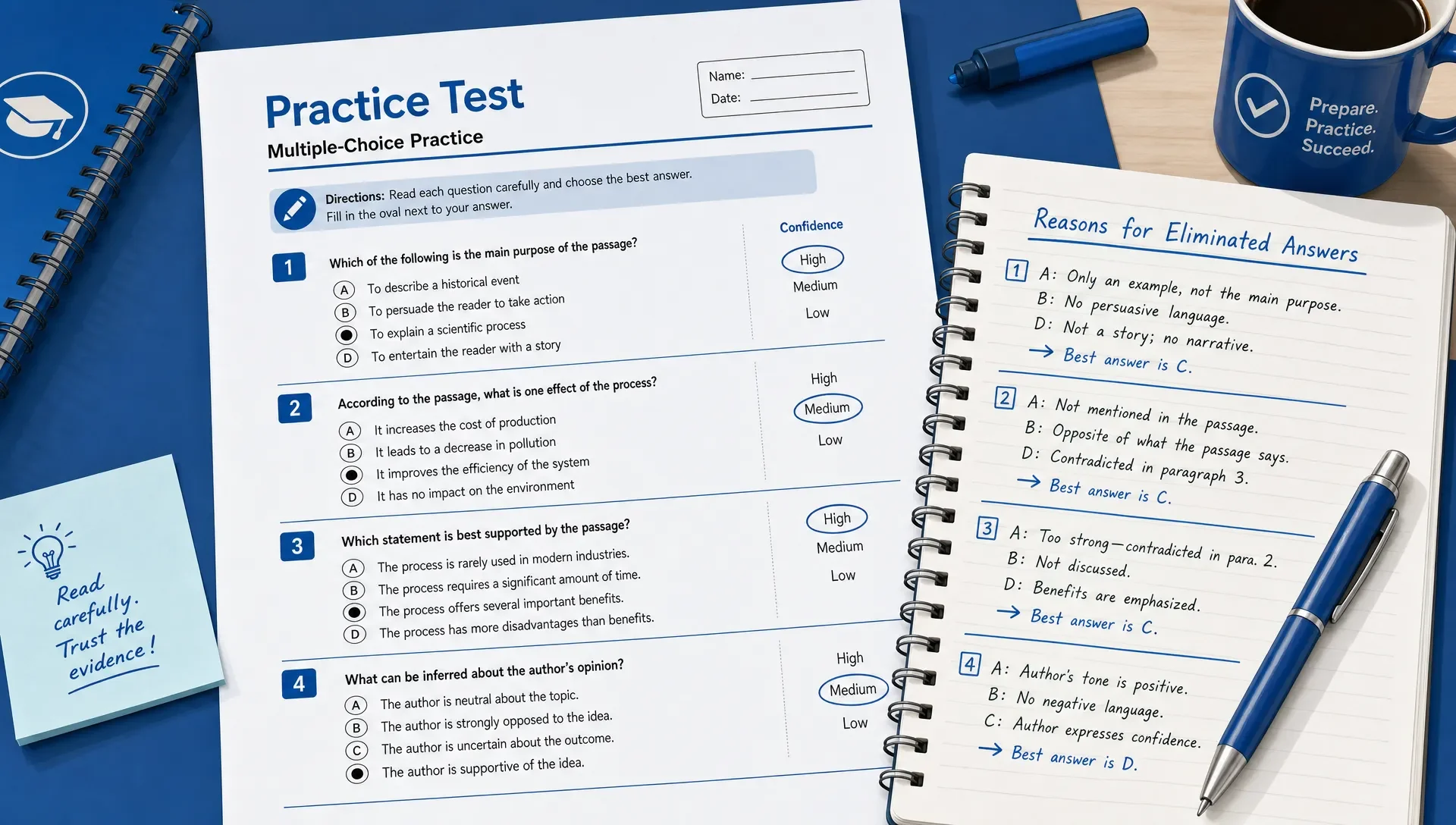
Eliminate only when you can give a reason
Elimination is useful, but only if your reason is content-based. "This one sounds too extreme" isn't enough. "This option doesn't meet the encryption requirement" is enough. So is "This service solves authentication, but the question asks about authorization."
If you eliminate two options for weak reasons and then pick between the remaining two blindly, mark the question yellow or red. The answer may be correct, but the knowledge isn't stable yet.
Choose the best answer, not the familiar answer
Many certification questions include more than one technically true statement. The right answer is the one that best satisfies the scenario. Pay attention to words such as "first," "most cost-effective," "least administrative effort," "best," or "required."
For more help with that skill, use a dedicated process to spot the key clue in exam test questions before you commit to an option.
Score Your Practice Test With Adjusted Readiness, Not Raw Points
Raw score answers one question: "How many did I get right?" Adjusted readiness answers the better question: "How many did I know well enough to trust on exam day?"
After each test, calculate both numbers:
- Raw score: all correct answers divided by total questions.
- Adjusted score: green correct answers divided by total questions.
- Review load: yellow, red, and wrong answers divided by total questions.
For example, if you take an 80-question practice test and get 64 correct, your raw score is 80 percent. But if only 52 of those were green correct, your adjusted score is 65 percent. That difference matters. It tells you that your next step isn't another full test. Your next step is targeted repair.
This is where many learners waste time. They retake the same test, remember the answer order, and celebrate a higher score. That feels productive, but it can become answer memorization. If you use large quiz banks, follow rules that prevent answer memorization, such as protecting first attempts, delaying retakes, and tracking confidence.
Review Every Option, Including the Ones You Got Right
A no-guessing test is only half the process. The review is where the score turns into learning.
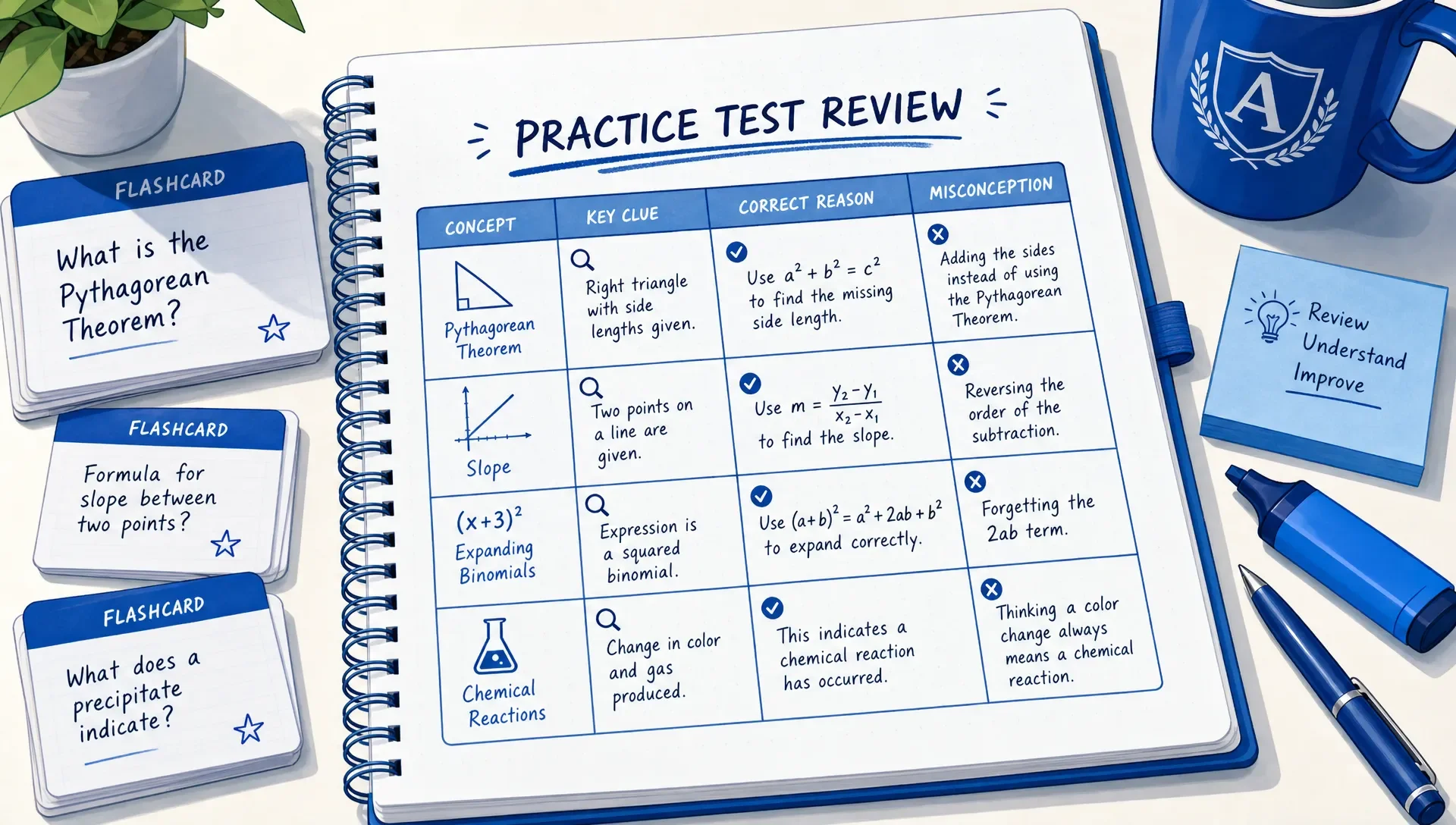
For each yellow, red, or wrong question, write a short review note. Keep it compact. You're not rewriting the whole study guide. You're correcting the exact point that caused uncertainty.
Your note should answer four things:
- What concept was tested?
- What clue in the stem mattered most?
- Why is the correct answer correct?
- Why was my selected answer wrong or risky?
Also, review green wrong answers with extra care. When you're confident and wrong, the explanation should change how you understand the topic. If it doesn't, go back to the study guide objective and rebuild from there.
You can use MindMesh Academy's study workflow for this kind of loop: study guides by exam objectives, practice questions with explanations, flashcards with spaced repetition, and readiness tracking. If you're preparing for a specific certification, objective-aligned practice helps you avoid random question drilling. For cloud fundamentals, the AWS Certified Cloud Practitioner practice exam gives you a way to practice against that exam path. For security learners, the CompTIA Security+ practice exam can support the same no-guessing approach.
If you want a deeper review method, use a process that helps you review practice exam questions more effectively instead of only checking the right letter.
Common Guessing Habits and What to Do Instead
Guessing usually has patterns. Once you name the pattern, it's easier to replace it with a better habit.
| Guessing habit | What it sounds like | Better replacement |
|---|---|---|
| Picking the longest answer | "This one is detailed, so it's probably right." | Match each option to the requirement in the stem |
| Choosing familiar vocabulary | "I remember seeing this term." | Define the term before selecting it |
| Eliminating by tone only | "This sounds too broad." | Find the technical reason it fails |
| Changing answers without evidence | "Now I'm nervous about my first choice." | Change only when you find a missed clue |
| Treating guessed-correct as mastered | "I got it right, so I'm fine." | Mark it red and review it like a miss |
One practical rule helps with answer changes: don't change your answer unless you can point to a specific clue you missed. Anxiety isn't evidence. A requirement in the stem is evidence.
When to Use Timed Multiple-Choice Practice Tests
Timed tests are useful, but they're not always the right tool. If you're guessing through half the questions, timing pressure will mostly train you to guess faster.
Start with untimed or lightly timed practice when you're still building the content. Use the no-guessing protocol, read explanations, and send weak topics back into study. Once your adjusted score rises and your red marks drop, add time limits.
A good progression looks like this:
- Learning phase: Use short sets by objective, mark confidence, and review every uncertain item.
- Integration phase: Mix objectives so you have to identify the topic without being told.
- Exam simulation phase: Take full-length timed tests, still marking confidence before submission.
- Final readiness phase: Focus on weak topics, pacing, and reducing careless errors.
Performance-based formats deserve the same discipline. Don't jump straight to the answer pattern. Identify the task, constraints, and expected outcome first. Then choose or configure the response.
Build a Weekly No-Guessing Practice Routine
You don't need to take a full practice test every day. In fact, doing that too early can burn through questions before they give you clean data.
A better weekly routine uses different practice sizes for different purposes. Early in the week, do smaller objective-based sets and repair gaps. Later in the week, use mixed sets to test whether the knowledge transfers when the topic isn't announced.
Try this simple rhythm:
- Two short objective sets: 15 to 25 questions each, focused on weak areas.
- One mixed set: 30 to 50 questions across several objectives.
- One review block: Rework yellow, red, and wrong answers without looking at the options first.
- Spaced flashcard sessions: Use flashcards to keep definitions, processes, and comparisons active between tests.
The key is to separate testing from reviewing. During the test, answer closed-book and mark confidence. During review, slow down, use explanations, and rebuild weak concepts.
Signs You're Ready to Trust Your Practice Test Scores
You don't need perfection before scheduling an exam, but you do need stable evidence. A single high raw score isn't enough, especially if it came after multiple retakes of the same questions.
Look for these readiness signals:
- Your adjusted score is close to your raw score.
- Red marks are rare and spread out instead of clustered in one domain.
- You can explain why the closest distractor is wrong.
- Your missed questions come from small gaps, not whole objectives.
- Your timed score stays stable without rushing or changing answers from panic.
Readiness tracking works best when it's topic-specific. A learner can be strong in identity and access but weak in networking, or solid on risk concepts but shaky on cryptography. Progress tracking by topic helps you decide what to study next instead of retaking broad tests and hoping the score improves.
Frequently Asked Questions
Should I ever guess on a multiple-choice practice test? If you need to submit an answer, choose one, but mark it as a guess before checking results. The problem isn't selecting an answer. The problem is counting a guessed-correct answer as mastered.
What should I do when I narrow the answer down to two choices? Write or say why each remaining option could be right, then look for the requirement in the stem that decides between them. If you still can't decide with evidence, mark the question yellow or red and review the concept after the test.
Is a high practice test score still useful if I guessed some answers? Yes, but use an adjusted score. Separate confident correct answers from guessed correct answers. Your adjusted score is a better readiness signal than the raw score.
How many times should I retake the same multiple-choice practice test? Retake only after enough time has passed and after you have studied the weak objectives. If you retake too soon, you may remember the answer choices rather than retrieve the concepts.
Should I review questions I got right? Yes, review every guessed-correct and unsure-correct question. You can skim confident correct answers, but anything marked yellow or red needs explanation review.
How do I stop changing correct answers to wrong ones? Change an answer only when you find a specific clue you missed. If the reason is just nervousness, keep your original answer and mark the item for review.
Turn Practice Scores Into Real Exam Readiness
A multiple-choice practice test should reduce uncertainty, not hide it. Mark confidence before feedback, require evidence for every elimination, and treat guessed-correct answers as study targets. Your score may look lower at first, but it will be more honest.
MindMesh Academy helps you apply these methods effectively. Our platform offers objective-aligned practice questions with detailed explanations and readiness tracking, designed to pinpoint your knowledge gaps. Build your confidence and ensure you're truly prepared for exam day. Start with our AWS Certified Cloud Practitioner practice exam to see how deep practice can transform your study.

Written by
Alvin Varughese
Founder, MindMesh Academy
Alvin Varughese is the founder of MindMesh Academy and an enterprise architecture leader. An electrical engineer by training, he moved from factory automation in South Africa to cloud architecture at GE Appliances and Humana (Fortune 50), and holds 20 professional certifications including AWS Solutions Architect Professional, Azure DevOps Engineer Expert, and Microsoft Agentic AI Business Solutions Architect. He built MindMesh Academy after interviewing too many highly certified candidates who couldn't answer basic questions: the goal is prep that makes you better at the job, not just able to pass the exam.