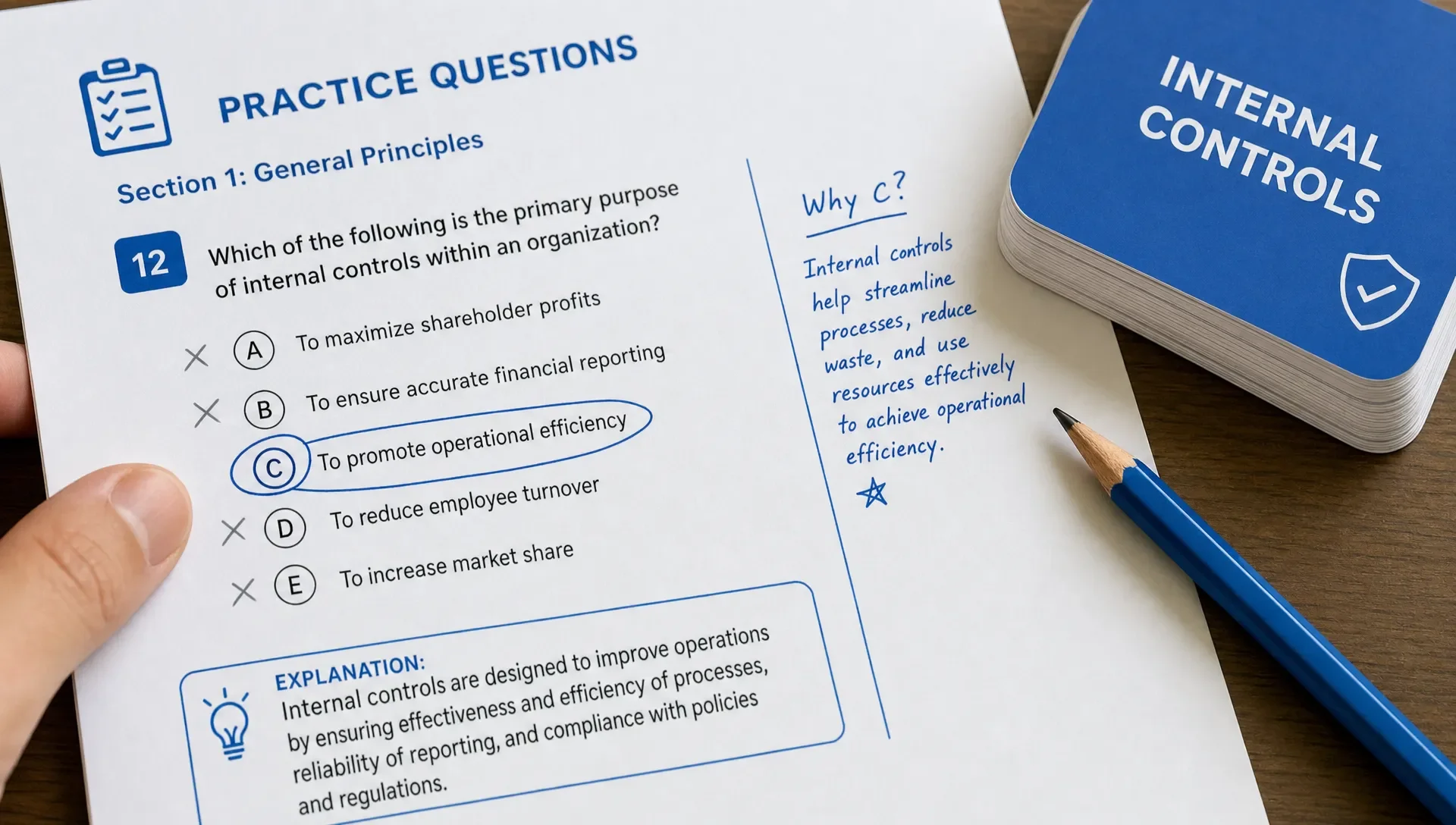
Multiple Choice Practice Tests That Build Confidence
Multiple Choice Practice Tests That Build Confidence
The best multiple choice practice tests do more than just show you what you got right. They offer a reliable way to prove your knowledge, pinpoint weak topics while you still have time to improve, and reduce the anxiety that comes from seeing unfamiliar wording on exam day. If you're only using practice exams to check your score, you're missing out on most of their confidence-building potential.
Start with a simple cycle: answer questions without notes, mark your confidence, review every option, strengthen weak objectives, and retest after a delay. This process works whether you're preparing for AWS, Azure, CompTIA, Cisco, ITIL, PMI, or another certification. The goal isn't just to feel good after one high score. It's to recognize patterns, explain your choices, and know what to do when a question looks unfamiliar.
How Practice Tests Build Real Confidence
Real exam confidence isn't the belief that every question will look familiar. It's the ability to read a new scenario, identify the tested concept, and rule out wrong answers for clear reasons. This kind of confidence comes from active retrieval, not just passive rereading.
Roediger and Karpicke's 2006 Science paper found that students who practiced retrieving information retained more over time than those who only restudied. Certification exams aren't identical to classroom recall tasks, but the lesson applies: when you force yourself to recall and apply a concept before checking the answer, you strengthen the mental path you'll need under exam pressure.
Used correctly, multiple choice practice tests turn uncertainty into clear evidence. You learn which objectives are solid, which ones are shaky, and which ones only feel familiar because you've seen the wording before. That distinction matters because high-stakes exams often change the surface details while testing the same underlying objective.
What Confidence-Building Practice Tests Should Include
Not all practice is equal. A weak quiz might reward simple recognition or let you memorize letter positions. Strong multiple choice practice tests make you choose between plausible answers, explain why the correct option is best, and connect each mistake to a specific exam objective.
| Practice test feature | Why it builds confidence | What to check as a learner |
|---|---|---|
| Objective alignment | Keeps practice tied to what the exam actually tests | Each question maps to a domain, task, or topic |
| Scenario-based stems | Trains decision-making, not trivia recall | You must identify requirements before choosing |
| Plausible distractors | Reveals partial understanding | Wrong answers are tempting for a clear reason |
| Answer explanations | Teaches reasoning after the attempt | Explanations cover correct and incorrect choices |
| Topic-level reporting | Shows where to repair knowledge | Scores are broken down by objective |
| Timed mode | Builds pace and reduces exam-day surprise | You practice with realistic time pressure |
| Confidence marking | Separates lucky answers from truly mastered concepts | You record sure, unsure, or guessed before review |
For certification learners, practice tests are strongest when they fit into a complete study workflow. Official exam guides, such as Microsoft's AZ-900 study guide, show how objectives are organized. Your practice should follow that structure. This way, a missed question leads to a focused repair session instead of vague extra studying.
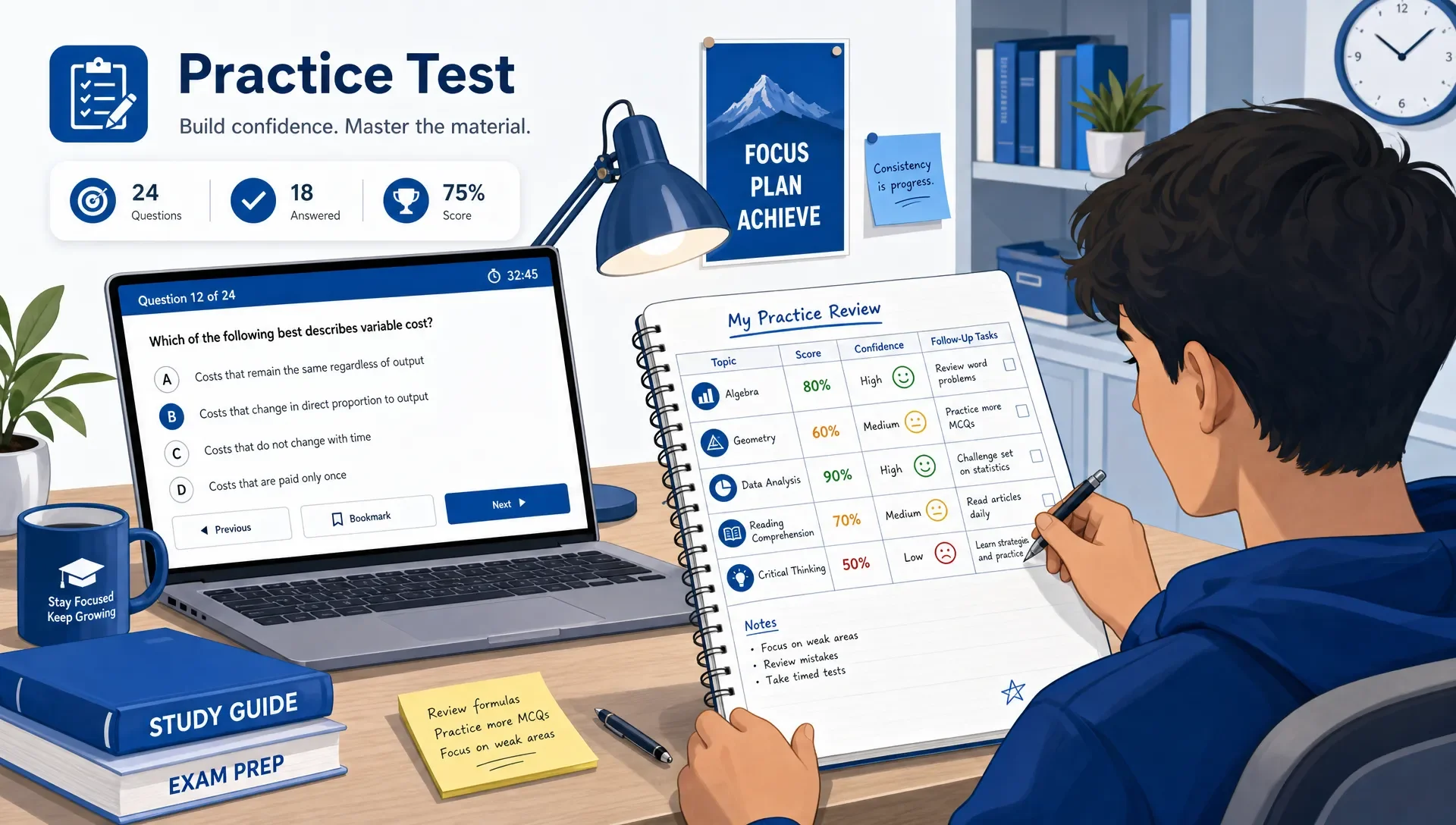
Use a Four-Pass Review Method After Every Practice Test
Before you score a test and move on, treat practice tests as diagnostic interviews. The answer you chose matters, but your path to that answer matters more. A lucky correct answer can hide a knowledge gap, and a wrong answer can still show solid reasoning if you misunderstood one keyword.
Pass 1: Answer closed-book before checking anything
Take the first attempt without notes, searching, flashcards, or hints. If you don't know, make the best choice you can and mark it as low confidence. Looking up facts during the attempt feels productive, but it changes the task from retrieval to research. Save research for the review phase.
For timed exams, run some sessions under time pressure and some untimed. Untimed practice is better for learning new reasoning steps. Timed practice is better for pacing, endurance, and deciding when to move on.
Pass 2: Mark confidence before the explanation
After each answer, record whether you were confident, uncertain, or guessing. This simple habit makes your score more honest. A 78% score with many guesses isn't the same as a 78% score with clear reasoning on most questions.
If guessing is becoming a habit, use a stricter approach like the one in multiple-choice practice tests without guessing. The aim isn't to eliminate educated elimination. It's to stop rewarding random picks as if they were true knowledge.
Pass 3: Review every answer choice, not just the correct one
For each missed or low-confidence item, write one sentence explaining why the correct option works. Then write one sentence explaining why your chosen option fails. If there are four options, make yourself account for all four. This is where many learners finally see the specific distinction being tested.
A deeper version of this routine is covered in practice answer reviews that teach better reasoning. That kind of review takes longer than skimming explanations, but it prevents the same mistake from returning in new wording.
Pass 4: Retest after a delay
Don't retake the same questions immediately unless you're checking a simple misunderstanding. Wait long enough that you can't rely on short-term memory of the answer. Then retest by topic, not just by full exam score. If you missed identity and access questions, do a targeted set on that topic before another full practice exam.
Delayed retesting turns review into proof. If you can answer a similar question days later and explain why, your confidence is becoming more reliable.
How to Read Your Practice Test Score Without Fooling Yourself
Your score from multiple choice practice tests is useful only when you interpret it with your confidence level, timing, and topic breakdown. A raw percentage can hide major risks. For example, a learner might score well overall because cloud billing questions are easy, but still be underprepared for networking or security domains.
| Practice result | What it usually means | Best next move |
|---|---|---|
| High score, high confidence | Strong readiness on the tested set | Maintain with mixed review and delayed retest |
| High score, low confidence | Possible lucky performance or fragile knowledge | Review explanations and retest similar objectives |
| Mid score, uneven topics | Some domains are carrying the average | Focus on the weakest two objectives first |
| Low score, high confidence | Misread objectives or overconfidence | Rebuild concepts from the study guide |
| Low score, low confidence | Content gaps are still broad | Return to guided study before another full test |
| Good untimed score, poor timed score | Pace and decision habits need work | Add timed sets of 15 to 25 questions |
A good readiness rule is simple: don't trust a score until you can repeat it with different questions, explain most answers, and finish within time. If your exam includes performance-based items, multiple choice alone won't prove full readiness. Add hands-on or performance-based question formats when your certification requires them.
How to Practice When Questions Feel Tricky
Good multiple choice practice tests include distractors that sound correct if you stop reading too early. That's not unfair. Certification exams often test whether you can apply a rule in context, not just whether you recognize a phrase from a study guide.
| Tricky question pattern | What to do |
|---|---|
| Best, most, or least wording | Identify the decision criteria before reading options |
| Long scenario with extra details | Circle the requirement, constraint, and outcome |
| Two answers that both seem correct | Ask which one satisfies the exact objective in the stem |
| Security or cloud service names that look similar | Match each service to its primary use case |
| Negative wording such as except or not | Rewrite the question in plain language before choosing |
| Familiar answer from a previous quiz | Re-evaluate it instead of trusting recognition |
The fastest way to improve on tricky items is to slow down before looking at the options. Decide what the question is testing first. Then eliminate answers that solve a different problem, use the wrong scope, or violate a stated constraint.
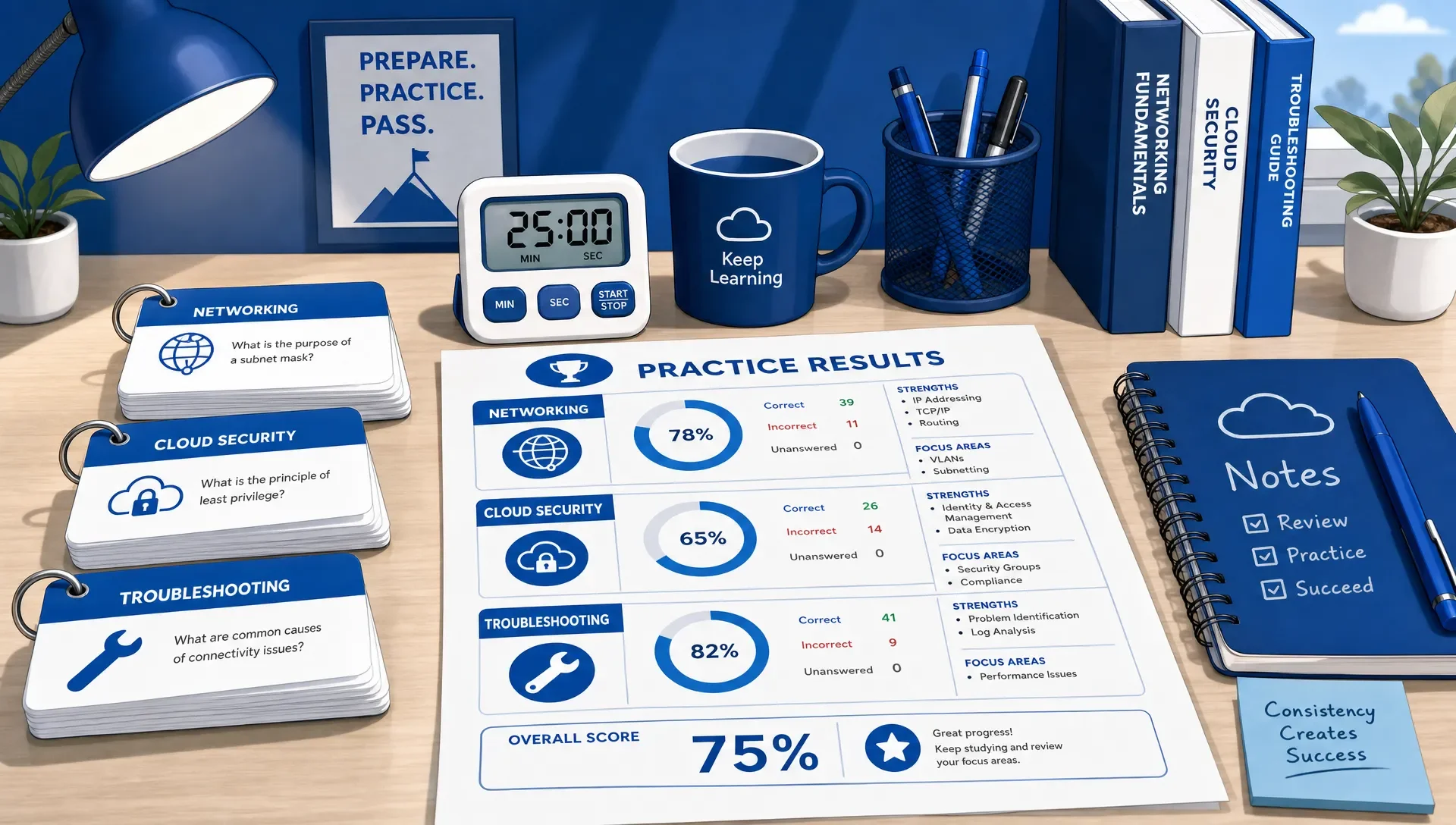
A One-Week Practice Schedule That Builds Confidence
This schedule assumes you're using multiple choice practice tests alongside a study guide, flashcards, and targeted review. Adjust the number of questions based on your exam date, but keep the sequence intact: diagnose, repair, retrieve, and confirm.
| Day | Main activity | Output to record |
|---|---|---|
| Monday | Take a 30- to 40-question mixed set closed-book | Score, confidence marks, and slow topics |
| Tuesday | Review every missed and low-confidence item | One repair note per weak objective |
| Wednesday | Study the two weakest objectives | Updated notes and flashcards |
| Thursday | Take a targeted quiz on weak areas | New score by topic |
| Friday | Do a timed mixed set | Completion time and skipped questions |
| Saturday | Retest similar objectives after delay | Evidence of retention or remaining gaps |
| Sunday | Rest lightly or review flashcards | Short list of next-week priorities |
Avoid the temptation to take full exams every day. Full tests are useful, but they take time and can lead to score fatigue. Shorter, targeted sets often produce faster improvement because they let you fix the exact objective that caused the miss.
How MindMesh Academy Fits This Practice Loop
MindMesh Academy helps you use multiple choice practice tests as part of a connected study workflow, not just isolated quizzes. For example, if you're preparing for cloud fundamentals, the AWS Certified Cloud Practitioner practice exam can help you test knowledge by topic while you review explanations. For security-focused learners, the CompTIA Security+ practice exam supports the same diagnose-and-repair routine. If you're still building your foundation before testing heavily, an objective-based path like the AZ-900 Microsoft Azure Fundamentals study guide can keep your review organized.
The advantage of this workflow is clarity. You don't have to wonder whether to reread everything, take another full exam, or make more flashcards. Your practice results point directly to your next action.
Frequently Asked Questions
How many practice tests should I take before an exam? Take enough to prove consistent performance, not just to hit a magic number. Most learners need a mix of topic quizzes, timed sets, and at least a few full-length attempts. Stop increasing volume when your scores are stable, your confidence marks are high, and your weak topics are shrinking.
Should I retake the same practice test? Yes, but not immediately and not as your only evidence of readiness. Retaking too soon can measure memory of the question instead of true understanding. Wait, study the weak objective, and then use a similar set or shuffled retake to confirm retention.
Is a high practice test score enough to prove I'm ready? Not by itself. A high score matters more when you can explain your answers, finish on time, and perform well across all domains. If your score depends on familiar wording, you're not ready yet.
How do I stop memorizing answers? Delay retakes, shuffle question order, review all answer choices, and write why each wrong option is incorrect. You can also use confidence marking to catch questions you got right for the wrong reason.
What should I do after failing a practice test? Treat it as a diagnostic, not a final verdict. Sort your misses by objective, choose the two most impactful weak areas, and study those before taking another full test. A failed practice attempt is valuable if it changes your next study session.
Do practice tests help with performance-based exams? They help with concepts, speed, and decision-making, but they may not cover every task format. If your certification includes simulations or performance-based questions, combine multiple-choice review with performance-based practice formats.
Turn Your Next Practice Test Into Better Evidence
Before your next study session, decide what you want the test to prove. If it's a diagnostic, go slow and capture your reasoning. If it's a readiness check, use time limits and mixed topics. If it's a repair session, focus only on the weak objective and retest after a delay.
Confidence doesn't come from seeing more questions. It comes from using each question to make your next answer more accurate, faster, and easier to explain. To solidify your understanding and prepare with confidence, explore our AZ-900 Microsoft Azure Fundamentals practice exam and build the skills you need for exam day.

Written by
Alvin Varughese
Founder, MindMesh Academy
Alvin Varughese is the founder of MindMesh Academy and an enterprise architecture leader. An electrical engineer by training, he moved from factory automation in South Africa to cloud architecture at GE Appliances and Humana (Fortune 50), and holds 20 professional certifications including AWS Solutions Architect Professional, Azure DevOps Engineer Expert, and Microsoft Agentic AI Business Solutions Architect. He built MindMesh Academy after interviewing too many highly certified candidates who couldn't answer basic questions: the goal is prep that makes you better at the job, not just able to pass the exam.