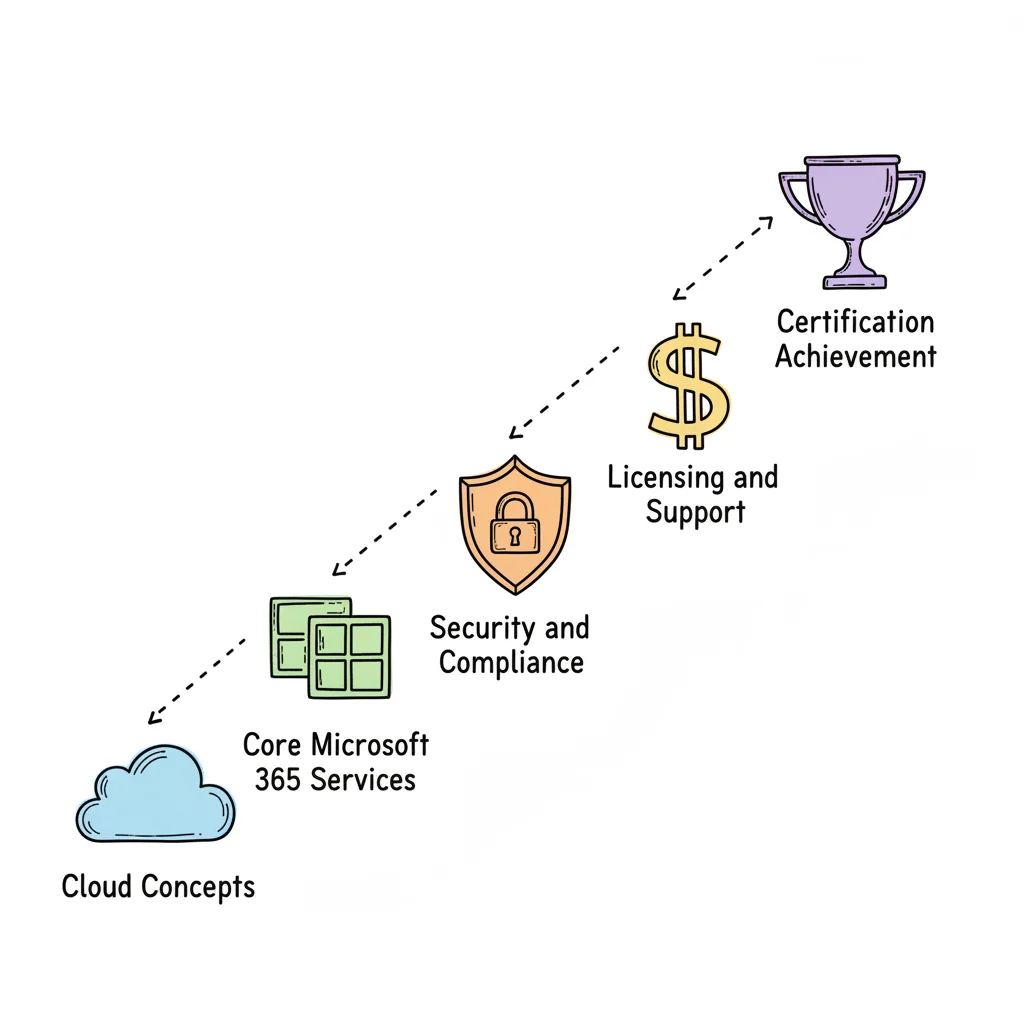
MS 900 Practice Test: The Ultimate 2026 Guide
Using MS-900 Practice Tests to Prepare for Microsoft 365 Fundamentals
You’ve probably done this already. You open an MS-900 practice test, answer a few questions, score lower than you hoped, and then wonder whether you should continue taking practice questions or return to foundational material.
That uncertainty is normal. MS-900 covers a broad set of ideas, from cloud concepts to Microsoft 365 services, security, compliance, licensing, and support. For many learners, the challenge isn’t a lack of effort. It’s using effort in the wrong way.
A good practice test isn’t just a score generator. It’s a diagnostic tool. Used well, it shows you which topics you misunderstand, which distractors keep fooling you, and which areas need spaced review instead of one-time cramming. Used poorly, it turns into answer memorization and a false sense of confidence.
I’ve seen the difference many times. The candidates who pass most smoothly usually aren’t the ones who take the most questions. They’re the ones who review questions with intention, track patterns in their mistakes, and build a repeatable study loop around those patterns. If you’re looking for certifications to advance your career, that habit matters as much as the exam itself.
Preparing Effectively for the MS-900 Exam
MS-900 is the front door to Microsoft 365 fundamentals. It’s designed for people who need working knowledge of cloud principles and Microsoft 365 capabilities, not deep engineering skill. That makes it attractive to IT support staff, administrators, career changers, students, and even non-technical professionals who work closely with Microsoft tools.
The tricky part is breadth. One day you’re reviewing SaaS, PaaS, and IaaS. The next day you’re comparing Teams, Exchange Online, and SharePoint. Then security, compliance, and licensing show up in the same study session and everything starts to blur together.
Practical rule: Don’t treat practice tests as a final checkpoint. Treat them as part of the learning process from day one.
A smart prep approach looks like this:
- Learn the blueprint first. Know what the exam measures before you chase random questions.
- Choose high-quality practice material. Good explanations matter more than giant question volume.
- Review every missed question thoroughly. Wrong answers often reveal thinking errors, not just content gaps.
- Build spaced repetition into your routine. Revisit weak topics on purpose, not by accident.
- Simulate exam conditions before test day. Confidence improves when the format feels familiar.
That's how you transform an MS-900 practice test from a simple quiz into an effective training system.
Deconstructing the MS-900 Exam Blueprint
The blueprint is your map. Without it, you’re studying in a fog. With it, you can decide where to spend your time and what kind of questions deserve the most attention.
The exam isn’t random. It has a structure. The official Microsoft exam guide states that the MS-900 exam consists of 40-60 questions to be completed in 45 minutes, with a passing score of 700 on a 1-1000 scale. It covers four domains: cloud concepts (5-10%), core Microsoft 365 services (45-50%), security, compliance, privacy, and trust (25-30%), and pricing, licensing, and support (10-15%).
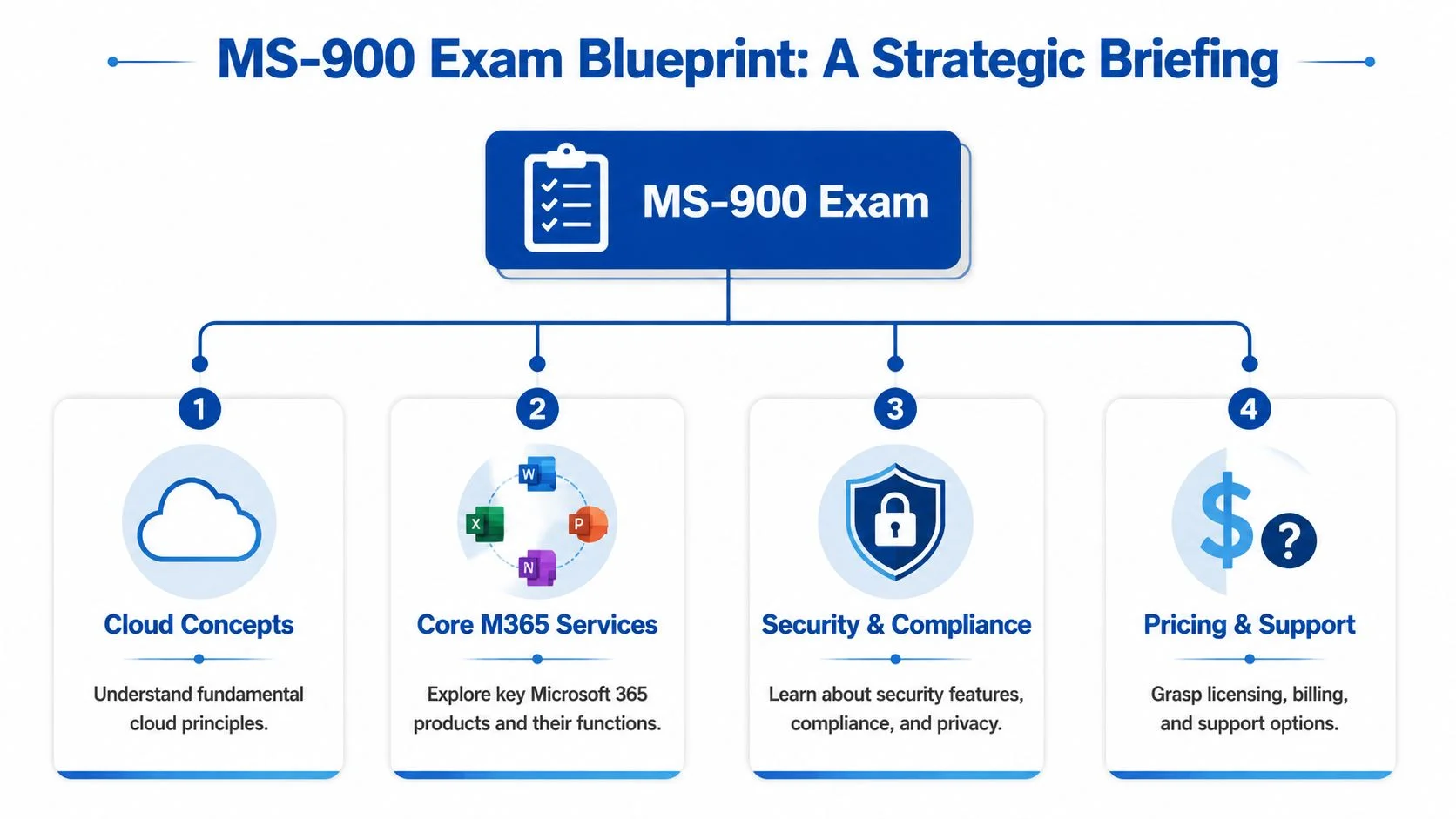
Read the blueprint like a recipe
Think of the exam like a recipe with four ingredients. All four matter, but they don’t go in equally.
If core Microsoft 365 services makes up the largest share, then that area deserves the largest share of your study time. If cloud concepts carries a smaller weight, you still need it, but you shouldn’t let it crowd out your review of the heavier topics.
That simple shift changes how you use practice tests. Instead of saying, “I got 70 percent overall,” you start asking better questions:
- Did I miss too many questions in core services?
- Am I confusing service names and use cases?
- Do I understand security terms conceptually, or only by recognition?
- Am I weak on licensing because I avoid it?
What each domain is really asking
Cloud concepts
This domain checks whether you understand the basic language of cloud computing. You should be comfortable distinguishing public, private, and hybrid cloud ideas, and recognizing service models such as SaaS, PaaS, and IaaS.
Many learners stumble here because the terms sound similar. The fix is to tie each model to responsibility. Ask: who manages what?
Core Microsoft 365 services
This is the heart of the exam. You need a usable understanding of products and what they do inside an organization. That includes knowing the general role of services such as Teams, Exchange Online, SharePoint, and OneDrive.
A common mistake is memorizing product names without a clear business use case. If you can explain a service in plain language to a coworker, you usually understand it well enough for the exam.
Security, compliance, privacy, and trust
This domain tests whether you can connect Microsoft 365 features to security and governance outcomes. You’re not expected to become a security architect, but you do need to recognize what certain controls and protections are for.
Pricing, licensing, and support
Candidates often postpone this area because it feels less exciting. That’s a mistake. Questions here can still determine the final outcome, especially if you’ve treated licensing as “something to look at later.”
The blueprint doesn’t just tell you what’s on the exam. It tells you where careless study habits hurt most.
What Defines a High-Quality MS-900 Practice Test
Not every MS-900 practice test deserves your time. Some resources train judgment. Others train guessing. The difference matters.
A low-value question bank usually pushes you toward surface recognition. You start remembering that option B was right last time, but you can’t explain why. A high-quality practice test forces you to reason through the scenario, compare choices, and understand why one answer fits better than the others.
Red flags and green flags
Here’s the easiest way to judge a resource before you spend hours in it.
| Type | What to look for |
|---|---|
| Red flag | Questions feel vague, outdated, or disconnected from the current exam domains |
| Red flag | No explanation for why an answer is correct or incorrect |
| Red flag | Every item uses the same simple format and never tests scenarios or multi-select thinking |
| Red flag | The resource encourages memorization over concept review |
| Green flag | Questions align clearly to the official domains and common task areas |
| Green flag | Explanations teach the logic behind both right and wrong choices |
| Green flag | The platform offers different modes, such as study mode and timed exam mode |
| Green flag | You can identify weak areas by topic, not just by total score |
One useful benchmark comes from MeasureUp’s MS-900 practice test details. MeasureUp offers 129 questions and a Test Pass Guarantee, and the same source says that users practicing with detailed simulations pass at rates 30-50% higher than those who don’t. The value isn’t just the number of questions. It’s the structure, including certification mode for weak-area identification and practice mode with online references.
Why explanations matter more than volume
A question you got wrong is only useful if you study the reason. That review should answer three things:
- What concept did I miss
- What wording trick or distractor caught me
- How will I recognize this idea next time
If a platform doesn’t help you answer those questions, it’s not doing enough.
A good explanation turns one missed question into five future correct answers.
That’s also why I recommend reading about broader strategies for acing certification tests instead of chasing raw question count. Good test prep teaches pattern recognition, not just recall.
The best practice tests feel like the exam
Strong MS-900 prep resources typically include a mix of:
- Straight knowledge checks for definitions and features
- Multi-select questions where partial understanding won’t save you
- Scenario-based prompts that ask what a team should use or why a control matters
If your practice source never makes you slow down and think, it’s probably too easy.
MS-900 Sample Questions with Step-by-Step Explanations
The best way to learn from an MS-900 practice test is to slow down and unpack the logic. Below are sample questions in the style MS-900 learners often face.
Sample question 1
A company wants employees to use software over the internet without installing and maintaining the full application infrastructure themselves. Which cloud model best fits this need?
- A. IaaS
- B. PaaS
- C. SaaS
- D. Hybrid cloud
Correct answer: C. SaaS
Why it’s correct: SaaS delivers software as a service. The customer uses the application, while the provider manages the underlying platform and infrastructure.
Why the others are wrong:
- A. IaaS gives you infrastructure resources such as virtual machines and storage. You still manage more of the stack.
- B. PaaS gives you a platform for building or deploying applications. It’s closer to app development and hosting than end-user software delivery.
- D. Hybrid cloud is a deployment approach, not a service model.
Lesson: don’t memorize acronyms in isolation. Match each one to the customer’s responsibility level.
Sample question 2
Which Microsoft 365 services are most directly associated with communication, collaboration, and file sharing? Select all that apply.
- A. Microsoft Teams
- B. Exchange Online
- C. SharePoint Online
- D. OneDrive
- E. Windows deployment tools
Correct answers: A, B, C, and D
Walk through it step by step.
Teams supports chat, meetings, and collaboration. Exchange Online handles email and calendaring. SharePoint Online supports document collaboration and content sharing across teams and sites. OneDrive supports individual file storage and sharing.
Windows deployment tools doesn’t fit the same core Microsoft 365 collaboration purpose in this context.
A question like this checks whether you understand broad product roles, not whether you can recite product names. If you confuse SharePoint and OneDrive, pause and compare them in plain English:
- SharePoint is more team and site oriented.
- OneDrive is more individual storage and sharing oriented.
That distinction helps on both simple and scenario-based items.
Sample question 3
An organization wants stronger account security for employees signing in to Microsoft 365. Which control most directly adds a second layer of verification beyond a password?
- A. Data loss prevention
- B. Multi-Factor Authentication
- C. Licensing support plan
- D. SharePoint version history
Correct answer: B. Multi-Factor Authentication
This is a classic cause-and-effect question. According to TheServerSide’s discussion of MS-900 practice exam themes, high-fidelity practice tests often include scenario-based security questions, and the same source notes that Multi-Factor Authentication can reduce breach risks by 99.9%. It also notes that 25-30% of questions probe security and compliance, including features such as Microsoft Purview data loss prevention.
Why the distractors are wrong:
- A. Data loss prevention helps control sensitive data movement. It’s important, but it doesn’t add sign-in verification.
- C. Licensing support plan affects service and support arrangements, not authentication.
- D. SharePoint version history helps with document recovery and tracking changes, not account protection.
Here’s the exam habit to build: when you see a security question, ask what problem the feature is solving. Sign-in protection, data protection, auditing, and compliance enforcement are related topics, but they aren’t interchangeable.
A short walkthrough can help reinforce how these questions are framed:
Sample question 4
A company wants to prevent employees from accidentally sharing sensitive information outside the organization. Which Microsoft 365 capability is most closely aligned to that goal?
- A. Data loss prevention policies
- B. Device wallpaper settings
- C. Calendar sharing
- D. Printer management
Correct answer: A. Data loss prevention policies
The wording gives you the clue. The issue is accidental or unauthorized sharing of sensitive information. Data loss prevention is designed for that kind of control.
The other options are operational or irrelevant. That’s how many distractors work on MS-900. They aren’t always absurd. They’re not aligned to the stated goal.
When you review a missed question, rewrite it as a plain-language problem. Then ask which option solves that problem most directly.
Creating Your Mock Test and Interpreting Results
A full mock test is useful only if you make it realistic and review it with discipline. Don’t open a random set of questions, pause every few minutes, and call that a simulation. That teaches start-stop thinking, which hurts pacing.
Use one sitting. Silence notifications. Keep notes only for questions you want to revisit after time expires. The point is to simulate pressure, then turn the results into a study plan.
A simple mock blueprint
Use the official weighting as your guide and build a balanced 50-question practice session. That gives you enough variety to diagnose patterns without turning the session into a marathon.
| Exam Domain | Approx. % of Exam | Target Questions (in a 50-Q Test) | Suggested Time Allocation |
|---|---|---|---|
| Cloud concepts | 5-10% | 4-5 | 5 minutes |
| Core Microsoft 365 services | 45-50% | 23-25 | 22 minutes |
| Security, compliance, privacy, and trust | 25-30% | 13-15 | 14 minutes |
| Pricing, licensing, and support | 10-15% | 5-7 | 7 minutes |
This table isn’t a prediction of your exact exam. It’s a practical way to build a realistic study session based on the published domain ranges.
What to record after the mock
Don’t stop at the overall score. Record your results in four buckets.
-
Domain performance Note which domain caused the most misses. That tells you where your understanding is weakest.
-
Question type trouble Did multi-select questions trip you up more than single-answer items? Did scenarios slow you down?
-
Error pattern Separate “I didn’t know this” from “I changed my answer” and “I rushed the wording.”
-
Confidence gap Mark questions you got right but felt shaky about. Those can become future misses under exam pressure.
How to interpret the score
If your mock score is lower than you want, don’t panic. Ask whether the issue is knowledge, confusion, or pacing.
For example:
- You miss many service questions. You probably need clearer product-role comparisons.
- You miss security questions. You may know the terms but not the purpose behind each feature.
- You run out of time. Your content knowledge may be fine, but your reading discipline needs work.
Don’t ask, “How close am I to passing?” Ask, “What kind of candidate am I right now?”
That question is more useful. It leads to better decisions.
A quick review method
After every mock, use this sequence:
- Review all incorrect answers first
- Review marked questions you guessed on
- Summarize the top three weak topics in one notebook page
- Write one sentence for each weak topic in plain English
- Turn those topics into spaced repetition prompts
That last step is where many learners improve fastest.
Building an Adaptive Study Plan with Spaced Repetition
Most candidates already know they should review weak areas. The core problem is timing. They revisit a weak topic once, feel a little better, and then don’t touch it again until they’ve forgotten half of it.
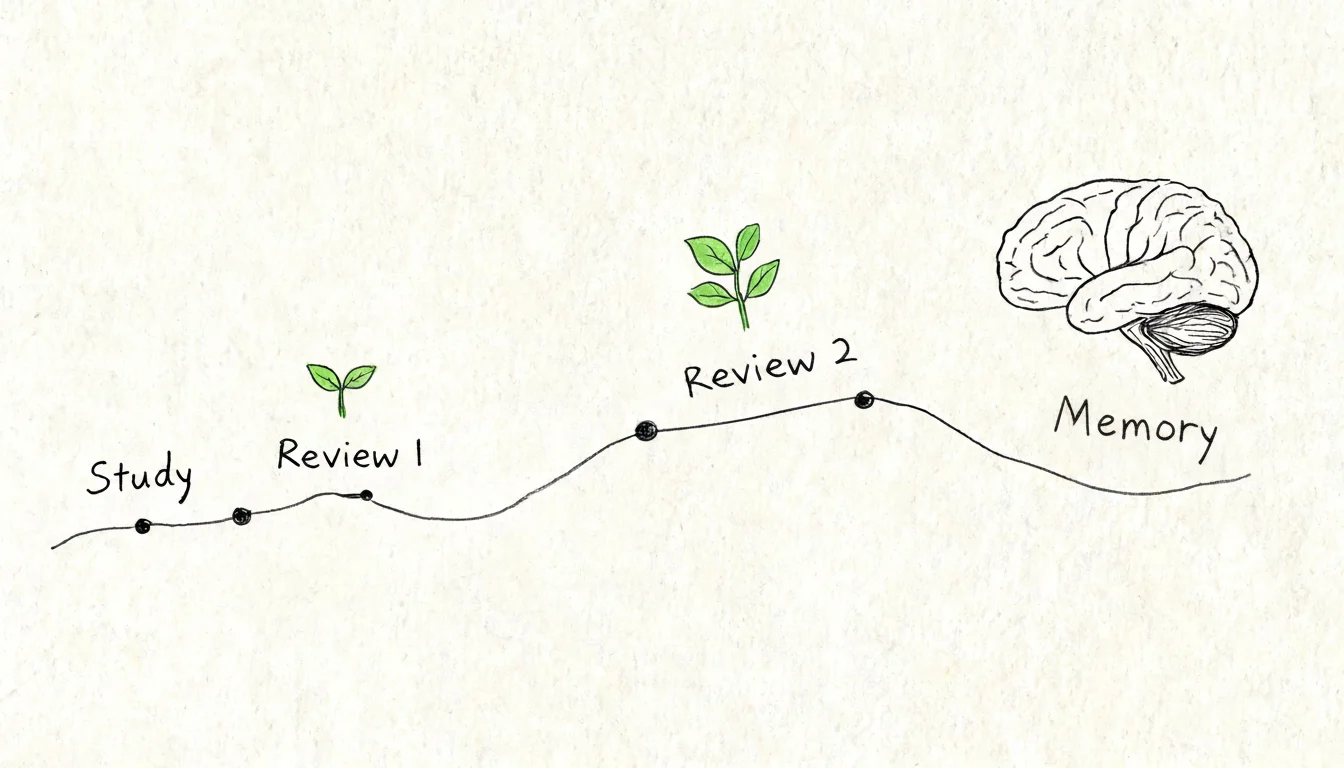
That’s where spaced repetition helps. Instead of reviewing everything evenly, you return to weaker topics at increasing intervals. This is similar to watering a plant. A new seed needs more attention early. Once roots are established, you can check in less often and still keep it growing.
Turn mock data into review buckets
After each mock, sort topics into three groups:
| Bucket | What it means | What to do |
|---|---|---|
| Strong | You answered correctly and could explain why | Review lightly to maintain recall |
| Needs review | You got it right or wrong, but your reasoning felt shaky | Revisit soon with examples and explanation review |
| Weak | You missed it and couldn’t explain the concept clearly | Review first, then retest within a short interval |
This approach works because it removes the temptation to study everything equally. That’s inefficient.
A practical spaced repetition rhythm
Use a simple cycle:
- Day 1 review newly missed topics
- Day 3 test yourself on those same topics again
- Day 7 revisit them with fresh questions or flashcards
- Later review move them into a lighter maintenance cycle once they feel stable
The exact schedule can vary. What matters is the repeated, intentional return.
Studies and user feedback consistently show that thorough review, especially with spaced repetition, significantly boosts retention. This approach helps learners achieve higher scores by focusing on concept reinforcement, not just answering more questions.
Build a weekly study loop
A simple weekly loop might look like this:
- One timed session for exam stamina
- Two targeted review sessions focused on weak and shaky topics
- One light recap session for stronger topics
- One short reflection where you update your error log
If you want a broader framework for this kind of targeted review, Mindmesh Academy's guide to adaptive learning is a useful companion read.
What your notes should actually look like
Don’t write long summaries you’ll never revisit. Keep notes compact.
Good note examples:
- “SaaS = use the software, provider manages more.”
- “MFA = sign-in protection, not data classification.”
- “SharePoint = team content and collaboration. OneDrive = personal file storage and sharing.”
- “DLP = helps prevent sensitive data from leaving where it shouldn’t.”
That style forces understanding. If you can’t write the concept clearly, you probably don’t own it yet.
Short notes reviewed repeatedly beat long notes reviewed once.
Common Pitfalls That Derail MS-900 Candidates
A lot of MS-900 frustration comes from study traps, not lack of ability. Here are the ones I see most often.
Study trap one
Memorizing answer positions instead of concepts
You remember that a certain choice was correct, but not why. Then the exam changes the wording and your confidence disappears.
How to escape: after each question, explain the right answer out loud in plain language before moving on.
Study trap two
Ignoring explanations after a correct answer
Getting the question right can hide weak reasoning. Maybe you guessed correctly. Maybe two options still looked plausible.
How to escape: review any question that felt uncertain, even if you answered correctly.
Study trap three
Practicing untimed forever
Untimed review is useful early, but staying there too long creates pacing problems. MS-900 rewards clear, quick recognition.
How to escape: mix study mode with timed sessions so you train both understanding and speed.
Study trap four
Treating weak areas emotionally
Some candidates avoid licensing, compliance, or cloud models because those topics feel boring or hard. Avoidance turns a small weakness into a lasting one.
How to escape: put weak topics first in your review block, when your attention is best.
The most dangerous study habit is confusing familiarity with mastery.
Beyond the Exam What Comes After MS-900
MS-900 is a starting point, not a finish line. This matters even more because the exam is currently scheduled to retire on March 31, 2026 (verify official dates with Microsoft directly). Many prep platforms help learners prepare for the current exam but often don't clearly map out what comes next, including paths toward AZ-900 or SC-900.
That retirement date shouldn’t discourage you. It should make you think strategically.
If your interest is broad cloud understanding, AZ-900 is a logical next move. If your interest leans toward security, governance, and identity, SC-900 is a natural follow-on. If your role touches Microsoft 365 administration, the foundations you build here still matter because the concepts transfer.
The key is to carry forward what MS-900 teaches best:
- how cloud services are described
- how Microsoft 365 products fit business needs
- how security and compliance features solve specific problems
- how licensing and support decisions affect adoption
That’s why I encourage students not to chase a badge in isolation. Learn the concepts well enough that the next certification feels like progression, not a restart.
If you want a smarter way to prepare for your next certification, MindMesh Academy can help you move beyond passive question drills. Our approach emphasizes concept mastery, adaptive study paths, and evidence-based methods like spaced repetition. You'll not only be well-prepared to pass your exam, but also build knowledge you can carry into the next stage of your career. Explore how MindMesh Academy can help you advance your career by visiting our certifications page.

Written by
Alvin Varughese
Founder, MindMesh Academy
Alvin Varughese is the founder of MindMesh Academy and an enterprise architecture leader. An electrical engineer by training, he moved from factory automation in South Africa to cloud architecture at GE Appliances and Humana (Fortune 50), and holds 20 professional certifications including AWS Solutions Architect Professional, Azure DevOps Engineer Expert, and Microsoft Agentic AI Business Solutions Architect. He built MindMesh Academy after interviewing too many highly certified candidates who couldn't answer basic questions: the goal is prep that makes you better at the job, not just able to pass the exam.