
The 7 Most Popular Azure Certifications for 2026
Azure remains one of the two dominant hyperscale cloud platforms, with about 20% of the cloud infrastructure market share. That matters if you're trying to pick the most popular azure certification, because popularity doesn't exist in a vacuum. It follows platform adoption, hiring volume, and the need for teams that can run, secure, and improve production environments.
The hard part isn't finding a ranked list. The hard part is avoiding the wrong certification for your actual job path. Microsoft's certification ladder starts with fundamentals and moves through associate, expert, and specialty tracks, and if you're new to cloud, several guides and Microsoft's own certification structure point to AZ-900 as the usual starting point. But “most popular” isn't always “best for you.”
That's why I'd treat Azure certifications as career tools, not trophy badges. If you want to work in operations, the useful cert looks different from the one that helps an architect, a security engineer, or a DevOps lead.
The seven options below are the certifications I'd put in front of individuals planning an Azure move in 2026. I'm ranking them by real-world usefulness and buyer intent, not just exam fame.
1. Certifications - Azure
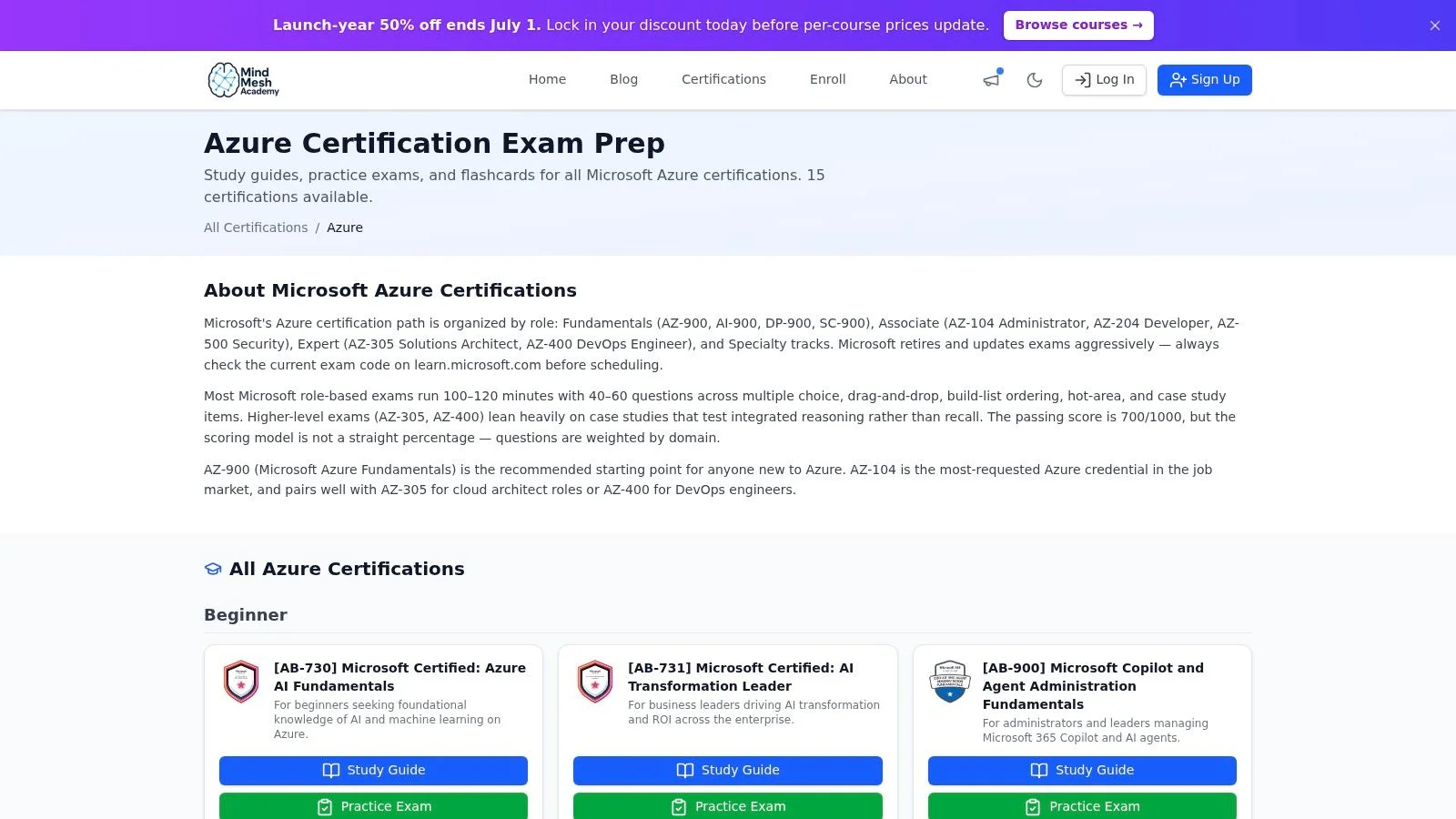
Candidates who pass Azure exams and still perform well on the job usually do two things: they follow a structured study plan, and they spend time in the platform. That matters across every path in this article, whether you are aiming at admin, architecture, security, or DevOps.
This section is about preparation, not a certification ranking. If you already know which exam fits your target role, a guided prep system can shorten the path and cut down on random studying.
Certifications - Azure is one option for that. The practical value is structure. Instead of juggling Microsoft docs, handwritten notes, flashcards, and scattered question banks, you get one study workflow that helps you see what you know, what you keep missing, and where to spend the next study block.
I care less about polished dashboards than whether a platform fixes common study mistakes. The useful features here are adaptive review, spaced repetition, and progress tracking. Those are helpful because candidates often spend too much time on familiar services and avoid weaker domains like governance, identity, or networking.
That matters even more once you move past AZ-900. AZ-104, AZ-500, AZ-305, and AZ-400 reward pattern recognition and decision-making under exam pressure, not just recall. A prep system can help you build that rhythm.
Where a prep platform actually helps
The biggest benefit is consistency.
A beginner can use structured prep to build baseline Azure vocabulary and avoid getting lost in Microsoft's documentation tree. An experienced engineer can use the same system to focus on gaps instead of rereading material they already use at work.
Use cases tend to break down like this:
- Career changers and junior candidates: Better for building a study routine and covering the full exam blueprint without guessing.
- Working admins and engineers: Better for targeted review before role-based exams, especially if time is limited.
- Candidates switching tracks: Useful if you know Azure in one lane, such as administration, but need to prepare for another, such as security or architecture.
If you are starting with fundamentals, AZ-900 practice test resources can help you gauge whether you are ready before paying for the exam.
Trade-offs to keep in mind
No prep platform replaces hands-on Azure work. That is the main limit, and it is a real one.
For AZ-104, AZ-500, AZ-305, and AZ-700, you still need time in the portal, CLI, policy configuration, networking, RBAC, and service deployment. If your only exposure is videos and practice questions, you may pass a test and still struggle in an interview or in production.
Cost is the other trade-off. Paid prep makes sense if lack of structure is your bottleneck. If your bigger problem is limited lab time, spend more effort on sandbox work, personal projects, and Microsoft Learn labs first.
My rule is simple: use a prep platform to organize study and improve retention, then pair it with real configuration work in Azure. That combination has more career value than exam prep alone.
2. Microsoft Certified: Azure Fundamentals (Exam AZ-900)
Azure Fundamentals is still the most popular azure certification for one simple reason. It's designed for beginners and requires no prior technical experience, and Microsoft positions it as the foundation of the Azure path in its Azure Fundamentals certification page.
That beginner-first design is why AZ-900 keeps showing up at the top of ranked lists. Firebrand's 2025 roundup placed AZ-900 first, and CertificationCamps' 2026 shortlist also puts Azure Fundamentals first, as summarized in the verified market overview above. In other words, this is the default on-ramp for the broadest set of learners.
Who should start here
AZ-900 fits three groups especially well:
- Career changers: You need cloud literacy before you can specialize.
- Students and junior IT staff: You need a credential that proves basic Azure fluency without assuming deep ops experience.
- Non-technical stakeholders: Project managers, analysts, and sales engineers often need enough Azure knowledge to communicate clearly with technical teams.
This exam covers cloud concepts, core Azure services, pricing, governance, and security basics. That sounds broad because it is broad. The upside is shared vocabulary. The downside is that it doesn't prove you can operate anything.
AZ-900 is valuable when you're trying to get into Azure. It's less valuable when you're trying to prove you can already run Azure.
For prep, I'd combine Microsoft Learn with focused AZ-900 practice test resources. That mix works better than passive reading alone because AZ-900 often trips people up on service distinctions and governance wording, not just raw definitions.
Where AZ-900 helps and where it doesn't
This cert opens doors to interviews and internal conversations. It gives hiring managers a quick signal that you understand the platform at a basic level. It also helps teams align on the same terminology before they branch into admin, architecture, data, or security tracks.
But don't overestimate it. If you're already an experienced engineer, AZ-900 by itself won't move the needle much. In that case, treat it as a fast foundation or skip straight to the role-based path that matches your target job.
3. Microsoft Certified: Azure Administrator Associate (Exam AZ-104)
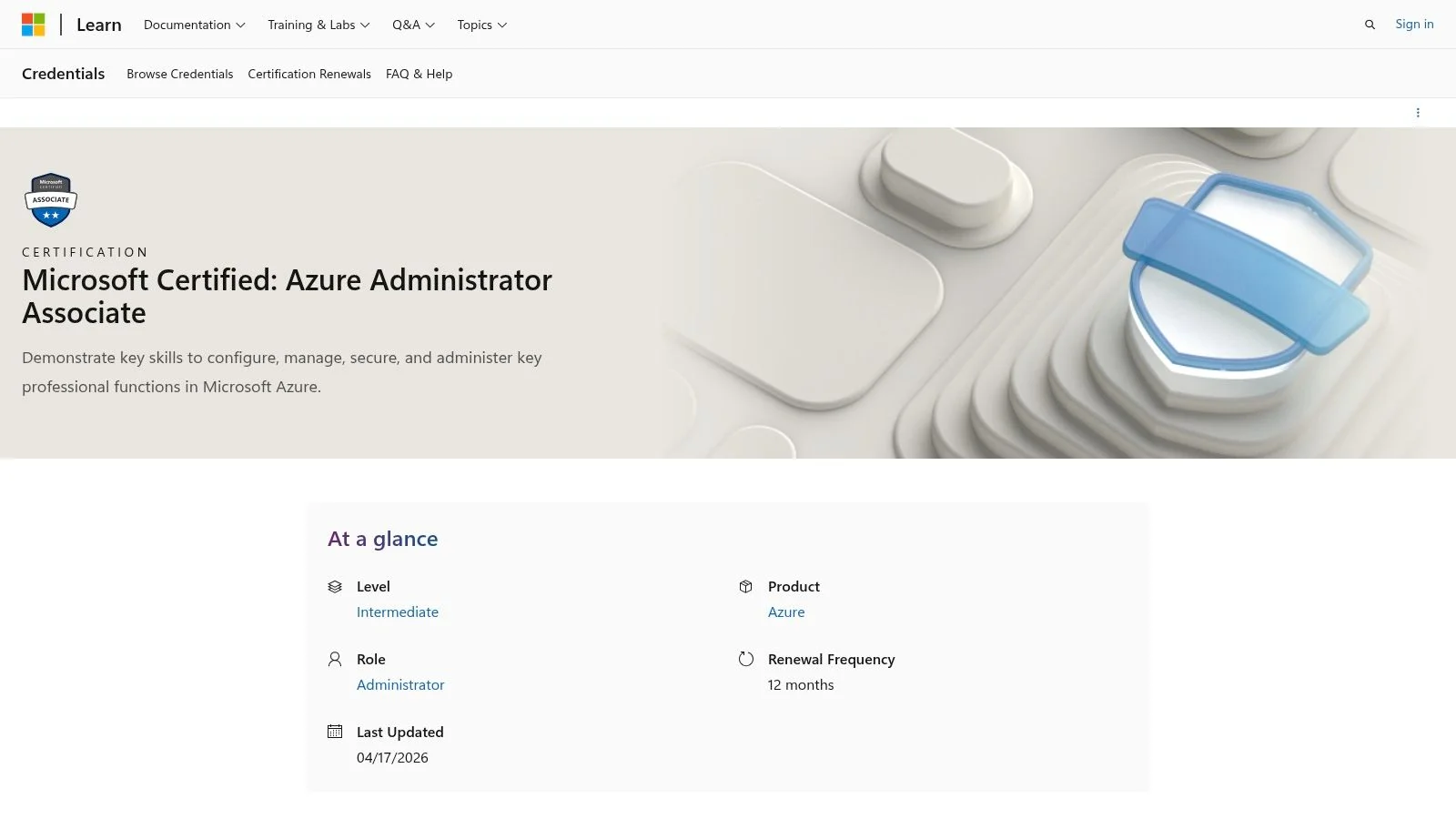
AZ-104 is where Azure certification starts feeling like job training instead of orientation. If someone tells me they want to work in cloud operations, infrastructure, platform support, or day-to-day Azure administration, this is usually the first serious recommendation.
The exam maps well to real admin work: subscriptions, identities, governance, networking, storage, compute, and security. That breadth is useful because many Azure admin roles aren't narrowly specialized. One week you're fixing access, the next week you're reviewing network config, and then you're cleaning up resource governance.
Best fit for the operations path
AZ-104 exam details make it clear that Microsoft treats this as a role-based certification, not a theory badge. It also renews annually through Microsoft Learn's free renewal model, which is the right setup for a platform that changes constantly.
Data on compensation also helps explain why this exam stays popular. ZipRecruiter reported Azure Administrators commonly earning between $80,000 and $116,500, based on the verified salary research summarized from the Pluralsight analysis earlier. That doesn't mean the cert alone creates that outcome. It means the role attached to it has real market weight.
- Choose AZ-104 if: You want to manage Azure environments, identities, storage, networking, and governance.
- Skip AZ-104 if: You're focused on app development, data engineering, or non-technical cloud literacy.
- Pair it with: Hands-on labs, subscription cleanup exercises, RBAC practice, and network troubleshooting.
What separates people who pass AZ-104 from people who use AZ-104 at work is repetition. Build and break things in Azure until the portal stops feeling unfamiliar.
The main trade-off
AZ-104's strength is also its pain point. The scope is wide. People who only study from summaries usually struggle because the exam expects you to think through scenarios, not just remember service names.
If your end goal is architect, security, or DevOps, AZ-104 is still often the right intermediate step. It gives you operational credibility that later certifications build on.
4. Microsoft Certified: Azure Solutions Architect Expert (Exam AZ-305)
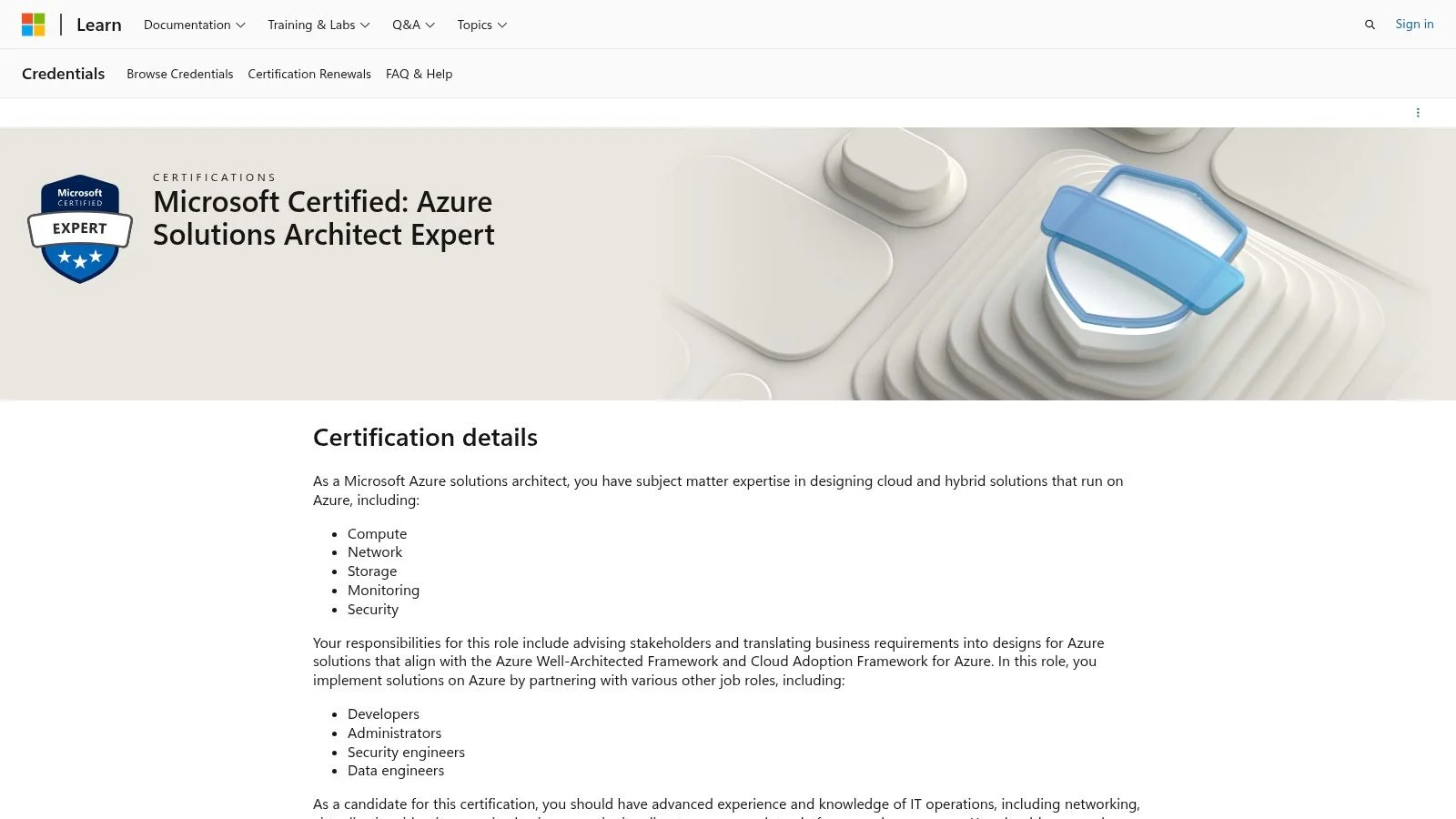
AZ-305 is the certification people often want too early. I understand why. Architect titles are attractive, and the cert is widely respected. But if you haven't spent time operating Azure, designing on paper is harder than it looks.
Azure Solutions Architect Expert is built for professionals who need to design secure, resilient, and cost-aware solutions across identity, governance, infrastructure, data storage, and continuity planning. That's not beginner territory. It's a senior design exam.
Why it stays near the top
Lists of the most popular azure certification options almost always include AZ-305 near the top because employers value end-to-end design skill. It's also a natural next move after admin experience. If you're aiming for consultant, lead engineer, cloud architect, or platform design roles, this cert has clear signaling power.
For salary context, verified research cited by Pluralsight showed Azure Fundamentals holders earning an average salary of $126,653 in 2020 and Azure Administrator Associate holders averaging $125,993 in the same dataset. I wouldn't use those numbers to claim architect pay directly, but they do show that Azure credentials sit inside a strong-paying ecosystem.
If you're trying to map your route, this is a good place to discover Azure certification tracks before jumping in.
What AZ-305 rewards
This exam rewards people who can make trade-offs, not just identify services.
- Security trade-offs: Identity boundaries, access control, and governance design
- Reliability trade-offs: Business continuity, recovery planning, regional choices
- Cost trade-offs: Matching architecture decisions to budget and workload patterns
- Platform trade-offs: Picking services that fit operational reality, not just ideal diagrams
If you can't explain why one Azure design is better than another for a specific business constraint, you're not ready for AZ-305 yet.
The downside is obvious. Breadth can overwhelm even solid engineers. I'd recommend it for people with hands-on Azure exposure who already think in systems, not just components.
5. Microsoft Certified: Azure Security Engineer Associate (Exam AZ-500)
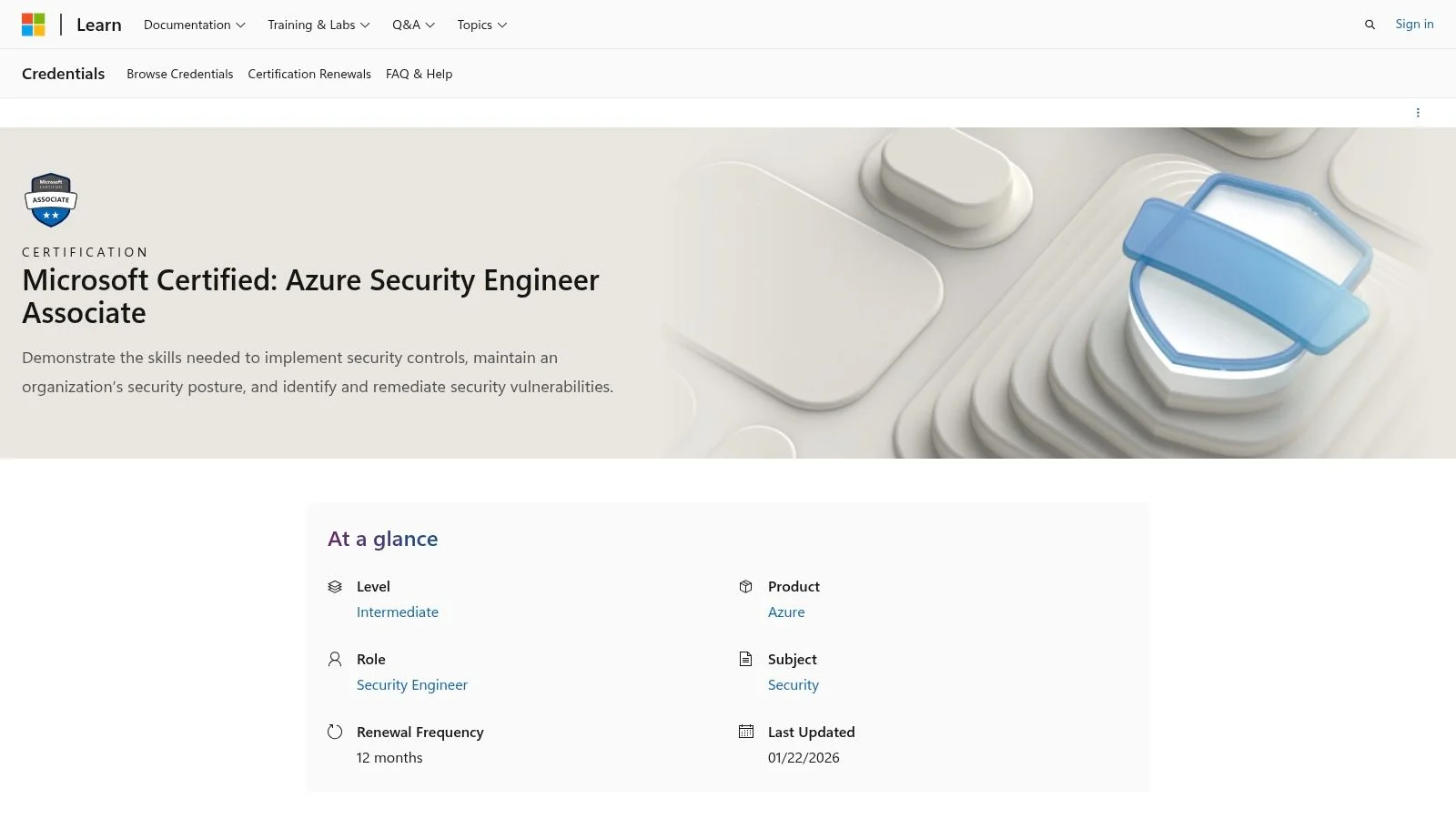
AZ-500 has become more important as Azure teams mature. Early cloud projects usually focus on getting workloads deployed. Later, the harder conversations arrive: identity boundaries, security posture, vulnerability remediation, policy enforcement, and incident response.
That's why AZ-500 is one of the smartest picks for admins and architects who want sharper cloud security credibility. It covers identity and access, platform protection, security operations, and data security across Azure and hybrid environments.
A better choice than another generic cert
Security certifications often offer greater career advantage than another broad generalist badge, especially if you already have baseline Azure knowledge. AZ-500 also complements multiple paths. An administrator becomes more valuable. An architect becomes more credible. A consultant becomes more trusted in regulated environments.
This also fits a broader market shift. Recent top-certification rankings increasingly include AI and data credentials such as AI-102 and DP-203, and security-focused options like AZ-500 are part of that same move away from a fundamentals-only conversation, as noted in the verified DataCamp summary.
- Strong fit: Cloud security engineers, admins moving into security, architects who design governed environments
- Weak fit: People with no grounding in identity, networking, or Azure administration
- Study advice: Spend real time with Defender for Cloud, Entra, policy, and posture review workflows
What doesn't work
Book knowledge alone usually isn't enough here. Security controls make more sense when you've seen misconfigurations, noisy alerts, access mistakes, or remediation workflows in action.
I also wouldn't recommend AZ-500 as a first Azure exam for most individuals. It's better as a second step after fundamentals or administration, unless you already work in cloud security and just need Azure-specific validation.
6. Microsoft Certified: DevOps Engineer Expert (Exam AZ-400)
AZ-400 is the certification I recommend when a team's real bottleneck isn't cloud provisioning. It's delivery. Slow releases, inconsistent pipelines, weak monitoring, poor collaboration between development and operations, and no clear deployment governance.
DevOps Engineer Expert focuses on CI/CD, source control strategy, release design, security and compliance in delivery pipelines, instrumentation, and collaboration using Azure DevOps and GitHub. That makes it highly relevant for tech leads, SREs, release owners, and cloud engineers who sit between code and operations.
The expert cert with the clearest practical payoff
This one has a direct prerequisite path. You need an associate-level Azure certification such as Azure Administrator Associate or Azure Developer Associate to earn it. That's a good thing. DevOps in production depends on foundational competence.
What I like about AZ-400 is that it validates a real business function. Companies don't just want cloud experts. They want teams that can ship safely and repeatedly.
Teams don't hire DevOps engineers to admire pipelines. They hire them to reduce deployment friction and make change safer.
When to choose it
Choose AZ-400 if your day job includes release automation, infrastructure as code, environment governance, observability, or deployment reliability. Skip it if you're still getting comfortable with Azure core services or if you've never owned a delivery pipeline.
A lot of candidates underestimate the governance side of this exam. It isn't just “how to make builds run.” It's also about quality controls, secure delivery, feedback loops, and aligning tooling with how teams work. That's why project experience helps so much.
7. Microsoft Certified: Azure Network Engineer Associate (Exam AZ-700)
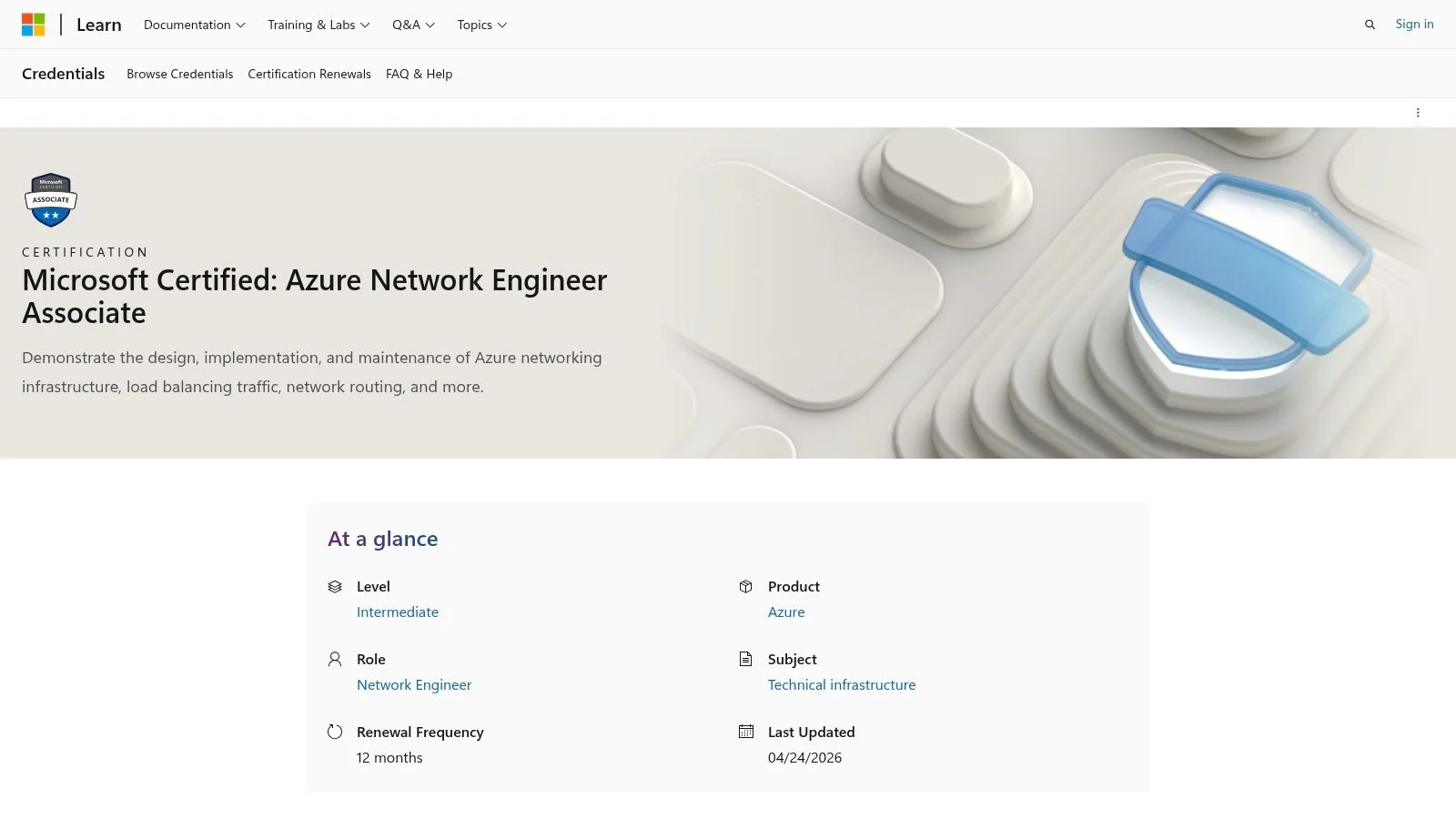
AZ-700 doesn't get as much mainstream attention as AZ-900 or AZ-104, but it solves a real hiring problem. Plenty of teams have people who can deploy compute. Fewer have people who can design and troubleshoot Azure networking well.
Azure Network Engineer Associate covers virtual networks, hybrid connectivity, application delivery, private access, routing, load balancing, and network security. If your environment spans on-prem and Azure, this certification becomes much more relevant.
Where it creates separation
This certification is especially strong for network engineers moving into cloud and for infrastructure professionals who want to own connectivity at scale. It also pairs well with AZ-104 or an architect path because networking weaknesses show up everywhere: performance, security, access, resilience, and migration design.
One overlooked advantage is specialization. A lot of certification content still revolves around the same small cluster of exams. Meanwhile, Microsoft's broader ecosystem and market guides increasingly point learners toward adjacent tracks tied to security, AI, data, and specialized operational needs instead of treating one “most popular” answer as universal.
- Best for: Hybrid infrastructure teams, network specialists, platform engineers with routing and connectivity responsibility
- Less useful for: Pure software developers and data-only practitioners
- Biggest challenge: The learning curve is steeper if your background is mostly compute or applications
A candidate with AZ-700 usually signals practical depth, not just broad Azure familiarity. That's valuable when your company's hardest incidents involve DNS, private endpoints, route propagation, firewalls, VPNs, or ExpressRoute-style thinking.
Top 7 Azure Certifications Compared
| Title | Implementation complexity | Resource requirements | Expected outcomes | Ideal use cases | Key advantages |
|---|---|---|---|---|---|
| Certifications - Azure (Mindmesh Academy) | Low–Moderate (structured, guided) | Subscription for full access; Azure account/labs for hands‑on practice | Durable knowledge, exam readiness, skill gap visibility | Learners seeking structured, evidence‑based prep from beginner to pro | Adaptive learning, spaced repetition, expert content, analytics dashboard |
| Microsoft Certified: Azure Fundamentals (AZ-900) | Very Low (theory-focused) | Study time, Microsoft Learn resources, optional practice tests | Foundational cloud literacy and entry-level credential | Career changers, students, teams aligning on cloud basics | Most approachable, widely recognized baseline |
| Microsoft Certified: Azure Administrator Associate (AZ-104) | Moderate (hands‑on admin tasks) | Hands‑on lab time, official learning paths, practice assessments | Validated day‑to‑day Azure administration skills | Aspiring cloud administrators and infra/ops roles | Scenario‑based, maps to operational job tasks |
| Microsoft Certified: Azure Solutions Architect Expert (AZ-305) | High (broad design responsibilities) | Extensive design experience, prior certs helpful, study guides | Expert credibility in end‑to‑end Azure solution design | Senior architects, consultants, lead engineers | Well‑regarded for senior roles, holistic design focus |
| Microsoft Certified: Azure Security Engineer Associate (AZ-500) | High (security across stack) | Hands‑on with Defender, Entra, SIEM/SOAR; labs and practice tests | Validated cloud security implementation and posture management | Cloud security engineers, compliance and security teams | Strong market demand, complements admin/architect paths |
| Microsoft Certified: DevOps Engineer Expert (AZ-400) | High (CI/CD and governance) | Real project experience with pipelines, Azure DevOps/GitHub, prerequisites | Validated end‑to‑end delivery and DevOps practices | SREs, tech leads, teams standardizing delivery pipelines | Bridges dev and ops, valued for pipeline/automation expertise |
| Microsoft Certified: Azure Network Engineer Associate (AZ-700) | High (deep networking concepts) | Deep networking labs, routing/firewall practice, official prep resources | Validated Azure networking planning and management skills | Network engineers moving to cloud, infra teams managing connectivity | Differentiates hybrid connectivity and application delivery skills |
Choosing Your Path and Taking the Next Step
AZ-900 stays the most common starting point because it is accessible and low risk. The stronger decision is to choose the certification that matches the job you want next, then build a study plan around that target.
For entry-level cloud support, help desk, or career changers, AZ-900 is a good first move if you need Azure vocabulary and platform basics. For hands-on administration work, AZ-104 usually delivers more hiring value because it maps to the day-to-day tasks teams assign. For senior design roles, AZ-305 carries more weight, but it pays off most for engineers who already understand operations and can defend architecture choices under real constraints. Security-focused candidates should prioritize AZ-500 if they want to stand out in access control, threat protection, and cloud governance. Pipeline owners, platform engineers, and SRE-leaning candidates get better returns from AZ-400. Network specialists and hybrid infrastructure teams often get faster differentiation from AZ-700 than from a broader cert that overlaps with what they already know.
Salary impact follows role alignment more than popularity. A certification tied closely to your current responsibilities or next promotion case tends to help more than a badge that looks good on a shortlist but does not reflect the work you do. I have seen AZ-104 open doors faster than AZ-305 for mid-level engineers for exactly that reason. Teams hire for problems they need solved now.
Study time should reflect exam depth and your hands-on experience. AZ-900 often fits into a shorter prep window. AZ-104, AZ-500, and AZ-700 usually need steady lab practice over several weeks. AZ-305 and AZ-400 generally take longer because design judgment, delivery trade-offs, and cross-service knowledge are harder to cram. A practical checkpoint is simple: book the exam only after you can explain why one Azure service fits better than another, complete common tasks without hunting through docs, and pass solid practice questions consistently.
Microsoft also treats certification as a continuing process, not a one-time milestone. Renewal is built into the system, and the skills that hold value keep shifting toward security, automation, data, and AI-adjacent work. That makes your first Azure cert a career direction signal, not just an exam result.
If you want a structured way to prepare, Mindmesh Academy is one option for building a timeline, finding weak areas early, and keeping review sessions focused on job-relevant skills instead of memorizing answers.

Written by
Alvin Varughese
Founder, MindMesh Academy
Alvin Varughese is the founder of MindMesh Academy and an enterprise architecture leader. An electrical engineer by training, he moved from factory automation in South Africa to cloud architecture at GE Appliances and Humana (Fortune 50), and holds 20 professional certifications including AWS Solutions Architect Professional, Azure DevOps Engineer Expert, and Microsoft Agentic AI Business Solutions Architect. He built MindMesh Academy after interviewing too many highly certified candidates who couldn't answer basic questions: the goal is prep that makes you better at the job, not just able to pass the exam.