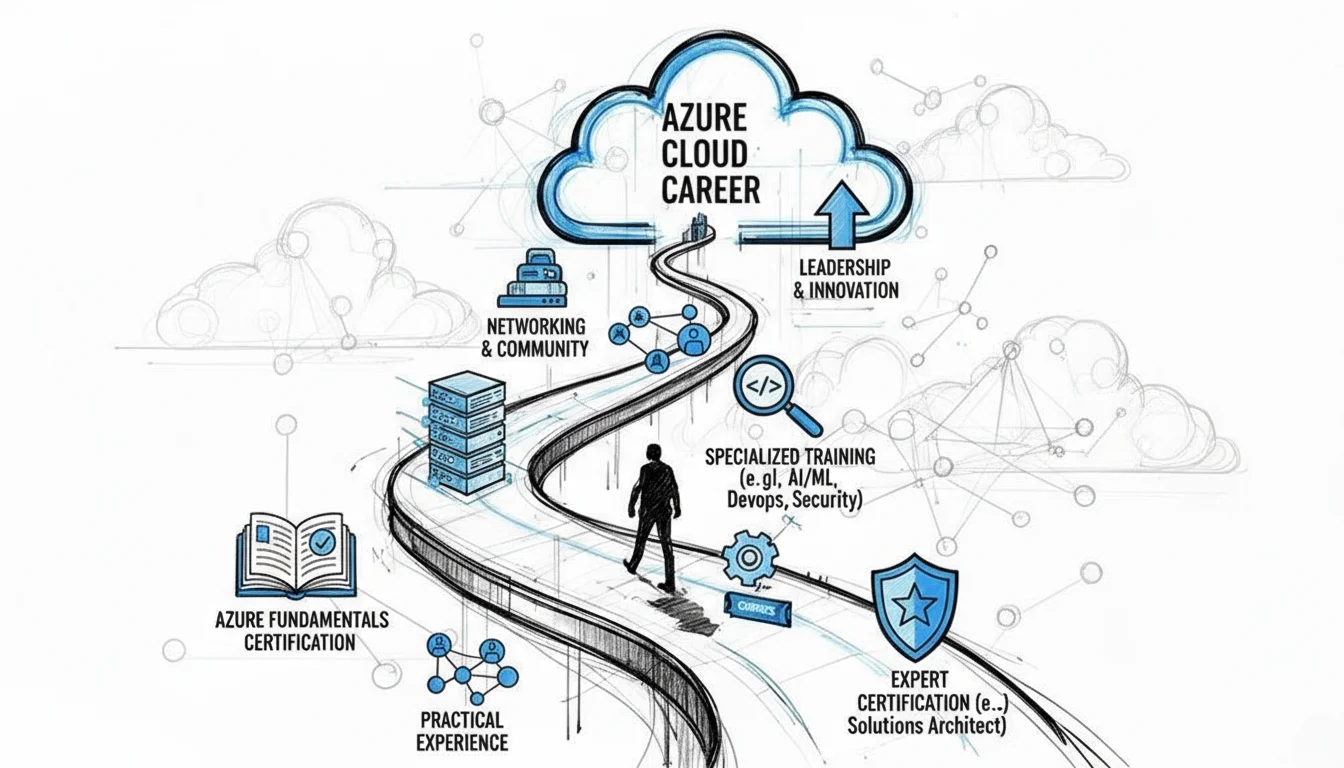
Launch Your Microsoft Azure Career in 2026
Starting a career in technology can feel overwhelming, but for those seeking a clear, high-demand, and lucrative career track, the direction is unmistakable: Microsoft Azure. The scale of its adoption is massive. Currently, 95% of Fortune 500 companies use Azure for their daily operations (verify current figures on the vendor site). This widespread reliance by the world’s leading organizations represents a permanent shift rather than a temporary trend. It creates an immense and sustained demand for skilled IT professionals. This choice offers more than simple job security. It provides an opportunity to build a stable career with high earning potential in an industry set for continuous growth.
Why Your Future Is in the Azure Cloud
Cloud technology is no longer an optional upgrade; it is the foundation where modern business growth happens. While several providers exist, Microsoft Azure stands out because of how it integrates into the daily operations of global corporations. Demand for Azure expertise is not just a trend. It is a structural requirement for businesses that want to stay competitive. This shift has changed how organizations manage their data, applications, and security.
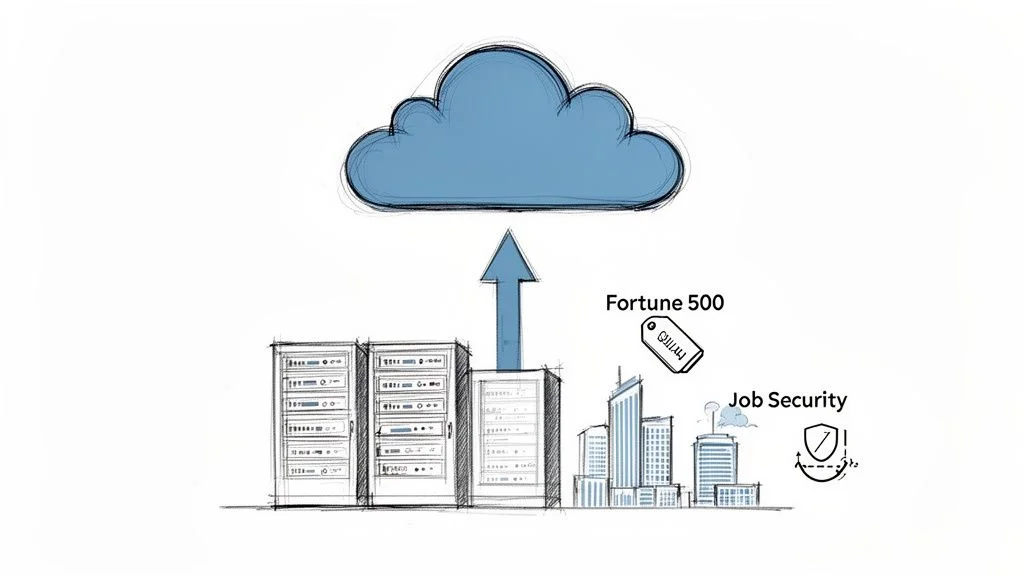
By 2026, Azure holds a 20% share of the global cloud infrastructure market. This position makes it the second-largest provider in the world. Its reputation for enterprise stability and reliable security is a major reason why 480,000 organizations—including those in healthcare, finance, and government—rely on it for critical operations. While market dynamics change, these figures show a clear pattern of growth and a steady need for skilled professionals.
Choosing a career in the Azure cloud is a practical move for long-term stability. The following table summarizes why this platform remains a top choice for IT professionals.
Why Your Future Is in the Azure Cloud
| Key Factor | What It Means for Your Career |
|---|---|
| Enterprise Dominance | Azure is the primary choice for large corporations that already use Microsoft software. This creates a constant demand for staff who can manage hybrid environments that mix on-premises servers with cloud tools. |
| Market Share & Growth | As a top-tier global provider, Azure’s expansion leads to more job openings. This growth provides IT professionals with various roles across different technical specialties. |
| Innovation in AI & Data | Specializing in Azure keeps your skills current. You will work with the systems that run the latest developments in artificial intelligence, machine learning, and advanced data analytics. |
| Massive Ecosystem | Thousands of organizations use Azure globally. Your technical skills will apply to many different industries and locations, giving you more freedom to choose where and how you work. |
These factors are not just statistics. They represent the actual market forces that create high-paying, stable, and interesting jobs for people with the right certifications and experience.
The Enterprise Advantage: Bridging Legacy and Cloud
Azure has a clear advantage in the corporate world that other providers struggle to match. For decades, large companies built their internal systems on Microsoft technology like Windows Server, Office 365, and Active Directory. When these companies move to the cloud, they rarely look for a total replacement. Instead, they look for a way to extend what they already own. Azure is the natural destination for this transition.
This creates a specific opportunity for you. If you specialize in Azure, you do more than just manage cloud storage. You act as the technical bridge. You help a company connect its existing on-premises systems with modern cloud services. This ability to integrate old and new technology is a high-value skill. Companies pay well for professionals who can manage this transition without disrupting their daily operations.
Reflection Prompt: Think about an IT environment you've worked with. How much of it relies on Microsoft products? How could an Azure specialization allow you to lead its cloud migration or modernization efforts?
Your Path to a Future-Proof Career
An Azure career involves much more than just setting up virtual machines. The platform is currently a center for development in artificial intelligence and big data.
When you build your skills around Azure, you are doing more than learning a platform. You are positioning yourself where business operations meet next-generation technology. This is the area where the most significant job growth is happening.
Microsoft is putting massive resources into services like Azure AI, Azure Machine Learning, and the Azure OpenAI Service. Learning these tools opens doors to some of the most lucrative roles in technology today. For example, the Azure AI Engineer (AI-102) certification proves you have the skills to build and deploy AI solutions in a professional environment.
To make sure your career stays relevant for the long term, focus your training on these specific areas:
- Artificial Intelligence: Most companies are now trying to find ways to use AI. If you understand Azure’s AI tools—ranging from machine learning models to cognitive services—you become a vital part of their strategy.
- Data and Analytics: Modern business depends on data-driven decisions. If you know how to use Azure data tools like Azure Synapse and Power BI, you provide the insights that executives need to lead their companies.
- Security: As cyber threats become more frequent, companies need experts who can protect their cloud assets. Learning how to use Azure Security Center and Microsoft Sentinel makes you a highly valued asset. This often leads to specialized roles such as an Azure Security Engineer (AZ-500).
Building expertise in these fields is a long-term investment. The goal is to build a career that stays relevant even as technology changes. Azure provides the tools and the market demand to make that possible.
Key Takeaway: Azure's Future-Proofing Azure’s presence in large enterprises and its focus on AI, data, and security ensure that the skills you learn today will be useful for years. It is a career choice that offers both stability and a clear path for advancement.
Identifying Azure Roles: Key Tasks and Career Paths
Before you can build a successful career in Microsoft Azure, you must understand where your skills and technical interests align. The Azure platform environment is extensive. Stating that you "work with Azure" is as vague as saying you "work in construction"—it does not clarify if you are the architect, the project manager, or the foundation specialist.
To advance, you must identify a specific, in-demand role. This section examines the most common and critical jobs in the Azure market, highlighting their distinct duties and differences. Use these descriptions to help determine your professional direction within the cloud space.
The Azure Administrator: The Infrastructure Specialist
Every stable cloud environment requires a dedicated professional to manage and maintain daily operations. This role belongs to the Azure Administrator. Administrators are the hands-on experts responsible for implementing, managing, and monitoring many different Azure resources. They handle virtual networks, storage solutions, identity management, and security governance. When technical issues arise, these professionals act as the first responders.
A typical day for an Azure Administrator involves practical infrastructure management:
- Provisioning and managing virtual machines (VMs): To ensure applications have the necessary compute resources, administrators deploy and configure VMs. This work includes selecting appropriate instance sizes, managing operating systems, and setting up persistent storage disks.
- Securing virtual networks: These specialists configure firewalls and Network Security Groups (NSGs). They control inbound and outbound traffic to ensure proper data flow while maintaining strict isolation between development and production environments.
- Setting up backup and disaster recovery plans: Using services like Azure Backup and Recovery Services Vaults, administrators anticipate potential failures. They prepare for the rapid restoration of critical data to keep the business running during outages.
- Monitoring resource usage and costs: Administrators use tools like Azure Monitor to track system health. They analyze telemetry data to optimize efficiency and ensure the cloud spend stays within the allocated budget.
This role does not focus heavily on writing application code. Instead, you will work with infrastructure automation and management. Proficiency with PowerShell and the Azure CLI is necessary to automate routine tasks and manage resources at scale. The Microsoft Certified: Azure Administrator Associate (AZ-104) certification validates these core operational skills.
The Azure DevOps Engineer: Bridging Development and Operations
If the Azure Administrator ensures the stability of the environment, the Azure DevOps Engineer focuses on the speed of software delivery. Their mission is to streamline the software delivery lifecycle so developers can ship code faster and with higher reliability. They act as the architects of automation, connecting the world of software development (Dev) with IT operations (Ops).
Their work centers on building automation pipelines and using Infrastructure as Code (IaC):
- Designing and implementing CI/CD pipelines: Using tools like Azure Pipelines, they automate the building, testing, and deployment of code. This ensures that every update is verified before it reaches the end user.
- Managing source code: DevOps engineers maintain version control systems such as Azure Repos or Git. They manage branching strategies and merge requests to ensure code quality and collaboration among development teams.
- Defining and deploying cloud environments: Instead of manual setup, they use Infrastructure as Code (IaC) tools like Bicep or Terraform. This allows them to treat infrastructure like software, making it repeatable and less prone to human error.
- Monitoring application performance: They track system health and application logs to identify and resolve performance bottlenecks before they affect customers.
For example, an Azure DevOps Engineer might create a workflow where every code commit automatically triggers a pipeline. This pipeline builds the application, runs a suite of automated security tests, and deploys it to Azure App Service without any manual intervention. The Microsoft Certified: Azure DevOps Engineer Expert (AZ-400) is the primary certification for this career path. These engineers do more than just manage infrastructure; they build the automated systems that deliver software. They are the architects of speed.
The Azure Solutions Architect: The Strategic Planner
While Administrators and DevOps Engineers handle technical implementation, the Azure Solutions Architect operates at a strategic level. These professionals are the visionaries who design cloud solutions. They ensure that every technical choice aligns with business objectives regarding performance, security, cost, and scalability.
The role of an Architect involves consultation and high-level design. They meet with business leaders to understand organizational requirements, then translate those needs into a detailed technical blueprint. They make the final decisions on which Azure services to use and how those services will integrate into a unified, reliable solution.
A large part of the job involves creating technical diagrams and documentation that guide implementation teams. For instance, an architect might design a highly available, multi-region architecture for a global e-commerce platform. This design must ensure the platform can handle massive traffic spikes during holiday sales and stay online even if an entire Azure region suffers an outage. The Microsoft Certified: Azure Solutions Architect Expert (AZ-305) validates this advanced design expertise. Architects focus on the "why" and "how" of the entire system.
The Azure AI Engineer: The Machine Learning Specialist
Positioned at the intersection of cloud infrastructure and artificial intelligence, the Azure AI Engineer represents a fast-growing specialization. These engineers build, manage, and deploy AI solutions using services like Azure Machine Learning and the Azure OpenAI Service.
The work is dynamic and changes as AI technology evolves. Typical tasks include:
- Training custom machine learning models: Engineers use organizational data to train models and then deploy those models into production environments where they can make real-time predictions.
- Integrating pre-built AI capabilities: They add features like computer vision, speech recognition, or natural language processing into existing business applications to improve user experiences.
- Developing intelligent applications: Using large language models (LLMs), they build new tools that can summarize documents, generate content, or provide advanced chatbot support.
- Managing data pipelines: AI workloads require massive amounts of data. AI engineers manage the underlying infrastructure that moves and processes this data to keep models accurate.
Success in this field requires a background in software development—often using the Python language—along with an understanding of machine learning concepts and algorithms. It is a challenging path that puts you at the front of technical innovation. The Microsoft Certified: Azure AI Engineer Associate (AI-102) is the central certification for this specialization. This role is ideal for those who want to solve complex problems using data and intelligent automation.
Choosing the Right Azure Certifications for Your Goals
Organizing your plan for Azure certifications can feel like a heavy task at first. With so many options available, it is easy to feel uncertain about which direction to take. The most important thing to remember is that you do not need to earn every single certification available. Success comes from selecting the specific credentials that align with your professional targets and your long-term career goals.
View these certifications as more than just a digital badge or a line on a resume. They serve as verified evidence of your technical ability. These credentials show hiring managers and recruiters that you have mastered specific, tested skills. When you are looking for your first job in the cloud or trying to move into a different role, these certificates help you explain your value clearly. Building a clear plan for your certifications is vital to starting your career on the Microsoft platform effectively.
Start with the Fundamentals: AZ-900
Regardless of your ultimate career goal, everyone starts at the same entry point: the Microsoft Certified: Azure Fundamentals (AZ-900) exam. This is your first step. The exam focuses on broad concepts rather than requiring you to perform deep technical configurations. It checks your understanding of essential cloud concepts and the primary services offered by Azure. You will also learn about the basics of security, privacy, and how Microsoft handles its pricing and support models.
While passing the AZ-900 will not get you a senior engineering position on its own, that is not the goal of this specific certificate. Earning this certification will:
- Confirm your direction and provide the confidence you need to know that a cloud career is a good fit for your skills.
- Give you the vocabulary and the technical foundation you need before you try to earn more difficult certifications.
This exam acts as the foundation for your technical knowledge. You would not try to build a house without checking the ground first, so do not skip this initial step in your training.
Reflection Prompt: Even if you have prior IT experience, why might the AZ-900 still be a valuable starting point for understanding Azure's unique terminology and service categories?
Match Associate Certifications to Your Target Role
After you have mastered the basics, it is time to specialize. At this stage, you must match your training to the job you actually want to do. Associate-level certifications are designed to prove that you have the practical, hands-on skills needed to handle specific tasks in a professional work environment.
Different roles require different types of technical knowledge. The training path for a Cloud Architect will be very different from the path for a Systems Administrator or a DevOps Engineer.
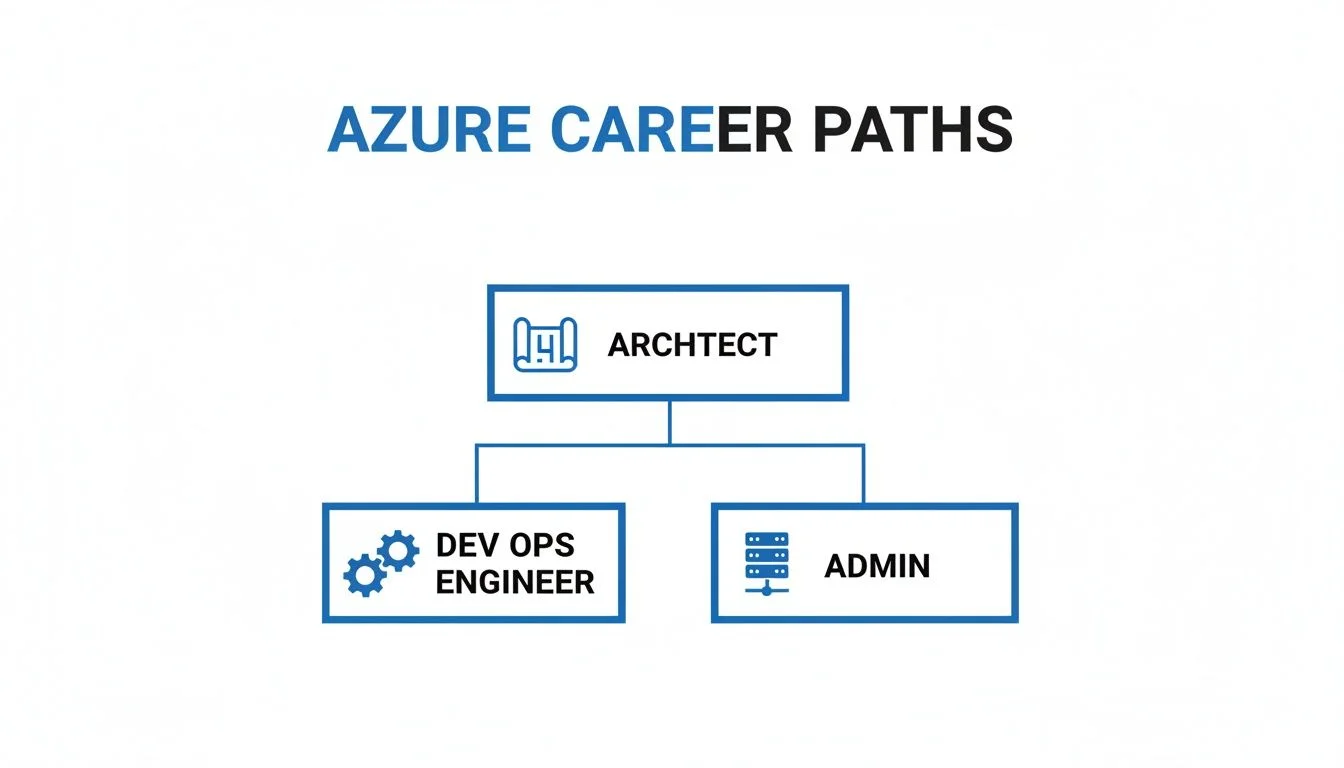
Each of these career paths has a specific exam. Selecting the right one saves you time and ensures you are learning the tools you will use every day on the job.
Here is a look at the most common Associate-level certifications and the roles they lead to:
- Azure Administrator Associate (AZ-104): This is the main certification for people who want to manage cloud environments. It proves you can handle daily management tasks. These tasks include managing user identities, setting up governance policies, and overseeing storage, virtual machines, and virtual networks.
- Azure Developer Associate (AZ-204): This is the path for those who enjoy writing code and building software. It shows that you know how to build, deploy, and fix applications that run on Azure. You will spend your time working with services like Azure App Service, Azure Functions, and Cosmos DB.
- Azure DevOps Engineer Expert (AZ-400): This certification is for professionals who work at the intersection of development and operations. You will learn to design plans for continuous integration and continuous delivery (CI/CD). It also covers managing source control and infrastructure through code. (Note: Even though the name says 'Expert,' this exam often functions as the practical 'Associate' level for DevOps once you have earned your first certification).
The best approach is simple. Find job descriptions for roles that interest you and see which certifications those companies ask for. That certificate should become your primary target.
Reach for Expert-Level and Specialty Credentials
Once you have earned an associate certification and gained some real-world experience, you can aim for the expert level. These certifications show you have a high level of skill and a thorough understanding of the platform. They are often required for leadership or senior roles. For example, if you want to become an Azure Solutions Architect, you will work toward the Microsoft Certified: Azure Solutions Architect Expert (AZ-305).
Cloud technology moves fast, and the certifications change just as quickly. Staying current with these changes is a necessary part of a successful career.
Microsoft updates its certifications often to keep up with new tools and industry needs. In early 2024, the company introduced new exams focused on AI agents and Copilot administration. At the same time, they retired older exams that were no longer useful. This shows how quickly the needs of the 480,000 global organizations using Azure can shift. You should watch official announcements from Microsoft to make sure your skills remain relevant to the market.
Do not ignore specialty certifications either. The Azure AI Engineer Associate (AI-102) and the Azure Security Engineer Associate (AZ-500) can make you a very attractive candidate. As companies focus more on security and artificial intelligence, having these specific skills can open doors to high-impact roles. If you are not sure which path to take, MindMesh Academy has the resources to help you make an informed decision about your future.
Proven Study Methods for Mastering Azure Skills
Earning an Azure certification represents a major professional milestone, but the end goal involves more than placing a digital badge on a LinkedIn profile. The true objective is building the technical self-reliance and practical capability needed to resolve actual business difficulties. To reach this level of proficiency, you must change your focus. Instead of memorizing facts to pass a test, adopt a study method that prioritizes repeated hands-on practice.
Theoretical knowledge explains the "what," but physical application shows you the "how" and the "why." Reading a technical white paper or watching a video tutorial informs you about the functions of a specific service. However, you only understand the specific behaviors and potential limitations of that service by building with it. You will become a skilled expert by working through the difficult errors and the specific configuration requirements that occur during a live build.
The most useful insights you will acquire for a Microsoft Azure career do not come from a textbook. They come from the moment of clarity you experience late at night while fixing a virtual network peering failure in your private lab.
Build Your Personal Azure Sandbox
You can start your practical training by using free resources provided by Microsoft. These tools allow you to gain experience without an immediate financial commitment. Your first action should be to register for an Azure free account. This account provides 12 months of free access to several popular services, along with a starting credit to use on a broader selection of Azure products. (Verify the specific credit amount and service list on the official Microsoft site, as these details can change.)
You should also use the Microsoft Learn Sandbox. This tool provides a temporary, free environment that works inside many of the official learning modules. It lets you perform specific technical tasks within an active Azure portal. This environment does not affect your personal subscription and will not result in unexpected charges.
Use these tools together to create a training cycle specifically for Azure certifications:
- Microsoft Learn Sandbox: Use this for guided, sequential exercises. It helps you get comfortable with the basic operations of a service as you prepare for specific exam goals.
- Azure Free Account: Use this as a space for independent testing. Try to recreate a previous tutorial from memory or design a small project of your own. When you force yourself to connect different Azure services together, you develop a much stronger understanding of the platform.
Go Beyond Passive Learning for Certification Mastery
Mastering complex technical material requires an active approach. Simply watching a screen or reading a blog post results in a superficial understanding that fades quickly. Real expertise, especially for advanced Azure certifications, comes from engaging with the data. You can use techniques like active recall and spaced repetition to change how you study. Learning how to memorize information quickly can help you spend less time studying while increasing how much you remember about vital Azure functions.
The training methods used at MindMesh Academy are based on these active learning ideas. You can use these same tactics in your daily routine. For more detail on how to prepare for a technical test, read our article on the best study methods for exams.
A Sample 3-Month Study Plan for AZ-104
The AZ-104 (Azure Administrator Associate) certification is a fundamental requirement for anyone building an Azure career. Below is a logical, three-month schedule designed to help you prepare. You can adjust this timeline based on your existing knowledge.
Month 1: Core Infrastructure and Identity for AZ-104
- Weeks 1-2: Start with a detailed study of Azure Active Directory and platform governance. Learn how to manage user accounts, group memberships, and Role-Based Access Control (RBAC). Practice the creation of management groups and use Azure Policy to enforce specific rules across an organization. Lab Focus: Set up an Azure AD tenant, add users, use RBAC to assign specific resource permissions, and create a policy that limits which resource types can be deployed.
- Weeks 3-4: Focus your attention on Azure Storage. Set up different storage accounts and look at the functional differences between blob, file, and table storage. Practice setting up lifecycle management rules that move data automatically. Secure your data using access keys and Shared Access Signatures (SAS). Lab Focus: Create multiple storage types, upload blob data, create a file share using SAS, and test data protection settings like immutability.
Month 2: Compute and Networking for AZ-104
- Weeks 5-6: Learn the details of Azure Virtual Machines. Deploy systems running both Windows and Linux. Configure Availability Sets to ensure high availability and test the functionality of Virtual Machine Scale Sets. Learn how to add and manage additional data disks. Lab Focus: Build an application with multiple layers across VMs in an Availability Set and configure an auto-scaling rule with Scale Sets.
- Weeks 7-8: This is a vital part of the exam: Virtual Networking. Build VNets and subnets. Protect your resources by configuring Network Security Groups (NSGs). Connect different virtual networks using VNet peering. A strong understanding of networking is necessary for almost every Azure job and is a major part of the AZ-104 test. Lab Focus: Design a hub-and-spoke network layout using VNet peering and set up NSG rules to manage how traffic moves between subnets.
Month 3: Backup, Monitoring, and Review for AZ-104
- Weeks 9-10: Focus on data protection and disaster recovery. Use Azure Backup to protect your virtual machines and individual files. Set up a Recovery Services Vault and perform a complete restore. A backup only has value if the restore process works correctly. Lab Focus: Enable VM backups, create manual restore points, and perform a test restore to a brand-new virtual machine.
- Weeks 11-12: The final stage involves monitoring and a thorough review. Learn to use Azure Monitor to follow specific performance metrics and create automated alerts. During this time, take several practice exams to find the topics where you still struggle. Use the last two weeks to study those specific areas and perform more hands-on labs. Lab Focus: Create a custom alert in Azure Monitor that triggers when a VM uses too much CPU and go back through all previous lab tasks to ensure you can do them without a guide.
This schedule is a guide, not a set of rigid rules. If you already have a background in enterprise networking, you can move through those weeks faster. You can then spend that extra time on a subject like Azure Active Directory. The most important factors are showing up every day and spending as much time as possible working directly in the portal.
From Skills to Salary: Landing Your First Azure Job
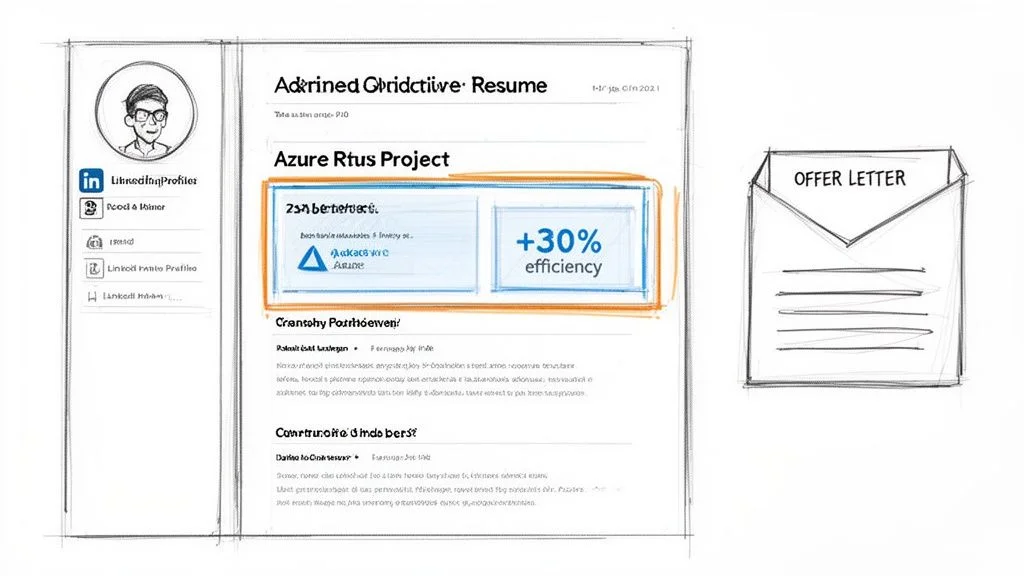
You have put in the work. You earned the certifications and built the labs. Now you face the task of turning those credentials into a job offer. A certification badge gets your resume past the initial filters, but your ability to explain your value is what secures the position. You must move beyond listing tools and start showing results. Recruiters want problem solvers who understand business goals, not people who have simply memorized a list of services.
The strategy is simple: prove you can solve concrete business problems. Hiring managers are looking for professionals who can translate cloud features into stability and savings. If you can describe how you reduced costs or increased speed, you will stand out in the 2026 job market.
Build a Resume That Speaks in Numbers
Your resume and LinkedIn profile are your primary tools for grabbing attention. They have about thirty seconds to make an impact. Generic statements such as "Experience with Azure VMs" are weak and often lead to rejection. They do not tell the reader anything about your skill level or the scale of your work.
You need to reframe your experience by focusing on the problems you solved and the quantifiable results you delivered. Compare these two examples:
- Before: Managed Azure Virtual Machines.
- After: Deployed and managed a fleet of 50+ Azure VMs, implementing Availability Sets and backup policies that achieved 99.9% uptime for critical business applications, directly supporting business continuity.
The second version is much more effective. It tells the recruiter that you understand scale and reliability. By mentioning specific features like Availability Sets and relating them to 99.9% uptime, you show that you understand the "why" behind the technology. You aren't just clicking buttons; you are meeting a Service Level Agreement (SLA). This level of detail proves you are ready for a production environment where mistakes have financial consequences.
Don’t just list what you did; explain the result. A project that "automated infrastructure deployment" is a start, but one that "reduced manual deployment time by 90% using Bicep and Azure Pipelines" is a story of efficiency. It shows you can save the company time and money.
Turn Projects into Proof of Your Value
Treat your personal labs and certification projects like professional case studies. When you document your work on GitHub or in a portfolio, adopt a consultant's mindset. Think about how your technical choices improved operational performance. If you built a web application, don't just say you used App Service. Explain the architecture and the performance gains.
Consider a web application built on Azure App Service:
- Weak Description: "Built a web app using Azure App Service and SQL Database."
- Strong Description: "Developed and deployed a customer-facing web application on Azure App Service, integrated with Azure SQL Database for data persistence. Optimized database queries and implemented Azure CDN, resulting in a 40% improvement in page load times and a better user experience."
This approach demonstrates that you are an engineer. You are thinking about latency, data persistence, and the experience of the end user. Improving page load times by 40% is a victory for both the technical team and the sales department. If you are new to the field, review our guide on how to get started in IT for more advice on mapping your early projects to professional roles.
Reflection Prompt: Look at one of your current projects. Can you describe it using a specific number? Think about uptime, cost reduction, or deployment speed. How does adding that number change the way your work looks to a stranger?
Nail the Azure Interview
Interviews for cloud roles usually involve a mix of technical testing and behavioral questions. You should expect a whiteboard session. A manager might ask you to sketch a three-tier web application that includes disaster recovery. Be ready to explain your choices. Why did you pick a Load Balancer instead of an Application Gateway? How did you secure the connection to the database?
For behavioral questions, use the STAR method (Situation, Task, Action, Result). This framework keeps your answers organized and prevents rambling.
- Question: "Tell me about a time you had to troubleshoot a complex issue in Azure."
- STAR Answer: "(Situation) A critical e-commerce application was experiencing intermittent timeouts during peak traffic, which was causing lost sales. (Task) I had to find the root cause and fix it without taking the site offline. (Action) I used Azure Monitor to look at performance metrics and logs. I found that the Azure SQL Database was hitting its limits. I scaled up the database DTUs and added read replicas to handle the query load. (Result) The timeouts stopped immediately. We saw a 60% improvement in response time during peak hours, which protected company revenue."
A specific result like "60% improvement" is a fact that a hiring manager can easily understand. It makes your contribution tangible and shows you can use monitoring tools to solve high-pressure problems.
Know Your Worth and Get Paid for It
Azure skills are in high demand as we head into 2026. Your salary should reflect the value you bring to a company. Industry data shows that certified cloud professionals earn more than those without credentials. Earning a Microsoft Azure certification can lead to an 8-15% higher salary on average. Many professionals see an annual increase of $10,000 or more after getting certified.
The earning potential grows as you specialize. Architects and DevOps engineers command the highest salaries because they combine technical knowledge with strategic planning. Look at the salary projections for these key roles in the US market.
2026 Salary Projections for Key Azure Roles (US Market)
| Azure Role | Relevant Certification | Average Annual Salary Range |
|---|---|---|
| Azure Administrator | AZ-104 | $100,000 – $135,000 |
| Azure Developer | AZ-204 | $110,000 – $145,000 |
| Azure DevOps Engineer | AZ-400 | $125,000 – $170,000 |
| Azure Solutions Architect | AZ-305 | $130,000 – $180,000+ |
| Azure Security Engineer | AZ-500 | $120,000 – $165,000 |
Note: These figures are estimates. Always verify current pricing and local market trends on sites like Glassdoor or Dice to ensure accuracy for your specific location.
Investing in these skills offers a high return. Roles like the Azure Solutions Architect require deep expertise in design and often pay well into the six figures. With your skills validated and your resume filled with measurable wins, you are in a strong position. You can apply for remote or on-site roles with confidence. When you receive an offer, use your documented successes to negotiate a salary that matches the value you deliver to the business.
Answering Your Top Questions About an Azure Career
As you map out a career in Microsoft Azure, you will likely encounter several practical questions. Addressing these concerns before you commit your time and resources is a strategic move. Most people starting this career path ask the same few questions about technical requirements, exam difficulty, and market competition.
The following discussion provides a direct look at what to expect. Use these answers to gain clarity as you decide which direction to take within the Microsoft cloud environment.
Do I Actually Need to Be a Coder for an Azure Career?
This is the question I hear most frequently. The answer is not a simple yes or no because the requirement for coding skills depends on your specific job role. Many high-value roles in the cloud do not require you to be a traditional software developer.
If you follow the Azure Administrator path, which aligns with the AZ-104 certification, your daily work focuses on infrastructure management. You will spend your time provisioning virtual machines, configuring virtual networks, and managing storage solutions. You will not spend your day writing application code. However, you cannot rely entirely on the graphical user interface of the Azure portal. Managing enterprise environments requires automation. Because of this, you must learn to write scripts using PowerShell or the Azure CLI. These scripts allow you to perform bulk operations that are impossible to do manually.
For other career tracks, coding is a core requirement of the daily routine:
- Azure Developer (AZ-204): This role requires you to build and maintain the applications that run on cloud infrastructure. You will need a strong grasp of programming languages such as C# or Python to succeed here.
- Azure AI Engineer (AI-102): In this role, you spend your time building and deploying artificial intelligence models. This work relies heavily on Python and various data science libraries to process information and train models.
Identify your target role before you worry about learning a programming language. If you choose to become an Administrator, focus on scripting. If you want to be a Developer or an AI specialist, focus on the specific coding languages those roles require.
How Hard Are the Azure Certification Exams?
Microsoft designs these exams to be difficult. They serve as a filter to ensure that certified professionals actually possess the skills they claim to have. The difficulty level changes depending on which tier of certification you are attempting.
You can view the certification path as a three-tier system:
- Fundamentals (e.g., AZ-900): This is the starting point for most people. The exam is broad and covers high-level concepts rather than deep technical configurations. If you understand basic cloud concepts, you can pass this exam with a few weeks of dedicated study.
- Associate (e.g., AZ-104): This level represents a major increase in difficulty. Theoretical knowledge is rarely enough to pass. Microsoft uses these exams to test your hands-on ability. You will likely face questions that require you to troubleshoot specific network configurations or storage permissions. You should spend significant time in the Azure portal building labs to prepare for this level.
- Expert (e.g., AZ-305): These exams are the most demanding in the catalog. They move away from "how" to perform a task and focus on "why" you should choose one solution over another. You must demonstrate that you can design complex, enterprise-level systems that balance security requirements against budget constraints and performance needs.
To pass these exams with confidence, you must move beyond memorizing facts. The most successful candidates are those who build "muscle memory" by performing the tasks in a lab environment every day. Role-based exams prioritize practical experience over textbook definitions.
Is It Better to Learn Azure or AWS?
You can find success on either platform. While AWS currently maintains a larger portion of the total market, Azure is seeing rapid adoption among large corporations. Many businesses have relied on Microsoft software like Windows Server, SQL Server, and Office 365 for decades. When these companies move to the cloud, Azure is the logical choice for them.
Azure has a clear advantage in hybrid cloud scenarios. Many organizations are not ready to move 100% of their data to the cloud and prefer to keep some servers on-premises. Azure services like Azure Arc make this hybrid approach easier to manage than competing platforms. In a market where many companies use multiple cloud providers, knowing both platforms is a benefit. However, when you are first starting out, you should pick one and master it. Specializing in Azure provides a competitive edge when you apply for positions at established enterprise companies.
How Do I Keep My Skills Sharp After I’m Certified?
Earning a certificate is a major milestone, but it is not the end of your education. The cloud changes so fast that your knowledge can become outdated within a year. Continuous learning is a requirement of the job.
You should renew your certifications annually. Microsoft provides a free renewal process through Microsoft Learn. This process is much simpler than the original exam and focuses on the new features added to the platform over the past twelve months. Keeping your credentials active shows employers that you are staying current with the technology.
You should also follow official updates. The Azure Blog and the Microsoft Tech Community are the best places to learn about new service launches and security updates. Reading these sites for twenty minutes a day can keep you ahead of most of your peers.
The most effective way to stay sharp is to keep building. Use your Azure free account to test new features as they are released. If Microsoft announces a new way to manage containerized apps, go into your sandbox and try to set it up. Hands-on practice ensures your skills remain relevant in a competitive job market and protects your long-term career prospects.
If you are ready to stop planning and start doing, MindMesh Academy can help. We have developed study materials and learning strategies, such as Spaced Repetition, to help you master Azure concepts rather than just memorizing answers. We provide the tools and structure you need to pass your exams and build a high-impact career. Explore our complete courses and start your professional work today at AZ-900 Azure Fundamentals Practice Exams.

Written by
Alvin Varughese
Founder, MindMesh Academy
Alvin Varughese is the founder of MindMesh Academy and an enterprise architecture leader. An electrical engineer by training, he moved from factory automation in South Africa to cloud architecture at GE Appliances and Humana (Fortune 50), and holds 20 professional certifications including AWS Solutions Architect Professional, Azure DevOps Engineer Expert, and Microsoft Agentic AI Business Solutions Architect. He built MindMesh Academy after interviewing too many highly certified candidates who couldn't answer basic questions: the goal is prep that makes you better at the job, not just able to pass the exam.