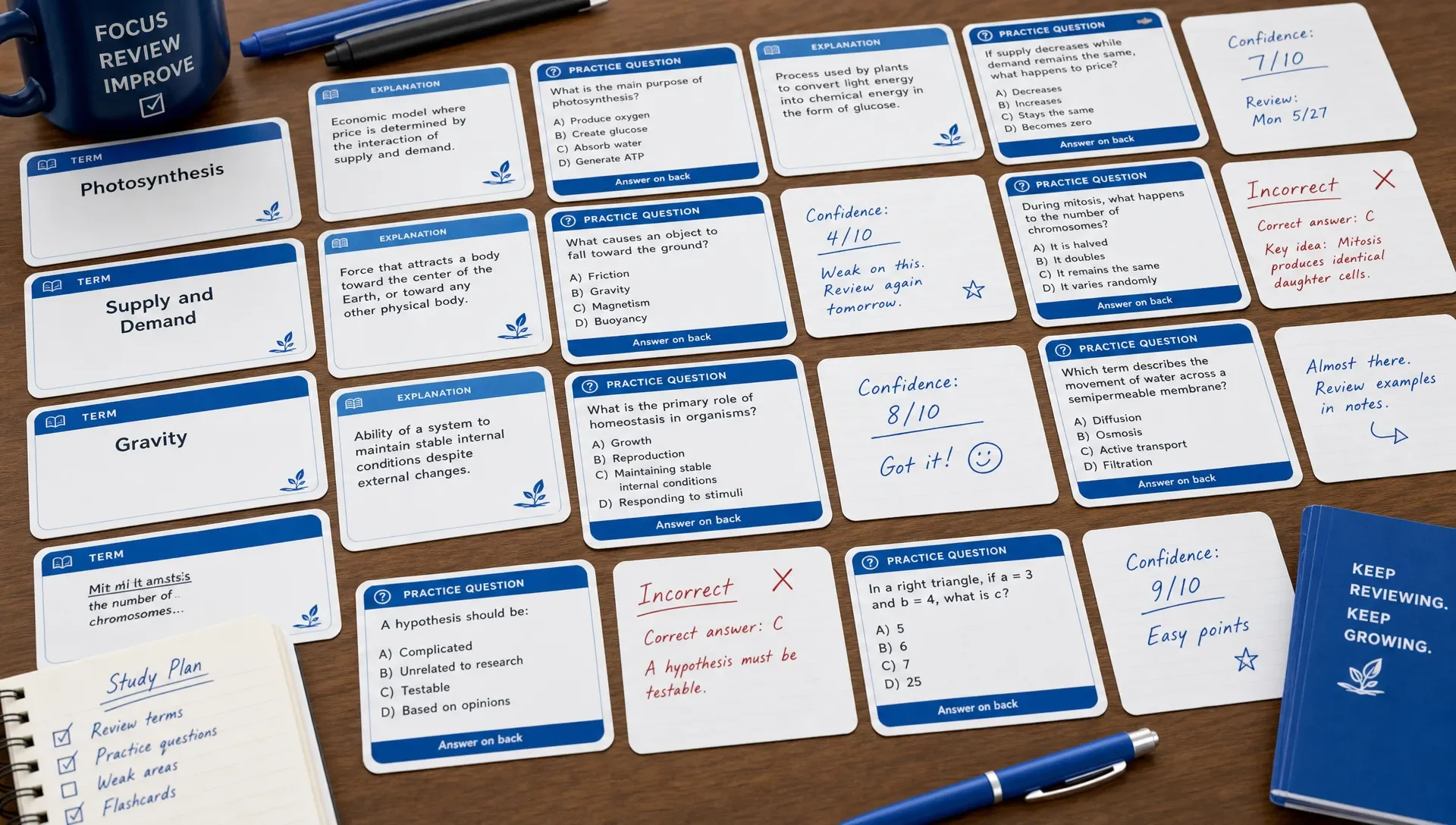
Knowledge Test Questions That Measure Understanding
Knowledge Test Questions That Measure Understanding
If your practice sessions feel easy but your exam scores stay unpredictable, the problem often lies with the question design. Strong knowledge test questions don't just ask whether you recognize a term. They force you to explain, compare, apply, troubleshoot, or choose under realistic constraints.
Start by changing what you count as a good answer. A correct option with no reasoning is weak evidence. A correct option plus a clear explanation of why the distractors fail tells you much more. For certification prep, that difference matters because exams from AWS, Microsoft, CompTIA, Cisco, and PMI usually test decisions in context, not isolated definitions.
What Knowledge Test Questions Should Measure
Good questions should measure the kind of thinking the real exam expects. If an exam objective says "identify," a recall question may be enough. If it says "configure," "troubleshoot," "compare," or "recommend," your question needs a scenario, constraints, and plausible wrong answers.
The safest way to check understanding is to ask for transfer. Transfer means the learner can use a concept in a slightly new situation. For example, someone might memorize that encryption protects confidentiality. A better question, though, asks them to choose the right control when data is moving between services, stored on disk, or exposed through a misconfigured policy.
| What the question tests | Weak evidence | Stronger evidence |
|---|---|---|
| Term recall | Learner recognizes a definition | Learner explains the term in their own words |
| Concept boundaries | Learner names a service or process | Learner knows when not to use it |
| Application | Learner remembers a step | Learner chooses a step based on constraints |
| Troubleshooting | Learner spots an error after reading the answer | Learner isolates the likely cause before seeing choices |
| Exam readiness | Learner gets repeat questions right | Learner handles new questions mapped to the same objective |
The point isn't to make every item harder. The point is to make knowledge test questions honest. If a learner can only answer after seeing familiar wording, the question is measuring recognition more than understanding.
Build Questions From Exam Objectives, Not From Notes
The fastest way to write useful knowledge test questions is to start with the official exam objectives. Notes are helpful, but they usually reflect what you studied. Objectives reflect what the vendor says may be tested.
For example, AWS publishes certification information and exam guidance through its official AWS Certification pages, and Microsoft provides role-based study guides such as the AZ-900 Microsoft Azure Fundamentals study guide. Those sources help you avoid overstudying favorite topics while missing objectives that appear on the actual exam blueprint.
A practical workflow is simple: choose one objective, identify the skill verb, then write several question types for the same idea. If the verb is "describe," use a definition, a comparison, and a short scenario. If the verb is "implement" or "troubleshoot," include symptoms, constraints, and an outcome.
| Objective language | Question design that fits | What to avoid |
|---|---|---|
| Describe | Ask for meaning, purpose, or difference | Turning it into a complex troubleshooting case |
| Compare | Present two options with tradeoffs | Asking for a memorized list only |
| Configure | Give a target state and a constraint | Asking where a button appears in a console |
| Troubleshoot | Provide symptoms and ask for the next best check | Giving away the root cause in the stem |
| Recommend | Include business, security, or cost requirements | Making one answer obviously perfect |
If you're preparing for cloud fundamentals, a structured path like the AZ-900 Microsoft Azure Fundamentals study guide can help you keep practice tied to objectives instead of drifting into random trivia.
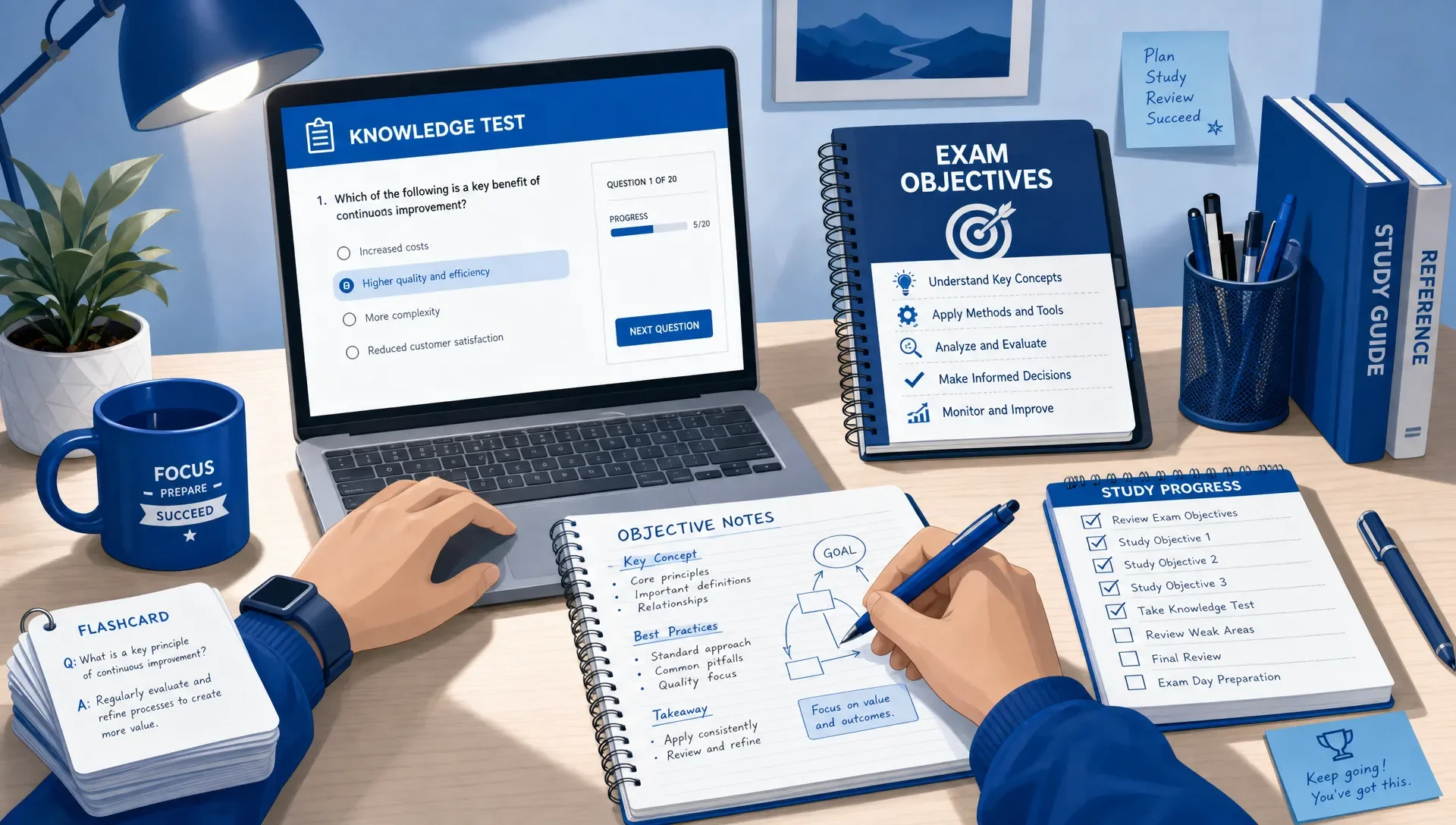
Question Formats That Reveal Understanding
Different formats reveal different gaps. Multiple-choice items are useful, but only when the wrong answers are meaningful. Flashcards are useful, but only when they ask for recall before showing the answer. Scenario questions are useful, but only when the scenario contains relevant clues rather than extra noise.
Strong knowledge test questions often combine a short situation with a decision. The learner should have to notice the key requirement, eliminate answers that are technically true but not best, and explain the choice.
| Format | Best for measuring | Example prompt style |
|---|---|---|
| Short answer | Recall without answer cues | "Define least privilege and give one example." |
| Compare and choose | Concept boundaries | "Which option fits this constraint, and why?" |
| Scenario multiple choice | Applied decision-making | "A team needs X with Y limitation. What should they do first?" |
| Error diagnosis | Troubleshooting | "Which misconfiguration most likely caused this symptom?" |
| Sequence question | Process knowledge | "Put these steps in the safest order." |
| Explanation scoring | Depth of understanding | "Why are the other choices less suitable?" |
This is also where performance-based thinking matters. Even when the final exam question is multiple choice, you can study as if you had to perform the task. Ask what you would check, configure, or rule out before looking at the options.
For Security+ learners, this approach is especially useful because many objectives ask you to apply security concepts to incidents, controls, architecture, and operations. A realistic CompTIA Security+ practice exam should help you practice that judgment, not just memorize acronyms.
Use Distractors to Test Reasoning, Not Trivia
A distractor is a wrong answer, but a good distractor isn't random. It should represent a mistake a learner might actually make: choosing a service at the wrong layer, confusing authentication with authorization, selecting a process step too early, or overlooking a requirement in the stem.
When distractors are too silly, learners can answer without understanding. When distractors are unfair, learners start guessing. The best middle ground is a set of answers that are all related to the topic, with only one that fits the exact constraint.
For certification practice, knowledge test questions should make learners prove that they found the key clue. If the scenario says "lowest administrative overhead," "public internet exposure," "regulatory audit," or "temporary access," the correct answer should depend on that detail.
Here is a quick quality check for distractors:
- Each wrong answer should be plausible to someone with partial knowledge.
- Each wrong answer should be wrong for a clear reason.
- The correct answer should be best because of the scenario, not because it is longer.
- The explanation should teach the concept, not just restate the answer.
If you struggle with clue recognition, review how to spot the key clue in exam test questions before you build or answer more practice items.
Score Explanations, Not Just Correct Answers
A score alone can hide weak understanding. Two learners may both answer 80 percent correctly, but one may understand the material while the other is recognizing repeated patterns. That difference shows up when questions are reworded, delayed, or mixed with other objectives.
Retrieval practice is one reason question-based study works. In a controlled experiment, Karpicke and Roediger reported in Science that repeated retrieval produced stronger long-term retention than repeated studying in their tested conditions. For exam prep, that supports a simple rule: don't just reread explanations. Try to retrieve the idea first, then check it.
To make knowledge test questions more diagnostic, score the explanation along with the answer. Use a three-part review: answer closed-book, write why you chose it, then write why the top distractor is wrong. This takes longer than clicking through a quiz, but it turns each item into feedback.
| Result | What it probably means | What to do next |
|---|---|---|
| Correct with clear explanation | Reliable understanding | Move to mixed practice later |
| Correct with weak explanation | Possible recognition | Retest with a new version |
| Wrong but reasoning is close | Partial understanding | Review the boundary or exception |
| Wrong with high confidence | Dangerous misconception | Log it and review the objective |
| Correct only on repeat | Memorized item risk | Delay retake and use a fresh question |
A review habit like this pairs well with rules that prevent answer memorization. If you reuse a quiz bank, follow quiz bank rules that protect real learning so your scores don't become inflated.
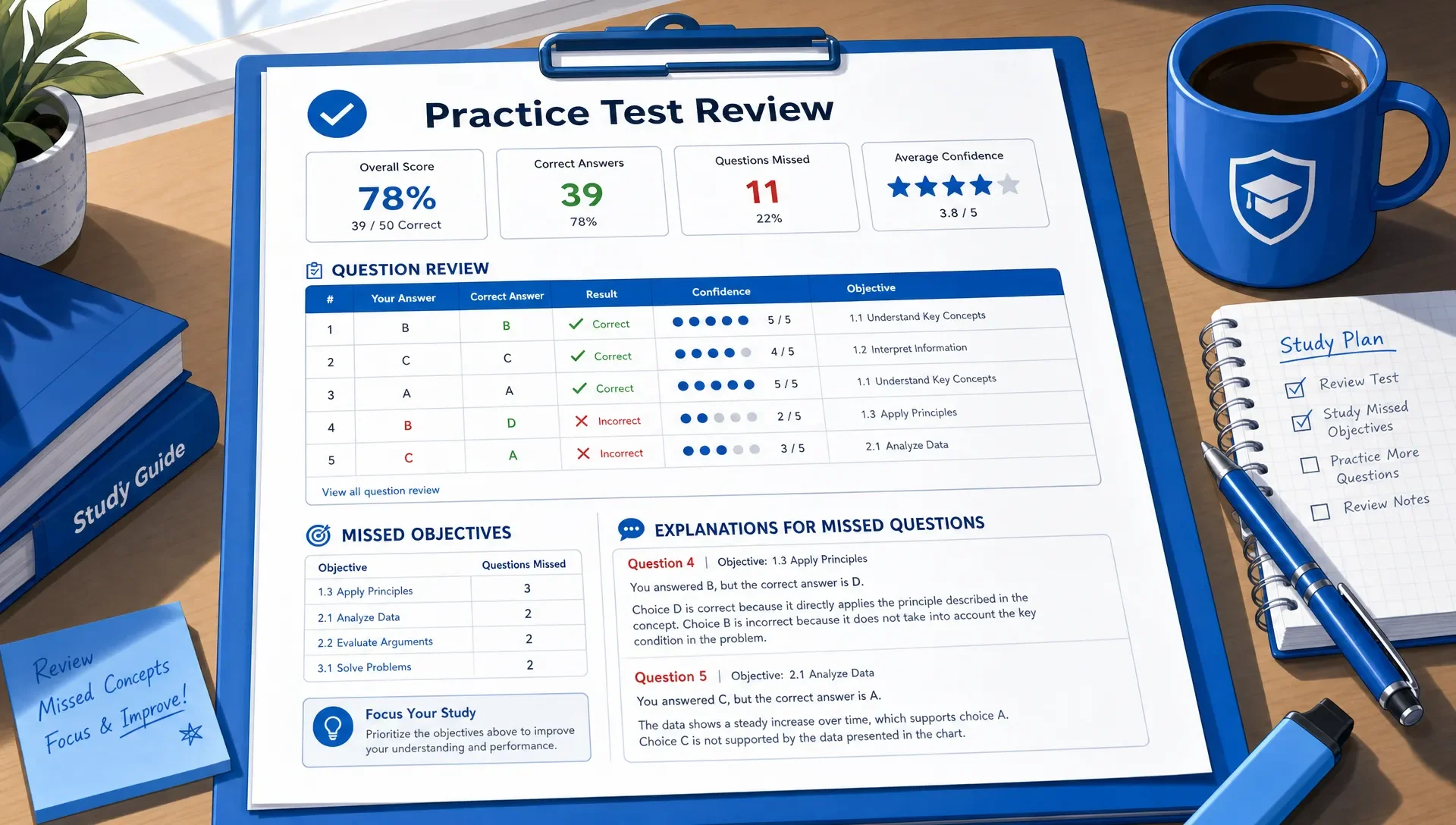
A Simple Routine for Using Questions Each Week
You don't need a complicated system. You need a routine that separates learning, practice, and readiness checks. If every session is just another full quiz, you may collect scores without fixing the reason behind missed questions.
Use knowledge test questions in three passes during the week. First, use them to diagnose what you don't know. Next, use targeted questions to rebuild weak objectives. Finally, use mixed questions to check whether you can still choose correctly when topics are blended.
A practical weekly rhythm looks like this:
- Day 1: Take a short objective-based quiz closed-book and mark confidence.
- Day 2: Review explanations and convert misses into flashcards or short-answer prompts.
- Day 3: Practice only the weak objective with new question wording.
- Day 4: Mix that weak topic with stronger topics so you don't rely on context clues.
- Day 5: Take a timed set and review every high-confidence miss.
MindMesh Academy is built around this kind of connected study workflow. You can move between study guides by exam objectives, practice questions with explanations, flashcards with spaced repetition, adaptive weakness-based practice, and readiness tracking so you know whether you're improving by topic.
For cloud learners, an AWS Certified Cloud Practitioner practice exam can help you turn broad service knowledge into exam-style decisions. If you're aiming at networking, a CCNA practice exam can help you test subnetting, routing, security, and troubleshooting concepts under pressure.
Examples of Better Knowledge Test Questions
The easiest way to improve a weak item is to ask what evidence it gives you. If the question only proves that a learner can match a phrase, rewrite it so the learner has to apply the idea.
Here are examples of knowledge test questions that move from recall toward understanding:
| Weak question | Better question | Why it works better |
|---|---|---|
| "What does MFA stand for?" | "A user password is stolen, but the attacker still can't sign in. Which control most likely blocked access?" | Tests the purpose of MFA in context |
| "Define availability." | "A system must stay usable during a single server failure. Which design goal is being addressed?" | Connects the term to a requirement |
| "What is a subnet?" | "Two hosts are on different subnets and can't communicate. What should you check first?" | Moves from definition to troubleshooting |
| "What is risk mitigation?" | "A team adds a control that lowers likelihood but doesn't remove the risk. What response strategy is this?" | Tests boundary between risk responses |
| "What is encryption?" | "Which control best protects stored data if a disk is removed from a server?" | Requires matching the control to the threat |
Notice that the better versions are not always longer. They simply include a decision point. That is the main test of understanding: can the learner choose when the concept applies?
Common Mistakes That Make Questions Too Easy
Many practice questions fail because they teach the answer pattern instead of the concept. Learners start noticing that the longest option is often right, that repeated wording from the stem points to the answer, or that two choices are obviously unrelated.
| Mistake | Why it weakens the question | Better approach |
|---|---|---|
| Obvious wrong answers | Learner can eliminate without knowledge | Make distractors plausible but clearly wrong |
| Copying wording from notes | Learner recognizes phrasing | Reword the concept in a new scenario |
| Testing tiny trivia | Score doesn't reflect useful readiness | Tie details to an objective or task |
| Too many clues | The stem gives away the answer | Include only relevant operational details |
| No explanation review | Misses don't turn into learning | Require why-right and why-wrong notes |
If you already have a bank of questions, don't throw it out. Sort items into three groups: recall, application, and troubleshooting. Keep recall items for warm-ups, then spend most of your serious prep time on application and troubleshooting questions.
How to Tell If Your Questions Are Working
Your practice is working when scores transfer to new wording. If you can answer a fresh item on the same objective, explain the reasoning, and avoid the same distractor trap, you're building usable knowledge.
Look for these signs that knowledge test questions are measuring understanding rather than familiarity: your confidence ratings become more accurate, your explanations get shorter and clearer, your wrong answers cluster around fewer objectives, and your performance holds after a delay.
The delay matters. A quiz you retake immediately mostly tells you what you remember from minutes ago. A quiz you retake after a few days, mixed with other topics, gives a better signal. If you miss the same objective again, don't just reread the page. Write a new question that tests the boundary you missed.
For a deeper review process, use practice tests to find patterns in your wrong answers instead of treating every miss as a separate problem.
Frequently Asked Questions
What makes a knowledge question different from a memorization question? A memorization question checks whether you can recall or recognize a fact. A stronger knowledge question checks whether you can use that fact to explain, compare, troubleshoot, or choose the best action in context.
How many knowledge test questions should I answer before an exam? There isn't a universal number. A better target is consistent performance across every exam objective, with clear explanations for correct answers and improving scores on fresh mixed sets.
Are multiple-choice questions enough for certification prep? They can be enough if they're well written and you review them properly. To build deeper understanding, add short-answer explanations, confidence ratings, and scenario-based review before checking the answer choices.
Should I retake the same questions? Yes, but not too soon. Immediate retakes can inflate your score because you remember the item. Delay retakes, shuffle topics, and use new wording when possible.
What should I do with questions I miss more than once? Treat repeated misses as objective-level gaps. Review the related concept, write your own explanation, create a flashcard if needed, and answer a fresh question that tests the same idea from a different angle.
Build Readiness With Questions That Prove Understanding
Better exam prep isn't about endless questions. It's about questions that reveal what you truly understand and can apply, troubleshoot, or explain without hints. MindMesh Academy helps you build that kind of readiness. Our platform offers objective-based study guides, practice questions with explanations, and adaptive weakness-based practice to solidify your understanding across 30+ certification paths. Ready to test your knowledge, not just your memory? Explore MindMesh Academy's full range of certification offerings and start preparing with questions that truly measure your grasp of the material.

Written by
Alvin Varughese
Founder, MindMesh Academy
Alvin Varughese is the founder of MindMesh Academy and an enterprise architecture leader. An electrical engineer by training, he moved from factory automation in South Africa to cloud architecture at GE Appliances and Humana (Fortune 50), and holds 20 professional certifications including AWS Solutions Architect Professional, Azure DevOps Engineer Expert, and Microsoft Agentic AI Business Solutions Architect. He built MindMesh Academy after interviewing too many highly certified candidates who couldn't answer basic questions: the goal is prep that makes you better at the job, not just able to pass the exam.