Decoding the PMP Exam Passing Score
For IT professionals striving to earn their Project Management Professional (PMP) certification, one question often dominates study group discussions: "What's the magic PMP exam passing score?" It's a natural query, given the rigor and value of this esteemed credential. However, let's clarify a common misconception right from the start: the Project Management Institute (PMI) does not publish an official, fixed passing score for the PMP exam. If you've encountered whispers of a 61% threshold, understand that this figure is entirely outdated. Relying on such old information can misguide your preparation strategy, which is why MindMesh Academy is dedicated to providing you with the most current and accurate insights.
Short answer: there is no percentage. PMI does not publish a passing score for the PMP exam, and no fixed number of correct answers guarantees a pass. You are rated Above Target, Target, Below Target or Needs Improvement in each of the three domains, and the pass/fail decision is made on your combined performance against a psychometrically set standard — one that adjusts for the difficulty of the particular exam you sat. The rest of this guide explains how that works, how to read your score report, and what to aim for on practice exams instead.
Why the PMP Passing Score Is a Moving Target
If you've been tirelessly searching online for that one magic number you need to hit, you can stop. There's a fundamental reason it remains elusive. Years ago, PMI intentionally moved away from a simplistic, fixed percentage score. They replaced it with a far more equitable and sophisticated method rooted in psychometric analysis.
The Science Behind a Fair Assessment: Psychometric Analysis
It might sound like complex academic jargon, but the underlying concept of psychometric analysis is quite intuitive, especially when applied to high-stakes certifications like the PMP. Think of it less as a simple test score and more like a sophisticated calibration process designed to ensure absolute fairness and consistency.
Consider an Olympic diving competition, as a useful analogy. Not all dives carry the same degree of difficulty. A diver executing a highly complex maneuver, even with minor imperfections, might still score higher than someone who performs a much simpler dive perfectly. The judges factor in the difficulty rating of each dive to normalize the scores, ensuring a fair comparison across varied performances.
The PMP exam operates on a similar principle. PMI recognizes that not every question carries the same weight or difficulty, and different versions of the exam candidates receive can naturally vary in overall toughness. To 'level the playing field,' psychometric analysis statistically adjusts the passing standard based on the specific set of questions you encounter. This sophisticated methodology ensures that regardless of which exam version you receive, a 'Pass' signifies the exact same level of demonstrated project management competence. This commitment to valid and reliable assessment is crucial for maintaining the PMP's global prestige, much like it is for other industry-leading certifications such as AWS Solutions Architect or Azure Administrator, where consistent standards are paramount.
This rigorous approach guarantees that every PMP candidate is evaluated against the same high standard of competence. Passing means you've unequivocally demonstrated the required level of project management knowledge and skill, irrespective of the specific questions presented on your exam.
Reflection Prompt: How does understanding the concept of psychometric analysis change your perspective on preparing for high-stakes certification exams?
The Deliberate Shift from a Fixed Score
If you've spent time searching online for that elusive magic passing number, your efforts have likely been in vain – and for good reason. PMI made a strategic and intentional decision years ago to move away from a simple, fixed percentage pass mark. Since 2006, the exact PMP passing score has been kept confidential. This isn't an arbitrary choice; it's a commitment to a more sophisticated, data-driven system for evaluating competence.
What this fundamentally means for you, as an aspiring PMP, is that your preparation shouldn't revolve around aiming for a mythical percentage. Instead, your strategic focus must be on cultivating a deep, practical understanding across all project management domains. Chasing an arbitrary number can lead to rote memorization, which is insufficient for the PMP exam's scenario-based questions. True, demonstrable competence is the only reliable path to earning your certification.
A Historical Perspective: The Evolution of PMP Scoring
To truly grasp how the PMP exam is scored today, it's incredibly helpful to understand the journey that led us here. The evolution of the PMP exam passing score is not a linear progression; it's a winding road from a simple, publicly known number to the nuanced, competency-based system utilized now. This history perfectly explains why conflicting advice still abounds online and why targeting a single percentage is no longer a viable strategy. For a long time, the rules of the game were crystal clear, with PMI being completely transparent about the passing score.
The Era of a Transparent Percentage: Before 2005
For many years, the rules for PMP certification were straightforward and public. Prior to significant changes in 2005, the PMP handbook explicitly stated the passing requirement: candidates needed to answer 61% of the questions correctly to pass. This clear benchmark provided aspiring project managers with a definitive target against which to measure their readiness and progress.
The Tumultuous Transition and the Rise of Competency-Based Assessment
The period around 2005 marked a significant turning point in the PMP exam's history. This era of straightforward percentage scores came to an abrupt halt when PMI, without extensive prior warning, dramatically increased the passing threshold to an imposing 81%. Predictably, this brief but intense period witnessed a considerable decline in first-time pass rates, causing widespread concern within the project management community. The strong feedback from candidates and trainers alike prompted PMI to re-evaluate its approach.
Responding swiftly, by the end of 2005, PMI reverted the passing score to the familiar 61%. Crucially, however, this marked the last time a specific passing percentage would ever be publicly disclosed. This pivotal decision ushered in the modern psychometric model we utilize today. Rather than simply counting correct answers, the contemporary PMP exam is meticulously designed to assess a candidate's overall proficiency and practical application of project management principles. The emphasis shifted profoundly from mere numerical achievement to a genuine demonstration of understanding.
Key Takeaway: This transition represented a fundamental philosophical shift. The PMP exam moved decisively away from merely rewarding rote memorization and towards evaluating a candidate's true, practical command of project management skills. This historical context underscores why developing a deep, conceptual understanding and the ability to apply it to real-world scenarios is now the absolute key to PMP success.
Understanding this evolution is vital. It highlights PMI's continuous commitment to ensuring the PMP certification remains relevant and reflects the dynamic skills required in today's project environments. The intentional ambiguity surrounding today's exact passing score is not a flaw, but a deliberate design choice—a testament to PMI's dedication that the PMP credential is exclusively awarded to professionals who have truly mastered their craft.
How Your PMP Exam Is Scored Today
As an IT professional, understanding the mechanics of any certification exam is crucial. When you sit down for the PMP exam, you'll tackle a total of 180 questions over a demanding 230 minutes. However, it's vital to grasp a specific detail: only 175 of these questions actually contribute to your final score. The remaining five are "pretest" questions that PMI uses to evaluate for future exams. You will not be able to distinguish between scored and unscored questions during the exam, so the only viable strategy is to approach every single question with the same level of focus and critical thinking.
Psychometrics Revisited: The Engine of a Fair Score
So, given the absence of a fixed percentage, how exactly does PMI determine your pass or fail status? The answer lies, once again, in the sophisticated methodology of psychometric analysis. This isn't just about statistics; it's about engineering fairness.
Let's expand on our earlier analogy. Imagine you're a high-performance chef renowned for baking the perfect sourdough loaf, consistently. You know that environmental factors—like a sudden change in kitchen humidity or ambient temperature—can subtly impact your baking. To maintain consistent quality, you don't just follow a recipe rigidly; you adapt. You might slightly adjust the proofing time or oven temperature based on that day's unique conditions.
PMI employs a similar adaptive, statistical process for the PMP exam. They use psychometric techniques to account for subtle differences in difficulty that naturally exist between different versions of the exam. This ensures that a PMP certification achieved on a slightly 'harder' exam version holds the exact same value and represents the same level of real-world project management competence as one earned on a comparatively 'easier' version. The ultimate goal isn't for you to hit a predetermined number, but to unequivocally prove you meet a rigorously defined standard of project management excellence.
Beyond Numbers: The Transition to Proficiency Ratings
The days of receiving a simple pass/fail percentage score are firmly in the past. Today, your PMP performance is distilled into a comprehensive set of proficiency ratings, offering a far more nuanced and actionable picture of your skills. This evolution wasn't an overnight change; it reflects a commitment to providing genuinely valuable feedback to candidates. The infographic below visually depicts this evolution, making it clear why any advice based on a 61% passing score is now significantly outdated.
 Figure 1: Evolution of PMP Exam Scoring Methodology
PMI implemented this detailed rating system to provide a true diagnostic assessment of your strengths and areas for development. Instead of a single, ambiguous pass/fail verdict, your official score report meticulously breaks down your performance across each domain using four distinct performance ratings:
- Above Target: You've demonstrated performance well beyond the minimum standard in this domain. A strong indicator of mastery.
- Target: Your performance consistently met the minimum requirements for this domain, indicating a solid understanding.
- Below Target: Your performance dipped just below the required standard in this area. This signals a specific knowledge gap that requires attention.
- Needs Improvement: Your performance was significantly below the target, highlighting a substantial deficiency in this domain's knowledge and application.
This granular feedback is exceptionally valuable. It transforms your score report from a mere result into a personalized roadmap, pinpointing exactly where you excelled and where you should concentrate your future professional development or re-study efforts. To get a realistic preview of where you might stand, consider taking a high-quality PMP practice exam offered by MindMesh Academy to assess your current proficiency.
Reflection Prompt: Imagine you receive a "Below Target" in one domain on a practice exam. How would you use this specific feedback to refine your study plan, rather than just rereading the entire PMBOK® Guide?
Understanding Your PMP Score Report
So, you’ve completed the exam. Whether you passed or not, the score report you receive from PMI is an invaluable asset. Don't simply glance at the pass/fail result and set it aside. Instead, view it as a detailed diagnostic from a specialist—it provides a precise overview of your standing in project management knowledge and application.
This is more than just a grade; it’s a personalized breakdown of your performance. The real value lies in how it rates your proficiency across the three core domains. This is where you gain clear insight into your specific strengths and weaknesses, offering a defined roadmap for your next steps.
Decoding the Four Performance Ratings for Action
PMI's sophisticated rating system offers far more insight than a simple numerical score. Each of the four performance ratings on your report provides specific guidance on your proficiency within that domain:
- Above Target: This is the gold standard! It indicates you possess a deep understanding and can consistently apply principles in this domain. This is an area of strength to leverage and potentially mentor others in.
- Target: You met the required standard. This is a solid performance, demonstrating the competence expected of a PMP. Your goal should be to achieve 'Target' or 'Above Target' across all domains.
- Below Target: This indicates a borderline performance. You likely have some foundational knowledge, but struggled with application or more complex scenarios. This domain should be a priority for review, focusing on specific weaknesses identified through practice questions.
- Needs Improvement: This is a clear indicator of a significant knowledge gap. This domain requires extensive, focused study, perhaps revisiting foundational concepts, methodologies, and applying them through numerous practice scenarios.
Crucially, remember that your overall PMP pass or fail status is determined by a combined, weighted evaluation across all three domains. You don't pass or fail based on a single domain's rating. This holistic assessment is why understanding the full picture of your report is so critical for strategizing your next steps, whether it's celebrating your pass or planning a targeted re-study.
Transforming Your Report into a Strategic Action Plan
The true power of your PMP score report lies not just in the result, but in how you strategically use the detailed feedback. For IT professionals, this report is an invaluable diagnostic tool, akin to a network performance monitor highlighting bottlenecks.
If you passed, the report showcases your areas of expertise and can guide your continuing professional development (CPD) activities, informing where you might seek advanced training or mentorship opportunities. If, however, you need to retake the exam, this report becomes your single most important study aid.
Let’s illustrate with an example: If your report indicates ‘Below Target’ in the Process domain, this isn't merely bad news; it's a precise directive. It signals that you need to intensify your focus on the technical execution aspects of project management—everything from detailed planning and scheduling (e.g., critical path method, PERT analysis) to meticulous risk management techniques, quality assurance processes, and resource allocation. For an IT professional, this might mean diving deeper into Agile sprint planning, understanding Kanban flow, or mastering the nuances of managing technical debt.
This kind of targeted feedback empowers you to study smarter, not just harder. Instead of indiscriminately re-reading the entire PMBOK® Guide or Agile Practice Guide, you can pinpoint specific knowledge areas and process groups that require reinforcement. This focused approach maximizes the efficiency of your study time, significantly increasing your chances of success on your subsequent attempt.
Mastering the PMP's Core: The Three Domains of Project Management
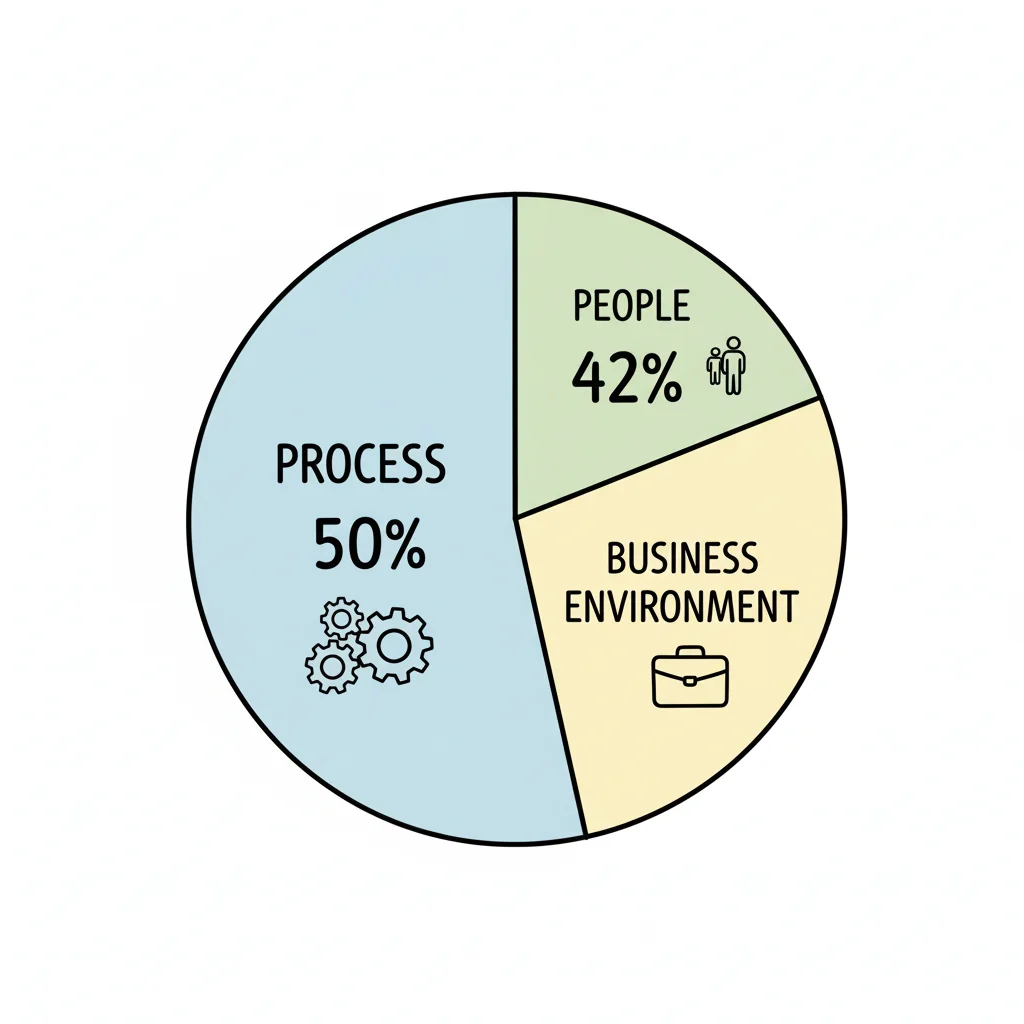
How does PMI genuinely assess your readiness to lead complex projects? It's not about memorizing facts; it's about demonstrating comprehensive competence across three fundamental areas, or "domains," that meticulously mirror the multifaceted reality of modern project management. Your final PMP score is a composite reflection of your performance in each of these domains, and critically, they are not weighted equally.
Think of it like building a robust enterprise application. You need visionary leadership (People), a solid architectural framework and development process (Process), and a clear understanding of how it delivers business value (Business Environment). The PMP exam tests your mastery of all three, ensuring you're a well-rounded project leader, not just a task manager.
Domain 1: The People Domain (42%)
Comprising a significant 42% of the exam, the People domain underscores the indispensable human element of project management. This area delves into the critical 'soft skills' that elevate a competent project manager to an exceptional leader. It encompasses a broad spectrum of competencies, including:
- Effective Team Leadership: Guiding, motivating, and supporting diverse project teams, whether co-located or remote.
- Stakeholder Engagement & Communication: navigating complex relationships, managing expectations, and ensuring clear, consistent communication with all project stakeholders.
- Conflict Resolution: Mediating disagreements and fostering a collaborative environment.
- Mentoring and Coaching: Developing team members and fostering a culture of continuous improvement.
For IT professionals, the People domain is especially relevant. In today's highly collaborative and often matrixed IT environments, the ability to build high-performing teams, manage cross-functional conflicts, and communicate technical concepts effectively to non-technical stakeholders is paramount. This domain tests whether you can inspire, collaborate, and navigate the intricate human dynamics that ultimately drive project success. To further deepen your understanding, explore our comprehensive guide on project management domains, stakeholders, and teams.
Domain 2: The Process Domain (50%)
As the largest component of the exam, accounting for a full 50% of the questions, the Process domain represents the technical 'nuts and bolts' of project execution. This is where your comprehensive knowledge of project management lifecycle processes and methodologies is rigorously tested. You'll need to demonstrate mastery in areas such as:
- Scope Management: Defining, validating, and controlling project work.
- Schedule Management: Developing, monitoring, and controlling project timelines using various techniques.
- Cost Management: Planning, estimating, budgeting, and controlling project expenditures.
- Risk Management: Identifying, analyzing, planning responses for, and monitoring project risks.
- Quality Management: Ensuring project deliverables meet defined quality standards.
- Resource Management: Acquiring, developing, and managing project team and physical resources.
Crucially, this domain requires a firm grasp of predictive (waterfall), agile, and hybrid methodologies. For IT professionals, this means understanding how to apply these processes whether you're managing a traditional software development lifecycle, an Agile sprint cycle for a new feature, or a hybrid approach integrating both. A strong performance here confirms you possess the essential technical toolkit to guide any project—from conception to successful closure.
Domain 3: The Business Environment Domain (8%)
While making up just 8% of the exam, the Business Environment domain is far from negligible. It serves as the critical link between your project and the broader organizational strategy, testing your understanding that projects do not operate in a vacuum. This section evaluates your grasp of:
- Strategic Alignment: How projects contribute to organizational objectives and deliver measurable business value.
- Compliance: Adhering to relevant regulations, standards, and external requirements.
- Organizational Change Management: Understanding how projects impact the organization and planning for successful adoption.
For an IT professional, this domain tests your ability to see beyond the technical implementation and connect your project's outcomes to the enterprise's strategic goals. It assesses whether you understand concepts like benefits realization management, ensuring your IT project delivers tangible value rather than just a completed product. A strong score here demonstrates you function as a strategic business partner, capable of navigating compliance landscapes and driving organizational value, not merely as a technical task manager.
PMP Exam Domain Weightings and Strategic Focus Areas
To summarize and guide your study priorities, the table below outlines the PMP exam's domain weightings and their key focus areas:
| Exam Domain | Percentage of Questions | Key Focus Areas |
|---|---|---|
| People | 42% | Leadership, team building, stakeholder communication, conflict resolution, and mentoring. |
| Process | 50% | Methodologies (agile, waterfall, hybrid), managing scope, schedule, budget, risk, and quality. |
| Business Environment | 8% | Strategic alignment, benefits realization, organizational change, and compliance. |
As you can see, your path to passing the PMP is paved with a deep understanding of the people you lead and the processes you manage, all while keeping the business's strategic goals in sight.
Preparing to Excel: Strategies to Exceed the PMP Passing Threshold
If the PMP exam lacks a clear, published passing score, how then should an IT professional effectively prepare for it? This is perhaps the most common question, and the answer is both straightforward and empowering: you cease chasing a phantom number and instead focus on cultivating true mastery.
Your ultimate goal should be to build a deep, resilient understanding of the project management principles and practices. Think of this as establishing a significant 'buffer zone' of knowledge. A robust comprehension will empower you to confidently navigate any variations in exam question difficulty, ensuring you perform strongly regardless of your specific test version. This approach ensures you're ready not just to pass, but to excel.
A highly recommended benchmark from seasoned PMP instructors and successful candidates alike is to consistently achieve scores in the 75-85% range on high-quality, full-length practice exams. While this is not an official PMI guarantee, it serves as a powerful indicator of your readiness. Consistently hitting this benchmark demonstrates that you've moved beyond mere memorization and can effectively apply complex project management concepts to varied scenarios—a critical skill for the PMP exam.
Diagnostic Power: Meticulously Analyzing Your Practice Performance
Simply completing practice tests is insufficient; the real value lies in treating each one as a sophisticated diagnostic tool. Your results offer a detailed roadmap, precisely highlighting your knowledge gaps and weak spots.
For example, are you consistently struggling with questions related to risk identification in Agile environments, or perhaps earned value management calculations in a predictive context? This isn't a setback; it's a precise instruction. It tells you exactly where to concentrate your subsequent study sessions, allowing for efficient, targeted learning.
This analytical approach ensures you allocate your finite study time wisely. Remember, the People and Process domains collectively constitute a substantial 92% of your total score, demanding the lion's share of your attention. However, never entirely neglect the Business Environment domain; those 8% could be the critical differentiator on exam day.
Shifting your mindset from simply 'passing' to striving for 'mastery' through consistent high scores on practice exams builds profound confidence. This self-assurance will be one of your greatest assets when you step into the testing center.
Reflection Prompt: Beyond just identifying incorrect answers, how can you deeply analyze a missed practice question to understand the underlying concept you struggled with and prevent future errors?
The Marathon Mentality: Building Mental Stamina for Exam Day
The PMP exam is as much a test of mental endurance and focus as it is a test of knowledge. At 230 minutes (just under four hours) for 180 questions, it's a true intellectual marathon. The most effective way to prepare for this sustained cognitive effort is to rigorously simulate the actual exam experience.
Dedicate specific blocks of time to take full-length, timed practice exams in a single sitting. Eliminate all distractions, resist the urge to pause, and simulate the actual testing environment as closely as possible. This practice cultivates the mental fortitude and concentration needed to maintain sharpness and make sound decisions from the very first question to the last.
While mastering the core project management content is non-negotiable, integrating smart general learning strategies will significantly enhance the effectiveness of your study time. For more tactical advice on optimizing your preparation, be sure to consult our comprehensive guide on proven PMP exam study tips to truly sharpen your approach and ensure you're ready for the long haul.
PMP Scoring: Demystifying Your Most Pressing Questions
Having navigated the intricacies of the PMP exam scoring methodology, it's natural to still have some lingering questions. Let's address the most common queries IT professionals have, ensuring you're fully informed and confident about what to expect.
Is the PMP Exam Graded on a Curve?
No, definitively not. It’s a common misconception, but the PMP exam is not graded on a curve. Think of it less as a competitive academic exam where your performance is measured against your peers, and more like a professional licensure or driver's license test. Your success hinges entirely on whether you meet a predefined, fixed standard of competence, irrespective of how other candidates performed.
PMI leverages its psychometric analysis to ensure the exam is fair and reliable across all versions—meaning an intrinsically 'easier' set of questions is statistically normalized against a 'harder' one. However, your final score is always a reflection of your individual performance against established competency criteria, not a comparison to other test-takers.
What Is the Ideal Practice Exam Score to Aim For?
This is indeed a crucial question, especially given the lack of an official passing score from PMI. While there's no official 'magic number,' a robust benchmark has emerged from years of successful PMP preparation: consistently strive to achieve scores in the 75% to 85% range on high-quality, full-length practice exams.
Why this range?
- Demonstrates Mastery: It shows you've grasped the material deeply, beyond surface-level memorization, and can apply it to complex scenarios.
- Builds Confidence: Consistent high scores are a massive psychological boost, reducing exam-day anxiety.
- Provides a Buffer: This range gives you a healthy cushion to account for potential exam-day nerves, unexpected question phrasing, or the inherent difficulty variations across different exam versions. For an IT professional, this is like ensuring your system has ample redundant capacity—you're prepared for variability.
Is Passing Possible with a 'Below Target' in a Single Domain?
Technically, yes, it is possible to pass the PMP exam even if you receive a 'Below Target' rating in one of the three domains. The final pass/fail decision is made based on your overall, combined performance across all domains, not on the individual outcome of a single section.
Your overall score is a weighted average of your performance across the People (42%), Process (50%), and Business Environment (8%) domains. This means that an exceptional performance ('Above Target' or strong 'Target') in the high-weighted People and Process domains can, in theory, compensate for a weaker score in the less-weighted Business Environment domain.
However, let's be realistic and strategic. Earning a 'Below Target' in a massive domain like Process (50%) or People (42%) places you in an extremely precarious position and significantly diminishes your chances of passing. It introduces a high degree of risk.
The smartest and most reliable strategy for any aspiring PMP is to aim for 'Target' or 'Above Target' in every single domain. This comprehensive approach maximizes your weighted score and ensures the highest probability of receiving that coveted 'Pass' on your score report, affirming your holistic competence as a project manager.
How Do the Unscored Pretest Questions Affect My Score?
They don't affect your score at all. The PMP exam consists of 180 questions, but your pass/fail result is based on 175 of them. The remaining five are "pretest" questions PMI is evaluating for inclusion in future exams.
Those five are scattered at random through the paper, and there is no way to tell them apart from the scored ones. Treat every question as if it counts — spending mental energy guessing which are pretest items costs you time and gains you nothing.
Does Everyone Get the Same PMP Exam?
No. PMI draws each candidate's questions from a large secure item bank, so the specific set you see differs from the next candidate's.
This is exactly why the psychometric model matters. It adjusts statistically for the small differences in difficulty that arise between versions: your paper might carry a few more layered scenario questions, another candidate's a few more direct definition questions. The model smooths that out so everyone is measured against the same standard of competence. For a feel for how the questions themselves are built, see our guide to PMP exam questions and answers.
Ready to stop guessing and start mastering the PMP domains? MindMesh Academy provides the expert-curated study materials and practice exams you need to build the confidence to pass on your first try. Start your journey with us today!

Written by
Alvin Varughese
Founder, MindMesh Academy
Alvin Varughese is the founder of MindMesh Academy and an enterprise architecture leader. An electrical engineer by training, he moved from factory automation in South Africa to cloud architecture at GE Appliances and Humana (Fortune 50), and holds 20 professional certifications including AWS Solutions Architect Professional, Azure DevOps Engineer Expert, and Microsoft Agentic AI Business Solutions Architect. He built MindMesh Academy after interviewing too many highly certified candidates who couldn't answer basic questions: the goal is prep that makes you better at the job, not just able to pass the exam.