
Help Me Study for a Test When I Keep Mixing Up IT Terms
Stop Mixing Up IT Terms on Your Certification Exam
If "help me study for a test" is your immediate thought when authentication and authorization blur together, tackle the differences head-on. Don't just re-read definitions. Instead, pick three pairs of terms you consistently confuse. For each pair, write down what each term does, the specific detail that separates them, and a scenario where only one term accurately fits.
Then, close your notes and explain your choices aloud. Your goal isn't simply to recognize a term. It's to select the correct one when a question describes a requirement without explicitly naming the concept. This approach helps you build that skill for IT certification exams.
Why You Keep Mixing Up Similar IT Terms
Two terms can appear within the same workflow but perform distinct jobs. Take authentication and authorization, for instance. Both relate to access, but they answer different questions: "Who are you?" and "What are you allowed to do?"
Studying each definition separately often leaves their boundary unclear. You might recognize both definitions, yet still hesitate when a scenario combines a successful login with a denied resource request.
Acronyms add another layer of confusion. Knowing that RPO stands for recovery point objective doesn't automatically tell you whether a question focuses on lost data or service downtime. Expanding the acronym is useful, but it's only the first step.
Start a small "confusion log" using your actual practice exam answers. Record the term you chose, the alternative you confused it with, and the specific sentence in the question that should have helped you differentiate. Keep this list focused enough for practice, not so broad it becomes just another glossary.
How to Make "Help Me Study for a Test" a Specific Request
A tutor, study partner, or even an AI tool needs more direction than "quiz me on networking." Give them the exact pairs you confuse and ask them to test the boundary between those concepts.
Try a request like this:
I'm preparing for an IT certification. I confuse authentication with authorization and encryption with hashing. Give me one scenario at a time without naming the answer. Ask me to choose the concept and explain why the alternative doesn't fit. After I answer, explain the deciding detail.
If you know the exam name and relevant objectives, add them. This ensures practice aligns with the specific depth and terminology you need.
If you use AI, verify any questionable explanations against exam objectives and official documentation. Treat AI-generated questions as practice material, not an authoritative answer key.
Compare IT Terms by Purpose, Not Just Definition
A productive study session should help you compare terms along the same dimensions. Ask what each concept does, what requirement makes it appropriate, and what it doesn't provide on its own.
This table offers a starting point:
| Terms you confuse | Core distinction | Deciding detail in a question |
|---|---|---|
| Authentication vs. authorization | Authentication verifies identity; authorization determines permitted access | Identity verification or permission to use a resource |
| Encryption vs. hashing | Encryption supports recovering plaintext with the appropriate key; hashing produces a digest without a decryption operation | Recover readable data or compare a digest with a trusted reference |
| TCP vs. UDP | TCP provides a reliable, ordered byte stream; UDP sends datagrams without built-in delivery or ordering guarantees | Required transport behavior, not simply "fast" versus "slow" |
| RTO vs. RPO | RTO concerns the target time to restore service; RPO concerns the acceptable data-loss window | Service downtime or how far back recovered data may go |
Microsoft's explanation of authentication versus authorization is a good reference for the first distinction. For transport behavior, the primary specifications are TCP's RFC 9293 and UDP's RFC 768.
Avoid unreliable shortcuts. Saying "UDP is fast" doesn't clarify whether an application requires ordered delivery. "Hashing is secure" doesn't explain which specific security property a scenario needs.
For Azure fundamentals, organize your comparisons around the objectives in MindMesh Academy's AZ-900 study guide. Don't spend equal time on every technical distinction if your exam only requires some of them.
Build Flashcards That Make You Reject the Other Term
A traditional flashcard might ask, "What is authorization?" A better contrast card would ask, "A user signs in successfully but can't open a protected folder. Which access decision should you investigate?"
The second type of card forces you to apply the boundary. Its answer should explain that successful sign-in establishes identity, while the denied folder access points to permissions. It shouldn't just display "authorization."
Use four fields for each contrast card:
- Scenario: Describe a requirement or event without naming the concept.
- Answer: Name the best-fitting term.
- Deciding detail: Identify the words that support your choice.
- Why not the alternative: Explain what would need to change for the other term to fit.
When you ask someone to "help me study for a test," ask them to check that last field too. A correct selection with an incorrect explanation still needs work.
The Institute of Education Sciences practice guide recommends quizzing that requires active retrieval and spacing learning over time. Apply those recommendations to your confusing pairs: answer before turning the card over, then revisit it in later sessions.
For more prompt ideas, use study questions that reveal what you actually know to move beyond recognizing familiar wording.
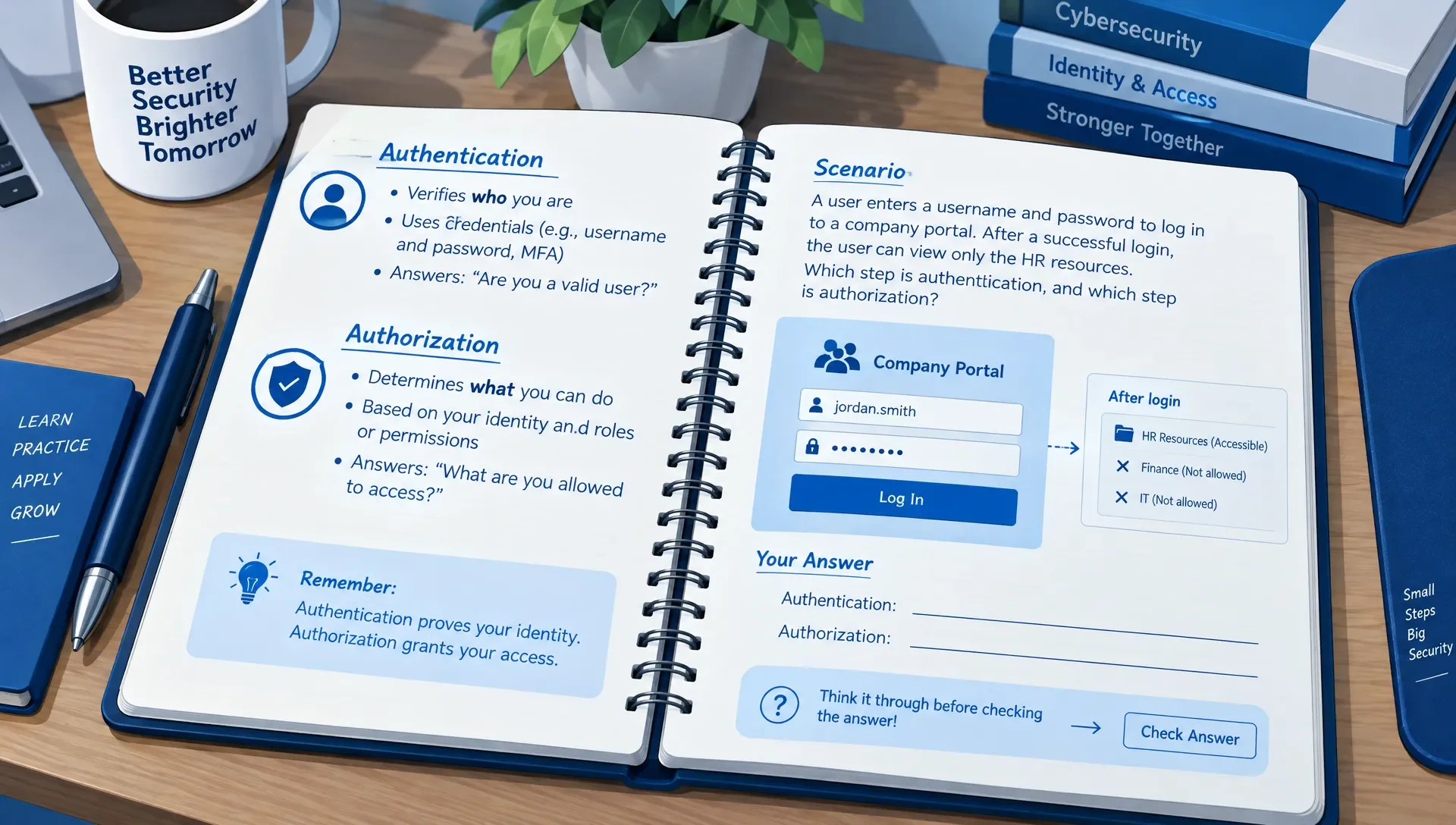
Practice Paired Scenarios Where One Requirement Changes
Once you can explain a distinction, test whether you notice it when the context shifts. Keep most of a scenario identical, and then change the requirement that determines the answer.
Authentication and Authorization
Scenario A: An application needs to verify that the person signing in controls the claimed account. This concerns authentication.
Scenario B: The person has signed in, but the application must decide whether they can delete a customer record. This concerns authorization.
The deciding detail isn't the presence of an account or application. It's whether the system is verifying identity or deciding permission.
Encryption and Hashing
Scenario A: A team needs to protect a stored document from unauthorized reading and recover its readable contents later. Encryption fits that requirement.
Scenario B: A team needs to compare a downloaded file's digest with a trusted published digest. Hashing fits that comparison.
Ask a partner, "Please help me study for a test by changing one requirement after I answer." If they replace "recover readable contents" with "compare a digest," you should change your answer and explain why.
RTO and RPO
Scenario A: A service must be restored within two hours of an outage. That describes an RTO.
Scenario B: Recovery must lose no more than 15 minutes of recent data. That describes an RPO.
AWS discusses both objectives in its disaster recovery planning guidance. A question can contain both targets, so identify which one it asks you to evaluate rather than choosing whichever acronym looks familiar.
Review Wrong Answers by Finding the Missed Detail
After a wrong answer, don't immediately copy the full explanation into your notes. First, pinpoint the exact detail your reasoning missed.
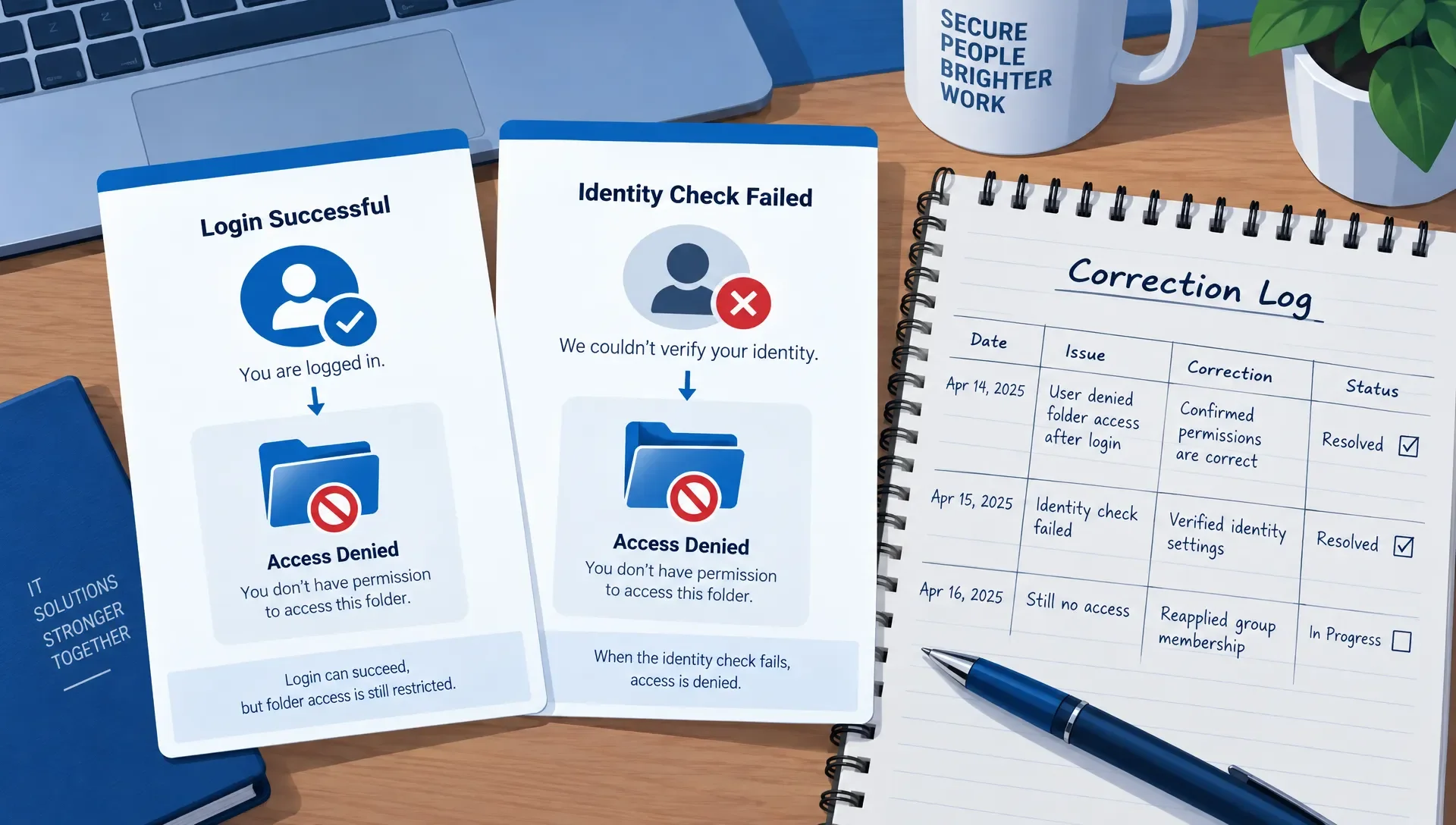
Write a short correction such as: "I chose authentication because I saw 'user account.' The question said the user had already signed in and couldn't access a folder, so authorization was the relevant decision."
Then, create a new scenario that changes the answer. If you can't write an authentication version of that authorization question, revisit the definitions before adding more practice questions.
A productive "help me study for a test" session should expose why you made a choice, not just tally whether it was right. Track whether you can name the concept, identify the deciding detail, and reject the alternative.
Also, practice distinguishing related concepts that aren't mutually exclusive. A system can use encryption and hashing for different purposes. When a question asks for the best answer, match the stated requirement instead of assuming the other technology is absent.
Use a 20-Minute Routine for Confusing IT Terms
You don't always need a full-length practice exam to address a specific confusion. Use this suggested routine for a focused session:
- Minutes 0-3: Choose two term pairs from recent mistakes and explain their differences without notes.
- Minutes 3-8: Answer contrast cards, including why the alternative doesn't fit.
- Minutes 8-15: Work through unfamiliar paired scenarios with changed requirements.
- Minutes 15-20: Check explanations, correct your reasoning, and schedule another review.
To make "help me study for a test" a measurable request, tell your partner to ask for evidence: the detail you used and the alternative you ruled out. Merely saying the right word isn't enough.
Treat improvement across separate sessions and unfamiliar examples as a reason to reduce a pair's review frequency. That's a study-management rule, not proof that you're ready for the entire exam.
When you return to broader practice, carry the same requirement-first approach into your answers. These test-taking strategies for IT certification exams can help you apply your distinctions under exam conditions.
Frequently Asked Questions
Should I memorize definitions before practicing scenarios? Learn a short, accurate definition of each term first, then compare the pair. Don't wait until you've memorized a whole chapter. Once you can explain each concept, practice choosing between them in context.
How many confusing IT terms should I study at once? Start with two or three pairs from recent mistakes. That's a manageable starting point, not a universal limit. Add another pair when you can distinguish the current ones in unfamiliar scenarios and explain why the alternatives don't fit.
Can AI help me study for a test without teaching me incorrect definitions? AI can generate comparison prompts and variations, but it can also produce incorrect explanations. Specify your exam and objectives, check uncertain claims against official documentation, and don't memorize an answer just because it sounds confident.
What if I choose the right answer but can't explain why? Keep reviewing that distinction. Your choice may reflect recognition or guessing rather than a usable decision rule. Name the deciding detail and explain what change would make the other term correct.
Should I stop doing full practice tests until I fix these terms? No. Use focused practice to address particular confusions and broader practice to check coverage across objectives. A term pair that feels easy on a flashcard may still cause trouble when it appears among several plausible options.
Turn Your Next Practice Session Into a Comparison Check
Bring three confusing pairs to your next session instead of asking only, "Can you help me study for a test?" For every answer, explain the requirement it satisfies and why its nearest alternative doesn't fit.
If you're preparing for Security+, use MindMesh Academy's Security+ practice questions and explanations to identify those pairs. Turn each relevant mistake into a contrast card, then check whether you can make the distinction in a new scenario before moving on.
To solidify your understanding and ensure you're ready for exam day, explore MindMesh Academy's comprehensive CompTIA Security+ practice exam with detailed explanations for every question. This resource can help you sharpen your discernment and approach questions with confidence. Start building your Security+ foundation with our practice exam.

Written by
Alvin Varughese
Founder, MindMesh Academy
Alvin Varughese is the founder of MindMesh Academy and an enterprise architecture leader. An electrical engineer by training, he moved from factory automation in South Africa to cloud architecture at GE Appliances and Humana (Fortune 50), and holds 20 professional certifications including AWS Solutions Architect Professional, Azure DevOps Engineer Expert, and Microsoft Agentic AI Business Solutions Architect. He built MindMesh Academy after interviewing too many highly certified candidates who couldn't answer basic questions: the goal is prep that makes you better at the job, not just able to pass the exam.