
Good Flashcards for Exams Start With Better Prompts
Good Flashcards for Exams Start With Better Prompts
To make effective flashcards, start by writing the question before its answer. The front of your card should describe a specific task: identify a service, differentiate between two concepts, or choose an action based on a given condition. If a prompt could lead to multiple valid answers, refine it before adding the card to your study deck.
Focus on a concept you've struggled with. Instead of a broad prompt like, "Explain multifactor authentication," try "Does a password plus a PIN count as two distinct authentication factors?" This gives you a question you can answer and grade precisely: no, both are knowledge factors. This level of precision is more important than how neat the card looks.
Start with the exam decision, not the topic label
A topic tells you what to study. A prompt tells you what information to retrieve. "Azure governance" is a topic; "Which Azure service can restrict resource deployments to approved regions?" is a prompt with a clear, defined answer.
Before you draft a card, identify the specific operation the exam objective requires. Does it ask you to name something, explain a relationship, distinguish between alternatives, or apply a rule? Align your question with that operation, instead of simply copying a section heading from your notes.
For instance, you might use an Azure Fundamentals study guide organized around exam objectives to find a concept, then create a prompt that specifically tests your ability to apply it.
This approach focuses on retrieval practice, not just rereading. The Institute of Education Sciences practice guide on organizing instruction and study suggests quizzing methods that require learners to pull information from memory. A card that displays most of the answer on its front provides little retrieval practice.
How to write effective flashcards with bounded answers
A bounded answer has a clear stopping point. You'll know exactly what a complete response includes and what it doesn't.
Compare 'What do you know about DNS?' with 'Which DNS record maps a hostname to an IPv4 address?' The second question asks for just one record type: A. You won't have to guess whether the card expects information about ports, recursive resolution, caching, or troubleshooting steps.
Use these three checks when you're drafting a prompt:
- Name the task: Use verbs like identify, distinguish, select, or explain, rather than just a topic label.
- State the necessary conditions: Always include the platform, service model, or constraint if it alters the correct answer.
- Limit the response: Ask for a single decision or a clearly defined set of information, not everything you recall about a subject.
A comparison can still represent one task. For example, 'How does authentication differ from authorization?' asks for a single distinction. However, a prompt like 'Define authentication, list its methods, and explain how to troubleshoot login failures' combines several tasks. Each of these deserves its own card.
Don't make the question artificially small, though. If the correct answer depends on a condition, keep that condition on the front of the card. 'Who patches the operating system?' is ambiguous across cloud service models. Specifying Amazon EC2 makes the question clear and answerable.
Replace vague prompts with decisions and contrasts
You can often improve your flashcards without adding more information. Just replace an open-ended instruction with a question that targets the precise distinction you want to remember.
| Broad or unclear front | Better prompt | Essential answer |
|---|---|---|
| Explain shared responsibility. | For an application running on Amazon EC2, who patches the guest operating system? | The customer. |
| What is Azure governance? | Which Azure service can enforce a rule that restricts resource deployments to approved regions? | Azure Policy. |
| Explain MFA. | Do a password and a PIN represent two different authentication factors? | No. Both are knowledge factors. |
| What is DNS? | Which DNS record maps a hostname to an IPv4 address? | An A record. |
The AWS example depends on the specific service named in the question. AWS outlines customer responsibility for the guest operating system on EC2 in its shared responsibility model. Removing 'Amazon EC2' would remove a crucial condition needed to answer correctly.
Notice that these improved prompts aren't necessarily harder. Some test basic facts. Their real advantage is that they pinpoint a specific knowledge gap when you miss them.
If you answer 'AAAA' to the DNS card, the correction is precise: you've confused IPv4 and IPv6 record types. Simply saying 'Review DNS' offers a far less useful instruction.

Include the detail that changes the answer
A short prompt isn't automatically a strong one. Effective flashcards keep the details that determine the answer and remove those that merely decorate the question.
Consider this example prompt: 'A company has offices in three cities, employs 600 people, and uses Azure. Which tool should it use for governance?' The company size doesn't resolve the question, and 'governance' still covers several possible needs.
A better version is: 'An Azure administrator must block new resources outside approved regions. Which service should enforce that rule?' The specific action—blocking noncompliant deployments—clearly identifies the relevant capability.
Change one condition to test a different distinction
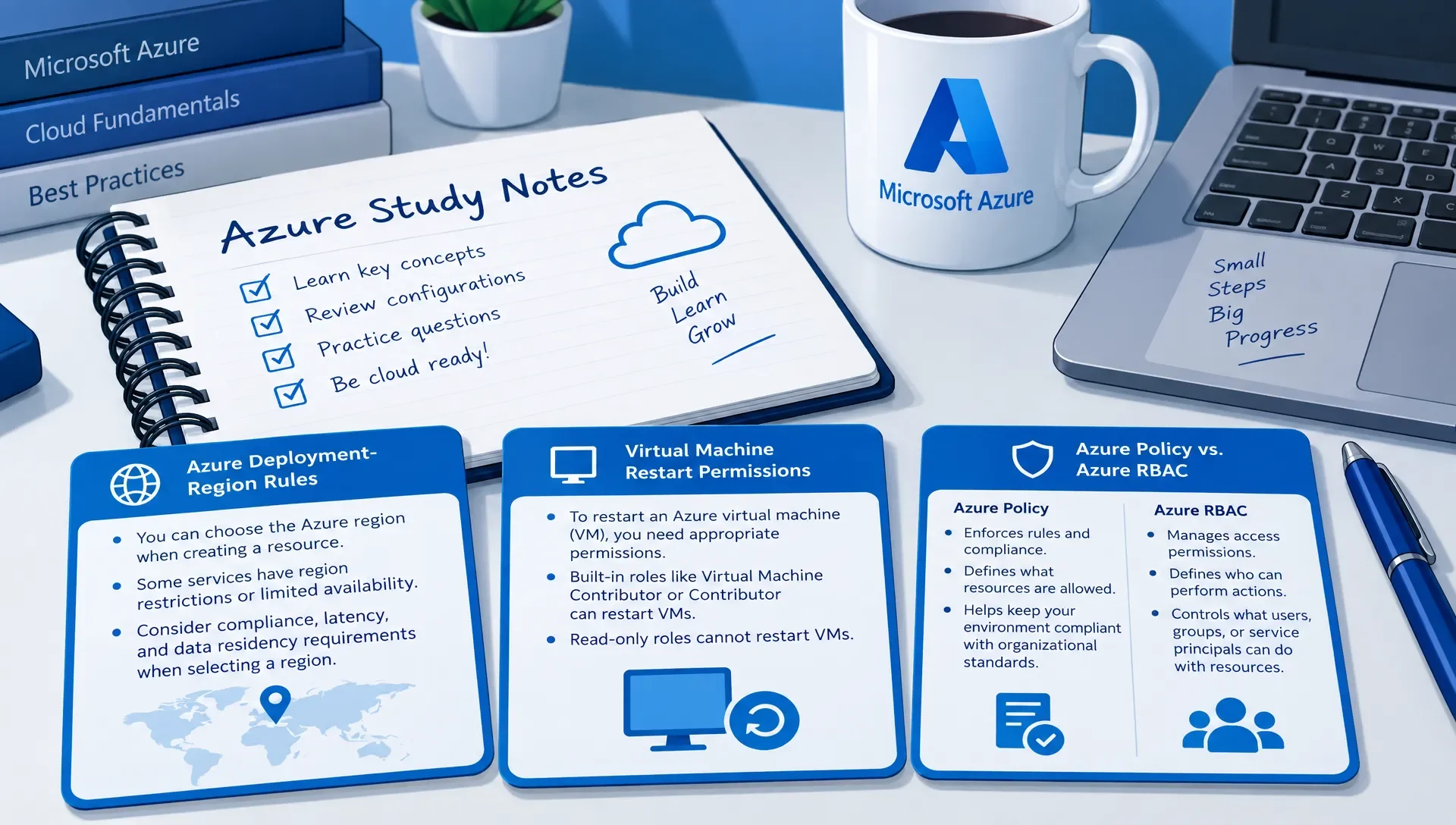
Write a companion card: 'An Azure administrator needs to let a support group restart virtual machines without granting broader management permissions. Which mechanism controls that access?'
The answer is Azure role-based access control, or Azure RBAC. The first card focuses on resource compliance, while the second deals with permissions. Microsoft's Azure Policy overview clearly explains this distinction between Policy and RBAC.
These cards should remain separate because each asks for a different decision. Together, they reveal whether you understand the boundary between the services, not just if you recognize their names.
Write an answer you can grade consistently
The back of the card serves as an answer key, not a replacement textbook. For effective flashcards, it should make a correct response easy to distinguish from one that's plausible but incomplete.
Front: For an application running on Amazon EC2, who patches the guest operating system?
Required answer: The customer.
Explanation: AWS manages the underlying infrastructure. The customer manages the guest operating system on the EC2 instance, including patches.
Common confusion: Don't apply this answer unchanged to every AWS service. Responsibilities vary with the service used.
You don't need all four labels on every card. A simple factual question might only require an answer. Add an explanation when it clarifies a boundary you've misunderstood.
Decide beforehand which wording counts as correct. For instance, 'The customer' and 'the organization using the EC2 instance' express the same responsibility. 'AWS handles security' does not accurately answer the question.
For a distinction card, require both sides of that distinction. 'Authentication verifies identity; authorization determines permitted access' is a complete answer. Recalling only one side counts as partial recall, even if the other half seems familiar once revealed.
Turn a practice-question mistake into a new prompt
When you miss a practice question, resist copying the entire question onto a card. Effective flashcards isolate the specific reasoning gap that caused you to miss it.
Imagine you selected Azure RBAC when a scenario required enforcing allowed deployment regions. A card that merely repeats the original scenario might lead you to memorize its wording. Instead, a card asking, 'Does limiting deployment regions concern user permissions or resource compliance?' tests that distinction more directly.
Next, create a separate application prompt with different wording: 'A subscription must reject resources created outside two approved regions. Which Azure service can evaluate that requirement?' The answer is still Azure Policy, but the wording changes how the concept is presented.
Review the original question's explanation before writing either card. You need to determine if the error came from a missing fact, a confused distinction, or an overlooked constraint. This method for reviewing every practice-question answer helps you pinpoint what truly belongs on your flashcard.
Use fresh application questions to check your understanding. For security concepts, a CompTIA Security+ practice exam can complement your flashcard deck by testing concepts within longer, more complex scenarios. Flashcard recall alone doesn't prove readiness for every exam format.
Check whether you're recalling the concept or the wording
A quick editing test for effective flashcards is to change the phrasing while keeping the core task the same. If you can only answer the familiar version, examine whether you're remembering the concept itself or just a verbal cue.
For example, change 'Which DNS record maps a hostname to an IPv4 address?' to 'A DNS lookup needs an IPv4 address for a hostname. Which record type provides it?' Both questions require the same underlying knowledge.
You can also reverse a relationship if doing so creates a meaningful question. After learning what an A record supplies, for instance, ask which record type you would investigate when a hostname's IPv4 mapping is incorrect. Avoid reversals that become ambiguous, such as 'What uses DNS?'
Repeated success on an unchanged card isn't the only check you need. Pair recall practice with unfamiliar questions and hands-on tasks where appropriate. These approaches to avoiding memorized question patterns help prevent familiar wording from becoming your main cue.
Spaced repetition determines when you revisit a card, but prompt quality defines what you're actually practicing when it reappears. Fix ambiguous wording instead of repeatedly reviewing an unclear question.
Frequently asked questions
What makes a flashcard effective for exam preparation? Effective flashcards ask for a specific fact, distinction, or decision, and they provide an answer you can grade consistently. Include enough context to resolve the question without giving away the answer.
Should every flashcard use a scenario? No. Direct questions work well for terminology, record types, and other foundational facts. Use a scenario when a condition changes the correct answer or when you need to practice choosing between plausible alternatives.
How long should a flashcard answer be? Keep the required answer as concise as the task allows. Add a brief explanation separately if it helps correct a misunderstanding. If the answer needs several unrelated paragraphs, split the task into multiple cards or refer to a study guide instead.
Should I put multiple-choice options on the front? Generally, leave them off when your goal is unaided recall. Options can provide clues that make recognition easier than pure retrieval. Use multiple-choice practice separately to work on evaluating alternatives and identifying scenario constraints.
Can AI help me write flashcard prompts? Yes, but treat its output as a preliminary draft. Always check technical answers against official documentation, remove any accidental clues, and ensure each question has a defensible answer. Don't accept invented exam requirements or unsupported service behavior.
Improve the next ten cards before expanding your deck
Start by selecting ten cards you've frequently missed or answered with uncertainty. Rewrite each front to focus on a specific task, retain the conditions that change the answer, and clearly define what counts as a correct response.
For a structured approach to exam prep that complements effective flashcard creation, MindMesh Academy's certification prep resources provide exam-objective study guides, practice questions with explanations, and spaced-repetition flashcards. Use these tools to reinforce concepts, test your knowledge in context, and review strategically, helping you build a strong foundation for your certification journey.

Written by
Alvin Varughese
Founder, MindMesh Academy
Alvin Varughese is the founder of MindMesh Academy and an enterprise architecture leader. An electrical engineer by training, he moved from factory automation in South Africa to cloud architecture at GE Appliances and Humana (Fortune 50), and holds 20 professional certifications including AWS Solutions Architect Professional, Azure DevOps Engineer Expert, and Microsoft Agentic AI Business Solutions Architect. He built MindMesh Academy after interviewing too many highly certified candidates who couldn't answer basic questions: the goal is prep that makes you better at the job, not just able to pass the exam.