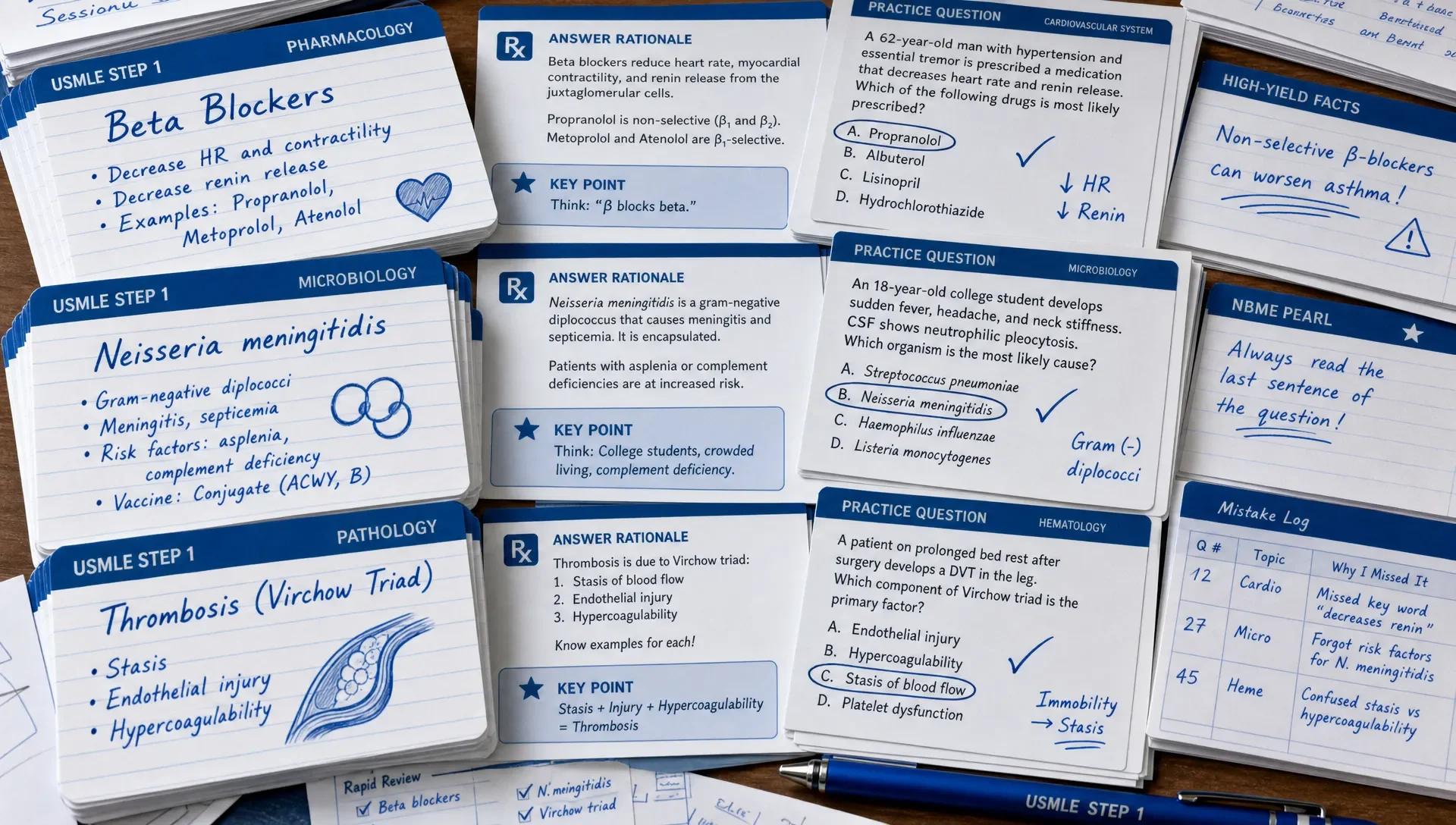
Exam Bank Questions: How to Avoid Memorizing Patterns
Exam Bank Questions: How to Avoid Memorizing Patterns
Exam banks can sharpen your recall, but only if you stop treating repeated questions as proof of readiness. Your goal isn't to recognize familiar wording or answer orders. Instead, you need to rebuild the reasoning path, allowing you to solve new versions of the same objective under exam pressure.
Start with this rule: every practice question should produce evidence. Before you check the answer, write down the objective being tested, your confidence level, and the reason each tempting option might be wrong. If you can't explain those three things, a correct answer is still unfinished work. That single habit prevents the most common question-bank trap, which is confusing familiarity with mastery.
Why exam bank pattern memorization happens
Pattern memorization usually feels productive because your scores rise. You see a familiar scenario, remember that the shortest answer was correct last time, and move on. The problem is that the real exam may test the same concept with different wording, a different service name, a longer scenario, or two answers that both sound partly correct.
Once an exam bank feels familiar, your brain can lean on surface cues instead of retrieval. Karpicke and Roediger's research in Science found that repeated retrieval improved long-term retention more than repeated studying, but the benefit comes from pulling knowledge from memory, not from recognizing a prompt you have already seen before.
| What feels like progress | What it often hides | Better evidence of readiness |
|---|---|---|
| You remember the correct letter | You memorized answer position | You can justify the concept without choices |
| You answer fast because the stem looks familiar | You skipped scenario analysis | You can name the key constraint in the prompt |
| Your score rises after quick retakes | You repeated the same cues too soon | You improve after delayed mixed practice |
| You know why one answer is right | You ignored why distractors are wrong | You can eliminate each wrong option for a clear reason |
A familiar exam bank can make weak recall feel strong because the question itself becomes a hint. Your study system has to remove those hints often enough that you find out what you actually know.
How to review practice questions without memorizing them
Use an exam bank for retrieval first and feedback second. That means you answer closed-book, commit to a choice, rate confidence, then review. If you read the explanation before you have struggled with the prompt, you reduce the value of the question.
A strong review routine has four moves. First, identify the tested objective. Second, explain the right answer in your own words. Third, explain why each wrong answer fails in this scenario. Fourth, decide what to do next: reread a targeted section, make a flashcard, retry a related question, or practice a performance-based format.
If you want a deeper review workflow, MindMesh Academy's guide on how to review practice exam questions more effectively explains how to learn from every option instead of only checking the correct answer.
Answer before you look at the choices
For scenario questions, cover the options mentally and predict the kind of answer you expect. In cloud exams, that might be a storage class, identity control, network path, or monitoring service. In project management, it might be a process response, stakeholder action, or risk technique.
This works because it forces recall before recognition. If your predicted answer is close to the correct option, you probably understand the objective. If you had no prediction and simply picked the option that sounded familiar, flag the item even if you got it right.
Make explanations harder than the question
The explanation step should take longer than choosing the answer.
A weak review says, "I got it right because that service is for security." A useful review says, "This option fits because the scenario asks for centralized identity control across accounts, and the other options solve logging, encryption, or network filtering instead."
An exam bank is most valuable when you use it to practice discrimination. Certification questions often include answers that are technically true but wrong for the specific requirement. Your job is to connect the clue in the stem to the most precise answer.
How to spot pattern cues before they distort your score
Pattern cues are shortcuts that help you answer a repeated item without understanding it. They can come from the bank design, your memory of the last attempt, or repeated wording across similar questions. You don't need to avoid practice questions because of this. You need to notice the cues and neutralize them.
Common warning signs include finishing too quickly, recognizing the answer before reading the full stem, skipping distractors, or feeling certain without being able to explain the objective. These are not moral failures. They are signals that the item has lost diagnostic value for now.
| Pattern cue | What to do instead |
|---|---|
| You remember the exact answer | Rewrite the stem as a new scenario and solve it again |
| You recognize the wrong options | Explain the concept without viewing any options |
| You rely on wording like "always" or "never" | Check the objective and scenario constraint before eliminating |
| You retake the same set the same day | Delay the retake and mix in other topics |
| You know the topic but miss scenario clues | Highlight the requirement, constraint, and outcome before answering |
Delay retakes long enough to test memory
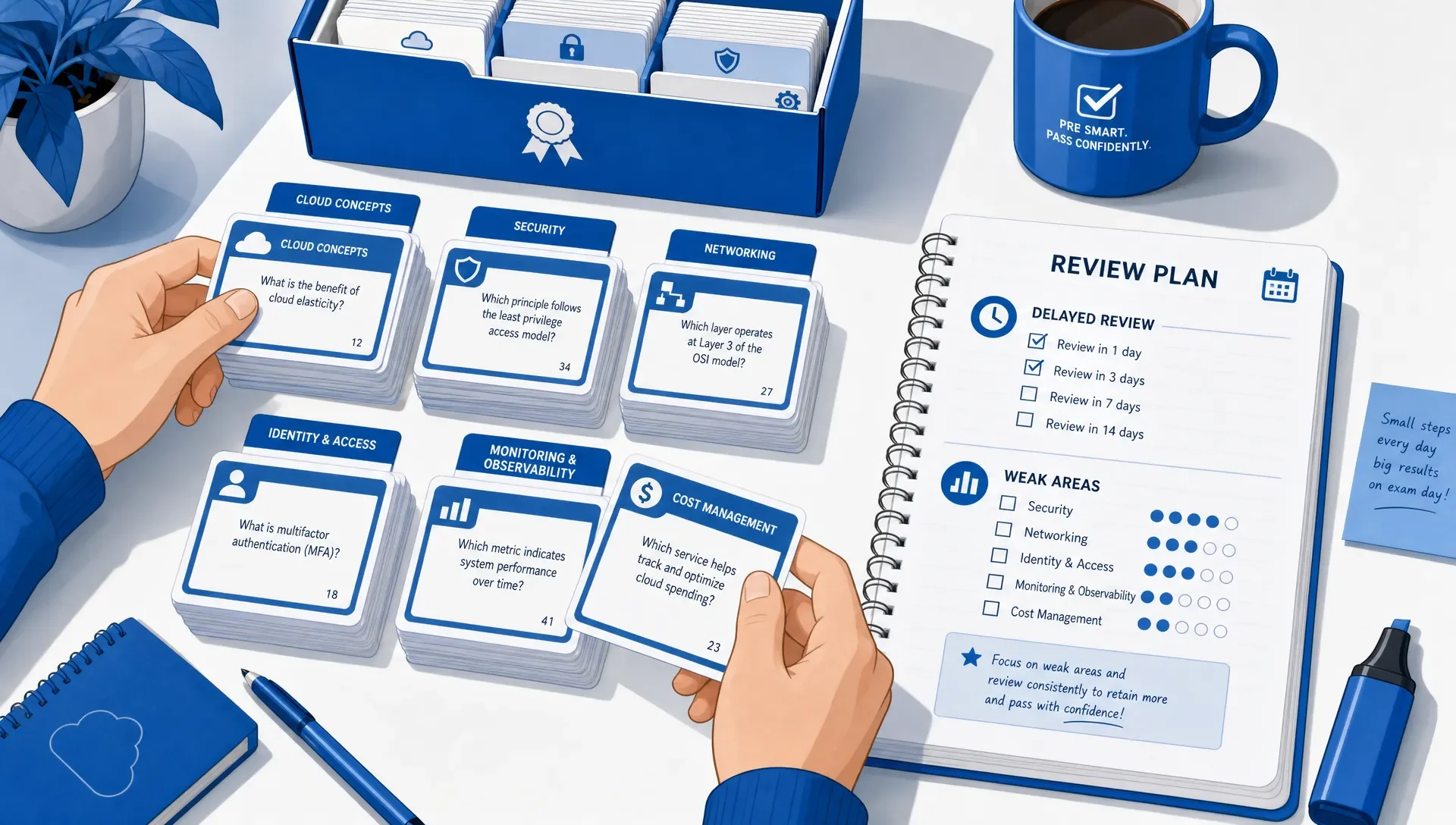
Immediate retakes inflate scores. If you retry the same set ten minutes later, you're often measuring short-term familiarity. Delay missed questions long enough that you have to retrieve the concept again. For many learners, that means reviewing the explanation today, studying the weak objective, then trying related questions tomorrow or later in the week.
This aligns with the broader learning principle behind distributed practice. Dunlosky and colleagues rated practice testing and distributed practice as high-utility learning techniques in their review in Psychological Science in the Public Interest because they consistently support durable learning when used correctly.
If your exam bank supports adaptive weakness-based practice or topic tracking, use those tools to delay repeated exposure while still returning to weak areas. The key is to revisit concepts, not memorize a fixed sequence of prompts.
Turn repeated questions into new questions
When a question becomes too familiar, don't throw it away. Transform it. A repeated item can still teach you if you change the task from answering to generating.
Here are practical ways to convert an overused question into real study work:
- Rewrite the scenario with one changed constraint, such as cost, availability, compliance, latency, or stakeholder priority.
- Remove the answer choices and explain the solution as if you're teaching a classmate.
- Turn the missed concept into a flashcard that asks for the rule, not the original answer.
- Create a "why not" note for each distractor so you understand when that option would be correct.
- Map the question to the official objective domain so your review stays aligned with the exam blueprint.
Treat every exam bank item as raw material for transfer. Transfer is the ability to solve a new version of the problem, which is what certification exams demand. If you can only answer the original version, you haven't finished learning from it.
For example, if you're preparing for cloud fundamentals, a repeated storage question should become a comparison of durability, access pattern, cost model, and retention requirement. If you're preparing for security, a repeated access-control question should become a decision between authentication, authorization, accounting, least privilege, and monitoring.
Learners working toward entry-level cloud certification can apply this workflow inside an AWS Certified Cloud Practitioner practice exam. Security learners can do the same with a CompTIA Security+ practice exam, especially when reviewing scenario questions and performance-based formats.
Use readiness checks that are harder to fake
Before you trust an exam bank score, ask whether the score would survive different wording. A high percentage on familiar questions is useful only when it matches other evidence: steady performance across objectives, accurate explanations, delayed recall, and the ability to handle mixed sets.
A better readiness check uses mixed practice. Combine weak and strong domains so your brain has to identify the topic before solving. This is closer to exam day, where the test does not announce, "This is an IAM question" or "This is a stakeholder engagement question" before the scenario begins.
Track confidence, not just correctness
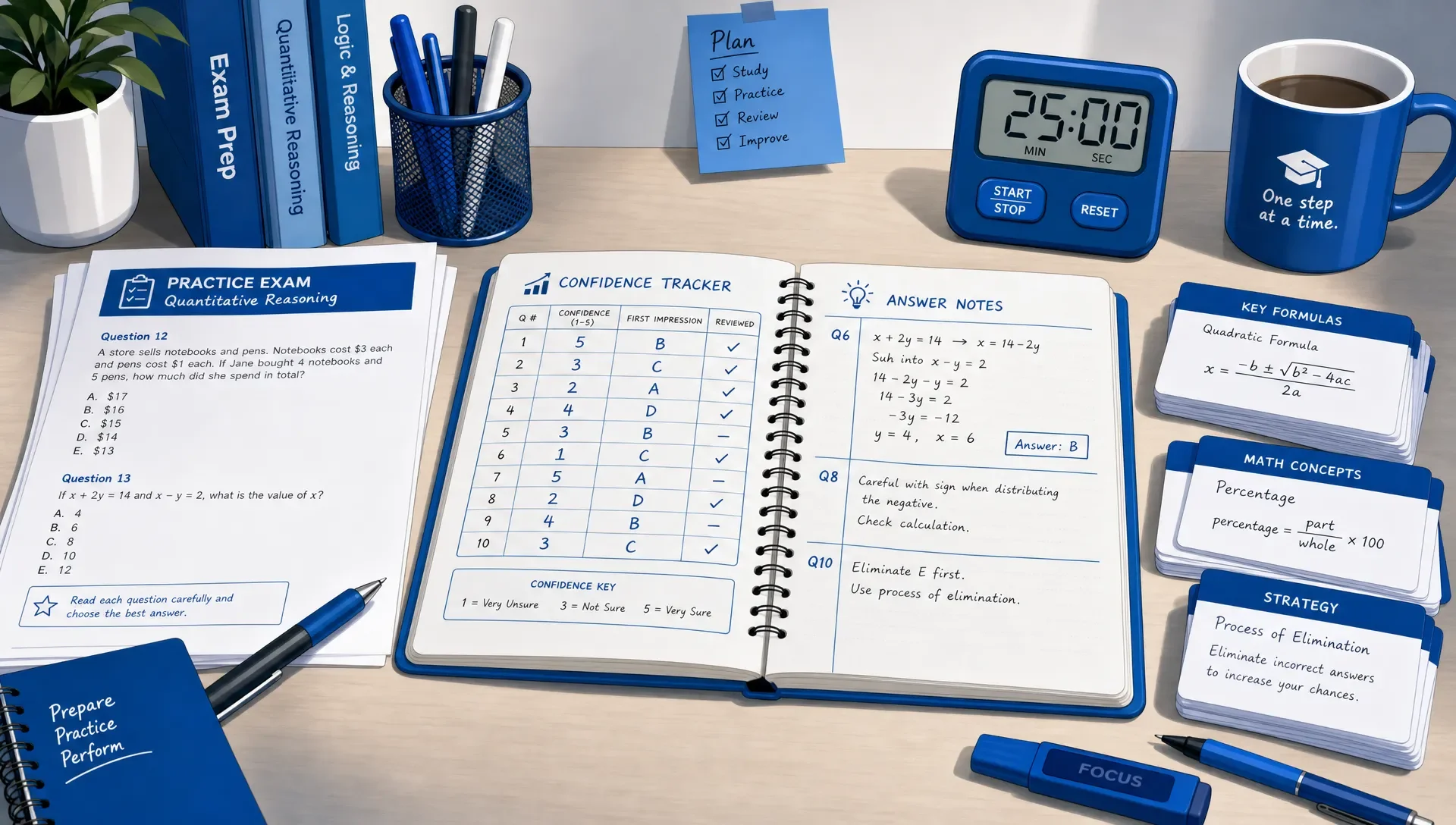
Correctness alone is too shallow. Add a confidence rating before you reveal the answer. A correct high-confidence answer usually means the concept is stable. A correct low-confidence answer needs review because it may have been a guess. An incorrect high-confidence answer is urgent because it means you have a misconception.
| Result | What it means | Next action |
|---|---|---|
| Correct, high confidence | Likely strong understanding | Move to mixed or harder questions |
| Correct, low confidence | Possible guess or partial knowledge | Review explanation and retry later |
| Incorrect, low confidence | Known weak spot | Study the objective and practice related items |
| Incorrect, high confidence | Misconception | Rebuild the concept from the guide before more questions |
MindMesh Academy includes mastery and readiness tracking, which can help you separate lucky correct answers from reliable performance. That matters because a passing score on practice is less valuable than knowing which domains remain fragile.
Protect your first attempt
Your first attempt is the cleanest diagnostic result because you haven't seen the wording yet. Don't waste it by rushing, checking hints, or reviewing the answer too early. Simulate exam conditions when you need a readiness check: closed-book, timed, and without pausing to research.
For more tactics focused on understanding rather than recall-by-pattern, the MindMesh Academy article on question bank tactics that build real understanding pairs well with this approach.
A simple weekly routine to prevent pattern memorization
A sustainable routine beats heroic cramming. You need enough question exposure to find weak areas, but not so much repeated exposure that every item becomes familiar noise.
Try this weekly rhythm:
- Day 1: Study one objective section, then answer a small closed-book set tied to that objective.
- Day 2: Review explanations from missed and guessed items, then create flashcards for rules and distinctions.
- Day 3: Practice a mixed set that includes older topics, not just the current one.
- Day 4: Retry only selected weak concepts with changed wording or related questions.
- Day 5: Take a timed set and track confidence before reviewing answers.
- Day 6: Rebuild weak concepts from the study guide, especially high-confidence misses.
- Day 7: Rest or do light flashcard review with spaced repetition.
This routine keeps an exam bank from becoming a memorization loop. You still get repetition, but the repetition targets concepts, timing, confidence, and transfer instead of answer strings.
Frequently Asked Questions
Is it bad to use the same practice questions more than once? No. Reusing questions can help if you delay retakes and change the task. The second pass should test whether you understand the objective, not whether you remember the answer.
How do I know if I'm memorizing patterns instead of learning? Watch for speed without explanation. If you can answer before reading the full stem, can't explain why distractors are wrong, or score much higher on repeated sets than new mixed sets, you're probably relying on pattern memory.
Should I review only the questions I missed? No. Review guessed answers and low-confidence correct answers too. Those items often reveal partial knowledge that could fail when the real exam changes the wording.
How long should I wait before retaking missed questions? Wait long enough that you need to retrieve the concept again. A next-day or later-in-the-week retake is usually more useful than an immediate repeat, especially after you study the weak objective.
Are flashcards better than practice questions? They solve different problems. Flashcards are useful for spaced recall of definitions, rules, and comparisons. Practice questions are better for applying those facts to scenarios and eliminating distractors.
What score means I'm ready for the real exam? Don't use a single score alone. Look for consistent performance across objectives, strong confidence calibration, solid explanations, and good results on new or mixed timed sets.
Build exam readiness without training the wrong habit
MindMesh Academy helps you integrate study guides, practice questions, explanations, and readiness tracking into a single workflow. This comprehensive approach is key because passing a certification exam means more than just seeing many questions. It requires you to retrieve the right concept, apply it to new scenarios, and articulate why tempting but incorrect answers don't fit. For detailed insights into the topics covered, prepare for the AWS Certified Cloud Practitioner exam with our study guide.
If your practice scores are rising but you suspect you're recognizing patterns, slow down your review process this week. Protect first attempts, delay retakes, track confidence, and turn repeated questions into new prompts. Used that way, an exam bank becomes a tool for real exam readiness instead of a shortcut that only works on questions you've already seen.

Written by
Alvin Varughese
Founder, MindMesh Academy
Alvin Varughese is the founder of MindMesh Academy and an enterprise architecture leader. An electrical engineer by training, he moved from factory automation in South Africa to cloud architecture at GE Appliances and Humana (Fortune 50), and holds 20 professional certifications including AWS Solutions Architect Professional, Azure DevOps Engineer Expert, and Microsoft Agentic AI Business Solutions Architect. He built MindMesh Academy after interviewing too many highly certified candidates who couldn't answer basic questions: the goal is prep that makes you better at the job, not just able to pass the exam.