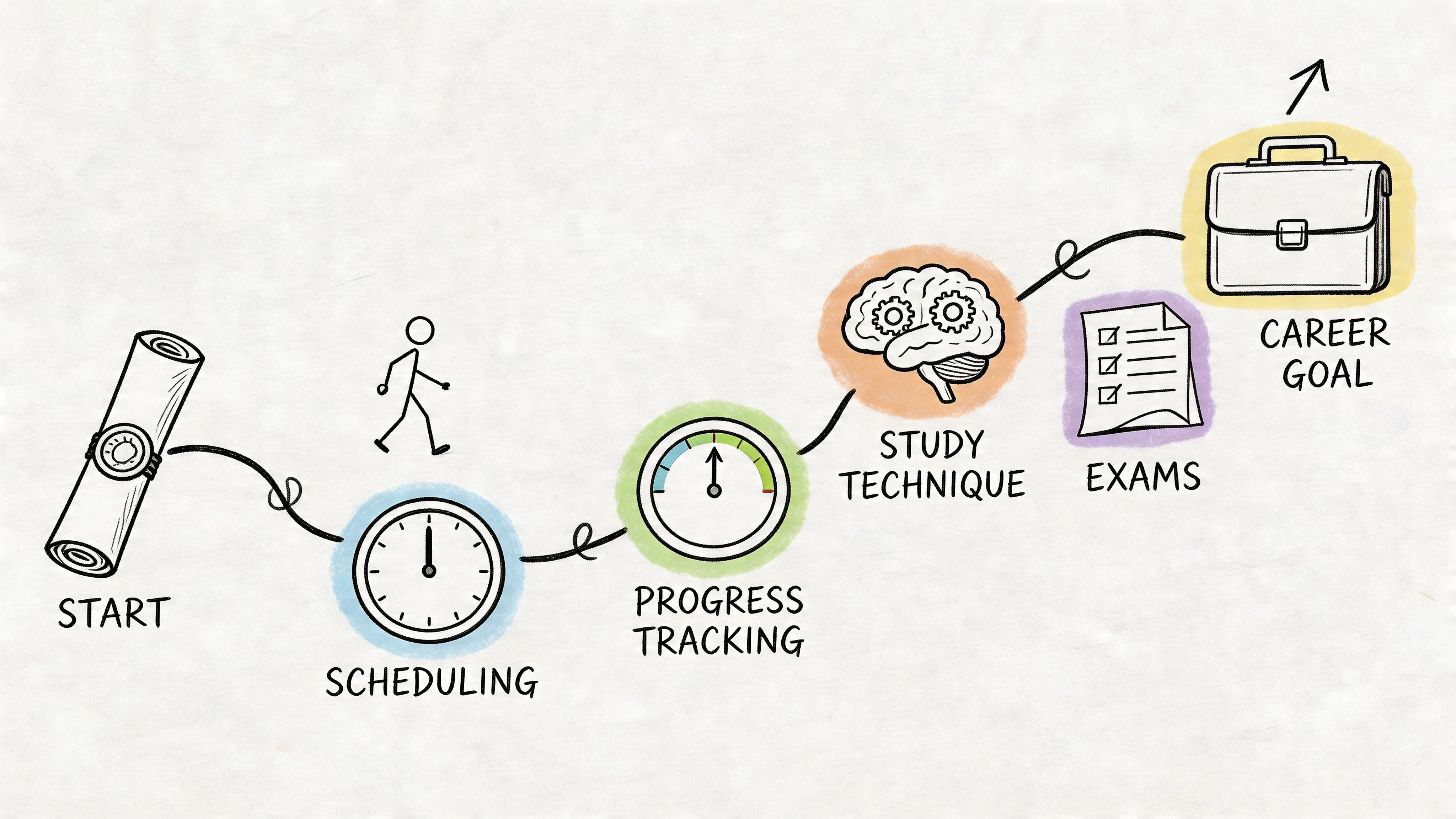
Get Ahead Get Certified: Your 2026 Career Roadmap
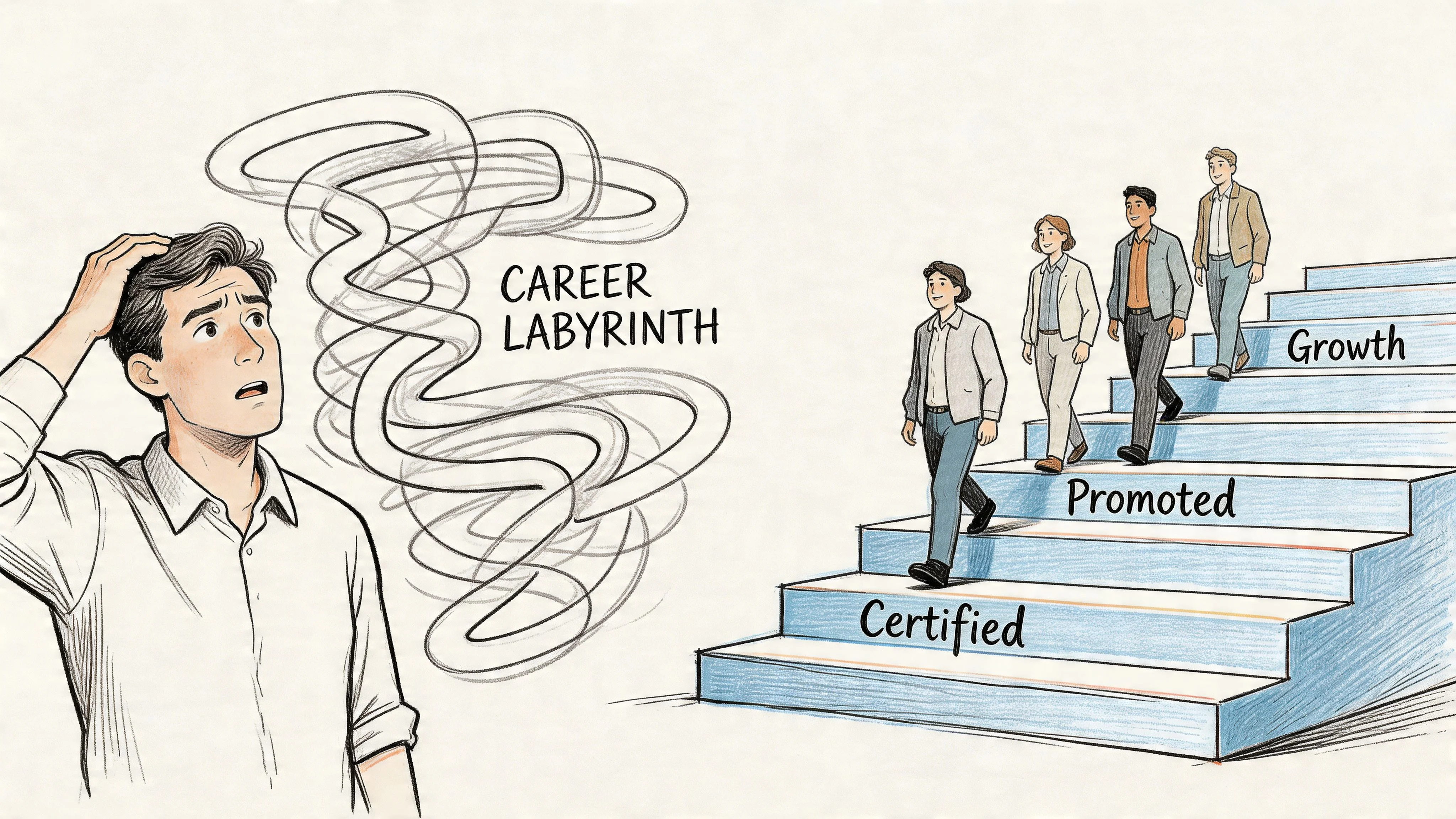
You’re likely in one of two places right now. You either know a specific certification is essential for the next role you covet, or you’re deep into your tech career, observing peers with credentials consistently landing the interviews, high-profile projects, and promotions you believed experience alone would secure.
This realization often triggers a search for phrases like "get ahead get certified." The motivation isn't vague inspiration; it's a pragmatic search for a clear, actionable career trajectory.
The common pitfall is treating certification as a singular event—just an exam to pass. The IT professionals who truly excel view it as a strategic career project. They meticulously choose the right credential, commit to disciplined study, approach the exam with a tactical plan, and then skillfully leverage their success to propel their careers forward. This complete cycle, from selection to activation, is far more impactful than any individual study resource.
Beyond the Exam: Why Certification Is a Career Project
A certification's true value emerges when it directly solves a career problem. Perhaps you're a help desk technician aspiring to a cybersecurity role. Maybe you've been leading projects informally but lack the Project Management Professional (PMP®) or ITIL® 4 Foundation credential that hiring managers expect. Or perhaps you're transitioning industries and need a recognized signal that says, "I possess the core competencies for this work, and I've invested structured effort to prove it."
This is precisely why the phrase "get ahead get certified" resonates when interpreted strategically. It's not about merely collecting badges; it's about generating tangible career momentum where stagnation previously existed.
The Mindset That Changes the Outcome
Highly successful candidates rarely conquer major certifications by "hoping to find time." Instead, they adopt a project management approach:
- Define the Target Role: What specific job are they aiming for?
- Pick the Right Exam: Which credential directly supports that goal?
- Set an Exam Date: A non-negotiable deadline.
- Build Weekly Deliverables: Structured study tasks leading up to that date.
This "project mindset" is a cornerstone of effective certification preparation. It's why resources like Darril Gibson's Get Certified Get Ahead series became foundational, particularly his CompTIA Security+ guide. His practical, objective-focused approach is highly regarded because he himself holds multiple advanced certifications, including CISSP and CASP, as detailed in the Get Certified Get Ahead Security+ reference. This systematic method has empowered thousands to pass on their first attempt.
Conversely, professionals who struggle often make one of three critical mistakes:
- They chase popularity: Opting for whatever certification is currently trending on LinkedIn, irrespective of its alignment with their personal career path. For instance, pursuing an AWS Certified Solutions Architect – Associate because it's popular, rather than an Azure Administrator Associate if their organization is Microsoft-centric.
- They confuse content consumption with competence: Spending weeks watching video lectures or reading study guides but failing to articulate or apply concepts without prompts or external aids. They can recognize the information but not retrieve or utilize it.
- They postpone the uncomfortable parts: Critical activities like practice questions, hands-on labs, and timed review sessions are delayed until the last minute, or worse, entirely omitted. These are the diagnostic tools that reveal true readiness.
Practical rule: If your certification plan doesn’t explicitly connect to a specific target role, a desired salary negotiation, or a clear internal promotion pathway, it remains a wish, not a well-defined career project.
What the Project Actually Includes
Shift your thinking from vague effort to tangible deliverables. A truly effective certification project incorporates:
- A Business Goal: This could be securing a new job, facilitating an internal team transfer, earning a promotion, or simply strengthening your resume for future opportunities.
- A Skills Goal: What specific technical or conceptual knowledge must you master well enough to apply on the job, not just recall for an exam? For an AWS Solutions Architect, this might mean designing resilient, cost-optimized cloud architectures. For a PMP, it’s about applying project management methodologies.
- A Robust Study System: This includes dedicated calendar blocks, carefully selected resources, a disciplined review cadence, and consistent practice with exam-style questions.
- An Activation Plan: What will you do immediately after passing? This involves updating your resume and LinkedIn profile, having strategic conversations with your manager, and preparing compelling stories about how your new credential enhances your capabilities for interviews.
This holistic perspective dramatically reduces anxiety. Instead of a high-stakes question like, "Can I pass this intimidating exam?" you begin asking more empowering questions: "Which credential best fits my next role?" "What core skills are absolutely essential for this certification and subsequent job?" "How much dedicated study time can I realistically commit each week?" and critically, "How will I leverage this credential within days of earning it?"
That's how certification transforms from a stressful event into a strategic career move.
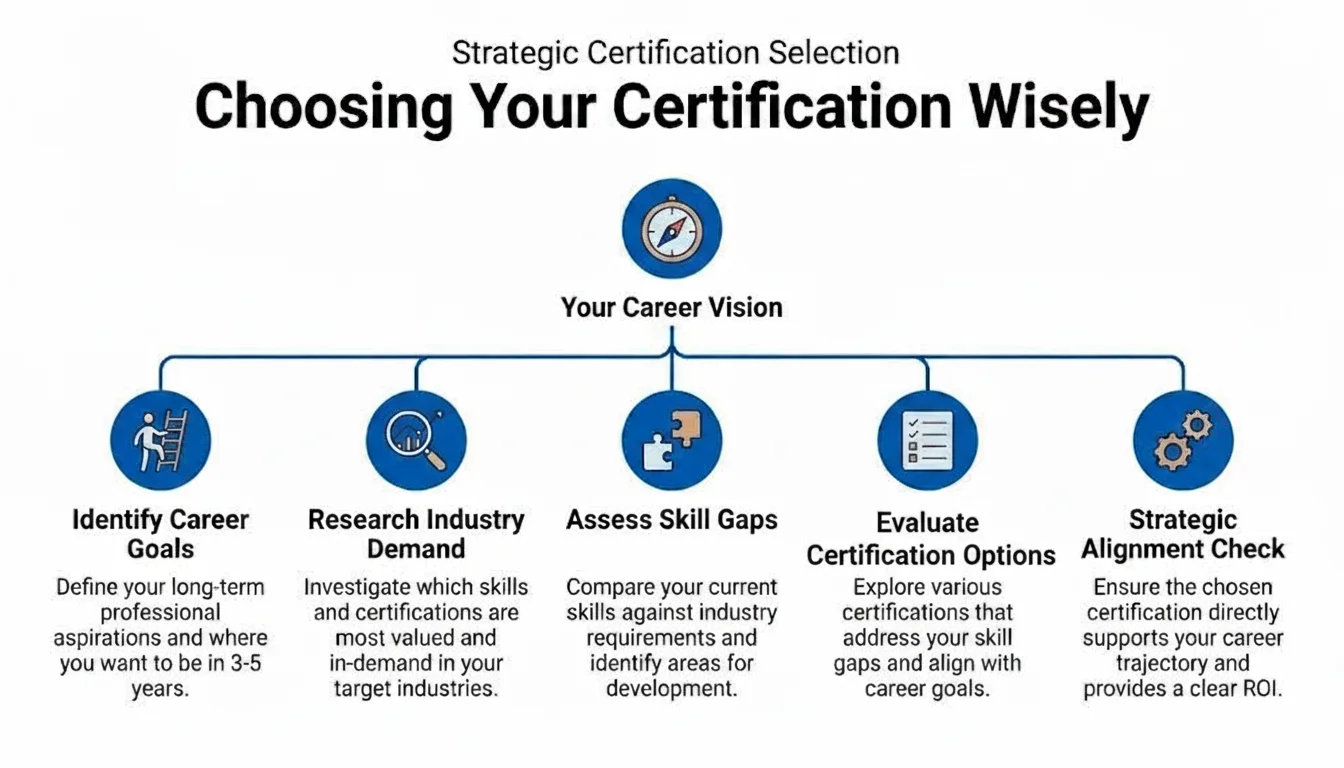
Choosing Your Certification Wisely
Selecting the wrong certification can waste months of effort and valuable resources. Conversely, the right credential can provide unparalleled clarity for your next career move, sharpen your learning, and present recruiters with a concise, compelling narrative about your professional capabilities.
Start by working backward. Instead of asking, "Which cert is currently trending or 'hottest'?" ask, "What specific job do I want next, and what skills does it demand?"
Reverse Engineer the Target Role
Consider a help desk technician aspiring to become a cloud engineer. Their initial focus shouldn't be a Project Management Professional (PMP) credential unless their actual career path involves service delivery management or coordination. Similarly, a junior data analyst keen on deepening their data science expertise shouldn't automatically jump into a CompTIA Security+ exam just because it "sounds technical."
A more effective and streamlined process looks like this:
- Name the specific role you want next: Be precise. (e.g., "Junior Cloud Administrator," "Cybersecurity Analyst L1," "Project Manager for Software Development")
- List the core responsibilities and tasks in that role: (e.g., for Cloud Admin: "deploying EC2 instances," "managing S3 buckets," "basic network troubleshooting").
- Identify the recurring tools, concepts, and expectations: (e.g., for Cyber Analyst: "SIEM monitoring," "incident response frameworks," "understanding attack vectors").
- Choose a certification that directly validates those expectations: (e.g., AWS Certified Cloud Practitioner then AWS Certified SysOps Administrator - Associate for the Cloud Admin, or CompTIA CySA+ for the Cyber Analyst).
This systematic approach prevents you from accumulating a disparate collection of credentials that don't coalesce into a coherent, compelling career story.
Use Role Families, Not Hype Cycles
Certifications generally make the most strategic sense when grouped by their relevance to specific role families. This approach provides a clearer ladder for progression.
| Role Direction | Common Certification Level to Start With | What You’re Really Validating (Examples) |
|---|---|---|
| IT support to admin work | Foundational/Entry-Level | Core operating systems (Windows Server, Linux), networking fundamentals (CompTIA Network+), basic troubleshooting, essential IT operations. |
| Admin to cloud or security | Associate-Level | Applied technical judgment in a specific domain; e.g., cloud deployment and management (AWS Certified Solutions Architect – Associate, Microsoft Azure Administrator Associate AZ-104), or foundational security principles and implementation (CompTIA Security+). |
| Analyst to data-focused roles | Entry or Associate Analytics Cert | Data handling, interpretation, visualization, and communication; e.g., Google Data Analytics Certificate, Microsoft Certified: Azure Data Scientist Associate. |
| Coordinator to project manager | Project-Focused Cert | Formal project delivery, planning, risk management, agile methodologies (PMP, Certified ScrumMaster, PMI-ACP), and stakeholder management. |
| Mid-career specialist to leadership expert roles | Advanced or Professional | Breadth of knowledge, governance, strategic decision-making, and specialized expertise; e.g., CISSP, AWS Certified Solutions Architect – Professional, ITIL 4 Managing Professional. |
You don't need to be intimately familiar with every single certification on the market. What's crucial is understanding which certification level accurately aligns with your current experience and your intended next step. A common mistake for early-career candidates is to prematurely target advanced exams that implicitly assume years of practical context, leading to unnecessary frustration and prolonged study.
Look for Industry Reach, Not Just IT Brand Recognition
A significant and beneficial shift in recent years is the expansion of certification value beyond traditional core IT roles. The demand for certified professionals now permeates fields like digital marketing, public health, and artificial intelligence. Credentials such as the SAS Certified Statistical Business Analyst and the Google Data Analytics Certificate exemplify how extensively organizations across various sectors now rely on data-driven decision-making, as highlighted in this piece on skills acquired through statistical analysis certification.
This broad applicability is particularly relevant for career changers. If your goal is to transition into a tech-adjacent role, rather than purely infrastructure or software engineering, your certification options might be far broader and more impactful than you initially perceived.
A strategically chosen certification acts as a powerful signal. It succinctly tells employers precisely what kind of technical problems you are prepared and qualified to solve.
Test the Certification Before You Commit
Before you invest significant time or money into any certification, conduct these five essential checks:
- Job-Posting Check: Scrutinize actual job listings for your desired role. Does this specific certification appear repeatedly, or do the underlying skills it covers matter more? This tells you if it's a direct requirement or a strong differentiator.
- Prerequisite Check: Thoroughly review the official prerequisites for the exam. Does it assume a level of experience you already possess, or that you can realistically build during your preparation period? Avoid certifications that demand years of experience you simply don't have.
- Content Check: Download and review the official exam objectives. Do the topics resonate with your target work, or do they feel entirely disconnected? If the latter, it's likely not the right fit.
- Tooling Check: Does the exam prepare you for practical, hands-on tasks and real-world tools, or is it heavily focused on broad theory? For practical roles like Cloud Engineer or Cybersecurity Analyst, hands-on application is critical.
- Narrative Check: Can you articulate in one concise sentence why this certification is the logical and necessary next step in your career progression?
Reflection Prompt: If you struggle with that last question, pause and reconsider. A clear "why" is crucial for sustained motivation.
Two Practical Examples
Scenario One: Advancing from Support to Cloud Engineering You currently work in IT support and aspire to become an AWS Cloud Engineer. Your most effective path would typically involve gaining foundational infrastructure knowledge first (e.g., basic networking, operating systems), followed by an associate-level cloud credential such as the AWS Certified Solutions Architect – Associate or AWS Certified SysOps Administrator – Associate. Pursuing a random management certification here would be largely ineffective as it doesn't close your technical skills gap.
Scenario Two: Formalizing Project Leadership You informally coordinate technical projects and aim for a formal Project Manager role. In this case, a project-focused credential like the Project Management Professional (PMP) or Certified ScrumMaster (CSM) would be far more beneficial than a general IT technical exam. These certifications directly align with and formalize the work you're already doing, providing a recognized framework for your experience.
If you seek a broader framework for comparing diverse career paths, the guide on Choosing Your Certification Wisely can serve as an excellent starting point, as it organizes certifications by career direction rather than just by vendor.
A Simple Decision Filter
When advising IT professionals on their first major certification, I typically recommend scoring each option against these three critical questions:
- Does this genuinely help me qualify for my next desired role?
- Will I actively use this knowledge in my actual work, projects, or future interviews?
- Can I explain this certification choice without sounding defensive, vague, or random?
If the answer isn't a confident "yes" to all three, it’s highly probable that you need to re-evaluate and find a more suitable strategic move.
Designing Your Personal Study Blueprint
Once you've strategically chosen your certification, the immediate impulse is often to ask, "Which book, course, or practice exam should I buy?" However, this isn't the first question to address. The initial and more crucial question is: "How will I systematically transform these exam objectives into consistent, weekly study behaviors?"
A robust study blueprint accomplishes three key objectives:
- Breaks the Exam into Manageable Parts: Decomposing a large body of knowledge into smaller, digestible chunks.
- Assigns Parts to Realistic Time Blocks: Allocating study time that you can realistically protect and commit to each week, avoiding burnout.
- Builds in Early Review: Integrating revision from day one, ensuring that weaker areas are identified and strengthened long before exam day stress sets in.
Start with the Exam Objectives and a Baseline Check
The quickest way to waste precious study time is to approach every exam topic as equally difficult. Certain domains will already be familiar from your professional experience, while others will be entirely new. It is crucial to identify this disparity before you dive into week one of your study plan.
A highly effective method, popularized in the CompTIA Security+ world, is to begin with a pre-test or diagnostic assessment. Then, systematically work through the material, chapter by chapter, continually taking quizzes until you consistently achieve scores of 90%+, meticulously studying the explanations for both correct and incorrect answers. This approach, leveraging 300+ realistic questions, is credited with helping thousands achieve first-attempt passes, with an estimated 50% retention boost noted in the exam prep reference for CompTIA Security+ Get Certified Get Ahead.
The core principle here extends far beyond Security+: always establish a baseline first, and then adapt your study plan accordingly.
Build Your Week Around Energy, Not Guilt
Most candidates don't fail due to laziness. They fail because they construct study plans for an idealized version of themselves. They schedule ambitious three-hour weekday sessions after mentally exhausting workdays, miss two consecutive sessions, and then quickly fall behind, leading to demotivation.
Instead, create a study structure that you can realistically repeat on an ordinary, busy week.
| Week | Monday-Thursday (1-2 hours/day) | Friday (Review) | Saturday-Sunday (3-4 hours/day) |
|---|---|---|---|
| 1 | Read exam objectives, take baseline quiz, start Domain 1 (e.g., AWS Cloud Concepts or PMP Initiating Process Group) | Review missed quiz questions and notes; identify immediate weak points. | Deep study on Domain 1 (videos, primary guide), short practice set. |
| 2 | Continue Domain 1 and start Domain 2 (e.g., AWS Security or PMP Planning Process Group) | Flashcards for new terms, focused review of weak points identified Friday. | Hands-on labs (e.g., EC2 setup) or scenario-based questions from Domain 1. |
| 3 | Domain 2 study and active recall practice (explaining concepts aloud). | Rework missed items from prior quizzes without notes, focusing on understanding. | Mixed questions across Domains 1 and 2; create an error log. |
| 4 | Start Domain 3 (e.g., Azure Virtual Networking or ITIL Service Strategy), update error log with patterns. | Review definitions and processes from all covered domains. | Lab work (e.g., configuring VNets) plus a timed quiz block on Domains 1-3. |
| 5 | Domain 3 and Domain 4 study (e.g., Azure Compute or ITIL Service Design) | Revisit weak topics only; focus on areas consistently missed. | Mixed practice across all domains, emphasizing explanation review for answers. |
| 6 | Domain 4 and Domain 5 study (e.g., Azure Storage or ITIL Service Transition) | Short recap session of key concepts, formulas, and acronyms. | Longer, scenario-based review questions covering entire curriculum. |
| 7 | Timed mixed practice across all domains, focused gap closure. | Light review and flashcards; avoid new material. | Full or near-full practice exam under simulated conditions. |
| 8 | Final weak-area cleanup based on practice exam results. | Light review only; focus on confidence-boosting topics. | Exam-readiness check, logistics confirmation, and crucial rest. |
This schedule is effective because it intentionally separates learning, review, and application into distinct activities, rather than blending everything into vague, undifferentiated "study sessions."
Use Multiple Resource Types on Purpose
Different study resources are optimized to solve different learning challenges:
- Official Exam Objectives: These are your north star, explicitly defining the scope of what will be tested.
- A Primary Study Guide/Textbook: Provides structured, comprehensive coverage of all topics, often with practical examples.
- Video Lessons: Invaluable when a concept (e.g., complex networking diagrams or abstract cloud services) simply won't "click" from reading alone.
- Hands-on Labs or Demos: Make abstract theoretical topics concrete and build practical skills, essential for certifications like AWS or Azure.
- Practice Questions: Crucial for exposing weak reasoning, identifying knowledge gaps, and familiarizing you with exam question formats.
- Flashcards (Physical or Digital): Excellent for reinforcing recall, mastering terminology, and sharpening your understanding of subtle distinctions between concepts.
The goal isn't to hoard every available resource. Instead, select one primary comprehensive resource, one strong secondary explainer (like a video course for visual learners), and one high-quality practice question source. Exceeding this often leads to content overwhelm and less focused study.
Your daily study plan should answer one practical question every evening: “What precisely am I supposed to do during my study block tonight?” If the answer is vague, your plan is too loose and prone to procrastination.
Create an Error Log That Does Real Work
Most learners track their scores. Strategic learners meticulously track their mistakes. An error log is a straightforward document (digital or physical) where you record every question you miss and systematically classify why you missed it.
Use categories such as:
- Didn’t know the core concept (a genuine knowledge gap)
- Knew it but confused similar terms/concepts (e.g., distinguishing between AWS S3 Standard and S3 Intelligent-Tiering)
- Read the question too fast/misinterpreted (a test-taking error)
- Changed a right answer to a wrong one (overthinking)
- Need hands-on practice for this topic (a practical skill deficit)
Over several weeks, distinct patterns will emerge. Some candidates consistently exhibit a knowledge gap in specific domains. Others primarily struggle with test-taking strategies or time management. Identifying these patterns early allows you to address the root cause, as each type of mistake requires a different corrective action.
Add Spaced Review from Day One
The most effective study systems do not relegate revision solely to the final weeks. They proactively cycle material back into view at increasing intervals, ensuring that concepts transition from mere recognition to durable, confident recall. This is a core principle of spaced repetition.
A simple, effective rhythm for integrating spaced review:
- Review new concepts within 24 hours of first exposure.
- Review them again later in the same week.
- Revisit the same material during the following week.
- Incorporate them back through mixed practice questions and comprehensive quizzes at increasing intervals.
Leveraging a tool can be incredibly valuable here. Some learners effectively manage this with calendar reminders and digital flashcard apps (like Anki). Others prefer structured templates such as Designing Your Personal Study Blueprint, which can assist in translating abstract exam objectives into concrete, scheduled review blocks.
Protect the Schedule Like a Work Commitment
If your personal calendar is chaotic, prioritize tightening your execution habits before adding more study content. A consistent, shorter study block consistently outperforms frantic, heroic weekend cramming sessions. For busy IT professionals who often struggle to defend dedicated study time, these time management tips for students are particularly useful, as they emphasize planning, prioritization, and protecting focused attention, rather than simply encouraging longer work hours.
A few seemingly minor habits have a disproportionately large impact:
- Pre-decide the session task: Before you even sit down, know exactly what you will be studying.
- Leave a short shutdown note: Conclude each study session by writing down the very next action item for your next session.
- Maintain one capture list: Consolidate every weak topic, lab idea, or lingering question into a single, centralized list.
- Study at the same time, when possible: Establishing a routine reduces decision fatigue and reinforces the habit.
Know What a Good Week Looks Like
A "good" study week isn't defined by having touched every single resource you own. Rather, it's a week where you successfully completed your assigned domain work, thoroughly reviewed prior material, and accurately surfaced your weak spots for targeted improvement.
If you are consistently achieving these objectives, your study plan is dynamic and effective. If you're merely consuming more lessons and delaying diagnostic work, you're not building true readiness; you're simply staying busy.
Mastering Content with Smart Study Techniques
More challenging certification exams mercilessly punish passive studying. Mindlessly re-reading a chapter twice often feels productive because the material becomes familiar. However, familiarity is not mastery.
What truly drives results is the deliberate application of study techniques that force your brain to actively retrieve, compare, and apply knowledge under mild, productive pressure.
Why Active Recall Beats Re-reading
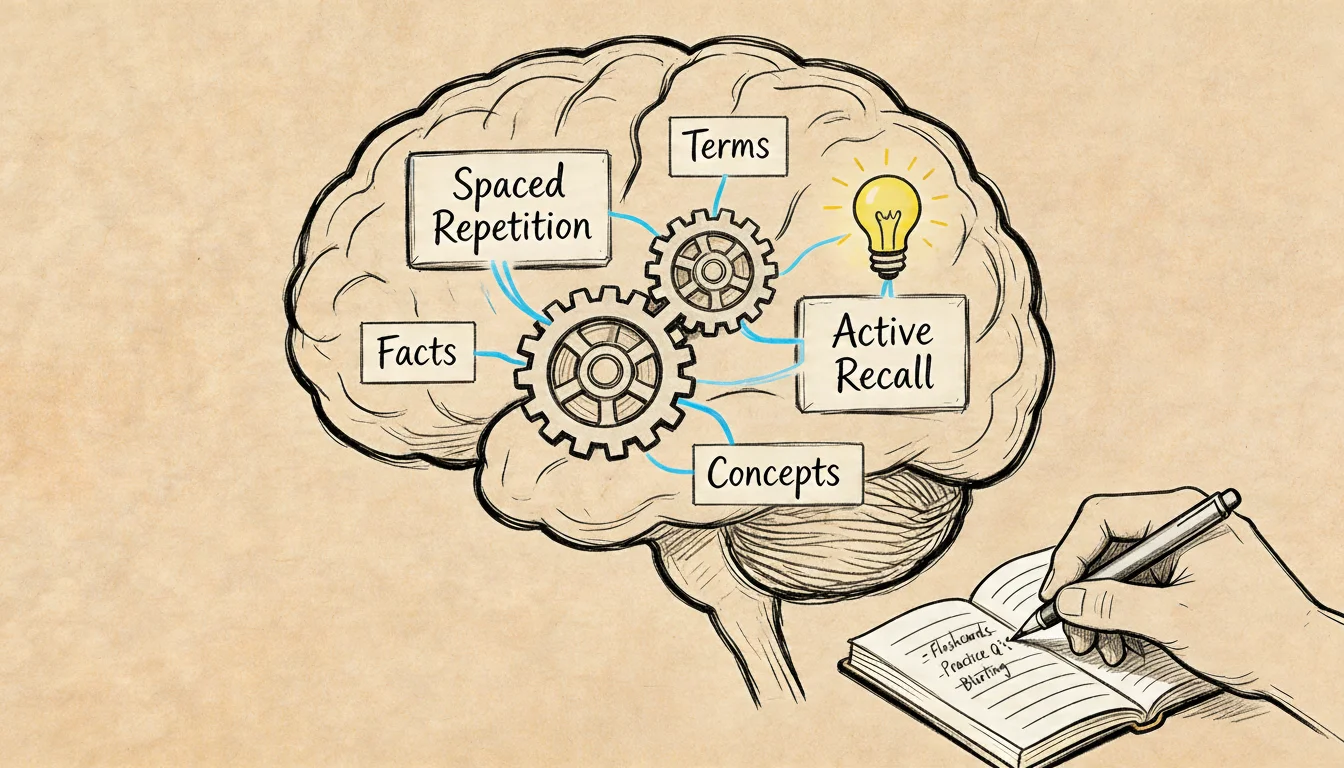
Active recall is the practice of attempting to produce an answer from memory before consulting your notes or study materials. This can range from simple actions like closing your book and explaining a complex concept aloud, writing down the step-by-step process for an AWS S3 bucket policy, or answering practice questions without any visual cues.
This technique is effective because certification exams don't ask if a topic seems familiar. They demand that you can actively retrieve and utilize that knowledge. The deliberate mental effort involved in active recall is precisely what strengthens long-term memory.
Try this cycle with any domain you're studying (e.g., Azure Virtual Machines or PMP Risk Management):
- Read a short section on a specific topic.
- Immediately close your material or look away.
- Write down everything you can recall about that topic, in your own words.
- Check your notes to see what you remembered correctly and, more importantly, what you missed or misinterpreted.
- Rewrite the weak or incorrect parts in clear, plain language, focusing on understanding the gaps.
This cycle might feel slower than simply highlighting text, but it’s profoundly more effective at exposing true understanding versus superficial familiarity.
Spaced Repetition Turns Fragile Knowledge into Durable Knowledge
Spaced repetition is a powerful learning technique that leverages the natural process of forgetting. It works on the principle that if you revisit material at increasing intervals—just as your memory of it begins to fade—you significantly strengthen its retention.
In practical terms, this means avoiding the common trap of drilling one topic to exhaustion and then abandoning it completely. Instead, you cycle back to it later through flashcards, mixed quizzes, and brief, targeted recall sessions. This strategic revisiting reinforces neural pathways. This is one of the key reasons why structured learning platforms can be incredibly helpful; they automate this process, reducing the likelihood that you'll neglect earlier topics while chasing new ones.
Use Practice Exams as Diagnostics, Not Ego Tests
The primary purpose of practice exams is not to validate your current readiness or boost your ego. Their true value lies in their ability to precisely show where your judgment breaks down, which concepts you misunderstand, and how you perform under timed pressure.
When you miss a question on a practice exam, move beyond simply noting the correct answer. Instead, ask yourself these analytical questions:
- Did I genuinely misunderstand the core concept (e.g., the difference between AWS EBS snapshots and AMIs)?
- Did two answer choices seem plausible because I don't grasp a subtle but critical distinction (e.g., PMP Crashing vs. Fast Tracking)?
- Did I miss a crucial keyword or phrase in the question stem (a common error in ITIL questions)?
- Would I make the same mistake if the idea were phrased differently or presented in a new scenario?
That last question is particularly vital. If you only memorize answers from one specific question bank, you're likely to falter when the actual exam presents the same underlying concept with different wording or a novel context.
Don’t ask, “What score did I get?” first. Instead, ask, “What kind of critical thinker was I while attempting these questions?”
A detailed progress dashboard can be incredibly beneficial here, as patterns of strengths and weaknesses are far easier to discern visually. If one particular domain consistently remains weak across various quizzes, labs, and flashcards, you probably need to relearn the topic from scratch, not merely review it. Some IT professionals track this manually in spreadsheets, while others benefit from platforms that map strengths and weak areas over time, including adaptive systems that intelligently reallocate attention toward the concepts you struggle with most frequently.
Here’s a short explainer worth watching before your next review block, reinforcing effective study strategies:
Stress Management Is a Study Technique
High-stakes certification preparation frequently overlooks the psychological dimension of learning. Research in trauma-informed care clearly demonstrates that stress and anxiety can profoundly impair learning, memory retention, and persistence, yet few exam platforms explicitly integrate mental health or stress-management support, as noted in this discussion of trauma-informed support gaps.
You don't need a formal program to act on this insight immediately. What you do need to do is stop pretending that your anxiety is separate from your performance. Proactively manage your mental state as part of your study plan.
If your mind becomes noisy or overwhelmed during study sessions or practice tests, implement these practical controls:
- Shorter, Timed Blocks: When stress is high, focused 25-50 minute blocks (like the Pomodoro Technique) are far more effective for concentration than marathon sessions.
- Pre-test Routines: Establish a consistent routine before practice exams (same snack, same start time, same scratchpad process) to reduce cognitive load and build familiarity.
- Breathing and Reset Cues: Develop a quick technique (e.g., box breathing, a mental mantra) to use after a challenging question or a frustrating run of missed answers.
- Peer Accountability: Discussing difficult topics with a study partner or mentor not only lowers feelings of isolation but also exposes any shaky understanding you might have.
Burnout Usually Starts with Bad Feedback Loops
Burnout isn't always a result of simply "studying too much." More often, it stems from studying without clear proof of progress. If every session feels like you're drowning in an endless sea of new content, motivation will plummet rapidly.
The key is to fix the feedback loop:
- Track questions missed by topic, not just total score.
- Record concepts you can now confidently explain without notes.
- Retest weak areas after a few days to see if knowledge stuck.
- Keep some study sessions deliberately short and "winnable" to build confidence.
On this point, MindMesh Academy is one example of a platform engineered around principles like spaced repetition, adaptive learning paths, exam-aligned study materials, and a dashboard that visually highlights your evolving strengths and weak areas. This kind of structured support can significantly benefit learners who require their review system to dynamically adjust as their knowledge and skills improve.
Consistency becomes significantly easier to maintain when you can visibly track your progress and see movement, rather than just feeling the sheer effort.
Navigating Exam Day and Overcoming Blockers
By the time exam week arrives, your primary objective is no longer to learn entirely new concepts. Instead, the focus shifts to protecting what you already know and maintaining steady, rational decision-making under pressure.
Many candidates undermine their chances in the final stretch by frantically attempting to compensate for every perceived weak spot. This usually leads to increased fatigue and anxiety, not greater clarity or improved recall.
What to Do in the Last Forty-Eight Hours
Keep your final review highly focused and narrow.
Use this critical checklist:
- Confirm Logistics: Double-check your testing center route, required identification, check-in rules, or ensure your online proctoring setup is fully functional.
- Review Summary Notes Only: Focus exclusively on your condensed notes, flashcards, key formulas (e.g., network subnetting), critical distinctions (e.g., AWS VPC Flow Logs vs. CloudTrail), process steps, and your personal error log patterns.
- Do Short Mixed Practice Sets: Engage in just enough practice questions to stay mentally sharp, but not so many that you risk shaking your confidence with unexpected misses.
- Stop Hunting for New Resources: Introducing a new video series or study guide at this late stage almost always creates cognitive conflict and doubt, rather than adding value.
- Prioritize Sleep: Treat your sleep as a critical component of your exam preparation, because its impact on cognitive function and recall is profound.
Resist the urge for "one last full cram." If you haven't mastered a domain by now, forcing six more hours of study into the night before the exam is more likely to impair your recall than enhance it.
Plateau Doesn’t Mean You’re Failing
It's common for a learning plateau to emerge roughly halfway through your exam preparation. Your practice scores might stop rising, concepts can begin to blur, and you might start to internalize thoughts like, "Maybe other people are just naturally better at these exams."
In most cases, these thoughts are inaccurate. Plateaus often signify that your current study method has extracted most of the "easy gains." The solution isn't to abandon your goal; it's to strategically change your study activity.
Try one of these shifts:
- Switch from passive reading to active, hands-on work: For cloud certs like Azure or AWS, dedicate a full session to building and configuring resources.
- Stop doing random questions and focus intensively on one weak domain: Deep dive into the material you consistently struggle with.
- Explain topics aloud to another person or even to an empty room: This forces active recall and exposes gaps in understanding.
- Meticulously review wrong-answer rationales and group them by pattern: This helps identify systemic weaknesses, not just individual missed questions.
- Take a short, deliberate recovery day: Sometimes a mental break is the most effective way to break through a plateau, then resume with a tighter, adjusted plan.
Some blockers are purely academic; they require a different study strategy. Others are emotional or psychological; these demand self-compassion and mental resilience techniques. Treat them differently.
Imposter Syndrome Needs a Factual Response
If you're a career changer, new to the tech industry, or the first person in your social circle to pursue a demanding IT certification, the exam can quickly start to feel like a referendum on your entire identity. This is when self-doubt creeps in, leading to thoughts like, "Maybe this field isn't truly for me."
Do not allow a single exam to carry that immense psychological weight. Remember your "why."
There's also a broader systemic issue at play here. While programs like LA County’s HRTPs effectively provide free training and foundational certifications for job seekers facing employment barriers, there's a documented gap in seamlessly connecting these entry-level credentials to higher-value tech certifications like AWS or Azure, as described by LA County HRTPs. This context is crucial because many candidates aren't just grappling with technical content; they're also navigating a complex career system that rarely illustrates the full, clear pathway for progression.
Therefore, proactively build your own robust support structure:
- One study partner: For accountability and collaborative learning.
- One mentor: To provide guidance, context, and encouragement.
- One realistic schedule: Designed for your actual life, not an imaginary one.
- One clear next-step plan if you don't pass on your first attempt.
That last point is critical. A failed attempt does not erase the learning or effort you've invested. Instead, it provides invaluable, granular data that is far superior to any pre-test for pinpointing your exact weaknesses.
A Calm Exam Strategy
On exam day itself, commit to a procedural, methodical approach:
- Read the question stem first: Understand precisely what the test writer is asking before looking at the answer choices.
- Eliminate obviously wrong answers: This increases your probability of guessing correctly if unsure.
- Mark and move on: If a question begins to drain too much time, flag it for review and proceed. Come back to it later with a fresh perspective.
- For performance-based questions (PBQs) or complex scenario questions, resist the urge to panic if they appear early. Acknowledge the stress response, then methodically work through the problem, trusting the preparation you've diligently completed.
Confidence on exam day isn't a feeling you passively wait for. It's the tangible result of having a clear, repeatable process to follow, even when your nerves inevitably make an appearance.
Turning Your Certification into Career Currency
Passing the exam brings immense satisfaction, usually for about a day. After that, the most important question resurfaces: "What are you going to do with this credential?"
A certification's true value is realized when you actively convert it into increased visibility, enhanced credibility, and more meaningful career conversations with potential employers and your current management.
Update the Places Recruiters and Managers Actually Look
Begin by updating your most critical professional assets:
- LinkedIn Profile: Update your headline, add the certification to the dedicated "Licenses & Certifications" section, and mention it in your "About" summary and "Skills" section.
- Resume: Ensure the certification is prominently listed, potentially in a dedicated section or your summary.
- Internal Employee Profile: If your company uses an internal HR or talent management system, update your profile to reflect your new achievement.
- Email Signature: If professional email signatures are common in your workplace, consider adding the credential abbreviation (e.g., John Doe, AWS-SAA).
Crucially, don't just add the credential name and move on. Connect it directly to work you can discuss. If you earned an AWS Certified Solutions Architect – Associate certification, mention how it now informs your ability to support cloud migration discussions, design secure environments, or optimize cloud costs. If you passed CompTIA Security+, link it to enhanced understanding of access control, incident handling procedures, or participating in risk assessment conversations.
If you need assistance refining this wording, this guide on what skills to put on your CV is particularly helpful because it encourages you to match your skills and certifications to specific role expectations, rather than simply listing generic traits.
Rewrite Your Resume Bullets So the Certification Matters
A weak resume update merely states that you "earned a certification." A far stronger, more impactful version demonstrates how that certification has demonstrably sharpened your capabilities and positively influenced your work.
Compare the difference:
| Weak Bullet | Stronger, More Impactful Bullet |
|---|---|
| Earned cloud certification | Applied AWS Solutions Architect principles from certification study to inform infrastructure discussions and document optimal cloud deployment decisions for a hybrid environment. |
| Passed security certification | Leveraged strengthened understanding of threat landscapes, security controls, and incident response concepts from CompTIA Security+ to enhance daily operational support and participate in vulnerability assessments. |
| Completed project cert prep | Formalized existing project planning, risk tracking, and stakeholder communication methods using PMP methodologies, leading to more predictable outcomes in cross-functional team projects. |
| Achieved ITIL Foundation | Integrated ITIL 4 Foundation principles to streamline service request fulfillment and improve incident management processes, reducing resolution times by 15%. |
| Passed Azure Administrator | Configured and managed Azure Virtual Networks and Azure Active Directory based on AZ-104 certification knowledge, contributing to secure and scalable cloud infrastructure. |
The objective here is not to exaggerate your experience, but to eloquently translate the theoretical knowledge gained through your credential into practical, work-relevant language.
Use the Certification in Conversations, Not Just Profiles
When engaging with your manager, avoid the confrontational "I got certified, so I automatically deserve more" approach. Instead, frame the credential's value in terms of its business usefulness and your readiness for greater responsibility.
You could effectively communicate:
“I completed the [Certification Name] to proactively strengthen my expertise in areas our team frequently addresses. I'm eager to take on new assignments that leverage this knowledge, whether that involves deeper technical tasks, leading specific projects, or supporting the team in this domain.”
In job interviews, frame it similarly to demonstrate initiative and alignment:
“I pursued the [Certification Name] because I wanted to gain structured, verifiable depth in the critical areas this role depends on. It provided me with a robust framework for approaching and solving the precise kinds of problems your team is known for handling.”
This approach works because it directly connects your personal effort and investment to tangible value for the organization.
Keep the Momentum Alive After the Pass
Passing the certification exam should trigger a concise action plan to be executed within days:
- Update LinkedIn and Resume: Immediately reflect your new credential across all professional profiles.
- Inform Key Influencers: Share your achievement with your manager, mentors, and any internal stakeholders who influence project assignments or career progression.
- Apply to New Roles: Actively apply to those roles you might have previously hesitated to pursue, now armed with your strengthened credentials.
- Collect Impact Stories: Proactively gather one or two concise stories demonstrating how your new knowledge directly maps to real-world work challenges you've encountered or solved.
- Strategize the Next Step: Make a deliberate decision whether this certification marks a satisfactory stopping point, or if it is a calculated stepping stone towards a higher-level or complementary credential.
If the certification is part of a longer career trajectory, be highly intentional about planning your next rung on the ladder. The guide on Turning Your Certification into Career Currency can help you think strategically about which higher-value certifications best complement your initial meaningful win.
A Note for Managers and Team Leads
If your organization sponsors certifications for staff, your responsibility extends beyond simply reimbursing exam fees. You must also provide employees with meaningful opportunities to apply their newly acquired knowledge. This includes exposure to relevant projects, internal visibility for their expertise, and appropriate role expansion.
Failing to do so means you're investing in learning but burying the potential return on that investment.
The strongest certification investments yield benefits on two fronts: the employee gains a clearer, more accelerated career path, and the team simultaneously gains sharper, more capable talent. This dual benefit encapsulates the true meaning of "get ahead get certified"—not passing for its own sake, but transforming structured learning into tangible forward momentum.
If you're seeking a more organized, efficient way to plan, study, and strategically apply what you learn, MindMesh Academy offers certification preparation built around exam-aligned resources, spaced repetition, adaptive review, and comprehensive progress tracking. Leverage it as an integral component of your larger career strategy, rather than just as a last-minute exam cram tool.

Written by
Alvin Varughese
Founder, MindMesh Academy
Alvin Varughese is the founder of MindMesh Academy and an enterprise architecture leader. An electrical engineer by training, he moved from factory automation in South Africa to cloud architecture at GE Appliances and Humana (Fortune 50), and holds 20 professional certifications including AWS Solutions Architect Professional, Azure DevOps Engineer Expert, and Microsoft Agentic AI Business Solutions Architect. He built MindMesh Academy after interviewing too many highly certified candidates who couldn't answer basic questions: the goal is prep that makes you better at the job, not just able to pass the exam.