
Master IT Exams: Learning Plan Template
Master IT Exams: Your Personalized Learning Plan Template
Preparing for a major IT certification often feels overwhelming without a clear strategy. A well-crafted learning plan template transforms your study sessions from a chaotic scramble into a directed process. It serves as a personal guide, detailing exactly what topics to study, when to tackle them, and how to track your results. Use this structure to gain clarity and define a precise path toward your goal. Instead of guessing your progress, you can rely on a specific schedule that holds you accountable. This approach ensures you cover every exam objective systematically while managing your time effectively before taking the exam.
Why a Learning Plan is Your Strategic Advantage for Exam Success
Have you ever opened the official exam blueprint for a high-level certification like AWS Certified Solutions Architect, the PMP, or CompTIA Security+, and felt a wave of stress? These documents are often dozens of pages long, listing hundreds of technical objectives. It is similar to being told to climb Mount Everest without a map or a compass. This is where a strong learning plan template becomes essential for your success. This is not about generic advice or simple tips. It is a concrete framework designed to help you handle both the complex technical material and the mental pressure that comes with exam preparation.
At its center, a learning plan ensures you spend your study time in an effective way. Instead of jumping between random topics based on what you feel like doing that day, a plan forces you to think about the big picture. You will map out how to cover every required domain before your scheduled exam date arrives. This guarantees you have enough time to master difficult concepts rather than just cramming them at the last minute. This structured approach is vital for high-stakes exams where the test checks for deep understanding of technical systems, not just your ability to repeat facts from a book.
Building Study Momentum and Reducing Anxiety
One of the biggest benefits of a structured learning plan is how it helps your mental state. Creating this plan turns a giant, intimidating goal—like earning a professional certification—into a series of small, manageable tasks for each day and week. This alone can help lower study anxiety. It stops the "analysis paralysis" that hits when you have too many resources and are not sure where to start. When you know exactly what to study on a Tuesday night, you waste less energy deciding and more energy learning.
Every time you cross off a study block, understand a hard concept, or finish a lab, you build real momentum. This creates a positive feedback loop that increases your confidence and keeps your motivation high. This makes it much easier to stay consistent over many weeks or months of preparation.
A structured learning plan is a great defense against burnout. It gives you proof that you are making steady progress. This is the best way to fix the feeling that you are just spinning your wheels without getting anywhere.
The Core Components of an Effective Template
What makes a learning plan template actually work? Several parts are mandatory. These are the building blocks for any study roadmap that leads to a passing score. Each piece helps guide you from the first day of learning to being ready for the testing center. Without these elements, a plan is just a list of wishes.
Before we look at how to build one yourself, we should examine the basic parts that make a template effective. The table below shows exactly what you need to include in your document to stay on track.
Core Components Of An Effective Learning Plan Template
| Component | Purpose | Example for AWS Solutions Architect (SAA-C03) (verify current exam code on the vendor site) |
|---|---|---|
| Exam Domains | Organizes your study according to the official exam blueprint, ensuring 100% coverage of all weighted sections. | Domain 1: Design Secure Architectures (26% of exam) (verify current domain weights on vendor site) |
| Topic Breakdown | Deconstructs broad domains into granular, manageable sub-topics and core concepts. | Under Domain 1: "IAM Policies," "VPC Security Groups vs. NACLs," "AWS WAF" |
| Resource Mapping | Links specific study materials (e.g., video lectures, official documentation, hands-on labs, practice questions) to each topic. | For "IAM Policies": Specific video lecture on IAM, official AWS documentation on policy structure. |
| Scheduled Time | Allocates dedicated time blocks for new material acquisition, conceptual review, and practical application (labs/practice exams). | Mon/Wed: 2 hours for new concepts. Fri: 1 hour for review. Sun: 2-hour practice exam simulation. |
| Progress Metrics | Establishes measurable indicators to gauge your understanding and precisely identify areas needing more attention. | Confidence Score (1-5) for each topic; Detailed practice test scores by domain. |
With these building blocks in place, you create a system for learning. You move past having a simple to-do list and instead build a way to track your knowledge. This allows you to see exactly where your gaps are before you pay for an expensive exam voucher.
Reflection Prompt: Think about the most difficult certification exam you ever took. How would a structured approach, like the one described above, have changed your preparation? Would it have changed the outcome or how much stress you felt?
This structured method is not just for IT professionals. For example, a study guide for the AP English Exam uses the same type of organized method. While the subject is different, the principle is the same: a detailed, goal-oriented plan is the most reliable path to success. By using this mindset for your IT certification, you give yourself a tool for focused learning. This ensures that when you walk into the testing center, you are ready.
Building Your Personalized Study Roadmap From Scratch
This stage allows you to convert a blank page into your most effective study asset. Generic templates provide a starting point, but an effective plan centers on your existing knowledge, schedule, and learning style. Your goal is to create a sustainable roadmap that leads to a passing score without causing total exhaustion. An effective plan acts as a guardrail, keeping you focused when technical topics become dense or discouraging.
The process starts with an honest self-assessment. Before you can map the route to the exam date, you need a clear picture of your starting point. Review the official objectives and determine which areas you already understand. Identify the topics that feel foreign or intimidating. This is a calibration process for your entire timeline. For the PMP exam, you might evaluate your familiarity with Agile methodologies compared to traditional Waterfall project management. If you are pursuing an Azure Administrator certification, you should judge your comfort level with virtual networking against your knowledge of identity management.
Once you establish this baseline, the next task is to study the official exam blueprint. Every major certification provider publishes a guide that lists exam domains and their specific weightings. Use these percentages to dictate how you distribute your time. If a domain accounts for 30% of the total score, it should receive a proportional amount of your attention. Your mission is to take these large domains and break them down into smaller, manageable study tasks.
Define Your Study Modules
Do not simply list the high-level exam domains as your study tasks. You need to look closer at the sub-topics. For example, a domain on the CompTIA Security+ (SY0-701) exam like "Threats, Vulnerabilities, and Mitigations" covers a wide range of information. It includes concepts such as social engineering, malware analysis, vulnerability scanning, and penetration testing. These are separate technical skills that require different study methods. Similarly, for the Cisco CCNA, "IP Connectivity" involves OSPF concepts, first-hop redundancy protocols, and routing logic.
Breaking topics into granular units provides a psychological advantage. Instead of facing a massive subject, you see a list of manageable hills to climb. This structure prevents you from feeling overwhelmed and provides a sense of progress as you check off each specific item. Begin by identifying your biggest knowledge gaps. If you need a more formal way to categorize what you don't know, a skill gap analysis can help organize these thoughts before you commit them to a calendar.
Building a study plan is a logical process that follows three distinct phases:
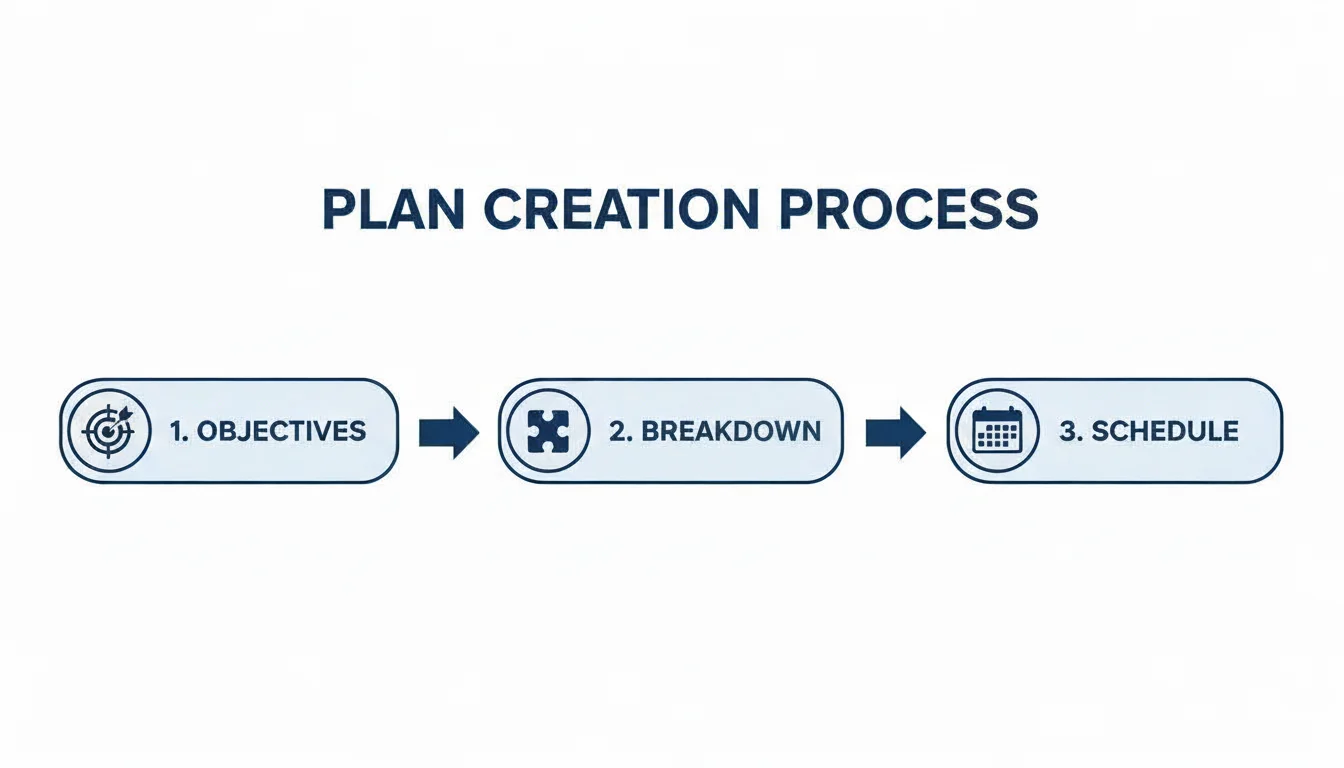 Image: A three-step visual guide illustrating the process of creating an effective learning plan, starting with goal setting and moving through task breakdown to final scheduling.
The process starts by setting clear objectives, continues by segmenting the work into units, and concludes by placing those units into a realistic timeline.
Set S.M.A.R.T. Goals and Estimate Time
After defining your modules, attach specific goals to each one. The S.M.A.R.T. framework helps ensure your objectives are clear and lead directly to certification success:
- Specific: Do not just say "Learn AWS networking." Instead, aim to "Master VPC security groups and Network Access Control Lists (NACLs), focusing on the differences between stateful and stateless traffic filtering."
- Measurable: Set a target like "Score over 85% on the practice quiz for the Azure Active Directory Concepts module before moving to the next section."
- Achievable: Be realistic about how many hours you can study each day. Consider the difficulty of the topic and your current workload to avoid setting impossible expectations.
- Relevant: Confirm that every goal aligns with the official exam blueprint. For a PMP candidate, this means ensuring you understand how the 5 process groups and 10 knowledge areas apply to situational exam questions.
- Time-bound: Set a hard deadline, such as "I will finish the Kubernetes Pod Networking module and all associated labs by next Friday at 5 PM."
Estimating the time needed for each module is difficult. It is best to be generous with these estimates. A topic you think will take two hours often takes four, particularly in technical fields where labs and troubleshooting are required. It is better to have extra time than to fall behind your schedule. A helpful rule is to add a 20% time buffer to all initial estimates. This extra time protects your plan from unexpected events or topics that prove more difficult than they first appeared.
Key Takeaway: Your study plan is a dynamic roadmap. You should revisit and adjust it every week based on how fast you are moving through the material and how well you are retaining the information.
Build Your Schedule with Flexibility
The final step is to put your plan onto a calendar. Do not try to fit study sessions into random gaps in your day. Block out dedicated time slots as if they were mandatory work meetings. Consider your energy levels throughout the day. If you are most alert in the evening, do not schedule a difficult technical review for 6 AM. You are more likely to stick to a plan that respects your natural productivity peaks.
Use these strategies to build a schedule that remains practical over several weeks:
- Mix It Up: Alternate between difficult technical topics and easier administrative ones. This maintains your momentum and prevents mental fatigue. After a long session on complex subnetting for the Network+ N10-009, switch to a lighter review of cloud service models or basic hardware components.
- Plan for Downtime: Use techniques like Pomodoro to take regular breaks during study sessions. You should also take at least one full day off per week. Your brain needs this time to process new information and recover, which helps prevent long-term burnout.
- Schedule Your Reviews: Reading new material is only part of the process. You must set aside recurring time to review what you learned in previous weeks. This type of spaced repetition is necessary for cumulative exams like the CCNA, CompTIA A+ 220-1201/1202, or ITIL foundations.
This system turns a list of hopes into an actionable plan. It creates a rhythm that makes studying a habit rather than a desperate rush in the days before the exam. By scheduling both your study time and your review time, you ensure that the knowledge stays with you long enough to pass the test and apply the skills in a professional setting. Check the current pricing for your exam, which might range from $150 to $600 depending on the vendor, and verify those details on the official site as you set your final test date (verify current pricing on the vendor site).
Integrating Proven Study Strategies Into Your Schedule
Building a carefully organized learning plan is an excellent first step, but it only accounts for half of the work required to succeed. To truly master the material for your IT certification, you must use study methods that scientific research has proven to be effective. This goes far beyond the habit of scanning through your notes or highlight reels. True learning requires you to engage with the technical content in ways that ensure long-term retention and a functional understanding of the topics.
When you intentionally integrate these high-impact techniques into your weekly study schedule, your preparation changes. It moves away from simple review and becomes a high-performance system for building real, lasting knowledge. This shift is the primary difference between candidates who barely pass their exams and those who achieve a deep level of expertise. While your learning plan provides the necessary structure, these strategic methods act as the driver that moves you toward your goal. If you want to be ready for professional scenarios in the field, your study time must be as efficient as possible.
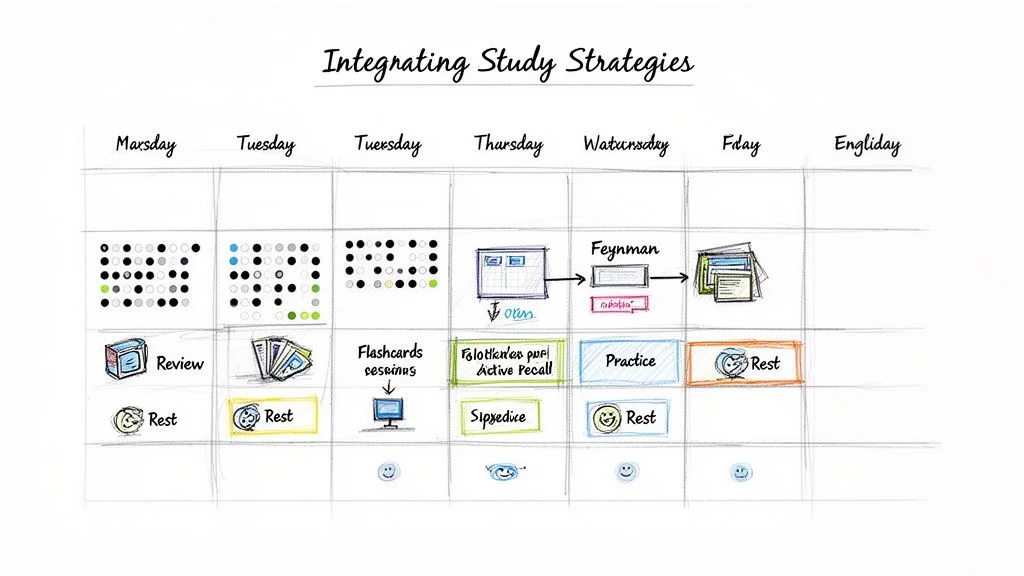 Image: An illustrative study schedule showing the integration of various effective learning techniques like spaced repetition, flashcards for active recall, and crucial rest days, demonstrating a balanced approach.
Beat the Forgetting Curve with Spaced Repetition
It is a common experience to study a difficult topic one week only to realize that most of it has slipped away just a few days later. This happens because of the "forgetting curve," a natural process where the brain discards information it does not perceive as vital for immediate survival or frequent use. Spaced Repetition is the most effective tool available to fight this decay. The core principle of this method is simple: you must review information at increasing intervals over a set period.
Rather than trying to finish one massive review session right before you take a practice exam, you should schedule several shorter, focused reviews. If you are studying the layers of the OSI model for a CompTIA Network+ exam, you might review the concepts one day after you first learn them. You would then revisit that same material three days later, and then again after one full week. This repeated exposure at specific intervals tells your brain that the information is essential. This helps move the facts from your short-term memory into long-term storage.
Spaced repetition works because it forces you to retrieve information at the exact moment you are most likely to forget it. This process of active retrieval strengthens the neural connections related to that knowledge. By the time you reach your exam date, the facts are not just familiar; they are firmly fixed in your mind and easy to access under pressure.
Prioritize Active Recall Over Passive Review
Many people fall into the trap of passive review. This happens when you spend hours rereading your textbook, looking over your highlighted notes, or watching the same lecture videos repeatedly. While this feels like work, it often creates an illusion of competence. A much more effective strategy is Active Recall, which involves the deliberate effort of pulling information directly from your memory without looking at your resources.
There is a major difference between recognizing a correct answer when you see it in a list and being able to generate that answer from scratch. This is why tools like flashcards and practice quizzes are so useful. They require your brain to perform the difficult work of retrieval, which is exactly what you will have to do during the actual certification exam.
You can integrate active recall into your daily IT study routine using several different methods:
- Flashcards: These are perfect for memorizing specific command syntax, such as Linux
grepflags or PowerShell cmdlets. They also work well for port numbers and core definitions. When you use them, make sure to say the answer out loud or write it down before you flip the card over to check yourself. - Self-Quizzing: Once you finish a chapter or a video module on a topic like AWS Lambda functions or Azure Virtual Networks, put your materials away. Take a blank piece of paper and write down every key point and practical application you can remember. Compare your list to the source material to see what you missed. This process clearly shows you which areas need more attention.
- Explain it to Someone: Try to describe a complex process to a friend or a colleague. You might explain how a CI/CD pipeline moves code from development to production or how different types of firewalls filter traffic. If you can explain a troubleshooting methodology to someone who does not work in IT, you have likely mastered the concept.
To see more ways to use these methods, examine our guide on exam preparation strategies. The goal is to make your brain work for the information. If you only look at things you already recognize, you aren't actually learning; you are just confirming that you have seen the words before.
Use The Feynman Technique to Find Your Blind Spots
The Feynman Technique is a mental model named after physicist Richard Feynman. It is designed to help you find the limits of your understanding. It is very easy to memorize technical jargon without actually understanding the underlying technology. This four-step process helps you move past rote memorization.
First, choose a specific concept from your study plan. You might pick "AWS VPC Peering," "SQL Injection Prevention," or "Kubernetes Ingress Controllers." Second, try to explain that concept as if you were teaching it to a beginner with no technical background. Use plain language and avoid using industry terms unless you also explain what those terms mean.
As you try to simplify the explanation, you will notice parts where you struggle to find the right words or where you feel the urge to use jargon to cover up a gap in your knowledge. These points of friction are your blind spots. When you hit one of these gaps, go back to your study materials and read up on that specific detail until you understand it well enough to explain it simply. Finally, read your new, simplified explanation aloud. If the logic feels broken or the explanation is still too complex, keep refining it until the concept is clear and easy to follow.
This method ensures that you are not just repeating definitions. It builds a genuine understanding that allows you to solve problems and answer scenario-based questions on the exam. It is a highly useful tool for mastering the most difficult parts of any syllabus.
The importance of using structured, milestone-driven planning applies to many fields beyond IT. For instance, the ChildFund Alliance’s Safe & Wise campaign’s strategic framework suggests that major goals and outputs should be achieved within a window of 1 to 3 years. This provides a clear example of how to break down large, complex objectives into stages that are easier to manage. You can see more about their strategic planning framework and how they organize these long-term efforts to reach their goals.
By adding these science-backed strategies to your learning plan, you create a system that is both efficient and effective. You are no longer just guessing if you are ready for the exam. Instead, you are building a foundation of knowledge that will last throughout your career. You will be prepared for the test, but more importantly, you will be prepared for the actual technical challenges you will face in the workplace.
Tracking Your Progress and Adapting on the Fly
A carefully prepared study plan provides a strong starting point, but it is not a fixed contract. Real progress happens when you track your results, identify which methods work, and make changes based on data. Without a consistent feedback loop, you are essentially studying in the dark. You cannot improve what you do not measure.
Treat your learning plan as a flexible tool rather than a rigid set of rules. Its value comes from your ability to change it based on what your performance data shows. Before you can use this data, you must define exactly what progress looks like for your specific certification. This involves moving past the feeling of "getting better" and looking at hard numbers that reflect your technical readiness.
*Video: This video explains how to monitor study metrics and update a plan to improve exam performance.*Defining What to Track
To get a clear view of your standing, you must monitor specific metrics. These numbers tell the story of your preparation and help you make choices based on facts instead of guesses. Focus on these core indicators to maintain a clear picture of your trajectory:
- Practice Test Scores: These numbers are your most direct measure of exam readiness. For IT certifications, you should track scores by domain. For example, if you are preparing for the CompTIA Network+ N10-009, track your percentages in Networking Fundamentals versus Network Security. If your scores are not climbing toward the 85-90% range, your current study method needs a change.
- Topic Mastery Percentages: An overall score can hide specific weaknesses. You might see a total score of 75%, which looks acceptable at first glance. However, if you look closer and find you scored 95% on Cloud Technology but only 50% on Network Troubleshooting, your overall score is misleading. You need to know which specific technical areas are pulling your average down so you can focus your energy there.
- Study Hours Logged: Recording your time helps you see if your effort matches your output. If you spend 10 hours studying Azure identity management but your practice scores in that domain remain flat, the problem might be your resource or your focus level. Tracking hours prevents the mistake of spending too much time on easy topics while ignoring the difficult ones that require more concentration.
- Confidence Ratings: This is a subjective but useful metric. After you finish a module, such as Docker containerization or Linux file permissions, rate your comfort level on a scale of 1 to 5. A score of 1 means you are confused, while a 5 means you can perform the task without any help. This helps you find gaps that practice tests might miss, particularly in hands-on lab environments.
Tracking progress is often what separates those who pass from those who do not. This is a challenge in many fields. A 2026 analysis of global adaptation plans found that while 73% of organizations committed to reporting their progress, a separate 2021 study showed that over 60% failed to track their key metrics properly. These figures show that many people plan to succeed but fail to monitor the steps required to get there. In IT certification, missing these metrics often leads to failing an exam you thought you were ready for.
Using the MindMesh Academy Dashboard
You can use a spreadsheet for this, but tools like the MindMesh Academy dashboard simplify the process. These platforms automate data entry and show your progress in a visual format. A dashboard helps you see patterns that are hard to find in a list of numbers.
A clear dashboard uses color coding to show you exactly where you stand. Green usually indicates mastery, while yellow and red show areas that need immediate work. This allows you to change your study focus in seconds. Instead of reviewing everything, you can spend your limited time on the specific red-coded domains that are preventing you from reaching a passing score. This visual feedback keeps you from wasting time on topics you already know.
When and How to Adjust Your Plan
A low score on a practice quiz is a signal to change your approach. Data is only useful if you use it to change your behavior. If your current method is not producing results, staying the course will only lead to a failed exam.
View your initial plan as a hypothesis. Your progress data is the experiment that proves if the plan works. If the data shows you are not learning, you must refine the plan.
Consider these common scenarios in IT certification prep and the steps you should take to fix them:
- You are behind schedule on a difficult topic: This often happens with subjects like advanced networking for the CCNA or complex security protocols. First, determine if the topic is more difficult than you expected or if outside distractions took your time. If the topic is the problem, you must adjust your timeline. Do not rush through it. Instead, find small windows of time, such as 15 minutes during a lunch break, to use flashcards or read documentation. You may need to push your exam date back by a week to ensure you actually understand the material.
- A technical concept is too hard to grasp: If you are struggling with container orchestration in Kubernetes or subnetting math, stop using the same book or video. If one explanation is not working, find another. Use a different instructor, watch a lab demonstration, or join a technical forum to ask specific questions. You should take time away from a domain where you are already scoring 90% and move that time to the difficult subject.
- You are consistently scoring high in one area: If you already have high marks in cloud security fundamentals for Azure, stop studying it. It is common for students to keep reviewing topics they like because it feels good to get right answers. This is a mistake. Move that study time to your weakest domain. If you are strong in security but weak in database management, move your 2-hour Monday session from security to databases.
Adjusting a plan is a skill you will use throughout your career. Technology changes, and the way you learn must change with it. By checking your metrics and updating your learning plan template, you ensure your study time leads directly to exam success.
When preparing for exams like the CompTIA A+ 220-1201 and 220-1202, look at the specific domain weightings provided by the vendor. If the 220-1201 exam places a heavy weight on Mobile Devices (15%) and Networking (20%), and your scores in Networking are low, your plan must prioritize that domain. Use the current exam codes and check vendor sites for any updates to domain objectives.
If you are pursuing an AWS certification, like the SCS-C03 (AWS Certified Security – Specialty), the price is often around $300 (verify current pricing on the vendor site). With that level of investment, guessing your readiness is not an option. Use your data to ensure you can pass with confidence. If your scores on AWS official practice sets are below 80%, do not schedule the exam yet. Use the feedback from those tests to target specific services like AWS Key Management Service (KMS) or Identity and Access Management (IAM) where you might be losing points.
Finally, keep a log of why you got questions wrong. Is it because you did not know the fact, or because you misread the question? If you find that 50% of your errors come from misreading, your adjustment should be to practice reading exam questions more slowly, rather than more technical study. This level of detail in your tracking turns a standard study routine into a focused path to certification.
Actionable Learning Plan Templates For Top IT Certs
Discussing the abstract principles of building a study plan is a start, but seeing a concrete, functional example often makes the concepts click. To bridge the gap between planning and execution, we have developed detailed, pre-filled templates for several of the most popular IT certifications.
These templates are not rigid commandments. View them as tested starting points—reliable frameworks built on official exam blueprints and feedback from professionals who have passed these exams. You can copy and adapt any structure that works for you. The effectiveness of these plans depends on how well you customize them to your schedule, your current knowledge level, and how you prefer to learn. These models eliminate guesswork and show what a productive, actionable plan looks like in practice.
 Image: An example of a partially completed, handwritten learning plan template, featuring checkboxes to track progress for multiple certifications like AWS, Security+, and PMP, illustrating a practical approach to study organization.
AWS Certified Solutions Architect - Associate (SAA-C03) Template
The AWS Certified Solutions Architect - Associate (SAA-C03) is a standard for anyone aiming for a career in cloud architecture. Its four domains require a organized study strategy. Our sample 10-week plan is built for someone who can commit approximately 10-12 hours per week to study.
This plan distributes study time across the official exam domains while prioritizing sections with higher weightings. For instance, "Design Secure Architectures" and "Design Resilient Architectures" represent 56% of your total score. These areas deserve the most attention.
Pro Tip: With a subject as broad as AWS, it is easy to get distracted by services that might not appear on the exam. A structured plan keeps you focused on the objectives in the official blueprint. This template ensures you stay on track.
Here is a look at what a typical week within this plan includes:
Week 3 Focus: Core Compute (EC2) and IAM Study
- Monday (2 hours): Study EC2 instance types and review all pricing models, including On-Demand, Spot, Reserved Instances, and Savings Plans. Review the various EBS volume types and their use cases. Your specific goal is to score 80% or higher on a practice quiz focused on EC2 fundamentals.
- Wednesday (2 hours): Conduct a thorough review of AWS Identity and Access Management (IAM). Learn to manage IAM policies, roles, users, and groups. Focus on applying the principle of least privilege in every configuration scenario.
- Friday (1 hour): Spaced Repetition Session. Use this hour to review key concepts from the first two weeks, such as VPCs, Subnets, and Security Groups. Use flashcards or active recall techniques to verify you remember the core details.
- Sunday (3 hours): Complete a hands-on lab. Build a simple two-tier web application inside a custom VPC. You will need to configure security groups, subnets, and an Internet Gateway. Document every step and configuration choice to reinforce the process.
This rhythm of learning new material, reviewing old topics, and applying knowledge in labs helps build the understanding needed for this certification. If you are looking at other certifications, MindMesh Academy offers a full catalog of IT certifications to help you prepare.
CompTIA Security+ (SY0-701) Template
The CompTIA Security+ (SY0-701) exam covers a wide range of topics, from threat intelligence and incident response to cryptography and network security. This 8-week plan is designed for someone with basic IT knowledge who can commit 8-10 hours weekly.
The strength of this plan is how it connects security concepts to real-world situations. For example, when studying the "Social Engineering" domain, the plan suggests researching a recent news story about a phishing attack. You analyze the incident to see how the attack happened and identify which security principles could have prevented it. This makes the technical details easier to remember.
Here is how a week focused on cryptography is organized:
Week 5 Focus: Cryptography and PKI Fundamentals
| Day | Task | Duration | Goal |
|---|---|---|---|
| Tuesday | Compare Symmetric vs. Asymmetric Encryption; study Hashing Algorithms and Digital Signatures. | 2 hours | Explain the differences, identify use cases for each, and define the role of non-repudiation. |
| Thursday | Study Public Key Infrastructure (PKI), X.509 Certificates, Certificate Authorities, and Key Management. | 2 hours | Diagram the steps of a TLS/SSL handshake from the initial client request to the secure connection. |
| Saturday | Active Recall & Practice Questions | 1.5 hours | Answer 30 practice questions on Domain 3 (Cryptography) and aim for at least 80% accuracy. |
Using a table format makes your weekly targets clear and easy to track. It links your daily tasks directly to exam objectives, so you know exactly why you are studying a specific topic.
Project Management Professional (PMP) Template
The Project Management Professional (PMP) certification is a different type of challenge. It focuses less on technical facts and more on project management processes and methodologies like predictive, Agile, and hybrid. It also requires you to adopt a specific mindset used by the Project Management Institute (PMI). This is a fast-paced 12-week plan requiring 15+ hours per week. It includes heavy use of practice questions to help you master the situational judgment questions on the exam.
The schedule follows the three exam domains: People (42%), Process (50%), and Business Environment (8%). A unique feature of this template is "Mindset Mondays." The first hour of study each week is spent reviewing core project management principles, ethics, and professional conduct. This helps you choose the "correct" answers according to PMI standards.
The PMP exam does not ask what you would do in your specific job. It tests what the PMI framework says a project manager should do. Your study plan must include time to practice this specific way of thinking.
As you build your plan, you may find it helpful to download a free course outline PDF template to organize your thoughts and initial ideas. These examples provide a clear starting point. They show how to combine different study methods, allocate time based on how much a domain is worth on the exam, and set measurable goals for each week. Following a structure like this helps you pass with confidence.
When you prepare for the PMP, you are essentially learning a new professional language. You will need to understand how to handle conflicts within a team (the People domain) and how to manage the technical steps of a project (the Process domain). By sticking to a 12-week schedule, you avoid burnout while ensuring you cover the material required to succeed. If you find you are struggling with a specific domain, such as Agile methodologies, you can shift your Sunday hours to focus on those specific practice questions.
Effective preparation is about more than just reading a book. It involves active participation. Whether you are building VPCs for AWS, analyzing phishing attacks for Security+, or reviewing PMI ethics for the PMP, the goal is the same: move from passive reading to active application. Use these templates to build a routine that fits your life. A well-organized plan is the most effective tool you have for passing your next IT exam. Check the current exam details and requirements on the vendor websites to ensure you have the most up-to-date information before you begin your study sessions. For example, verify the current exam fee (which may be around $405 for PMI members or $555 for non-members) on the official site. Having all the facts and a solid plan puts you in the best position for success.
Answering Your Questions About Learning Plans
Even a well-built learning plan will face real-world challenges. Preparing for a professional IT certification is a marathon, not a sprint. Success in this field depends on your ability to handle the unexpected obstacles that appear after the first few weeks of excitement fade. Handling these hurdles is just as important as the initial act of building your schedule. Here are answers to common questions that arise during a long study period.
It happens to almost everyone: you find yourself behind schedule. The primary rule is to avoid panic. Life is unpredictable, and your calendar will rarely be perfect. Instead of discarding your entire plan, take a moment to analyze why you are behind. Did a specific technical area, like advanced routing protocols for a CCIE lab, turn out to be more complex than you budgeted for? Or did a high-priority project at work take over your study week?
Think like a strategist rather than a rigid manager. If a challenging topic caused the delay, adjust your future hours. You might need to borrow time from a subject you already know well or find a different resource to explain the concept. If life events intervened, look for small windows of time to regain your rhythm. A 20-minute flashcard session during lunch or a technical audio lecture during your commute can help you keep moving without feeling overwhelmed. Rushing through advanced material when your foundations are shaky often leads to failure, so it is better to adjust the timeline than to ignore the gap in your knowledge.
How Do I Stay Motivated for Months on End?
Motivation is rarely a constant resource. It must be managed and maintained like any other professional skill. One of the best ways to keep moving is to focus on small, consistent wins. This is where your learning plan template becomes an effective psychological tool. Checking off a single task—no matter how minor—provides a sense of accomplishment that builds momentum. This visual progress reminds you that you are closer to the goal than you were yesterday.
Vary your study methods to keep your brain active. If you feel your interest fading, change your approach. If you have been reading dense technical manuals for several days, spend your next session watching video tutorials, participating in an online forum, or working in a lab. This change of pace makes the material feel fresh. It also helps to connect your daily tasks to your career goals. If you are studying for a cloud certification, think about how a specific service solves a problem you have seen at work. This practical connection makes the theory easier to remember and gives the study session a clear purpose.
Key Insight: Discipline is more reliable than motivation. Motivation often arrives after you start the work, not before it. Once you begin to see real progress, the satisfaction of moving forward provides the energy needed to continue. Action creates its own momentum.
How Often Should I Be Taking Practice Exams?
Practice exams are a reality check for your progress. Taking them too often can lead to burnout and lower their diagnostic value because you might start memorizing specific questions. Conversely, not taking them enough means you are flying blind. A balanced approach works best. Schedule a full-length, timed practice exam every 2 to 3 weeks. This frequency is enough to track your progress and find weak spots without causing test fatigue.
In the final two weeks before your actual exam, increase the intensity. Take a simulated practice test every 3 to 4 days. This builds the mental endurance needed to focus for several hours. It also sharpens your time management, teaching you when to flag a hard question and move on. When you finish a practice test, the most important work begins: the review. Do not just look at your score. Go through every question you missed and read the explanation for why the correct answer was right. Even for the questions you got right, check the reasoning to ensure you did not just make a lucky guess. This review process is where the most significant learning happens and where you should adjust your study plan to cover identified gaps.
Should I Study Multiple Topics at the Same Time?
Should you master one domain before moving to the next, or is a mixed approach better? Learning science suggests a method called interleaving. This is the practice of mixing different but related topics within a single study session or across a few days. It is a more effective strategy for long-term memory and conceptual understanding than focusing on a single subject for weeks at a time.
For an exam like Microsoft Azure Administrator, an interleaved schedule might look like this:
- Monday: Study foundational Azure networking concepts (e.g., Virtual Networks, subnets, and NSGs).
- Tuesday: Focus on Azure Identity and Access Management (e.g., Azure AD and RBAC).
- Wednesday: Review the networking material from Monday, then start on new concepts like VPN Gateways or ExpressRoute.
This approach is harder than staying on one topic, but that difficulty is useful. It forces your brain to work harder to retrieve information from different domains. This process of loading and unloading information into your working memory is what builds long-term retention. It prepares you for the actual exam, where questions are randomized and you must jump from a security problem to a networking problem in seconds. You can use this technique by alternating domains on different days or within one long session. It prevents burnout and improves your ability to remember the entire exam blueprint on test day.
Ready to stop guessing and start following a clear path to your next IT certification? The MindMesh Academy platform is built to integrate these principles into your study process. Our tools include adaptive learning paths and progress dashboards that help you track your work and adjust your plan as needed. Take control of your certification process. Build your winning study plan with MindMesh Academy today.
Ready to Get Certified?
Prepare with study guides, practice exams, and spaced repetition flashcards at MindMesh Academy to pass your current exam with confidence:

Written by
Alvin Varughese
Founder, MindMesh Academy
Alvin Varughese is the founder of MindMesh Academy and an enterprise architecture leader. An electrical engineer by training, he moved from factory automation in South Africa to cloud architecture at GE Appliances and Humana (Fortune 50), and holds 20 professional certifications including AWS Solutions Architect Professional, Azure DevOps Engineer Expert, and Microsoft Agentic AI Business Solutions Architect. He built MindMesh Academy after interviewing too many highly certified candidates who couldn't answer basic questions: the goal is prep that makes you better at the job, not just able to pass the exam.