Free CompTIA A+ Practice Tests Worth Your Time
Free CompTIA A+ Practice Tests Worth Your Time
Free CompTIA A+ practice tests can save you money, but only if they give you clear direction on what to study next. The most effective ones align with the current A+ exam objectives, separate Core 1 from Core 2 content, include thorough explanations, and offer enough scenario-style questions to test your troubleshooting skills, not just rote memorization.
Think of free tests as diagnostic tools first, and score checks second. Take a short quiz before you begin studying a domain, carefully review every missed answer, then retest with a different set of questions later. If a free test only provides a percentage score without objective mapping or explanations, it's usually not worth your valuable study time.
What Makes Free CompTIA A+ Practice Tests Worth Using
A good free A+ practice test should help you make a concrete decision: continue studying a specific topic, move on to the next, or schedule a full mock exam. If a test can't support that kind of decision, it might feel productive, but it won't reliably improve your exam readiness.
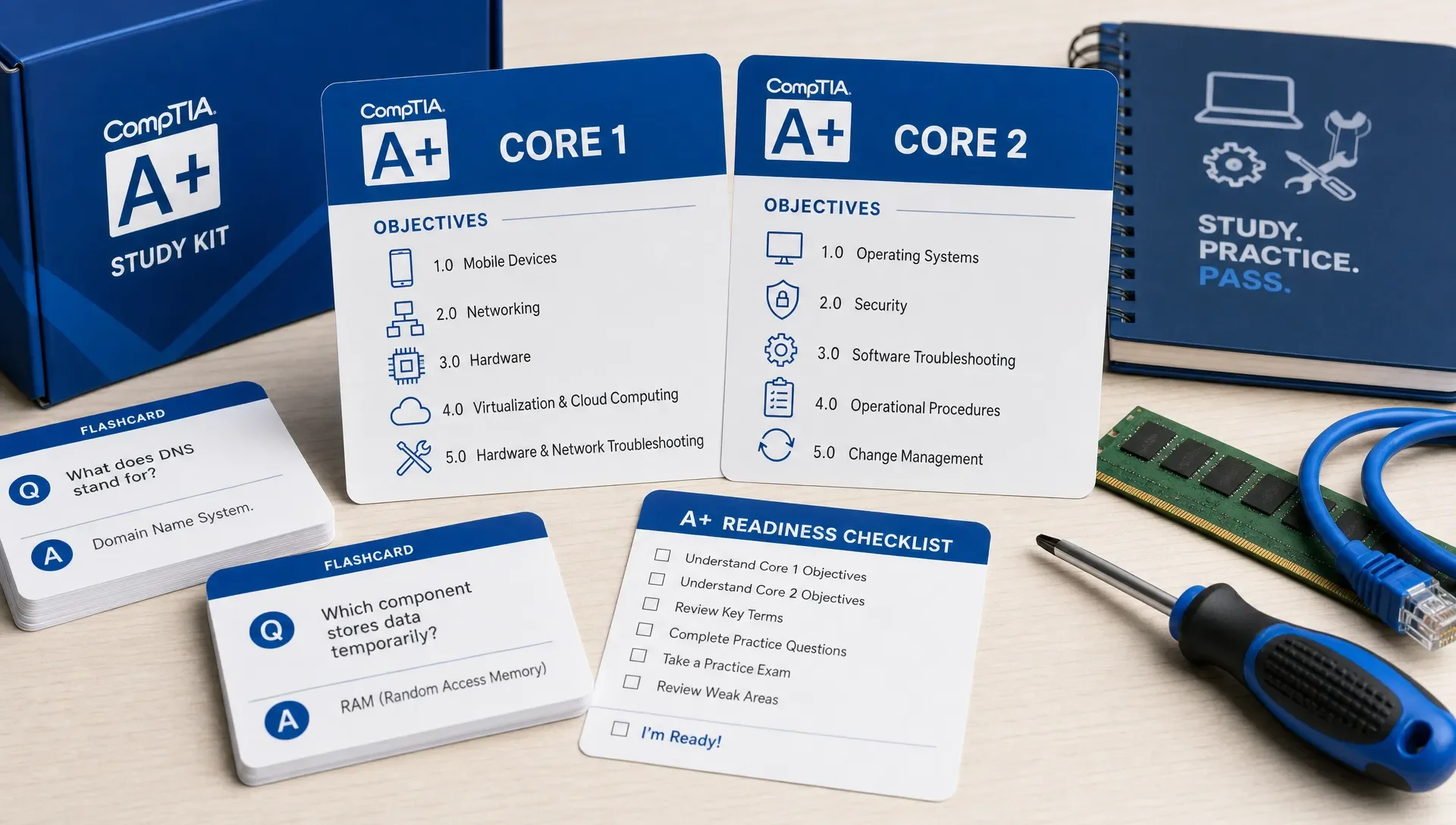
CompTIA A+ covers a broad set of entry-level IT skills across two separate exams. Core 1 focuses heavily on hardware, networking, mobile devices, virtualization, cloud concepts, and general troubleshooting. Core 2 covers operating systems, security fundamentals, software troubleshooting, and operational procedures. Because these two exams test distinct skill sets, a single, unlabeled collection of questions can easily obscure your weak areas.
Use the table below to evaluate whether a free test deserves a place in your study plan.
| Quality signal | Why it matters | What to look for |
|---|---|---|
| Current exam alignment | A+ objectives evolve over time | The test explicitly names the current Core 1 or Core 2 objective areas. |
| Separate Core 1 and Core 2 | You prepare for two distinct exams | Questions are clearly labeled by exam (Core 1 or Core 2) and by specific topic. |
| Detailed answer explanations | Explanations transform incorrect answers into learning opportunities | Each answer clarifies why the correct option is right and why distractors are wrong. |
| Scenario & troubleshooting questions | A+ assesses applied decision-making abilities | Questions ask what you would do first, next, or best in a realistic support situation. |
| Performance-based practice | A+ includes hands-on, task-style items | The resource includes drag, match, configure, or scenario-based formats when possible. |
| Review history | Retesting should demonstrate progress | You can track missed topics and avoid aimlessly repeating questions. |
You don't need every free test to do everything. A 10-question hardware quiz can be highly valuable if it reveals that you often confuse RAM compatibility with storage compatibility. A full-length mixed quiz can be useful if it shows that your pacing falls apart after 60 minutes. The key is understanding the specific job each test is meant to do for you.
Match Practice Tests to Core 1 and Core 2 Exam Objectives
Before you take any free CompTIA A+ practice tests, confirm the exam version you're studying for. CompTIA's official A+ certification page is the definitive source for current exam codes, domain breakdown, question types, and exam policies. Free tests can sometimes lag behind the current objectives, so don't assume every question bank you find online is up to date.
A simple objective map helps you avoid random studying. Create two columns, one for Core 1 and one for Core 2, then categorize every missed practice question under its closest objective. If you miss three printer troubleshooting questions, that doesn't mean you're generally weak at Core 1. It means printer troubleshooting specifically needs another round of dedicated study and practice.
If you need a structured domain breakdown before you start testing, MindMesh Academy's CompTIA A+ certification study guide by exam domain can help you organize what to learn before you burn through more practice questions.
Best Types of Free CompTIA A+ Practice Tests to Use
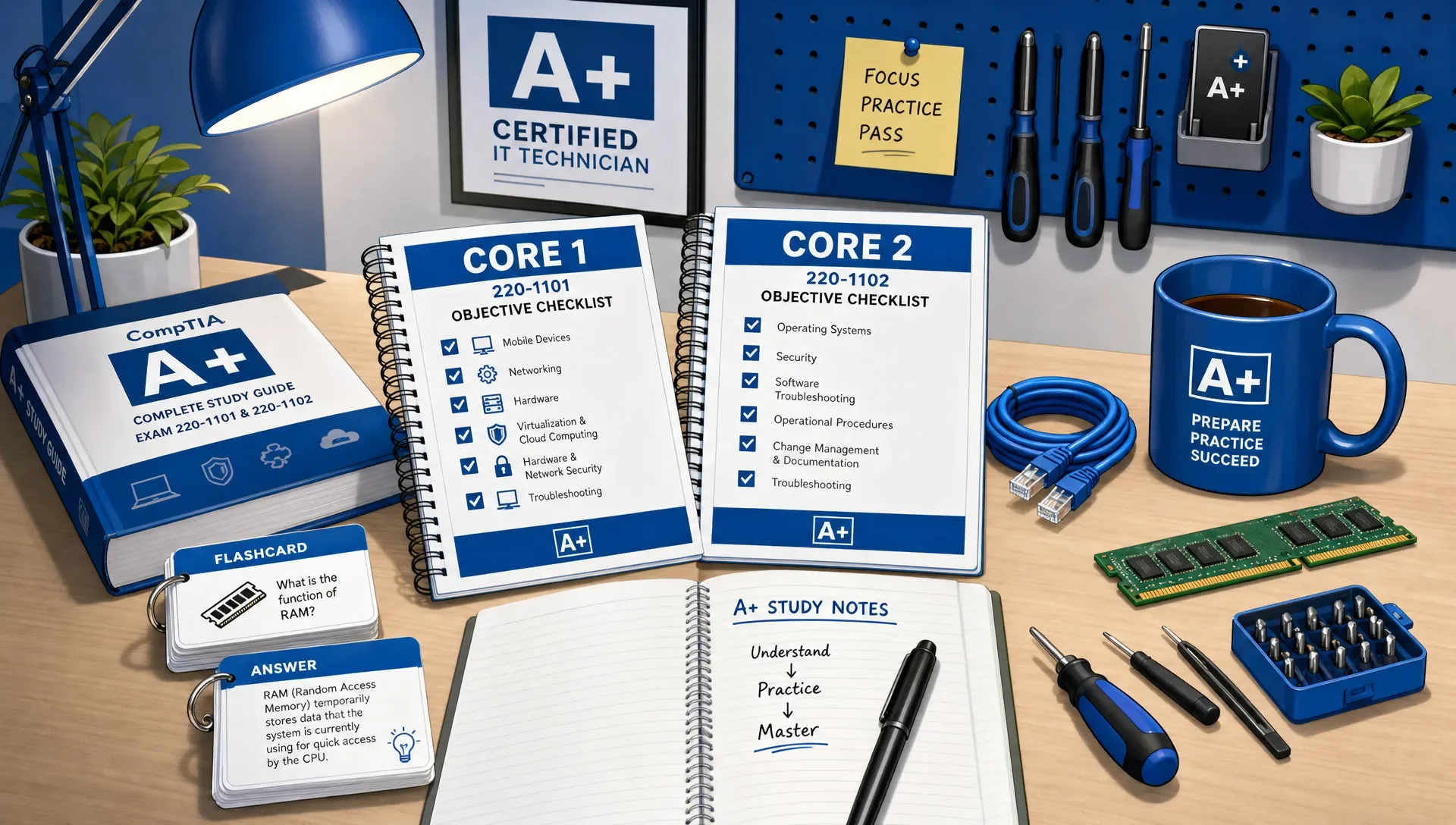
Not all free practice is designed for the same stage of preparation. Early in your study plan, short topic quizzes are often better than full mock exams because they help you pinpoint knowledge gaps quickly. Later, full mixed tests become more useful as they challenge your recall, pacing, and mental endurance.
| Free practice test type | Best time to use it | What it helps you learn | Limitation to watch |
|---|---|---|---|
| Official sample questions | At the start of preparation | How CompTIA phrases exam questions | Too few questions for comprehensive readiness checks |
| Topic quizzes | During domain study | Which subtopics are weakest for you | May encourage memorization if repeated too often |
| Mixed Core 1 or Core 2 tests | After initial domain review | Whether knowledge transfers across different topics | Weak explanations reduce the learning value |
| Timed full-length practice | During the final review phase | Pacing, stamina, and overall exam strategy | Scores can vary based on question quality |
| PBQ-style drills | Throughout preparation | Applied troubleshooting and configuration thinking | Free versions may be limited or simplified |
| Flashcard-based quizzes | Between study sessions | Ports, commands, acronyms, and common processes | Not enough for scenario mastery on its own |
The most effective study routine combines several types of practice. Use short quizzes to identify weak areas, flashcards to reinforce key facts, and mixed tests to check whether you can apply those facts under pressure.
How to Review Free CompTIA A+ Practice Tests
The review session matters more than the score itself. If you take a 50-question quiz and only look at the percentage, you've missed out on most of the value. A missed question is a vital clue about a gap in your knowledge, reading comprehension, or test-taking strategy.
Start your review by labeling each missed answer. You don't need a complicated system. Use broad labels such as "concept gap," "misread question," "guessed correctly before," "outdated knowledge," or "weak troubleshooting sequence." You'll notice patterns appearing faster than you expect.
For example, a question about a laptop not connecting to Wi-Fi might not indicate a networking failure for you. It might be a troubleshooting-order failure because you jumped to reinstalling drivers before checking airplane mode, the wireless switch, or known-good network access. That distinction is crucial, as the appropriate fix changes based on the root cause.
For Core 1 preparation, build extra practice around hardware, networking, mobile devices, and general troubleshooting. MindMesh Academy's A+ Core 1 practice exams are organized for focused Core 1 work with practice questions, explanations, and progress tracking by topic.
For Core 2, pay special attention to operating system tools, malware removal steps, permissions, authentication concepts, and operational procedures. If those are the areas pulling your score down, the A+ Core 2 practice exams give you a structured way to practice with explanations instead of hopping between unrelated free quizzes.
A Simple Practice Test Schedule for A+ Core 1 and Core 2
You don't need to take a full practice exam every day. In fact, that can actually make your preparation less effective if you're repeating the same questions and remembering answers instead of reasoning through them. A better schedule alternates between testing, reviewing, and targeted study.
| Study phase | Practice test approach | What to do after the test |
|---|---|---|
| First pass through a domain | Take 10 to 20 topic questions | List weak subtopics and review the matching study guide section. |
| Midway through Core 1 or Core 2 | Take a mixed quiz for that exam | Sort missed questions by objective and redo only weak topics. |
| After finishing all domains | Take a timed Core 1 or Core 2 practice test | Review every missed question, including any lucky guesses. |
| Final week before the exam | Take one or two fresh timed tests | Focus on pacing, command recall, and troubleshooting order. |
| Day before the exam | Use light flashcards and short review sets | Avoid cramming brand-new material unless it's critical. |
This schedule works because it incorporates spaced retrieval. In a key review of learning techniques, Dunlosky and colleagues identified practice testing and distributed practice as highly effective strategies. For A+, this means you'll typically learn more by testing a topic, reviewing it, waiting, then testing it again, rather than by simply rereading the same notes for hours.
Red Flags in Free CompTIA A+ Practice Tests
"Free" doesn't automatically mean low quality, but some tests can actively waste your time. Be cautious when a resource encourages you to memorize answers rather than truly understanding troubleshooting logic.
Watch for these warning signs:
- The test doesn't specify whether questions are for Core 1 or Core 2.
- Questions reference obviously outdated operating systems, tools, or hardware without appropriate context.
- There are no answer explanations, or the explanations merely repeat the correct choice.
- Every question is a definition question with no real-world scenarios.
- The same small question pool appears every time you retake the test.
- The test uses extreme wording that doesn't align with professional IT decision-making.
The biggest danger is false confidence. If you've seen the same 100 free questions three times, a 90 percent score may only prove that you remember that specific set. Before you schedule your official exam, seek out fresh questions and make sure you can explain why each incorrect answer option is wrong.
For a deeper diagnostic approach, the article on CompTIA A+ practice questions that reveal real weaknesses shows how to interpret your mistakes as signals for improvement rather than simply as score deductions.
How to Know You're Ready After Free Practice Tests
No free practice test can guarantee an exam result, and percentage scores don't perfectly convert to CompTIA's scaled scoring. Still, your practice trends can tell you a lot if you're using current, objective-aligned questions.
Use your score as one piece of information, not the sole deciding factor.
| Practice result pattern | What it usually means | Best next step |
|---|---|---|
| Below 60 percent on topic quizzes | You have significant concept gaps | Return to study guide sections before taking more tests. |
| 60 to 75 percent on mixed quizzes | You understand parts of the exam but lack consistency | Drill weak objectives and review answer explanations very carefully. |
| 75 to 85 percent on fresh timed tests | You're close, but certain mistakes still matter | Identify recurring misses and practice PBQ-style scenarios. |
| Above 85 percent on multiple fresh tests | Your knowledge is likely stabilizing | Focus on pacing, command recall, and troubleshooting order. |
| High score on repeated questions only | The score may be inflated due to memorization | Find fresh questions before making a judgment about your readiness. |
Also, assess the quality of your confidence. Genuine confidence sounds like, "I chose this because the symptom points to DNS resolution, and the other options don't match the failure pattern." Weak confidence sounds like, "I remember seeing this answer before." The first approach transfers well to the real exam; the second often doesn't.
Frequently Asked Questions
Are free CompTIA A+ practice tests enough to pass? They can be sufficient for review if you already have strong hands-on knowledge, but most learners need more structure. Free tests work best when combined with study guides, explanations, flashcards, and targeted review by exam objective.
How many free CompTIA A+ practice tests should I take? Take enough to demonstrate consistent performance across fresh question sets. A few short topic quizzes per domain and several mixed Core 1 or Core 2 tests are more useful than repeating the same full test until you've memorized it.
Should I study Core 1 and Core 2 at the same time? You can, but many beginners make faster progress by separating them. Core 1 and Core 2 test distinct skill sets, so separate practice sessions make weak areas easier to identify and address.
What score should I aim for on free A+ practice tests? Aim for consistent scores above 80 percent on fresh, objective-aligned tests. However, don't rely on a single number as your only readiness signal. Review your missed topics, assess your pacing, and verify your ability to explain why each answer is correct.
Do free CompTIA A+ practice tests include performance-based questions? Some resources include PBQ-style drills, but many free options focus primarily on multiple-choice questions. Since A+ includes applied tasks, look for scenario-based questions and practice troubleshooting steps, not just definitions.
What should I do after failing a practice test? Don't immediately retake the same test. Instead, review every missed answer, group your mistakes by objective, study the weakest topics, and then use a fresh quiz to see if the gap is closing.
Build a CompTIA A+ Practice Routine You Can Trust
Free CompTIA A+ practice tests are valuable when they help you make smarter study decisions. Look for resources with current objectives, clear separation between Core 1 and Core 2 content, detailed explanations, and enough scenario practice to test your real-world troubleshooting judgment.
When scattered free quizzes stop giving you clear study direction, MindMesh Academy offers a structured path. Our platform features objective-aligned CompTIA A+ Core 1 practice exams with detailed explanations, plus adaptive practice to target your weak spots. It's designed to ensure your study time directly improves your readiness.
Ready to build a strong foundation for your A+ certification? Start your preparation with the CompTIA A+ Core 1 practice exam.

Written by
Alvin Varughese
Founder, MindMesh Academy
Alvin Varughese is the founder of MindMesh Academy and an enterprise architecture leader. An electrical engineer by training, he moved from factory automation in South Africa to cloud architecture at GE Appliances and Humana (Fortune 50), and holds 20 professional certifications including AWS Solutions Architect Professional, Azure DevOps Engineer Expert, and Microsoft Agentic AI Business Solutions Architect. He built MindMesh Academy after interviewing too many highly certified candidates who couldn't answer basic questions: the goal is prep that makes you better at the job, not just able to pass the exam.