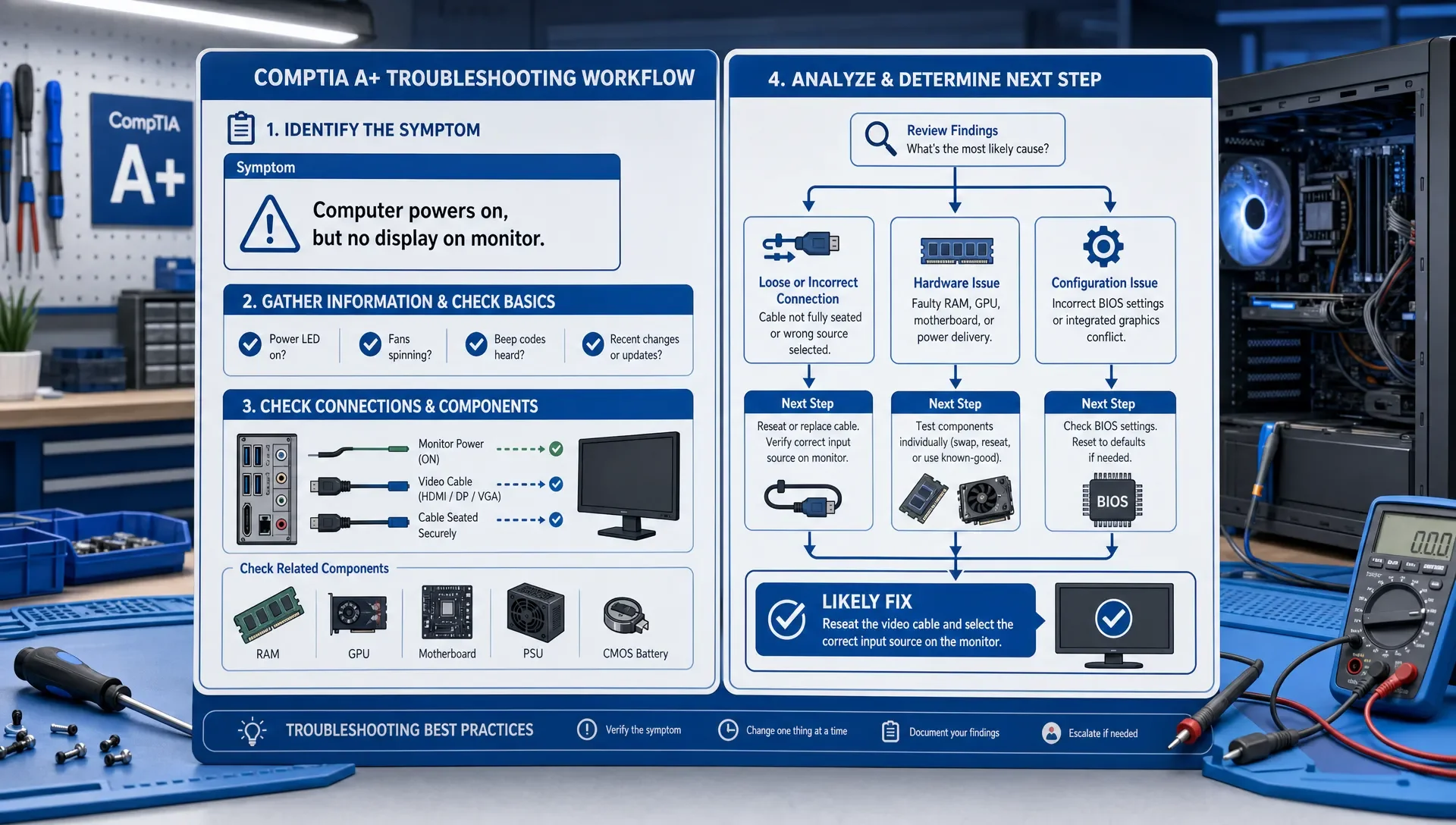
CompTIA A+ Practice Questions That Reveal Real Weaknesses
CompTIA A+ Practice Questions That Reveal Real Weaknesses
If your CompTIA A+ practice questions only give you a percentage score, you're missing the most useful part of practice: diagnosis. A good question should tell you exactly what broke down, such as the concept, the troubleshooting sequence, the command choice, the security judgment, or the way you read the scenario.
Treat each practice block as a mini lab review. After each question, ask three things: Which exam objective did this test? Which clue mattered most? Why were the wrong answers tempting? That process transforms a quiz from passive repetition into a targeted study plan for Core 1 and Core 2.
Why CompTIA A+ practice questions should diagnose, not just grade
The A+ exam is not built around isolated trivia. CompTIA describes A+ as covering the ability to troubleshoot and support hardware, operating systems, networking, security, mobile devices, and operational procedures, with multiple-choice and performance-based questions included on the exam format. You can review the current exam structure on the official CompTIA A+ certification page.
That matters because a question like, 'What port does HTTPS use?' checks recall. A question that gives you symptoms, a partial network configuration, user constraints, and a 'best next step' prompt checks whether you can apply that recall under technician-style pressure.
A revealing question usually tests at least one of these skills:
- Recognizing the actual failure point from symptoms instead of guessing from familiar words.
- Choosing the safest first step, not just a technically possible step.
- Eliminating plausible distractors that belong to the wrong layer, tool, or procedure.
- Explaining why the right answer is right without needing the same wording next time.
If you can't explain the wrong choices, the question still found a weakness even if you guessed correctly.
What weakness-revealing CompTIA A+ questions look like
Weak questions ask for definitions in isolation. Strong questions make you decide. They include constraints, symptoms, and distractors that force you to use the troubleshooting mindset the exam expects.
| Question trait | What it reveals | Example cue |
|---|---|---|
| Scenario with symptoms | Whether you can isolate the likely cause | A laptop display fails only when the lid moves |
| Best or first action wording | Whether you know troubleshooting order | A system shows malware symptoms on a shared network |
| Command output or configuration details | Whether you understand tools, not just names | Valid IP address but name resolution fails |
| Plausible wrong answers | Whether your knowledge is precise | Replacing a screen when the cable is the likely issue |
| Mixed-domain context | Whether you can connect topics | Security policy affecting OS behavior |
When reviewing practice sets, don't just sort by correct and incorrect. Sort by weakness type instead. A missed hardware question and a missed security question might stem from the same underlying issue: skipping scenario clues and jumping to the first familiar answer.
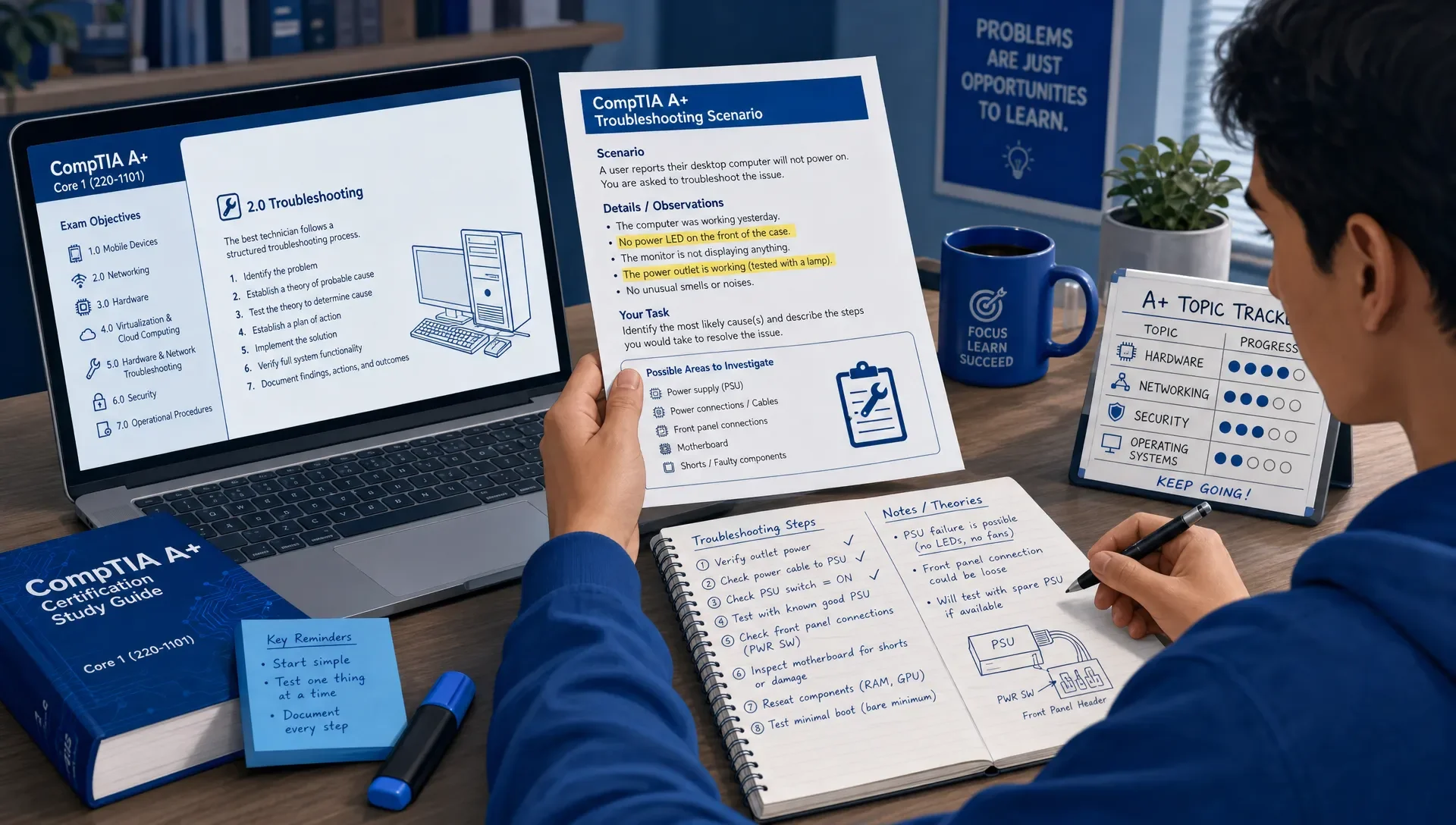
Sample CompTIA A+ practice questions with weakness diagnosis
These practice questions aren't exam dumps, nor do they predict exact exam wording. They're examples of questions that reveal what you need to study next.
Hardware troubleshooting question
A user reports that a laptop screen flickers and sometimes goes black when the lid angle changes. The laptop works normally when connected to an external monitor. Which component should a technician inspect first?
Choices: A. LCD panel, B. Display cable, C. Battery, D. Solid-state drive.
Answer: B. Display cable. The key clue is that the problem changes when the lid angle changes, while the external display works normally. That points toward the internal display path, especially the cable running through the hinge area.
Weakness revealed: If you chose the LCD panel, you may be matching the symptom to the visible component instead of isolating the failure path. Review laptop display assemblies and how external monitor testing narrows the fault.
Networking question
A Windows workstation can ping 8.8.8.8 successfully but cannot reach websites by name. Other devices on the same network browse normally. Which issue is most likely?
Choices: A. Default gateway failure, B. DNS configuration problem, C. Damaged Ethernet cable, D. Incorrect subnet mask.
Answer: B. DNS configuration problem. Successful ping to a public IP address suggests basic network connectivity is working. The failure occurs when resolving names, so DNS is the best answer.
Weakness revealed: If you chose gateway or cabling, review how to separate physical connectivity, IP routing, and name resolution. A+ networking questions often reward layer-by-layer reasoning.
Operating systems question
A user says secure websites show certificate warnings. The browser and network connection are working, and the issue appears only on one computer. What should the technician check early in troubleshooting?
Choices: A. System date and time, B. Printer spooler service, C. RAM speed, D. File extension settings.
Answer: A. System date and time. Certificate validation depends on the system clock. An incorrect date or time can cause valid certificates to appear invalid.
Weakness revealed: If you missed this, you may be studying browser symptoms without connecting them to OS settings. Build flashcards that connect symptoms to likely configuration checks.
Security procedure question
A technician confirms that a workstation is showing malware symptoms and is connected to the company network. What should the technician do next?
Choices: A. Quarantine the system, B. Reinstall all user applications, C. Delete browser history, D. Replace the hard drive.
Answer: A. Quarantine the system. Once symptoms are confirmed, isolating the affected system helps reduce the risk of spread before remediation.
Weakness revealed: If you chose a cleanup step first, review malware response order. Security questions often test process discipline, not just tool knowledge.
Operational procedures question
A technician is replacing a user's storage drive. The user says the drive contains local files that may not be backed up. What should the technician do before replacing the drive?
Choices: A. Verify backup or preserve user data according to policy, B. Format the replacement drive immediately, C. Update the BIOS, D. Clear browser cache.
Answer: A. Verify backup or preserve user data according to policy. The best technical fix can still be the wrong support decision if it risks data loss.
Weakness revealed: If you chose the hardware action first, study operational procedures alongside technical topics. A+ expects safe, professional support behavior.
How to review wrong answers so they become study tasks
Wrong answers are only useful if you label them precisely. 'I need to study networking' is too broad. 'I confused DNS failure with default gateway failure' gives you a fixable target.
| Miss pattern | What it usually means | What to do next |
|---|---|---|
| You picked a familiar term | You recognized vocabulary but not the scenario | Rewrite the question in your own words before answering |
| You knew the fact but missed the word first | You understand the topic but not the procedure | Drill troubleshooting order and safety steps |
| You guessed between two tools | You haven't mapped tools to use cases | Create flashcards for commands, utilities, and when to use them |
| You got it right but can't explain why | The answer may have been luck or memorized wording | Redo a similar question with changed symptoms |
| You miss the same objective repeatedly | The foundation is weak | Return to the exam objective, then practice in a smaller set |
This is how practice questions become a feedback loop. Answer, explain, tag the weakness, study the missing concept, then answer a related question later. Evidence-based guidance from the Institute of Education Sciences recommends spacing practice over time instead of cramming it into one session. This supports using short, repeated review cycles instead of one long block. You can find that guidance in the IES practice guide Organizing Instruction and Study to Improve Student Learning.
How to build Core 1 and Core 2 question sets around weak areas
Core 1 and Core 2 overlap in real support work, but you should track them separately while studying. A single combined score can hide the fact that you're strong in hardware but weak in operating systems, or comfortable with security vocabulary but shaky on malware response steps.
For Core 1, build question sets around hardware, mobile devices, networking, virtualization, cloud concepts, and hardware or network troubleshooting. If you need targeted repetition in those areas, a CompTIA A+ Core 1 practice exam can help you practice with explanations and topic-level progress tracking.
For Core 2, separate your practice into operating systems, security, software troubleshooting, and operational procedures. If your misses come from Windows utilities, malware workflow, or support process questions, use a CompTIA A+ Core 2 practice exam to focus on the second half of the certification path.
A useful weekly rhythm looks like this:
| Study session | Practice focus | Review action |
|---|---|---|
| Session 1 | Mixed diagnostic set | Tag every miss by objective and weakness type |
| Session 2 | Weakest Core 1 topic | Review explanations and make flashcards |
| Session 3 | Weakest Core 2 topic | Redo similar questions with different wording |
| Session 4 | Performance-based or scenario questions | Practice sequencing and tool selection |
| Session 5 | Timed mixed set | Check whether weak topics are improving |
Keep the blocks short enough that you can review properly. Ten carefully reviewed questions are usually more valuable than fifty questions you rush through and never analyze.
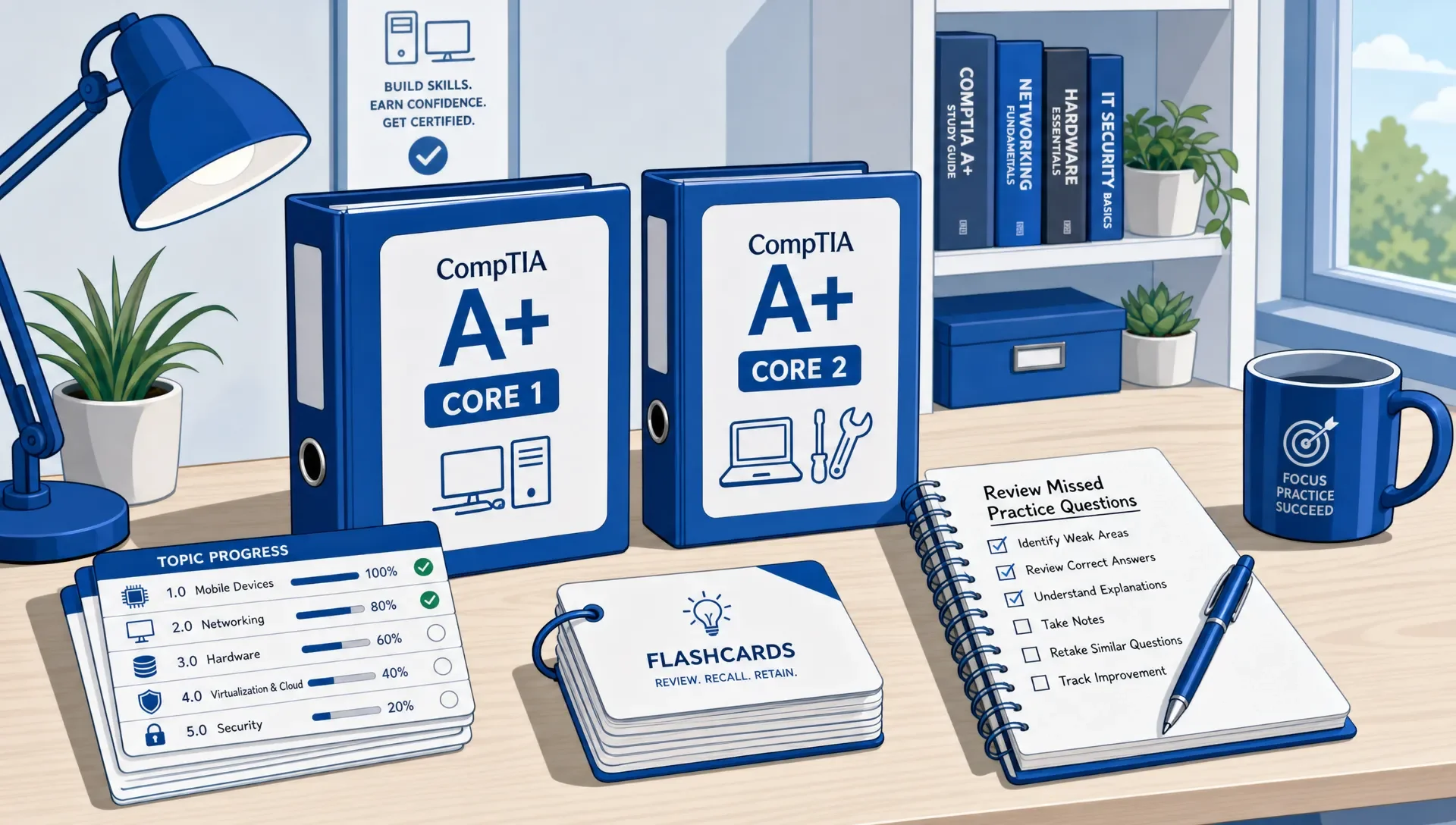
When a high practice score still hides weak spots
A high score feels good, but it can be misleading if you earned it by recognizing repeated questions. Once you've seen the same wording several times, you're no longer measuring readiness as much as memory of that item.
Watch for these warning signs:
- You score well on repeated sets but drop sharply on fresh questions.
- You can identify correct answers but can't explain distractors.
- You avoid performance-based questions because they feel slower.
- One or two objectives keep dragging down your domain-level results.
- You finish quickly because you're skimming, not because you're certain.
If you're trying to decide whether a score means you're ready, compare your results by topic and by question type, not just by the final percentage. For a deeper breakdown, MindMesh has a guide to CompTIA A+ practice test scores and what they mean.
How to write your own weakness-revealing questions
Writing your own questions is a powerful study method; it forces you to think like the exam. Pick an objective, choose a realistic support scenario, then build answer choices that are all plausible in some context, but only one is best for the given symptoms.
For example, don't write, 'What does DNS do?' Write a scenario where IP connectivity works but name resolution fails. Then include gateway, cable, and subnet mask as distractors. That structure tests whether you understand the concept well enough to diagnose it.
A good self-written question includes four parts: a user symptom, two or three technical clues, a constraint such as first or best, and answer choices that test common confusions. After writing it, explain every choice. If you can't explain the distractors, you found a study gap.
Frequently Asked Questions
How many CompTIA A+ practice questions should I answer before taking the exam? There isn't a universal number because question quality and review depth matter more than volume. Keep practicing until you can score consistently across objectives, explain your wrong answers, and handle fresh scenario questions without relying on memorized wording.
Are free CompTIA A+ practice questions enough? Free questions can help with early review, but they often vary in depth and explanation quality. Use them for exposure, then move toward exam-objective-aligned sets with explanations, topic tracking, and scenario-based practice.
Should I study Core 1 and Core 2 at the same time? You can, but track them separately. Many learners benefit from alternating sessions so hardware and networking don't crowd out operating systems, security, and operational procedures.
Why do I miss questions when I know the topic? You may be missing the decision language. Words like first, best, most likely, and next change the answer. Slow down long enough to identify the actual task before looking at the choices.
Do performance-based questions need a different practice strategy? Yes. Performance-based questions test sequencing, configuration, and tool selection more directly than simple recall. Practice by explaining the steps you would take, not just naming the answer.
How should I use flashcards with practice questions? Make flashcards from missed-question explanations, not just definitions. The best cards connect a symptom to a cause, a tool to a use case, or a procedure to the correct order.
Turn your next practice set into a weakness map
The next time you answer CompTIA A+ practice questions, don't stop at the score. Mark each miss by objective, write the reason in one sentence, and schedule a follow-up set on that exact weakness. That's how practice transforms into preparation, not just repetition. MindMesh Academy provides tools designed for this connected workflow, offering practice questions with detailed explanations, adaptive weakness-based practice, and readiness tracking. If you're ready to solidify your A+ knowledge, explore the full range of certification prep options at MindMesh Academy certifications.

Written by
Alvin Varughese
Founder, MindMesh Academy
Alvin Varughese is the founder of MindMesh Academy and an enterprise architecture leader. An electrical engineer by training, he moved from factory automation in South Africa to cloud architecture at GE Appliances and Humana (Fortune 50), and holds 20 professional certifications including AWS Solutions Architect Professional, Azure DevOps Engineer Expert, and Microsoft Agentic AI Business Solutions Architect. He built MindMesh Academy after interviewing too many highly certified candidates who couldn't answer basic questions: the goal is prep that makes you better at the job, not just able to pass the exam.