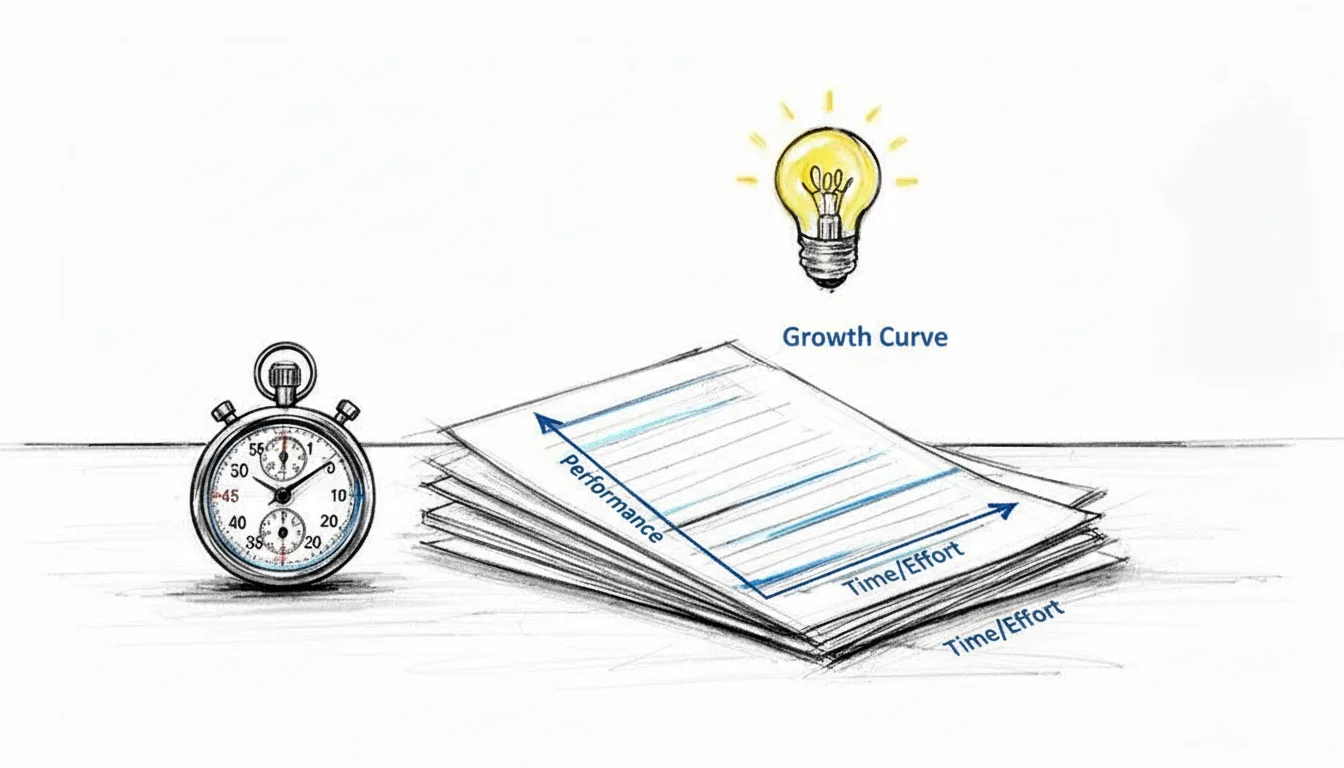
Fast Practice Test: Ace Your Certs in Less Time
You sit down to prepare for a crucial IT certification like AWS Solutions Architect, CompTIA A+, PMP, or Microsoft Azure Administrator. You open countless tabs, a video course, an expansive PDF guide, and a massive question bank. Two hours later, you feel a sense of activity but not genuine improvement. Then, a full mock exam reveals a score lower than anticipated, leaving you questioning your progress and potentially leading to burnout.
This common cycle drains even the most determined candidates.
A fast practice test addresses a different challenge than a full-length mock exam. Its purpose isn't to prove you're ready; it's designed to make you ready. Instead of relying on one exhausting weekend study session, you integrate short, focused, repeatable tests throughout your week. This strategy efficiently exposes weak spots, strengthens knowledge recall, and builds exam speed without overwhelming your busy schedule.
For working IT professionals, this distinction is critical. You don't need more study hours that blend into a blur; you need more high-quality, targeted practice sessions. At MindMesh Academy, we champion methods that deliver maximum educational value in minimal time.
Beyond Burnout: Why Full-Length Mocks Might Be Hindering Your Progress
Many certification candidates make a similar error: they approach every study block as if it were the final exam rehearsal.
They spend too much time on passive reading, excessive highlighting, and postpone actual testing until the very end of their study cycle. When they finally tackle a full practice exam, they aren't just measuring their mastery of the content. They are also measuring their fatigue, inefficient pacing, and the lack of active retrieval practice under exam-like pressure.
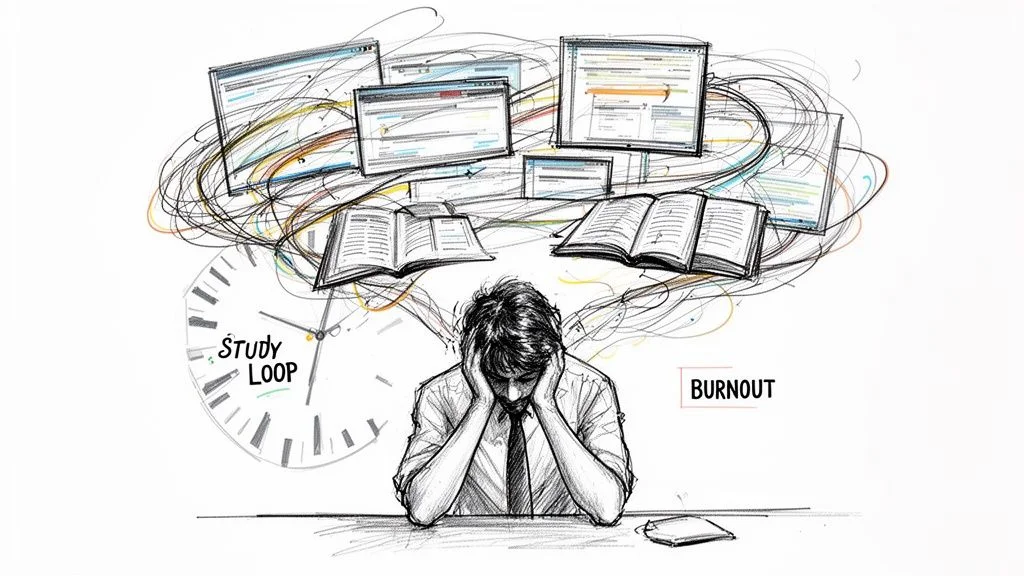 Illustration: The common pitfalls of traditional, exhaustive study methods leading to candidate burnout.
What usually goes wrong
While a long mock exam holds significant value, it shouldn't be your primary or default study method. Here's a typical pattern that can impede progress:
- Too much passive review: Candidates spend hours rereading notes on complex topics like AWS IAM policies, PMP Agile artifacts, Azure subnetting rules, or ITIL incident management processes. They mistakenly equate familiarity with the material to actual readiness for the exam.
- Testing too late: They delay practicing questions until they feel "completely prepared." This often means days, or even weeks, are spent avoiding the very activity that would reveal what they truly know and where they need to improve.
- No repeat correction cycle: A single, long exam provides one big score, but it rarely establishes the frequent, iterative feedback loop essential for daily learning and correction.
- Confidence crashes: A single poor performance on a long mock can severely undermine the confidence of an otherwise capable learner. Often, the core issue isn't a lack of knowledge but a flawed study design.
Why this gap matters
Educational test preparation, particularly in K-12, has advanced significantly in incorporating adaptive and spaced repetition methods. However, adults preparing for high-stakes professional certifications often still lack access to fast practice tests that leverage these proven techniques. Research, such as the ReadTheory Florida test prep study, shows that students who practice regularly outperform non-practicing peers by 3X.
This gap isn't just academic; it's profoundly practical. If your certification prep platform only offers lengthy, static quizzes, it will unevenly train your endurance and provide feedback too slowly to be truly effective.
A full mock is a checkpoint. A fast practice test is a training tool.
The better use of your effort
For the majority of your study week, you'll benefit from tighter, more frequent learning loops:
- Focus on testing a single domain or specific topic.
- Immediately review any missed questions to understand the 'why.'
- Re-test on the same ideas later to reinforce learning.
- Track whether the error was due to a knowledge gap, misinterpretation of wording, or timing issues.
This pattern builds consistent momentum. It also significantly reduces the emotional burden and stress that often comes from linking every study session to one intimidating, high-stakes score. If exam anxiety is a challenge for you, shorter, repeatable sessions are an excellent way to lower pressure while maintaining high study standards. For further insights, our article Overcome Exam Anxiety provides valuable strategies.
The Power of Micro-Testing for Certification Mastery
A fast practice test is effective because it actively forces your brain into active recall, preventing it from settling into passive recognition.
This distinction is crucial for certification success. Watching another lesson on cloud pricing models, incident management frameworks (ITIL), or network security groups (Azure) can feel productive. However, answering a timed question without notes or external aids is the only way to truly reveal whether you can retrieve and apply the concept when it matters most: during the exam.
Short tests create better training conditions
Micro-testing excels in three key areas for certification preparation:
- Reduces Friction: A short, focused session is far easier to integrate into a busy day. You can tackle one before work, during a lunch break, or at the end of a long day without feeling overwhelmed. This promotes consistency.
- Keeps Attention Sharper: When a test has a narrow topic and a clear stopping point, your attention is less likely to wander. This sharp focus is essential for mastering complex IT concepts.
- Creates More Review Cycles: More frequent, shorter tests mean more opportunities to catch recurring patterns in your mistakes and address them quickly, leading to faster improvement.
Academic research on certification preparation strongly supports the broader case for structured testing. Studies indicate that success rates improve by 25-40% for cohorts utilizing 10 or more practice tests compared to those relying solely on traditional study methods. Specifically, reports show a 32% uplift in IT certifications such as CompTIA and AWS for those who incorporate consistent practice testing (SSRN paper).
Consistency beats intensity. A candidate who tests often learns faster than a candidate who studies hard but checks progress rarely.
Why this works better than marathon sessions
A long, unfocused study block often combines several unproductive habits:
- Topic sprawl: You might jump from AWS VPC routing to S3 storage classes to billing alerts, or from PMP schedule management to stakeholder engagement, without a clear, defined objective.
- Low retrieval pressure: You primarily consume information rather than actively producing answers under pressure, which is what the exam demands.
- Slow correction: Errors remain unaddressed and unreviewed until the very end of a lengthy session, making the feedback less impactful.
- Poor transfer: You might understand the notes, but you haven't practiced translating that knowledge into the specific question formats found on the exam.
Micro-tests tighten all four of these areas, ensuring your study time is efficient and effective.
Consider the approach serious learners take for other high-stakes exams, such as the LSAT practice tests. The most effective prep systems don't solely rely on one giant exam every so often. Instead, they break down the work into focused practice units, timed drills, and iterative review loops. Certification preparation for IT professionals should adopt this same highly effective methodology.
What a micro-test is not
A fast practice test is far more than random trivia or a casual motivational quiz. It's not ten easy questions you answer while distracted.
A well-designed fast practice test should have:
- A narrow scope: Focusing on a specific sub-topic or skill.
- Realistic wording: Mirroring the language and complexity of actual exam questions.
- A strict time limit: Simulating exam pressure to build speed and accuracy.
- Immediate review: Providing instant feedback and explanations.
- A clear next action: Guiding your subsequent study steps based on performance.
If you need a clean baseline on what differentiates an effective practice tool from casual review, start with our guide, What Is a Practice Exam.
The principle is simple: You don't need to feel overwhelmed to make significant progress. You need a study format that quickly exposes weaknesses and provides sufficient repetition to cement your knowledge and fix those gaps.
How to Design Your Perfect 20-Minute Practice Test
The most effective fast practice test is structured to be both repeatable and rigorous. Many candidates tend to overcomplicate this, believing they need a polished mock exam with dozens of questions. In reality, you simply need a focused set that trains a single exam skill under realistic time constraints.
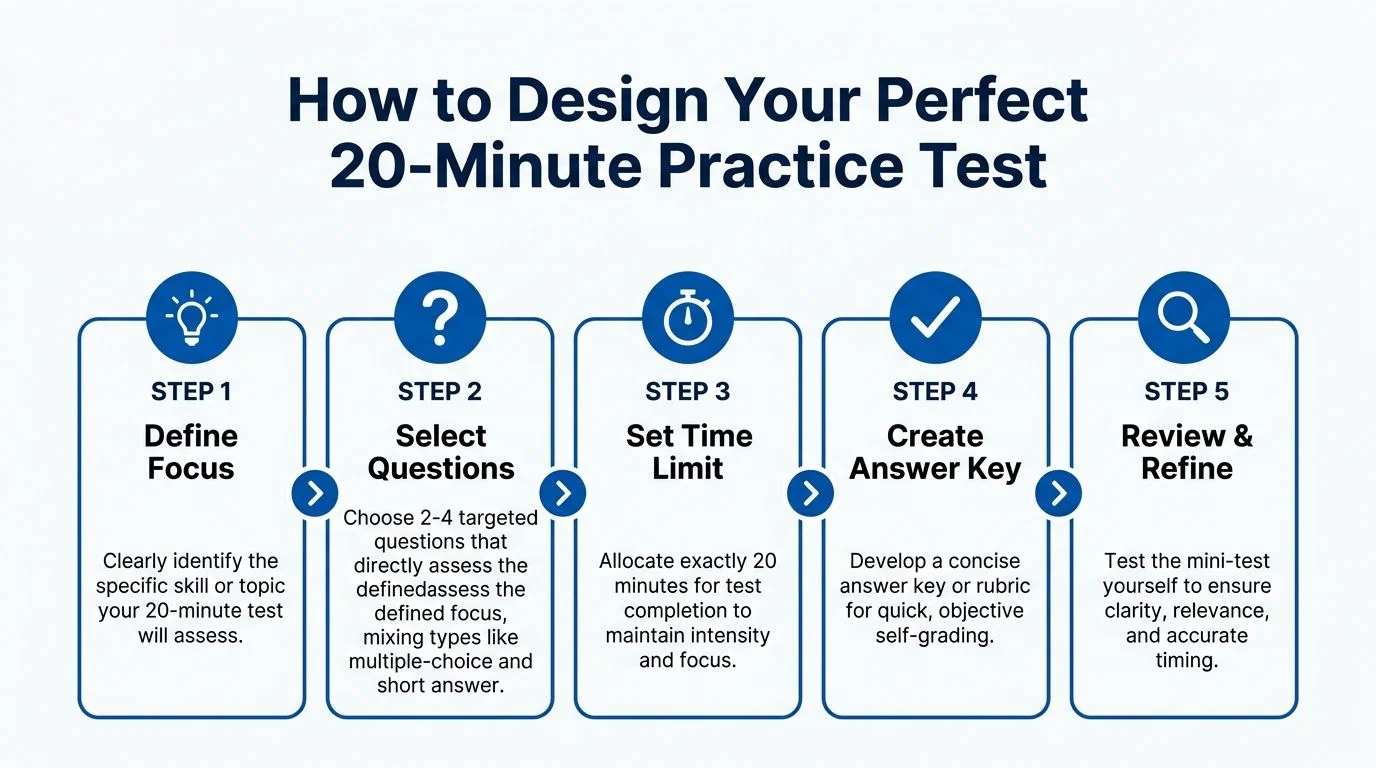 Illustration: Key elements for constructing an effective 20-minute fast practice test.
Start with one narrow objective
Select one specific slice of the exam content, rather than attempting to cover an entire domain. This targeted approach provides much cleaner feedback.
Good examples for various certifications:
- AWS: S3 security policies, IAM role assumptions, Route 53 routing behavior, EC2 instance types and use cases.
- CompTIA: Command-line troubleshooting steps, printer issues, authentication basics, common malware types.
- PMP: Risk response strategies, stakeholder engagement techniques, change control processes, Agile sprint planning.
- ServiceNow: Incident lifecycle stages, form behavior configurations, reporting logic for specific modules.
- Azure: Azure identity and access management (IAM) roles, specific PowerShell cmdlets for resource management, Virtual Network peering configurations.
- ITIL: ITIL service value chain activities, problem management process steps, differences between service request and incident management.
Bad example: "Cloud security." This is far too broad for a productive 20-minute session. A narrow target allows you to pinpoint exactly what to fix. If you miss two questions on AWS bucket policies, you know precisely where to focus your review. If you miss two questions from a giant, mixed topic set, your result remains vague and unactionable.
Build the right question mix
Curate a question mix that addresses your specific needs, rather than what simply feels comfortable. A practical 20-minute mini-test typically includes:
- Core weak-area questions: Prioritize the hardest items or those topics you consistently struggle with. If you keep missing Azure identity questions or PMP sequencing logic, these should be at the forefront of your test.
- One review question from an older topic: This helps keep previously learned material fresh in your mind and reinforces the principle of spaced repetition.
- One transfer question: Include a scenario-based question that demands application of knowledge, not just rote recall. These are crucial for many higher-level certifications.
For example, an AWS learner designing a 20-minute mini-test might include:
- One direct question on S3 bucket policy behavior syntax.
- One scenario question on cross-account access using IAM roles.
- One older review item on the distinctions between IAM policies and permission boundaries.
- One mixed architecture question that checks whether the concept of least privilege security transfers to a serverless application design.
Match the clock to the actual exam
The time limit is a fundamental component of this method. If your actual certification exam rewards quick interpretation and decision-making, your mini-test should replicate that pressure. Do not turn off the timer. While untimed practice has its place when first learning a new concept, a fast practice test should feel slightly uncomfortable, pushing you to perform under pressure.
A simple rule works well: Base your per-question timing on the actual exam's pace, then apply that same pressure to your mini-test.
Use the timer for two crucial reasons:
- It exposes hesitation: The timer reveals where you understand a concept but still move too slowly, indicating a need for faster recall or more confidence.
- It reveals bad reading habits: Rushing past critical qualifiers or missing key details is a common pitfall under exam pressure. The timer helps you identify and correct these habits.
Make the answer key brutally clear
Don't just mark questions as right or wrong. For each question, a truly effective answer key should include:
- The correct answer.
- A clear explanation of why it is correct.
- An explanation of why the tempting wrong answers are incorrect.
- The exact concept, standard, or objective being tested.
The quality of your review directly determines the educational value you gain from the test.
If your answer key only tells you the right option, it helps your score less than you think. You need the reasoning path.
Use a simple creation template
Keep your workflow efficient and lean. A straightforward template ensures consistency:
| Element | What to decide |
|---|---|
| Focus | One specific topic or sub-skill (e.g., AWS SQS vs. SNS, PMP Earned Value Management formulas) |
| Question count | A small, manageable set with a mix of difficulty levels |
| Timing | Realistic exam pressure per question (e.g., 90 seconds per question) |
| Review method | Immediate self-grading with detailed explanations and reasoning |
| Next action | Retest, revise specific notes, create flashcards, or escalate difficulty level |
Test types that work well
Not every mini-test needs the same format. Varying your test types can keep things engaging and challenge different skills.
- Scenario set: Ideal for certifications like AWS, Azure, and ServiceNow that heavily feature situational questions, or PMP where you apply processes to real-world project challenges.
- Paired comparison: Excellent for PMP process distinctions (e.g., Plan Scope vs. Define Scope), ITIL terminology (e.g., incident vs. problem), or CompTIA hardware specifications.
- Troubleshooting sprint: Best for CompTIA-style diagnosis questions, Cisco networking issues, or Azure log analysis scenarios.
- Short written explanation: Useful when you consistently get fooled by similar answer choices, forcing you to articulate the nuanced differences.
The goal isn't variety for its own sake. It's to build a test you can reuse, score quickly, and learn from immediately.
Building a Study Schedule Around Fast Practice Tests
A fast practice test delivers its best results when integrated into a consistent, repeatable study rhythm. Many candidates falter here; they create a few excellent mini-tests, use them sporadically, and then revert to long, unfocused sessions. The solution is straightforward: proactively schedule short tests into your calendar, even before you feel completely ready for them.
Florida's FAST model offers a valuable lesson in scheduling. Its progress-monitoring approach contributed to a 42-point rise in math scores from PM1 to PM3 in one school year, achieved through targeted interventions based on frequent test data (Education Advanced on FAST testing). While the numbers themselves are context-specific, the underlying pattern is universally applicable to certification prep: Test, review, adjust, retest.
A weekly rhythm that holds
You don't need an overly ambitious study plan; you need one that is sustainable and repeatable, especially for working professionals. A practical weekly structure might look like this:
- Morning (before work): Light recall exercises or flashcards for definitions (e.g., ITIL guiding principles, CompTIA networking terms).
- Lunch Break: One focused fast practice test (the ideal time for a 20-minute session).
- Evening (after work): Deeper study, reviewing concepts related to your test misses, or a focused lab (e.g., configuring an AWS VPC, deploying an Azure web app).
The lunch session often presents the biggest missed opportunity for many candidates. Twenty minutes is ample time to complete a meaningful mini-test and review, without disrupting the rest of your demanding workday.
Sample Weekly Fast Practice Test Schedule for an AWS Certification
This schedule illustrates how to weave fast practice tests into your week for targeted improvement:
| Day | Morning (30 min) | Lunch (20 min) | Evening (60 min) |
|---|---|---|---|
| Monday | Review notes on IAM roles (e.g., cross-account vs. service roles) | Fast practice test on IAM trust policies | Review misses in detail and update knowledge base |
| Tuesday | Flashcards on S3 security terms (e.g., bucket policies, ACLs) | Fast practice test on S3 bucket policy scenarios | Hands-on lab for S3 permissions or lifecycle rules |
| Wednesday | Review prior errors log and identify patterns | Mixed mini-test on IAM and S3 (reinforcement) | Read deeper architecture explanations for cloud security |
| Thursday | Quick recall on VPC basics (e.g., subnets, gateways) | Fast practice test on security groups vs. NACLs | Lab on VPC traffic flow or routing table configuration |
| Friday | Revisit weakest concepts identified from the week | Mixed review mini-test from the entire week's topics | Light review only, or plan for weekend deep dive |
| Saturday | Create a concept map for a weak domain (e.g., database services) | Slightly harder timed mini-test on a challenging topic | Deeper scenario practice or whitepaper review |
| Sunday | Rest or short flashcard review | Optional confidence check on a mixed domain | Plan next week’s weak-area focus sets and resources |
Pair fast tests with spaced repetition
An effective study schedule doesn't just repeat topics; it strategically spaces them out. This leverages the power of spaced repetition, a scientifically proven method for long-term memory retention.
One clear pattern for incorporating this:
- Test a topic when you first learn it to establish a baseline.
- Retest it a short time later (e.g., within 24-48 hours) to reinforce immediate recall.
- Bring it back again later in the week after other topics have intervened.
- Revisit it periodically in subsequent weeks or months to ensure durable memory formation.
This spacing is crucial because it forces retrieval after some natural forgetting has occurred, which is precisely where memory becomes more robust and enduring.
Keep one full mock, but demote it
Full-length practice exams still play an important role in your certification preparation. They are excellent for building stamina, practicing pacing, and simulating the complete exam experience.
However, they should not dominate your weekly study efforts. Use them as:
- An occasional benchmark to gauge overall progress.
- A way to test your endurance for the multi-hour exam.
- A final readiness check closer to your actual exam date.
Conversely, use fast practice tests as:
- Your daily learning engine.
- Your highly efficient weak-spot detector.
- Your consistent habit builder.
If your calendar only has room for one serious study action per weekday, make it a focused mini-test plus immediate review.
For candidates who need structure before they dive into content, strong study schedule templates from MindMesh Academy can save significant time and effort in setting up an effective plan.
Mastering the Feedback Loop From Score to Strategy
A score, by itself, is merely a number; it doesn't provide the actionable insights you need to determine your next steps. This is why many candidates answer countless questions but still find their progress plateauing. They log a result, experience a brief moment of satisfaction or disappointment, and then move on without extracting any useful, diagnostic information. The true value of a fast practice test emerges in the quality of its review.
Florida's educational practice resources offer a useful lesson here. In pilot programs, consistent use of practice materials, coupled with detailed answer keys and tool simulations, was linked to 5-10% gains in proficiency rates (St. Johns County practice test page). The common thread isn't simply answering more questions, but engaging in a tighter, more diagnostic feedback process.
Sort every miss into a real category
After each mini-test, take the crucial step of classifying your wrong answers. This transforms errors into actionable data. Use categories like these:
- Knowledge gap: You genuinely did not know the concept (e.g., the specifics of Azure Firewall rules, the stages of the PMP risk management process, or the various ITIL practices).
- Misread question: You missed a critical word, qualifier, or condition in the question (e.g., a "NOT" or "EXCEPT" in a CompTIA troubleshooting question, or a crucial keyword in an AWS scenario).
- Timing pressure: You knew the answer but couldn't recall or process it quickly enough under the time constraint (e.g., quickly identifying the correct ITIL Guiding Principle or a PMP formula).
- False confidence: Two choices looked familiar, and you guessed from recognition instead of applying logical reasoning to distinguish between them (e.g., confusing two similar AWS services like SQS and SNS, or PMP artifact definitions).
This classification takes only a few minutes but can fundamentally change your study approach. Once errors have clear categories, your next study step becomes immediately obvious.
Review the reason, not just the result
Many answer reviews are superficial. Candidates often check the right option, nod, and move on. This is insufficient for deep learning and lasting improvement.
Instead, ask yourself these diagnostic questions for each missed item:
- Why was the correct answer definitively right?
- Why did the incorrect answer initially attract me, and what was its core flaw?
- What specific signal, keyword, or nuance in the question's wording should I pay attention to next time?
For PMP, this might involve understanding the difference between what happens first versus what happens next in a process. For AWS, it could be a subtle clue about a managed service's scope or the application of least-privilege design. For CompTIA or Azure, it might be whether the question asks for the "most likely cause" versus the "best next step" in troubleshooting.
Fast testing only works when review is diagnostic. If you cannot name the cause of the miss, the mistake will come back.
Change the plan immediately
Every mini-test should trigger at least one concrete action to adjust your study plan.
Examples of immediate actions:
- Repeat the same topic tomorrow with slightly different questions, perhaps with more complex AWS S3 scenarios or PMP situational questions.
- Create flashcards for specific terms or concepts you confused (e.g., different ITIL practices or Azure resource types).
- Perform a short lab or hands-on exercise if the issue is procedural rather than purely conceptual (e.g., configuring an Azure Virtual Network or troubleshooting a Linux command).
- Add a specific note to your "always misread" checklist if your problem isn't knowledge, but consistent misinterpretation of phrasing or critical keywords under pressure.
The last point is often underestimated. If your primary challenge is not a lack of content knowledge but rather misinterpreting question phrasing, you don't need more study material; you need better reading discipline and strategic awareness under time pressure.
A fast practice test is short. Critically, its feedback loop should be short too, driving immediate, targeted improvements.
Visualizing Your Progress with a Study Dashboard
A study dashboard transforms scattered study sessions into a clear, visible trend of your progress. Without this visual aid, most candidates rely on vague intuition. They might think they're "bad at networking" or "getting better at Agile," but they lack objective data to confirm or deny these perceptions over time. A dashboard rectifies this by revealing patterns and insights that your intuition might miss.
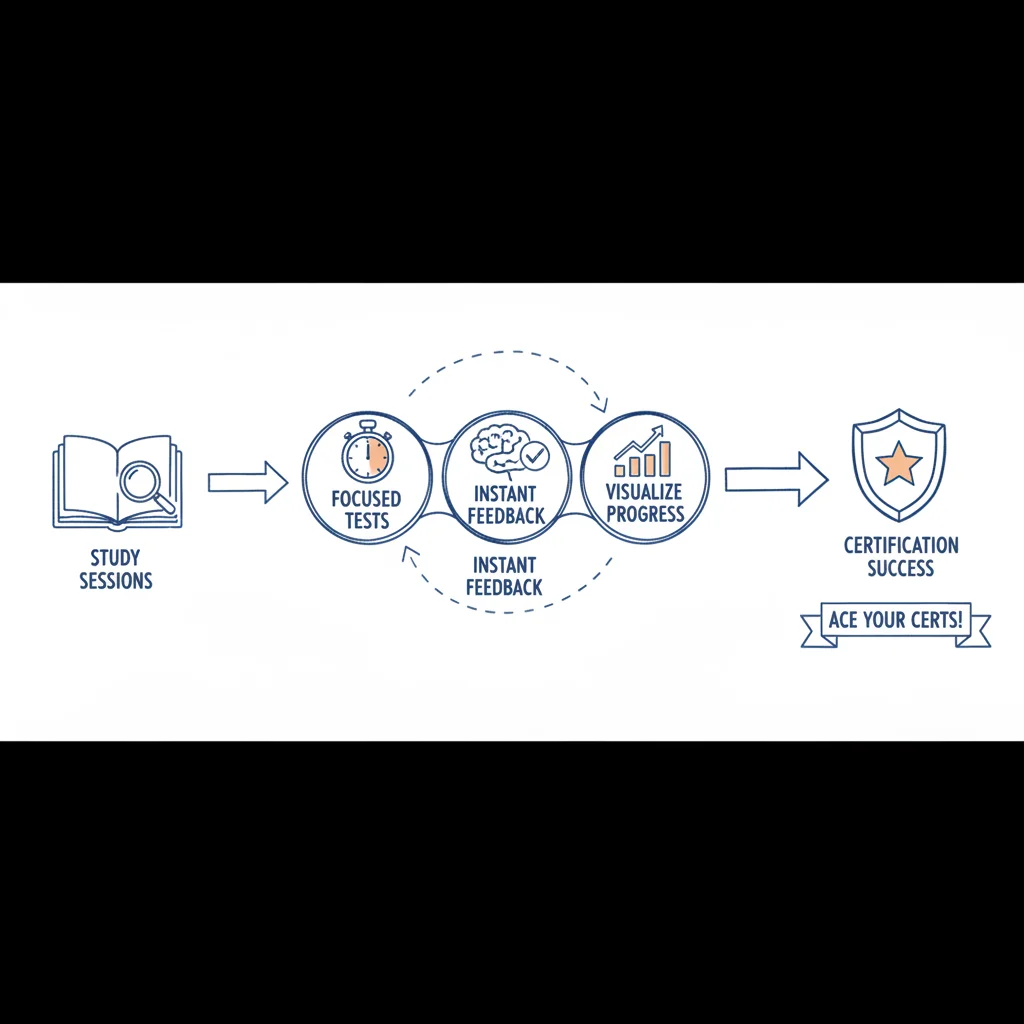 Illustration: A digital dashboard visualizing study progress with key metrics and trends.
What useful tracking looks like
You don't need a sophisticated analytics stack. You need a simple, actionable view that answers practical questions about your preparation:
- Which specific domains or certification objectives are showing consistent improvement (e.g., AWS Compute vs. Networking, PMP Process vs. People)?
- Which topics consistently slip after a few days, indicating a need for more spaced repetition (e.g., PMP Quality Management processes, specific CompTIA troubleshooting steps)?
- Are your mistakes primarily conceptual knowledge problems, or are they related to execution and pacing (crucial for certifications like CompTIA or CISSP)?
- Which question types consistently cause the most trouble (e.g., drag-and-drop for Azure, multi-select for CISSP, complex scenario questions)?
Studies on practice test performance, such as those involving OpenStax introductory statistics practice tests, show that individuals who actively track their results can improve by an average of 12-18% on final exams. This principle applies powerfully to IT certification prep: tracking changes how you study because it objectively shows whether your effort is translating into better, cleaner decisions.
A simple learner story
Consider a candidate preparing for an AWS certification. In week one, their dashboard clearly indicates weak accuracy on identity and access management (IAM) topics and slower timing on scenario-based questions. By week two, after targeted fast practice tests, their accuracy on IAM mini-tests improves, but complex, mixed architecture questions still drag down their overall performance.
This specific insight tells the learner something invaluable: their isolated concept recall for IAM is improving, but their ability to transfer that knowledge to real-world scenarios or complex architectural decisions is still a weak point.
Based on this, their next batch of fast practice tests can be strategically adjusted:
- Fewer direct-definition items.
- More scenario-based questions that require applying IAM concepts in complex architectures.
- A repeated focus on their weakest areas every few days.
- A closer review of why distractors look plausible in multi-choice questions.
This is a far more effective and precise plan than simply thinking, "I need to study cloud security more."
Tools matter when consistency matters
This is also where effective operational tools become critical. If you're coaching teams or running a certification prep program, visibility into learner progress matters just as much as the quality of the content. Many training providers seek tools that can organize learners, track scores, and identify trends in a centralized location. For teams managing this side of the process, software designed for standardized test tutoring demonstrates how dashboards and administrative workflows can powerfully support consistent intervention and progress monitoring.
What to put on your own dashboard
Even a basic tracker should include these essential metrics:
| Metric | Why it matters |
|---|---|
| Topic | Clearly shows where weakness clusters, e.g., specific AWS services like S3 or EC2, or PMP knowledge areas like Risk Management. |
| Score | Gives a quick signal of performance, but remember it’s not the whole story; always focus on why the score is what it is. |
| Time used | Reveals pacing issues; helps you identify if you’re spending too long on simple questions or rushing complex ones. |
| Error type | Separates knowledge problems from execution problems, allowing you to direct your study precisely (e.g., more content vs. more practice). |
| Next action | Prevents passive logging; every data point should directly inform and drive an actionable next step in your study plan. |
If your dashboard does not change tomorrow’s study choice, it is just decoration.
That is the core principle behind a fast practice test: not speed for its own sake, nor an endless stream of quizzes. A short, focused test, seamlessly tied to spaced review and visible progress tracking, provides you with a robust system that fits into real life and demonstrably improves actual exam performance.
MindMesh Academy helps certification candidates prepare with structured practice, spaced repetition, and progress tracking that makes weak areas visible well before exam day. If you want a smarter, more efficient way to prep for AWS, Azure, CompTIA, PMP, ServiceNow, and many other high-stakes IT certifications, explore how MindMesh Academy can support your journey.
Ready to Get Certified?
Prepare with expert-curated study guides, practice exams, and spaced repetition flashcards at MindMesh Academy:

Written by
Alvin Varughese
Founder, MindMesh Academy
Alvin Varughese is the founder of MindMesh Academy and an enterprise architecture leader. An electrical engineer by training, he moved from factory automation in South Africa to cloud architecture at GE Appliances and Humana (Fortune 50), and holds 20 professional certifications including AWS Solutions Architect Professional, Azure DevOps Engineer Expert, and Microsoft Agentic AI Business Solutions Architect. He built MindMesh Academy after interviewing too many highly certified candidates who couldn't answer basic questions: the goal is prep that makes you better at the job, not just able to pass the exam.