Exam Quiz Test: Build Recall Before Test Day
Exam Quiz Test: Build Recall Before Test Day
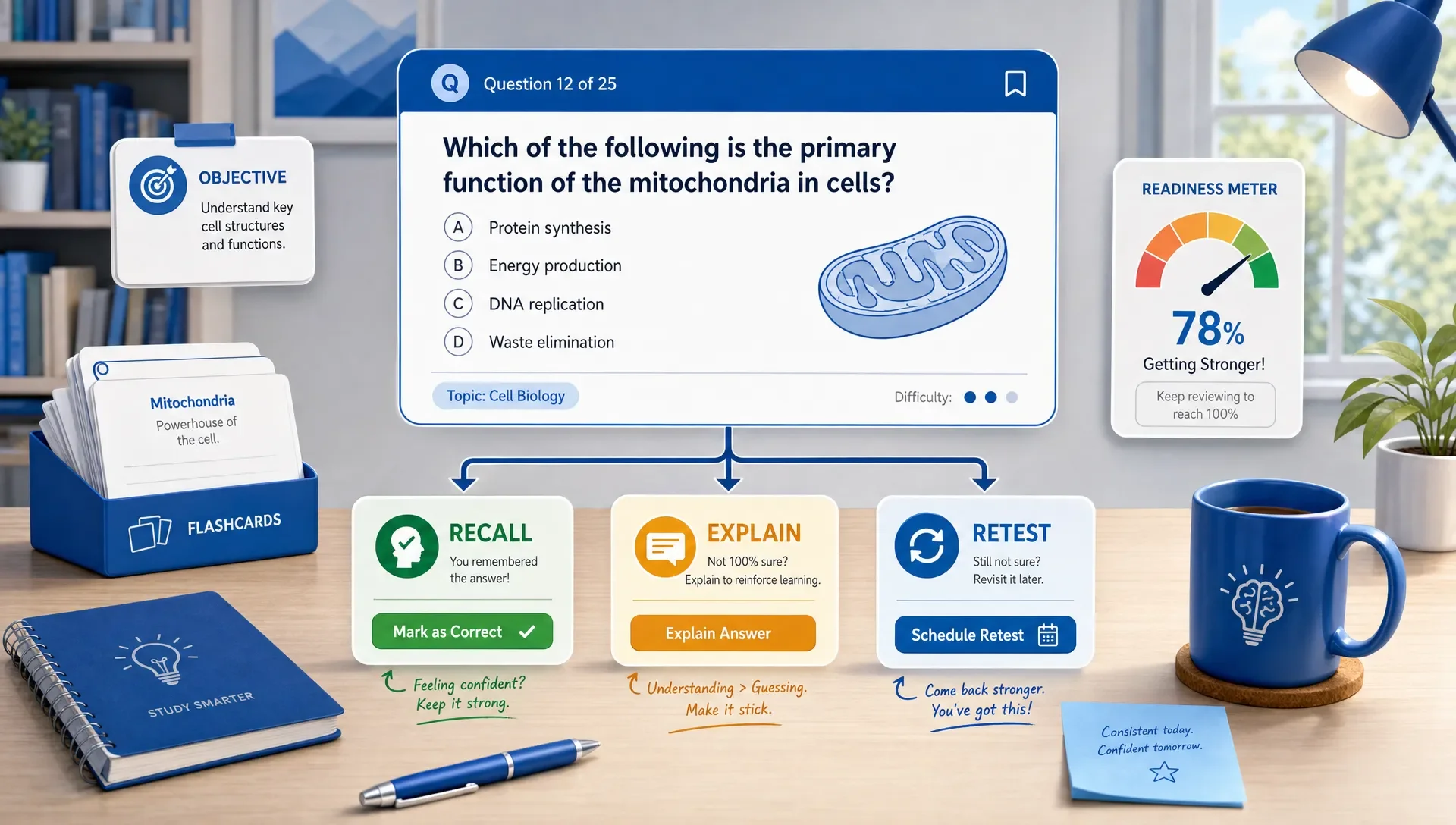
An exam quiz test should make you retrieve facts, concepts, commands, workflows, and decisions before the real exam asks for them. If you only use questions to check a score, you're getting half the value. A simple, effective routine is better: answer closed-book, explain your reasoning, review the objective, turn misses into flashcards, and retest later.
Start today with one exam objective, 15 to 25 questions, and a short review block. Don't wait until you feel ready to test yourself. Testing is how you build readiness. The goal isn't to prove you know everything right now. The goal is to expose weak recall while you still have time to fix it.
What an Exam Quiz Test Should Measure
A good exam quiz test measures more than whether you can recognize the right option. Certification exams often ask you to choose the best answer under specific constraints: least privilege, lowest cost, highest availability, fastest recovery, safest change, or the correct order of operations. This means your practice must train both recall and judgment.
Use each question set to answer four key things:
- Can I recall the concept without looking at notes?
- Can I apply the concept in a scenario?
- Can I explain why the correct answer is better than the distractors?
- Can I map the question back to an exam objective?
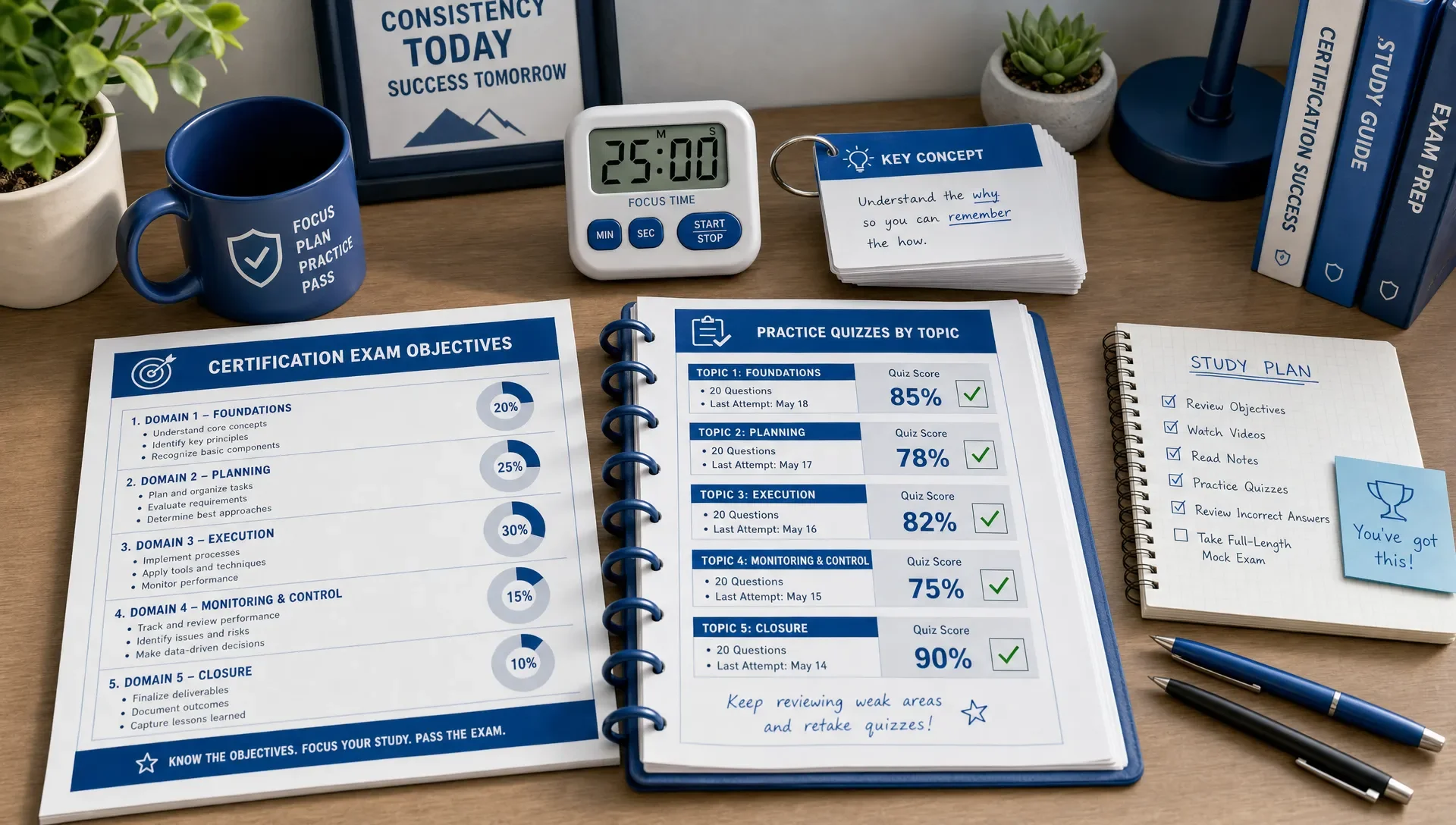
That last point is critical. Random questions can create a false sense of progress. Objective-based quizzes, however, show whether you're improving in the specific areas the exam actually tests.
| Practice format | What it should measure | Best time to use it | What to record |
|---|---|---|---|
| Short quiz | Basic recall for one objective | After studying a topic | Missed terms, weak definitions, unclear facts |
| Mixed quiz | Switching between related objectives | Midweek review | Confused concepts and repeated traps |
| Timed test | Pacing and decision quality | After several study blocks | Score, timing, confidence, objective gaps |
| Full practice exam | Exam readiness under realistic pressure | Final preparation phase | Domain performance, endurance, review priorities |
Research supports this approach. In Roediger and Karpicke's 2006 Psychological Science study, students who practiced retrieval remembered more after a delay than students who only restudied. For certification prep, a quiz isn't just an assessment. It's a learning event.
If you want a deeper routine for using questions as retrieval practice, MindMesh Academy also has a guide on practice examination habits that improve recall.
Use Exam Objectives to Choose the Right Questions
Before you open a question bank, open the exam objectives. Vendor blueprints tell you exactly what knowledge and skills are in scope. For instance, the official AWS Certified Cloud Practitioner certification page and Microsoft's AZ-900 exam page outline domains and measured skills, so candidates know what to prepare for.
Your quiz plan should mirror that structure. If the exam includes identity, networking, billing, governance, troubleshooting, or risk management domains, your quizzes should be tagged to those areas. Otherwise, you might spend too much time on topics you enjoy and too little time on topics that actually cost points.
For fundamentals-level cloud preparation, you can pair objective review with the AWS Certified Cloud Practitioner practice exam or use the AZ-900 Microsoft Azure Fundamentals study guide to keep your study sessions aligned to the exam path.
Build a Recall Ladder From Quiz to Full Test
Don't jump straight from reading a study guide to taking a full practice exam every night. That's exhausting and often leads to shallow review. A better plan is to climb a recall ladder: small quiz, mixed quiz, timed test, full exam simulation.
| Recall ladder step | How to run it | What success looks like |
|---|---|---|
| Objective quiz | Answer 10 to 20 questions from one objective | You can explain the rule, fact, or process without notes |
| Mixed quiz | Combine 2 to 4 related objectives | You can switch concepts without confusing similar terms |
| Timed test | Use a larger set with a time limit | You make decisions without over-reading every question |
| Full practice exam | Simulate the real test experience | Your weak areas are specific, not broad and mysterious |
The ladder works because it increases difficulty gradually. Early quizzes help you retrieve clear facts. Mixed quizzes force you to choose between similar ideas. Timed tests add pressure. Full simulations show whether your knowledge holds together for the length and style of the exam.
Review Every Missed Question in Four Passes
Most learners review too quickly. They see the correct answer, nod, and move on. This feels efficient, but it doesn't rebuild the memory path that failed during the question. To make recall stronger, review in passes.
| Review pass | Question to ask | Output you should create |
|---|---|---|
| Reasoning pass | Why did I choose my answer? | A short note about your thought process |
| Objective pass | Which exam objective does this test? | The domain or topic tag |
| Explanation pass | Why is the correct answer best? | One sentence in your own words |
| Retest pass | When will I see this again? | A flashcard or scheduled retry |
This is where many score gains come from. You're not just collecting missed questions. You're diagnosing why recall broke. Maybe you knew the definition but missed a scenario clue. Maybe you confused two services. Perhaps you rushed. Or maybe you guessed because the wording looked familiar.
For larger practice tests, use a more structured review process. MindMesh Academy's guide on how to review an exam practice test the right way walks through score, timing, confidence, and objective-level review.
Space Your Retests So Recall Survives Test Day
Repeating the same quiz immediately can inflate your score because you're remembering the question, not the underlying concept. Retesting is useful, but spacing matters.
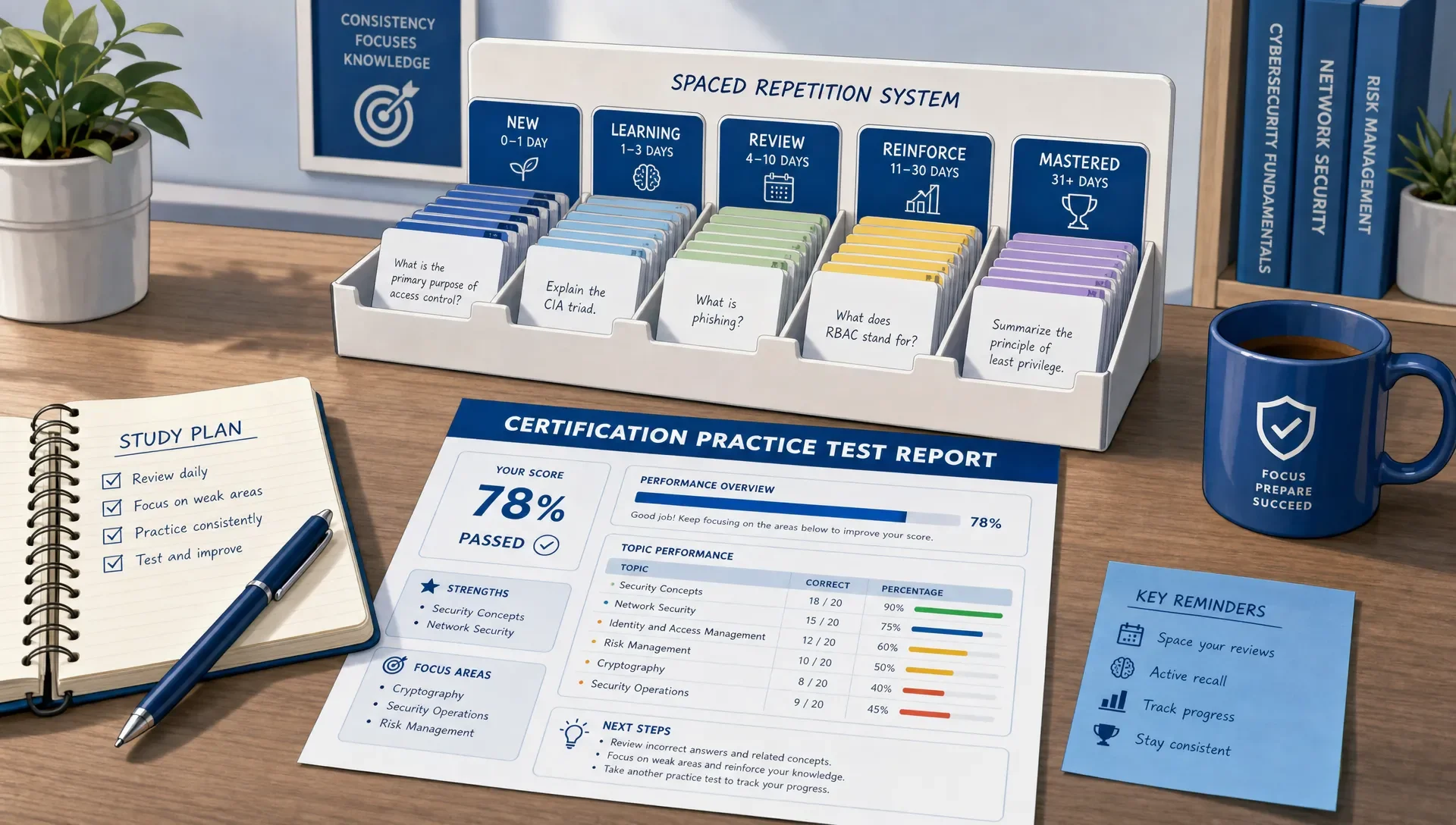
A major review by Cepeda and colleagues on distributed practice found that spacing learning over time generally improves long-term retention compared with massed practice. In plain English: don't cram all your review into one sitting if you want recall to last.
Use this spacing rhythm for missed or low-confidence questions:
| When to retry | What to do | What you're checking |
|---|---|---|
| Same day | Review the explanation and objective | Did you understand the correction? |
| Next day | Answer a similar question closed-book | Can you recall without seeing the same wording? |
| 3 to 4 days later | Mix it into a broader quiz | Can you identify it among other topics? |
| Final review window | Use a short targeted set | Is the weakness still active? |
Flashcards help here, especially for facts, acronyms, command options, formulas, governance terms, port numbers, process steps, and service limits. But don't turn every missed question into a giant paragraph. A useful flashcard asks one clear prompt and expects one clear answer.
Set Quiz Difficulty So You Practice Recall, Not Guessing
If every quiz is too easy, you build confidence without depth. If every quiz is too hard, you start guessing and stop learning. The right difficulty should make you pause, retrieve, and decide.
A practical signal is confidence. After each answer, mark it as high, medium, or low confidence before you check the explanation. High-confidence misses are dangerous because they reveal misconceptions. Low-confidence correct answers are also important because they may hide lucky guesses.
| Result | What it means | What to do next |
|---|---|---|
| Correct, high confidence | Strong recall | Move it into spaced review |
| Correct, low confidence | Possible lucky guess | Review the explanation and retest later |
| Incorrect, high confidence | Misconception | Rebuild the concept from the objective |
| Incorrect, low confidence | Knowledge gap | Study the topic, then use a smaller quiz |
For exams with scenario or performance-based question formats, don't only memorize definitions. Practice the sequence of decisions. Ask yourself what you would do first, what constraint matters most, and what option would create risk.
If you're preparing for a security certification, the CompTIA Security+ practice exam can help you practice applying concepts through questions and explanations rather than reading passively.
Seven-Day Exam Quiz Test Plan Before Test Day
The final week shouldn't be a panic sprint through every topic. It should be a controlled recall check. You want to confirm strengths, isolate remaining weaknesses, and protect your energy.
| Timing | Main task | Keep it focused by |
|---|---|---|
| 7 days out | Take a mixed quiz across all major domains | Tag every miss by objective |
| 6 days out | Study only the weakest objectives | Use short quizzes after each review block |
| 5 days out | Take a timed test or full practice exam | Record score, pacing, and confidence |
| 4 days out | Review missed and guessed questions | Convert patterns into flashcards |
| 3 days out | Retest weak objectives with new questions | Stop when the issue is clearly diagnosed |
| 2 days out | Run a shorter mixed quiz | Focus on accuracy and calm pacing |
| 1 day out | Do light recall and logistics | Avoid heavy cramming and protect sleep |
If last-minute cramming has been your default, build a more predictable schedule earlier in the process. This guide to certification examination prep without last-minute cramming explains how to spread review across the full study cycle.
Common Exam Quiz Test Mistakes That Weaken Recall
Question practice can help or hurt depending on how you use it. These mistakes are common because they feel productive in the moment.
| Mistake | Why it weakens recall | Better move |
|---|---|---|
| Reading explanations before answering | It turns recall into recognition | Answer closed-book first |
| Retaking the same set too soon | You memorize wording instead of concepts | Space retries and use similar questions |
| Tracking only total score | It hides objective-level weaknesses | Track misses by domain and topic |
| Ignoring lucky guesses | It leaves unstable knowledge unreviewed | Mark confidence before checking answers |
| Doing only full practice exams | It makes review too broad | Use targeted quizzes between simulations |
| Reviewing while tired | It creates shallow corrections | Keep review blocks shorter and more deliberate |
The fix isn't to do more questions blindly. The fix is to create a feedback loop: study an objective, quiz yourself, review the reason for each miss, schedule spaced retests, and measure whether the weak topic is improving.
How to Know You're Ready for Test Day
No single quiz score can promise readiness. Certification exams vary, question pools vary, and some learners need more buffer than others. Instead, look for a pattern across several practice sessions.
You're getting close when your weak areas are narrow and explainable. For example, you don't want to say, "I'm bad at networking." You want to say, "I need one more review of subnetting rules or security group behavior." Specific weakness is fixable. Vague weakness usually means you need more objective-based practice.
Readiness also shows up in your explanations. If you can explain why the correct answer is best, why two distractors are wrong, and which objective is being tested, you're building real recall. If you can only say the answer looked familiar, keep practicing. MindMesh Academy is built around this kind of connected study workflow: study guides by exam objectives, practice questions with explanations, flashcards with spaced repetition, adaptive weakness-based practice, and mastery and readiness tracking. That combination helps you see whether you're improving by topic, not just hoping a higher score means you're ready.
Frequently Asked Questions
Is an exam quiz test different from a practice exam? Yes. A quiz is usually shorter and targets recall for one or a few objectives. A practice exam is longer and tests pacing, endurance, and mixed decision-making. You need both, but they serve different purposes.
Should I retake the same quiz questions? Yes, but not immediately every time. Review the explanation first, wait, then retry later. If you retake too soon, you may remember the wording instead of the concept.
How many practice questions should I do per day? It depends on your exam date and baseline knowledge, but quality matters more than volume. A carefully reviewed set of 20 questions can teach more than 100 rushed questions with no analysis.
Should every quiz be timed? No. Early quizzes should focus on recall and explanation. Add timing once you understand the objective well enough to make decisions under pressure.
What score means I'm ready for test day? Don't rely on one score alone. Look for stable performance across multiple objectives, fewer high-confidence misses, better pacing, and the ability to explain answers without notes.
How do flashcards fit with exam quiz test practice? Use flashcards for the knowledge that caused missed or low-confidence answers. Keep them short, review them with spacing, and connect them back to practice questions so recall stays exam-relevant.
Build Recall With a Better Study Loop
If your current question practice feels random, tighten the loop. Start with the objective, answer closed-book, review the reasoning, create targeted flashcards, and retest on a schedule. That's how an exam quiz test becomes recall training instead of score checking.
To put this workflow into action, test your foundational Azure knowledge with our AZ-900 practice exam. MindMesh Academy provides structured study guides, detailed practice questions with explanations, and adaptive practice to highlight and strengthen your weak areas, helping you prepare with confidence.

Written by
Alvin Varughese
Founder, MindMesh Academy
Alvin Varughese is the founder of MindMesh Academy and an enterprise architecture leader. An electrical engineer by training, he moved from factory automation in South Africa to cloud architecture at GE Appliances and Humana (Fortune 50), and holds 20 professional certifications including AWS Solutions Architect Professional, Azure DevOps Engineer Expert, and Microsoft Agentic AI Business Solutions Architect. He built MindMesh Academy after interviewing too many highly certified candidates who couldn't answer basic questions: the goal is prep that makes you better at the job, not just able to pass the exam.