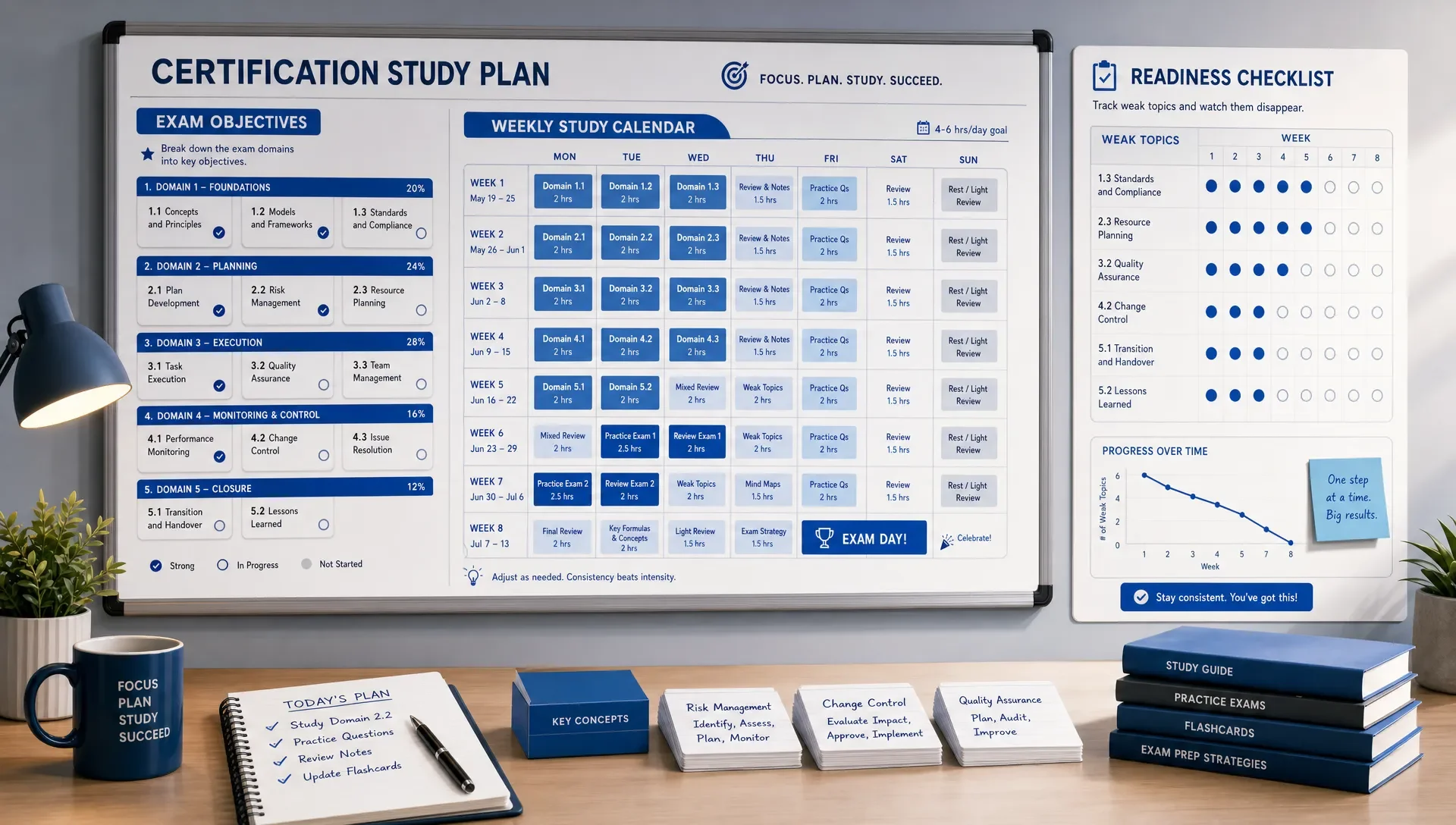
Certification Examination Prep Without Last-Minute Cramming
Certification Examination Prep Without Last-Minute Cramming
If your certification examination is coming up, the solution isn't another 12-hour cram session. Instead, turn the exam objectives into a weekly plan, practice closed-book from day one, review weak topics on a schedule, and use readiness signals before you book or sit the exam.
A no-cram plan works because it makes your memory do the right kind of work repeatedly. Rather than rereading notes until they feel familiar, you'll practice retrieving answers, explaining why choices are correct or incorrect, spacing reviews over days, and steadily reducing weak areas long before exam week.
What Last-Minute Cramming Gets Wrong in Certification Examination Prep
Cramming helps you recognize terms for a short time, but certification exams typically test more than just recognition. You might need to choose the best service for a scenario, troubleshoot a network symptom, prioritize a project management response, or identify a security control from partial information.
That kind of performance depends on retrieval, discrimination, and application. You don't just need to know a definition. You need to understand when it applies, when it doesn't, and what clue in the question points you there.
Research on learning supports this approach. In a well-known review, Dunlosky and colleagues rated practice testing and distributed practice as high-utility learning techniques because they consistently improve learning across many conditions. You can read the review in Psychological Science in the Public Interest. The practical takeaway is simple: test yourself often and spread learning across time.
Cramming usually fails for four reasons:
- It creates familiarity without reliable recall.
- It leaves too little time to repair weak foundations.
- It overloads working memory right before the exam.
- It makes you mistake "I saw this yesterday" for "I can solve this under pressure."
A better plan doesn't demand perfect discipline. It requires a repeatable weekly system.
Start With the Official Exam Objectives
The exam blueprint is your map. Before you buy another book, watch another video, or open another practice test, download the official objectives and turn them into a tracking checklist.
For cloud and IT exams, vendors typically publish detailed domains, task statements, or skills measured. For example, AWS publishes certification exam guides on the AWS Certification exam pages, Microsoft lists skills measured in Microsoft Learn certification pages, and CompTIA publishes exam objectives through its certification pages. These documents should determine what you study, not the order of chapters in a random resource.
Use the objectives to label every study session. If you're preparing for AWS fundamentals, an objective might become "billing and pricing models" or "shared responsibility model." If you're preparing for Security+, an objective might become "authentication factors" or "incident response process."
| Planning step | What to do | Output you should have |
|---|---|---|
| Download the objectives | Get the current official blueprint for your exam | A complete list of domains and subtopics |
| Mark confidence | Rate each subtopic as strong, medium, or weak | A first-pass priority list |
| Map resources | Match study guide sections, labs, notes, and questions to objectives | No orphan study sessions |
| Schedule review | Assign weak objectives to specific days | A calendar that prevents cramming |
| Track readiness | Re-test by topic after review | Evidence that weak areas are improving |
If you're studying for a specific path, MindMesh Academy's objective-based guides can make this easier. For example, the AZ-900 Microsoft Azure Fundamentals study guide is organized to help you connect study time to the skills measured instead of bouncing between disconnected notes.
Replace Cramming With a Weekly Study Rhythm
A strong weekly rhythm has three parts: new learning, active recall, and review. Most learners overinvest in the first part and underinvest in the other two.
Here's a practical weekly structure that works for busy candidates:
| Day | Main focus | Time target | What counts as done |
|---|---|---|---|
| Monday | Learn one small objective group | 45-75 minutes | Notes reduced to key ideas and examples |
| Tuesday | Closed-book recall and flashcards | 30-45 minutes | You can explain the topic without looking |
| Wednesday | Practice questions for that objective | 45-60 minutes | Missed questions reviewed with explanations |
| Thursday | Learn the next objective group | 45-75 minutes | New topic added to your tracking sheet |
| Friday | Mixed review of older topics | 30-45 minutes | Flashcards and short questions across domains |
| Saturday | Timed practice block | 60-90 minutes | Results logged by topic, not just score |
| Sunday | Light review or rest | 20-30 minutes | Only weak cards, missed concepts, or recovery |
This schedule matters because spacing gives your brain time to forget a little, then retrieve again. That retrieval effort is part of the learning. Cepeda and colleagues reviewed distributed practice research and found that spacing learning over time benefits long-term retention. The review is available through Psychological Bulletin.
You don't need to study every day, but you do need repeated contact with the material. Three focused sessions per week can beat one exhausting weekend session because the reviews happen at the right intervals.
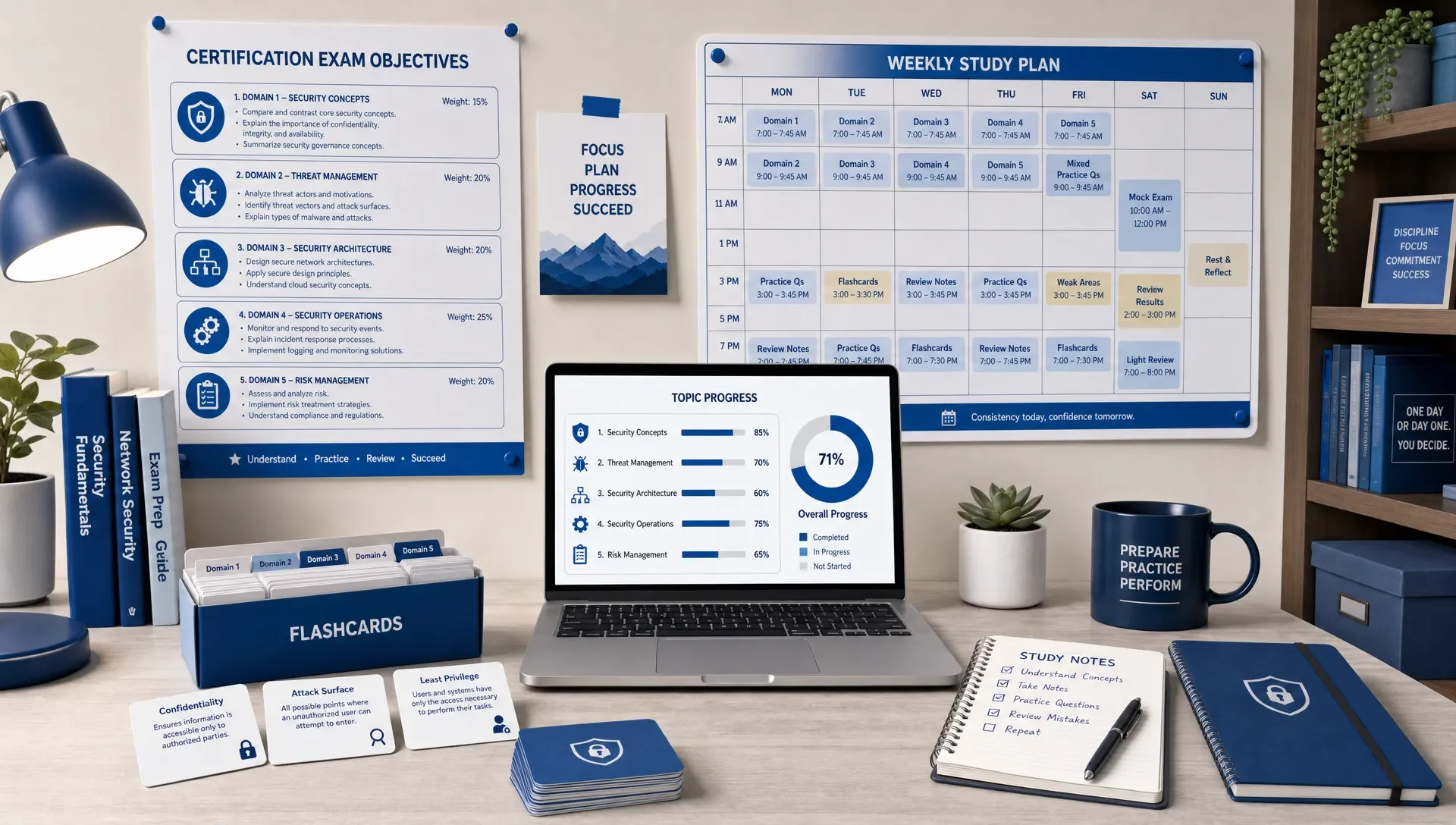
Use a No-Cram Study Cycle for Every Objective
Instead of asking, "How many chapters did I finish?" ask, "Can I retrieve and apply this objective under exam conditions?" That question changes how you study.
Use this four-part cycle for every domain:
| Study cycle stage | What you do | Why it prevents cramming |
|---|---|---|
| Learn | Read or watch enough to understand the concept | Builds the foundation without overloading one session |
| Recall | Close the resource and explain the idea from memory | Reveals gaps while there's still time to fix them |
| Apply | Answer scenario-based or objective-specific questions | Trains decision-making, not just definitions |
| Re-test | Return to the same objective days later with new questions | Confirms retention beyond short-term familiarity |
The key is to make the recall step non-negotiable. After studying a topic, close your notes and write a short explanation in plain English. If you can't explain the topic without looking, you haven't finished learning it yet.
For technical certifications, add examples. Don't just define identity and access management. Explain how a user, group, role, permission, and policy interact in a realistic setup. Don't just define a subnet. Explain what changes when a host can't reach another network.
For project management certifications, don't just memorize terms. Explain what the project manager should do next, who should be engaged, and why one answer is more appropriate than another.
Use Practice Questions as Diagnostics, Not Score Chasers
Practice questions are most useful when they show you what to study next. They are least useful when you burn through hundreds of items, memorize the wording, and celebrate a score that doesn't reflect true readiness.
Start practice early, but keep it targeted. After learning a small objective group, answer a short set of questions before moving on. Review every missed question and every lucky guess. Your review should answer three questions:
- What clue in the question did I miss?
- What concept did I misunderstand or forget?
- What will I do differently when I see this pattern again?
If you want a deeper method for turning practice into memory work, MindMesh Academy's guide to practice examination habits that improve recall pairs well with this no-cram approach.
A simple practice review log can be enough:
| Result pattern | What it usually means | Best next action |
|---|---|---|
| Correct with confidence | The concept is likely stable | Revisit later in mixed practice |
| Correct but guessed | Recognition is ahead of understanding | Review explanation and create a flashcard |
| Wrong due to wording | You missed a constraint or keyword | Practice slower question parsing |
| Wrong due to concept gap | The underlying objective is weak | Return to the study guide section |
| Wrong due to two close options | You need better discrimination | Compare the two concepts side by side |
For example, if you're preparing for Security+, don't treat "access control" as one big topic. Break missed questions into smaller patterns: authentication, authorization, account management, physical controls, identity federation, or privileged access. That tells you where to spend the next session.
If you're ready to test your weak spots in a structured way, the CompTIA Security+ practice exam can help you practice with explanations and topic tracking instead of relying on raw score alone.
Use Flashcards for the Right Kind of Knowledge
Flashcards are powerful, but they aren't magic. They work best for information you need to retrieve quickly: ports, formulas, definitions, command options, service limits, acronym meanings, process steps, and comparison points.
They are weaker for complex scenario judgment unless you write them carefully. A bad card asks, "What is multi-factor authentication?" A better card asks, "A user logs in with a password and a fingerprint. How many authentication factors are used, and why?"
Good certification flashcards usually follow these rules:
- One idea per card.
- Plain language, not copied textbook sentences.
- A prompt that forces recall, not recognition.
- A short answer with one useful example.
- A review schedule that brings cards back before you forget completely.
Spaced repetition helps you avoid the classic exam-week pileup. Instead of reviewing every fact the night before, you let difficult cards appear more often and stable cards appear less often. MindMesh Academy includes flashcards with spaced repetition as part of its connected study workflow, which is especially useful when you're juggling multiple domains.
How Many Study Hours Do You Need Per Week
There isn't one correct number of study hours because background matters. A help desk technician preparing for Network+ has a different starting point than someone new to IT. A cloud engineer preparing for an associate cloud exam has a different path than a project coordinator preparing for PMP.
Use these ranges as planning heuristics, then adjust based on diagnostic results:
| Certification level | Typical weekly target | Common timeline | Best focus |
|---|---|---|---|
| Fundamentals or entry-level | 4-6 hours | 4-6 weeks | Vocabulary, core concepts, basic scenarios |
| Associate or core professional | 6-8 hours | 6-10 weeks | Applied questions, domain comparisons, troubleshooting |
| Advanced or broad-scope | 8-12 hours | 10-16 weeks | Mixed scenarios, weak-domain repair, endurance |
The goal isn't to accumulate hours. The goal is to accumulate correct retrieval attempts, reviewed mistakes, and improved topic mastery.
If your schedule is tight, don't wait for long open blocks. Use shorter sessions with a clear job. A 25-minute flashcard review, a 30-minute weak-topic drill, or a 15-question practice set can move you forward. If most of your prep happens after work, this guide on study help for busy people preparing after work offers useful ways to protect consistency when energy is low.
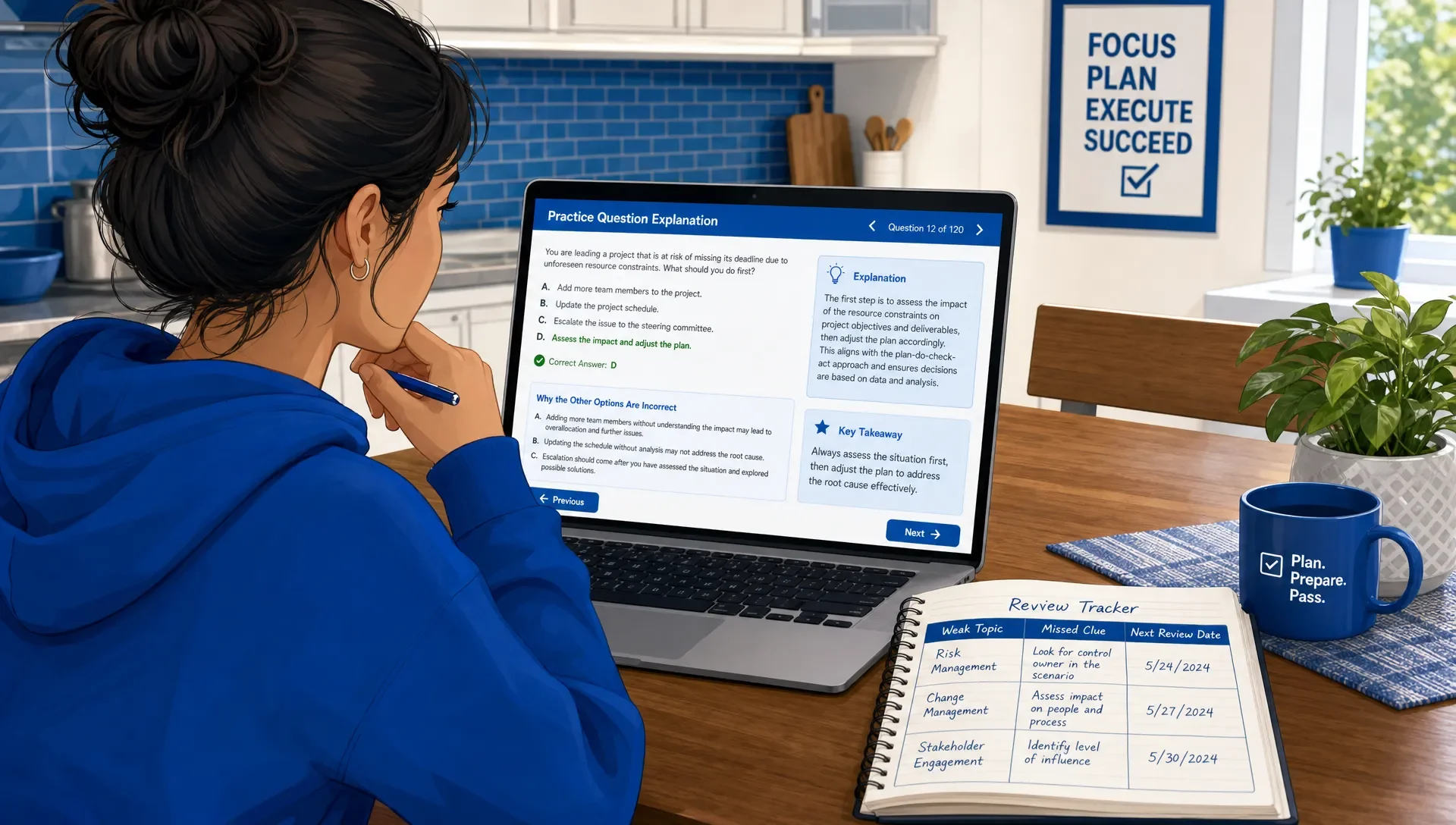
Build a Final Two-Week Review Plan Without Cramming
The last two weeks should not be your first serious study period. They should be a controlled review phase where you sharpen timing, repair weak topics, and protect sleep.
Here's a realistic final review structure:
| Time before exam | What to focus on | What to avoid |
|---|---|---|
| 14-10 days | Full diagnostic or larger timed practice block | Ignoring explanations after scoring |
| 9-7 days | Repair the lowest-scoring objectives | Starting brand-new resources from scratch |
| 6-4 days | Mixed practice across all domains | Practicing only your favorite topics |
| 3-2 days | Light review of notes, flashcards, and missed patterns | Taking repeated full tests out of panic |
| 1 day | Logistics, light recall, rest | Late-night cramming or new heavy topics |
During this phase, review explanations more than scores. A score tells you what happened. An explanation tells you what to change.
Also practice exam pacing. If your exam includes performance-based questions, case studies, drag-and-drop items, or long scenarios, you need a timing strategy. Decide when to flag and move on. Decide how long you'll spend on a complex item before returning later. This prevents one hard question from stealing time from five manageable ones.
Know When You're Ready for the Certification Examination
Readiness isn't a feeling. In fact, many candidates feel least confident right before the exam because they finally understand the size of the material. That's normal. Use evidence instead.
You are getting close when these signals are true:
- Your practice scores are stable across mixed topics, not just repeated sets.
- You can explain missed questions without rereading an entire chapter.
- Weak domains are improving after targeted review.
- You can finish timed practice without rushing the final section.
- You understand why wrong answers are wrong.
- Your flashcard misses are concentrated in a small, manageable set.
If you're preparing for a broad exam like PMP, stable performance across domains matters more than a single good score. The Project Management Professional practice exam can support that kind of readiness check by giving you structured practice and explanations.
For cloud exams, readiness often shows up as better scenario discrimination. You stop asking, "Have I seen this service before?" and start asking, "Which service best fits these constraints?" That's the difference between memorized facts and exam-ready understanding.
Common No-Cram Prep Mistakes to Fix Early
Even motivated learners fall into patterns that create last-minute pressure. The earlier you spot them, the easier they are to fix.
| Mistake | Why it creates cramming | Better habit |
|---|---|---|
| Studying without the exam objectives | You spend time on low-value material | Track every session to a domain |
| Reading before every practice session | You avoid retrieval difficulty | Answer closed-book first, then review |
| Taking full practice exams too early and too often | You drain questions without learning from them | Use short targeted sets during learning |
| Reviewing only wrong answers | You miss lucky guesses | Review guessed answers too |
| Saving flashcards for the final week | Facts pile up at the worst time | Add and review cards daily or every other day |
| Treating the final week as rescue time | Weaknesses become emergencies | Use the final week for refinement |
The fix is usually smaller than people think. You don't need to overhaul your life. You need to stop letting study sessions end without proof of recall.
How MindMesh Academy Supports No-Cram Certification Prep
A no-cram plan works best when your resources are connected. If your study guide, practice questions, flashcards, and progress tracking all live in separate places, it's easy to lose the thread.
MindMesh Academy is built for certification learners who want structured preparation instead of last-minute guessing. You can work through study guides by exam objective, answer practice questions with explanations, review flashcards with spaced repetition, and use adaptive weakness-based practice to focus on topics that need more work.
The value is not just having more material. It's having a workflow that keeps asking the right question: "What should I study next based on my current readiness?" With mastery and readiness tracking, topic progress, performance-based question formats, and expert-reviewed content across 30+ certification paths, you can make preparation more measurable and less frantic.
Frequently Asked Questions About Certification Examination Prep
How early should I start certification examination prep? Start as soon as you can study consistently, but a practical window is often 4-10 weeks for fundamentals or associate-level exams and longer for advanced certifications. Use a diagnostic first so your timeline reflects your starting point.
Is cramming ever useful before a certification exam? A short final review can help refresh facts, but cramming should not be your main learning strategy. Use the last day for light recall, logistics, and rest instead of trying to learn entire domains from scratch.
Should I take practice exams before I finish studying all topics? Yes, but use short, targeted sets early. Save full timed exams for later readiness checks. Early practice helps you discover weak areas while you still have time to fix them.
What should I do if my exam is only two weeks away? Prioritize the official objectives, take a diagnostic, study the weakest high-weight domains first, and review every missed question carefully. Don't try to use every resource. Choose a focused workflow and repeat it daily.
How do I know whether I'm memorizing practice questions? If your score drops when wording changes or when topics are mixed, you're probably memorizing. To fix it, explain the concept behind each answer and practice new questions by objective.
Are flashcards enough to pass a certification exam? Flashcards help with recall, but they aren't enough for most exams. Combine them with scenario practice, explanations, timed sets, and objective-based review.
Build a Prep Plan That Doesn't Depend on Panic
Last-minute cramming can feel productive, but certification success usually comes from steady, deliberate effort: covering objectives, reviewing questions, repairing weak topics, and strengthening recall over time.
If you're ready to build a more connected and effective study plan, MindMesh Academy can help. Choose your certification path to study by exam objective, get practice questions with detailed explanations, and track your readiness before exam day. For example, test your Azure Fundamentals knowledge with our AZ-900 practice exam to see how prepared you are.

Written by
Alvin Varughese
Founder, MindMesh Academy
Alvin Varughese is the founder of MindMesh Academy and an enterprise architecture leader. An electrical engineer by training, he moved from factory automation in South Africa to cloud architecture at GE Appliances and Humana (Fortune 50), and holds 20 professional certifications including AWS Solutions Architect Professional, Azure DevOps Engineer Expert, and Microsoft Agentic AI Business Solutions Architect. He built MindMesh Academy after interviewing too many highly certified candidates who couldn't answer basic questions: the goal is prep that makes you better at the job, not just able to pass the exam.