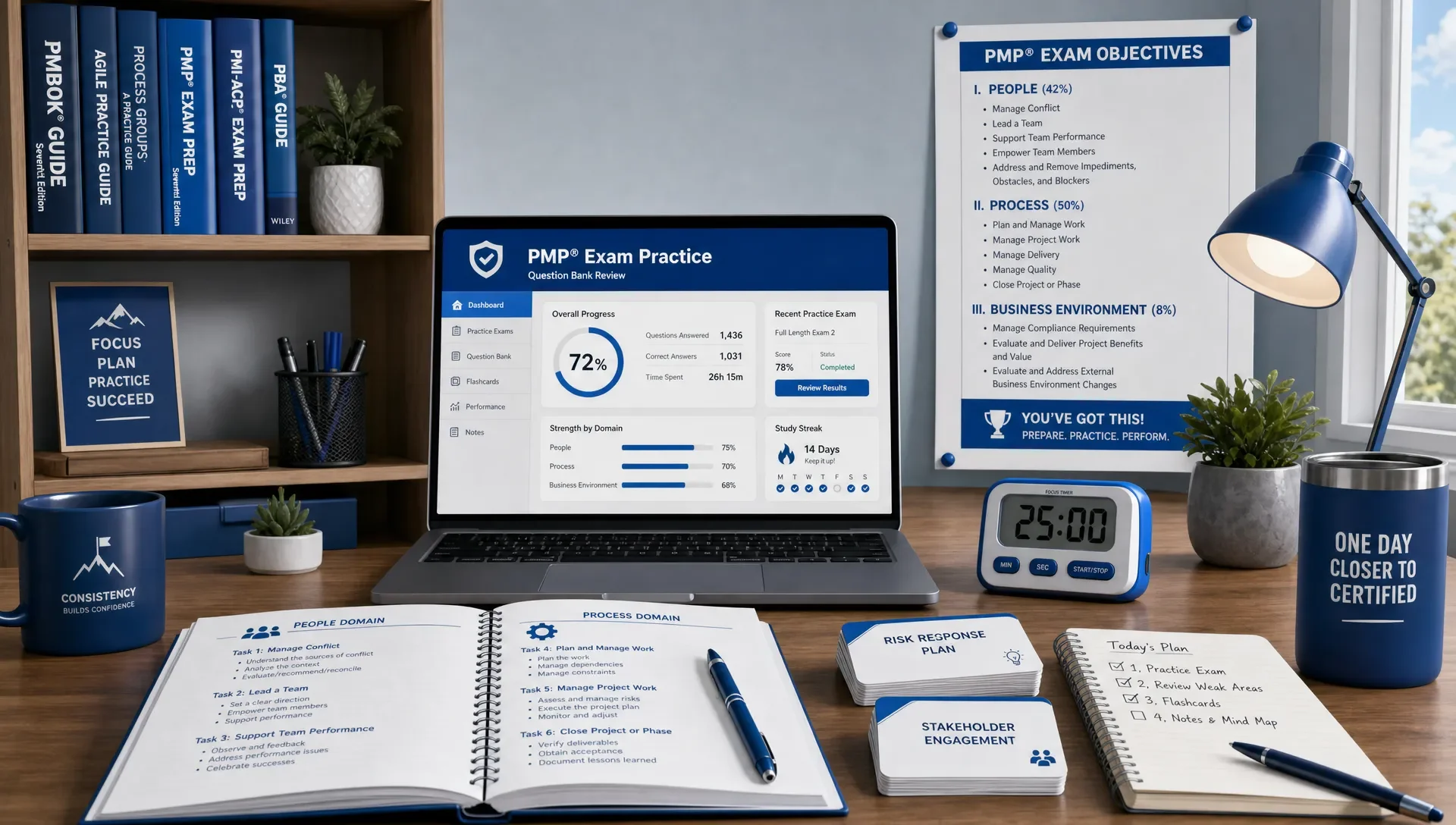
Exam Question Bank Rules for Smarter Practice
Exam Question Bank Rules for Smarter Practice
An exam question bank is most useful when you treat every question as a measurement, not a shortcut. Start closed-book. Record why you chose your answer. Review every option. And delay retakes until you can explain the concept without seeing the prompt again.
If you're preparing for AWS, Azure, CompTIA, Cisco, PMI, or another certification, your goal isn't just to see as many questions as possible. Your real goal is to find weak objectives early, repair the reasoning behind each miss, and prove your readiness under timed conditions before exam day.
Why Question Bank Rules Improve Practice
Rules matter because practice questions can create false confidence. If you repeat items too soon, remember answer patterns, or peek at notes, your score might climb without your actual skill improving. That feels productive, but it won't hold up against a new scenario on the real exam.
Retrieval practice does help, but only when you use it correctly. In a classic study, Roediger and Karpicke found that testing improved long-term retention more than repeated studying, even when learners felt less fluent during practice. Used well, an exam question bank transforms that retrieval effort into focused certification preparation.
Set a Clear Purpose Before Each Practice Session
Don't just open a question bank and start clicking. Decide whether your session is diagnostic, repair-focused, or readiness-focused. Each purpose changes how many questions you answer, how you time yourself, and how strict you are with your review.
A diagnostic session helps you find weak topics. A repair session helps you rebuild understanding for one specific objective. A readiness session tests whether you can perform without hints, notes, or immediate feedback. Mixing these modes in the same session makes your data unreliable.
| Practice purpose | Best question set | Timing | What to track |
|---|---|---|---|
| Diagnostic | Mixed by exam domain | Light timing | Missed objectives and confidence |
| Repair | One weak objective | Untimed or lightly timed | Reasoning errors and notes to review |
| Readiness | Full mixed set | Exam-like timing | Score, pacing, and fatigue |
Protect Your First Attempt Data
Your first attempt offers the cleanest signal you'll get. Answer without notes, web searches, flashcards, or hints. If you don't know an answer, make the best choice you can and mark your confidence before checking the correct solution.
Treat your question bank session like a mini lab: question, answer, confidence, review, repair. If you change your answer after seeing a clue in the explanation, record your original choice. Otherwise, you'll lose the evidence you need to fix the actual problem.
A simple confidence scale is usually enough. Use high, medium, and low. A high-confidence miss is more serious than a low-confidence miss because it means your mental model is wrong, not just incomplete.
Review Every Answer Choice Before Moving On
Many learners only read the explanation for the correct option. That's a shallow approach. Certification questions often test close distinctions, such as "most secure," "least operational overhead," "best first step," or "most cost-effective." You need to understand why the distractors are incorrect.
For every question you review, write one short note that captures the rule you missed. Keep it concrete. "Use security groups for instance-level traffic control" is far better than a vague "Review AWS networking."
If you're looking for a deeper review routine, MindMesh Academy has a guide on how to review practice exam questions more carefully without just passively rereading explanations.
Map Weak Questions to Exam Objectives
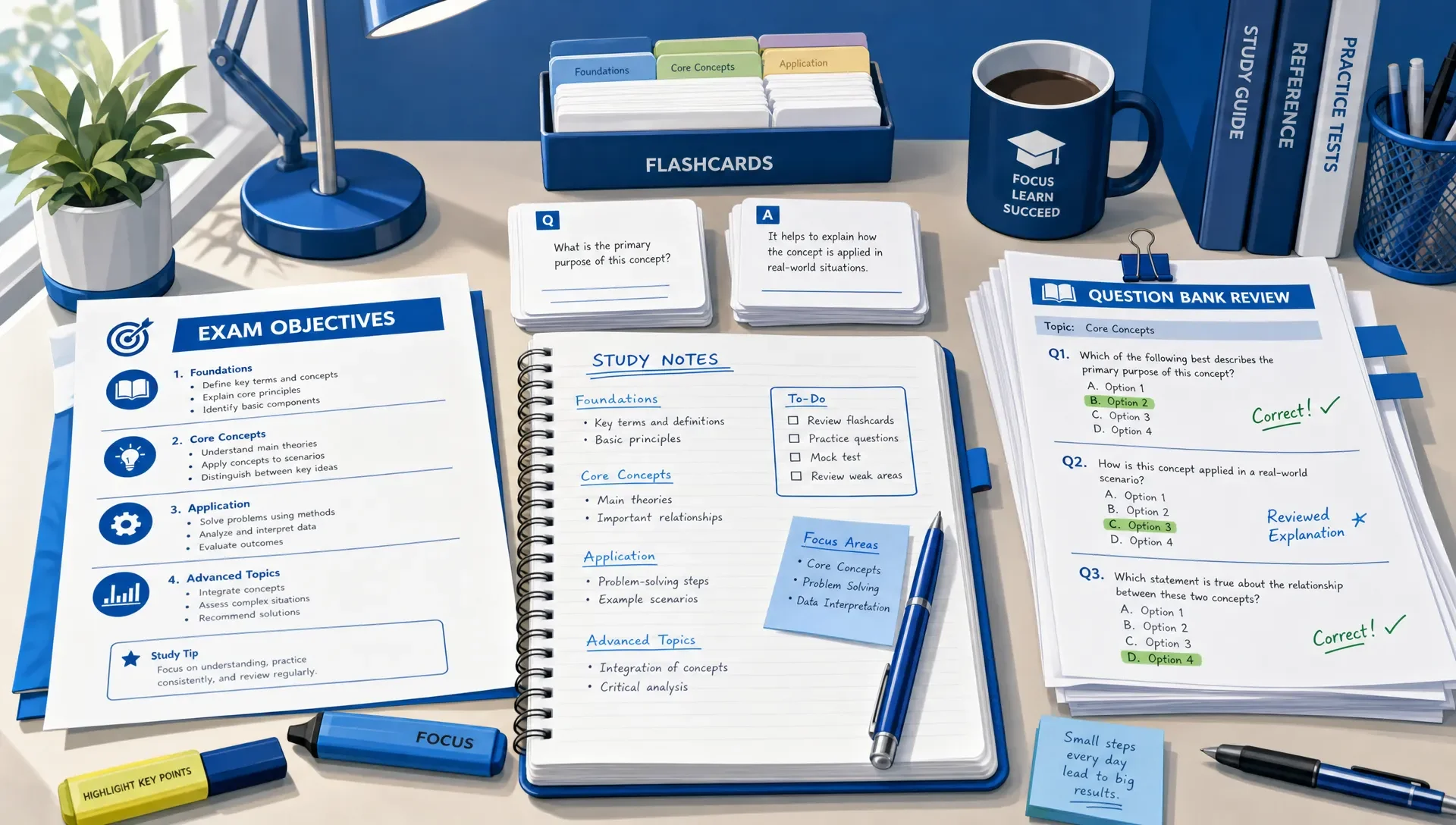
Overall scores are less useful than objective-level patterns. If you miss four questions related to identity and access, that tells you exactly where to study next. If you only record an overall score, you might just repeat random practice and hope the weak area resolves itself.
Your exam question bank results should always map back to the official exam objectives. Vendors publish exam guides or skill outlines, like the AWS Certified Cloud Practitioner exam information. Use these domains as your study roadmap.
For example, if you're preparing for cloud fundamentals, combine objective-based review with an AZ-900 Microsoft Azure Fundamentals study guide. If you're focusing on security topics, a CompTIA Security+ practice exam can help you test whether those concepts hold up in scenario questions.
Separate Question-Bank Practice from Full Practice Exams
Question banks and full practice exams are distinct tools. A bank works best for repetition, targeted repair, and ensuring objective coverage. A full practice exam is ideal for testing readiness, timing, and endurance.
A practice exam and an exam question bank should complement each other, not replace one another. If you only use banks, you might never experience the fatigue and pacing pressure of a full exam. If you only take full exams, you'll waste time retesting topics you already know well.
| Tool | Use it when | Avoid using it for |
|---|---|---|
| Question bank | Finding weak objectives and drilling concepts | Final readiness proof by itself |
| Full practice exam | Testing pacing, stamina, and score stability | Learning a topic from scratch |
| Flashcards | Reinforcing facts, commands, and definitions | Replacing scenario-based reasoning |
| Study guide | Building conceptual understanding before practice | Proving exam readiness alone |
For a more detailed breakdown, compare the roles in test bank vs. practice exam before planning your final review week.
Delay Retakes to Prevent Memorizing Answers
Retaking missed questions immediately feels efficient, but it often tests recognition, not true recall. You might remember the answer's location, wording, or a distractor pattern instead of the underlying concept.
Retaking a question bank item works better after a delay. For a minor mistake, wait at least a day. For a concept gap, study the topic, answer new questions in that objective, and then return to the missed item later. Distributed practice has strong support in learning research; Dunlosky and colleagues rated practice testing and distributed practice as high-utility learning techniques.
Use this retake timing as a starting point:
| Miss type | What it means | When to retake |
|---|---|---|
| Careless read | You knew the concept but missed a crucial clue | Next day |
| Concept gap | You didn't know the rule or process | After targeted study |
| High-confidence miss | You were sure, but wrong | After rewriting the concept in your own words |
| Repeated miss | The same objective consistently causes errors | After a mixed set on related topics |
Track Confidence, Pacing, and Explanation Quality
A score alone won't tell you if you're truly ready. You need to know whether your correct answers came from solid reasoning or lucky elimination. You also need to know if you can answer questions fast enough without rushing through the last third of the exam.
If a question bank provides explanations, don't just mark right or wrong. Track whether you can explain the correct answer in one or two sentences without copying the provided text. If you can't, that question still offers study value.
Useful tracking fields include:
- Objective or domain
- Correct or incorrect
- Confidence before review
- Reason for the miss
- Time spent on the question
- One-sentence takeaway
MindMesh Academy's study workflow is designed for this kind of preparation: study guides organized by exam objectives, practice questions with explanations, flashcards with spaced repetition, adaptive weakness-based practice, and readiness tracking.
Use Performance-Based Questions Differently
Performance-based questions demand more than simple recognition. You might need to configure, order, match, or troubleshoot steps. Treat these as reasoning drills, not just quick score boosters.
Read the task first. Identify the required outcome. Ignore extra details until you know exactly what the scenario is asking. Then, solve from the objective, not by recalling a similar item from memory. If you're working toward networking certification, a CCNA practice exam can help you practice scenario discipline across routing, switching, security, and troubleshooting topics.
After each performance-based item, review the sequence you used. A wrong final answer can often stem from one bad assumption made early in the process. Your review should pinpoint where your path broke down.
Build a Weekly Practice Rhythm
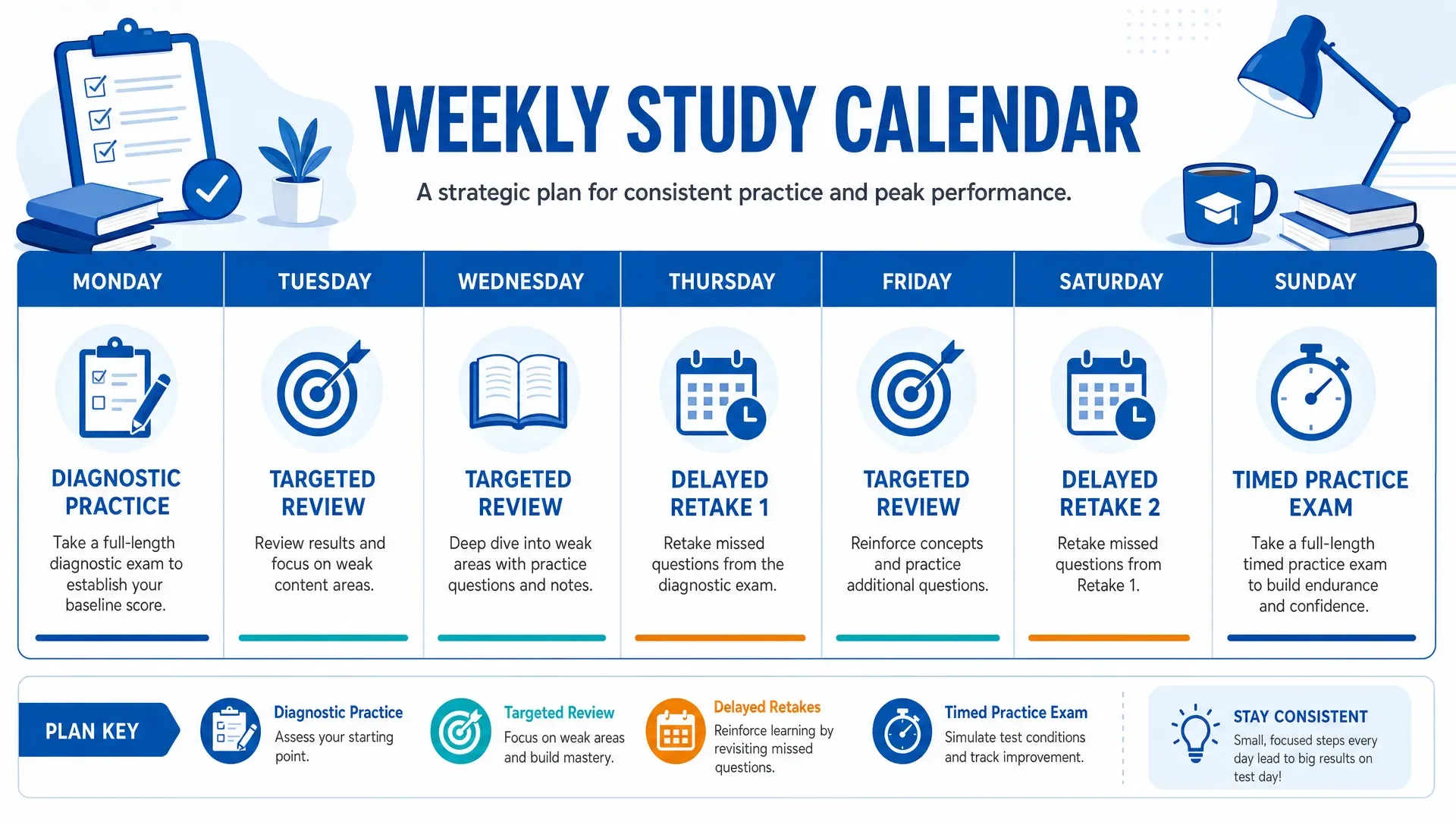
A smarter rhythm keeps practice varied without making it random. Start the week with mixed questions, spend the middle repairing weak objectives, and finish with a timed set or a full practice exam.
Here's a simple weekly pattern for most certification learners:
| Day | Main task | Output |
|---|---|---|
| Monday | Mixed diagnostic set | Weak objective list |
| Tuesday | Study the weakest objective | Notes and flashcards |
| Wednesday | Targeted question set | Updated miss log |
| Thursday | Delayed retakes | Confirmed repairs |
| Friday | Mixed timed set | Pacing and readiness data |
| Weekend | Longer review or practice exam | Final plan for the next week |
This schedule works because it provides your brain with time between attempts. It also helps prevent the common habit of practicing only your favorite topics.
Common Question-Bank Mistakes to Avoid
The biggest mistake is chasing volume. Answering 500 questions with shallow review is usually less effective than answering 150 questions with careful explanations, objective mapping, and delayed retakes.
Another mistake is stopping review after a correct answer. A correct answer with low confidence still needs work. Getting an answer right by elimination might be acceptable on exam day, but during study, it should prompt a review of the options you couldn't confidently rule out.
Also, avoid practicing in the same order every time. Shuffle items, mix domains after targeted study, and include new questions often enough to test transfer. The real exam won't present topics in the exact order your notes do.
Frequently Asked Questions
How often should I use an exam question bank? Use it several times per week, but vary its purpose. Mix diagnostic sets, targeted repair sessions, and timed readiness sets instead of doing the same style of practice every day.
Should I read explanations after questions I got right? Yes. A correct answer can still hide weak reasoning. Review the explanation and the distractors, especially when your confidence was low or you guessed between two options.
How many questions should I answer in one session? For learning sessions, 15 to 30 well-reviewed questions can be enough. For readiness sessions, use longer timed sets that simulate the pressure and pacing of your certification exam.
When should I take a full practice exam instead of using a bank? Take a full practice exam when you need to test timing, stamina, and overall readiness. Use question banks before that point to find and repair weak objectives.
What should I do if my scores stop improving? Stop adding volume for a few sessions. Review your miss log, identify repeated weak objectives, study those topics directly, and return to mixed practice after you can explain the rules in your own words.
Practice with Better Feedback, Not Just More Questions
Smarter certification preparation follows a simple loop: study the objective, answer closed-book, review your reasoning, repair any weaknesses, and retest after a delay. This loop keeps your practice honest and helps you build understanding that truly transfers to unfamiliar exam scenarios.
MindMesh Academy supports this workflow with structured study guides, practice questions with detailed explanations, and robust readiness tracking features. If you're ready to make your next study session produce useful data and help you identify exactly what to fix next, test your knowledge with an AZ-900 Microsoft Azure Fundamentals practice exam.

Written by
Alvin Varughese
Founder, MindMesh Academy
Alvin Varughese is the founder of MindMesh Academy and an enterprise architecture leader. An electrical engineer by training, he moved from factory automation in South Africa to cloud architecture at GE Appliances and Humana (Fortune 50), and holds 20 professional certifications including AWS Solutions Architect Professional, Azure DevOps Engineer Expert, and Microsoft Agentic AI Business Solutions Architect. He built MindMesh Academy after interviewing too many highly certified candidates who couldn't answer basic questions: the goal is prep that makes you better at the job, not just able to pass the exam.