How to Judge Study Material Before You Trust It
How to Judge Study Material Before You Trust It
Before you commit to a study plan, evaluate your resources. Good study material aligns with the official exam blueprint, provides clear explanations, and helps you pinpoint your weak areas. If a resource doesn't show which exam objective a question maps to, why the correct answer is right, and why the incorrect options are wrong, it's probably not ready for prime time.
A quick first check takes about 15 minutes. Open the official exam objectives. Then, sample 10 to 15 pages or practice questions from your material. Check its update date. Finally, ask yourself: does this material force me to retrieve knowledge, or does it just let me passively reread? Effective certification prep helps you understand, practice, correct mistakes, and measure your actual readiness.
Start With the Official Exam Objectives
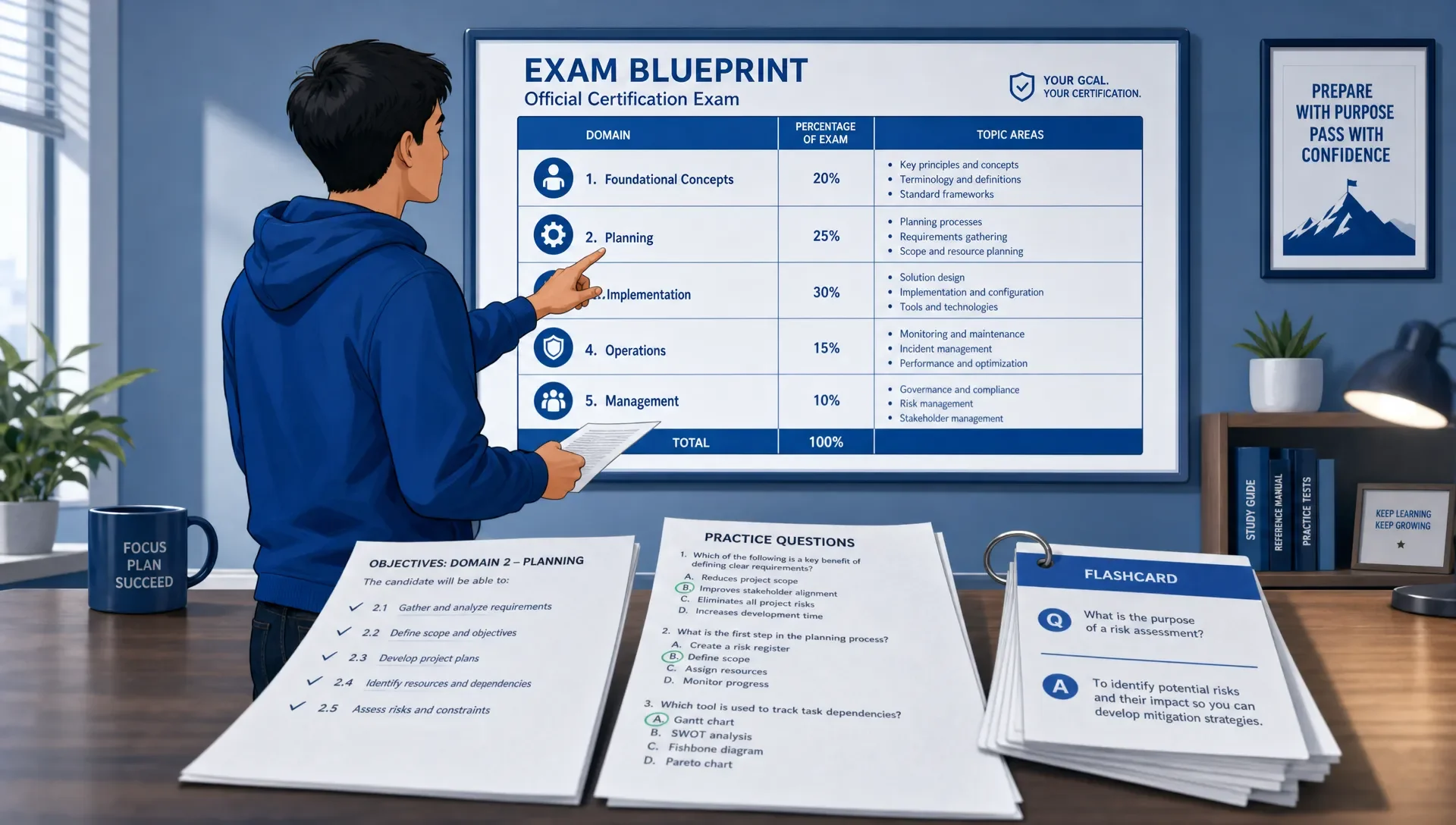
The most effective study material is built directly from the official exam objectives, not on an author's favorite topics. Certification exams follow a blueprint. Your first question for any resource should be: does it clearly map its lessons, questions, and review items to the domains tested by the vendor?
For instance, AWS publishes official certification pages like the AWS Certified Cloud Practitioner exam page. Microsoft offers exam-specific pages, such as the AZ-900 study guide. CompTIA also provides exam objectives for its certifications. These official documents are your authoritative source.
If a resource claims to cover Security+, PMP, AWS, Azure, ITIL, CCNA, or CISSP but doesn't show how its content aligns with these official objectives, you're trusting a black box. This doesn't automatically mean the material is wrong, but it does mean you can't easily tell if you're overstudying easy topics or missing high-value domains entirely.
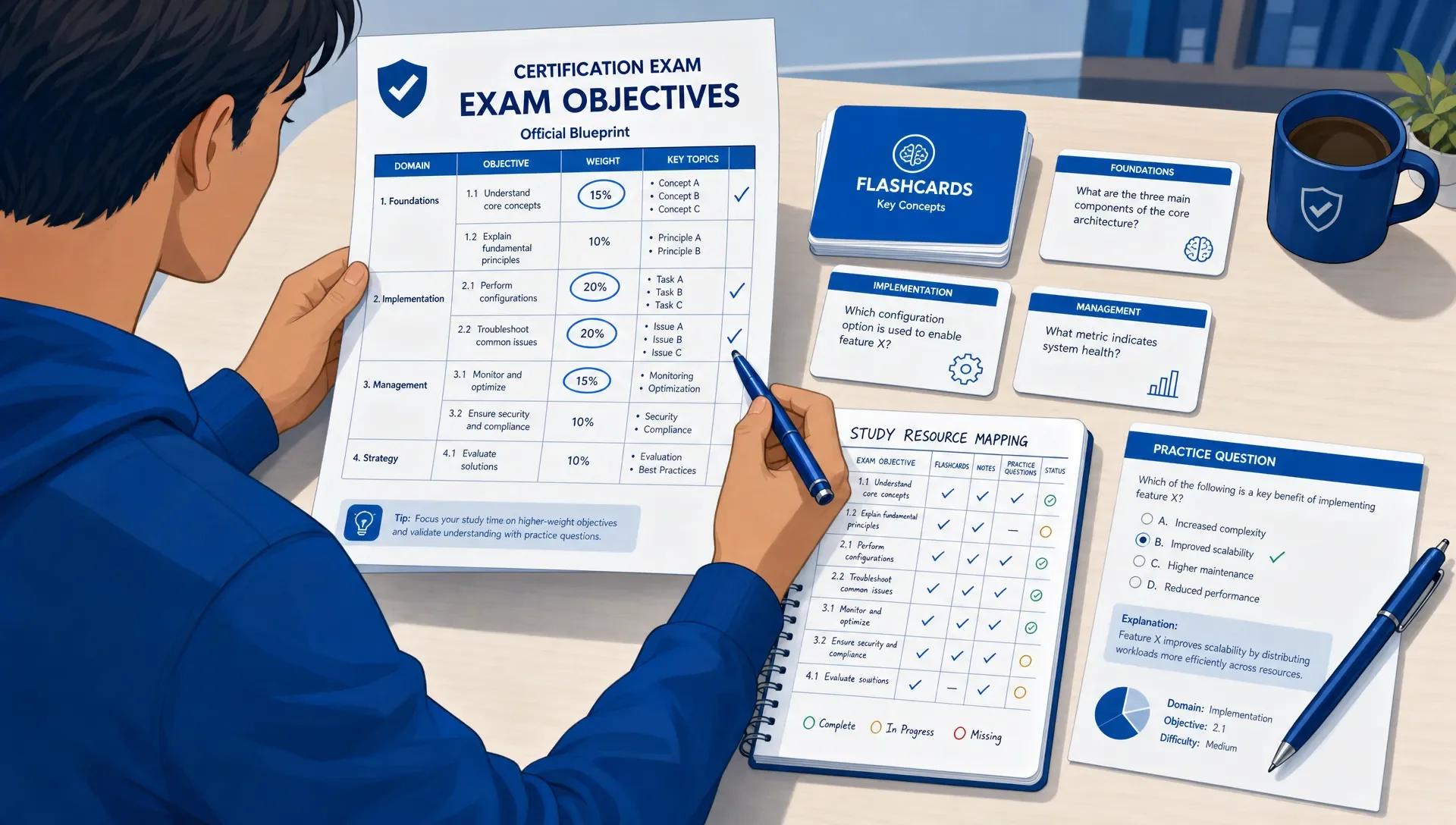
Try this simple test: Choose three objectives from the official blueprint. Then, try to find matching lessons, flashcards, and practice questions in your study material. If you can't locate them quickly, the resource might create more confusion than structure.
Compare Study Material Against Practical Red Flags
You don't need to be an expert to spot weak exam prep resources. What you need is a repeatable evaluation process. The table below provides a practical way to judge study material before you commit weeks of study time to it.
| What to check | Trustworthy signal | Red flag | Quick test |
|---|---|---|---|
| Exam blueprint alignment | Lessons and questions map to objectives | Topics are grouped vaguely or randomly | Pick 3 official objectives and find matching content |
| Explanation quality | Explains correct and incorrect answers | Only gives the right letter or a one-line answer | Review 5 missed questions and look for reasoning |
| Scenario realism | Questions test decisions, tradeoffs, and application | Questions only test definitions | Ask whether the question feels like a workplace problem |
| Update discipline | References current exam versions and services | Mentions outdated tools, services, or retired exams | Check dates and vendor terminology |
| Practice design | Uses active recall, mixed review, and spaced repetition | Relies mainly on passive reading | Look for quizzes, flashcards, and review cycles |
| Integrity | Uses original questions and ethical examples | Claims to provide real exam questions | Avoid anything that sounds like an exam dump |
| Progress visibility | Shows strengths and weak areas by topic | Gives only a total score | Check whether you can see domain-level performance |
A resource doesn't have to be perfect in every single category. But if it fails on blueprint alignment, explanation quality, and integrity, it's likely not worth your time.
Check Whether the Material Teaches Understanding or Memorization
Some study material feels helpful because it provides quick wins. You recognize terms, finish chapters fast, and score well on questions you've seen before. But recognition isn't the same as true readiness for an exam.
A stronger test is whether you can explain the reasoning behind an answer without looking it up. For technical exams, this might mean explaining why one AWS storage service is a better fit for a specific scenario than another, how a security control reduces a particular risk, or why a project management action should happen before communicating with a stakeholder.
Good material should help you answer questions like these:
- What core concept is being tested here?
- What specific detail in the scenario changes the answer?
- Why are the distractors (incorrect options) tempting but ultimately wrong?
- What would make the answer different if the scenario changed slightly?
- Which official exam objective does this question relate to?
This focus matters because effective learning requires active retrieval and consistent feedback, not just passive exposure. A widely cited review by Dunlosky and colleagues in Psychological Science in the Public Interest highlighted practice testing and distributed practice as highly effective learning techniques. Simply put, you remember more when you repeatedly pull knowledge from memory over time and correct your errors.
That's why passive PDFs, hastily copied notes, and long video playlists can feel productive, yet leave you underprepared. They might expose you to information, but they don't always force you to actively use it.
Evaluate Practice Questions Before You Trust the Score
Practice questions are often the easiest part of study material to judge, as weak ones quickly show their flaws. If every question is a basic definition, the actual exam will likely feel much harder. If explanations are shallow, you'll probably repeat the same mistakes. If the question wording is sloppy, you'll learn to second-guess the resource instead of focusing on the concept itself.
A good practice question should test a real decision. It should include enough context to make you choose between plausible options, not just recall a simple term. The explanation should identify the relevant exam objective, outline the reasoning path, and explain the common mistake patterns behind the distractors.
If you're using practice exams, don't just stop at the total score. Review your timing, your confidence level, and the types of errors you made. A 78 percent score built on lucky guesses is far less reliable than a 72 percent score where you can explain every miss and know how to fix the weak domain. For a more detailed review method, MindMesh Academy has a guide on how to review an exam practice test the right way.
When you evaluate a certification platform, sample its questions before committing fully. For example, if you're preparing for cloud fundamentals, a resource like the AWS Certified Cloud Practitioner practice exam should help you practice exam-style reasoning, not just memorize service names. If you're preparing for security, a CompTIA Security+ practice exam should help you identify weak areas across security concepts, threats, architecture, operations, and governance topics.
Look for Feedback Loops, Not Just Content Volume
More content doesn't always translate to better preparation. A 700-page guide can be less useful than a shorter resource that precisely tells you what you know, what you're missing, and what to review next.
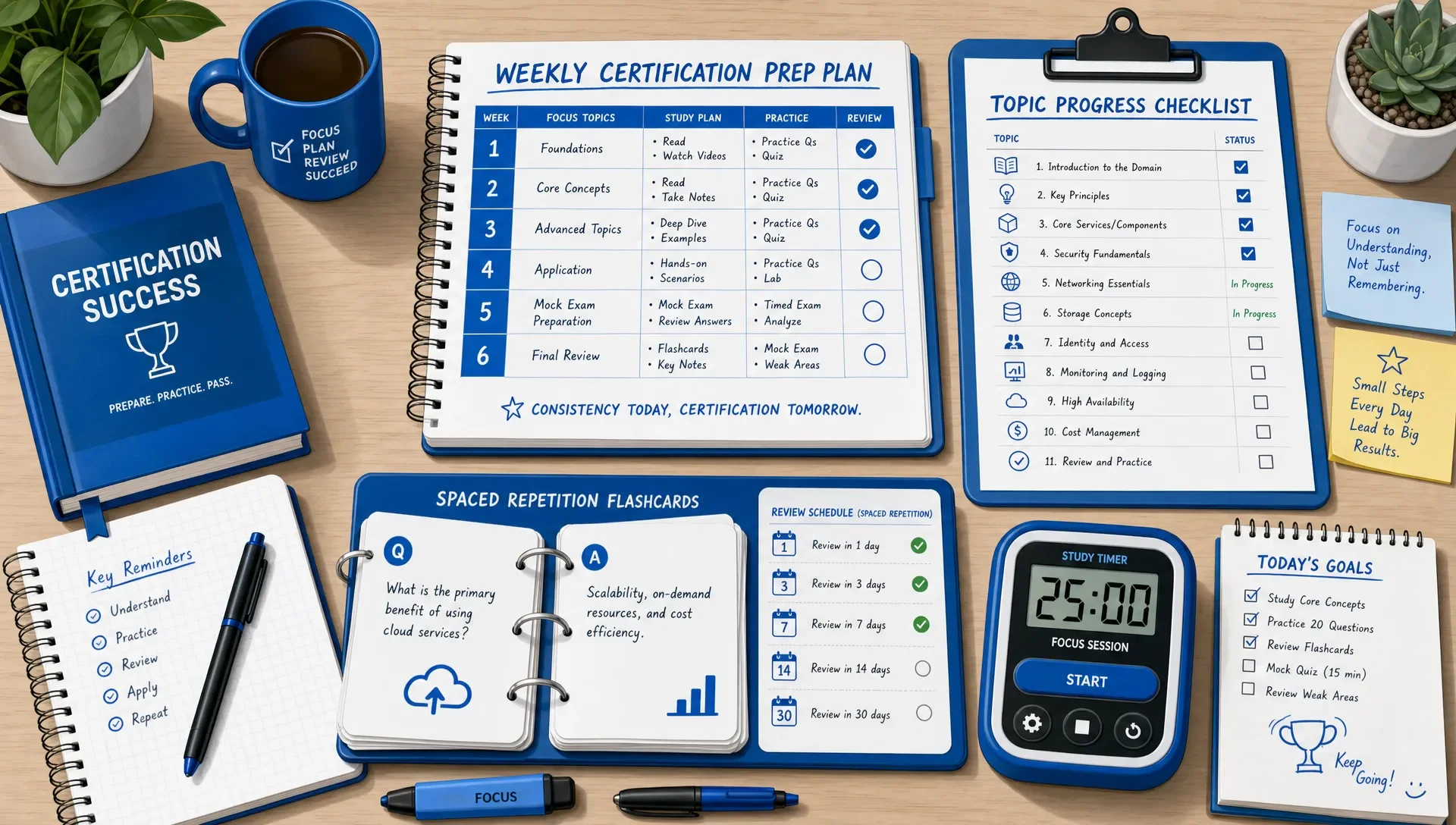
The strongest study material builds a feedback loop. You study an objective, answer questions, review explanations, revisit weak topics, and then retest later. This cycle provides real evidence of your progress. Without it, you're relying on how familiar the material feels, which is an unreliable signal for actual readiness.
This is where features like topic progress, mastery tracking, spaced repetition, and adaptive weakness-based practice become genuinely valuable. They help you spend less time reviewing what you already know and more time correcting specific gaps. MindMesh Academy designs its study workflow around these principles, integrating objective-based study guides, practice questions with explanations, flashcards using spaced repetition, and readiness tracking across various certification paths.
If your learning extends beyond exam prep, apply the same standard. Broader professional learning platforms, such as expert-led upskilling programs with structured learning paths, can be valuable for building workplace skills. Still, you should ask whether each resource has clear outcomes, current content, and a way to measure your progress.
Verify the Author, Review Process, and Update History
Study material can become outdated quickly, especially in cloud, cybersecurity, networking, and IT service management. Services change names, interfaces evolve, best practices shift, and exam outlines get refreshed. You don't need every sentence to be brand new, but you do need evidence that someone actively maintains the material.
Look for signs of a real review process. Does the resource mention expert review? Does it reflect current vendor terminology? Does it avoid retired exam codes? Does it explain changes when exam versions shift? Does it differentiate timeless fundamentals from version-specific details?
Author credentials matter, but they aren't enough on their own. A certified instructor can still produce weak study material if the questions are poorly written or the guide isn't mapped to the current objectives. Treat credentials as one signal, then verify the content itself.
Be especially careful with forum notes, recycled PDFs, and anonymous question banks. They might contain useful fragments, but they often lack context, version control, and accountability. Use them, if at all, as secondary references rather than your primary study system.
Use a Small Pilot Before You Commit
Before fully trusting any study material, run a short pilot program. This prevents you from discovering three weeks into your studies that a guide is too shallow or that the practice questions don't match the actual exam style.
A practical pilot can be simple:
- Study one complete exam objective or subdomain.
- Answer 15 to 25 related practice questions without notes.
- Review every explanation, even for questions you got right.
- Note down the concepts you missed or guessed on.
- Retest the same objective after two or three days.
- Decide whether the resource genuinely helped you understand the topic better.
This pilot tells you more than marketing pages or reviews can. If your second attempt improves because you understand the underlying reasoning, the study material is likely helping. If you only remember the exact question wording, proceed with caution.
The pilot also reveals whether the tone and format work for your learning style. Some learners prefer dense text. Others need question-first practice. Many benefit from flashcards and spaced review. The best resource for you is one that's accurate, objective-aligned, and easy enough to use consistently.
Decide What Role Each Resource Should Play
Not every study resource needs to do everything. A vendor guide might define your scope. A textbook can explain theory. Flashcards might help with terminology. Practice exams can test your readiness. A comprehensive platform can connect all these pieces into a cohesive workflow.
The common mistake is treating every resource as equally authoritative. Instead, assign specific roles.
| Resource type | Best use | What to watch for |
|---|---|---|
| Official exam guide | Scope, domains, task statements, exam policies | Usually not enough for learning by itself |
| Study guide | Structured explanations and concept coverage | Must map clearly to objectives |
| Flashcards | Terminology, commands, formulas, definitions | Weak if used without scenario practice |
| Practice questions | Retrieval, application, timing, error analysis | Must include strong explanations |
| Full practice exam | Readiness check and stamina building | Scores can mislead if questions are poor |
| Notes from peers | Alternative explanations and study tips | May be outdated, incomplete, or incorrect |
This approach prevents you from expecting the wrong things from the right tools. A flashcard deck isn't bad because it doesn't teach architecture tradeoffs. A practice exam isn't bad because it doesn't explain a full chapter. The problem arises when you use a narrow tool as your entire study plan.
Final Checklist Before You Trust Any Study Material
Before you rely on any resource, ensure you can answer "yes" to most of these questions:
- Does it map to the current official exam objectives?
- Does it explain why answers are right and wrong?
- Does it include scenario-based practice, not just definitions?
- Does it help you identify your weak topics?
- Does it use active recall and spaced review?
- Does it avoid claims about providing real exam questions?
- Does it show signs of expert review or maintenance?
- Does it help you make better decisions after each study session?
If a resource passes these checks, it's more likely to build your real readiness. If it fails several of them, don't ignore the warning signs just because it has a polished design or a large question count.
Frequently Asked Questions
How do I know if study material is outdated? Compare it against the current official exam objectives, check whether the exam code or version matches, and look for outdated product names, retired services, or old terminology. For cloud and security exams, even small wording changes can signal that the resource hasn't been maintained.
Are free study materials enough to pass a certification exam? Sometimes, but only if they are accurate, current, objective-aligned, and combined with enough practice. Free resources can be useful for review, but you'll still need strong explanations, practice questions, and a reliable way to track weak areas.
Should I trust practice questions that look exactly like the real exam? Be careful. Ethical practice questions should be original and designed to match the style and objectives of the exam, not claim to reproduce live exam items. If a resource advertises "real exam questions," that's a major red flag.
What is the fastest way to evaluate a new study guide? Pick three official objectives, find the matching lessons, answer a small set of related questions, and review the explanations. If the guide can't effectively connect content, practice, and feedback, it probably shouldn't be your primary resource.
Is a high practice test score enough to prove I'm ready? Not by itself. You also need consistent scores, good timing, strong domain-level performance, and the ability to explain your reasoning. A high score from memorized questions can create false confidence.
How many study resources should I use? Use as few as you can while still covering the exam thoroughly. A reliable setup often includes the official objectives, one structured study guide, flashcards for recall, and quality practice questions. Too many resources can create overlap and decision fatigue.
Build Trust in Your Prep Before Exam Day
You don't pass certification exams by simply collecting more study material. You pass by choosing resources that accurately match the exam, encourage active recall, clearly explain mistakes, and consistently show whether you're improving.
Before your next study session, audit your current materials using the checklist above. Keep what provides you with evidence of learning. Replace what only gives you a sense of familiarity. If you're looking for an exam-prep workflow that connects objective-based study guides, practice questions, flashcards, adaptive review, and readiness tracking, explore the AWS Certified Cloud Practitioner study guide at MindMesh Academy to prepare with a clearer view of what you know and what still needs work.

Written by
Alvin Varughese
Founder, MindMesh Academy
Alvin Varughese is the founder of MindMesh Academy and an enterprise architecture leader. An electrical engineer by training, he moved from factory automation in South Africa to cloud architecture at GE Appliances and Humana (Fortune 50), and holds 20 professional certifications including AWS Solutions Architect Professional, Azure DevOps Engineer Expert, and Microsoft Agentic AI Business Solutions Architect. He built MindMesh Academy after interviewing too many highly certified candidates who couldn't answer basic questions: the goal is prep that makes you better at the job, not just able to pass the exam.