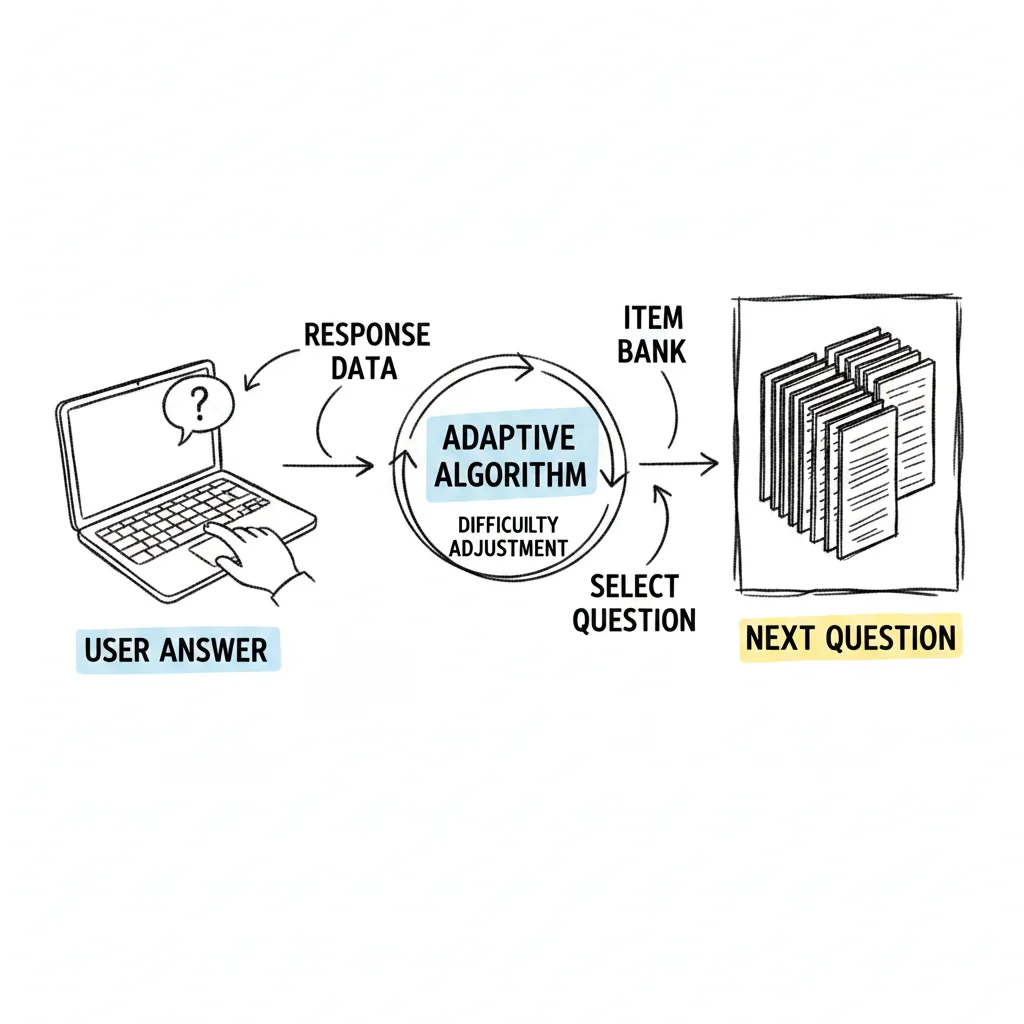
Computer Adaptive Test Online: Your 2026 Prep Guide
Computer Adaptive Tests Online: Understanding and Preparing for Your Certification
You’ve put in the hours. Maybe you’ve been reviewing AWS services after work, drilling PMP process groups on weekends, or rebuilding your networking fundamentals for CompTIA. Then, the exam guide mentions a crucial detail: a computer adaptive test online.
That phrase often makes candidates second-guess themselves.
It’s not because they suddenly forgot the material. It’s because the test format feels opaque. If the test changes as you take it, how do you know where you stand? If others get different questions, how can the score be fair? If the exam gets harder, is that a good sign or a warning?
I’ve seen this reaction across all types of candidates: experienced admins, first-time career changers, and strong learners fully capable of passing. They lose confidence because the test engine feels like a black box. That anxiety is real, and it matters. A smart study plan must include both content mastery and format familiarity.
The Modern Challenge in IT Certification Exams
A common scenario plays out like this:
A candidate performs well in practice. They can explain IAM roles, compare Agile and predictive planning, or work through subnetting with ease. Then they discover the actual exam is adaptive. Suddenly, their focus shifts from the subject matter to the underlying system.
They start asking questions unrelated to cloud, project management, or infrastructure. They ask if every wrong answer makes the next item easier. They ask if easy questions mean they're failing. They ask if they should interpret the difficulty on screen as a signal from the scoring model.
This mental spiral can derail even strong candidates.
Why the adaptive format creates stress
Traditional tests feel familiar. Everyone sees a set list of questions. You can often flag items, review, and return later. An adaptive test removes some of that comfort. It reacts to you in real time, and that reaction isn't fully visible.
Practical rule: If the exam format feels mysterious, your brain will try to invent patterns during the test. Most of these patterns are wrong, and they drain attention from the question in front of you.
This matters for IT certifications because many candidates already carry pressure from work, budget, and career goals. Passing might influence a promotion, a job change, or confidence in a new field. Understanding the test experience, therefore, belongs alongside domain study. This is why many learners first explore broader career context, such as MindMesh Academy's insights on IT certifications, before narrowing down into specific exam strategies.
What candidates often misunderstand
Here are three common misconceptions I frequently hear:
- "If questions get harder, I must be close to failing." Often, the opposite interpretation is true.
- "If everyone sees different questions, fairness is compromised." Well-built adaptive systems are designed to compare ability, not identical item lists.
- "I need to decode the algorithm while I test." You don’t. You need a consistent response process you can trust under pressure.
The good news is that CAT isn't random or designed to trick you. Once you grasp its logic, the format becomes much less intimidating.
What Is a Computer Adaptive Test Online?
A computer adaptive test online is a digital exam that adjusts the next question based on your current performance. Instead of giving every candidate the same fixed sequence, the system uses your responses to choose what comes next.
Think of it like a fitness coach.
If a coach gives you weights that are too light, they increase them. If they're too heavy, they scale back. The goal isn't to punish you; it's to efficiently find your actual strength level. A CAT does the same with questions.
The core idea
Most adaptive tests start with a question of moderate difficulty. After each response, the system updates its estimate of your ability and selects another question that helps it measure you more clearly.
This means the test isn't trying to see if you can answer every question correctly. It's trying to pinpoint the range where the challenge matches your current skill level.
A standard online quiz asks, "How many did you get right?"
A CAT asks, "What level of challenge can you handle consistently?"
For those interested in a broader learning parallel, this is similar to how AI personalizes education, where the system adapts the next step instead of forcing every learner through the same path.
Why providers use adaptive tests
Certification programs use adaptive formats because they can measure ability more directly and efficiently than a one-size-fits-all test. Strong candidates don’t spend long stretches proving they can answer overly basic items. Newer candidates aren't overwhelmed by a block of questions far above their level from the start.
This makes the experience feel more personal, but also more psychologically intense. Since the exam reacts to you, many candidates assume every change in difficulty is a message about their pass status. That's where confusion begins.
The adaptive engine is measuring you. It is not providing live commentary about your pass status.
What distinguishes CAT from a normal online exam
Several practical differences stand out:
- Dynamic question selection: The next item depends on your previous response.
- Individualized path: Two candidates may see different questions but are still measured on the same scale.
- Early precision: The test aims to quickly learn your ability level, rather than sampling every topic uniformly.
- Less value in memorizing order: You cannot rely on a predictable question flow.
This last point is crucial for certification preparation. If your study habits depend on spotting repeated patterns from static practice sets, CAT can feel uncomfortable. If your study habits focus on understanding why an answer is correct, the format becomes much friendlier.
How CAT Algorithms and Item Banks Really Work
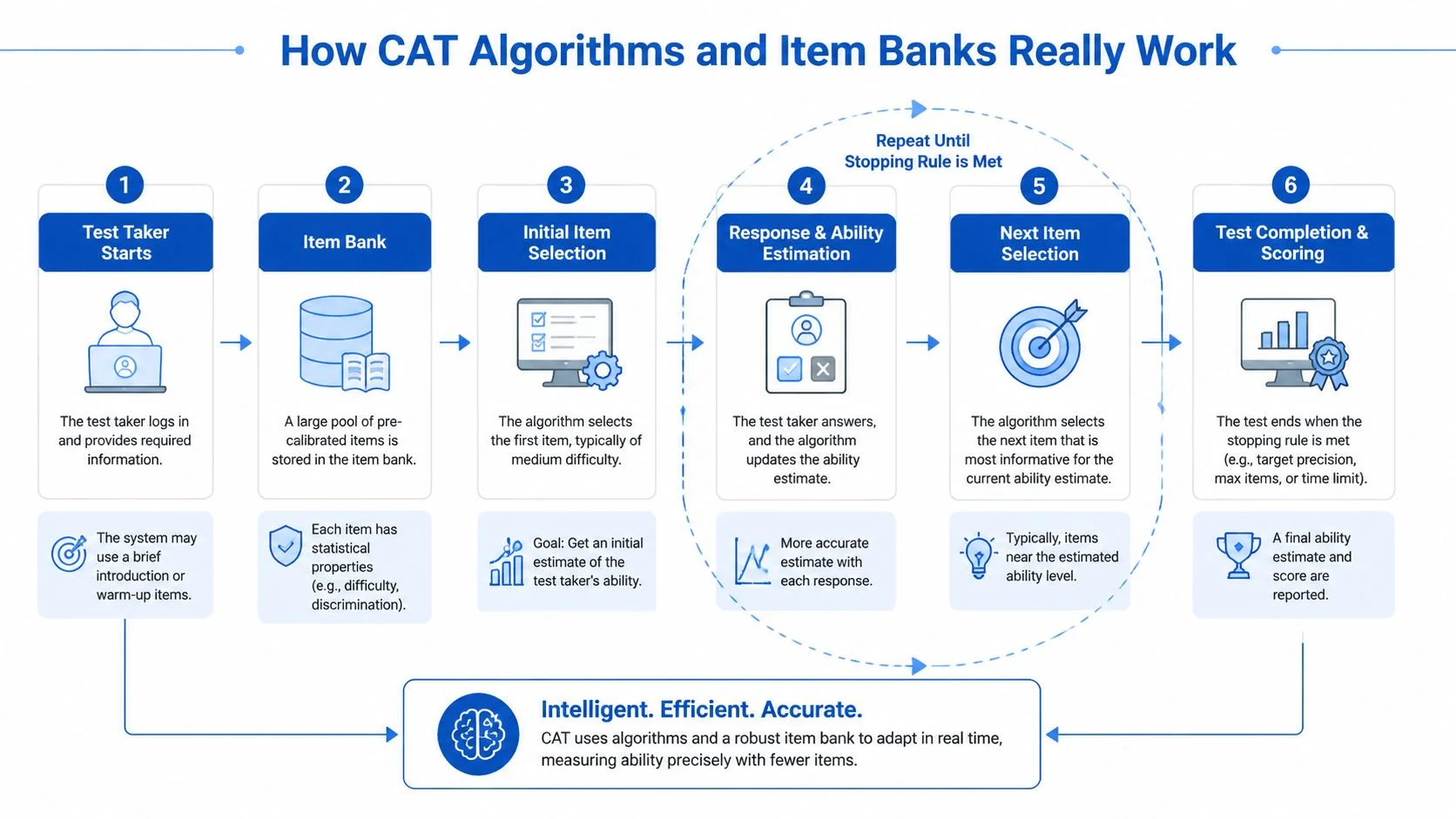
Adaptive testing sounds mysterious until broken down. Under the hood, a CAT performs two jobs simultaneously: estimating your ability and searching a question bank for the next item that will refine that estimate.
Here is the process visually.
The item bank is more than a question pile
A serious CAT platform uses an item bank. This means questions are organized and calibrated, not just stored. Each item has characteristics tied to its difficulty and how well it distinguishes between different ability levels.
Simply put, some questions are better than others at separating someone who is guessing from someone who truly understands a concept. The algorithm seeks out these useful questions.
What the algorithm does after each answer
Most modern CATs use Item Response Theory (IRT). The platform estimates your ability, often represented as theta (θ), and updates that estimate after each response. It also tracks the uncertainty around that estimate using a standard error value. Technical descriptions of CAT administration note that the system can stop when its precision target is met, typically when SE(θ) reaches 0.30 or lower. This approach can reduce the number of required items by 30 to 50% compared with fixed-form tests while maintaining equivalent or stronger measurement precision, according to this overview of CAT and IRT methods.
This efficiency is one reason adaptive exams are often shorter. The same source indicates adaptive tests are frequently around 25 to 35 minutes, compared with 60 to 90 minutes for linear tests.
A simple step flow
Here’s the process explained in everyday terms:
- Start near the middle: The exam begins with a question to get an initial reading of your ability.
- Evaluate your response: The software checks if your answer was correct.
- Update your ability estimate: Your estimated ability shifts up or down, and the system recalculates its certainty.
- Search the item bank: It doesn't just pick a harder or easier question randomly. It looks for the item that will provide the most information.
- Repeat until precise: Once the system reaches its target confidence level, it can end the exam.
Do not think of CAT as a ladder where every correct answer moves you up one rung. Think of it as a narrowing search.
Why skipping and backtracking are often disabled
Candidates often ask why many adaptive tests don’t allow them to return to previous items. The reason is structural. Each new item is chosen partly based on the answer given to the item before it. If you changed earlier responses later, the path that followed would no longer reflect the same measurement logic.
This is also why the test can feel unusually responsive. It is responsive, constantly trying to home in on your ability level with fewer questions and less wasted effort.
One caution is worth knowing: real-world adaptive systems don't always hit the ideal target as neatly as theory suggests. In a large-scale study of adaptive online testing over a decade, the overall correct answer rate was 0.353, with 138,143 total responses and 48,829 correct, remaining below the theoretical midpoint of 0.5. The study points to practical issues like limited item banks, simplified algorithms, and test-taker behavior (such as bypassing or abandoning items), as described in this adaptive testing analytics study. For learners, this means the quality of the item bank and the platform design significantly impact the experience.
CAT vs. Fixed-Form Tests Compared
Most candidates don’t need more theory. They need to know how the test experience changes once the clock starts.
The clearest way to see this is side-by-side.
Computer Adaptive Test (CAT) vs. Fixed-Form Test
| Feature | Computer Adaptive Test (CAT) | Fixed-Form Test |
|---|---|---|
| Question order | Changes based on your responses | Pre-set for everyone |
| Difficulty flow | Adjusts during the exam | Stays fixed by design |
| Navigation | Often limited, with little or no backtracking | Usually easier to review and revisit |
| Test length | Can end when the system has enough precision | Usually fixed from start to finish |
| Score reflection | Estimated ability based on item difficulty and responses | Often closer to raw performance across a set paper |
| Candidate experience | Feels interactive, but less transparent | Feels predictable, but less personalized |
Fairness as a primary concern
The question of fairness is valid. If two people don’t see the same questions, they need assurance that the results still mean the same thing.
A recent study on score comparability in CAT found median conditional standard errors of measurement under 20 points for scale scores between 700 and 1250, where most examinees scored. In that same range, pairwise measurement comparability at a distance of 1 was predominantly above 80%, supporting strong agreement between CAT forms. The researchers also noted weaker comparability near score extremes, where calibration data are thinner, in this study on CAT score comparability.
For candidates, the practical meaning is straightforward: a well-built CAT can be fair even when the item sets differ.
How strategy changes on exam day
The format difference changes your behavior during the exam:
- Pacing changes: In a fixed-form test, you might budget time knowing you can circle back. In CAT, each question deserves a complete attempt when you see it.
- Review habits change: Mark-and-return strategies may not exist.
- Confidence signals change: Question difficulty is not a reliable emotional scoreboard.
This last point is often where candidates struggle most. On a fixed-form exam, you can roughly estimate your position by sections completed and flagged items. On a CAT, that sense of control weakens. The best replacement is process control.
If you're strengthening your exam habits with targeted drills, practicing with IT cert sample questions is usually more effective than chasing sheer volume.
A fixed-form test rewards broad time management. A CAT rewards decision quality on the current item.
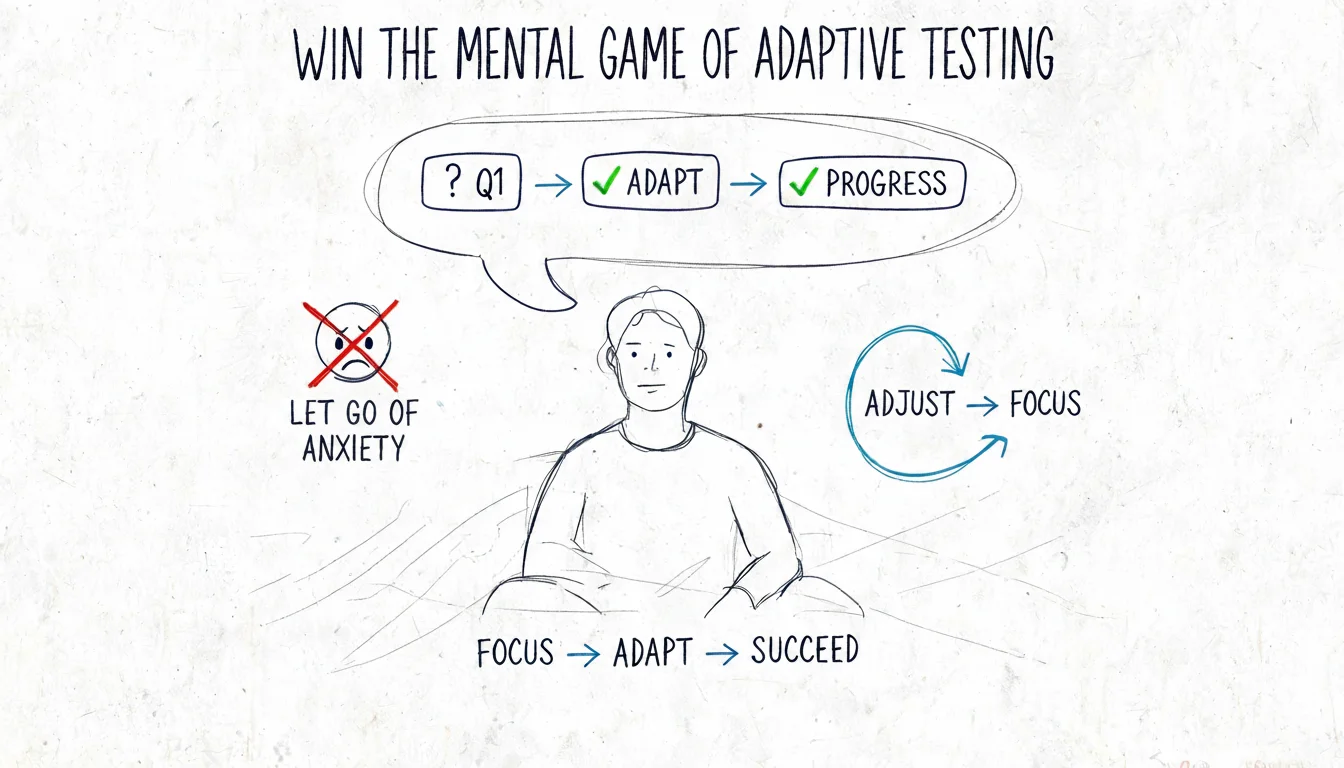
Win the Mental Game of Adaptive Testing
The hardest part of adaptive testing often isn’t the content. It’s the silence.
The system keeps changing, but it never tells you what those changes mean. This gap creates the hidden algorithm problem. Candidates start trying to interpret the exam while they’re still inside it.
The NCLEX guidance around computerized adaptive testing highlights a major source of anxiety: test takers often feel confused about whether they are “passing or failing” as questions get harder or easier, and that confusion can hurt performance, as noted in this CAT overview from NCLEX.
Reframe difficulty changes
When a question feels harder, many candidates tense up, assuming the exam is exposing weakness. But in adaptive testing, a harder item might indicate the system is probing a higher ability level because your recent answers support it.
An easier item doesn’t automatically mean failure either. It might reflect content balancing, uncertainty adjustment, or a simple shift in what the system needs to measure next.
So, the first mental rule is simple: stop reading emotion into difficulty.
Build a strong response routine
An adaptive test rewards calm, consistent repetition. I teach candidates to use the same micro-routine on every item:
- Read the task first: What is the question asking you to do? Identify, compare, configure, troubleshoot, or choose the best next step.
- Anchor to the concept: Before examining options too long, recall the rule, process, or principle involved.
- Eliminate with intent: Remove choices that clearly violate the concept, even if two answers still seem plausible.
- Commit and move: If the item isn’t yielding easily, make the best supported choice and continue.
You usually cannot rely on later review. You need a decision habit that works efficiently in one pass.
Study for transfer, not recall
Rote memorization breaks down faster in CAT because the system constantly adjusts. If your preparation depends on recognizing familiar wording, the algorithm can quickly present less familiar forms.
Conceptual understanding holds up much better.
This means your study sessions should focus on questions like these:
- Why is this answer correct in this scenario?
- What clue in the prompt changes the decision?
- How would this concept appear in a troubleshooting case instead of a definition question?
- What is the exam writer trying to distinguish between these two answer choices?
When you cannot predict the next question, conceptual understanding becomes your safety net.
Manage the clock without obsessing
Adaptive exams can create a unique kind of time pressure. Some candidates rush, believing speed proves confidence. Others freeze because every item feels high-stakes.
Neither approach helps.
Maintain a steady rhythm. If a question is difficult, it doesn’t warrant panic. It deserves your normal process. The exam is already designed to account for difficulty. Your job isn’t to outsmart the engine; your job is to provide the clearest evidence of your knowledge on each item.
What to tell yourself during the test
Keep your internal script plain and boring. That’s a good thing.
Try lines like these:
- "This question is only one data point."
- "Difficulty is not a verdict."
- "My process matters more than my mood."
- "Best answer, then next question."
Candidates who handle CAT well typically aren’t calmer by nature. They’re calmer because they stop trying to decode hidden signals.
Online Delivery and Technical Considerations
A computer adaptive test online isn’t only a psychometric experience. It’s also a technical one. The same exam that measures your knowledge also depends on your device, your connection, your room, and the testing platform’s delivery rules.
This can feel unfair, and sometimes it is.
The access problem is real
Adaptive testing brings efficiency but can also create what some have called an equity and accessibility paradox. Test takers may face technical difficulties or lack reliable technology, which can become a serious barrier for global candidates and those working with weaker infrastructure, as discussed in this article on computerized adaptive testing access concerns.
For IT professionals, this is frustrating because technical failure has nothing to do with actual competence in cloud, support, security, or project delivery. Yet, it can still affect the test experience.
What to control before exam day
You cannot redesign the platform, but you can reduce avoidable risk.
- Test your device early: Use the exam provider’s system check if one is available.
- Prepare your environment: Ensure a quiet room, stable setup, charger ready, and notifications off.
- Know the proctoring rules: ID checks, webcam requirements, desk rules, and room scans can feel intrusive if they surprise you.
- Have a fallback plan: Know who to contact if the session fails or freezes.
If you want more varied material while practicing under exam-like constraints, tools outside your main prep stack can help. For example, Open Past Paper's new feature lets learners generate practice papers in a structured way, which can be useful for building concentration and timing discipline before a live online session.
Accessibility is part of readiness
Some candidates need more than content review. They need platform compatibility, lower-bandwidth options, or a device setup that won’t undermine performance. If that’s your situation, treat logistics as part of study planning, not an afterthought.
A stable testing setup is not separate from preparation. It is preparation.
If your exam provider offers support channels, use them before the test, not during a crisis. You want fewer unknowns when the adaptive engine starts.
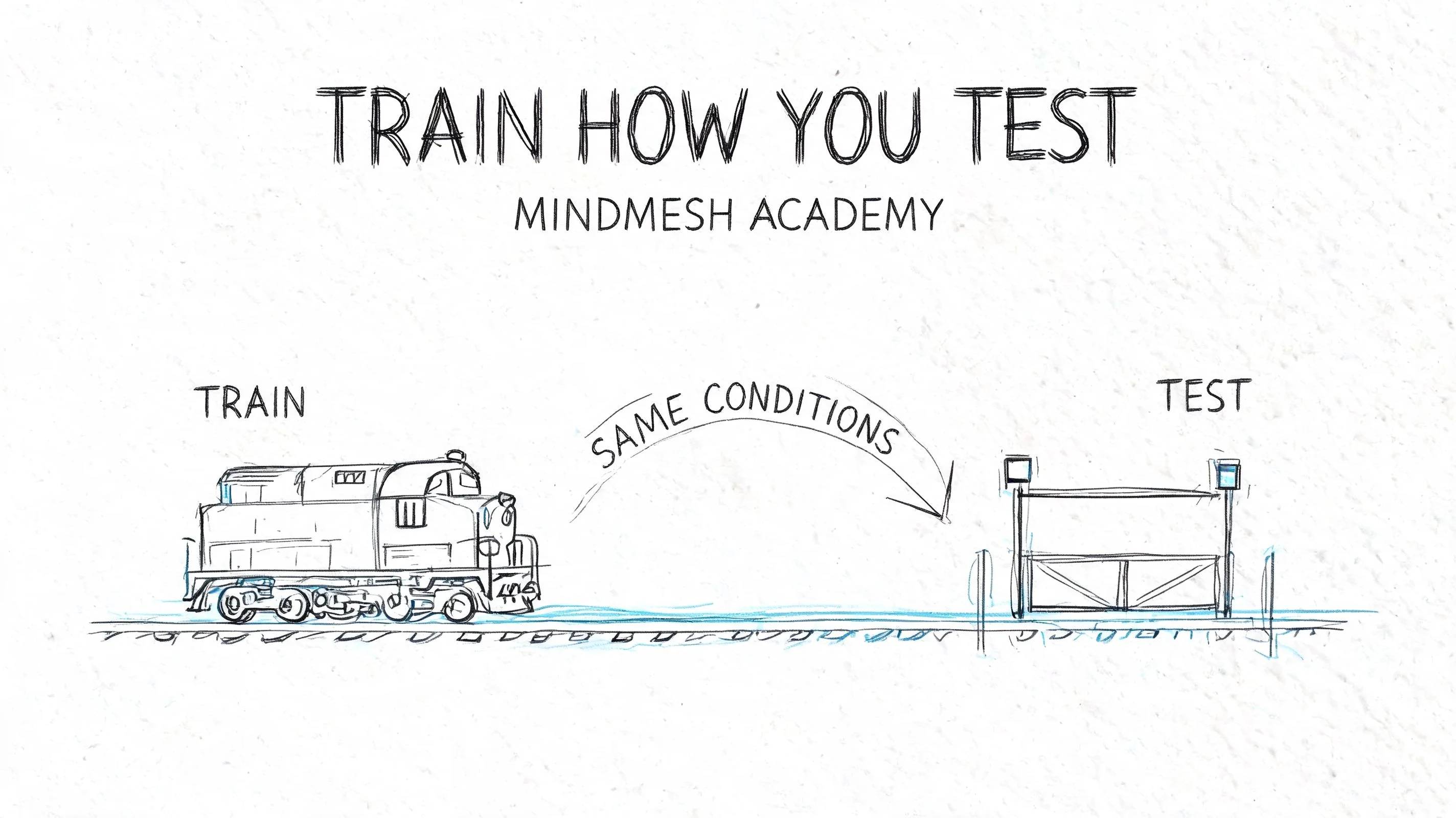
Train How You Test with MindMesh Academy
Understanding CAT helps. Practicing in a way that matches CAT helps more.
Candidates often fail to prepare for adaptive exams in one of two ways. They either over-focus on memorizing answer keys, or they practice in static formats that never recreate the pressure of one-pass decision-making. Neither builds much confidence when the exam starts shifting around them.
Match your prep to the challenge
Useful training features are those that map directly to CAT demands:
- Adaptive practice: This helps you get used to changing difficulty without turning every harder item into a psychological event.
- Concept-first study materials: These support reasoning, not just recall.
- Progress dashboards: These help you spot weak areas before the exam does.
- Spaced review: This strengthens retention over time, crucial when adaptive exams probe across connected concepts.
MindMesh Academy fits that pattern with expert-curated certification prep, adaptive learning paths, spaced repetition, practice exams, and dashboards that help learners identify weaker topics and revisit them more deliberately.
The goal is not just passing
Good CAT preparation builds a different kind of confidence. Not the fragile confidence that comes from recognizing recycled questions, but the steadier kind that comes from knowing you can handle uncertainty.
This means you can sit down, see a question you didn’t expect, and still work the problem. You can let the algorithm do its job without trying to read its mind. You can treat the exam as a measurement process instead of a personal verdict. This adaptive readiness becomes useful far beyond test day. IT work itself is adaptive: requirements shift, systems behave unexpectedly. Strong professionals respond with method, not panic. A smart preparation environment should reinforce that habit.
If you're preparing for an adaptive certification exam and want to train effectively for the format you'll face, explore MindMesh Academy's range of certification practice exams. Our resources support conceptual learning, adaptive practice, and visible progress tracking to help you build confidence on exam day.

Written by
Alvin Varughese
Founder, MindMesh Academy
Alvin Varughese is the founder of MindMesh Academy and an enterprise architecture leader. An electrical engineer by training, he moved from factory automation in South Africa to cloud architecture at GE Appliances and Humana (Fortune 50), and holds 20 professional certifications including AWS Solutions Architect Professional, Azure DevOps Engineer Expert, and Microsoft Agentic AI Business Solutions Architect. He built MindMesh Academy after interviewing too many highly certified candidates who couldn't answer basic questions: the goal is prep that makes you better at the job, not just able to pass the exam.