
Master IT Certs With Exam Sample Questions in 2026
Hours spent rereading technical manuals or highlighting course chapters rarely guarantee that information sticks. Many IT professionals fall into the trap of assuming that marathon study sessions lead to exam success. MindMesh Academy identifies a different path: the secret lies in strategic preparation rather than sheer effort.
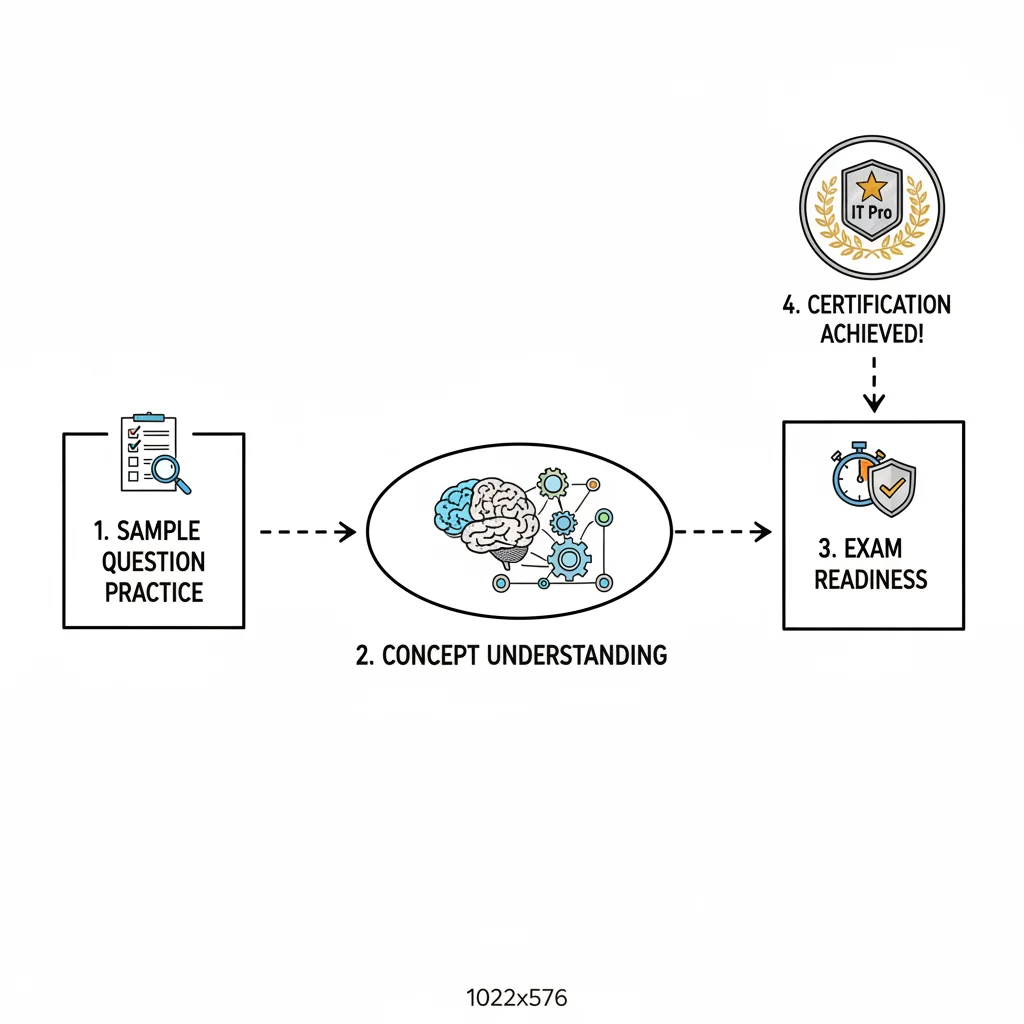
To prepare for certifications like AWS Solutions Architect, PMI PMP, or CompTIA A+ exams, change how you view your materials. Most candidates treat exam sample questions as a final review to test their knowledge before the big day. Instead, use these questions as your primary learning tool from day one. By analyzing how questions are structured and why specific answers are correct, you build practical understanding that static reading cannot provide. This active method ensures you focus on the specific concepts that appear on the test.
Move Beyond Memorization to True Understanding
Traditional, passive study methods—like simply reading a chapter and highlighting text—rarely lead to genuine comprehension. True mastery for IT certifications like Azure Developer Associate or ISC2 CISSP comes from actively engaging with the material. Nothing forces this active engagement quite like wrestling with a well-crafted exam question. Many students fall into the trap of thinking that reading a technical guide three times is the same as knowing how to apply the information. It is not. Reading is a passive intake of data, whereas answering a question requires you to retrieve that data, analyze it, and apply it to a specific problem.
This isn't just about quizzing yourself; it's a deliberate, iterative strategy designed to expose your blind spots and build a sturdy, conceptual foundation. You're shifting from passively absorbing information to actively solving problems, which mirrors the analytical and practical demands of the actual certification exam. When you sit for a high-stakes test, the proctor isn't asking you to recite a textbook. They are asking you to fix a broken network or secure a cloud environment. Using sample questions early in your preparation helps you practice that exact mental shift.
This smarter process involves three core phases:
- Understand: Analyze the logic behind each question. Do not just look at the correct answer and move on. Instead, link the question back to core concepts. If the question asks about a specific encryption standard, ask yourself why that standard is preferred over others in that specific scenario. Read the documentation or whitepapers associated with the topic to confirm you understand the underlying technology, not just the answer choice.
- Diagnose: Identify your specific knowledge gaps based on your performance and the reasoning behind incorrect answers. If you consistently miss questions about subnetting, your problem isn't "networking" as a whole; it is a specific mathematical or conceptual hurdle. By labeling your mistakes, you turn a vague sense of confusion into a concrete list of things to learn. This allows you to stop studying what you already know and start fixing what you don't.
- Build: Systematically strengthen those weak areas by targeted review and further practice. Once you have diagnosed a gap, go back to your primary study materials or lab environments. Spend an hour configuring the service you struggled with. After that focused review, return to a new set of questions to see if your performance improves. This creates a feedback loop that ensures your knowledge is growing where it matters most.
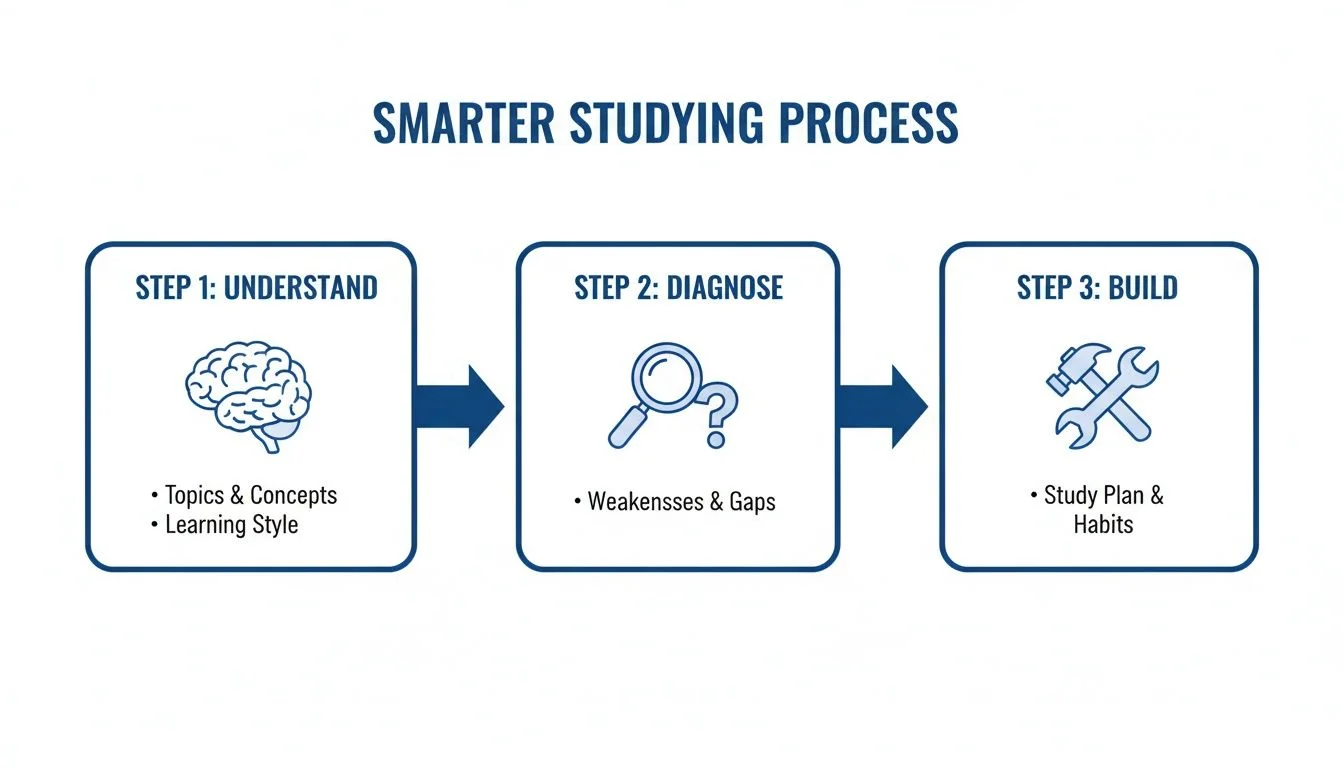
When you adopt this workflow, practice questions transform from simple assessments into your most powerful learning engine. You're no longer just chasing a score; you're gaining a precise roadmap that shows you exactly where to focus your precious study time. This method prevents the burnout that comes from trying to memorize a thousand-page guide. Instead, you are building your knowledge piece by piece, ensuring that every hour you spend studying actually contributes to your readiness for the test.
Why a Question-First Approach Wins in Certification Prep
Placing exam sample questions at the core of your studying compels you to apply concepts, rather than merely recognizing them. This is a significant change in how effectively you internalize technical material. Recognition is a low-level cognitive skill. It is why you might feel like you understand a topic while reading a book, only to feel lost when you try to explain it to someone else. Application, however, forces your brain to create stronger neural connections.
- Pinpoints Weaknesses with Precision: Getting an AWS-scenario question wrong isn't a failure; it's helpful feedback. It’s a clear indicator pointing directly to a specific service, architectural principle, or configuration detail you need to revisit. For a PMP exam, it might reveal a misunderstanding of a particular process group or knowledge area. For example, if you miss a question about the "Critical Path Method," you know exactly which section of the PMBOK Guide to open. You save time by avoiding the chapters you have already mastered.
- Builds Exam Endurance and Pacing: Answering a significant number of questions under timed pressure is a skill in itself. Consistent practice builds your mental stamina, improves your focus, and hones your time management instincts. This is crucial for multi-hour exams like the CISSP or longer CompTIA tests. Many candidates fail not because they lack knowledge, but because they run out of energy or time in the final hour. By simulating the full length of the exam during your practice sessions, you train your brain to stay sharp even when you are tired.
- Contextualizes Information for Deeper Retention: Questions bridge the divide between abstract theory and practical application. A textbook might define a firewall as a barrier between networks. A sample question will ask you where to place that firewall in a multi-tier architecture to satisfy a specific security requirement. This contextual learning makes dense topics, like advanced networking or cloud security principles, feel much more concrete and memorable. You begin to see the technology as a tool to solve a problem rather than just a list of facts to remember.
Every sample question should be treated as a mini-lesson. By dissecting them, you begin to understand the test-maker's logic, identify recurring patterns in problem types, and develop the kind of confidence that won't waver on exam day. This is the blueprint for achieving true competence, not just rote recall. When you see a question on the actual test, you should be able to recognize the "distractors"—those answers that look right but are technically incorrect—because you have seen the same tricks in your practice materials.
It's crucial to acknowledge that not all practice questions are created equal. Using low-quality or misleading questions can derail your study plan and lead to false confidence. The first step in your certification journey is to identify and use high-quality exam sample questions that accurately simulate what you'll encounter on test day. This is particularly vital for intricate exams from providers like AWS, Microsoft Azure, CompTIA, or PMI, where the question style and nuance are significant skills to master. Poorly written questions might focus on obscure trivia that the actual exam never covers, wasting your time and creating unnecessary stress.
Where to Find Exam Sample Questions You Can Trust
Always begin your search with the official source. The certification body itself—such as ISACA for CISM, Amazon Web Services for their certifications, or Microsoft for Azure exams—typically provides a limited set of sample questions. While these won't constitute a full practice exam, they are the gold standard. They offer an unfiltered glimpse into the exam's structure, difficulty, and question style. Official questions use the same terminology and phrasing that you will see on the real test, which is vital for getting used to the "language" of the exam.
From there, broaden your search to reputable training providers that have a proven track record. These organizations invest heavily in developing practice questions with certified subject matter experts. Look for platforms that not only provide answers but also detailed explanations for both correct and incorrect options, and that directly map each question back to the official exam objectives. If a provider cannot tell you which specific objective a question covers, the material is likely outdated or poorly researched.
Here’s a practical list of reliable sources:
- Official Certification Vendor Websites: The most accurate benchmark for question style and content. Always check here first for the latest exam blueprints and "free samples."
- Authorized Training Partners: Companies officially recognized and vetted by the certification body (e.g., a Microsoft Learning Partner). These partners often have access to curriculum materials that align closely with the current exam versions.
- Established eLearning Platforms: Look for platforms specializing in IT certification prep. These companies employ full-time staff to keep content current and relevant as exam versions change.
- Community-Vetted Resources: Exercise caution here, but professional forums and study groups (e.g., on Reddit or LinkedIn) can offer recommendations for quality resources from recent exam passers. If a specific practice test is widely praised by those who just passed the exam, it is usually a safe bet.
How to Spot and Avoid Low-Quality 'Brain Dumps'
The most dangerous trap in certification preparation is falling for "brain dumps." These are sites that illegally compile and offer questions supposedly copied from live exams. Beyond the ethical implications, using them is a disastrous study strategy. The questions are frequently outdated, often contain incorrect answers, and provide a false sense of security. If you memorize a set of answers that are wrong, you will fail the test and have no idea why. Furthermore, certification vendors like Microsoft and Cisco actively monitor these sites and may ban candidates caught using them.
A glaring red flag is any website that promises a "pass with confidence" (verify current pricing on the vendor site) or boasts about having "real exam questions." Legitimate providers prioritize helping you master the underlying material and problem-solving skills, not merely memorize answers. If a site looks unprofessional or uses aggressive sales tactics, stay away. Your goal is to become a skilled professional, and shortcuts like these only undermine your long-term career prospects.
Here’s what to scrutinize when vetting a study resource:
- Detailed Rationales: High-quality question banks explain why the correct answer is right and, critically, why the incorrect options (distractors) are wrong. This is where the deepest learning occurs. If you understand why Choice B is a better security practice than Choice C, you have truly learned the concept.
- Professional Interface and Experience: A well-designed, intuitive study platform often reflects a well-researched and professionally developed content library. A sloppy interface with spelling errors and broken links often indicates sloppy, inaccurate content.
- Regular Content Updates: The provider should explicitly state that their content is regularly updated to align with the latest versions of the exam blueprint and objectives. IT certifications evolve rapidly, and outdated materials are detrimental. For instance, an AWS practice test from two years ago might mention services that have since been renamed or replaced.
The global demand for trusted certification preparation is immense. For instance, the International Software Testing Qualifications Board (ISTQB) has issued over 1 million certifications across 130 countries. This demonstrates the critical need for standardized, high-quality preparation materials that ensure professionals are truly competent. When the stakes are this high, relying on unverified sources is a risk that rarely pays off.
Understanding the 'Why' Behind Each Question
Once you've secured a reliable source of exam sample questions, the next step is to dissect the questions themselves. Certifications use diverse question formats to assess different cognitive skills, and recognizing the intent behind each one is crucial. Some questions test your memory of facts, while others test your ability to synthesize information under pressure. If you know that a specific exam relies heavily on scenario-based questions, you should spend less time on flashcards and more time on labs.
This table illustrates some common question formats you’ll encounter across major IT certifications, highlighting the shift from simple recall to complex problem-solving.
Question Type Analysis for Major Certifications
| Certification | Primary Question Type | Key Focus Area |
|---|---|---|
| CompTIA A+ | Multiple-choice, Multiple-response, Performance-based | Hardware/software troubleshooting, procedural knowledge |
| AWS Solutions Architect | Multiple-choice, Multiple-response, Scenario-based | Architectural design, problem-solving, best practices |
| PMI PMP | Multiple-choice, Multiple-response, Hotspot | Situational judgment, applying frameworks to scenarios |
| ISC2 CISSP | Multiple-choice, Advanced innovative questions | Analytical thinking, risk management principles, decision-making |
This analysis prepares your brain for the task at hand. A straightforward multiple-choice question might test your recall of an ITIL definition. However, a lengthy, multi-part scenario question from AWS or Azure is designed to evaluate your ability to apply complex concepts to a messy, real-world problem. These require critical thinking and the synthesis of information from different domains. You cannot simply guess your way through a performance-based question where you must configure a virtual router or fix a broken script in a live environment.
As you work through practice tests, don't just answer the question; ask yourself why it's being asked in this particular way. What specific skill or knowledge area are the test designers trying to measure? You can explore deeper into effective exam preparation strategies in our guide on exam preparation strategies. Understanding the "logic of the test" is half the battle. Once you see the patterns, the questions become much less intimidating.
Sometimes, your analysis will reveal a very specific knowledge gap, perhaps a particular command syntax, a networking protocol, or a specific calculation. When this occurs, you can seek out highly targeted resources, like finding one of the 7 Best Resources for Polynomial Practice Problems if foundational math is a weakness for a data science certification. This laser-focused approach is far more efficient than broad, generic practice. By treating every missed question as a pointer toward a specific lesson, you ensure that your study time is always spent on the areas that will have the biggest impact on your final score.
Deconstruct Answers to Deepen Your Knowledge
Selecting the right choice on a practice exam gives you a quick boost. However, that green checkmark can be deceptive if you don’t truly understand the mechanics behind the question. To reach true mastery, stop treating exam sample questions as simple binary tests of pass or fail. Instead, treat every question as a detailed case study meant for dissection. Your goal is to see why the correct answer is the only valid solution and, just as importantly, why the other options fail. This change in perspective is what separates people who merely memorize from those who gain functional knowledge.
Move Beyond Correctness to Comprehension
For your next few practice questions, try a different tactic: ignore the result for a moment. Whether you were right or wrong, go immediately to the answer explanations. You want to see the reasoning that supports the correct choice. Don't just read the explanation; interrogate it. Ask yourself these questions:
- Which specific exam objective from the vendor is this question testing?
- Can I explain this logic in my own words without reading the explanation?
- Could I teach this specific topic to a junior colleague right now and ensure they grasp it?
If you cannot say "yes" to all three, you haven't finished with that question. This disciplined study method builds the mental endurance you need when the exam timer is running. You aren't just looking for the right answer; you are looking for the underlying logic.
Learning occurs when you break down the logic of the distractors—the incorrect options. Understanding why an answer is wrong is as useful as knowing why one is right. This approach turns every practice question into multiple learning moments that build a defense against tricky exam wording.
Reflection Prompt: Think about a question you answered correctly earlier today. Did you click through immediately, or did you analyze the logic? If you had to explain why the other three choices were wrong, what new details would you discover about the topic?
Hunt for the Logic in Distractors
The most effective part of this process is analyzing the incorrect answers. These are often called distractors. The people who write exams are very good at creating options that look right but rely on common misunderstandings. If you learn how to identify these traps, you become much harder to fool. For every incorrect option, figure out exactly why it does not work. Most distractors follow a few specific patterns:
- Partially Correct but Incomplete: The statement might be technically true on its own, but it doesn't solve the problem asked in the question. For example, on an AWS exam, an answer might suggest a service that works but is not the most cost-effective or most secure choice for that specific scenario.
- Conceptually Related but Irrelevant: This choice uses real terms and technology from your study guide, but they have no relation to the problem in the scenario. It's there to see if you are just recognizing familiar keywords.
- Logically Flawed or Factually Incorrect: The statement is either based on bad logic or contains a factual error about how the software or hardware functions.
- Subtly Inaccurate: These are the hardest to catch. The answer looks perfect until you notice a single word that changes the meaning. Watch for words like "always," "never," or "only," or look for a mismatched port number or protocol name.
Finding the specific flaw in a distractor is like finding a gap in your own defense. It tells you exactly where you need to go back into your books or lab environment to study more. This detailed analysis makes your study time much more productive because you aren't wasting time on things you already know.
This level of intensity is why many top certifications have high standards. According to The IIA, the global pass rate is 44% for CIA Part 1 and 48% for CIA Part 2. These numbers prove that basic knowledge is not enough to pass with confidence. You can review the full data on the official certification pass rate data page. These statistics show that your study method must focus on building functional expertise rather than just picking the right letter.
Simulate Real Exam Conditions to Beat the Clock
Understanding technical material is only one part of the equation. Performing at your peak while a timer counts down in a high-pressure environment is a different challenge entirely. I have seen many skilled IT professionals struggle during an exam, not because they lacked technical knowledge, but because the environment was distracting. The most effective way to eliminate test-day anxiety is to make the experience feel familiar through repetitive, realistic practice.
By using exam sample questions in a timed, simulated setting, you build the mental stamina and focus required to succeed. Your goal is to reach a point where the actual certification exam feels like just another practice run—routine and manageable. This is not about how fast you can read; it is about how clearly you can make decisions when time is a limited resource.
Create Your Personal Exam Simulation
To prepare effectively, you must set up a practice session that mirrors the official exam conditions. Do not simply browse through questions while distracted. Every detail matters. Replicating the specific constraints of the test center transforms your study time into a genuine rehearsal.
When you prepare your simulation, adjust these three factors:
- Question Count: Use the exact number of questions specified for the current exam. For example, a 65-question AWS Certified Cloud Practitioner (CLF-C02) exam (verify current question counts on the vendor site) is a fast-paced sprint. By contrast, a 150-question PMI PMP exam (verify current pricing and question counts on the vendor site) is a test of endurance that requires you to stay sharp for hours. Your approach to pacing must change depending on the length of the test.
- Time Limit: Use the official time limit provided by the certification body. Do not give yourself extra time. You should aim to finish the entire set of questions with at least 15 minutes remaining. This buffer is necessary so you can review the specific questions you flagged during your first pass.
- Environment: This factor is vital. Find a quiet space where you will not be interrupted. Turn off your phone and move it out of sight. Close all browser tabs and applications on your computer except for the exam software. Recreating the sterile, quiet atmosphere of a professional testing center as closely as possible helps you stay focused.
By controlling these variables, you are doing more than just testing your knowledge. You are training your brain to stay calm under specific conditions. This familiarity is your most effective tool for managing the stress that often leads to avoidable mistakes.
Recreating the test environment builds more than just speed; it trains your focus. When you sit for the real exam, your brain will recognize the familiar setup. This allows you to skip the initial surge of panic and focus on the technical questions immediately.
Reflection Prompt: When you take practice tests, do you use a timer and try to mimic the actual exam setting, or do you work through questions casually? Consider how a more disciplined simulation might improve your performance during the actual event.
Master the Art of Pacing and Flagging
During a timed practice run, you will encounter questions that cause you to hesitate. Getting stuck on one difficult problem is the quickest way to run out of time. From my experience, the most successful candidates use a simple flag-and-return strategy to stay on schedule.
The most important rule for timed exams is this: Answer the easy ones first.
On your first pass through the test, only answer questions that you know instantly. If a question requires more than a minute of deep analysis, or if the wording seems confusing, flag it and move on. Do not let your ego force you to solve a difficult problem right then.
This strategic approach provides two major advantages:
- You Collect Easy Points First: You finish every question that you are certain about. This prevents a situation where you run out of time before you even see the easier questions at the end of the exam.
- You Build Confidence: Answering a string of questions correctly creates momentum. You will feel more relaxed when you return to the harder, flagged questions because you know the majority of the work is already done.
Once you reach the end of the exam, go back to the items you flagged. You will often find that a question you saw later in the test provides a hint or triggers a memory that helps you solve an earlier problem. Our AWS Certified Cloud Practitioner practice exam (CLF-C02) is built to help you practice this navigation and flagging. Learning to move through the test efficiently ensures you never leave points on the table because the timer hit zero.
Integrate Advanced Study Techniques for Lasting Recall

Timed practice exams provide a solid foundation for your studies, but reaching a level of mastery that leads to certification success requires a transition from passive review to strategic learning. You need methods that fix technical information in your long-term memory. This ensures that the facts and procedures you learn remain accessible during the pressure of the exam and throughout your daily work in the IT field.
Two techniques that significantly improve certification preparation are Spaced Repetition and adaptive learning. These methods move you away from rote memorization and toward a deeper understanding of the subject matter. They are proven strategies that help you store data efficiently so you can recall it when the timer is running and when you are solving problems on the job.
Use Spaced Repetition to Lock in Knowledge
Instead of repeatedly drilling the same exam sample questions until you have simply memorized the answers, Spaced Repetition applies a calculated rhythm to your study schedule. The core idea is to review information at increasing intervals over time. If you answer a question correctly without any doubt, the system waits longer before showing it to you again. If you struggle, the question reappears sooner. Research in cognitive science demonstrates that this approach is far more effective for long-term retention than traditional cramming, which often leads to forgetting information shortly after the test.
You can implement this system manually by categorizing your practice questions. After you finish a set of questions, group them based on how well you performed:
- "Nailed It" Pile: These are the questions you answered correctly and immediately. Since you have a strong grasp of these topics, schedule your next review for approximately ten to fourteen days from now.
- "Got It, but Hesitated" Pile: You arrived at the correct answer, but you felt uncertain or took a long time to decide. These concepts are not yet fully secure in your memory. Revisit these questions and the related documentation in two or three days.
- "Completely Missed It" Pile: These questions highlight your most significant knowledge gaps. They must be your highest priority. Plan to review the underlying technical concepts and re-attempt these questions the very next day.
This specific approach prevents you from wasting hours on topics you already understand. It forces you to spend your energy where it is needed most, making every study session more productive. To help structure this process, you might use an ultimate study guide to keep your notes and schedules organized as you move through the curriculum.
By spacing out your review of exam sample questions, you align your habits with how the human brain actually processes and stores data. This turns studying into a precise strategy for building professional competence rather than a test of endurance.
Let Adaptive Learning Personalize Your Path
Modern study platforms, such as MindMesh Academy, use adaptive learning engines to improve your efficiency. These systems function as a digital tutor that observes your performance in real time. As you answer practice questions, the software creates a profile of your current knowledge. It identifies exactly which exam objectives you understand and which ones require more work.
For example, if you are preparing for an Azure certification and the data shows you consistently miss questions about load balancing or virtual networks, the adaptive engine will adjust. It will start presenting you with more questions that target those specific technical gaps. This ensures that you are always working on the material that is most difficult for you. This customized approach helps you cover the entire exam syllabus without spending unnecessary time on your strengths.
The benefit of this preparation is visible in the job market. Professionals who hold certifications bring a lot of value to their employers. Industry data shows that employees with specialized AI skills can generate an average of over $30,000 in additional value for their companies (verify current salary data and ROI figures with vendor or industry reports). This level of return on investment explains why many IT professionals prioritize high-quality preparation that leads to genuine expertise rather than just a passing score.
When you combine spaced repetition with adaptive technology, you do more than study to pass an exam with confidence. You build the technical foundation needed to advance your career. For more information on how to use these strategies, explore our guide on memory aids and advanced study techniques.
Your Top Exam Prep Questions, Answered
When you spend weeks preparing for a high-stakes IT certification, questions about the best way to use your study time will surface. Most candidates want to know how to use exam sample questions to get the best results without wasting effort or burning out. Over the years, I have talked to many professionals about these same uncertainties. Getting clear answers to these questions will change how you study. It helps you avoid the common mistakes that lead to failure and instead builds a strategy that works when you sit for the actual test.
Let’s address the most common concerns IT professionals have when they are striving for their next certification. By addressing these points directly, you can move past the confusion and focus on the technical mastery required to advance your career.
How Many Sample Questions Should I Do Before My Exam?
Candidates often search for a specific number of questions to answer before they feel ready. There is no magic figure like 500 or 1,000 that applies to everyone. The truth is that the quality of your practice sessions is much more important than the volume of questions you finish. I have seen people answer thousands of questions without actually learning the core concepts required by the exam objectives. This often leads to frustration when the real exam presents a scenario they haven't seen before.
View high-quality exam sample questions as a diagnostic tool rather than a checklist. Your goal is not to click through a bank of questions until you see a green "correct" icon. Your goal is to find the gaps in your knowledge and fix them. A small set of 200 questions that align with the official exam blueprint is far better than a massive pile of generic or outdated ones. If you are preparing for the CompTIA A+ 220-1201/220-1202, for example, you need questions that specifically target the current hardware and software standards, not general IT knowledge from five years ago.
How do you know when you are ready? A reliable benchmark is hitting a score of 90% or higher on at least three different, full-length practice exams. You should reach this score under timed conditions that mimic the real testing environment. If you can do this across different sets of questions, it suggests you have handled your weak points and understand the material well enough to face the real exam. This disciplined method proves you are applying concepts instead of just memorizing specific answers to specific questions.
Are Free Exam Sample Questions Good Enough?
The word "free" is tempting, but using free question banks or "brain dumps" for a professional IT certification is a massive risk. Your career and the cost of the exam are on the line. Free resources are often inconsistent and can sabotage your preparation. Most free banks have three major flaws that make them dangerous for anyone serious about passing.
- Outdated Content: These sources rarely keep up with version changes. For instance, if you use a free site for the CompTIA Network+ but the material is based on the retired N10-008 instead of the current N10-009, you will miss new technologies and waste time on retired topics.
- Incorrect Answers and Explanations: Without subject matter experts to check the work, these sites often contain wrong answers. In the IT world, learning an incorrect configuration or a flawed security protocol can be a disaster. These sites can actively teach you erroneous information, which is a fatal flaw when you are trying to build technical competence.
- Poor Quality and Inaccurate Style: Free questions usually fail to mimic the tricky wording or the scenario-based depth of the actual test. If you are studying for the AWS Certified Cloud Practitioner CLF-C02, the real questions will test your ability to choose the right service for a specific business case. Free questions are often too simple, giving you a false sense of security that disappears the moment you start the actual exam.
Paying for premium practice exams from a reputable source is like buying insurance. It is a small price to pay to ensure you pass with confidence on your first try. This saves you from the stress and the financial burden of paying for an expensive retake.
What's the Best Way to Review My Incorrect Answers?
Real learning happens when you get a question wrong. If you just look at the right answer and move to the next question, you are wasting a chance to improve. Every mistake is a sign showing you exactly where your knowledge is weak. You need a systematic way to review every missed item.
Use a forensic approach to reviewing every incorrect answer. Do not gloss over it. First, analyze your reasoning. Why did you pick the wrong option? Did you misread a technical term, or did you misunderstand how a specific protocol works? Next, explain the correct logic in your own words. Do not just read the explanation provided by the software. Write it down or say it out loud. This forces your brain to process the information and helps you internalize the concept.
Finally, go back to your main study tools. If you missed a question on the AWS Certified Security - Specialty SCS-C03 regarding identity management, go back to that specific chapter in your book or watch that video again. Consult the official documentation. This circular process of testing, failing, and reviewing is how you turn weaknesses into strengths. It ensures that when you see a similar problem on the actual exam, you will have the knowledge to answer it correctly.
At MindMesh Academy, our platform is built upon these proven strategies. We provide high-quality, vetted practice questions and the tools you need to analyze your performance. Our system helps you find your unique learning gaps so you can master the material. Stop guessing about your readiness and start building your skills by exploring our full library of certification resources at MindMesh Academy.
Ready to Get Certified?
Prepare using expert-curated study guides, practice exams, and spaced repetition flashcards at MindMesh Academy. These tools help you pass with confidence:

Written by
Alvin Varughese
Founder, MindMesh Academy
Alvin Varughese is the founder of MindMesh Academy and an enterprise architecture leader. An electrical engineer by training, he moved from factory automation in South Africa to cloud architecture at GE Appliances and Humana (Fortune 50), and holds 20 professional certifications including AWS Solutions Architect Professional, Azure DevOps Engineer Expert, and Microsoft Agentic AI Business Solutions Architect. He built MindMesh Academy after interviewing too many highly certified candidates who couldn't answer basic questions: the goal is prep that makes you better at the job, not just able to pass the exam.