CompTIA Security Plus Training: Pass SY0-701 in 2026
CompTIA Security+ Training: Pass SY0-701
You're likely in one of three common situations. Perhaps you work in IT and want to transition into a security role. Maybe you're changing careers and need a certification employers recognize. Or you've already started exploring Security+ videos and books, only to find the material broad, disjointed, and harder to organize than you expected.
That feeling is normal.
CompTIA Security+ covers a wide range of cybersecurity topics. The exam expects you to understand threats, secure systems, respond to incidents, and consider risk and compliance – all within a single test. Many learners don't struggle because they lack intelligence. They fall short because they study inefficiently, use disconnected resources, or spend too much time reading without enough practical application.
Quality CompTIA Security+ training helps solve this. It offers a roadmap, not just content. It guides you on what to study first, how deeply to learn it, when to move from theory to hands-on labs, and how to confirm you're ready for SY0-701.
Why CompTIA Security+ Is Your Next Career Move
If you're looking for a cybersecurity credential that hiring teams already understand, Security+ is one of the clearest starting points. CompTIA announced that over one million individuals worldwide have earned the CompTIA Security+ certification, demonstrating its widespread adoption for building foundational cybersecurity skills across the market, as noted in CompTIA's milestone announcement.
This milestone matters for a simple reason: employers don't just want someone who has watched a few security videos. They want proof that you can speak the language of access control, threats, secure architecture, incident response, and risk. Security+ provides that baseline in a vendor-neutral way. This makes it useful whether you pursue support, administration, Security Operations Center (SOC) work, or a more specialized path later on.
Why it works for both beginners and working IT pros
Security+ occupies a productive middle ground. It's accessible for beginners compared to advanced offensive or analyst certifications, yet it still tests practical judgment. This makes it a strong move for help desk professionals, system administrators, network technicians, college students, and career changers needing a respected entry into the field.
It also aligns well with how employers think about entry-level security talent. Technical hiring managers often seek a mix of proven skills, curiosity, and good work habits. For a broader view of this mix, consider this roundup of the most important skills for getting hired. It shows how communication, problem-solving, and technical ability often combine to form a desirable candidate profile.
Security+ is a starting point, not a finish line
One reason I recommend Security+ so often is that it creates options. It builds the foundation for more advanced certifications such as CySA+, PenTest+, and other next-step certifications mentioned by CompTIA in the same announcement linked above.
If you're thinking beyond just one exam, a professional cybersecurity certification timeline can help you visualize where Security+ fits into a longer career progression.
Practical rule: Don't choose Security+ because it's “easy.” Choose it because it teaches the security vocabulary and habits that other certifications assume you already have.
Deconstructing the Security+ SY0-701 Exam
Most exam anxiety comes from uncertainty. Once you understand the structure of SY0-701, the challenge becomes much more manageable.
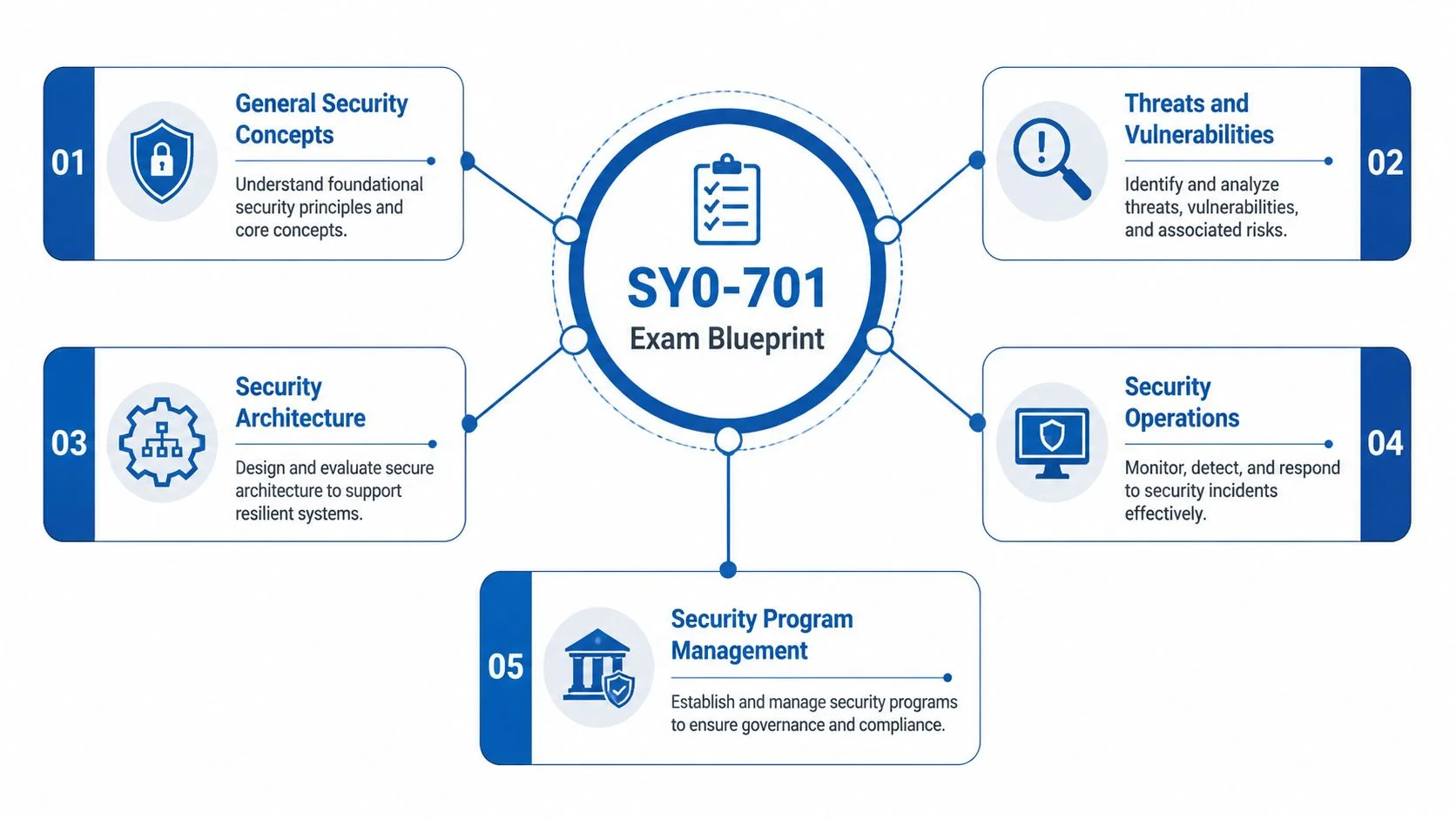
The current exam requires a passing score of 750 on a 100 to 900 scale. It uses a mix of multiple-choice and performance-based questions across five domains: Attacks, Threats & Vulnerabilities (24%), Architecture & Design (21%), Implementation (25%), Operations & Incident Response (16%), and Governance, Risk & Compliance (14%), according to the CompTIA Security+ certification page.
What the five domains truly cover
Reading domain names can feel abstract, so here's the practical breakdown:
- Attacks, Threats & Vulnerabilities covers how attackers operate, what common weaknesses look like, and how defenders recognize risk.
- Architecture & Design focuses on building secure environments. You'll encounter topics tied to network design, cloud security principles, segmentation, and broader defensive design choices.
- Implementation is where you apply controls. This includes security technologies and the details of putting safeguards in place.
- Operations & Incident Response tests what happens after systems are live. Monitoring, alerts, response workflows, and handling security events are key here.
- Governance, Risk & Compliance checks your understanding of policy, risk treatment, and the frameworks that shape security decisions.
The exam tests judgment, not just recall
Many students expect Security+ to be a pure memorization test. It isn't. The performance-based questions, often called PBQs, are the clearest example. These ask you to work through practical scenarios rather than pick a definition from four options.
A PBQ might require you to decide which control fits a specific environment, identify the most likely security gap in a workflow, or interpret what a set of findings means for response priorities. Even when the content is familiar, the pressure comes from applying it quickly and accurately.
PBQs reward students who've practiced security tasks in context. They challenge students who only highlighted a book.
Details that often trip people up
CompTIA states that the exam includes 90 questions completed in 90 minutes, costs $425 in the US (verify current pricing on the vendor site), and is available in English, Japanese, Portuguese, Spanish, and Thai on the same certification page linked earlier. These details affect your preparation strategy.
Here's what I advise students:
- Study to the domain weights. Don't allocate equal time to every topic. Focus more on areas with higher percentages.
- Practice under time pressure. Ninety minutes passes quickly on exam day.
- Expect scenario wording. The exam often asks for the best answer, not just a technically possible one.
Choosing Your Ideal Training Path
There isn't one perfect way to prepare for Security+. The best fit depends on your schedule, budget, background, and learning style.
Some learners succeed with self-study because they already work with networks, operating systems, and basic security concepts. Others need structure, deadlines, and guided practice. A third group wants an intensive format because they need to certify quickly for a new role or employer requirement.
Comparison of Security+ Training Formats
| Format | Best For | Average Cost | Pros | Cons |
|---|---|---|---|---|
| Self-study with books and free videos | Independent learners with strong discipline | Low to moderate | Flexible, easy to start, good for reviewing concepts at your own pace | Easy to drift, weak accountability, often limited lab depth |
| Structured online course platform | Working professionals who need a guided path | Moderate | Organized objectives, built-in sequencing, easier progress tracking, often includes quizzes and practice material | Requires consistency, quality varies a lot by provider |
| Instructor-led bootcamp | Learners on a deadline or employer-sponsored students | High | Fast immersion, direct instructor access, external accountability | Intense pace, less flexible, can move too fast for true retention |
I've seen all three paths lead to success. I've also seen all three fail when the format didn't match the learner's needs.
How to decide without overthinking it
Use these filters to guide your choice:
- Choose self-study if you already understand networking concepts, are skilled at planning your own study weeks, and will consistently do hands-on labs.
- Choose a structured online path if you need guidance and organization but still want schedule flexibility.
- Choose a bootcamp if your employer is sponsoring your training, you learn best in a live environment, and you can handle concentrated study.
A practical way to check your goal is to browse actual security job roles and see what employers value. For example, this Udemy security engineer job on Blockchain Jobs shows how real positions blend technical depth with broad security understanding. Even if the role is more advanced than Security+, it helps you study with the job market in mind rather than treating the exam as a closed academic exercise.
The training format matters less than the study design
Whatever path you choose, ensure it includes four key elements:
- A complete SY0-701 map so you don't overlook weaker domains.
- Hands-on practice for applying controls and incident response thinking.
- Practice exams with explanations so every mistake becomes a learning opportunity.
- A review system that revisits older material before you forget it.
If a course offers hours of video but no meaningful way to test and refresh what you've learned, it's incomplete.
Building Your 60-Day Security+ Study Plan
Most working adults don't need a heroic study sprint. They need a plan they can actually stick to. A strong 60-day schedule works because it's long enough to build understanding and short enough to maintain urgency.
Your study plan should reflect the official weighting of the exam. According to Cybersecurity Guide's Security+ overview, SY0-701 is weighted as follows: Attacks, threats, and vulnerabilities (24%), Architecture and design (21%), Implementation (25%), Operations and incident response (16%), and Governance, risk, and compliance (14%).

Days 1 through 14: Laying the foundation
Start with your foundation and build a system for review from day one.
- Week 1: Focus on attacks, threats, and vulnerabilities. Learn common attack types, threat categories, and how defenders identify exposure. Don't chase every niche term. Aim for recognition first, then understanding.
- Week 2: Move into architecture and design. Many students improve quickly during this phase because understanding design topics makes later implementation concepts easier to grasp.
Your routine should be simple: learn a concept, test yourself, review weak points, then briefly revisit older material before adding new content.
Study habit that works: Short daily recall sessions are more effective than occasional marathon sessions. Security+ rewards repeated retrieval much more than passive rereading.
Days 15 through 35: Core content
This is the center of your plan, and it deserves the most time.
- Week 3 and Week 4: Dedicate your biggest block to implementation. This domain holds the largest weight, and it's where many technical ideas become practical. Work through controls, configurations, and the purpose behind various security tools.
- Week 5: Add operations and incident response. Practice reading scenarios and deciding what happens first, what gets escalated, and what evidence matters.
At this stage, many students benefit from a structured guide that keeps all objectives in order. If you want a focused path, this resource can help you prepare for the SY0-701 certification exam.
After you've built some momentum, switch formats for a bit and use a walkthrough to reinforce the exam mindset:
Days 36 through 60: Bringing it all together
Now, pull everything together.
- Week 6: Cover governance, risk, and compliance. Don't treat this domain as “the boring one.” On exam day, this section often rewards careful reading and common-sense reasoning.
- Week 7: Begin mixed review. Combine all domains instead of studying in silos. Deeper connections between concepts often form during this phase.
- Week 8: Shift into full exam mode. Take timed practice exams, review every incorrect answer thoroughly, and revisit your weakest categories.
A simple weekly rhythm
Use the same rhythm each week so your study becomes automatic.
- Learn early in the week.
- Do labs in the middle.
- Take a quiz or mini-exam near the end.
- Review mistakes before starting the next domain.
That sequence matters. Reading creates familiarity. Labs create understanding. Review creates retention.
Essential Resources Beyond the Textbook
A textbook can teach terminology. It can explain cryptography, access control, risk, and network defenses. But Security+ expects more than just recognition. It expects applied understanding.
Consequently, two resource types are essential in CompTIA Security+ training: hands-on labs and high-quality practice exams.
Why labs matter so much
Effective Security+ preparation must cover technical areas like Identity and Access Management, cryptography, and enterprise security implementation such as firewalls and IDS/IPS. These areas tie directly to risk reduction and appear in hands-on scenarios, as summarized in Coursera's overview of the certification.
If you only read about Multi-Factor Authentication (MFA), Public Key Infrastructure (PKI), firewall behavior, or intrusion tools, the ideas can remain abstract. Labs change that. They force you to connect the “what” with the “why.”
Here's what labs accomplish for different topics:
- IAM labs show how authentication and authorization decisions affect actual user access.
- Cryptography labs help you understand the purpose and selection of algorithms, not just acronyms.
- Network defense labs make controls such as filtering, detection, and segmentation feel concrete instead of theoretical.
- Incident-oriented tasks train you to notice clues, prioritize response, and think clearly under pressure.
What makes a practice exam worth your time
Not all practice exams are equally helpful. Some are simply trivia banks. Others are too easy, too vague, or poorly written.
Use this checklist when judging a question bank:
| What to look for | Why it matters |
|---|---|
| Realistic scenario wording | The actual exam often tests judgment, not raw recall. |
| PBQ-style practice | You need exposure to task-based thinking. |
| Detailed explanations | Wrong answers should teach you why, not just mark you incorrect. |
| Performance tracking | You should see patterns in your weak areas. |
| Timed full-length sessions | Endurance and pacing are skills you need to develop. |
A good practice exam doesn't just tell you that you're wrong. It shows you what assumption led you there.
Build a resource stack, not a resource pile
Students often collect too many materials and use none of them effectively. A better setup is lean and deliberate:
- One primary course or book for core instruction.
- One lab source for practical skills.
- One exam bank for measurement and review.
Keep your resource stack tight. Depth beats variety.
How to Evaluate Any Training Provider
Training providers all promise coverage, clarity, and confidence. These words don't mean much unless you know how to inspect the product behind them.
A strong provider should make your study process easier, more organized, and more practical. If it adds confusion, hides weak coverage behind marketing language, or gives you endless videos with little feedback, it's time to look elsewhere.
The checklist I'd use before paying
Ask these questions directly:
- Does the course align to SY0-701 objectives? You want clear mapping to current exam topics, not recycled material from older versions.
- Are there hands-on labs, not just lectures? Security+ includes applied thinking. Training should reflect that.
- Is there PBQ-style practice? Multiple-choice questions alone are not enough.
- Can you track progress by domain? If the platform can't show you what your weak areas are, you'll waste time reviewing what you already know.
- Are there full timed practice exams? Timed rehearsal exposes pacing problems before exam day.
- Do explanations teach the concept? “Correct answer: B” is unhelpful. You need clear reasoning.
- Does the study system help with retention? Without scheduled review, students forget early material while learning later domains.
Red flags that deserve caution
You don't need to be cynical, but you should be alert.
| Red flag | Why it matters |
|---|---|
| Heavy focus on video hours | Long runtime isn't the same as mastery. |
| No demo of analytics or progress tracking | You may end up studying blind. |
| Little mention of labs | Practical gaps show up fast on PBQs. |
| Generic “updated content” language | Providers should specify alignment to SY0-701, not just claim it. |
A good provider reduces friction
The best training experience usually feels simple from the learner's side. You know what to do today, what to review tomorrow, and what still needs work before the exam. That's what you're paying for – not just information, but a reliable path through the information.
The MindMesh Academy Advantage for Security+ Mastery
One of the biggest changes in SY0-701 is its stronger attention to automation, orchestration, and Zero Trust. CompTIA notes that many training courses still don't provide hands-on labs for these areas, leaving a meaningful skills gap in the market, as described in CompTIA's discussion of the new Security+ exam.
This gap matters because modern security work isn't just about recognizing terms. It's about seeing how controls fit together, how defensive decisions affect operations, and how newer models such as Zero Trust influence access, monitoring, and architecture.

What a mastery-focused platform should do
A platform built for mastery should handle four jobs simultaneously:
- Sequence the material so students don't study in a random order.
- Reintroduce older concepts before they fade from memory.
- Adapt review to weak areas instead of treating all topics equally.
- Make progress visible so learners know where to focus next.
That's the real value of learning science in certification preparation. Spaced repetition keeps earlier topics alive. Adaptive pathways reduce wasted time. Progress dashboards replace guesswork with evidence from your own performance.
Where this approach fits in practice
For Security+, this means a learner shouldn't just watch a lesson on access control, answer a few questions, and move on forever. The platform should bring related material back later, connect it to scenarios in architecture or operations, and show whether the student retained the idea.
MindMesh Academy fits this model by offering expert-curated certification preparation with spaced repetition, adaptive learning paths, and a dashboard that helps learners visualize progress and spot weak areas. This combination is especially useful for Security+ because the exam is broad enough that students often feel “kind of familiar” with everything while still being shaky in a few high-impact topics.
The students who pass with confidence usually aren't the ones who studied the most. They're the ones who used feedback well and kept circling back to weak spots until those weak spots disappeared.
The practical benefit is straightforward. Instead of guessing whether you're ready, you can see whether your understanding is stable across domains, whether your weaker areas are improving, and whether your review habits are producing genuine recall rather than just short-term recognition.
If your goal is to pass SY0-701 and still feel useful on day one in a security role, that's the standard to aim for.
If you want a structured way to study without bouncing between disconnected videos, notes, and question banks, MindMesh Academy offers a focused path for certification prep built around retention, practice, and progress tracking. It's a practical option for learners who want to build a strong foundation for the SY0-701 exam with our CompTIA Security+ practice exam.

Written by
Alvin Varughese
Founder, MindMesh Academy
Alvin Varughese is the founder of MindMesh Academy and an enterprise architecture leader. An electrical engineer by training, he moved from factory automation in South Africa to cloud architecture at GE Appliances and Humana (Fortune 50), and holds 20 professional certifications including AWS Solutions Architect Professional, Azure DevOps Engineer Expert, and Microsoft Agentic AI Business Solutions Architect. He built MindMesh Academy after interviewing too many highly certified candidates who couldn't answer basic questions: the goal is prep that makes you better at the job, not just able to pass the exam.