Your Essential Study Guide for Security Plus SY0-701
Welcome to MindMesh Academy’s guide for IT professionals aiming to pass the current CompTIA Security+ SY0-701 certification. Successful candidates move far beyond rote memorization. This resource provides a strategic plan to help you gain the practical, applied cybersecurity knowledge that employers demand. The sheer volume of exam topics often feels daunting, so we focus on study methods and preparation strategies to ensure you gain a deeper understanding and retain material for both the exam and your professional career. Mastering these core concepts will help you pass with confidence.
Your Strategic Roadmap to Security+ Success
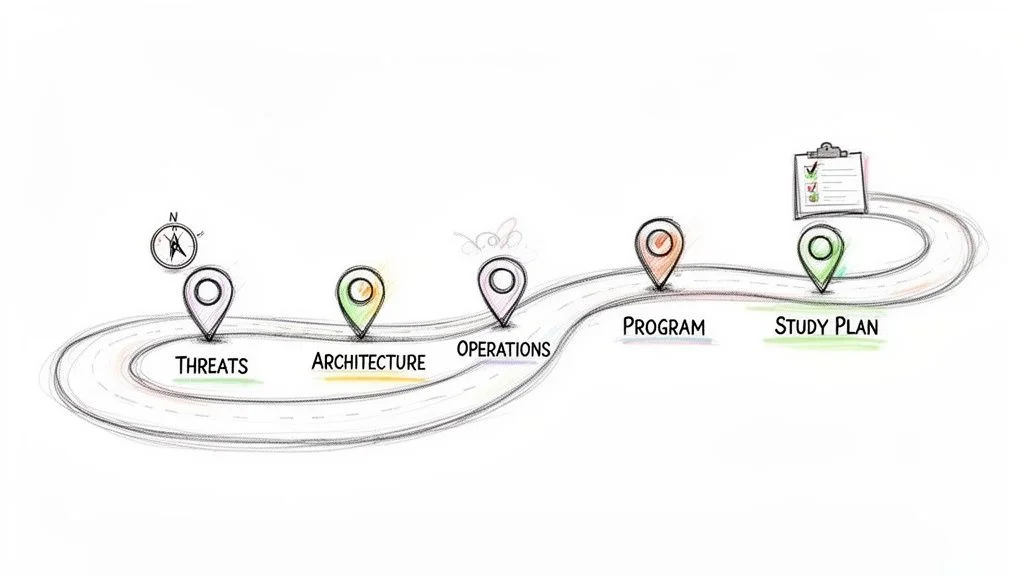
Earning your Security+ certification is not about frantic cramming. It requires executing a smart, structured plan. You should treat your preparation like a construction project where you establish a solid base before building the walls. This guide transforms the long list of CompTIA SY0-701 exam objectives into a manageable, progressive path. We carefully designed this sequence to help you identify your weak spots and gain actual proficiency in the field.
Our approach uses effective study techniques like spaced repetition and active recall. Instead of simply reading the material again, you will practice pulling information directly from your memory. This method strengthens your memory and helps you recall facts much faster. It is essential for using complex security concepts during the exam or in real-world scenarios. We will show you exactly how to add these high-impact habits to your daily study routine so they become second nature.
Reflection Prompt: How have your past study methods (e.g., re-reading vs. flashcards) impacted your retention? How can you apply spaced repetition to reinforce Security+ concepts?
Mastering the CompTIA SY0-701 Exam Domains
The first step toward passing the CompTIA SY0-701 exam is understanding how it is organized. CompTIA divides the test into five core domains. Each domain has a specific weight that affects your final score. This breakdown is your main strategic tool. It shows you exactly where to spend your study time for the best results.
The table below details the five core domains and how much of the exam they represent:
| Exam Domain | Percentage of Exam |
|---|---|
| Security Operations | 28% |
| Threats, Vulnerabilities, and Mitigations | 22% |
| Security Program Management and Oversight | 20% |
| Security Architecture | 18% |
| General Security Concepts | 12% |
You will notice that Security Operations makes up the largest portion at 28%. You should focus heavily on incident response, security monitoring, and forensic analysis. While this domain is critical, the other sections are also important. You need a balanced study plan to succeed. If you ignore any of these areas, you could jeopardize your passing score.
Testing your knowledge often is a key part of preparation. Practice tests help you get used to the question types and the overall format. This builds your confidence and helps you find your knowledge gaps before you take the actual certification exam.
Real mastery of these Security+ domains goes beyond just passing a test. It involves building the skills you need to work in a modern security role. The SY0-701 exam checks if you can use these concepts in a real business environment. This prepares you to contribute to a team immediately.
In this guide, we will explain each domain and turn complex topics into clear, actionable steps. As you move forward in your career, remember that a strong base in security helps you get other IT and project management certifications. Let's get started.
Reflection Point: Given the domain percentages, where do you anticipate needing to spend the most time? What existing knowledge might give you a head start in certain areas?
Decoding Threats, Vulnerabilities, and Mitigations: Thinking Like an Adversary
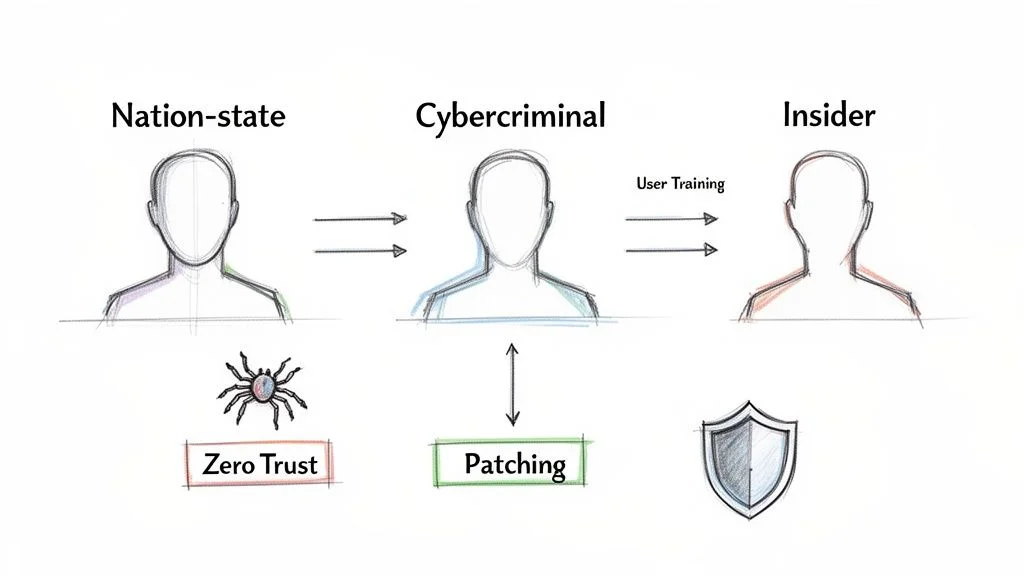
Effective cybersecurity defense starts with an adversarial mindset. This domain of the CompTIA Security+ SY0-701 exam tests your ability to go beyond basic definitions and analyze the actual methods attackers use in modern digital conflict. You are not just learning a list of malware names; you are learning how to identify the intent and strategy of a motivated opponent.
The goal is to understand the motivation driving different types of attacks. You will analyze the security environment from the viewpoint of various threat actors. These range from organized cybercriminal groups seeking financial profit through massive ransomware campaigns—such as the WannaCry incident that exploited SMBv1 vulnerabilities—to advanced nation-states that deploy stealthy, custom-built tools for long-term espionage against government or infrastructure targets. This understanding of their goals, whether it is rapid financial gain or quiet data exfiltration, allows you to build layered defenses that address the specific risks your organization faces.
Key Takeaway: Identifying why an attacker targets a system helps you predict their methods and the vulnerabilities they will likely seek, shifting your security posture from reactive to proactive.
Understanding the Attacker's Playbook: The Art of Social Engineering
Building a resilient defense requires a clear view of the entire operational cycle an attacker follows, from the first reconnaissance steps to the final objective. Any high-quality study guide for Security+ must prepare you to analyze human-centric attack vectors with the same technical rigor as software vulnerabilities.
Social engineering remains a common and dangerous entry point. These attacks do not rely on broken code or software bugs. Instead, they exploit human psychology by manipulating trust, urgency, or fear. It is a psychological manipulation designed to trick people into giving up confidential information or access.
Take phishing as an example. It is rarely a simple, random message with a visible malicious link. Modern attackers use spear phishing to create highly personalized messages that look like they come from a known, trusted source—such as a specific company executive, the internal IT help desk, or a cloud service provider. For instance, an attacker might send a spear phishing email that perfectly mimics an AWS login alert, leading a cloud engineer to a convincing but fake credential-harvesting page.
Social engineering often succeeds because it works around technical security measures. Even the most advanced firewall cannot stop a user from giving away their password if they believe they are talking to a legitimate authority figure. This is why regular security awareness training is just as important as technical defenses. On the SY0-701 exam, you should be prepared to identify specific social engineering tactics in various scenarios and recommend the right ways to stop them.
For the SY0-701 exam, you must have a clear understanding of these common social engineering tactics:
- Phishing: These are broad, non-targeted attacks that use generic emails to reach the widest possible audience, such as fake package delivery notifications or password reset requests.
- Spear Phishing: These are customized attacks directed at specific individuals or teams. Attackers often use information found on social media or company websites to make the message seem credible and legitimate.
- Whaling: This is a high-level form of spear phishing that targets senior leadership and C-suite executives. The goal is usually to authorize large financial transfers or steal highly sensitive corporate secrets.
- Vishing: Also known as voice phishing, this tactic uses phone calls or automated voice recordings to trick people into sharing sensitive data, often by pretending to be from a bank or a government agency.
- Smishing: Short for SMS phishing, these attacks happen over text messages. They usually contain an urgent request and a link to a malicious site, disguised as a bank alert or a gift card notification.
Reflection Prompt: Recall a time you saw a suspicious email or text. Which indicators helped you realize it was a social engineering attempt? What specific steps would you take to ensure others in your organization do not fall for it?
From Vulnerabilities to Mitigations: Closing the Security Gaps
After you understand how attackers operate, you must be able to find the specific weaknesses they want to use. A vulnerability is a flaw in a system, a software bug, or a gap in a business process. An exploit is the actual tool, code, or method that an attacker uses to take advantage of that vulnerability to gain access or cause damage.
Imagine a vulnerability is an unlatched window in an office building. The exploit is the specific ladder and technique a thief uses to climb up and enter through that exact window. As a security professional, you have to find that open window and lock it before an intruder arrives.
This "Threats, Vulnerabilities, and Mitigations" domain makes up 22% of the SY0-701 exam. This weight shows that basic knowledge is not enough to pass. With cybercrime costs estimated to have reached $8 trillion globally in 2023 (verify current pricing and cost estimates on the CompTIA or Cybersecurity Ventures sites), organizations need people who can connect these dots.
Every threat you identify must be met with a specific mitigation. A mitigation is an action or a tool used to make an attack less likely or to reduce the damage if an attack happens. These are usually grouped into three categories:
- Technical controls: Using hardware or software, such as firewalls, intrusion prevention systems, and encryption, to protect data.
- Administrative controls: Using policies, procedures, and training, such as an incident response plan or a strict onboarding process, to manage risk.
- Physical controls: Using tangible barriers, such as security guards, biometric locks on server rooms, and surveillance cameras, to protect the actual hardware.
Consider this scenario to see how these concepts work together:
- Threat: A group of cybercriminals launching a ransomware attack to lock up company files.
- Vulnerability: A server running an outdated operating system with a known security hole, combined with employees who have not been trained to spot phishing.
- Mitigation: Creating a strict patch management schedule to update servers, requiring multi-factor authentication (MFA) for all users, and keeping encrypted backups in a separate, offline location.
To master this domain, you must be able to look at a situation and quickly link these elements. The Security+ exam uses scenario-based questions where you will be asked to identify a specific threat, name the vulnerability being targeted, and pick the best mitigation from a list. To further explore these concepts, you can review our detailed guide on the threats, vulnerabilities, and mitigations domain.
Designing a Secure Architecture: Building Resilience from the Ground Up
Preparing for the Security+ SY0-701 exam requires more than memorizing the functions of security technologies. It demands a shift in perspective where you learn to think like a security architect. This involves conceptualizing and constructing secure systems from their inception. You must move past the idea of attempting to add security features as an afterthought and instead focus on building them into the foundation of the environment.
Your understanding must evolve from simply defining a firewall to strategically determining its placement within a network topology. You should focus on achieving maximum defense efficacy through logical positioning. Effective architectural design is proactive. It anticipates potential threats and embeds resilience directly into the blueprint of your systems and networks. This type of foundational thinking is critical for anyone aiming for roles in security engineering or solution architecture. Architects do not just install tools; they design systems that remain functional even while under active attack.
Building Your Digital Fortress with Defense in Depth
You will master the fundamental philosophy of defense in depth in this domain. The underlying principle is straightforward: operate under the assumption that any single security control will eventually fail. No single tool is perfect, regardless of how strong it may seem. Therefore, instead of relying on a singular perimeter, you construct multiple, overlapping layers of security.
The medieval castle provides a useful model for this concept. Its defenses are not limited to one massive wall. Instead, the design features a moat, a drawbridge, stone walls, positioned archers, and vigilant guards. Should an adversary breach the moat, they still confront the next layer of resistance. This multi-layered logic is fundamental to IT security. When implementing these strategies, you should follow established network security best practices to ensure these layers operate together without gaps.
For the Security+ exam, you will need to recognize and apply a diverse mix of controls to implement defense in depth effectively:
- Technical Controls: These are the hardware and software mechanisms deployed to protect digital assets. Examples include firewalls that filter network traffic based on stateful inspection or application-level data. You might also use Intrusion Detection Systems (IDS) and Intrusion Prevention Systems (IPS) to monitor for and block malicious activities in real time. Strong encryption protocols for data at rest and in transit, such as AES-256 for storage and TLS 1.3 for web traffic, fall into this category. Secure environments also frequently utilize multi-factor authentication (MFA) to verify user identities through multiple independent channels.
- Administrative Controls: These are the policy-driven rules, procedures, and standards that govern organizational behavior and security practices. They focus on the human and procedural element of security. This includes mandatory security awareness training for all staff members and stringent user access reviews to enforce the Principle of Least Privilege. You should also develop and test incident response plans and follow thorough change management policies to ensure that system updates do not introduce new vulnerabilities.
- Physical Controls: These encompass tangible measures designed to protect physical hardware and infrastructure from unauthorized access or environmental hazards. This includes secure server rooms with restricted access, uniformed security guards, and perimeter fencing. You should also consider environmental controls like fire suppression systems and HVAC monitoring. Biometric scanners or smart cards are often used to secure critical areas where sensitive data is processed or stored.
Reflection Prompt: How can defense in depth principles be applied to a simple home network? What technical, administrative, and physical controls would you implement to protect your personal data?
Segmenting the Network to Contain Threats: The Watertight Compartments
Network segmentation is one of the most potent architectural strategies for mitigating risk. A compelling analogy for this is the use of watertight compartments within a ship. If one compartment takes on water due to damage, the sealed bulkheads prevent the entire vessel from sinking. Network segmentation applies this same principle to your digital infrastructure to prevent a single point of failure from compromising the entire organization.
By logically dividing a large network into smaller, isolated sub-networks or Virtual Local Area Networks (VLANs), you enhance your ability to contain a breach. For instance, if malware compromises a workstation in the marketing department, segmentation can prevent the threat from moving to critical assets. Firewalls or Access Control Lists (ACLs) placed between VLANs stop lateral movement toward financial servers or intellectual property repositories. This strategy is crucial for limiting the impact, or blast radius, of an attack.
A specific application of segmentation is the Demilitarized Zone (DMZ). A DMZ functions as a secure, isolated buffer zone. It is a dedicated sub-network hosting all public-facing servers, such as web servers, email servers, or public APIs. By placing these high-risk assets in a DMZ, you separate them from the internal network. Should an attacker successfully compromise a server within the DMZ, their access is restricted to that isolated segment. This prevents them from pivoting directly to more sensitive internal databases or file shares. Modern architectures often use a screened subnet approach where two firewalls sandwich the DMZ to provide even higher levels of isolation.
On-Premises, Cloud, and Hybrid Environments: Understanding the Shared Responsibility Model
As a security professional, you will manage resources that extend beyond traditional on-premises data centers. The SY0-701 exam emphasizes cloud and hybrid environments because they represent the current industry reality. As of 2026, research shows that 94% of enterprises use some form of cloud services (verify current industry statistics periodically). You must be able to apply core security principles across on-premises hardware, cloud infrastructures like AWS or Microsoft Azure, and the connections that form hybrid deployments. The official CompTIA site provides more details on how the exam objectives integrate these modern paradigms.
A critical concept for the exam is the Shared Responsibility Model. This framework defines which security duties belong to you and which belong to your cloud provider. Misunderstanding these boundaries is a major cause of data breaches.
| Environment | Primary Security Responsibility | Key Challenge for Your Team |
|---|---|---|
| On-Premises | You are accountable for every layer of the stack. This includes the physical security of the data center, the network infrastructure, the server hardware, operating systems, applications, and all data. | High upfront capital expenditure and high operational overhead are major factors. The entire security burden, including patching every system and maintaining compliance, rests solely on your internal team. |
| Cloud (IaaS - Infrastructure as a Service) | You manage the operating systems, applications, configurations, and data. The cloud provider (e.g., AWS, Azure) is responsible for the security of the cloud itself, which includes the physical infrastructure, virtualization layer, and the global network. | Misconfigurations represent the single largest security risk in this model. You must understand that the cloud provider does not secure your data or your settings. You are responsible for securing what you put in the cloud, such as configuring your own virtual firewalls and storage permissions. |
| Hybrid | You manage a blend of on-premises and cloud resources. Data often flows dynamically between these different environments, requiring a unified security approach. | The primary challenge is maintaining consistent security policies and visibility across different platforms. You must ensure that access controls are applied equally to a user whether they are accessing an on-premises file share or a cloud-based application. This requires effective orchestration and integration strategies. |
Mastering these distinctions enables you to assess business requirements and evaluate the security implications of different deployment models. You should be prepared for scenario questions on the Security+ exam that test your understanding of these responsibility boundaries. For example, if a provider offers a Platform as a Service (PaaS) solution, you would typically be responsible for the application and the data, while the provider manages the underlying operating system and middleware.
Reflection Prompt: If your company migrated a critical application to AWS IaaS, what specific security responsibilities would your team retain under the shared responsibility model? How does this differ from the responsibilities you would have in a standard on-premises deployment?
Mastering Daily Security Operations: On the Cybersecurity Front Lines
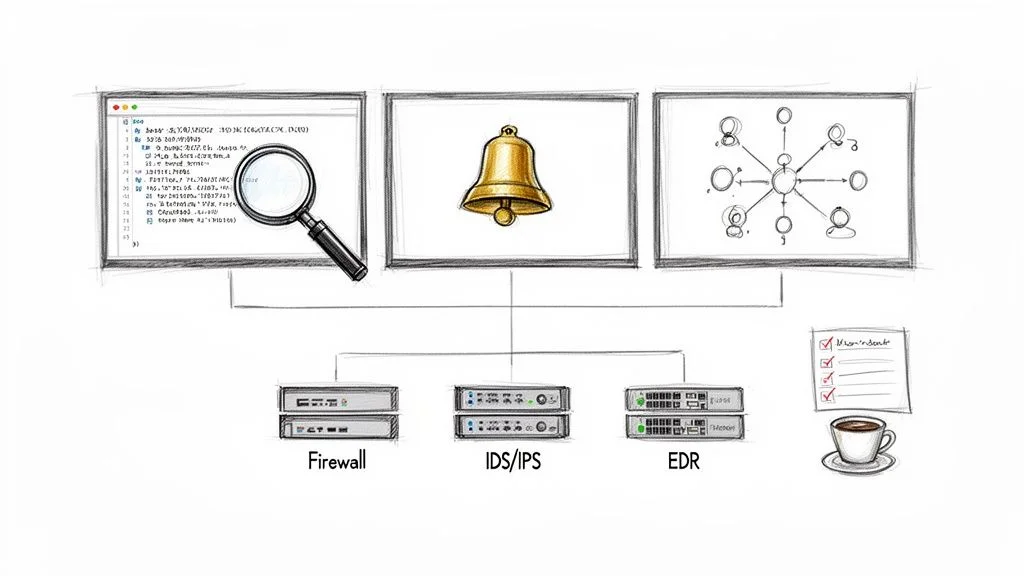
This domain serves as the space where theoretical knowledge meets practical application. It examines the daily, hands-on tasks that define the role of a security analyst: actively defending live networks against persistent, real-world threats.
You move from conceptualizing a secure environment to actively patrolling digital perimeters, investigating anomalies, and discerning precisely which alarms to trigger upon detecting an intrusion. This segment of the Security+ exam focuses on application, requiring proficiency in simulations where you might analyze log files, configure security tools, or respond to simulated incidents.
The 28% weighting of Security Operations on the CompTIA Security+ SY0-701 exam reflects the current demands of the job. With approximately 90 questions to answer within a 90-minute timeframe, including performance-based questions (PBQs), reaching the 750-point passing threshold requires more than memory. It requires demonstrated operational skill. For the current breakdown of exam objectives, refer to the official CompTIA website.
The Cybersecurity Toolkit: A Digital Detective's Arsenal
A proficient security analyst relies on a reliable toolkit designed for visibility and control across the network. The challenge goes beyond understanding individual tool functions. You must understand how these different components work together as a coordinated defense system.
Consider your organizational network as a busy international airport.
- Firewalls act as the primary security checkpoints at every entry and exit point. They check inbound and outbound data packets against set rules, denying passage to traffic without the required permissions. An Azure Network Security Group (NSG) or an AWS Security Group (verify current AWS CLF-C02 requirements) manages traffic flow this way.
- Intrusion Detection Systems (IDS) function as a network of security cameras and sensors monitoring the entire area. They observe and alert security personnel to suspicious activities or policy violations, such as a port scan, but they do not stop the event.
- Intrusion Prevention Systems (IPS) are the rapid-response guards who react to alerts from the IDS. Upon detecting a confirmed threat signature, an IPS intervenes by blocking malicious traffic, dropping packets, or resetting connections to stop the attack.
- Endpoint Detection and Response (EDR) solutions are like dedicated security agents assigned to each individual aircraft, such as laptops, servers, and mobile devices. They monitor activities at the endpoint level, detecting advanced threats like fileless malware or ransomware attempts, and can automatically quarantine or fix the compromised device.
Mastering the use of these tools changes your understanding from textbook definitions to practical skills. This is a central part of any study guide for Security+.
The measure of your skill, both on the Security+ exam and in a real cybersecurity role, is not just reciting the definition of a firewall. It is the ability to search a large log file, analyze thousands of entries, and accurately find the single event that signifies an active attack or a breach attempt. This analytical skill is what the exam and the job require.
From Proactive Monitoring to Structured Incident Response
The daily work of a security analyst follows a cycle: monitor, analyze, and respond. This loop supports all effective security operations.
It starts with monitoring and logging. Effective protection is impossible without visibility. Your security tools—firewalls, EDRs, and identity management systems—generate a high volume of data every second. This data is captured in various log formats. A Security Information and Event Management (SIEM) system, such as Splunk or Microsoft Sentinel, serves as the command center. It collects and organizes these logs into a single, actionable dashboard.
From this data, you move to analysis. A SIEM does more than collect logs. It helps you identify signals in the noise. It links unrelated events from different sources to find anomalies. For example, it might show a successful user login from an unusual geographic location immediately following several failed login attempts from a regular office IP address. This is a common indicator of compromise that requires investigation.
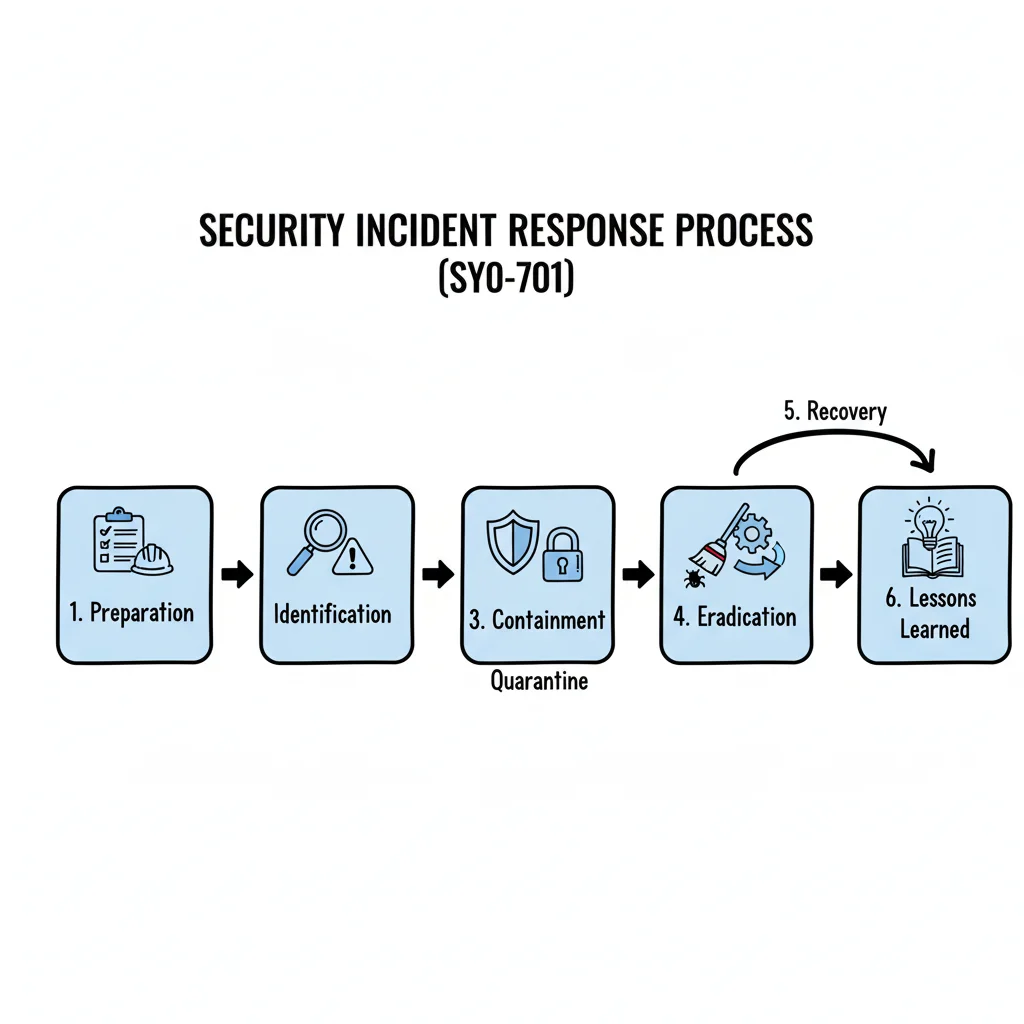
When analysis confirms a security incident, you begin incident response. This phase is not a chaotic reaction. It is the execution of a prepared plan to minimize damage, remove the threat, and restore operations. CompTIA uses an incident response model that follows frameworks like NIST or principles from ITIL Service Operation. It provides a sequential roadmap:
- Preparation: This involves building an incident response team and developing policies and procedures. It also includes gathering tools and conducting regular training before an incident occurs.
- Identification: This is the process of confirming that a security breach or incident has happened. You must determine its scope, nature, and how severe it is.
- Containment: This is the action taken to isolate affected systems and network segments. The goal is to stop the threat from spreading further and to limit its impact.
- Eradication: This involves the removal of the root cause of the threat from the environment. You must ensure all malicious components are gone.
- Recovery: You restore affected systems and data to a secure state. This often involves using verified backups and fixing the vulnerabilities that allowed the attack.
- Lessons Learned: This is a review of the incident. You identify weaknesses in defenses or procedures and implement changes to improve security for the future.
Following a structured process ensures effective action under pressure. For the Security+ exam, expect to apply these steps in multiple-choice scenarios and performance-based questions where you make decisions during a crisis.
Reflection Prompt: Imagine a ransomware attack hits your network. Briefly outline the immediate actions you would take during the "Containment" phase.
Leading Security Program Management and Oversight: The Strategic Imperative
After spending time with the command line and the technical details of hands-on security, we move into the strategic side of operations. This domain requires a change in perspective. You must think like a security leader or an architect who designs and oversees an entire security program, rather than someone focusing on a single technical component. It represents a move from reacting to individual threats toward proactive management of the security posture for an entire organization.
You are no longer just the engineer who configures a specific firewall rule. Instead, you act as the principal architect who writes the overarching security policy. This policy dictates how every firewall across the entire enterprise must be configured and managed to ensure consistency. This section of the SY0-701 exam moves away from individual software tools and focuses on the business language of governance, risk, and compliance (GRC). The goal is to align security efforts with the goals of the business and the requirements of the law.
The Core of GRC Explained: A Strategic Framework
The term Governance, Risk, and Compliance (GRC) might sound like corporate jargon, but it functions as a practical and necessary framework for any modern business. GRC is the structured, repeating process that a company uses to align its security actions with its business goals. It also ensures the company stays in line with legal, regulatory, and contractual duties. It functions as a loop of constant improvement rather than a project that has a specific end date.
The visual below shows how GRC works in practice. It starts with high-level strategy and moves down into the specific, daily checks required for compliance.
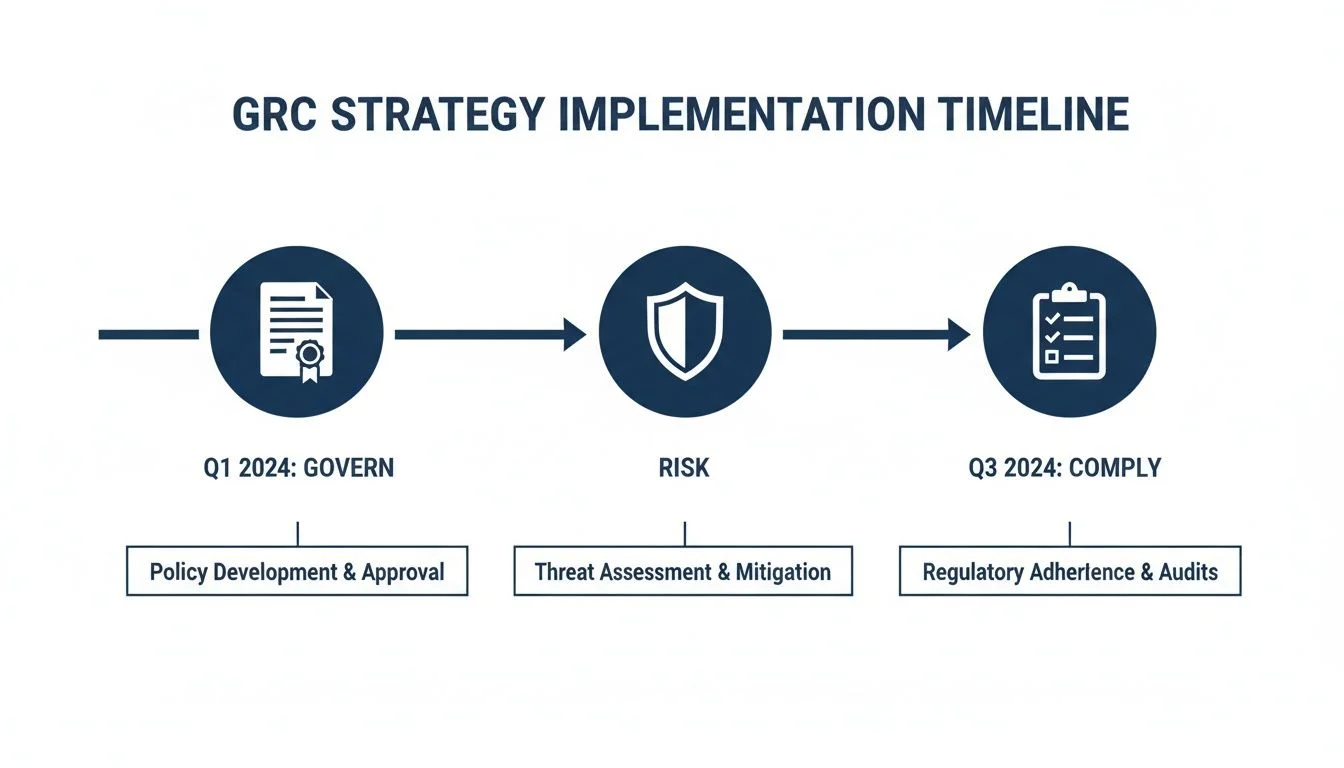
Reliable security starts with clear governance. This governance sets the direction for how the company identifies and evaluates risks. Those risk assessments then define the scope and frequency of compliance activities. For the Security+ exam, you must understand how these three parts connect to support the organization.
Govern: This stage involves setting the high-level rules and expectations. Leaders define the policies, standards, and guidelines that every employee and system must follow. It establishes the "why" and "what" of the security program.
Risk: During this phase, you identify what could go wrong. You look at potential threats and vulnerabilities to determine which ones are most likely to happen and which ones would cause the most damage. This allows the organization to prioritize its spending and effort.
Comply: This is the verification phase. You perform audits and reviews to confirm that the rules established during governance are being followed. You also check that the risk management strategies you implemented are actually working.
Navigating Risk and Compliance: Strategic Decision Making
Risk management is a major part of this domain and a large portion of the SY0-701 exam. One of the most important things to realize is that you cannot eliminate every single risk. That is impossible and too expensive for any business to achieve. Effective risk management is about finding potential threats, calculating their likelihood and impact, and making smart business decisions about how to handle them. This approach mirrors the risk management principles found in other professional tracks, such as those in the PMP (Project Management Professional) curriculum.
When you identify a risk to your organization, you generally choose from four main strategies to handle it:
- Avoid: You decide to stop the activity that causes the risk. For example, if a company has an old, legacy server that cannot be patched against modern exploits, the risk of a breach might be too high. By decommissioning that server and moving the data elsewhere, you avoid the risk entirely. This is a conscious choice to remove the threat source.
- Transfer: You move the financial or operational weight of the risk to someone else. The most common way to do this is by purchasing cybersecurity insurance. If a security incident happens, the insurance company pays for certain costs. You can also transfer risk by hiring a specialized third party to handle a high-risk task, such as using a managed service provider to monitor your network traffic.
- Mitigate: This is the strategy security professionals use most often. You implement controls to reduce the chance of a risk happening or to reduce the damage if it does. Technical controls include things like next-generation firewalls or endpoint protection software. Administrative controls involve creating strong policies or providing employee training. Physical controls might include using biometric scanners on the doors of your server room.
- Accept: Sometimes, a risk is so small that it is not worth the cost of fixing it. Other times, the cost to fix the problem is much higher than the potential loss from the risk itself. In these cases, the organization formally decides to live with the risk. This must be a documented decision by leadership, not just a failure to notice the problem.
This domain accounts for 20% of the SY0-701 exam. This weight shows how important these concepts are for modern companies. Data privacy laws like GDPR and CCPA have made the stakes much higher. Fines for breaking these laws are increasing; for instance, GDPR fines rose by 113% last year. Understanding GRC is now a business requirement, not just a task for the IT department. To see exactly how the current exam covers these laws, check the official CompTIA site for the latest objectives.
Reflection Prompt: Look at a common risk, such as a data breach caused by a phishing email. Which of the four risk responses would your current or past workplace likely choose, and why?
Building a Human Firewall and Ensuring Resilience
Technical defenses are vital, but your security is only as strong as its weakest link. That link is often human error. This is why security awareness training is a mandatory part of any security program. It is not just a nice thing to have; it is a critical defense.
A good training program does more than just help a company pass an audit. It should change how people behave and create a culture where everyone stays alert. For the Security+ exam, you need to know how to design training that works. You must teach employees how to spot advanced phishing emails, how to use strong and unique passwords, and how to report anything suspicious they see. The goal is to build a "human firewall." This turns every member of the staff into an active sensor who can help defend the network.
This domain also covers how to plan for major disasters through business continuity (BC) and disaster recovery (DR) plans. You will learn how to create plans that allow a business to keep running or restart quickly after a major event. This could be a ransomware attack that locks up all the files, a natural disaster that destroys a building, or a major cloud outage, like an Azure region going offline.
To pass the exam, you must understand two specific metrics:
- Recovery Point Objective (RPO): This measures how much data the company can afford to lose. If you back up your data every 24 hours, your RPO is 24 hours.
- Recovery Time Objective (RTO): This measures how quickly you need to get systems back online. If your web store must be back up within two hours of a crash to avoid losing sales, your RTO is two hours.
These concepts align with the service continuity management practices taught in ITIL. Mastering these will ensure you are well-prepared for this section of the test.
Reflection Prompt: Besides simple phishing tests, what kind of specialized social engineering training would you give to the executives in your company?
Your Actionable Security+ Study Plan: A 10-Week Blueprint
The difference between passing the CompTIA Security+ exam and feeling overwhelmed usually depends on one thing: your study plan. This section moves away from high-level advice to give you a practical, week-by-week timeline. This schedule helps you move toward certification without wasting time on inefficient study habits.
Our recommended blueprint covers a 10-week study period. Treat this as a flexible framework. You should adapt the timeline to fit your current job schedule, your existing IT knowledge, and how quickly you absorb technical material. Some people might need twelve weeks, while those with a strong networking background might finish in six.
The goal is to build functional knowledge, not just memorize facts for a day. CompTIA does not require specific prerequisites for the SY0-701 exam. However, they suggest that having two years of hands-on experience in a security role helps significantly. Data from students shows that those who follow a disciplined study plan for 8-12 weeks (verify recommended study hours on the CompTIA website) have a much better chance of success. These candidates often see a first-time pass rate between 70-80%.
The 10-Week Study Blueprint for CompTIA Security+ SY0-701
This schedule is your primary roadmap. It balances the introduction of new technical domains with frequent self-assessment to ensure you are actually retaining the material.
-
Weeks 1-2: Security Foundations. Focus on the General Security Concepts domain. During these first fourteen days, your goal is to learn the basic vocabulary and the core principles of the industry. You should focus on the CIA triad (confidentiality, integrity, and availability), non-repudiation, and basic risk management terms. Do not worry about mastering every detail yet. Instead, focus on understanding why these concepts exist and how they support a business.
-
Weeks 3-6: Technical Domain Concentration. This is the most intense part of your preparation. Give one full week to each of the heavy-hitting technical areas: Threats, Vulnerabilities, and Mitigations; Security Architecture; and Security Operations. These sections cover the bulk of the exam and require you to understand how different technologies interact. You will study social engineering tactics, malware varieties, and cloud security models. Use labs during this time to see how a single configuration change on a firewall or a server can stop an active threat.
-
Weeks 7-8: Management and Thorough Review. Finish your domain-specific work by studying Security Program Management and Oversight. This area covers governance, risk, and compliance (GRC) as well as the importance of organizational policies. As soon as you finish this domain, start a full review of all the material from the beginning. If you use MindMesh Academy, check your progress dashboard to see which domains have your lowest scores. Use those metrics to decide which practice drills to repeat.
Practice Isn't an Afterthought—It's the Core Strategy
Videos and textbooks give you a base of knowledge, but you build exam-day confidence by answering questions. You need to see how CompTIA phrases their problems to avoid falling for common distractors.
Many people wait until the last few days before their test to take a practice exam. This is a mistake that leads to unnecessary stress. You should use practice questions as a diagnostic tool throughout your entire study period. They show you exactly where your logic is weak while you still have time to fix it.
Start by answering a few dozen questions at the end of every week. By week six, you should take your first full-length, timed practice test. This builds the mental endurance you need for a 90-minute exam session. It also helps you get used to the specific pace required to finish all questions before the timer runs out.
This part of your study plan is vital for the performance-based questions (PBQs). These are not standard multiple-choice items. They require you to complete tasks in a simulated environment, like setting up a secure wireless controller or analyzing a firewall log to identify a breach. Use dedicated labs to get comfortable with these interfaces so they do not surprise you on test day. Our full-length Security+ practice exam provides a baseline to help you decide if you are ready for the official test.
- Weeks 9-10: Final Refinement and Simulation. Dedicate your final two weeks to full-scale exam simulations and fixing remaining weak points. You should aim to complete at least two full-length practice tests every week. When you get a question wrong, do not just look at the right answer. Study the explanations for every choice to understand why the other three options were incorrect. This process fixes knowledge gaps and ensures you can reason through the difficult scenarios found on the SY0-701.
Reflection Prompt: How will you integrate practice questions and labs into your weekly schedule? What strategies will you use to learn from incorrect answers on practice exams?
Frequently Asked Questions About the Security+ SY0-701 Exam
You have reached the final stage of your preparation for the CompTIA Security+ SY0-701 exam. At this point, it is natural to have questions about the logistics of the test and how it will impact your professional future. This section provides answers to common queries to ensure you are ready for exam day.
How Challenging Is the CompTIA Security+ SY0-701 Exam?
Most candidates find the Security+ exam difficult but fair. The primary difficulty does not come from a single complex topic. Instead, it comes from the breadth of material covered across five distinct domains: General Security Concepts, Threats and Vulnerabilities, Security Architecture, Security Operations, and Security Program Management and Oversight. You need a broad understanding of everything from risk management to cryptographic protocols to pass this test.
Performance-Based Questions (PBQs) are often the most difficult part of the test for many candidates. Unlike standard multiple-choice questions, PBQs put you in a simulated environment where you must solve a specific technical problem. You might have to configure a wireless access point, set up a firewall, or identify a malicious script in a log file. These questions test whether you can apply what you have learned rather than just memorizing definitions. If you follow a structured 8-12 week study plan and spend time in a lab environment, you will be well-prepared to pass with confidence. Most people with basic IT knowledge find this timeline sufficient to master the requirements.
Optimal Study Duration for Security+ Certification
The time you need to study for the Security+ exam depends on your current skills and professional history. There is no single timeline that works for everyone, but we recommend two common paths based on your background.
- Experienced IT Professionals: If you already hold a CompTIA Network+ certification or have worked for two years in IT administration or junior networking, an 8-week study plan is often enough. Much of the networking and troubleshooting logic will already be familiar to you from your daily work. This allows you to focus your time on security-specific objectives like incident response and governance.
- Newcomers and Career Changers: If you are new to the technology field or are transitioning from a different industry, you should plan for 12 weeks or more of preparation. This extra time allows you to build a foundation in networking basics and hardware before tackling the security-specific objectives. You will need to spend more time learning the vocabulary and the basic architecture of modern corporate networks.
A consistent schedule works better than last-minute cramming. Spending one or two hours on your studies every day helps you retain information much better than a single ten-hour session once a week. Treat your preparation like a daily habit to ensure the concepts stick. Consistency is the most effective way to manage the large amount of information required for this certification.
Reflection Prompt: Based on your current technical experience, how many weeks will you set aside for your study schedule, and what specific time of day will you commit to your review sessions?
The Value Proposition of Security+ Certification
Earning the Security+ certification is a smart move for anyone looking to enter the cybersecurity field. It is a vendor-neutral credential, which means the skills you learn apply to hardware and software from any company. Many organizations see this certification as a baseline requirement for new hires because it proves you understand the core principles of protecting data.
If you want to work for a government agency or a defense contractor, this certification meets the DoD 8140/8570 requirements for Information Assurance positions. This makes it a requirement for many federal roles. In the private sector, the certification helps you qualify for roles like Security Analyst, Cybersecurity Specialist, or Junior Penetration Tester. As companies face more frequent cyber attacks, they need people who understand how to secure their systems. Having this on your resume shows employers that you have a verified baseline of knowledge. It is a practical way to qualify for more advanced roles and move beyond entry-level positions.
Strategies for Excelling at Performance-Based Questions (PBQs)
You cannot pass Performance-Based Questions (PBQs) by just reading a textbook or watching videos. You need to use the tools and see the interfaces mentioned in the exam objectives. If the exam asks you to configure a firewall or set up a secure VLAN, you should have already practiced doing that in a lab.
Start by using practice labs that simulate the actual exam environment. This helps you get used to the interface and the types of tasks you will see. You should also watch videos where experts walk through sample PBQs. Pay attention to how they analyze the problem, which data they look at first, and how they implement the solution. The goal of these questions is to see if you can do the work of a security professional in a real-world scenario. Use your study time to practice these tasks until the steps become second nature. This hands-on experience is what separates successful candidates from those who only study theory.
Ready to turn all this knowledge into a passing score? MindMesh Academy has the tools, practice exams, and adaptive learning paths to help you conquer every Security+ domain. Start your journey with us today!

Written by
Alvin Varughese
Founder, MindMesh Academy
Alvin Varughese is the founder of MindMesh Academy and an enterprise architecture leader. An electrical engineer by training, he moved from factory automation in South Africa to cloud architecture at GE Appliances and Humana (Fortune 50), and holds 20 professional certifications including AWS Solutions Architect Professional, Azure DevOps Engineer Expert, and Microsoft Agentic AI Business Solutions Architect. He built MindMesh Academy after interviewing too many highly certified candidates who couldn't answer basic questions: the goal is prep that makes you better at the job, not just able to pass the exam.