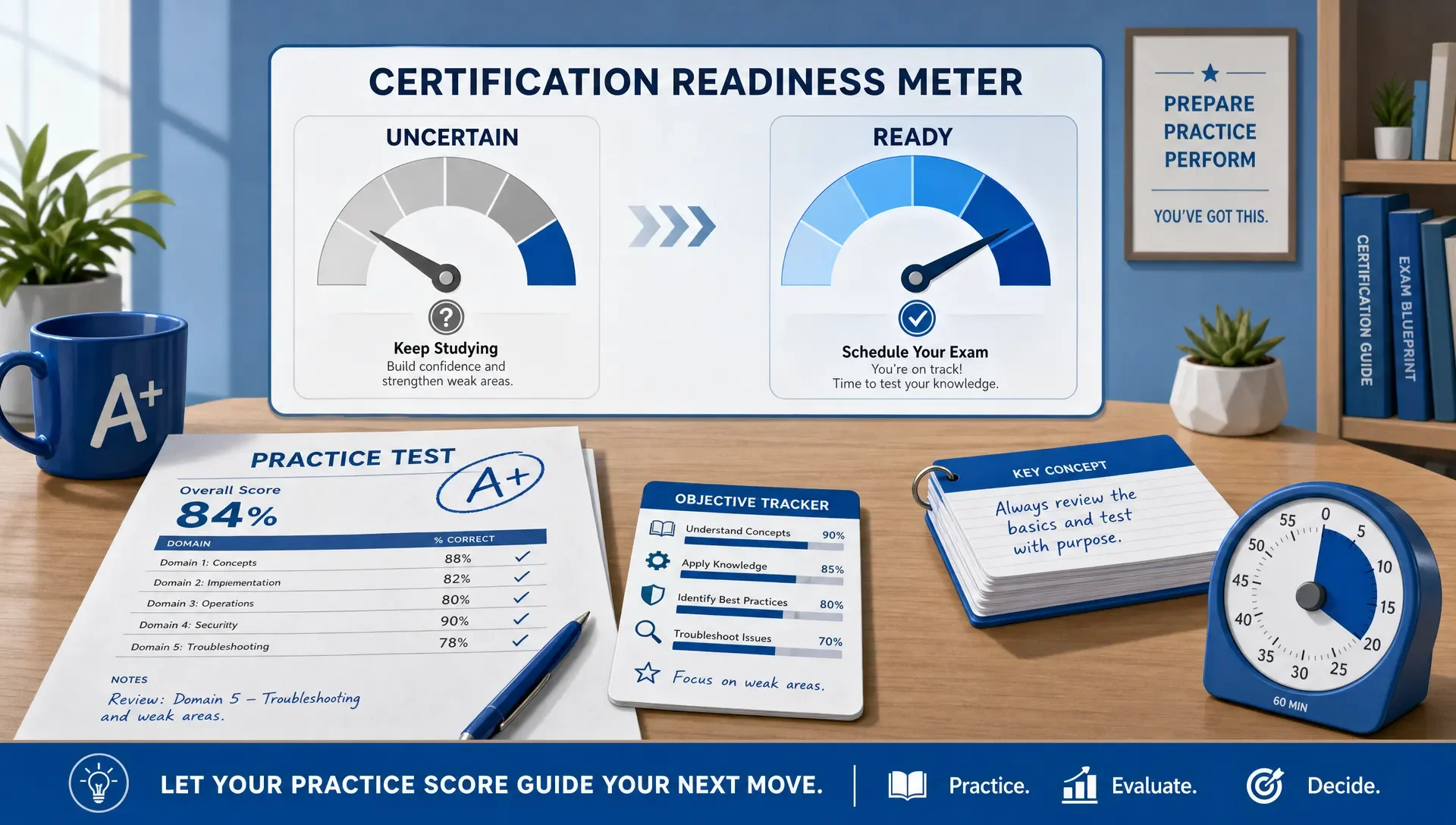
CompTIA A+ Practice Test Scores and What They Mean
CompTIA A+ Practice Test Scores and What They Mean
If your latest CompTIA A+ practice test score is 72%, 81%, or 94%, don't just treat that number as a simple pass or fail prediction. A practice score helps you most when you understand what kind of test produced it, whether the questions align with the current objectives, how you handled performance-based questions, and if you were testing from memory or truly solving new problems.
Use your score as a diagnostic tool. The goal isn't to chase a perfect percentage. Instead, aim to identify the domains, troubleshooting steps, and timing habits that could cost you points on Core 1 or Core 2. Then, fix them before you invest in the actual exam.
What a CompTIA A+ Practice Test Score Actually Measures
A CompTIA A+ practice test score usually reports a raw percentage, such as 78 out of 100 questions correct. This number reflects your performance on that specific set of questions. It doesn't automatically predict your official CompTIA scaled score.
A good practice test measures several skills: your factual knowledge, your ability to apply concepts in scenarios, your troubleshooting sequence, your comfort with technical wording, and your pacing. For A+, this matters because the exam asks more than just definitions of hardware, networking, operating systems, security, and operational procedures. It requires you to choose the best next step when something goes wrong.
When you review a practice score, ask three questions before deciding if you're ready:
- Did the test cover the current Core 1 or Core 2 objectives in the right depth?
- Did you answer under exam-like conditions, with a timer and no notes?
- Can you explain why the correct answer is right and why the incorrect answers are wrong?
If you answer no to any of these, your score might be inflated. That doesn't make the test useless, but it means you should use the result for study planning rather than as a confident indicator for scheduling your exam.
How Practice Scores Compare With the Real CompTIA A+ Exam
You earn CompTIA A+ by passing two exams: Core 1 and Core 2. CompTIA lists the current A+ exam details—including exam codes, time limits, question types, and passing scores—on its official CompTIA A+ certification page.
The official exam uses scaled scoring. This means you shouldn't convert the passing score into a simple percentage by dividing it by 900. CompTIA doesn't publish a public formula for turning raw correct answers into final scaled scores. Also, performance-based questions may not behave like standard multiple-choice questions in a basic practice test.
| Exam | Current exam code | Official passing score | Common exam format details | What your practice score cannot prove |
|---|---|---|---|---|
| Core 1 | 220-1201 | 675 on a 100-900 scale | Up to 90 questions, 90 minutes, multiple-choice and performance-based questions | Your exact scaled score on the real exam |
| Core 2 | 220-1202 | 700 on a 100-900 scale | Up to 90 questions, 90 minutes, multiple-choice and performance-based questions | How CompTIA will weight your specific mix of questions |
The key takeaway is simple: a 78% practice score isn't the same as a 700 scaled score. It might be good enough, too low, or misleading, depending on the quality of the test and the pattern of your missed questions.
If you need to connect your score to the actual exam domains, use a domain-based resource like this CompTIA A+ certification study guide by exam domain to identify whether your weak areas are small gaps or major objective-level risks.
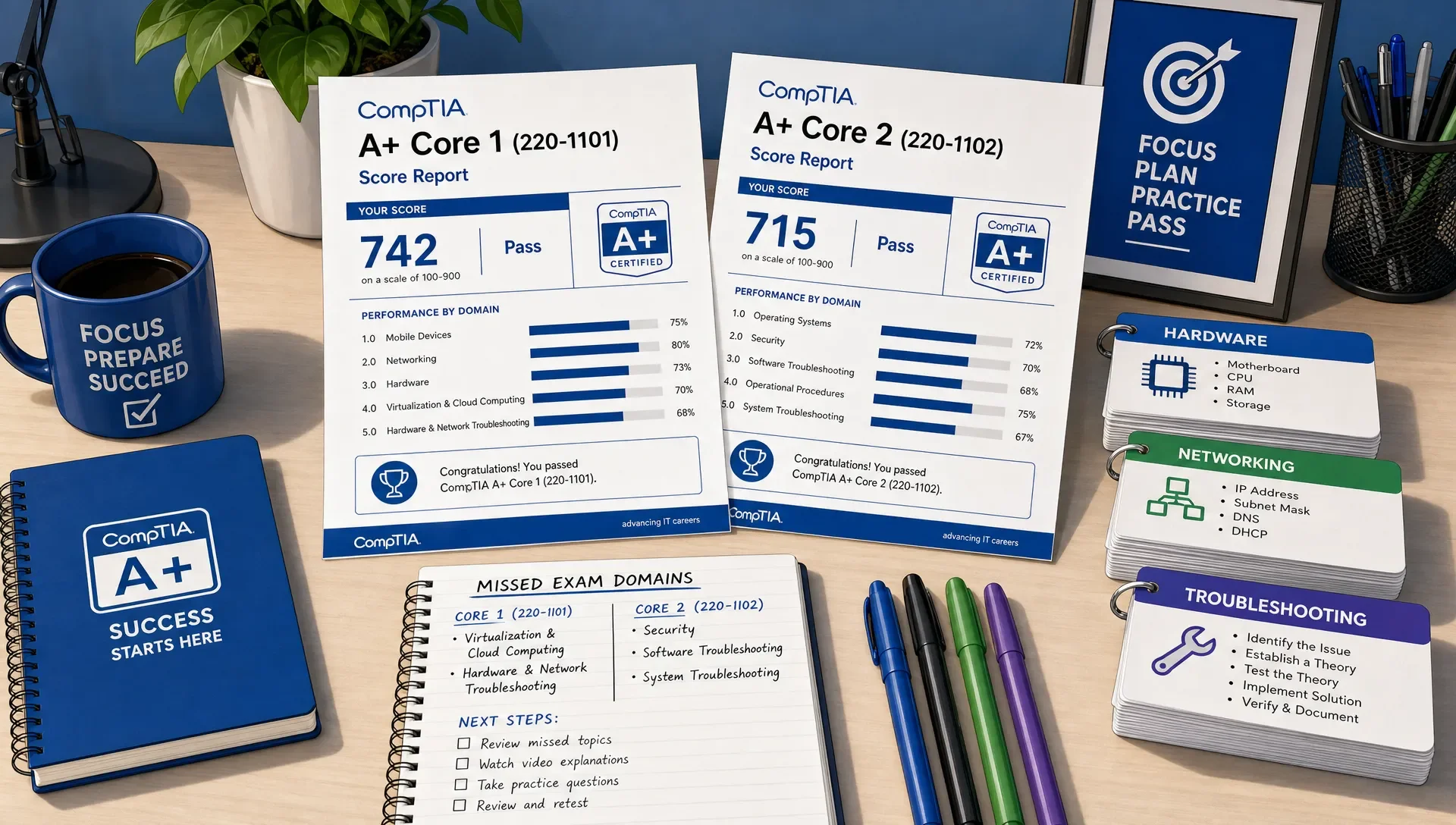
CompTIA A+ Practice Test Score Ranges: What They Usually Mean
Use the ranges below as planning guidance, not as a guarantee. A fresh, timed, objective-aligned practice exam provides much more meaningful insight than a repeated quiz where you already recognize half the questions.
| Practice test score | What it usually means | Best next move |
|---|---|---|
| 90% or higher | You're likely strong on that question set, but repeated exposure may be inflating the result. | Take a fresh timed test and review PBQs before scheduling. |
| 80-89% | You're close if the test is current, timed, and unfamiliar. | Fix your lowest domains, then confirm with another full-length test. |
| 70-79% | You understand many topics but still have exam-risk gaps. | Review missed objectives and do targeted practice before another full test. |
| 60-69% | Your foundation is uneven, especially if misses cluster by domain. | Return to study guides and short quizzes before full-length testing. |
| Below 60% | You're probably using the practice test too early. | Rebuild the basics by objective, then use quizzes as checkpoints. |
For most learners, a reliable readiness target is consistent scoring in the mid-80s or higher on fresh, timed tests, with no major domain below roughly the mid-70s. That buffer matters because the real exam can feel harder due to unfamiliar wording, performance-based questions, and test-day pressure.
A structured CompTIA A+ practice exam is most useful when it provides explanations and topic-level feedback, not just a final percentage. Your next study session should focus on what you missed, not on a vague feeling that you need to "study more."
Why a High Practice Test Score Might Not Mean You Are Ready
An 85% practice score can be excellent. It can also be a warning sign if you earned it the wrong way. Many candidates score well on practice questions because they remember the wording, not because they can truly solve a new troubleshooting scenario.
The biggest risk is remembering repeated questions. If you retake the same bank several times, your score will rise even if your underlying understanding hasn't improved much. That's normal. The fix is to separate review mode from readiness mode. Review mode can use repeated questions. Readiness mode should use fresh questions, a timer, and no notes.
| Inflated score signal | Why it matters | How to correct it |
|---|---|---|
| You recognize questions before reading all answers | You're testing memory, not exam reasoning. | Use fresh questions for readiness checks. |
| You skip explanations for correct answers | You may have guessed correctly or relied on elimination. | Explain every answer choice in your own words. |
| You score high overall but low in one domain | Averages can hide exam-threatening weaknesses. | Track scores by objective, not only by total score. |
| You avoid PBQs or simulations | A+ includes performance-based question formats. | Practice workflows like configuring settings, matching components, and troubleshooting steps. |
| You test untimed | You may not know whether you can finish under pressure. | Use full 90-minute timing for final practice attempts. |
Timing is especially important if you tend to overthink scenario questions. If your scores drop when the clock is on, review practical pacing strategies in these practice certification exam timing tips before you schedule.
How to Read Your Score Report by Exam Objective
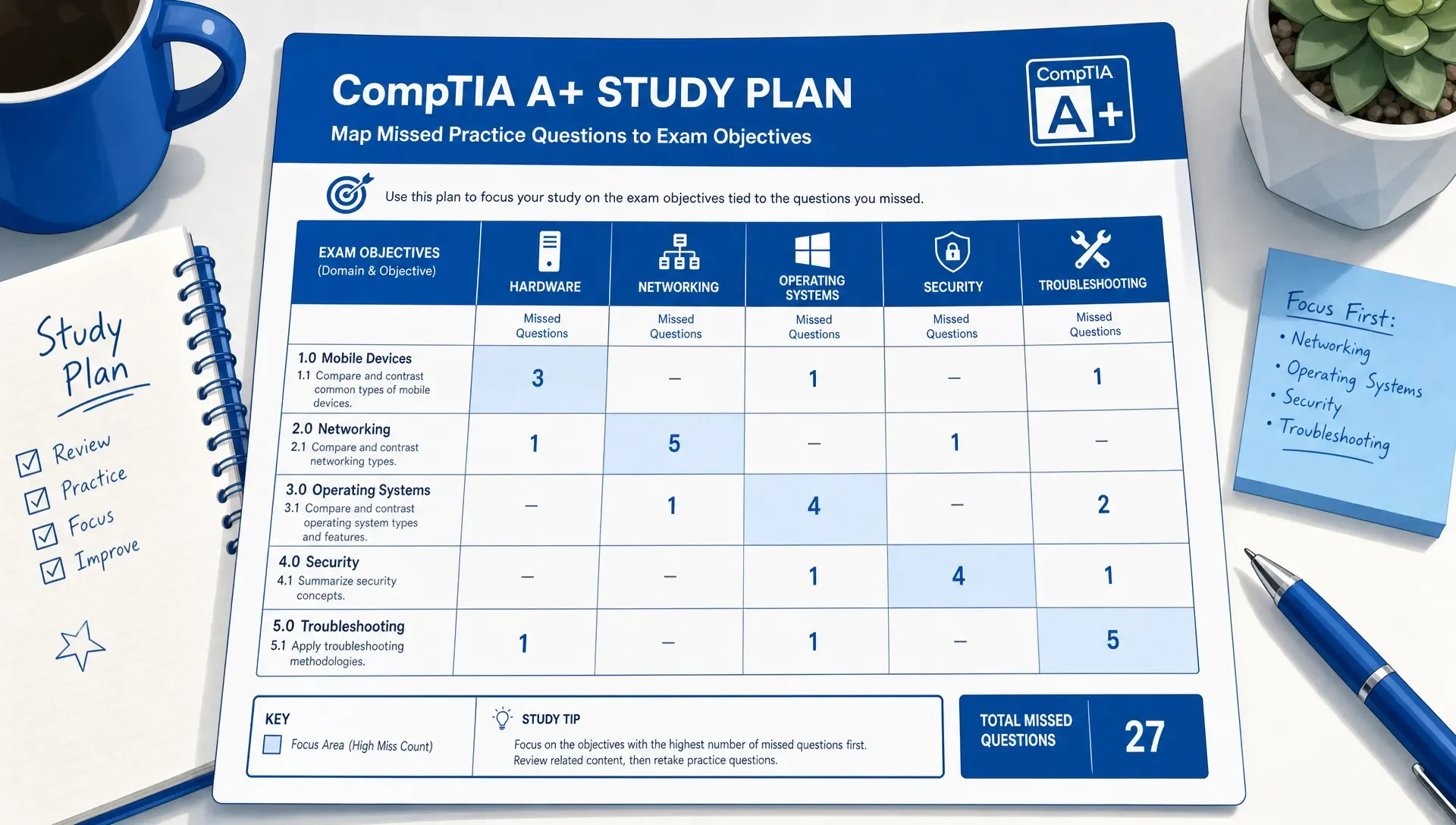
Your total score is the headline, but your objective-level breakdown tells the story. A 78% with balanced domain scores is very different from a 78% where you scored 95% in hardware and 52% in networking.
Start by categorizing every missed question by why you missed it. Don't just write down the correct answer. Write down why you missed it. This transforms review from passive reading into targeted repair.
| Miss pattern | What it likely means | What to do next |
|---|---|---|
| You didn't know the term or feature | Content gap | Revisit the objective, then make flashcards for definitions and use cases. |
| You knew the topic but chose the second-best answer | Scenario judgment gap | Study troubleshooting order and compare answer choices more carefully. |
| You missed several questions from the same domain | Objective-level weakness | Pause full exams and do focused practice for that domain. |
| You missed PBQ-style tasks | Hands-on workflow gap | Practice configuration steps, matching tasks, and process sequences. |
| You changed correct answers to wrong ones | Confidence or pacing issue | Mark uncertain questions, move on, and only change answers with clear evidence. |
This is where practice questions become much more powerful than reading alone. The Institute of Education Sciences recommends using quizzes to check understanding and guide study. It also supports distributing practice over time rather than cramming everything into one session, as detailed in its guide on organizing instruction and study to improve student learning.
How Many Practice Tests Should You Take Before Scheduling
More practice tests aren't always better. If you take five full exams in a row without reviewing deeply, you're mostly practicing endurance and frustration. A better approach alternates full-length tests with targeted repair.
A practical sequence looks like this:
- Take one baseline full-length test after your first pass through the objectives.
- Spend several sessions on targeted quizzes for your weakest domains.
- Take a second full-length timed test with fresh questions.
- Review every missed question and every guessed question.
- Take one final readiness test only after your weak domains improve.
For many candidates, two to four full-length practice exams per core is enough when combined with strong review. If your score is below 70%, another full exam usually isn't the best next step. You need focused study first.
Also, don't average Core 1 and Core 2 scores. A strong Core 1 score doesn't make up for a weak Core 2 score. You must pass both exams, and each exam emphasizes different topics. Core 1 focuses heavily on hardware, mobile devices, networking, virtualization, and troubleshooting. Core 2 places more weight on operating systems, security, software troubleshooting, and operational procedures.
A 7-Day Plan If Your Score Is Stuck
If your CompTIA A+ practice test score has been stuck in the 70s, don't just keep retaking the same exam. Use the next week to transform your score report into a recovery plan.
| Day | Focus | What to produce |
|---|---|---|
| 1 | Review your last full test | A list of missed questions grouped by exam objective |
| 2 | Repair your weakest domain | Notes, flashcards, and 20-30 targeted questions |
| 3 | Practice PBQ-style workflows | A checklist for common configuration and troubleshooting tasks |
| 4 | Review second-weakest domain | A smaller miss list and updated flashcards |
| 5 | Timed mixed quiz | Evidence that you can switch topics without notes |
| 6 | Fresh full-length practice test | A readiness score under exam-like conditions |
| 7 | Final review or reschedule decision | A clear go or delay decision based on objective-level scores |
MindMesh Academy is built around this connected workflow: study guides by exam objectives, practice questions with explanations, flashcards with spaced repetition, adaptive weakness-based practice, and readiness tracking. If you need a structured path instead of scattered notes, start with the CompTIA A+ study guide and use your practice scores to decide what to study next.
Frequently Asked Questions
What score do I need on a CompTIA A+ practice test to pass? There's no official practice-test percentage that guarantees a pass. As a practical target, aim for consistent scores in the mid-80s or higher on fresh, timed, objective-aligned tests, with no major domain significantly lagging.
Is 70% on a CompTIA A+ practice test good? A 70% score means you have a foundation, but you're likely not ready yet. Review the missed objectives, focus on weak domains, and retest with fresh questions after targeted study.
Can I average my Core 1 and Core 2 practice scores? No. Treat Core 1 and Core 2 separately because you must pass both exams independently. A high Core 1 practice score doesn't compensate for weak Core 2 readiness.
Why did I score high on practice tests but fail the real exam? Common reasons include memorizing repeated questions, practicing without performance-based questions, testing untimed, using outdated objectives, or having one weak domain hidden by a strong overall average.
Should I retake the same CompTIA A+ practice test? Yes, but only for review. Retaking the same test helps reinforce explanations, but it shouldn't be your final readiness check. Use fresh, timed questions before scheduling your exam.
Should I review questions I got right? Yes. Correct answers can include lucky guesses. If you can't explain why the right answer is best and why the distractors are wrong, mark that topic for further review.
Turn Your Practice Score Into Exam Readiness
A CompTIA A+ practice test score should tell you what to do next, not just whether to feel confident or worried. Look beyond the percentage, check your objective-level gaps, practice under realistic timing, and confirm your readiness with fresh questions before exam day.
If you're preparing for your CompTIA A+ certification, MindMesh Academy offers practice questions with detailed explanations, adaptive weak-area practice, and readiness tracking. Get ready for your Core 1 exam by trying our CompTIA A+ Core 1 practice exam.

Written by
Alvin Varughese
Founder, MindMesh Academy
Alvin Varughese is the founder of MindMesh Academy and an enterprise architecture leader. An electrical engineer by training, he moved from factory automation in South Africa to cloud architecture at GE Appliances and Humana (Fortune 50), and holds 20 professional certifications including AWS Solutions Architect Professional, Azure DevOps Engineer Expert, and Microsoft Agentic AI Business Solutions Architect. He built MindMesh Academy after interviewing too many highly certified candidates who couldn't answer basic questions: the goal is prep that makes you better at the job, not just able to pass the exam.