Cisco Practice Exam Review for CCNA Candidates
Cisco Practice Exam Review for CCNA Candidates
A good CCNA practice exam shows if you can explain, configure, and troubleshoot, not just recall memorized answers. Before you trust a mock-test score for your CCNA preparation, check three key areas: alignment with Cisco's current objectives, explanations that teach the underlying decision, and opportunities to apply concepts in a lab.
MindMesh Academy offers structured study guides, adaptive practice, and readiness tracking, providing a connected study workflow. This review focuses on evaluating these features, rather than independently measured pass rates or a direct audit of our question bank. We'll explore the critical checks to make when choosing a practice exam and practical methods to convert your test results into more effective study.
What a CCNA Practice Test Needs to Cover
Start with the official Cisco CCNA exam topics. Check the current blueprint when you begin studying, and again before you book your exam. An exam code alone doesn't guarantee a question bank reflects the most current objectives.
The following domains provide a useful coverage checklist. These examples illustrate the skills to examine, but they're not a replacement for Cisco's detailed blueprint.
| CCNA domain | What useful practice should help you do |
|---|---|
| Network fundamentals | Interpret addressing, interfaces, and basic network behavior |
| Network access | Reason through VLANs, trunks, switching, and wireless access concepts |
| IP connectivity | Read routing tables and understand static routing and OSPF behavior |
| IP services | Distinguish services such as DHCP, DNS, NAT, and NTP |
| Security fundamentals | Apply access-control concepts and recognize device-security requirements |
| Automation and programmability | Interpret controller-based networking, APIs, and structured data concepts |
A Cisco practice exam shouldn't let strong subnetting results obscure weak security or automation knowledge. Look for comprehensive coverage across the blueprint and feedback detailed enough to identify the specific objective behind a mistake.
Also, distinguish between objectives that ask you to describe something and those that ask you to configure and verify it. Simply recognizing a definition doesn't prove you can choose a command, interpret its output, or diagnose a failed configuration.
MindMesh Academy Review: Strengths and Limits for CCNA
MindMesh Academy's main strength is its connected study workflow. The platform offers objective-based study guides, practice questions with explanations, spaced-repetition flashcards, and adaptive weakness-based practice. Tools like topic progress, mastery, and readiness tracking help you organize what to study next.
These features address different preparation problems:
| Stated platform feature | How it can support your preparation |
|---|---|
| Study guides by exam objectives | Give weak-topic review a defined scope |
| Practice questions and explanations | Connect an answer to the reasoning behind it |
| Adaptive weakness-based practice | Focus additional practice on areas that need attention |
| Spaced-repetition flashcards | Revisit facts and distinctions over time |
| Topic progress and readiness tracking | Make progress easier to assess than an overall score alone |
| Performance-based question formats | Add practice beyond simple answer recognition |
The platform also highlights expert-reviewed content. While this context is helpful, you should still inspect representative explanations yourself and confirm that the CCNA material matches the current blueprint.
When choosing a Cisco practice exam, always distinguish between listed study features and actual evidence of exam fidelity. The stated features don't tell you the CCNA question bank's size, its precise difficulty, or how closely its interface resembles Cisco's official exam.
Best fit: Candidates who want study guides, questions, flashcards, and progress tracking within a single workflow. Important limit: These tools don't remove the need to configure networks and investigate unfamiliar failures. Don't assume performance-based practice provides a complete network simulator or precisely replicates Cisco's actual testing experience.
How to Evaluate a Cisco Practice Exam's Explanations
Inspect the reasoning behind several questions before you rely on a score. A useful explanation identifies the decisive evidence, explains why the correct choice fits, and addresses plausible alternatives. Simply repeating the correct answer doesn't give you much insight to transfer to a new problem.
Consider this example: A router's routing table contains a static route to 10.20.0.0/16 and an OSPF route to 10.20.30.0/24. A packet is destined for 10.20.30.77.
A weak explanation might say, "Choose the /24 route because it's more specific." A stronger explanation connects the destination to both prefixes and clarifies that forwarding uses the longest matching prefix. It also addresses the tempting mistake: the static route's lower administrative distance doesn't make the less-specific /16 route win this forwarding decision.
Now, change the destination to 10.20.40.77. The /24 route no longer matches, but the /16 still does. If you can explain that change without seeing answer choices, you've learned something reusable.
A reliable Cisco practice exam should support this kind of transfer, rather than simply rewarding recognition of a familiar sentence. Questions should provide enough information to reach a defensible answer, without forcing you to guess an unstated topology or configuration.
For additional topic examples, MindMesh Academy's walkthrough of core CCNA examination questions can help you compare explanation styles. Use examples to test your reasoning, not to build a list of answers to memorize.

How to Review Missed Questions Without Memorizing Answers
The review session is where a practice test truly becomes useful. Include questions you answered correctly by guessing, not just the ones marked wrong. A lucky answer can hide the same knowledge gap as an incorrect one.
After a Cisco practice exam, make a note of the specific decision you couldn't make and the evidence you overlooked. "Review routing" is too broad. "I compared administrative distance before checking which destination prefixes matched" gives you a specific behavior to correct.
Reconstruct the Reasoning Before Reading the Explanation
Try the question again without any answer choices. Identify the relevant addresses, interface states, commands, or constraints. State what you expect to happen and why, then compare your reasoning with the provided explanation.
For a command-output question, point to the exact line supporting your conclusion. For a configuration question, explain what each command changes. This process separates a true understanding gap from a rushed reading mistake.
Create a New Task from the Same Objective
Change an address, interface state, or requirement and solve the revised problem. For instance, replace an allowed source subnet in an ACL scenario and determine whether the same rule still permits the traffic.
Use flashcards for compact facts and distinctions. Turn to a lab when the gap involves configuration or verification. A flashcard can reinforce what a command does, but it can't demonstrate that you know when to use it.
Finish your review by choosing a specific next task: revisit an objective, run targeted practice, or build a small lab. Don't immediately retake the full test just to boost a percentage.
Which Practice Scores Indicate CCNA Readiness
An overall percentage is one signal, not a final verdict. No single provider-independent mock-test percentage guarantees a CCNA pass, and difficulty varies between question banks. Repeatedly taking the same test can also produce a high score because you remember its wording.
A Cisco practice exam offers stronger readiness evidence when you haven't seen the questions recently, complete it under controlled conditions, and can explain the decisions afterward. Separate those results from scores earned with notes, answer checking, or immediate retakes.
Use three complementary checks:
- Breadth: You can handle questions across all current objectives, rather than succeeding mainly in your strongest domains.
- Reasoning: You can explain correct answers and reject plausible alternatives without relying on answer position or wording.
- Execution: You can perform representative configuration and verification tasks without a step-by-step script.
Track hesitation as well as accuracy. A correct answer that requires prolonged trial and error may point to a topic needing more practice. Conversely, a quick wrong answer can expose an unchallenged assumption.
MindMesh Academy's topic progress and readiness tracking can help organize this assessment. Treat these indicators as inputs to your decision, alongside unfamiliar-question performance and lab work. Don't interpret a readiness label as a guarantee or assume it reproduces Cisco's scoring method.
If one objective consistently causes you trouble, address it directly before taking another broad test. More testing alone won't fix a concept you haven't grasped.
How to Combine Practice Exams with CCNA Labs
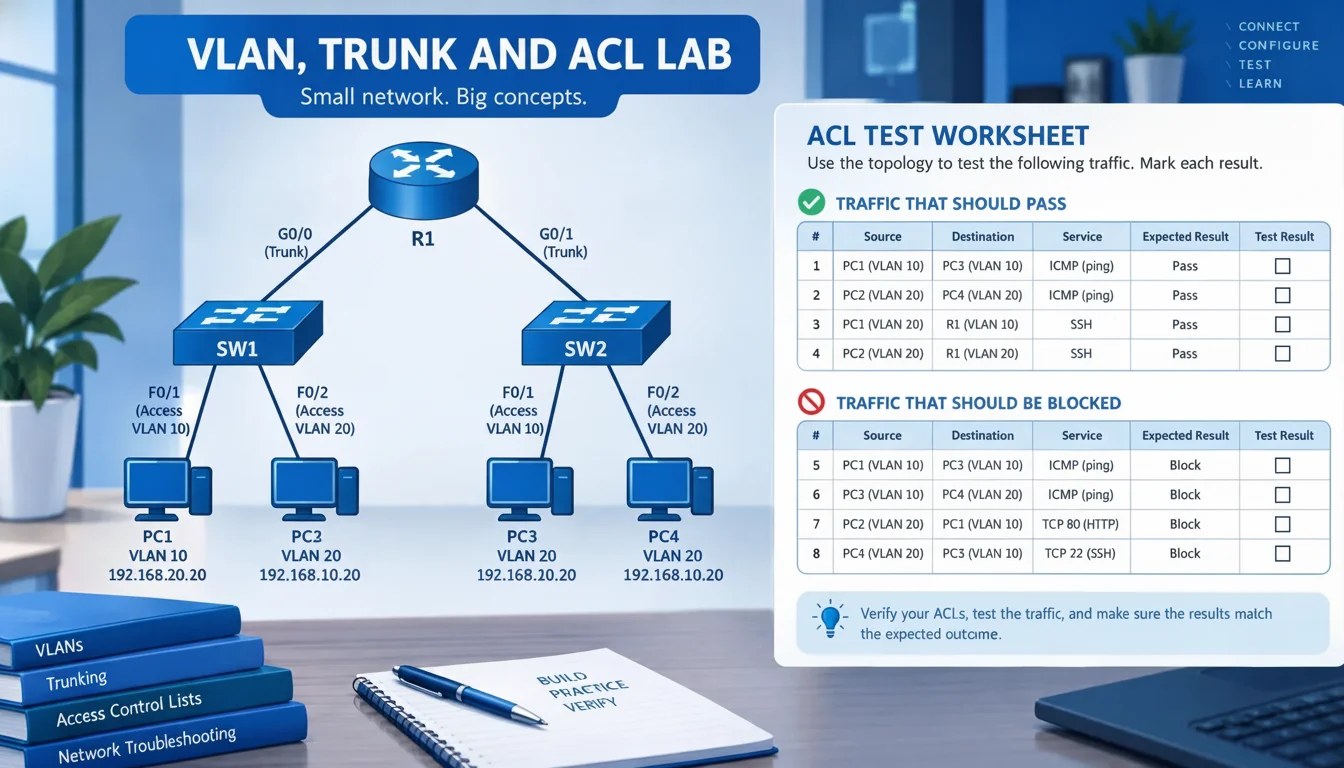
Build labs around the decisions your practice questions expose. You don't need a large topology for every objective. Two switches can reveal a trunk or VLAN mistake, while a small routed network can help you inspect next hops and route selection.
For each lab, define an expected result before configuring anything. Establish connectivity, introduce one controlled fault, and use verification commands to locate it. For an ACL exercise, test both traffic that should pass and traffic that should fail.
Use a Cisco practice exam to select the objective, then use the lab to check whether you can apply it. This connection prevents practice sessions from becoming disconnected collections of questions and commands.
Cisco Packet Tracer is an official option for building simulated networking exercises. Check that the device and command behavior you need are supported, since a simulator doesn't reproduce every hardware feature.
If your weak areas span multiple domains, the domain-by-domain Cisco study plan can help you organize the work. Prioritize topics that need repair, but retain occasional mixed practice so stronger areas don't disappear from your schedule.
Frequently Asked Questions
What is a good score on a CCNA practice exam? A useful score comes from unfamiliar questions completed without assistance. Consider consistency across objectives and your ability to explain answers, not just the percentage. A prep provider's score isn't automatically equivalent to Cisco's exam score.
How many practice exams should I take before CCNA? Take enough to establish a baseline, check your progress after targeted study, and assess performance under controlled conditions. The number matters less than the quality of your review. Repeating familiar questions adds little evidence that you're ready.
Can MindMesh Academy replace CCNA lab practice? Its features include performance-based question formats, explanations, and adaptive practice. These can certainly support preparation, but don't assume they fully replace hands-on network configuration and troubleshooting. Combine your study workflow with physical or simulated labs.
Should I choose a free or paid Cisco practice exam? Evaluate both by objective coverage, clear explanations, and their ability to identify your weaknesses. Price alone doesn't establish quality. Inspect representative questions to determine whether the resource teaches reasoning or merely displays an answer key.
Are exam dumps the same as legitimate practice questions? No. Dumps claim to reproduce actual exam content, rather than provide original preparation material. Avoid them and review Cisco's exam policies. Choose resources that teach the objectives without offering recalled exam questions.
Turn Your Next Practice Result into a Study Decision
If you're looking for a structured way to organize your CCNA preparation, explore MindMesh Academy's range of resources, including our CCNA practice exam. Assess its coverage and explanations against the checks above, then connect each weak result to a study guide review, targeted practice session, or lab. Your next Cisco practice exam should answer a specific question: can you now solve the problems that caused difficulty last time? A higher percentage is truly useful only when better reasoning and practical skills support it.

Written by
Alvin Varughese
Founder, MindMesh Academy
Alvin Varughese is the founder of MindMesh Academy and an enterprise architecture leader. An electrical engineer by training, he moved from factory automation in South Africa to cloud architecture at GE Appliances and Humana (Fortune 50), and holds 20 professional certifications including AWS Solutions Architect Professional, Azure DevOps Engineer Expert, and Microsoft Agentic AI Business Solutions Architect. He built MindMesh Academy after interviewing too many highly certified candidates who couldn't answer basic questions: the goal is prep that makes you better at the job, not just able to pass the exam.