Cisco Exam Prep: A Domain-by-Domain Study Plan
Cisco Exam Prep: A Domain-by-Domain Study Plan
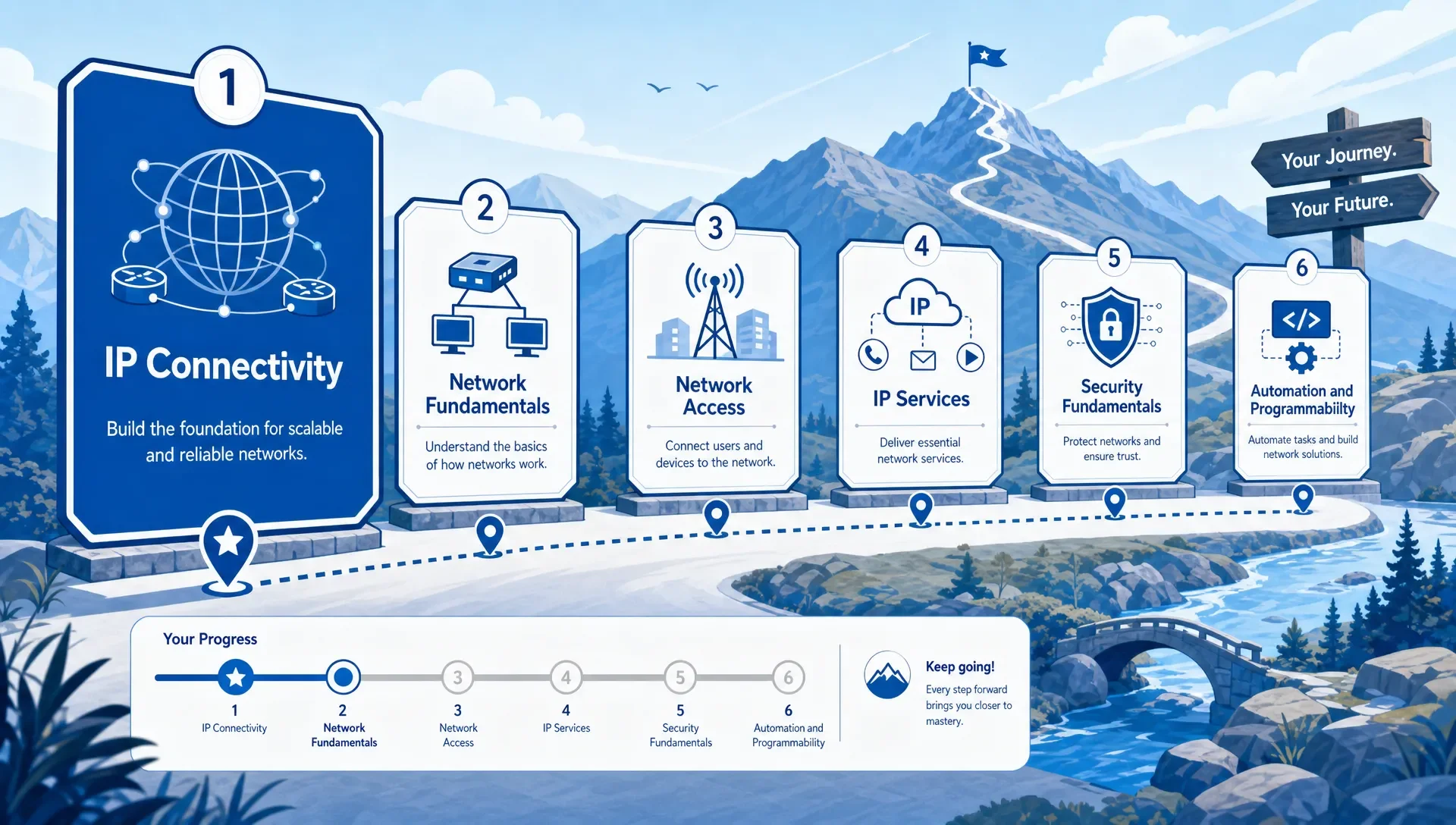
To prepare for a Cisco exam, begin with the official blueprint, not a stack of random notes. For the CCNA 200-301, Cisco organizes the exam into six weighted domains. These weights should drive your study hours, lab practice, and review schedule.
This plan uses CCNA as the working example because it's the most common entry point for Cisco certification. If you're preparing for another Cisco exam, use the same method: replace the domain names and percentages with the current blueprint for your exam. Then, study each domain until you can explain, configure, and troubleshoot its objectives without relying on answer memorization.
How to Build Cisco Exam Prep Around Official Domains
Your first step is to align your study plan with the official Cisco exam topics. Cisco publishes the official CCNA exam information and domain structure on its CCNA exam page, including the percentage weight for each major domain. Use that as your source of truth, because blog posts, forum threads, and older study plans can lag behind blueprint changes.
For most learners, a domain-based plan works better than studying chapter by chapter. Cisco exams don't ask whether you watched a lesson. They test whether you can interpret a scenario, identify the relevant concept, and choose the best technical action under time pressure. That means every study session should end with an output: a solved subnetting set, a configured lab, a command you can interpret, or a missed question you can explain.
Before you start, set up three simple tracking tools:
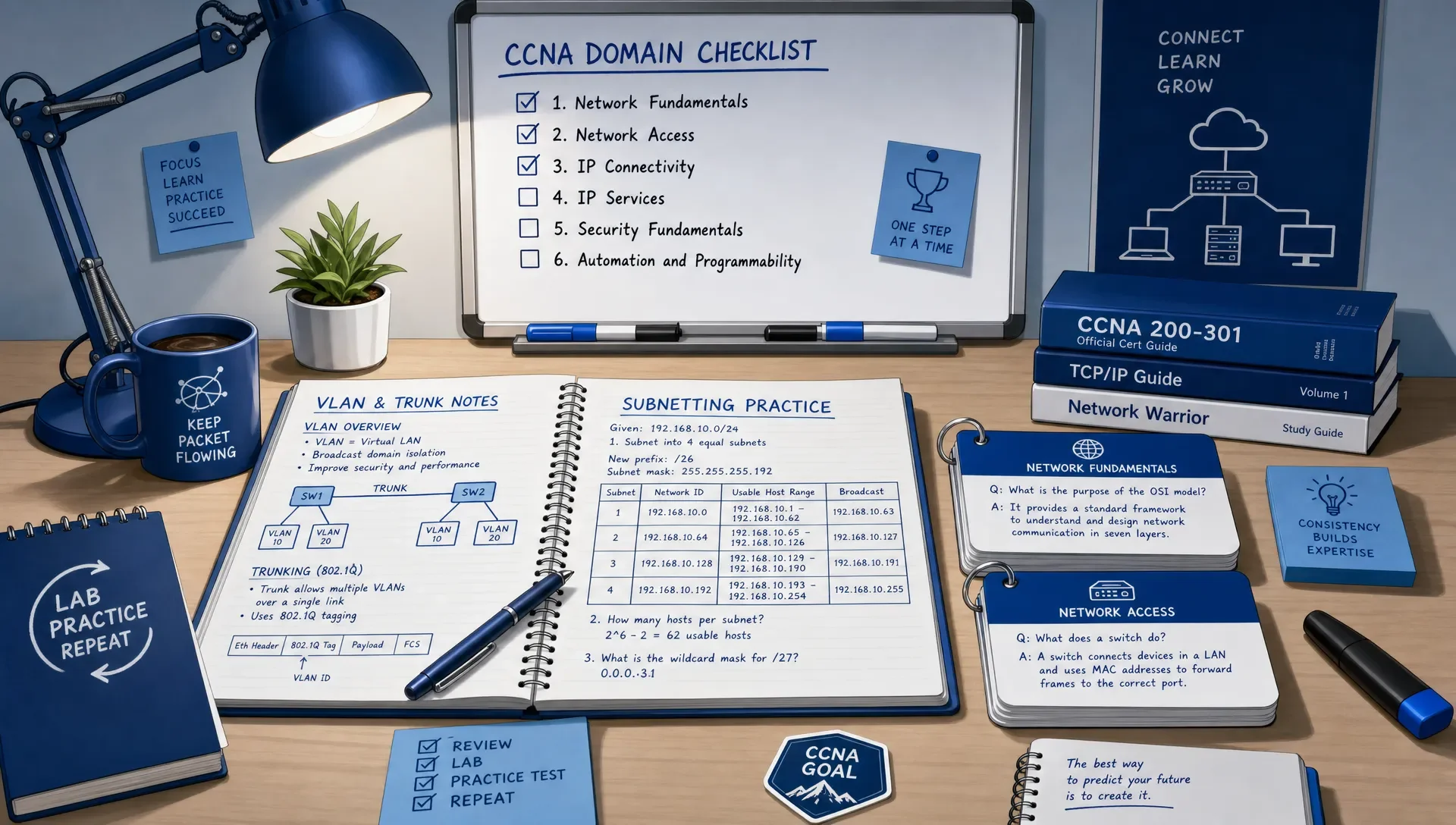
- A domain checklist copied from the official exam topics
- A lab notebook for commands, diagrams, and verification outputs
- A missed-question log that records the domain, the reason you missed it, and the fix
If you want a structured path instead of building your own checklist from scratch, the MindMesh Cisco CCNA study guide organizes preparation around exam objectives, so you can move from reading to practice without losing the thread.
Cisco CCNA Exam Domains and How Much Time to Spend
The CCNA domains aren't equal in weight, so your study calendar shouldn't treat them equally. IP Connectivity is the largest domain. IP Services and Automation and Programmability are smaller, but still easy places to lose points if you ignore them.
The table below uses an 80-hour study plan as an example. Adjust the total hours up or down based on your experience, but keep the proportions close to the official weights.
| CCNA domain | Official weight | Example hours in an 80-hour plan | Main outcome to prove |
|---|---|---|---|
| Network Fundamentals | 20% | 16 hours | Explain addressing, models, cabling, topology, and basic packet flow |
| Network Access | 20% | 16 hours | Configure and troubleshoot VLANs, trunks, STP, and wireless basics |
| IP Connectivity | 25% | 20 hours | Interpret routing decisions and troubleshoot static routing and OSPF |
| IP Services | 10% | 8 hours | Understand NAT, DHCP, DNS, NTP, SNMP, syslog, and QoS basics |
| Security Fundamentals | 15% | 12 hours | Apply device hardening, ACL logic, Layer 2 security, and authentication concepts |
| Automation and Programmability | 10% | 8 hours | Read JSON, understand APIs, controllers, and automation concepts |
A practical weekly schedule for this plan is nine weeks long: six weeks for the three largest domains, two weeks for the smaller domains, and one final review week. If you already work in networking, you may compress it. If you're new to IP addressing or routing, give yourself more time before you book the exam.
How to Study Network Fundamentals for the Cisco Exam
Network Fundamentals is where many candidates either build a strong foundation or develop gaps that affect other domains. Don't rush it because you recognize the vocabulary. Knowing that OSI Layer 3 is the network layer isn't enough. You need to trace what happens when a host sends traffic to a local device, a remote subnet, or a server behind a default gateway.
Your main study targets are IPv4 addressing, subnetting, IPv6 basics, Ethernet concepts, wireless principles, switching and routing roles, physical interfaces, and basic topology types. Subnetting needs daily repetition. You don't have to spend hours on it each day, but you should do enough problems that network ranges, usable hosts, and gateway placement become routine.
Each effective Network Fundamentals study session has three parts. First, review one concept from the blueprint. Next, draw or explain it from memory. Then, solve a few scenario questions where that concept changes the answer. For example, don't just define a default gateway. Explain why a host can ping another host in the same VLAN but can't reach a remote subnet when the default gateway is wrong.
By the end of this domain, you should be able to look at a small diagram and identify the IP network, likely default gateway, broadcast domain, collision domain, and path a frame or packet takes through the network.
How to Study Network Access for the Cisco Exam
Network Access turns switching from theory into behavior. Here, you need to understand VLAN segmentation, trunking, native VLANs, STP, EtherChannel, and wireless LAN architecture well enough to diagnose what would break in a real environment.
The fastest way to study this domain is to configure small switching scenarios and then intentionally break them. Create two VLANs, assign access ports, configure a trunk, and verify that traffic flows as expected. Then, change the allowed VLAN list, mismatch a native VLAN, or disable the wrong port and use show commands to find the issue.
MindMesh has a focused CCNA Network Access study guide section that covers this domain's core topics, including VLANs, trunk links, and Spanning Tree. Use it as a checkpoint after you've done hands-on configuration, so the concepts attach to something you've seen.
For wireless, don't get buried in vendor-specific implementation details. Make sure you understand access points, controllers, SSIDs, authentication options, roaming concepts, and how wireless clients connect to the wired network.
How to Study IP Connectivity for the Cisco Exam
IP Connectivity is the largest CCNA domain, and it needs the most deliberate practice. This is where Cisco tests whether you understand how routers make forwarding decisions and how dynamic routing behaves when the topology changes.
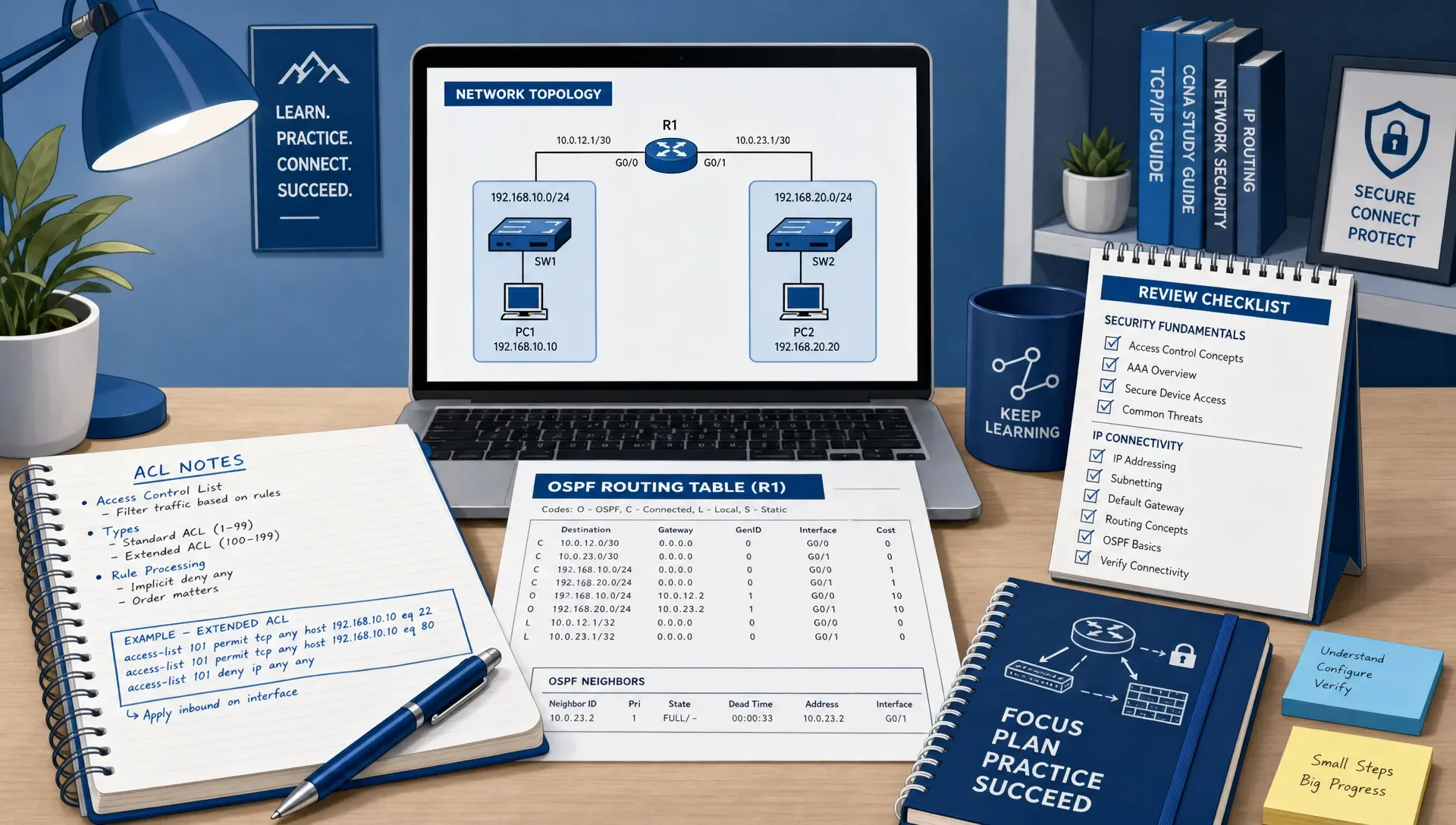
Start with routing table interpretation. You should be comfortable reading connected routes, static routes, default routes, and OSPF-learned routes. When multiple routes appear possible, explain the decision using longest prefix match first, then administrative distance and metric where relevant. If you can't explain why a specific route wins, you're not finished with this domain.
After that, build routing labs in small stages. Configure static routes between two routers, then add a default route, then introduce a third router, and identify where return traffic fails. Move to single-area OSPF and practice neighbor formation, network statements, passive interfaces, and verification commands.
Use scenario questions heavily here because routing questions often hide the issue in a small detail: the wrong wildcard mask, an interface in the wrong state, a missing return route, or an OSPF neighbor that never formed. When you miss a question, don't just write down the correct answer. Write the clue you failed to notice.
How to Study IP Services for the Cisco Exam
IP Services is only 10% of the CCNA, but it's a common challenge because the topics feel familiar. Most candidates have heard of DHCP, DNS, and NAT. The exam requires more than simple recognition. You need to understand the purpose, traffic flow, and basic verification for each service.
For NAT, focus on the difference between inside local, inside global, static NAT, dynamic NAT, and PAT. For DHCP, know what the client needs, what a relay agent does, and how address assignment can fail. For NTP, DNS, SNMP, syslog, and QoS basics, concentrate on function, placement, and interpretation rather than memorizing every possible command.
A helpful exercise is to create a one-page service map. For each service, write what problem it solves, what device commonly provides it, what traffic depends on it, and what symptom appears when it fails. This keeps the domain practical instead of turning it into a glossary.
How to Study Security Fundamentals for the Cisco Exam
Security Fundamentals requires a different mindset from routing and switching. You're still dealing with network behavior, but the question is often about reducing risk, controlling access, or applying the right protection at the right layer.
Spend time on device access security first: local authentication, strong passwords, SSH, privilege levels, login settings, and basic AAA concepts. Then move into ACLs. ACL questions reward precision, so practice reading them top to bottom, identifying implicit deny behavior, and knowing whether the ACL should apply inbound or outbound.
Layer 2 security is another high-value area. You should know the purpose of port security, DHCP snooping, Dynamic ARP Inspection, and related protections. Don't just memorize names. Tie each control to the attack or misconfiguration it helps prevent.
Wireless security also belongs here. Make sure you can distinguish open authentication, WPA versions at a high level, and enterprise authentication concepts. You don't need to become a wireless security engineer for CCNA, but you do need enough understanding to choose the safer design in a scenario.
How to Study Automation and Programmability for the Cisco Exam
Automation and Programmability might feel unfamiliar if you have a traditional networking background. Think of it as a literacy domain. You're not preparing to write a full application during the exam. You're preparing to understand how modern networks use controllers, APIs, and structured data.
Start with JSON. You should be able to identify key-value pairs, lists, and nested objects. Then, learn what REST APIs do, why HTTP methods matter, and how a controller-based network differs from purely device-by-device management.
Next, connect the concepts to network operations. Automation can retrieve device state, push configuration, enforce templates, or integrate with monitoring systems. Controller-based architectures centralize policy and visibility. The exam may ask you to recognize these patterns even when no code is required.
A solid study output for this domain is a short comparison table you can recreate from memory.
| Concept | What to know for exam prep | Simple check |
|---|---|---|
| JSON | Structured data format using keys and values | Can you read a nested object without confusion? |
| REST API | Interface that lets systems request or change data | Can you match GET, POST, PUT, and DELETE to actions? |
| Controller | Central point for policy, management, or visibility | Can you explain why it reduces device-by-device work? |
| Automation tool | Helps apply repeatable changes or collect state | Can you identify when automation is useful? |
Don't postpone this domain until the last minute. It may be smaller, but new terminology takes repeated exposure.
How to Review Cisco Exam Questions by Domain
Practice questions are most effective when they directly inform your next study session. If you answer 100 questions and only record the percentage, you lose the best data. Tag every missed or guessed question by domain, then identify the reason behind the miss.
| Missed-question pattern | What it usually means | Best next action |
|---|---|---|
| You didn't know the concept | Content gap | Return to the objective and make a short explanation note |
| You knew the concept but missed a keyword | Reading error | Slow down and underline qualifiers like best, first, not, or most likely |
| You misread output | Troubleshooting gap | Practice show command interpretation in a lab |
| You made a subnetting mistake | Speed or accuracy issue | Do short daily subnetting sets with written steps |
| You recognized the answer from repetition | Memorization risk | Switch to new questions and explain wrong choices aloud |
This is also where question format matters. Cisco-style questions may ask you to interpret diagrams, command output, or scenario details rather than recall a single definition. For a closer look at how prompts are structured, review MindMesh's guide to CCNA exam question types before starting full timed practice.
Use practice questions in two modes. In learning mode, answer by domain right after studying that topic and read every explanation. In exam mode, mix domains, set a timer, and don't pause to look things up. Both modes matter, but they solve different problems.
For more targeted practice habits, the MindMesh article on practice questions for the CCNA exam explains how active recall and timing can expose weak areas before exam day.
How to Know You're Ready for Your Cisco Exam
Readiness isn't just about finishing the last lesson. You're ready when your domain performance is stable, your weak areas are visible, and you can reason through unfamiliar questions without panic.
Use this checklist during your final review week:
- You can explain each CCNA domain in plain language without notes
- Your lowest domain scores are no longer in the highest-weight areas
- You can configure basic VLANs, trunks, static routes, and OSPF from memory
- You can interpret common
showcommand output without guessing - Your missed-question log shows repeated issues getting fixed, not repeated again
- You can explain why each wrong answer is wrong on difficult questions
MindMesh Academy's integrated workflow helps you prepare: study guides aligned with exam objectives, practice questions with explanations, and adaptive weakness-based practice. The goal isn't to feel busy. The goal is to see where you're strong, where you're exposed, and what to do next.
During the last few days, don't try to relearn every topic. Review your weakest domains, redo labs that once caused trouble, and practice mixed questions under time constraints. If one domain keeps dragging down your performance, spend one focused session fixing that domain before you attempt another full practice run.
Frequently Asked Questions
What is the best way to start Cisco exam prep? Start with the official Cisco exam topics, then build a domain checklist. Study the highest-weight domains early, but don't ignore smaller domains because they can decide the difference between almost ready and ready.
Should I study CCNA domains in order or by weight? A blended approach works best. Start with Network Fundamentals because it supports everything else, then give extra time to IP Connectivity, Network Access, and Security Fundamentals based on their weight and difficulty.
How many weeks do I need to prepare for the CCNA exam? Many learners can use a 9-week plan if they study consistently, but the right timeline depends on your background. If subnetting, routing, and switching are new to you, extend the plan rather than rushing through labs.
Do I need hands-on labs for a Cisco exam? Yes, especially for CCNA. Even when a question is multiple choice, lab practice helps you understand command output, configuration order, and troubleshooting symptoms.
How should I use flashcards for Cisco exam prep? Use flashcards for facts that need quick recall, such as port numbers, command purposes, acronym meanings, and security terms. Don't use them as a substitute for labs or scenario questions.
Are Cisco exam dumps a good study shortcut?? No. Dumps train recognition, not understanding, and they can violate exam policies. Use legitimate practice questions with explanations so you learn how to reason through new scenarios.
Turn This Cisco Exam Prep Plan Into Daily Practice
A domain-by-domain plan only works if you keep using it after the first week. Pick the next domain on your checklist, study the objective, test yourself, review the miss, and repeat until your weak areas shrink.
If you're preparing for CCNA, use the MindMesh CCNA practice exam to gauge your readiness and solidify your understanding. Our platform offers targeted practice questions and detailed explanations, helping you refine your skills based on your performance data, not just guesswork.

Written by
Alvin Varughese
Founder, MindMesh Academy
Alvin Varughese is the founder of MindMesh Academy and an enterprise architecture leader. An electrical engineer by training, he moved from factory automation in South Africa to cloud architecture at GE Appliances and Humana (Fortune 50), and holds 20 professional certifications including AWS Solutions Architect Professional, Azure DevOps Engineer Expert, and Microsoft Agentic AI Business Solutions Architect. He built MindMesh Academy after interviewing too many highly certified candidates who couldn't answer basic questions: the goal is prep that makes you better at the job, not just able to pass the exam.