Certification Practice Exams: When to Take Full Mocks
Certification Practice Exams: When to Take Full Mocks
You've covered every exam objective at least once, answered closed-book topic questions in each domain, and fixed your obvious weak spots? Only then should you take your first full mock certification practice exam. For most learners, this places that first full practice exam in the last third of their study plan, not on day one or the night before the real test.
After that, use full mocks sparingly: one baseline mock, one or two readiness mocks, and if needed, a final confidence check. A full mock takes time and focus. Its value isn't just the score; it shows whether you can combine topics under pressure, manage the clock, and avoid fatigue mistakes when questions are mixed.
What Counts as a Full Mock Certification Practice Exam
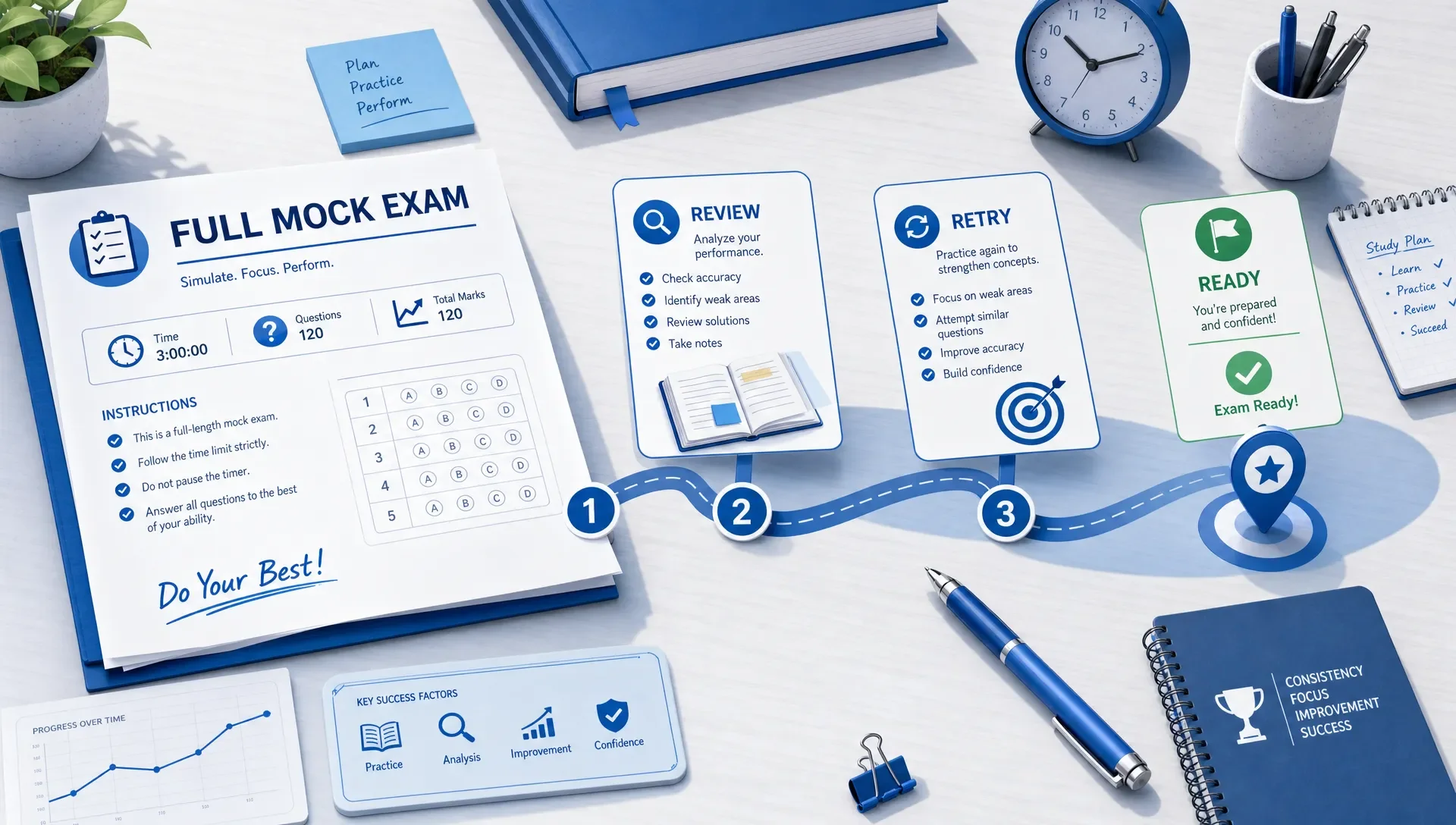
A full mock certification practice exam isn't the same thing as a 10-question quiz or a random test bank session. It should match the real exam as closely as your prep tool allows: timed, closed-book, full-length, mixed by domain, and completed in one sitting.
For exams with scenario-based or performance-based formats, the mock should include similar item types when possible. If the real exam expects you to interpret logs, choose a cloud service, troubleshoot a network path, or evaluate a security control, your full mock shouldn't be only definition recall.
Always consult the current exam blueprint. Before planning mocks, verify official objectives or exam guides from the certification provider. Check sources like the AWS certification exam guides, Microsoft certification study guides, CompTIA certification pages, or Cisco exam topics. Objectives change. A realistic mock schedule only helps if you're practicing against the current exam.
When to Take Your First Full Mock Exam
The best time to take your first full mock is after your first complete pass through the objectives, but before your final review window. That timing gives you enough knowledge to make the score meaningful and enough remaining study time to fix what the score reveals.
Taking a full mock too early usually confirms what you already suspect: you haven't studied enough. That's not a helpful diagnosis. A short diagnostic quiz near the start can work, but save full-length attempts for when mixed-domain testing can expose deeper problems.
Use this table as a practical checkpoint:
| Your current state | Should you take a full mock? | Better next move |
|---|---|---|
| You haven't studied several major domains | No | Work through the missing objectives first |
| You recognize terms but can't explain how they apply | Not yet | Use topic practice and flashcards until recall is stronger |
| You've covered every domain once and can answer basic closed-book questions | Yes, as a baseline | Take one full mock and review it deeply |
| You've completed targeted review after a baseline mock | Yes, as a readiness check | Compare patterns, not just scores |
| You're inside the final 24 hours before test day | Usually no | Review notes, rest, and keep confidence stable |
A good first mock should feel challenging but not completely foreign. If half the questions read like a different certification, your preparation probably hasn't reached full-mock stage yet.
Full Mock Exams vs Topic Practice Questions
Full mocks and topic practice solve different problems. Topic practice builds skill in a specific domain. Full mocks test whether you can switch between domains, stay accurate under time pressure, and apply knowledge without hints.
If you're still learning, topic practice is usually the better use of time. If you're nearly ready, full mocks become more valuable because they show whether your knowledge survives realistic exam conditions. For a deeper comparison, MindMesh Academy's guide on test banks vs practice exams explains when each format fits your study plan.
| Prep tool | Best used for | When to use it | Main mistake to avoid |
|---|---|---|---|
| Topic quiz | Learning one domain or objective | Early and middle study phases | Treating a high topic score as exam readiness |
| Test bank session | Getting more exposure to question styles | After reading or video study | Memorizing question wording |
| Flashcards | Strengthening recall over time | Throughout the plan | Only reviewing cards you already know |
| Full mock exam | Testing readiness under realistic conditions | Final third of prep | Taking too many without serious review |
If you're preparing for a broad cloud fundamentals exam, for instance, an AWS Certified Cloud Practitioner practice exam is most useful after you've worked through core areas like cloud concepts, billing, security, and basic architecture. Similarly, for a security role, a CompTIA Security+ practice exam becomes more revealing once you've studied threats, architecture, operations, risk, and governance enough to connect them in real-world scenarios.
How Often to Take Full Mock Exams Before Test Day
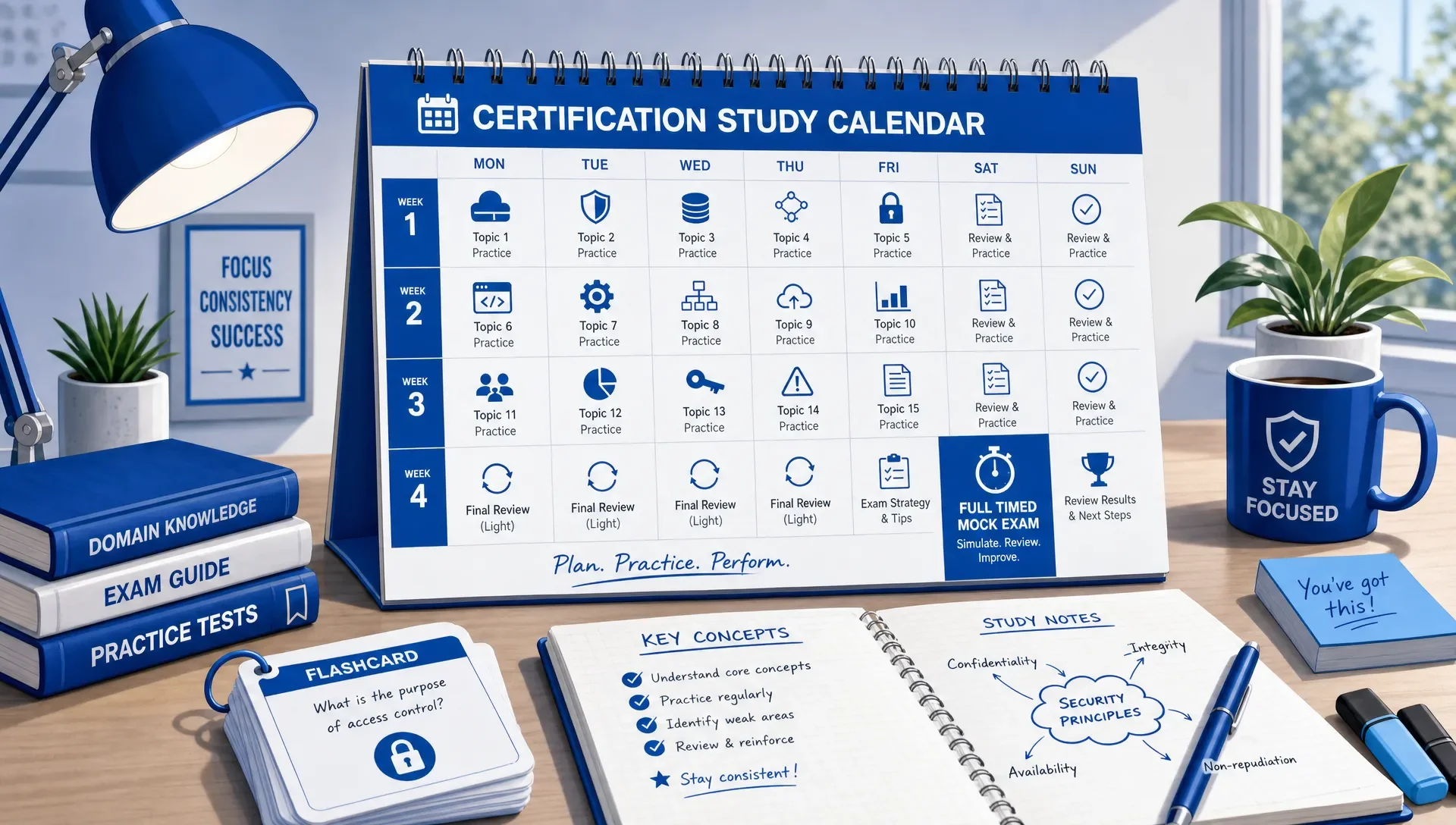
Most candidates don't need a full mock every day. Daily full mocks can actually worsen your prep. They consume valuable review time and train fatigue. A better rhythm involves a mock, followed by review, targeted repair, and then another mock.
A simple schedule looks like this:
| Timeframe | Full mock timing | Purpose |
|---|---|---|
| Start of study plan | Skip the full mock or use a short diagnostic only | Find broad weak areas without wasting a full attempt |
| After first pass through objectives | Take Mock 1 | Establish a baseline and identify priority domains |
| After several days of targeted repair | Take Mock 2 | Check whether weak areas improved |
| 3 to 7 days before the exam | Take Mock 3 only if needed | Confirm pacing, stamina, and score stability |
| Final 24 hours | Avoid a new full mock | Protect focus and reduce panic studying |
Spacing between mocks matters. That's where real improvement happens. If Mock 2 follows Mock 1 the next morning, you're mostly measuring the same preparation level, just with more fatigue. A better gap gives you time to rebuild weak concepts, use spaced repetition, and answer new questions by objective.
If your exam date is flexible, don't schedule the real test based only on finishing a course or reading every chapter. Schedule it when your mock results, topic performance, and confidence all point in the same direction.
How to Review a Full Mock Exam Without Wasting the Attempt
The review session after a full mock should always take longer than the mock itself. If you spend two hours on the exam but only 20 minutes skimming the answer key, you've missed the point.
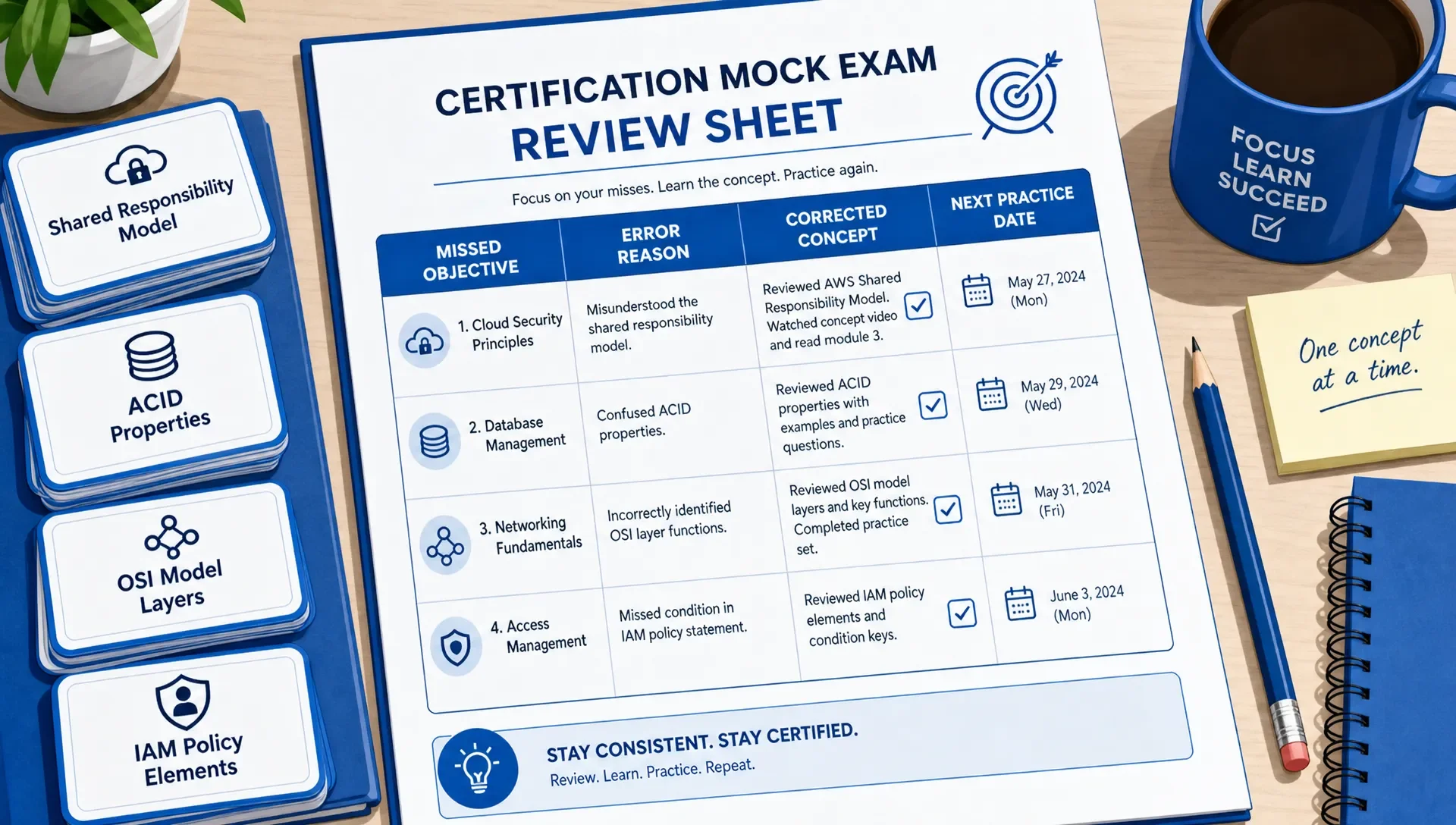
Start by reviewing questions you missed, questions you guessed, and questions you got right for the wrong reason. Then label each miss by cause. Was it a knowledge gap, a misread question, a weak elimination strategy, a time-pressure mistake, or a scenario you hadn't practiced?
Use a short review workflow:
- Re-answer missed questions before reading the explanation.
- Write the tested objective in your notes, not just the correct letter.
- Explain why each wrong option is wrong.
- Turn repeat misses into flashcards or a targeted practice set.
- Retest the same objective later with new questions, not immediately from memory.
This approach aligns with the learning principle of retrieval practice. The Institute of Education Sciences practice guide on organizing instruction and study to improve learning recommends practice tests as a learning activity, not just an assessment tool. In certification prep, that means the mock exam is the start of a learning loop, not the finish line.
MindMesh Academy's article on practice examination habits that improve recall goes deeper on using practice exams as retrieval training instead of passive answer checking.
What Mock Exam Scores Mean Before You Book the Real Exam
A mock score is useful, but don't treat one score as a guarantee. Certification exams often use scaled scoring, different item weights, or even unscored questions. A raw practice percentage is a readiness signal, not an official prediction.
Use the pattern across attempts instead. You want stable performance, fewer repeat misses, better pacing, and cleaner explanations when you review your answers.
| Mock result pattern | What it usually means | What to do next |
|---|---|---|
| Low score with many unfamiliar terms | Foundation is still weak | Return to objectives and rebuild core concepts |
| Moderate score with one or two weak domains | Study is progressing | Target those domains before another full mock |
| High score but poor time management | Knowledge may be ready, pacing isn't | Practice timed mixed sets |
| High score with many lucky guesses | Confidence is inflated | Review guessed questions and retest with fresh items |
| Two strong scores with stable pacing and few repeats | Readiness is likely improving | Move into final review and exam logistics |
As a rule of thumb, you want a buffer above the minimum you believe you need, because the real exam may feel harder than practice. The exact buffer depends on the certification, your risk tolerance, and whether your mock exams are truly realistic.
When to Take an Extra Full Mock Exam
An extra full mock makes sense when it will answer a specific question. For example, you might need to know whether your pacing improved after timed practice, whether a weak domain is still dragging down your score, or whether you can stay focused through a full sitting.
Don't take an extra mock just because you're anxious. Anxiety often asks for more data, but another score won't help if you don't have time or energy to act on it. In that case, a focused review set, flashcards, or a short mixed quiz may be the better option.
An extra mock is usually worth it if you've completed targeted repair, have at least a day to review the results, and the test attempt won't cut into sleep or final consolidation. It's often not worth it if you're tired, rushing, or using the result to decide whether to panic.
Common Mistakes With Full Mock Certification Practice Exams
Full mocks are powerful, but candidates often use them in ways that make the results less reliable. The most common errors are easy to avoid once you know what you're measuring.
| Mistake | Why it hurts | Better habit |
|---|---|---|
| Taking a full mock before learning the objectives | The result only confirms you haven't studied | Use a short diagnostic instead |
| Reviewing only wrong answers | You miss lucky guesses and shaky reasoning | Review guessed and flagged questions too |
| Repeating the same mock until the score rises | You start memorizing the test | Use new questions for readiness checks |
| Ignoring timing data | You may know the content but still run out of time | Track time per section or question type |
| Taking a mock the night before the exam | A bad result can damage confidence | Keep the final day light and targeted |
The goal isn't to collect as many mock scores as possible. It's to create enough realistic evidence that you're truly ready for the real exam.
Frequently Asked Questions
Should I take a full mock exam before I start studying? Usually no. A short diagnostic can help you find broad strengths and weaknesses, but a full mock before studying often wastes time and gives you a discouraging score that doesn't tell you much.
How many full certification practice exams should I take? Most candidates do well with two or three full mocks: one baseline after covering objectives, one readiness check after targeted review, and a final mock only if they need more evidence.
What score should I get before taking the real certification exam? Aim for consistent scores above your estimated passing level, but don't rely on just one number. Look for stable pacing, fewer repeat mistakes, and the ability to explain why wrong answers are wrong.
Is it okay to retake the same full mock exam? Retaking can be useful for checking if you learned from your review, but it shouldn't be your main readiness measure. Once you remember the questions, the score becomes less realistic.
Are short quizzes better than full mock exams? Short quizzes are better for learning and repairing weak areas. Full mocks are better for testing exam readiness, stamina, and time management once your foundation's mostly built.
When should I stop taking full mocks before exam day? Avoid new full mocks in the final 24 hours unless you have a specific reason and you're confident it won't hurt your focus. Use that time for light review, flashcards, logistics, and rest.
Build a Smarter Mock Exam Plan
Full mocks work best when they're part of a connected study workflow, not a last-minute ritual. Cover the objectives, practice by topic, use flashcards for spaced repetition, take a realistic mock, then let the review guide your next study block.
To build a stronger study loop for your next certification, MindMesh Academy offers detailed study guides, practice questions with explanations, and adaptive weakness-based practice. If you're preparing for an exam like the CompTIA Network+, put these strategies to work and measure your readiness with our CompTIA Network+ practice exam.

Written by
Alvin Varughese
Founder, MindMesh Academy
Alvin Varughese is the founder of MindMesh Academy and an enterprise architecture leader. An electrical engineer by training, he moved from factory automation in South Africa to cloud architecture at GE Appliances and Humana (Fortune 50), and holds 20 professional certifications including AWS Solutions Architect Professional, Azure DevOps Engineer Expert, and Microsoft Agentic AI Business Solutions Architect. He built MindMesh Academy after interviewing too many highly certified candidates who couldn't answer basic questions: the goal is prep that makes you better at the job, not just able to pass the exam.