Case Study Test Strategies for Certification Exams
Case Study Test Strategies for Certification Exams
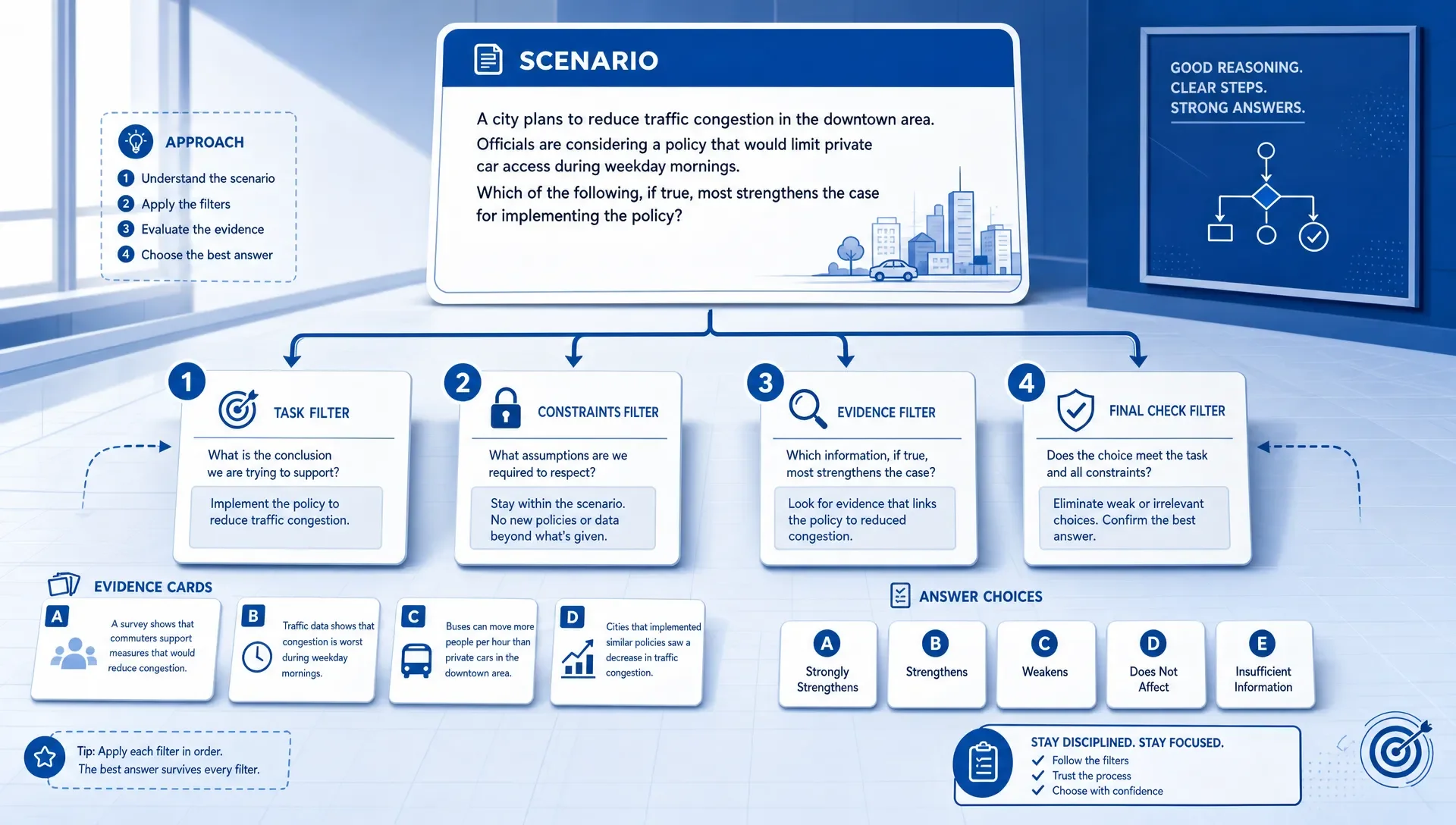
When you encounter a case study test item, your goal is to make the best decision under specific constraints. Start by reading the actual task first, not the entire scenario. Identify your role, the business or technical goal, any non-negotiable constraints, and the command word (such as first, next, best, or most cost-effective). Then, evaluate every answer choice against those facts.
Use the same routine every time: task, constraints, evidence, elimination, final check. This sequence prevents you from getting sidetracked by irrelevant details, which is often what long certification scenarios are designed to do. Below is a practical method you can use for IT, cloud, security, networking, service management, and project management certification exams.
What a Case Study Test Looks Like
Certification providers don't all use the phrase "case study test," but the underlying skill is consistent: you receive a realistic situation and are asked to choose, configure, sequence, or diagnose the best response. Some exams present long scenarios with multiple questions. Others use short situational prompts, exhibits, drag-and-drop tasks, or performance-based questions.
For example, CompTIA describes Security+ as including multiple-choice and performance-based questions, and Microsoft offers an exam sandbox so candidates can become familiar with exam item formats before test day. AWS also publishes official exam guides and sample questions through its certification preparation resources. While the format varies by vendor, the thinking process remains consistent.
| Case study format | What it usually tests | Best first move |
|---|---|---|
| Long scenario with several questions | Reading across business goals, technical facts, and constraints | Read the specific question first, then scan only for the facts needed |
| Short scenario-based multiple choice | Applying concepts to a realistic situation | Identify the command word and eliminate choices that violate constraints |
| Performance-based question | Completing a configuration, order, match, or workflow | Clarify the required end state before interacting with the options |
| Exhibit or tabbed case | Combining data from diagrams, logs, policies, or requirements | Check which exhibit answers the current question and ignore unused details |
| Project or service management scenario | Choosing the right next action in a process | Find the phase, stakeholder issue, risk, and decision authority |
A case study question is often more challenging than a definition question because several answer choices may appear reasonable. Your goal isn't to find an answer that could work in real life under certain assumptions. Your goal is to find the answer that perfectly fits the scenario, the exam objective, and the exact wording of the task.
How to Read Case Study Test Questions Efficiently
The biggest mistake candidates make is reading the entire case like a story and trying to remember everything. Instead, read with a specific purpose. Most case questions include background details, constraints, distractors, and only one or two facts that determine the correct answer.
A reliable reading approach looks like this:
- Read the task or question first: Before reading the scenario, find out what you're being asked to decide, such as the best solution, the first action, the missing control, or the most likely cause.
- Identify your role: Are you acting as a cloud architect, security analyst, project manager, network administrator, service desk lead, or auditor? Your role influences which actions are appropriate.
- Mark the command word: Words like first, next, best, most secure, least costly, and most likely all point to different reasoning paths.
- Find hard constraints: Budget, compliance, downtime, region, skill level, business priority, and compatibility requirements often rule out otherwise good choices.
- Predict the answer before reading options: If you can summarize the required action in your own words, distractors become easier to spot.
This approach is similar to the discipline needed for difficult written questions. If you struggle with dense wording, the MindMesh guide to tough written exam questions complements this case study strategy well.
How to Extract Clues That Change the Answer
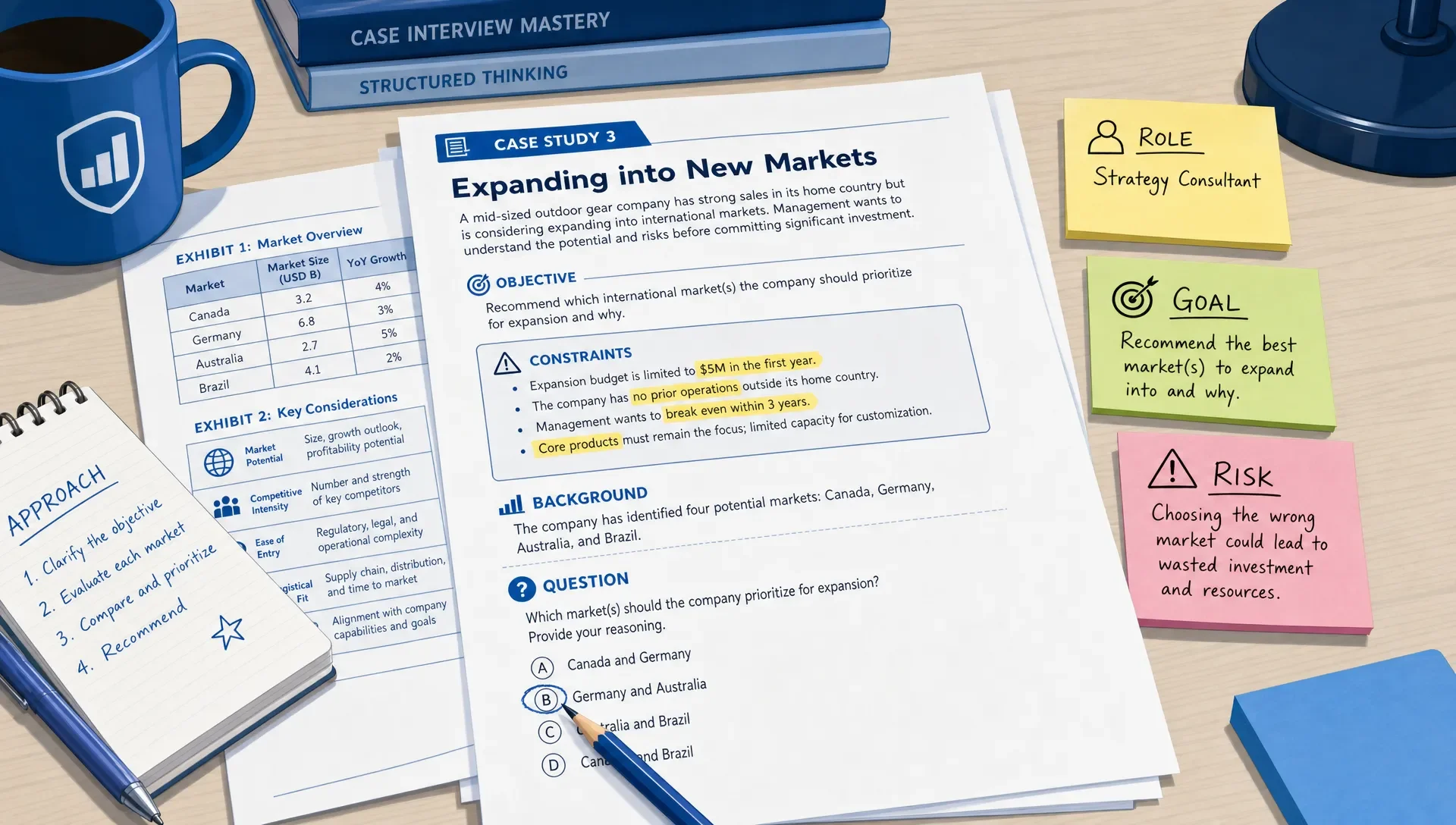
An effective case study test strategy depends on distinguishing decisive clues from filler. A long prompt might mention team size, legacy systems, compliance requirements, outages, user complaints, executive goals, and preferred tools. Not all of these facts will matter for the specific question you're answering.
Use this clue map during practice. It trains you to look for answer-changing details instead of rereading the entire text.
| Clue type | Question to ask | Why it matters |
|---|---|---|
| Role | What authority do I have in this scenario? | Prevents choosing actions outside your responsibility |
| Goal | What outcome is the organization trying to achieve? | Keeps you aligned with business or exam-objective intent |
| Constraint | What must not be violated? | Often eliminates tempting but noncompliant answers |
| Time signal | Is the question asking first, next, immediate, or long-term? | Controls the order of actions |
| Risk or compliance detail | What has to be protected, audited, documented, or approved? | Points to security, governance, and process controls |
| Current state | What already exists? | Prevents recommending unnecessary replacement or redesign |
| Failure symptom | What changed, broke, or triggered the issue? | Helps isolate the root cause in troubleshooting scenarios |
Once you've identified these clues, create a quick mental summary of the case: role plus goal plus constraint. For example: "security analyst, stop active risk, preserve evidence." Or "cloud practitioner, reduce admin overhead, keep costs predictable." This short version is much easier to use than a full paragraph of scenario text.
How to Choose the Best Answer When Several Options Seem Correct
Case study questions often include two technically valid answers. The exam asks for the one that is best for the stated conditions. This means you need a stricter filter than simply asking, "Does this sound right?"
Start by eliminating any answer that violates a hard requirement. If the scenario specifies minimizing administrative overhead, a highly manual solution should be suspect. If it states that the next action is needed before implementation, an answer that jumps straight to deployment is likely out of order. If it calls for least privilege, broad access should raise a red flag.
Then, compare the remaining choices against the exam objective. Certification exams are blueprint-driven, so the correct answer usually reflects a principle the vendor or governing body expects you to apply. A cloud exam might emphasize shared responsibility, managed services, resiliency, identity, or cost optimization. A security exam might emphasize risk reduction, evidence preservation, access control, incident response, or compliance. A project management exam might emphasize stakeholder engagement, change control, communication, or risk response.
The command word is your tie-breaker:
| Command word | What it usually means | Common trap |
|---|---|---|
| First | Do this before other valid actions | Choosing a final fix before assessment or approval |
| Next | Continue from the current point in the process | Restarting the process from the beginning |
| Best | Balance all constraints in the scenario | Picking the strongest feature while ignoring cost, risk, or scope |
| Most likely | Diagnose the probable cause | Choosing a dramatic cause instead of one supported by evidence |
| Most secure | Prioritize risk reduction | Choosing convenience or cost when security is the stated priority |
| Most cost-effective | Meet requirements with minimal waste | Choosing the cheapest option even if it misses a requirement |
A strong answer typically satisfies every must-have condition, fits the specified role, matches the sequence, and requires the fewest assumptions. If you find yourself inventing facts to make an answer work, it's probably not the best choice.
How to Manage Time on Long Case Study Test Items
Time pressure can make case studies feel more difficult than they are. The solution isn't to read faster, but to spend time in the correct order.
Use this timing pattern during practice, then adjust it to the official exam length for your certification:
| Step | Suggested time target | What to do |
|---|---|---|
| Question scan | 10 to 20 seconds | Identify the exact task and command word |
| Scenario scan | 45 to 90 seconds | Extract only role, goal, constraints, and relevant evidence |
| Answer elimination | 30 to 60 seconds | Remove options that violate facts or sequence |
| Final check | 10 to 20 seconds | Reread the command word and confirm the choice fits |
| Mark and move | Immediate if stuck | Flag the item and protect time for easier questions |
For multi-question cases, avoid rereading the entire scenario for each item. Read the new question, then refer back only to the part of the case that answers it. Vendors often reuse background information across several questions, but each question usually relies on a different specific detail.
If your exam allows marking items for review, use this feature strategically. Mark questions where you've narrowed the answer to two choices. Don't mark every uncomfortable question, or your review list will become unmanageable. During final review, only change an answer if you find a specific clue you missed, not due to general anxiety.
How to Practice Case Study Test Questions Before Exam Day
Case study skill improves through active retrieval and review, not passive rereading. In a well-known study, Roediger and Karpicke found that retrieval practice improved long-term retention compared with repeated studying. A broader review by Dunlosky and colleagues identified practice testing and distributed practice as highly effective learning techniques. For certification preparation, this means you should answer scenario questions closed-book, review the explanation, and revisit weak topics over time.
A good practice session has three parts. First, answer the question under light time pressure. Second, review why the correct answer is correct and why the distractors are incorrect. Third, tag the missed concept by objective so you can study the underlying knowledge, not just memorize that one item.
If you're studying cloud fundamentals, the AWS Certified Cloud Practitioner practice exam is a practical place to rehearse scenario-based decisions with explanations. If your goal is cybersecurity, the CompTIA Security+ practice exam helps you practice security reasoning across objectives instead of reviewing terms in isolation.
You can also build judgment by studying scenarios as small decision cases. The MindMesh article on scenario-based learning explains how realistic prompts train you to connect facts, constraints, and consequences. For memory and recall, combine that with practice examination habits that improve recall, especially closed-book answering and explanation review.
Common Case Study Test Mistakes and Better Moves
Most case study misses stem from process errors, not a lack of knowledge. You can understand the content but still lose points by answering the wrong question, overvaluing one clue, or choosing a solution that's too broad for the scenario.
| Mistake | What it looks like | Better move |
|---|---|---|
| Reading everything before knowing the task | You spend two minutes absorbing details that may not matter | Read the question first, then scan with purpose |
| Ignoring the command word | You choose a good final solution when the question asks for the first step | Circle first, next, best, or most likely before comparing answers |
| Overengineering the solution | You choose the most advanced option instead of the one that meets requirements | Prefer the simplest option that satisfies all constraints |
| Using outside assumptions | You rely on facts that aren't in the scenario | Make the answer prove itself from the prompt |
| Treating distractors as partially correct | You keep an option because one part sounds right | Eliminate answers that fail any must-have requirement |
| Reviewing only the right answer | You miss why the wrong answers were tempting | Study every distractor and label the trap |
A useful rule: every wrong answer teaches a pattern. Was it too broad, too late, too early, too expensive, outside the role, or missing a compliance requirement? Once you can label the trap, you're less likely to fall for it again.
Mini Case Study Test Walkthrough
Here is a simplified practice example, not a real vendor exam question.
A company wants to move an internal business application to a cloud environment. The team has limited operations staff. The application must be available to remote employees, access must be controlled by job role, and leadership wants to avoid maintaining unnecessary infrastructure. The question asks: What is the best initial recommendation?
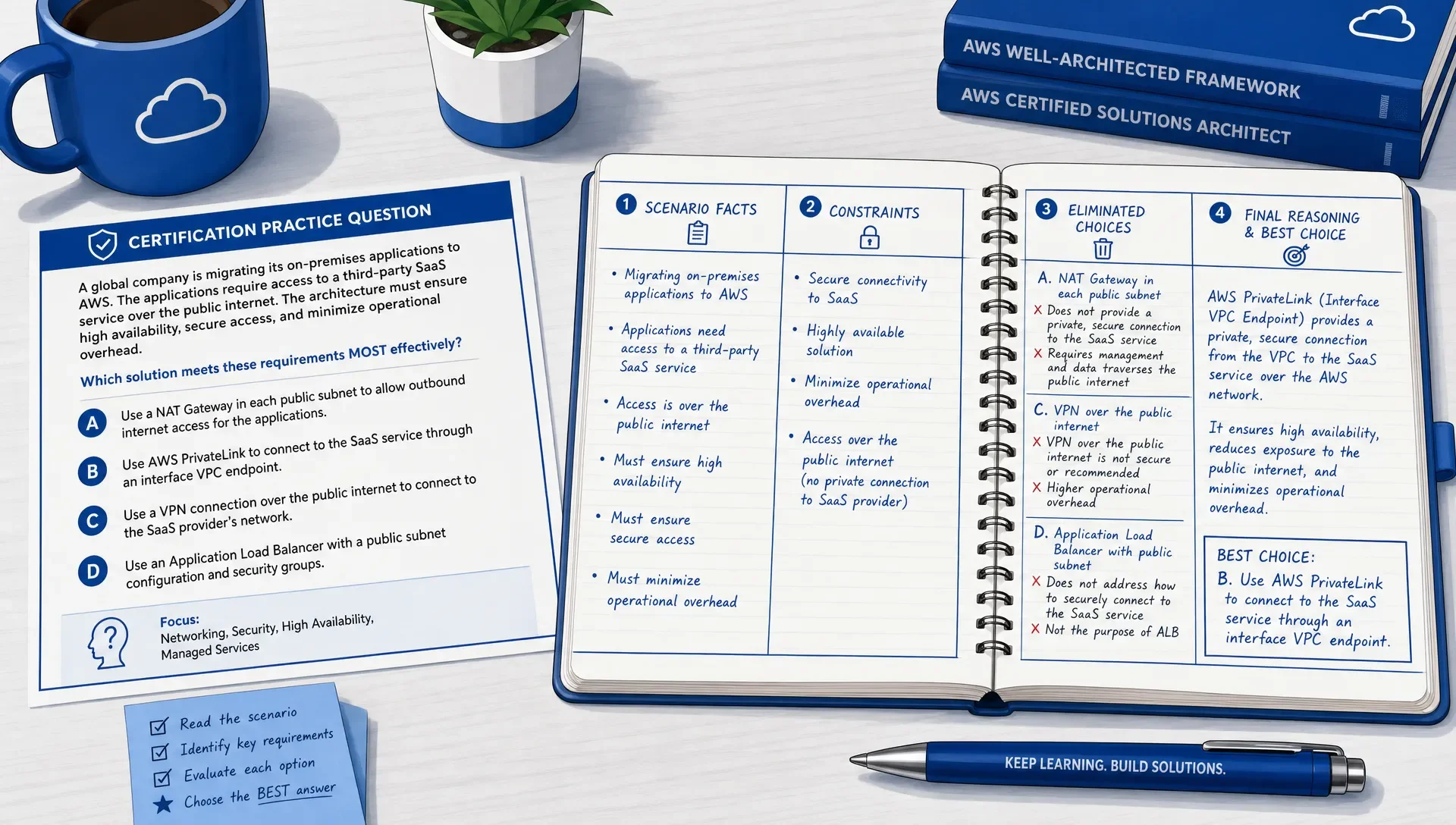
Don't start by choosing a product. Start by extracting the case.
Role: advisor. Goal: recommend an initial cloud direction. Hard constraints: limited operations staff, remote access, role-based control, avoid unnecessary infrastructure. Command word: best.
Now compare answer types. A choice that requires the team to manually maintain many servers may work technically, but it conflicts with limited operations staff and avoiding unnecessary infrastructure. A choice that provides broad shared access may help remote users, but it fails the role-based access requirement. A choice that uses a managed approach and supports role-based access is more aligned with the scenario, assuming it meets the rest of the stated requirements.
The key is that you didn't need to memorize a paragraph. You needed to preserve four decision facts and use them consistently. That's the repeatable skill behind most case study test performance.
How to Review Missed Case Study Questions
Review is where your score truly improves. When you miss a case question, don't just write, "I misunderstood the scenario." That's too vague to fix. Instead, identify the exact failure mode.
Use a short review note with five fields: exam objective, missed clue, wrong assumption, correct principle, and next practice action. For example: Objective: identity and access. Missed clue: job role access. Wrong assumption: remote access mattered more than permissions. Correct principle: meet security and access constraints together. Next action: practice five identity scenario questions and review flashcards.
This turns each miss into a study plan. It also pairs well with spaced repetition because you can convert the missed principle into a flashcard or a short scenario prompt.
Frequently Asked Questions
What is a case study test in a certification exam? A case study test question presents a realistic scenario and asks you to make the best decision based on goals, constraints, symptoms, or process steps. It evaluates your application of knowledge, not just recall of definitions.
Should I read the full case study before the questions? Usually, no. Read the question or task first so you know what information is most relevant. Then, scan the case for the role, goal, constraints, and evidence connected to that specific question.
How do I handle case study questions when two answers seem right? Eliminate any answer that violates a hard requirement, then use the command word as your tie-breaker. The best answer is the one that fits the scenario with the fewest assumptions.
Are performance-based questions the same as case study questions? Not exactly. Performance-based questions often require you to complete a task, while case studies may ask you to analyze a scenario and choose an answer. Both, however, demand applying knowledge to a realistic situation.
How many case study questions should I practice? Practice enough to recognize patterns across objectives, not just enough to memorize specific wording. A better goal is consistent accuracy by topic, plus the ability to explain why each distractor is wrong.
How can I get faster at long scenario questions? Use timed practice with a fixed routine: read the task, extract constraints, eliminate choices, and perform a final command-word check. Speed comes from reducing rereading, not from rushing.
Build Case Study Test Confidence With Targeted Practice
Becoming proficient with case study questions means consistent practice and smart review. At MindMesh Academy, we offer structured study guides, practice questions with detailed explanations, and progress tracking by topic to help you strengthen your decision-making skills for any certification exam. Build your confidence and prepare for success with our AWS Certified Cloud Practitioner practice exam today.

Written by
Alvin Varughese
Founder, MindMesh Academy
Alvin Varughese is the founder of MindMesh Academy and an enterprise architecture leader. An electrical engineer by training, he moved from factory automation in South Africa to cloud architecture at GE Appliances and Humana (Fortune 50), and holds 20 professional certifications including AWS Solutions Architect Professional, Azure DevOps Engineer Expert, and Microsoft Agentic AI Business Solutions Architect. He built MindMesh Academy after interviewing too many highly certified candidates who couldn't answer basic questions: the goal is prep that makes you better at the job, not just able to pass the exam.