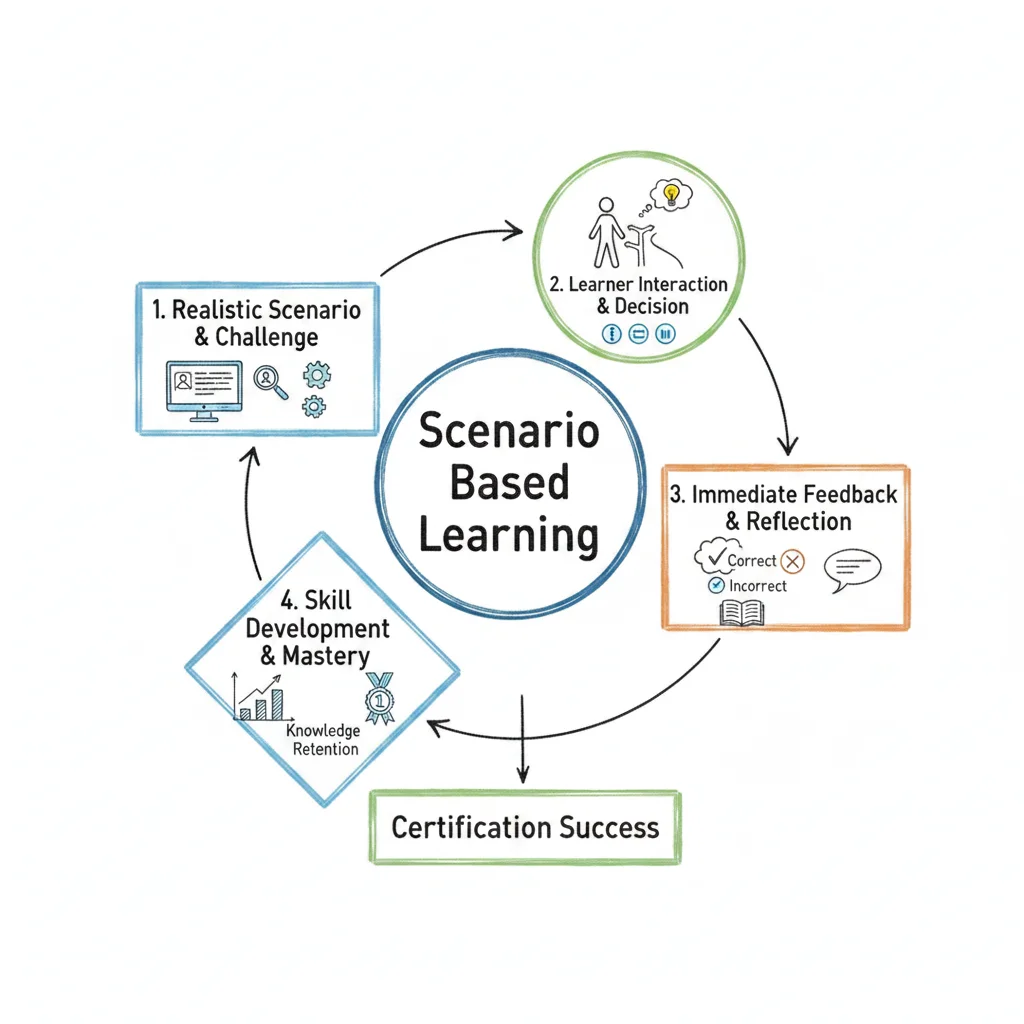
Scenario Based Learning for Certification Success
Scenario-Based Learning for Certification Success
You pass your certification exam on Saturday. On Monday, a teammate pings you with a real issue. A cloud deployment has failed, a stakeholder wants an answer in ten minutes, and the error message doesn't look anything like the clean examples from your study guide. You know the terms. You recognize the service names. But turning that knowledge into action feels slower than it should.
That gap frustrates learners, managers, and course creators for the same reason. Traditional preparation often rewards recognition. Real work rewards judgment. Certification candidates need both.
As an instructional designer, I've seen this pattern across cloud, security, project management, and platform training. People don't struggle because they're lazy or unprepared. They struggle because most learning materials stop at explanation. Work starts when the explanation ends. That's where scenario-based learning becomes useful, especially for IT certification preparation where someone needs to pass the exam and handle the job that comes after it.
Beyond Memorization to True Mastery
A newly certified systems administrator can often tell you what a service does, where it fits, and which option sounds right on a multiple-choice test. Then a ticket arrives with missing permissions, a failed integration, and a business deadline. Suddenly the task is no longer “identify the concept.” It's “decide what to do first, what to ignore, who to notify, and how to avoid making it worse.”
That's the difference between knowing and performing.
A learner trained only on recall usually pauses at the wrong moment. They second-guess themselves because real environments are noisy. Two answers may seem reasonable. The best move may depend on cost, risk, timing, or user impact. Certification exams increasingly reflect that kind of thinking, and jobs certainly do.
By contrast, someone who has practiced through realistic decision paths has already felt some of that pressure in a safe setting. They've had to choose between a quick patch and a durable fix. They've seen what happens when they escalate too early, too late, or to the wrong person. They've learned to explain their reasoning, not just pick an answer.
That's why training teams that prepare for industry IT certifications should treat scenarios as more than a nice add-on. They're a bridge between exam language and workplace action.
Practical rule: If your learner can answer a question but can't explain what they would do next in a live environment, the training isn't finished.
Scenario-based learning helps close that gap because it puts the learner inside a situation that feels like work. Instead of asking, “What is the right term?” it asks, “What would you do now?” That shift sounds small. In practice, it changes everything about how people study, how they retain information, and how confidently they perform.
What Is Scenario-Based Learning?
Scenario-based learning is a form of active learning that places learners in realistic, work-like situations and asks them to make decisions, solve problems, and reflect on consequences rather than just recall information, as described in this overview of scenario-based learning for data training.
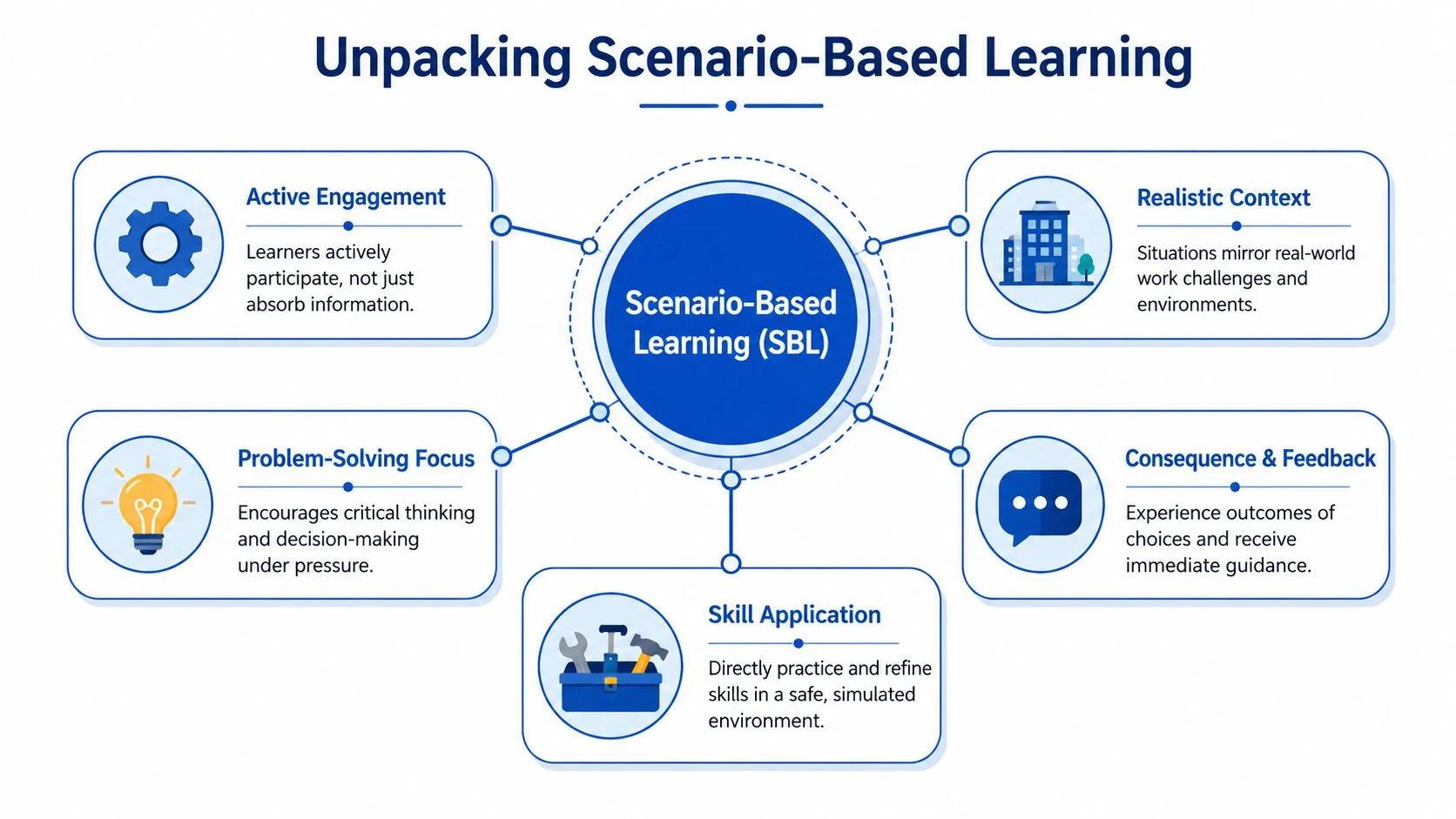
Think of it as a professional version of a choose-your-own-adventure story. The learner doesn't just consume content. They enter a situation, make a decision, and see what that decision causes.
The 5 Cs of Effective Scenarios
Foundational guidance often describes scenario-based learning through the 5 Cs. This model is simple, but it's useful because it keeps the scenario focused on decisions instead of decoration.
| Element | What It Means |
|---|---|
| Context | The setting feels real. The learner knows their role, the environment, and the stakes. |
| Challenge | A problem appears that requires judgment, not just recall. |
| Choices | The learner gets plausible options, not one obvious answer and two silly ones. |
| Consequence | Each choice triggers an outcome, with feedback tied to the decision. |
| Contemplate | The learner reflects on why the result happened and what they'd do next time. |
A weak scenario says, “Select the best practice.” A stronger one says, “You're the admin on call. A user group lost access after a policy change. The change window closes soon. What do you do first?” That small difference turns content into action.
Common Misconceptions
Many people hear “scenario” and think it just means “a story before a quiz question.” That's not enough. A short setup paragraph doesn't automatically create scenario-based learning.
For it to work, the decision has to matter. The options should feel believable. The feedback should show the effect of the learner's reasoning.
Comparing learning methods:
- Watching a video: useful for explanation, but passive
- Taking a quiz: useful for checking recall
- Working through a scenario: useful for practicing judgment in context
A scenario is not a wrapper around a question. It's a structured decision environment.
Scenario-Based Learning in IT Certification Prep
In certification training, a scenario might place the learner in one of these moments:
- Cloud operations: A workload is underperforming after a rollout, and the learner must balance availability, speed, and cost.
- Cybersecurity: An alert appears, and the learner must decide whether to isolate, investigate, or escalate.
- Project management: A sponsor requests a change late in the timeline, and the learner must manage scope, communication, and risk.
- Service management: A workflow update affects multiple teams, and the learner must choose an implementation path that minimizes disruption.
These aren't just exam-style questions with longer wording. They teach the learner how to interpret signals, prioritize action, and reflect on the result. That's why scenario-based learning tends to stick with people after the course ends.
Evidence for Scenario-Based Learning in Professional Training
A lot of learning methods sound good in theory. Scenario-based learning stands out because the available evidence points to a practical payoff in professional training.
A widely cited industry statistic says organizations using scenario-based learning report 57% better knowledge retention and application than more traditional methods, according to a summary attributed to the Association for Talent Development, as noted in Top Hat's scenario-based learning glossary. That number matters because it speaks to the two outcomes training managers care about most. People need to remember what they learned, and they need to use it when the moment arrives.
Why Scenario-Based Learning Works in Real Roles
The appeal of scenario-based learning isn't just that it feels more engaging. It matches the shape of real work. Most IT roles involve incomplete information, competing priorities, and decisions made under time pressure. A learner who practices inside those conditions builds a different kind of readiness than someone who only reviews definitions.
That's especially important in certification preparation. Exams may test architecture, troubleshooting, governance, security, or process knowledge. Jobs test whether the learner can combine those ideas in sequence and choose a response that fits the situation.
Here's what scenario-based learning trains well:
- Decision quality: The learner must distinguish between acceptable, risky, and preferred actions.
- Transfer of learning: Knowledge gets tied to a situation, which makes it easier to retrieve later.
- Error recovery: Learners can make a poor choice, see the impact, and adjust without real-world damage.
- Professional judgment: They practice trade-offs, not just facts.
Why Flashcards Fall Short
Flashcards, summaries, and drills still have value. They're efficient for terminology, commands, service limits, and model recall. The problem starts when teams expect those tools to prepare someone for judgment-heavy tasks.
A learner may correctly identify a root cause on paper and still mishandle the order of operations in a live incident. They may know the governance principle but fail to apply it when a stakeholder pushes for a shortcut. Scenario-based learning fills that space because it asks the learner to act, not just recognize.
If a certification maps to job performance, the study method should include job-shaped decisions.
There's also support from formal education in high-stakes fields. Verified data notes that a 2024 peer-reviewed study of nursing and midwifery students found that scenario-based learning had a significant positive effect on post-intervention knowledge scores. That doesn't mean every scenario is automatically better than every other method. It does suggest that in fields where people must apply knowledge under pressure, this design has real value.
For IT certification teams, the takeaway is simple. If the role requires judgment, your preparation should rehearse judgment.
Designing Effective Learning Scenarios
Most weak scenarios fail for one reason. They start with content instead of performance. The designer asks, “What topic should we cover?” when the better question is, “What should the learner be able to do when work gets messy?”
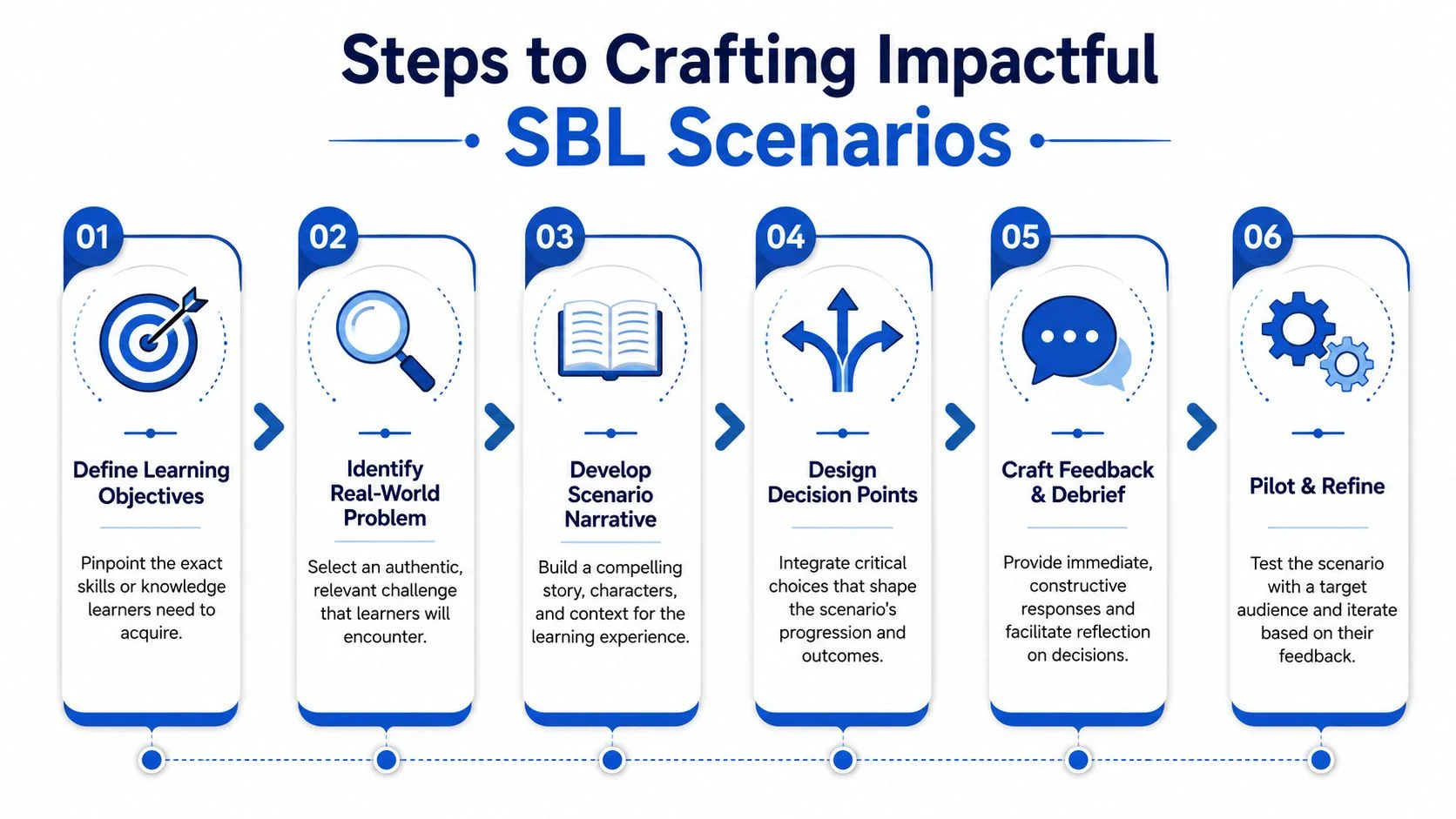
A strong SBL design uses the 5 Cs architecture of Context, Challenge, Choices, Consequence, and Contemplate, with each choice producing an explicit consequence and reflection step, leading to a closed feedback loop that supports assessment of knowledge retention and decision quality, as explained in Ohio State's guidance on building effective scenario-based learning activities.
Start with the Job Action, Not the Chapter Title
Before you write any narrative, define the action the learner must perform. In certification preparation, that action should connect to both exam reasoning and workplace behavior.
Good objective: “Diagnose a failed deployment and choose the next best action based on risk and business impact.”
Weak objective: “Understand deployment concepts.”
That difference changes the whole scenario. The first objective demands a situation, trade-offs, and consequences. The second invites a content dump.
A practical design sequence looks like this:
- Pin down the skill. Choose one behavior or judgment call the learner must demonstrate.
- Find a suitable trigger. Use a believable workplace event, such as an outage, change request, or audit issue.
- Limit the scope. One scenario should test a tight slice of competence, not an entire certification domain.
- Write the decision point. Ask what the learner does next, not what definition they remember.
Crafting Realistic Choices
The hardest part of scenario design is writing answer options that sound like something a real person might do. Many bad scenarios give away the answer because two options are obviously reckless. Real work is rarely that neat.
Use choices that reflect common patterns:
- One preferred option that aligns with best practice and context
- One plausible but incomplete option that solves part of the problem
- One risky shortcut that may look efficient but creates downstream issues
- One escalation path that may be right only under certain conditions
For example, in an Azure scenario, a learner might need to respond to a failed integration after a configuration change. The options shouldn't be “Fix it,” “Ignore it,” and “Delete everything.” They should reflect real choices such as reviewing recent changes, rolling back, escalating to the architecture team, or applying a temporary workaround.
If you need examples of how exam-relevant branching can look in practice, review these scenario-based practice questions.
Provide Consequence-Based Feedback
Most training becomes ineffective when feedback is shallow. The feedback says “Correct” or “Incorrect,” and the learning stops.
Instead, show what the learner's decision caused.
| Choice pattern | Recommended Feedback Style |
|---|---|
| Correct answer | Explain why it fits the context, what risk it avoids, and why it should happen first |
| Partly correct | Show what it improves, what it misses, and what problem remains |
| Risky choice | Show the likely operational or stakeholder impact |
| Premature escalation | Explain when escalation is appropriate and why timing matters |
Design test: If the feedback could fit any question in the course, it's too generic.
This is also where short media can help. Teams often support scenarios with screenshots, narrated walkthroughs, or short process demos. If you're adding those assets, this guide on making effective training videos for teams is useful because it focuses on clarity, pacing, and showing the right level of detail.
Pilot Your Scenarios Before Scaling
Even experienced designers miss hidden assumptions. A scenario that seems clear to a subject matter expert may confuse learners because it leaves out a detail they need to make a reasonable decision.
Run a small pilot and watch for these issues:
- Ambiguous context: Learners can't tell what role they're playing.
- Thin consequences: Feedback tells them the answer but not the impact.
- Trick wording: The scenario tests reading traps instead of judgment.
- Overbranching: Too many paths create noise instead of learning.
- Mismatched difficulty: The scenario is either too obvious or too broad.
Good scenario-based learning feels realistic, but it's also disciplined. It gives the learner enough complexity to think, not so much that the design collapses under its own ambition.
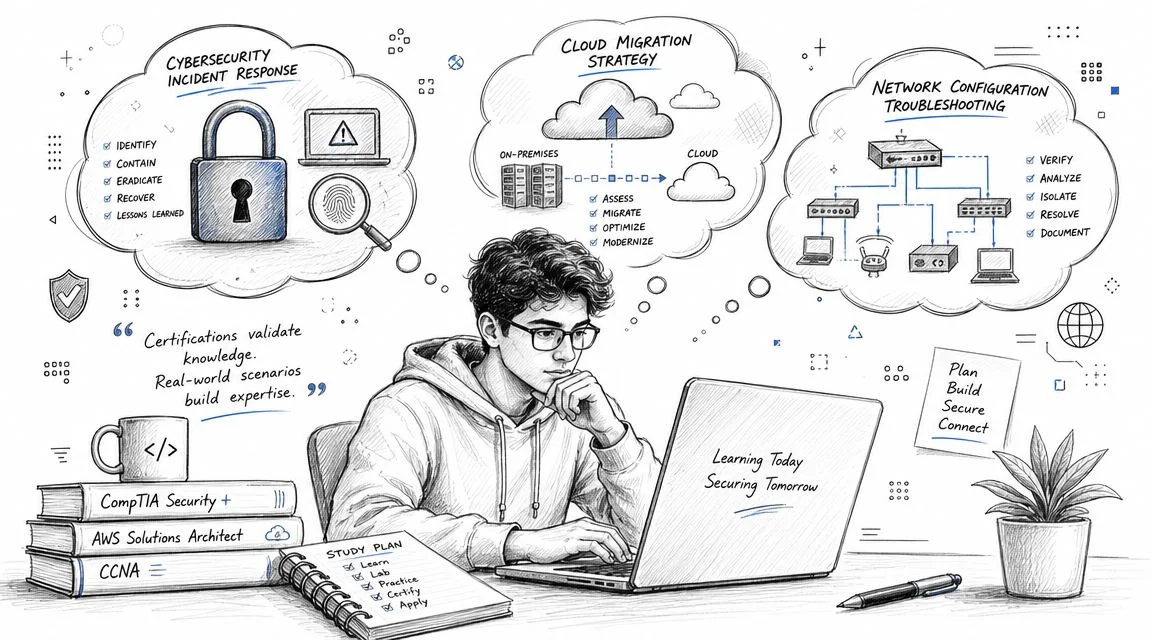
Scenario-Based Learning Examples for IT Certifications
Abstract advice only gets you so far. Scenarios become easier to design when you can see them in action.
PMP Example: Stakeholder Conflict
You're the project lead on a software rollout. Midway through the project, a key stakeholder asks for a feature change that the team can build, but only if the timeline or budget changes. Another stakeholder insists the current date can't move.
A weak preparation question would ask which document handles change requests.
A better scenario asks the learner what to do next:
- accept the request to preserve stakeholder goodwill
- reject it immediately because scope is fixed
- assess impact, document the request, and follow the change control process
- ask the technical lead to squeeze it into the current sprint
The preferred choice isn't just “the PMBOK answer.” It tests whether the learner can balance governance, communication, and execution. The consequence feedback should show what happens to trust, schedule, and risk in each path.
AWS Example: Service Outage
You're supporting an application hosted in AWS. Users report that a customer-facing service is timing out after a recent deployment. Leadership wants fast restoration, but finance has already raised concerns about unnecessary spending.
The scenario should force a trade-off. The learner might choose between immediate rollback, scaling a component before diagnosis, shifting traffic, or checking recent deployment changes and service health before acting.
What makes this useful is the realism. In actual cloud work, people don't solve incidents by recalling a definition. They interpret symptoms, prioritize customer impact, and choose an order of response.
A short walkthrough can help learners see how these decision trees feel in motion.
CompTIA Example: Security Incident
A help desk analyst notices unusual outbound traffic from an employee workstation. The user says they clicked an attachment from a sender they recognized. Business operations depend on that machine for same-day work.
This scenario should test incident response judgment, not just vocabulary. Strong options might include isolating the device, continuing to monitor, rebooting and hoping the issue clears, or asking the user to keep working while logs are collected.
The learner should feel the operational tension. Security decisions are rarely made in a vacuum. They affect users, managers, and timelines.
The debrief matters here. If the learner chooses convenience over containment, the feedback should explain the exposure created by delay. If they isolate too aggressively without communication, the feedback should show the business interruption they caused.
ServiceNow Example: Workflow Change
You're configuring a workflow change that affects HR, IT, and finance approvals. One department wants speed. Another wants more review steps. A rushed implementation could create confusion or duplicate tickets.
A shallow scenario asks which configuration item controls approvals. A stronger one puts the learner in a meeting aftermath where requirements conflict and the implementation date is near.
The choices can test whether the learner:
- pushes the change live to hit the deadline
- narrows the change scope and confirms process ownership first
- duplicates the old workflow and edits it directly without impact review
- delays communication until the update is complete
This kind of scenario prepares people for the practicalities of platform work. The tool matters, but so do handoffs, governance, and user adoption.
A Reusable Scenario Design Template
If you're building your own certification scenarios, this template works well:
| Part | Design Prompt |
|---|---|
| Role | Who is the learner in this moment? |
| Situation | What just happened? |
| Constraint | What makes the decision difficult? |
| Options | What are the plausible next actions? |
| Outcome | What happens after each action? |
| Reflection | Why was one path stronger in this context? |
That framework works across cloud, cybersecurity, project management, and service platforms because it mirrors how professionals think on the job.
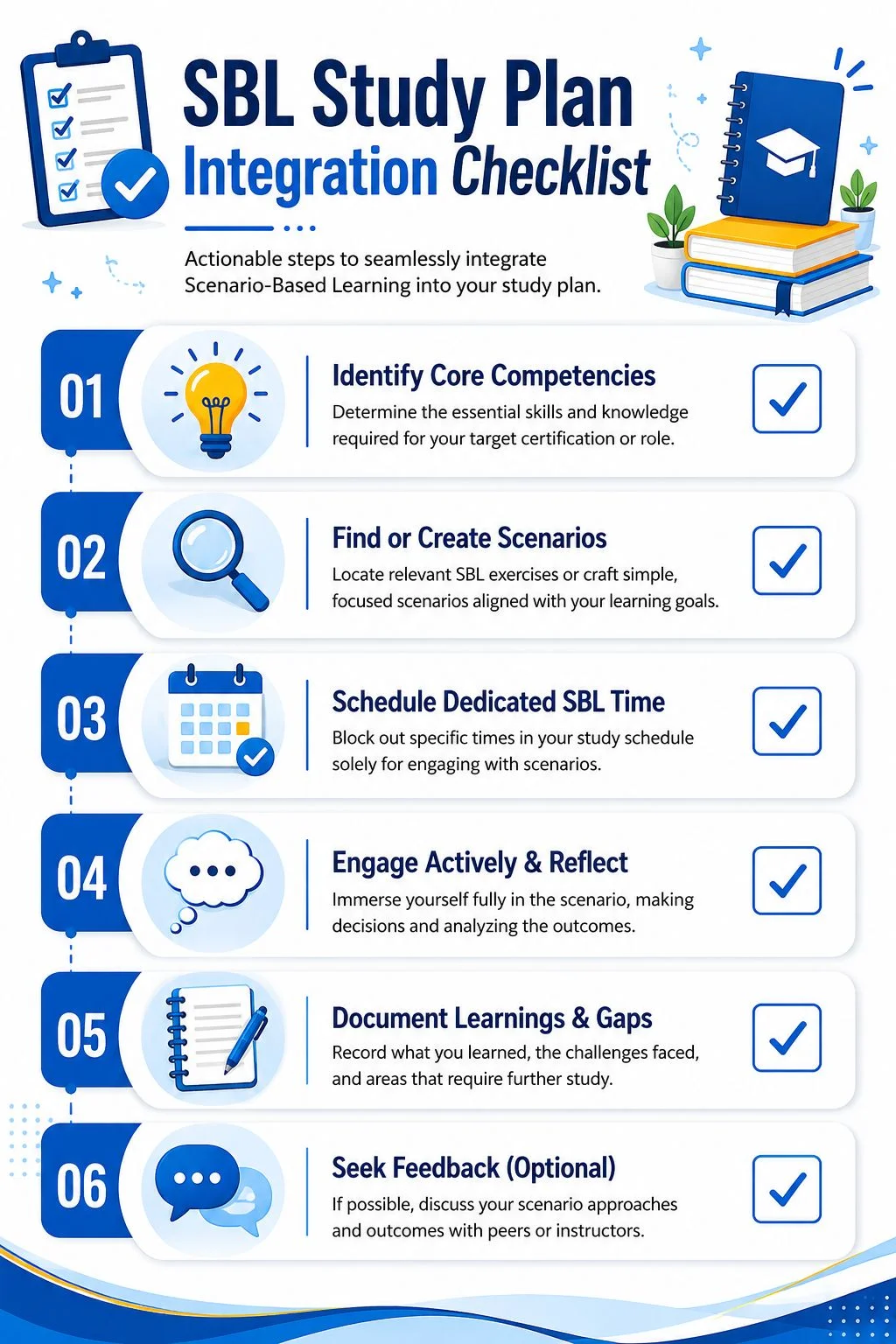
Implementing Scenario-Based Learning in Your Study Plan
The biggest pushback I hear is practical, not philosophical. People don't doubt that scenario-based learning is useful. They doubt they can run it at scale, especially in asynchronous certification preparation.
That concern is fair. Many guides praise realism and reflection, then stop before explaining how to deliver those features to large groups without an instructor in the room. One academic source notes that scenario-based learning can offer greater access and inclusion because it is not constrained by time or space, while also emphasizing the value of immediate feedback and adaptive narratives in online settings, as discussed in this analysis of SBL for asynchronous learning.
What Scalable Implementation Looks Like
You don't need a giant simulation budget to start. You need a repeatable structure.
For an individual learner, scenario-based learning can fit into a weekly study rhythm:
- Concept review day: Read or watch the core topic.
- Scenario day: Work through a realistic decision exercise tied to that topic.
- Reflection day: Document why each option was stronger or weaker.
- Gap-fix day: Return to the concepts that broke down during the scenario.
For a training manager, scale comes from standardization. Build a scenario template, define feedback rules, and map each scenario to one competency. That makes it easier to produce multiple modules without reinventing the design every time.
Low-Tech and Platform-Based Options for SBL
You can implement scenarios with more than one level of sophistication.
A basic version can live in a shared document or slide deck with hyperlinks between choices. A mid-level version can use an authoring tool with branching logic and automated feedback. A more mature version can track decision paths and reflection notes inside a learning platform.
One option learners can use alongside other methods is the MindMesh Academy prep guide, which includes study support tied to certification preparation workflows.
The key is not the tool itself. The key is whether the learner gets all of these elements:
- A believable setup that matches the target role
- A real decision point instead of a disguised recall question
- Immediate consequence feedback tied to the chosen action
- A reflection prompt that asks why the choice worked or failed
Implementation shortcut: Start with one high-value scenario per major exam domain. Depth beats volume when teams are learning the method.
Common Scenario Implementation Mistakes
Asynchronous delivery often fails because the course becomes passive again. The scenario appears, but the learner still just clicks through.
Watch for these traps:
- Too much setup text: Learners lose the thread before the decision arrives.
- No adaptation: Every choice leads to the same explanation.
- Weak feedback timing: The learner has to wait until the end to understand the impact.
- No reflection: The course checks completion, not thinking.
If you're studying solo, keep a simple decision journal. Write the scenario, your choice, why you made it, and what you missed. If you're running team training, collect those reflections and look for patterns. You'll quickly see where learners know facts but stumble on prioritization.
That's the practical promise of scalable scenario-based learning. It doesn't require a live workshop every time. It requires a design that respects how people learn from decisions.
Measuring Scenario-Based Learning Program Impact
Many teams stop measurement too early. They record completion rates, quiz scores, and maybe certification outcomes. Those metrics matter, but they don't tell you whether the learner can make better decisions at work.
That measurement gap is common in scenario-based learning. Content often claims it improves critical thinking, yet rarely explains what to track or how to show transfer to job performance. A useful framing from UPCEA's discussion of scenario-based learning outcomes is that you should pay attention to immediacy of feedback and narrative adaptation, not just whether the learner picked a correct answer.
Tracking Progress Within Scenarios
A scenario generates richer evidence than a standard quiz because the learner leaves a decision trail.
Track signals such as:
- Choice patterns: Do learners repeatedly choose risky shortcuts?
- Recovery behavior: After poor feedback, do they adjust effectively?
- Reflection quality: Can they explain why one option fit the context better?
- Decision consistency: Do they apply the same principle across different scenarios?
A learner who reaches the correct endpoint by guessing isn't showing mastery. A learner who makes a partly wrong choice, reads the consequence, and then improves their reasoning may be learning more.
Connecting Learning to Workplace Performance
For certification preparation tied to job readiness, use a simple three-layer view:
| Layer | Focus Area |
|---|---|
| Learning layer | Did the learner improve decision quality across scenarios? |
| Performance layer | Are they handling similar tasks with less hesitation and better sequencing? |
| Business layer | Are fewer preventable mistakes showing up in the work this training targeted? |
You don't need perfect attribution to make this useful. You need a consistent story between training behavior and job behavior.
Strong scenario programs don't just ask, “Did they finish?” They ask, “How did they think, and did that thinking improve?”
That's the standard worth holding. If the program prepares someone for both the exam and the role, the impact should show up in the choices they make when the screen is no longer simulated.
MindMesh Academy supports certification learners with structured preparation materials designed to build both exam readiness and practical understanding. If you're creating a study plan that needs more than recall drills, explore our Agentic AI Business Solutions Architect practice exam for certification-focused resources that align with real job skills.

Written by
Alvin Varughese
Founder, MindMesh Academy
Alvin Varughese is the founder of MindMesh Academy and an enterprise architecture leader. An electrical engineer by training, he moved from factory automation in South Africa to cloud architecture at GE Appliances and Humana (Fortune 50), and holds 20 professional certifications including AWS Solutions Architect Professional, Azure DevOps Engineer Expert, and Microsoft Agentic AI Business Solutions Architect. He built MindMesh Academy after interviewing too many highly certified candidates who couldn't answer basic questions: the goal is prep that makes you better at the job, not just able to pass the exam.