AWS Solutions Architect Practice Questions Decoded
Decoding AWS Solutions Architect Practice Questions
If you're studying for the AWS Solutions Architect exam and your practice scores aren't improving, it's time to change your approach. Don't just treat each incorrect answer as a random gap in your knowledge. Most mistakes stem from a common problem: failing to pinpoint the core requirement, selecting an over-engineered solution, or choosing a service feature that addresses the wrong issue.
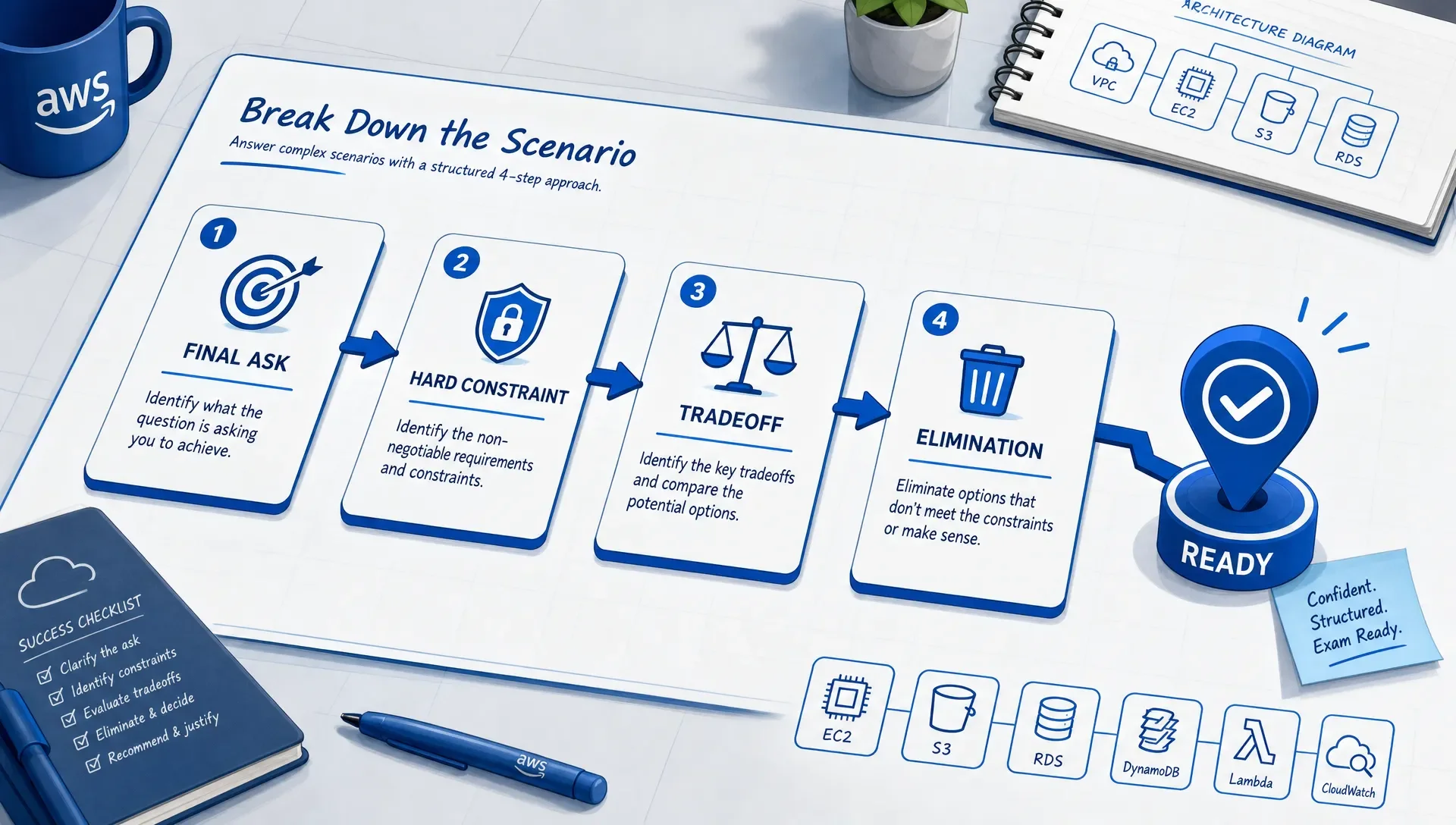
Adopt this simple routine before you even look at the answer choices: identify the main goal, highlight any strict limitations, consider the architectural tradeoffs, and immediately rule out options that violate a requirement. This habit transforms practice questions from memorization drills into genuine architecture training.
What AWS Solutions Architect Practice Questions Really Test
The AWS Certified Solutions Architect - Associate exam isn't merely a quiz about service names. The official AWS Certified Solutions Architect - Associate exam guide organizes the exam around four key domains: secure architectures, resilient architectures, high-performing architectures, and cost-optimized architectures.
This structure matters because strong practice questions typically combine at least two of these domains. A question might appear to be about storage, but its underlying challenge could be cost. Another might mention a database, but the critical clue often points to resilience across Availability Zones.
| Exam domain | Approximate weight | What practice questions usually test |
|---|---|---|
| Design Secure Architectures | 30% | IAM, encryption, network boundaries, least privilege, and secure access patterns |
| Design Resilient Architectures | 26% | Multi-AZ design, backups, failover, decoupling, and recovery requirements |
| Design High-Performing Architectures | 24% | Scaling, caching, storage performance, database read patterns, and latency |
| Design Cost-Optimized Architectures | 20% | Right-sizing, managed services, storage classes, lifecycle policies, and workload fit |
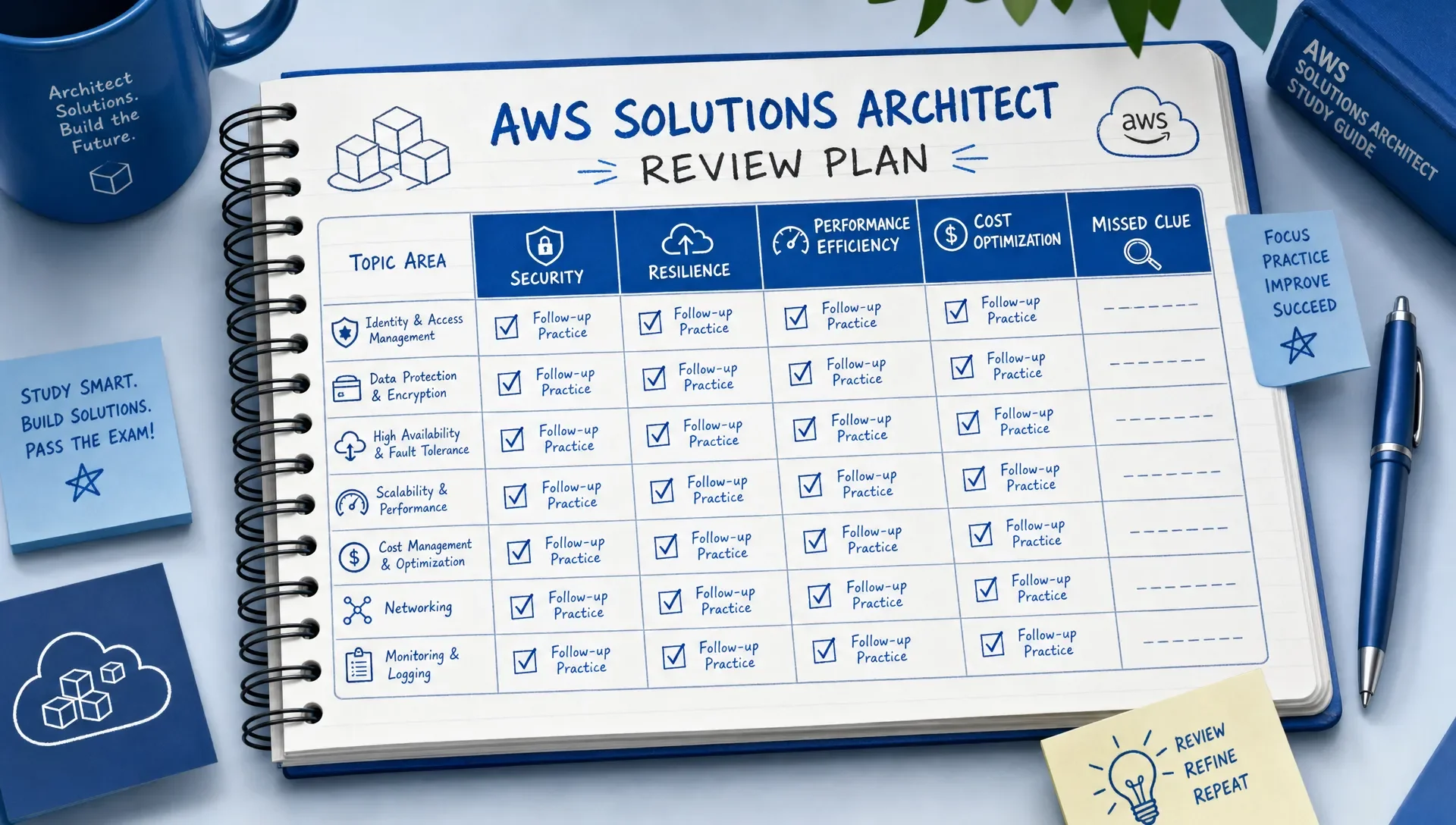
As you review AWS Solutions Architect practice questions, categorize each one by its primary domain. If most of your wrong answers fall into a single domain, hold off on taking another full-length exam. Instead, focus on targeted study in that specific area, then return to scenario practice.
For a structured path through the exam objectives, combine question review with the AWS Certified Solutions Architect Associate study guide. This ensures you're addressing topics systematically instead of patching knowledge gaps randomly.
How to Decode Every AWS Solutions Architect Question
Apply the same four-step process to every scenario, even if the question seems straightforward. Speed comes from consistent application, not from skipping steps.
First, identify the final ask. The last sentence usually reveals AWS's main objective: lowest cost, highest availability, minimal operational overhead, fewest application changes, or improved performance. Missing this phrase often leads to choosing an answer that's technically sound but not optimal for the given goal.
Second, distinguish hard constraints from background details. Hard constraints are phrases like "must not use public internet," "requires Multi-AZ availability," "must retain data for seven years," "users are global," or "cannot change application code." Background details describe the company, application, or current environment but don't directly determine the correct answer.
Third, name the tradeoff. AWS architecture questions frequently force a choice between competing priorities: cost versus performance, availability versus simplicity, or control versus operational overhead. If two answers offer similar security, the better choice might be the one requiring less administration. If two answers provide similar speed, the correct one could be the option that meets latency needs at a lower cost.
Fourth, eliminate answers that break a requirement before comparing the remaining choices. Don't evaluate all four options equally at first. Cross out any option that uses the public internet if the scenario forbids it, any that require application changes when minimal changes are specified, or any that add unnecessary operational work when a managed service is a better fit.
For a deeper look at clue words and common answer-choice traps, the MindMesh article on how to read AWS certification exam questions covers this skill in detail.
Common AWS Solutions Architect Question Patterns and How to Decode Them
You don't need to memorize every possible AWS architecture. You do need to recognize the recurring patterns in scenario questions.
Questions about resilience usually hide the failure boundary
When a question mentions availability, outage tolerance, or recovery, ask yourself what can fail. Is it an EC2 instance, an Availability Zone, a Region, a database node, or a queue consumer? The correct design protects against the stated failure without unnecessary complexity.
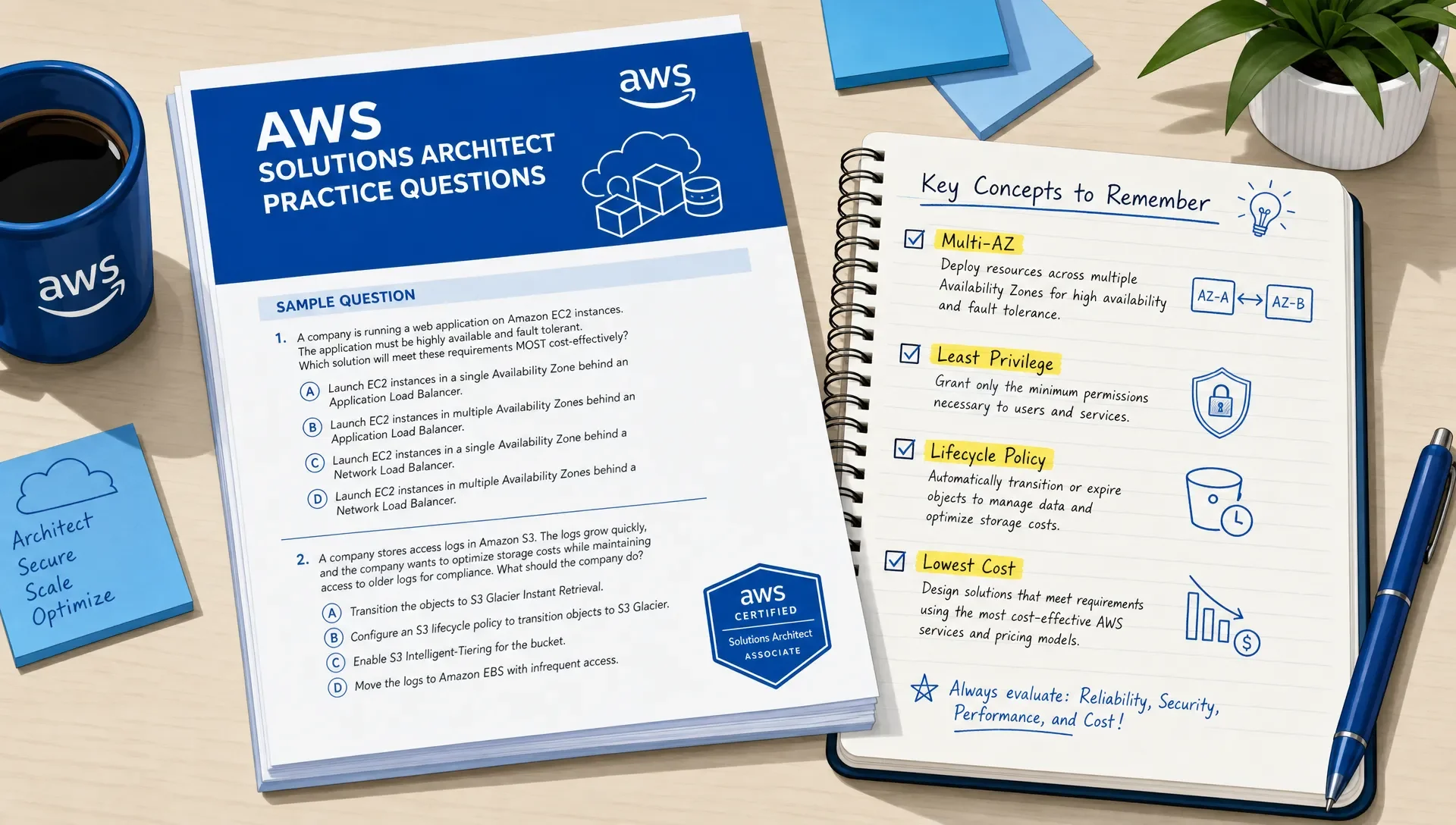
For an application running on EC2, a common resilient pattern involves an Application Load Balancer distributing traffic across EC2 instances in an Auto Scaling group, all spread across multiple Availability Zones. If the database is relational, a Multi-AZ deployment often provides better availability than read replicas, which primarily scale read operations.
AWS also frames good architecture through the AWS Well-Architected Framework, a valuable resource for deciding whether an answer improves reliability, performance efficiency, security, or cost optimization.
Questions about storage usually depend on access pattern
Storage questions often include three key clues: how often data is accessed, how quickly it must be retrieved, and how long it must be retained. For instance, active application data typically points to S3 Standard or EBS, depending on the workload. Infrequently accessed objects might suggest S3 Standard-IA or One Zone-IA, based on resilience needs. Long-term archive data is often best suited for S3 Glacier storage classes.
The official Amazon S3 storage classes documentation is essential reading, as the exam expects you to match storage class behavior to workload requirements, not just recall names.
Questions about performance usually point to bottlenecks
Performance questions become easier when you identify the bottleneck. If users are geographically distant from the origin, consider global edge caching and content delivery networks. If read traffic is overwhelming a relational database, explore read replicas or caching solutions. If EC2 capacity fluctuates throughout the day, think about Auto Scaling.
Don't automatically select the most powerful service. The exam frequently rewards matching capacity precisely to demand. A high-performance answer that overlooks cost or operational overhead might still be incorrect.
Questions about security usually reward least privilege
Security scenarios often present a simple challenge: an AWS service needs to access another AWS service. If an EC2 instance requires read access to an S3 bucket, the correct answer is usually an IAM role attached via an instance profile, not access keys stored directly on the instance. AWS clarifies this model in its documentation on IAM roles for Amazon EC2.
For network security, pay attention to whether traffic must remain private. A question stating resources must not traverse the public internet might suggest VPC endpoints, private subnets, or private connectivity options. If administrators need secure access to instances, Systems Manager Session Manager is often preferred over opening inbound SSH ports.
Questions about cost usually include a hidden minimum requirement
Cost-optimized doesn't mean the absolute cheapest option. It means the lowest cost while still meeting all stated requirements. If a workload demands high availability across Availability Zones, an answer that compromises resilience to save money isn't cost-optimized. If an application has predictable, steady usage, a pricing option for committed usage might be more suitable than purely on-demand capacity, but only if the scenario supports that assumption.
When reviewing cost questions, note down the requirement that cannot be violated. Then choose the least expensive architecture that still satisfies it.
Practice Questions Decoded Step by Step
The following questions are designed to illustrate the decoding process, not to be official exam questions.
Practice question 1: Highly available web application
A company runs a web application on a single Amazon EC2 instance in one Availability Zone. The application uses an Amazon RDS for MySQL database in the same Availability Zone. The company wants to improve availability with minimal application changes. Which solution best meets these requirements?
- A. Move the EC2 instance to a larger instance type and enable automated backups for the database.
- B. Place EC2 instances in an Auto Scaling group across multiple Availability Zones behind an Application Load Balancer and configure the RDS database for Multi-AZ deployment.
- C. Replace the RDS database with Amazon DynamoDB and rewrite the application data layer.
- D. Create an Amazon CloudFront distribution in front of the existing EC2 instance and database.
Decoded answer: B. The final ask is better availability with minimal application changes. Choice B improves instance availability by distributing traffic and instances across Availability Zones and makes the database more resilient. Choice C might be a valid modernization project, but it violates the minimal-change constraint. Choice D can improve content delivery, but it doesn't solve the single-instance and single-AZ database risks.
Practice question 2: Long-term log retention
A company stores application logs in Amazon S3. The logs must be retained for seven years for compliance. The company rarely accesses logs older than 90 days and can wait up to 12 hours when retrieving archived logs. Which solution is most cost-effective?
- A. Keep all logs in S3 Standard for seven years.
- B. Use an S3 Lifecycle policy to transition logs older than 90 days to S3 Glacier Deep Archive.
- C. Move logs older than 90 days to an Amazon EBS volume attached to an EC2 instance.
- D. Store all logs in Amazon EFS with lifecycle management enabled.
Decoded answer: B. The critical clues are seven-year retention, rare access, acceptable retrieval delay, and lowest cost. S3 Lifecycle policies fit the object transition requirements, and S3 Glacier Deep Archive fits long-term archive access patterns when retrieval delay is acceptable. Choice A is simpler but much more expensive. Choices C and D introduce services that don't fit the object archive requirement as cleanly.
Practice question 3: Secure access from compute to storage
An application running on Amazon EC2 needs to read objects from a specific Amazon S3 bucket. The security team requires least privilege and does not want long-term credentials stored on the instance. What should the solutions architect recommend?
- A. Create an IAM user, generate access keys, and store the keys in an encrypted file on the instance.
- B. Attach an IAM role to the EC2 instance with permissions limited to the required S3 bucket actions.
- C. Make the S3 bucket public and restrict access by IP address.
- D. Store access keys in the application source code and rotate them every 90 days.
Decoded answer: B. The deciding clues are least privilege and no long-term credentials on the instance. An IAM role for EC2 provides temporary credentials and can be scoped precisely to the required bucket actions. The other answers either expose credentials, increase risk, or violate the security requirement.
How to Review Wrong Answers Without Wasting Time
The least effective review habit is writing "I forgot S3" next to a missed question. That note won't help you correct the error. Instead, document why you chose the wrong option and what crucial clue you overlooked.
Use a review table like this after each practice set:
| Error type | What it looks like | How to fix it in your next session |
|---|---|---|
| Missed final ask | You chose a secure answer when the question asked for lowest cost | Circle the last sentence before reading choices |
| Ignored hard constraint | You picked a design that needs code changes when minimal change was required | List non-negotiable constraints in the margin |
| Overbuilt architecture | You chose multi-Region when Multi-AZ was enough | Match the failure boundary to the requirement |
| Service confusion | You mixed up read replicas and Multi-AZ databases | Review the service objective, not just the feature name |
| Weak elimination | You compared all choices without crossing out invalid ones | Eliminate requirement-breaking answers first |
This type of review is also where explanations truly matter. A short answer key tells you what was correct. A useful explanation tells you why the tempting alternative answers failed. MindMesh Academy's practice workflow includes practice questions with explanations, topic progress tracking, and weakness-based practice, so your misses translate directly into your next study task.
How Many AWS Solutions Architect Practice Questions Should You Do?
There isn't a universally useful number. A learner with hands-on AWS production experience might need fewer questions than someone transitioning from a help desk, networking, or project management background. A better goal is mastery by objective.
A practical approach involves working in short, targeted sets before attempting full exams. Start with 15 to 25 questions from a single domain, thoroughly review every missed question, and then revisit that weak objective two days later. Once your domain scores become consistent, move to longer, mixed sets to practice shifting between security, resilience, performance, and cost decisions.
Use full-length practice exams later in your preparation. They're excellent for testing pacing and stamina, but they're a poor initial diagnostic if you're still learning the services. If you need a dedicated timed environment, the AWS Certified Solutions Architect Associate practice exam is designed to connect practice questions, explanations, and readiness tracking in one workflow.
If you're still considering how this certification fits into your broader AWS career plan, refer to the AWS Certified Solutions Architect study path to map your sequence before overwhelming yourself with random question banks.
A Simple Weekly Practice Plan for AWS Solutions Architect Prep
A consistent weekly rhythm provides enough repetition to improve without turning every session into another marathon exam.
| Day | Session focus | What to produce |
|---|---|---|
| Monday | Secure architectures | Review IAM, encryption, and network access misses |
| Tuesday | Resilient architectures | Practice Multi-AZ, backups, failover, and decoupling scenarios |
| Wednesday | Flashcards and weak topics | Revisit missed service facts with spaced repetition |
| Thursday | Performance and scaling | Practice caching, read scaling, storage performance, and Auto Scaling |
| Friday | Cost optimization | Review lifecycle policies, right-sizing, and managed-service tradeoffs |
| Weekend | Mixed timed set | Track score, pacing, and recurring mistake patterns |
Keep your review notes concise. For each missed question, write one sentence: "I missed this because..." Then, add one correction: "Next time I will..." This format keeps your review focused and prevents notes from becoming a second textbook.
MindMesh Academy supports this connected workflow with exam-objective study guides, flashcards, adaptive weakness-based practice, and mastery tracking across certification paths. Use these tools to make your next question set more targeted than your last.
Frequently Asked Questions
Are AWS Solutions Architect practice questions enough to pass the exam? Practice questions are essential, but they aren't sufficient on their own if you're just guessing through explanations. Use them after learning the exam objectives, then review incorrect answers by analyzing requirements, service fit, and tradeoffs.
What score should I get on practice exams before scheduling the AWS Solutions Architect exam? Don't rely on a single score. Look for consistent performance across all domains: security, resilience, performance, and cost optimization. If one domain is significantly weaker, address that area before booking your exam.
Should I memorize AWS service limits for the Solutions Architect exam? Prioritize memorizing core service behavior before limits. You should understand what services do, how they integrate, and which constraints are critical in common architectures. Deep limit memorization is generally less useful than understanding design choices.
Why do two answer choices sometimes seem correct? AWS questions often include multiple technically possible designs. The correct answer is always the one that best satisfies the stated requirement, such as lowest cost, least operational overhead, highest availability, or minimal change.
How should I review questions I got right by guessing? Treat guessed correct answers as misses. Read the explanation, identify the clue that should have guided you, and add the relevant service behavior to your flashcard or review list.
Turn Practice Questions Into a Readiness Signal
AWS Solutions Architect practice questions are most effective when they inform your next study steps. Don't simply chase a higher percentage. Instead, track which domains you're struggling with, which clue words you're overlooking, and which AWS services you confuse under pressure.
To make your study sessions more effective and focused, explore MindMesh Academy's full range of IT certification resources.

Written by
Alvin Varughese
Founder, MindMesh Academy
Alvin Varughese is the founder of MindMesh Academy and an enterprise architecture leader. An electrical engineer by training, he moved from factory automation in South Africa to cloud architecture at GE Appliances and Humana (Fortune 50), and holds 20 professional certifications including AWS Solutions Architect Professional, Azure DevOps Engineer Expert, and Microsoft Agentic AI Business Solutions Architect. He built MindMesh Academy after interviewing too many highly certified candidates who couldn't answer basic questions: the goal is prep that makes you better at the job, not just able to pass the exam.