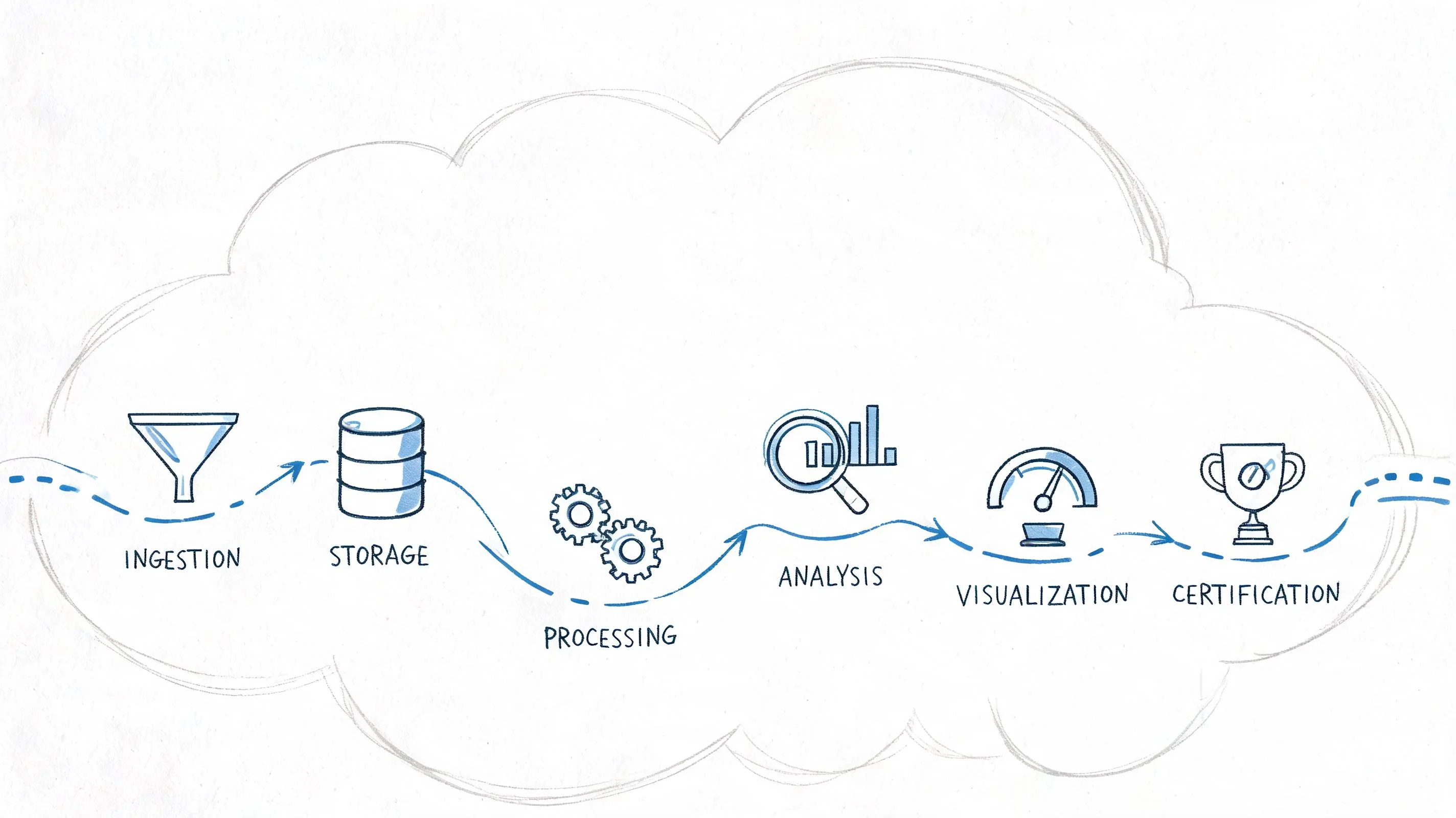
AWS Data Analytics Cert: Your 2026 Guide to the New Path
AWS Data Analytics Certification: Understanding the Shift to Data Engineer Associate (DEA-C01)
The AWS Certified Data Analytics - Specialty (DAS-C01) was retired in 2024 and replaced by the AWS Certified Data Engineer - Associate (DEA-C01). If you're searching for the old AWS data analytics certification, you're not on the wrong path. You're simply looking for a certification name that AWS updated to better reflect current data engineering work.
Many learners arrive here with the same question. You search for "AWS data analytics cert," find study guides for DAS-C01, then notice some pages say it's gone while others still refer to it as current. That confusion can be frustrating, especially when you're trying to choose the right exam, budget study time, or explain your career path to your manager.
The good news is straightforward. The certification name changed, but the underlying skills didn't disappear. You still need to know how data moves, where it lives, how it gets transformed, how people query it, and how to secure it. AWS didn't discard these concepts. It reorganized them around the job role organizations now hire for: the data engineer.
Think of it like a city updating a street name. The destination is still there; your map just needs the current label.
Navigating the Current AWS Data Certification Landscape
You open several tabs to understand the AWS data analytics certification, and the names don't align. One page says DAS-C01. Another points to DEA-C01. A forum post says the old exam is gone, but a course outline still teaches services you recognize. This confusion is common, especially if you're trying to choose the right study path without wasting weeks on retired exam details.
The key update is simple. AWS renamed the certification because the job role became clearer.
DAS-C01 was designed for professionals working on analytics systems at scale. Over time, employers began describing that work less as a narrow analytics specialty and more as data engineering. The day-to-day responsibilities remained closely related. You still need to move data, store it effectively, transform it reliably, secure it, and make it useful for downstream teams. What changed is the label AWS uses for the person performing that work.
A practical comparison helps here. The old certification title focused on outcomes, such as insights and reporting. The new title focuses on the machinery that produces those outcomes, such as pipelines, storage layers, streaming systems, and transformation jobs. If analytics is the meal served at the table, data engineering is the kitchen, prep station, and delivery route that ensure dinner arrives hot and on time.
Why the new name is more useful
"Data analytics" can encompass several different jobs. It might describe dashboard building, business intelligence, SQL analysis, feature engineering, or platform design. "Data engineer" gives students and hiring managers a clearer signal. It centers the certification on building and operating the data systems that analysts, data scientists, and applications depend on.
That clarity matters when planning your study time. If you searched for the old certification because you want to work with Kinesis, EMR, Redshift, data lakes, ETL jobs, or streaming pipelines, the current exam path still matches your goal. In many cases, it aligns more closely with an actual job title than DAS-C01 did.
You searched for an older exam name, but you are still aiming at a current skill set.
How to reset your plan without starting over
Start by separating exam logistics from technical knowledge. You can discard retired exam codes, old domain weights, and expired question formats. The underlying skills are still valuable.
Use this simple reset:
- Studying for a current AWS data certification? Choose AWS Certified Data Engineer - Associate (DEA-C01).
- Already collected DAS-C01 notes or courses? Keep the service knowledge, architecture patterns, and hands-on practice. Remove any retired exam specifics.
- Switching into data work from another IT role? Focus on the full data path: ingestion, storage, transformation, orchestration, quality, security, and governance.
This is the effective way to handle the current AWS data certification situation. You're not changing direction; you're updating your map to use the road names AWS and employers use now.
The Legacy and Enduring Value of AWS Data Analytics Skills
A learner searches for "AWS data analytics cert," opens an old study guide, and sees a retired exam code. That can feel like showing up at an airport and finding out the gate number changed. The destination didn't change; the boarding process did.
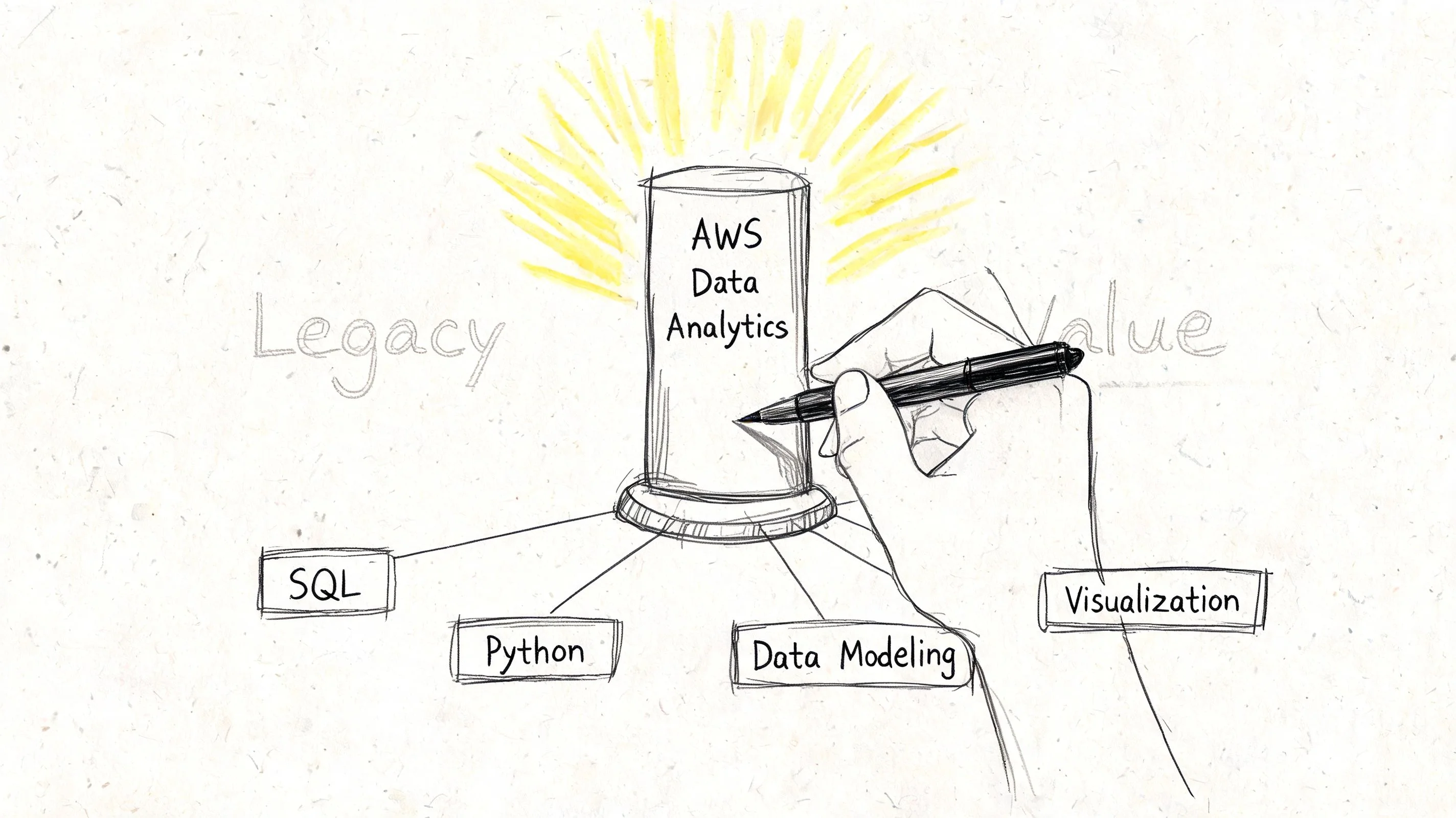
That's the correct way to view DAS-C01 now. The certification is gone, but the skills it tested remain central to AWS data work. Teams still need people who can reliably collect data, store it in the right place, transform it into something useful, and protect it from misuse.
The old exam earned respect because it demanded more than service trivia. You had to make architecture decisions. Should events arrive one by one through a stream, or in scheduled batches? Should raw files stay in object storage, or should they be modeled into query-friendly tables? Should a workload run in a data warehouse, a distributed processing framework, or both? These are the questions data engineers still answer every week.
That's why the retirement of DAS-C01 should not be seen as a loss of value. It's better understood as a relabeling based on current job responsibilities. AWS shifted from "analytics" to "data engineer" because the work extends beyond dashboards and reports. It includes pipeline design, orchestration, quality checks, permissions, data lineage, and operational reliability.
A simple comparison helps here. An older city map may use outdated street names, but it still teaches you where the bridges, highways, and bottlenecks are. DAS-C01 did that for AWS data work. It taught the flow of data across a platform. DEA-C01 uses newer labels, yet it still rewards the same systems thinking.
The skills behind the name
Students who prepared for the old AWS data analytics certification were really building a full-pipeline mindset. They learned how to follow data from its arrival to its decision point:
- Ingestion through services such as Amazon Kinesis
- Storage and organization in systems such as Amazon S3 and Amazon Redshift
- Transformation with large-scale processing tools such as Amazon EMR
- Consumption through queries, dashboards, and downstream applications
- Protection through IAM, encryption, network controls, and careful access design
That combination still marks the difference between someone who can use a tool and someone who can build a dependable data platform.
Practical rule: Treat retired certifications as archived blueprints, not expired knowledge.
The lasting value of DAS-C01 is the judgment it developed. A fast dashboard depends on clean ingestion and well-structured storage. A machine learning feature relies on reliable transformations. A finance report depends on data quality, permissions, and traceable pipelines. These needs did not disappear when AWS changed the exam name.
This is also where many learners get turned around. "Analytics" sounds like charts and SQL. "Engineering" sounds like pipelines and infrastructure. On AWS, those two areas meet in the same workflow. The person building the reporting layer often depends on choices made upstream about partitioning, schema design, stream handling, and security.
So if you came here looking for the old certification, you are not on the wrong topic. You are standing on the older side of the same bridge. The name changed from DAS-C01 to DEA-C01 because AWS now describes the role more directly. The underlying skills still matter, and they still pay off.
Deconstructing the Five Core Data Analytics Domains
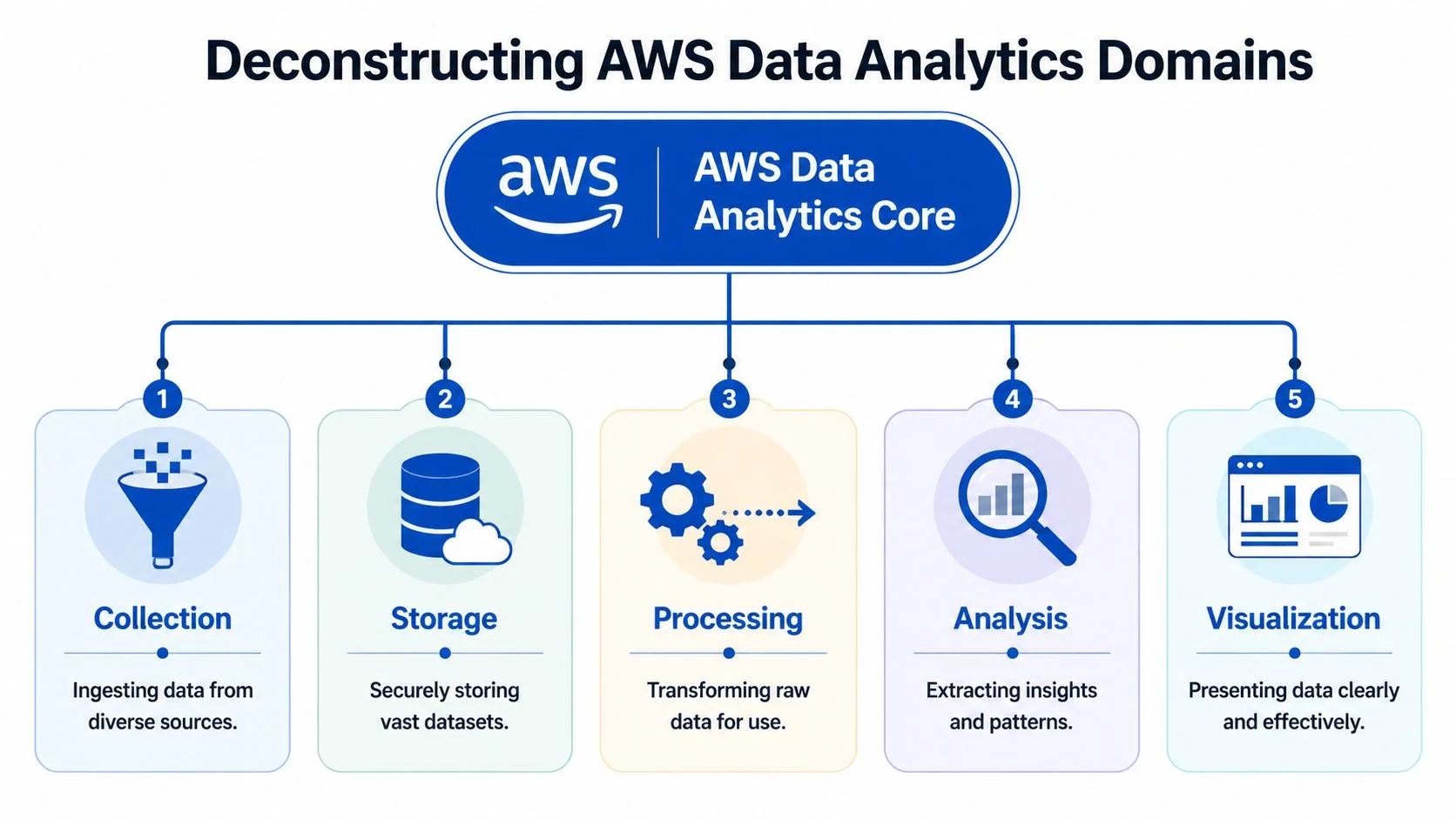
The retired DAS-C01 was organized around five domains, and those domains still provide one of the best ways to understand AWS data work. The exam weighted them as Processing 24%, Storage and Data Management 22%, and Collection, Analysis and Visualization, and Security at 18% each, according to Jefferson Frank’s DAS-C01 breakdown.
That weighting tells a story. AWS expected strong candidates to do more than move data around. They had to transform it and manage it well.
The five domains at a glance
| Domain | Exam Weighting (%) | Core Purpose | Key AWS Services |
|---|---|---|---|
| Collection | 18% | Ingest data from sources into AWS systems | Amazon Kinesis |
| Storage and Data Management | 22% | Store, organize, and serve data reliably | Amazon S3, Amazon Redshift |
| Processing | 24% | Transform raw data into usable datasets | Amazon EMR |
| Analysis and Visualization | 18% | Query, interpret, and present data | Amazon Redshift |
| Security | 18% | Protect data and control access across the lifecycle | IAM and service-level security controls |
Collection
Collection is the front door. If data can’t enter the system cleanly, everything that follows becomes harder.
In AWS terms, collection often means ingesting events, logs, clickstreams, transactions, or application data through services like Amazon Kinesis. I tell students to think of this like a loading dock at a warehouse. Packages arrive from many trucks, at different times, in different conditions. Your job isn’t to admire the boxes. Your job is to receive them reliably without blocking the whole operation.
Common learner confusion starts here. Many people think collection is just “send data to AWS.” It’s more than that. You need to think about source type, arrival pattern, buffering, ordering, and what downstream consumers need.
Storage and Data Management
Storage is where raw material becomes organized inventory. This domain covered where data lives, how long it stays, how it’s partitioned, and how teams can access it efficiently.
Two anchor services here are Amazon S3 and Amazon Redshift. S3 functions as a durable data lake foundation. Redshift acts more like a data warehouse built for structured analytical use. One common mistake is treating them as competitors. In practice, they often work together.
Use a warehouse analogy. S3 is the large storage facility where you keep raw and staged goods. Redshift is the curated showroom where customers can quickly find exactly what they need.
Processing
Processing had the highest weighting for a reason. Raw data is usually messy, incomplete, duplicated, or poorly shaped for analysis. Someone has to clean it, join it, reshape it, enrich it, and prepare it for use.
That’s where services such as Amazon EMR come in. Processing is the factory floor. Collection gets materials into the building. Storage keeps them available. Processing turns them into products people can use.
Students often ask whether processing is only about big clusters and code-heavy jobs. Not really. The deeper idea is transformation. Whether the mechanism is EMR, SQL, managed jobs, or orchestration workflows, the core skill is understanding how data changes from raw to useful.
If you can explain a pipeline as “ingest, land, transform, serve,” you’re already thinking like a data engineer.
Analysis and Visualization
This domain focused on turning prepared data into insight. That includes querying, summarizing, modeling, and presenting results so humans can act on them.
For many learners, this is the most familiar part because it feels closest to “analytics” in the everyday sense. But on AWS, analysis and visualization only work well when earlier stages are solid. A dashboard failure is often a storage or processing issue wearing a reporting disguise.
A useful mental model is a restaurant. Analysis and visualization is the plated meal arriving at the table. Customers judge the final dish, but the kitchen, supply chain, and prep station determine whether that dish succeeds.
Security
Security was not an add-on. It was its own domain.
That matters because many newcomers treat security as a final review item. In reality, every choice in collection, storage, processing, and analysis affects access control, data exposure, and operational risk. On AWS, this means thinking in layers: who can read the bucket, who can run the job, who can query the table, who can view the dashboard, and how data stays protected along the way.
How to use these domains today
If you’re studying under the old AWS data analytics certification label, use the five domains as a mental map:
- Start with flow. Can you trace data from source to insight?
- Name the handoff points. Where does data enter, land, transform, and serve?
- Attach services to roles. Kinesis ingests. S3 stores. EMR transforms. Redshift supports analytical consumption.
- Overlay security. Ask who can do what at every step.
That framework is timeless, even though the exam code is not.
Mapping Your Skills to the New AWS Data Engineer Path
The easiest way to understand the move from DAS-C01 to DEA-C01 is to stop thinking in exam names and start thinking in job tasks. The old certification tested whether you thoroughly understood the AWS data lifecycle. The new one directs that same knowledge toward the work a modern data engineer performs.
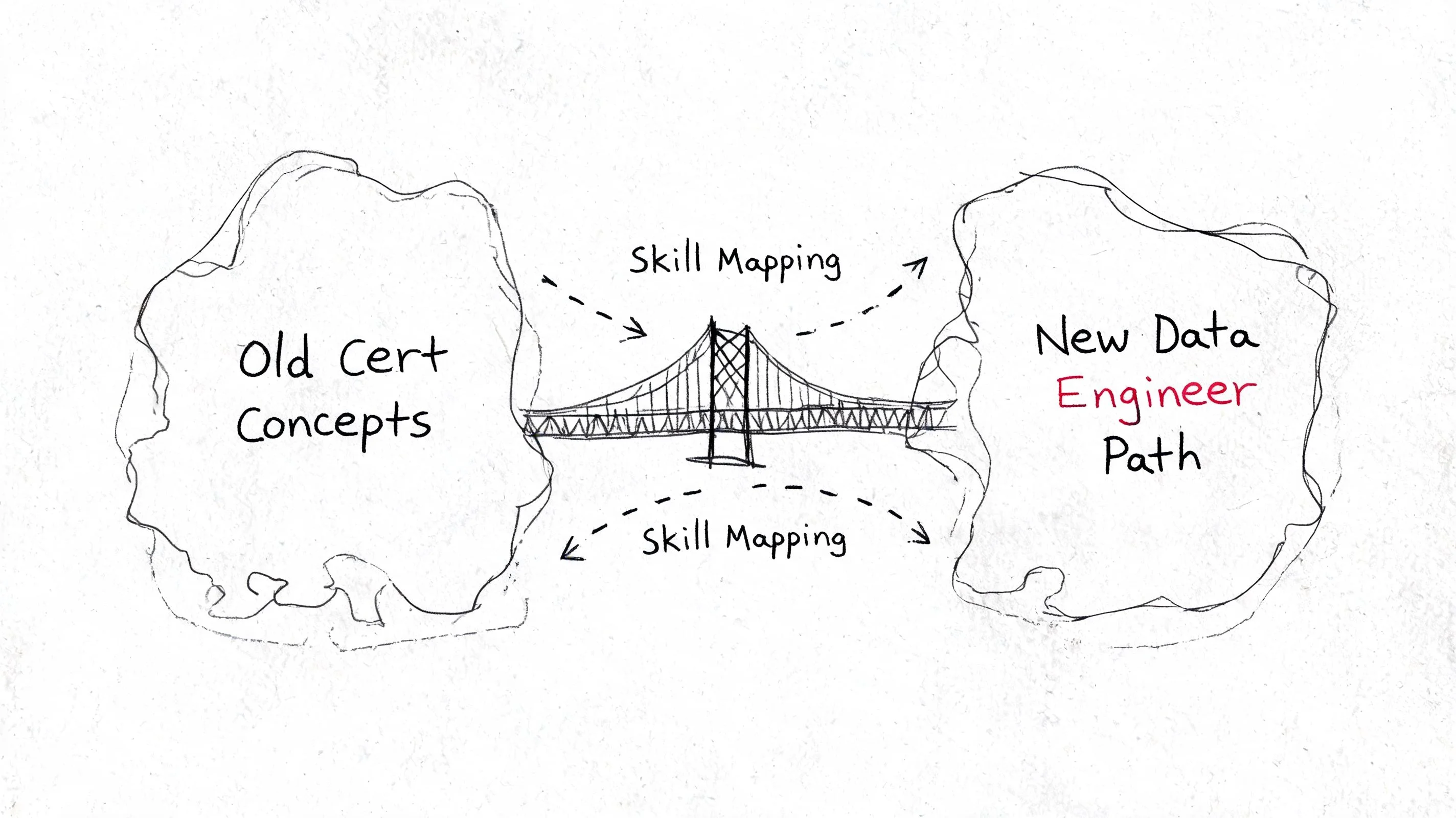
If you already studied for the AWS data analytics certification, you haven't wasted your time. You've built a foundation. The shift is mostly about framing and emphasis.
Old domain mindset, new role mindset
Here’s the bridge I use with students:
- Collection becomes ingestion design. You’re not just capturing data; you’re deciding how pipelines reliably receive events, files, and streams.
- Storage and Data Management becomes data lake and data warehouse architecture. You’re choosing where raw, staged, and curated data belongs.
- Processing becomes transformation and orchestration. You’re building repeatable jobs that prepare data for downstream use.
- Analysis and Visualization becomes data serving. You may not own every dashboard, but you do own whether analysts receive clean, queryable datasets.
- Security becomes built-in governance. You design access and protection as part of the platform, not as a final patch.
That’s why DEA-C01 feels current. It matches how teams divide work.
A practical translation
If your older notes say “learn Kinesis, EMR, Redshift, and secure the whole pipeline,” the updated translation is straightforward:
- Learn how data gets ingested.
- Learn how data gets modeled and stored.
- Learn how jobs transform it.
- Learn how others consume it.
- Learn how to protect every layer.
That’s the same movie with a newer title.
For a deeper roadmap tied to the current certification, this guide can help you accelerate your AWS Data Engineer career.
What changes in your study focus
The biggest adjustment is mental, not technical. Students coming from the old analytics label sometimes over-focus on dashboards and end-user reporting. DEA-C01 shifts attention toward the infrastructure and operational thinking that make analytics possible.
So when you study, ask different questions:
- How would I ingest this dataset?
- Where should raw versus curated data live?
- What transformation pattern fits this use case?
- How would another team query this safely?
- What breaks if schema, permissions, or orchestration goes wrong?
Later in your prep, it helps to watch someone walk through the role transition in plain language:
The modern data engineer isn’t replacing the analyst. They’re building the roads the analyst drives on.
That’s the core mapping. If DAS-C01 taught you to understand the data system, DEA-C01 asks you to operate as the builder of that system.
Your End-to-End Study Plan and Hands-On Labs
Many people fail data certifications for a simple reason. They study service definitions without ever building a flow. AWS exams reward connected thinking. You need to know not only what Amazon Kinesis or Amazon Redshift does, but also why you’d place one service before another in a working pipeline.
A strong study plan should rotate between three activities:
- Learn the concept
- Build a small version of it
- Explain the tradeoff in plain English
A practical study rhythm
You don’t need a perfect schedule. You need a repeatable one.
Start with ingestion and storage. Learn how data lands in AWS, where raw data belongs, and how curated data differs from a simple dump of files. After that, move into transformation. Practice cleaning, reshaping, and preparing data so a downstream user could query it without guessing what each field means.
Then spend time on serving and security. Query your own data. Notice what makes a dataset easy or painful to use. Add permissions thinking to everything you build.
A weekly rhythm can look like this:
- Early week: Read service documentation, notes, and architecture patterns.
- Midweek: Build a small lab around one data flow.
- Late week: Review mistakes, write a short summary, and answer scenario questions.
Hands-on labs that teach the right lessons
Don’t chase giant projects at first. Small labs teach more because you can finish them and reflect on them.
Build a streaming-to-lake path
Use Amazon Kinesis Data Firehose to deliver incoming data to Amazon S3. The point of this lab is to understand ingestion, delivery, and landing zones.
Questions to answer after the lab:
- What format did the data arrive in?
- How would an analyst find yesterday’s records?
- What changes if the incoming stream becomes inconsistent?
Create a simple warehouse workflow
Load cleaned data into Amazon Redshift and run analytical queries. Focus on table design, query usability, and how structured analytics differs from searching through raw files.
Good reflection prompts include:
- What data should stay in S3?
- What deserves a modeled table in Redshift?
- Which columns would analysts use repeatedly?
Run a transformation job
Use a processing service such as Amazon EMR or a managed transformation workflow to clean and reshape raw data. Treat this as your “factory” exercise.
Try tasks like:
- Remove duplicate records
- Standardize timestamps
- Join customer and transaction data
- Produce a curated output for downstream reporting
Add a security pass
Return to one earlier lab and review permissions. Many learners skip this because it feels less visible than query results. Don’t skip it. Ask who can access buckets, jobs, and outputs. Ask whether the design exposes more than it needs to.
Field advice: If you can build a tiny pipeline and explain where security applies at each handoff, your retention improves fast.
How to review without getting lost
Use practice questions carefully. Don’t just mark right or wrong. Tag each miss by type:
| Miss Type | What it usually means | What to do next |
|---|---|---|
| Service confusion | You mix up similar AWS tools | Build a comparison note with use cases |
| Architecture confusion | You know the tools but not the flow | Draw the pipeline from source to consumer |
| Security confusion | You understand function but not control | Revisit permissions and access design |
| Query confusion | You can store data but not serve it well | Practice querying curated datasets |
Toward the end of your prep, use rigorous practice for data engineer certification to pressure-test your understanding under exam conditions.
The habit that matters most
Explain every lab out loud as if you were teaching a teammate. If you can’t describe why data enters through one service, lands in another, and gets transformed before analysis, you probably memorized the service names without learning the system.
That’s the gap to close.
Accelerate Your Prep with MindMesh Academy
Certification preparation gets hard when the AWS service catalog starts to blur together. Many students don’t struggle because they’re incapable. They struggle because too much of their study process relies on rereading notes. That’s one of the weakest ways to remember technical distinctions.
MindMesh Academy is built for a better pattern. Instead of treating exam prep like a stack of static pages, it supports active recall, targeted review, and visible progress across the concepts that matter in AWS data work.
Why these study mechanics matter for AWS data topics
AWS data learning has a specific challenge. The services are related enough to confuse you, but different enough that the exam expects precise choices. You need to remember not only what a tool does, but when it’s the better fit in a larger architecture.
That’s where study design matters.
- Spaced Repetition helps you revisit service differences before you forget them.
- Adaptive Learning Paths push more time toward weak areas instead of forcing equal time everywhere.
- Progress Dashboards show whether your confidence matches your actual performance.
A student who keeps mixing ingestion services, for example, doesn’t need another passive overview. They need repeated retrieval practice until the distinctions become automatic.
A concrete example
Say you keep confusing streaming concepts with storage concepts. In a normal study routine, you’d reread notes on Amazon Kinesis, Amazon S3, and Amazon Redshift and hope the differences stick. In a more deliberate system, you get drilled on those distinctions over time, with extra review where you miss and less repetition where you’re already strong.
That matters because AWS exam questions often present familiar services in unfamiliar combinations. Recognition alone won’t save you. Recall will.
When your study tool keeps bringing back the concepts you nearly forgot, you stop mistaking familiarity for mastery.
Best fit for different learners
MindMesh Academy works especially well for three groups:
- Working IT professionals who need efficient review rather than endless content
- Students who need structure and a clear sense of progress
- Career changers who need both concept grounding and exam-style reinforcement
The platform’s biggest advantage is that it supports the way technical memory develops. You rarely learn AWS data services in one clean pass. You learn them in loops. You compare, revisit, forget a little, recover, and then finally connect them into a coherent system.
That’s the same pattern strong data engineers use on the job. They don’t memorize isolated features forever. They build working mental models and sharpen them through repetition.
Exam Strategy and Long-Term Career Growth
By the time you sit for the exam, your goal isn’t to prove you’ve seen the material. Your goal is to make calm, defensible decisions under pressure. AWS questions often describe a situation with multiple plausible answers. The winning move is usually the option that best fits the full pipeline, not just one service in isolation.
How to approach exam questions
Start by identifying the stage of the data lifecycle the question is really about. Is it asking about ingestion, storage, transformation, analytical serving, or protection? That simple filter cuts through a lot of noise.
Then look for hidden constraints:
- Operational need such as streaming versus batch
- Consumption need such as query speed versus raw retention
- Control need such as restricted access or secure handling
If two answers both seem possible, ask which one creates the cleanest architecture with the least friction for the downstream user.
Practice exam habits that actually help
Use practice exams as diagnostics, not just scoreboards.
After each session, review misses in writing. Don’t settle for “I picked the wrong one.” Write why the correct answer fit the scenario better. That habit trains the exact reasoning AWS exams reward.
For job preparation after the exam, it also helps to translate your new skills into resume language that hiring systems can recognize. A practical resource for that is this guide to ATS data analyst keywords, which can help you describe data pipeline, SQL, cloud, and analytics work in terms recruiters search for.
Think beyond the badge
The certification is useful, but the long game matters more. Treat DEA-C01 as proof that you can work across the AWS data lifecycle, then keep building small projects that show the same capability in public or in your internal portfolio.
Good next moves include:
- Strengthen your portfolio with a few clear end-to-end data labs
- Sharpen your job materials with architecture language, not just service lists
- Expand laterally into adjacent areas such as machine learning data prep or advanced analytics infrastructure
If you want a broader view of where this path can lead, start here to launch your AWS data engineer career.
The exam is one checkpoint. Your career growth comes from turning certified knowledge into repeatable judgment.
Frequently Asked Questions About AWS Data Certifications
Is the new Data Engineer exam easier or harder than the old analytics cert?
It’s better to think of them as different in emphasis. The retired DAS-C01 had a strong advanced-analytics identity and was associated with experienced practitioners. The newer path is more directly aligned to the day-to-day responsibilities of building and supporting data systems on AWS. If your strength is pipeline design, storage patterns, transformation logic, and platform thinking, the newer certification may feel more natural.
I already started studying for DAS-C01. What should I do now?
Keep the fundamentals. Drop the outdated exam-specific details.
Your old notes are still useful if they cover ingestion, storage, processing, analytical consumption, and security. Reframe those notes around the current data engineer role. Service understanding still transfers. The main shift is how you organize your study and what kinds of operational decisions you practice.
Which AWS services should I care about first?
Start with the services that help you understand a full path: Amazon Kinesis for ingestion, Amazon S3 for storage, Amazon EMR for transformation, and Amazon Redshift for analytical serving. Once those relationships make sense, other services are easier to place.
What programming languages matter most?
For this path, think less about “which language wins” and more about “which language supports the job.” You’ll benefit from being comfortable with SQL because analytical systems depend on querying and shaping data. Scripting knowledge also helps for automation and transformation logic. The exam path is about system design and data movement, so don’t assume deep software engineering is the first hurdle.
Is the old AWS data analytics cert still worth mentioning?
Yes, but with context. If you studied the retired certification, frame it as foundational preparation for modern AWS data engineering work. If you’re choosing an exam today, pursue the current certification rather than the retired one.
If you want a smarter way to prepare for AWS certifications without relying on passive rereading, MindMesh Academy is worth a close look. Its study platform is built around spaced repetition, adaptive learning, and progress tracking, which makes it especially useful for service-heavy paths like AWS data engineering where retention and clear architectural thinking matter as much as raw effort.

Written by
Alvin Varughese
Founder, MindMesh Academy
Alvin Varughese is the founder of MindMesh Academy and an enterprise architecture leader. An electrical engineer by training, he moved from factory automation in South Africa to cloud architecture at GE Appliances and Humana (Fortune 50), and holds 20 professional certifications including AWS Solutions Architect Professional, Azure DevOps Engineer Expert, and Microsoft Agentic AI Business Solutions Architect. He built MindMesh Academy after interviewing too many highly certified candidates who couldn't answer basic questions: the goal is prep that makes you better at the job, not just able to pass the exam.