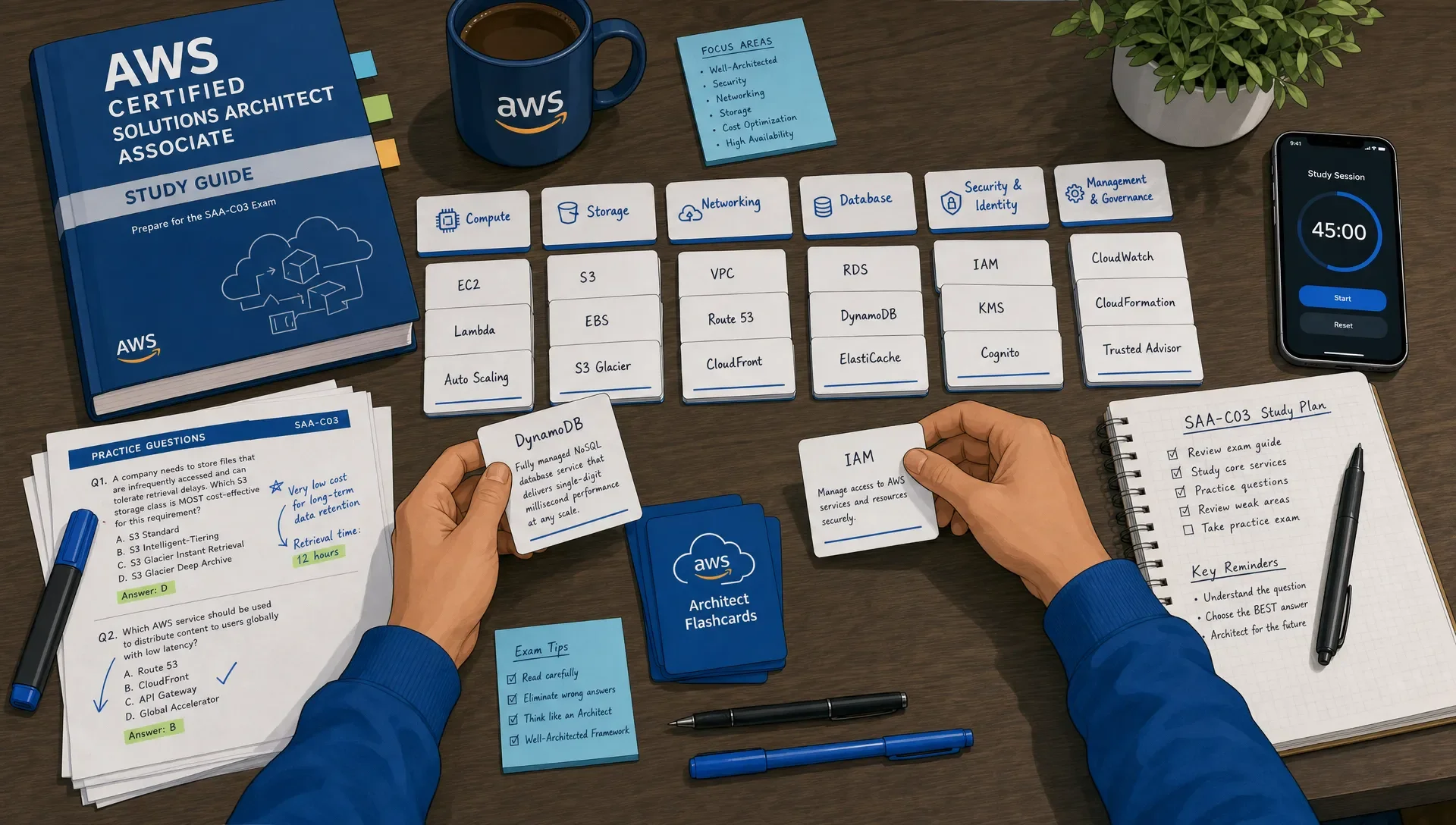
AWS Architect Certification Path for Working Professionals
AWS Architect Certification Path for Working Professionals
If you're fitting an AWS architect certification into a full-time job, don't start by collecting every AWS course you can find. Instead, begin with the exam level that matches your current role, schedule 5 to 7 focused hours per week, and study by architecture decisions, not service trivia. For most working professionals, this means preparing for AWS Certified Solutions Architect - Associate first, then moving to Professional only after you've built stronger design experience.
Your path should answer three questions: which exam should I take, how much time can I realistically study, and how will I know I'm ready? This guide offers a practical route for evenings, weekends, and lunch breaks, showing you how to use study guides, hands-on practice, and practice exams effectively, without turning certification prep into a second job.
The AWS Architect Certification Path at a Glance
The AWS Architect Certification path has two main role-based milestones: AWS Certified Solutions Architect - Associate and AWS Certified Solutions Architect - Professional. AWS Cloud Practitioner can be a useful first step if you're new to cloud concepts, but it's not a strict requirement for the architect track.
| Certification step | Best fit for working professionals | Official AWS experience signal | Main study focus |
|---|---|---|---|
| AWS Certified Cloud Practitioner | You're new to AWS or moving from a non-cloud role | Foundational understanding of AWS Cloud concepts | Shared responsibility, billing, core services, and cloud vocabulary |
| AWS Certified Solutions Architect - Associate | You understand basic cloud concepts and want an architecture credential | AWS says candidates should have experience designing cloud solutions on AWS | Secure, resilient, high-performing, and cost-optimized architectures |
| AWS Certified Solutions Architect - Professional | You already design complex systems or lead architecture decisions | AWS says candidates should have two or more years of hands-on experience designing and deploying cloud architecture on AWS | Multi-account strategy, migration, advanced networking, reliability, and tradeoffs |
AWS describes the Solutions Architect - Associate credential as validating knowledge of designing solutions based on the AWS Well-Architected Framework. For most working professionals, the AWS architect certification route isn't Cloud Practitioner, Associate, and Professional as a rigid ladder. It's Associate first if you can already explain core cloud services, then Professional when your job experience catches up to the exam depth.
If you want a broader view of where architect exams sit beside developer, operations, and specialty credentials, MindMesh Academy's guide to AWS certification paths for busy IT learners can help you compare tracks before you commit.
Which AWS Architecture Exam Should You Start With?
The right starting point depends less on your job title and more on how often you make architecture decisions. A help desk analyst, systems administrator, developer, or project manager can all prepare successfully, but they won't need the same ramp-up.
Start with Solutions Architect - Associate if you know the cloud basics
Choose Associate if you can already explain VPCs, IAM, compute, storage, databases, and high availability at a basic level. You don't need to be a full-time cloud architect, but you should be comfortable asking, "What is the secure, resilient, and cost-aware design here?"
The right AWS architect certification starting point for many IT professionals is Associate because it tests broad architecture judgment without assuming you've led large enterprise transformations. It's also the credential hiring teams most commonly recognize as the entry point into AWS architecture work.
Use Cloud Practitioner as a short bridge if AWS still feels unfamiliar
Cloud Practitioner can be worth it if you're coming from project management, business analysis, service desk work, or another platform such as Azure or on-premises infrastructure. Keep it short. Treat it as vocabulary training, not as the main event.
A reasonable bridge is 2 to 4 weeks of foundational study before you begin Associate-level preparation. If you already work with EC2, S3, IAM, CloudWatch, or VPCs, you can usually skip this step and spend your time on scenario questions.
Delay Professional until your experience is broad enough
The AWS Certified Solutions Architect - Professional exam is different. The official AWS Professional page emphasizes complex solutions and recommends substantial hands-on design experience. If you haven't worked through multi-account environments, hybrid connectivity, migration decisions, or advanced reliability patterns, you'll likely spend too much time memorizing instead of reasoning.
That doesn't mean you need the job title "architect" before you prepare. It does mean you should be honest about whether you've seen enough real constraints to make Professional-level choices under pressure.
How Many Study Hours Do You Need Per Week?
A weekly AWS architect certification plan should protect consistency before intensity. Two tired hours every night often fails because review quality drops. Three stronger sessions per week, plus short recall sessions, usually works better for people with jobs and families.
| Timeline | Weekly time | Best for | How to use the time |
|---|---|---|---|
| 6 to 8 weeks | 8 to 10 hours | You already use AWS at work | Focus on domain gaps, hands-on labs, and timed practice sets |
| 10 to 12 weeks | 5 to 7 hours | You know IT fundamentals but use AWS lightly | Combine structured study, flashcards, labs, and weekly practice reviews |
| 14 to 16 weeks | 3 to 5 hours | You're switching careers or returning after a break | Build foundations first, then move slowly into scenario practice |
Protect deep study blocks for architecture topics
Use your longest sessions for topics that require reasoning: networking, IAM, high availability, data storage tradeoffs, and disaster recovery. These areas are hard to learn in 10-minute windows because you need to hold multiple constraints in your head.
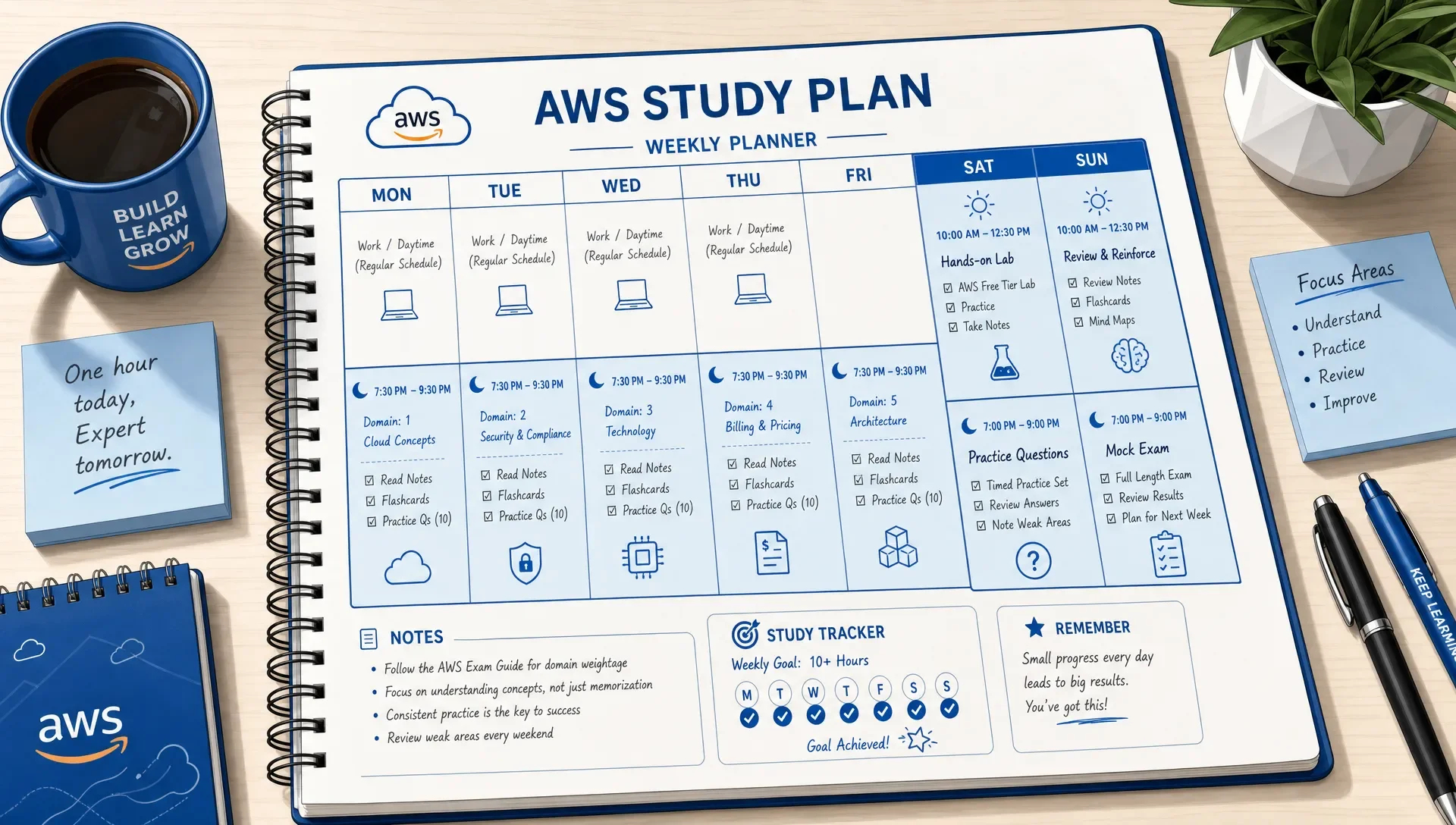
A strong weekly rhythm is one weekday evening for concept study, one weekday evening for hands-on practice, and one weekend block for practice questions. If your schedule is unpredictable, put the weekend block first. That way, the highest-value session doesn't get pushed out by work.
Use short sessions for recall and cleanup
Short sessions are still valuable when you use them correctly. Review flashcards, rewrite missed-question notes, and explain one design pattern out loud. The Institute of Education Sciences practice guide on organizing instruction and study supports spaced practice and retrieval practice as learning strategies, which fits certification prep well when you're balancing work and study.
Don't waste short sessions on passive videos. If you only have 15 minutes, retrieve something from memory or fix one weak point.
What to Study by Exam Domain Instead of by Service
AWS services change, but architecture domains stay more stable. The AWS Certified Solutions Architect - Associate exam guide organizes preparation around domains such as secure, resilient, high-performing, and cost-optimized architectures. Use those domains as your study map.
A domain-led AWS architect certification plan keeps you from studying EC2, S3, RDS, Lambda, and VPC as isolated facts. The exam usually wants you to choose between designs under constraints, so your study notes should capture when to use a service, when not to use it, and what tradeoff changes the answer.
| Domain lens | Questions you should be able to answer | Common decision areas |
|---|---|---|
| Secure architectures | Who can access what, from where, and under which conditions? | IAM policies, encryption, network boundaries, secrets management |
| Resilient architectures | What fails, how fast do we recover, and what does the business tolerate? | Multi-AZ design, backups, replication, failover, and decoupling |
| High-performing architectures | What handles load without overbuilding? | Caching, load balancing, storage performance, and scaling patterns |
| Cost-optimized architectures | Where are we paying for unused capacity or the wrong service class? | Pricing models, storage tiers, right sizing, and managed services |
Study IAM and networking before advanced services
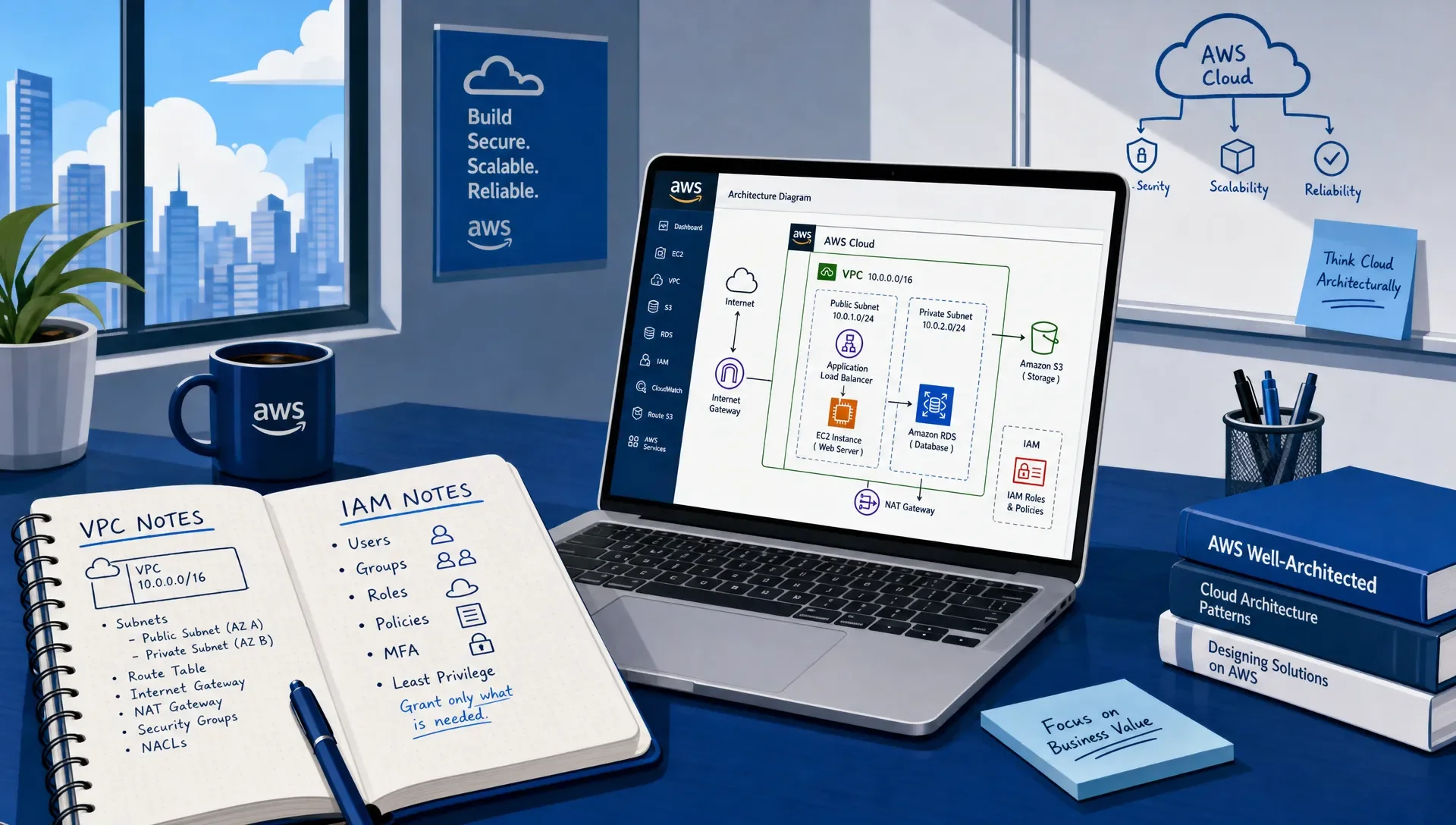
Many wrong answers on architecture questions fail because of identity or network assumptions. Before you explore niche services, make sure you can reason through IAM roles, security groups, network ACLs, public and private subnets, route tables, NAT gateways, VPC endpoints, and cross-account access.
You don't need to memorize every policy element, but you do need to know the flow of access. If a design exposes a database publicly, uses long-term credentials unnecessarily, or ignores least privilege, the service names won't save it.
Tie resilience to business requirements
Resilience questions often include recovery time objective, recovery point objective, regional availability, or operational overhead. Train yourself to underline those constraints first. A solution can be technically resilient but still wrong if it's too expensive, too manual, or more complex than the scenario requires.
When you use the MindMesh Academy AWS Solutions Architect Associate study guide, work through objectives in domain order and mark weak topics as you go. That helps you avoid rereading strong areas just because they feel comfortable.
How to Turn Limited Hands-On Time Into Architecture Skill
Hands-on work makes an AWS architect certification plan more durable because it connects exam language to real behavior. You don't need to build a production-grade platform. You need small projects that force decisions and make AWS concepts less abstract.
Build small systems that include constraints
Pick labs that require at least one security decision, one availability decision, and one cost decision. For example, build a simple web application pattern with a public entry point, private compute or database resources, and logging. Then ask how you would make it more resilient, cheaper, or easier to operate.
Useful mini-lab themes include:
- A static website using S3, CloudFront, and access controls
- A basic VPC with public and private subnets, route tables, and controlled outbound access
- A highly available web tier across multiple Availability Zones
- An RDS backup and restore exercise with encryption enabled
- An event-driven pattern using S3, Lambda, and monitoring
Keep each lab small enough to finish in one or two sessions. Your goal isn't a portfolio project every week. Your goal is to make exam scenarios feel familiar.
Write architecture notes after each lab
After a lab, write a short note with four lines: requirement, design choice, tradeoff, and failure mode. This is where real learning happens. If you built a Multi-AZ database, explain what problem it solves and what it doesn't solve. If you used a NAT gateway, explain why private resources needed outbound access and what cost or availability questions remain.
The AWS Well-Architected Framework is a useful reference here because it frames design around pillars such as operational excellence, security, reliability, performance efficiency, cost optimization, and sustainability. You don't need to read it cover to cover before the exam, but you should use its language to review your lab decisions.
How to Use Practice Exams Without Memorizing Answers
In a strong AWS architect certification routine, practice exams are diagnostic tools, not score-chasing exercises. If you take too many full exams too early, you train yourself to recognize answer patterns without understanding why the options differ.
Start with small sets by domain. After each set, review every missed and guessed question. A guessed correct answer is still a weakness because it won't be reliable on exam day.
| Review target | What to write down | Why it matters |
|---|---|---|
| Final ask | The exact outcome the question wants | Prevents choosing an answer that solves the wrong problem |
| Constraint | Cost, latency, security, operations, or availability requirement | Explains why one good solution beats another good solution |
| Eliminated option | Why a tempting answer is wrong | Builds faster exam judgment |
| Weak concept | The AWS service or design pattern you need to revisit | Turns practice into a study plan |
Timed practice becomes useful after you've covered most domains once. At that point, use the AWS Solutions Architect Associate practice exam to test readiness and focus review on weak objectives. MindMesh Academy's article on AWS practice questions that test architecture skills also explains how to read scenarios for tradeoffs instead of keywords.
How to Know You're Ready to Schedule the Exam
Don't treat an AWS architect certification exam date as motivation if your practice results are unstable. Booking too early can add pressure without improving your study quality. Use readiness signals that reflect repeatable performance.
You're likely close to ready when you can explain missed answers without rereading the full lesson, finish timed sets without rushing the last questions, and identify the key constraint in most scenarios before looking at the options.
Use a readiness checklist before you book
A practical readiness check should combine scores, confidence, and topic coverage. One high practice score isn't enough if it came from repeated questions or lucky guesses.
Before scheduling, confirm that you can:
- Explain the main AWS architecture domains in plain language
- Design a basic secure and highly available workload without looking up every step
- Compare storage, database, compute, and networking options by requirement
- Review missed questions and name the exact concept you got wrong
- Complete timed practice with consistent pacing
- Keep weak-topic flashcards under control through spaced review
If two or more of those are shaky, spend another week on targeted practice. That is usually better than adding another full-length test and hoping the score moves.
What Comes After Solutions Architect - Associate
After Associate, working professionals usually have three good options. The best choice depends on your job, not on which badge looks most impressive.
If you're moving deeper into design leadership, start preparing for Solutions Architect - Professional after you've gained broader hands-on exposure. If your role is security-heavy, AWS security topics may be a better next step. If you support deployment pipelines or operations, DevOps or SysOps paths may fit your daily work better.
The AWS architect certification path should create better architecture judgment, not just a longer certification list. Before choosing the next exam, ask which problems you're paid to solve or want to be trusted with next: migrations, governance, networking, security, cost control, or application modernization.
Frequently Asked Questions About AWS Architect Certification
Is AWS Cloud Practitioner required before Solutions Architect - Associate? No. AWS doesn't require Cloud Practitioner first. It can help if you're new to cloud terminology, but experienced IT professionals can usually begin with Solutions Architect - Associate and fill foundation gaps along the way.
How long does it take to prepare while working full time? Many working professionals should plan for 10 to 12 weeks at 5 to 7 hours per week. If you already use AWS regularly, you may need less time. If you're new to networking, IAM, or cloud architecture, give yourself more runway.
Can I pass if I don't use AWS at work? Yes, but you need hands-on practice. Reading alone usually leaves gaps because architecture questions test tradeoffs. Build small labs, review official AWS documentation, and use practice questions to expose weak domains.
Should I go straight to Solutions Architect - Professional? Usually no. Professional-level questions assume broader design experience and more complex constraints. If you haven't passed Associate or worked with AWS architecture decisions, start with Associate and build from there.
What practice exam score means I'm ready? Don't rely on one number. Look for consistent performance across domains, strong explanations for missed questions, and good pacing under timed conditions. If your score rises only because you've seen the same questions before, you're not measuring readiness.
Build a Study Workflow That Fits Your Workweek
The AWS architect certification path is manageable when you connect the pieces: objectives, hands-on practice, recall, practice questions, and readiness checks. Random study feels busy. Connected study tells you what to do next.
A well-structured study plan turns available hours into meaningful progress. If you're building your AWS architect skills while working full-time, MindMesh Academy offers tailored resources to help you succeed. Our platform provides structured study guides, detailed practice questions with explanations, and readiness tracking to help you turn focused effort into strong exam preparation. Start exploring the certification options and build your study workflow today.

Written by
Alvin Varughese
Founder, MindMesh Academy
Alvin Varughese is the founder of MindMesh Academy and an enterprise architecture leader. An electrical engineer by training, he moved from factory automation in South Africa to cloud architecture at GE Appliances and Humana (Fortune 50), and holds 20 professional certifications including AWS Solutions Architect Professional, Azure DevOps Engineer Expert, and Microsoft Agentic AI Business Solutions Architect. He built MindMesh Academy after interviewing too many highly certified candidates who couldn't answer basic questions: the goal is prep that makes you better at the job, not just able to pass the exam.