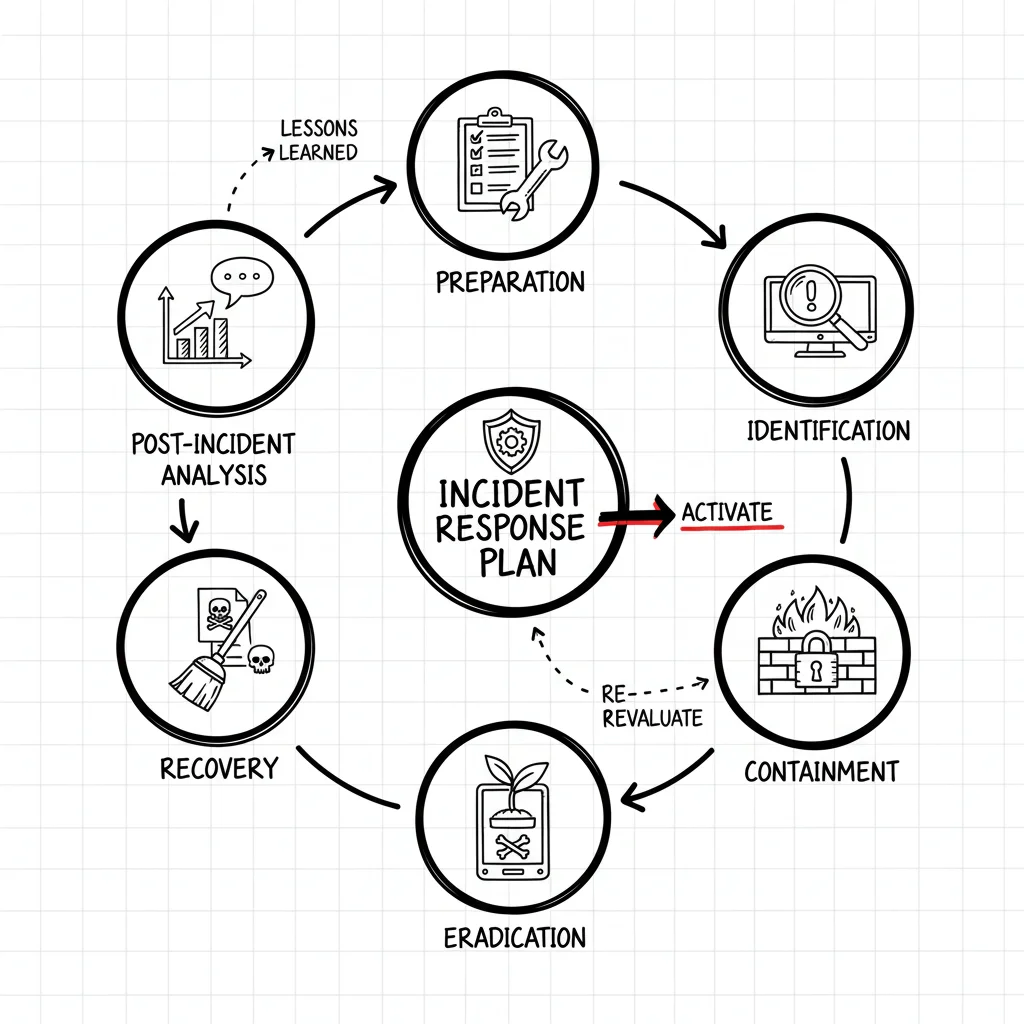
What Is a Service Level Agreement? A Practical Guide to SLA Basics
What is a Service Level Agreement (SLA): A Practical Guide for IT Professionals
At its core, a Service Level Agreement (SLA) is a robust, documented promise. For IT professionals, especially those navigating the complexities of service delivery and certification exams like ITIL or PMP, understanding SLAs is fundamental. It's a formal, often legally binding, agreement between a service provider and a customer, meticulously detailing the services to be rendered, the expected performance levels, and the responsibilities of each party.
Forget the image of a dense, impenetrable legal contract. Instead, envision an SLA as the practical rulebook for a service relationship. It transforms vague expectations, such as "fast service," into concrete, measurable commitments. For example, in a cloud environment, this might translate to "99.9% server uptime" for your AWS or Azure infrastructure, or for an IT support team, "response to critical incidents within 30 minutes." These precise definitions are crucial for both operational excellence and exam readiness.
Defining the Core Promise Between Provider and Customer
The primary objective of an SLA is to meticulously manage expectations and forge a shared understanding. In the high-stakes world of IT, relying on assumptions is a recipe for disaster. An SLA provides a single, authoritative document that both the provider (e.g., a managed service provider, a cloud vendor, or an internal IT department) and the customer (e.g., a business unit, an end-user, or an external client) can reference. This document precisely outlines every critical facet of their partnership.
This level of clarity is indispensable for cultivating trust, mitigating disputes, and ensuring accountability—concepts frequently emphasized in IT service management frameworks like ITIL. A well-structured SLA serves as a cornerstone of effective service management. To grasp how SLAs integrate into broader service strategies, you can deepen your understanding by exploring what is ITIL service management in our detailed article.
The Essential "Who, What, and Why" of an SLA
An SLA isn't just a document for legal teams or senior management; it's a vital operational guide for everyone involved in service delivery and consumption. To simplify its essence, let's dissect the fundamental components that define its purpose and structure.
The table below breaks down the core purpose of an SLA into its essential parts, providing a quick reference for its critical elements.
SLA At a Glance
| Component | Simple Explanation |
|---|---|
| Who | Clearly names the service provider (e.g., AWS, a help desk team) and the customer (e.g., your finance department, a client)—the two parties bound by the agreement. |
| What | Details the specific services being delivered, including their scope, any exclusions, and the quality standards to be met (e.g., VPN availability, ticket resolution). |
| Why | Lays out the consequences if the provider fails to meet the agreed-upon standards, such as service credits, refunds, or contract termination clauses. |
In essence, a robust SLA ensures all stakeholders are aligned from the outset, establishing a foundation for a successful, transparent, and accountable service relationship. For IT professionals, mastering these basics is crucial for certification exams, where scenario-based questions often test your understanding of SLA components and their practical application.
Reflection Prompt: Consider a service you regularly use (e.g., your internet provider, a SaaS application). How would you describe the "Who, What, and Why" of their implicit or explicit SLA with you?
The Building Blocks of a Strong SLA
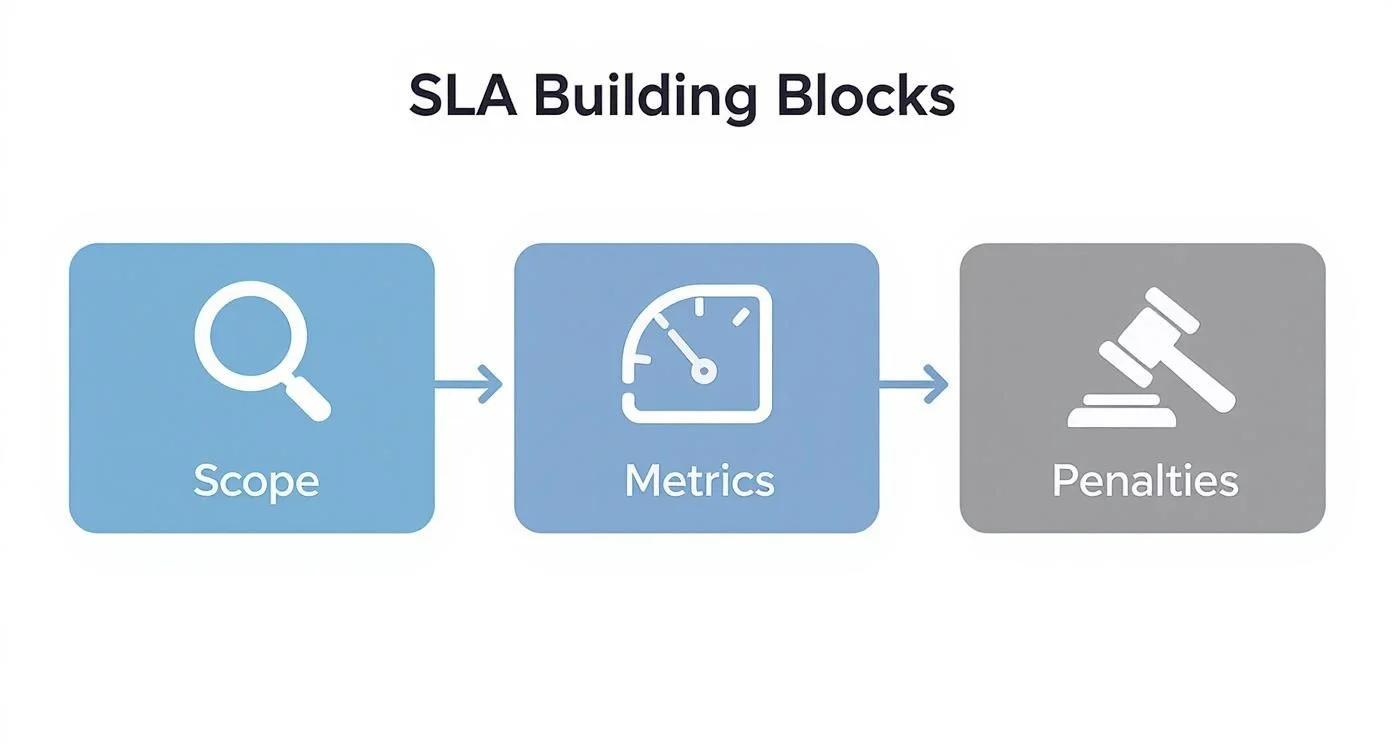
An effective Service Level Agreement should be viewed less as a static legal formality and more as a dynamic blueprint for a successful service relationship. To function optimally, it demands a robust foundation constructed from several indispensable components. Each element plays a distinct role in transforming a general promise into a precise, measurable commitment between a service provider and their customer.
The first crucial element is the scope of services. This section meticulously delineates precisely what the provider is obligated to deliver. Equally important, it explicitly clarifies what is not covered. For instance, an SLA for a cloud hosting provider like AWS EC2 might guarantee the uptime of the virtual machine instances but specifically exclude performance issues stemming from the customer's application code or their on-premises network connectivity. Similarly, an ITIL-focused SLA for a help desk might cover software troubleshooting but exclude hardware replacement, which falls under a different service agreement.
Achieving absolute clarity here from the inception is paramount. It preempts misunderstandings and ensures all parties share a consistent perception of the deliverables. Once the "what" is definitively established, the agreement can then progress to define the "how well."
Defining Performance and Accountability
With the services clearly articulated, the subsequent critical step involves defining performance metrics. These are the quantifiable measures that imbue the agreement with actionable teeth. Absent these metrics, an SLA is merely a collection of commendable intentions. In the context of IT certifications, understanding and applying these metrics is often a key area of examination.
You will almost invariably encounter a set of core performance metrics:
- Availability/Uptime: This is arguably the most recognized metric. It represents the percentage of time a service is fully operational and accessible, frequently expressed as the iconic 99.9% uptime guarantee. For an Azure administrator, this directly impacts the reliability of deployed services.
- Response and Resolution Times: These metrics define the speed at which the provider must acknowledge a reported issue (response time) and, critically, the duration within which they are obligated to resolve it (resolution time).
For issues categorized as high-priority or critical incidents, it is customary to specify resolution targets ranging from 4 to 6 hours, particularly for mission-critical IT services like database availability or network connectivity. The SLA will also meticulously delineate support hours—whether the agreement entails 24/7 technical assistance, which is standard for enterprise-grade SaaS platforms, or restricted support during conventional business hours. For a deeper dive, you can check out these benchmarks for fair performance standards.
Ultimately, a truly robust and effective SLA must unequivocally address the crucial "what if things go wrong?" question. This accountability is established through a remedies or penalties clause. This section meticulously outlines the predetermined consequences—such as service credits applied to subsequent invoices, direct financial refunds, or even the right to contract termination—if the provider fails to uphold their agreed-upon performance standards.
This comprehensive framework—encompassing the definition of services, the quantification of performance, and the establishment of clear consequences—forms the bedrock of effective service level management (SLM). SLM is a continuous, cyclical process that ensures these agreements are dynamic, actively monitored, and consistently enforced. To delve deeper into this critical area for ITIL certification candidates, the official ITIL 4 guidance covers Service Level Management in full.
Understanding the Different Types of SLAs
A Service Level Agreement is far from a monolithic, one-size-fits-all document. To be genuinely effective, an SLA must be meticulously structured and tailored to the specific nature of the relationship between a service provider and its customer. These agreements generally manifest in three distinct categories, each designed to accommodate a particular type of business arrangement or organizational structure.
Identifying which type of SLA is most appropriate for a given scenario is the critical first step in drafting a document that genuinely safeguards the interests of all involved parties and clarifies expectations.
Customer-Based SLAs
Consider a customer-based SLA as a bespoke solution, custom-tailored to meet the unique requirements of a single, specific client or customer group. This type of agreement consolidates multiple services into a unified contract, with all provisions meticulously customized to that customer's distinct operational demands and business objectives.
For instance, a Fortune 500 corporation might enter into a customer-based SLA with an enterprise managed service provider (MSP). This singular contract could comprehensively cover an array of services, from guaranteeing specific network uptime metrics and data security protocols for their entire global infrastructure, to providing dedicated 24/7 helpdesk support with specialized resolution times for their critical applications. It is the optimal choice when a standardized, generic service package simply cannot address the intricate needs of a large-scale or specialized client. This flexibility is key for major enterprise IT projects often managed by PMP-certified professionals.
Service-Based SLAs
In stark contrast, a service-based SLA represents a standardized, "off-the-rack" option. This is a generic contract that applies uniformly to every single customer subscribing to or utilizing a particular service. If you have ever subscribed to a popular cloud storage service like Dropbox or adopted a project management tool such as Asana, you have implicitly (or explicitly) agreed to a service-based SLA.
This model guarantees an identical level of service—for example, a ubiquitous 99.9% uptime for a Software-as-a-Service (SaaS) application, or a specified data retrieval speed for a cloud object storage service like AWS S3—to all users. From the provider's perspective, this approach offers a highly efficient and scalable method to establish clear, consistent expectations across a broad customer base.
Multi-Level SLAs
Finally, the multi-level SLA introduces a more intricate, layered approach predominantly found within extensive, complex organizations. This structure is ingeniously designed to prevent conflicts, minimize redundancy, and ensure comprehensive coverage by stacking various agreements hierarchically.
It typically segment into several distinct layers:
- Corporate Level: This foundational layer encompasses broad service parameters and commitments that are universally applicable across the entire organization. Examples include overarching security policies, enterprise-wide network availability targets, or general incident management processes.
- Customer Level: This layer introduces greater specificity, addressing service requirements pertinent to a particular department, business unit, or even specific user groups within the organization. For instance, it might define the unique software support needs of the marketing team or the specific data processing guarantees for the finance department.
- Service Level: The most granular layer, this defines the precise guarantees for a single, highly specific service. An example might be the guaranteed uptime for the company's critical Enterprise Resource Planning (ERP) system or the defined performance metrics for a specific database instance.
This tiered architecture is exceptionally beneficial for large enterprises as it ensures that every segment of the organization is adequately covered without generating a convoluted mess of overlapping or contradictory contracts.
To facilitate a clearer understanding of how these different types integrate, here’s a succinct comparison of the three SLA types.
Comparing SLA Types
| SLA Type | Who It Covers | Best For | Certification Relevance (Examples) |
|---|---|---|---|
| Customer-Based | A single customer or group | Businesses with unique, high-stakes requirements that need a tailored service package (e.g., enterprise clients of an MSP). | PMP (tailored project contracts), ITIL (customized service offerings) |
| Service-Based | All customers using one specific service | Providers offering a standard service to a large customer base (e.g., SaaS companies, cloud services like Azure Blob Storage). | AWS/Azure Certs (understanding cloud service guarantees), ITIL (standard service catalog) |
| Multi-Level | Different groups within the same organization | Large organizations managing internal IT service delivery to various departments (e.g., internal IT supporting HR, Finance, and Engineering). | ITIL (internal service management, complex organizations) |
The strategic choice of the appropriate SLA structure—be it custom, standardized, or layered—is paramount to constructing an SLA that effectively fulfills its fundamental purpose: establishing unequivocal expectations and ensuring all parties remain consistently aligned.
Why SLAs Are Critical for Business Success
From an IT professional's vantage point, a Service Level Agreement transcends mere contractual obligation; it represents a foundational instrument for robust risk management and the unwavering maintenance of operational stability. At its very core, an SLA serves as your business's primary defense mechanism against the potentially catastrophic financial repercussions of service downtime, suboptimal performance, or a vendor's failure to adhere to their commitments.
Operating without a clearly defined SLA is akin to relying solely on implicit trust—a precarious position that leaves your organization devoid of leverage when a mission-critical service inevitably falters. By meticulously establishing unambiguous, measurable standards, an SLA inherently motivates your service provider to consistently deliver their best work. It effectively transforms a vague assurance of "we'll do our best" into a tangible, enforceable commitment. This proactive approach is fundamental to resilience, a concept heavily emphasized in certifications like CompTIA Security+ or CISSP when discussing business continuity.
The Financial Impact of Service Failures
The financial repercussions stemming from a service failure can be staggeringly substantial and materialize with alarming rapidity. Each moment of an outage or period of degraded performance can directly deplete revenue streams, erode the painstakingly cultivated trust of customers, and tarnish the brand reputation that has taken years to build.
The empirical data underscores this reality. A significant study highlighted that the average cost attributed to a data center outage soared to an astounding $630,000 per incident. Breaking this down further, this translates to an approximate cost of $8,000 for every single minute of downtime. You can discover more insights about IT incident costs to fully appreciate the speed at which these financial losses can escalate, impacting budgets, project timelines (PMP relevance), and overall business health.
An SLA is not merely an administrative formality; it constitutes a vital strategic investment in safeguarding your revenue, preserving your reputation, and fortifying the trust you have diligently built with your customers. It is the indispensable mechanism that transforms promises into guaranteed, actionable outcomes.
The critical importance of SLAs is vividly illustrated across diverse industries. For example, a specialized telecom-specific CRM is an essential tool for managing intricate customer relationships and ensuring consistent service delivery. The rigorous performance metrics tracked within such systems are frequently directly tethered to stringent SLAs, making these agreements the very backbone of dependable service within a fiercely competitive market.
Ultimately, an SLA furnishes the indispensable clarity and security required to cultivate and sustain resilient, long-lasting business relationships.
Reflection Prompt: Think about a recent IT outage or service degradation you experienced (personally or professionally). How might a well-crafted SLA have prevented, mitigated, or provided clear recourse for that incident?
The Most Important SLA Metrics to Monitor
A Service Level Agreement that lacks clearly defined metrics is akin to a promise without an expiration date—it remains a benevolent intention with no tangible accountability. The true power and enforceability of an SLA reside in its specific, measurable targets, which transform a general commitment into a concrete guarantee. These quantitative benchmarks explicitly define what constitutes success, failure, and the predetermined consequences when performance deviates from the agreed-upon standards.
For IT professionals, a profound understanding of these metrics is indispensable for effectively negotiating agreements that genuinely protect their organizations. These metrics provide the precise vocabulary necessary to objectively evaluate a provider's proposed offerings and to hold them accountable throughout the service lifecycle. View them as the essential "scoreboard" that gauges the health and efficacy of your service relationship.
Core Performance Metrics
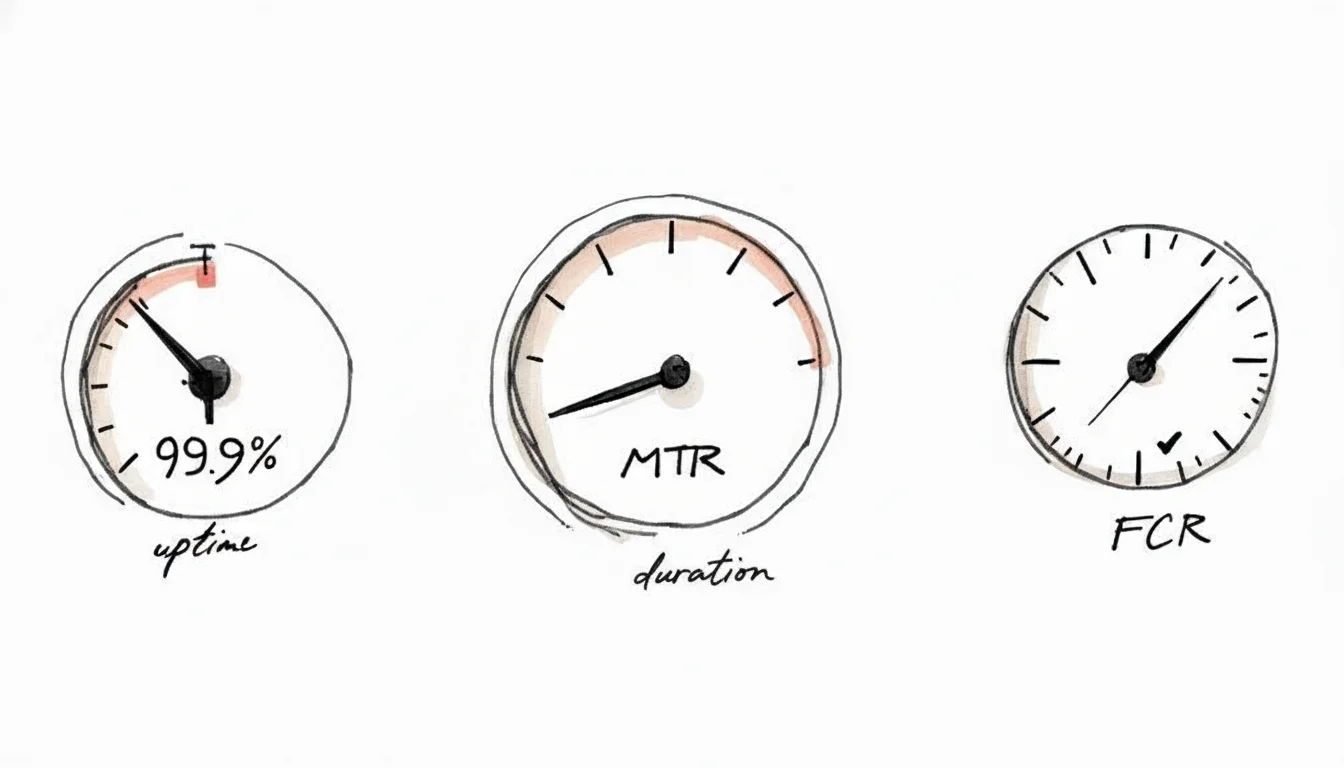
While the potential array of trackable metrics is vast, a select few invariably feature prominently in any robust SLA. These "heavy hitters" directly address the most critical aspects of service delivery: Is the service operational? How quickly are issues addressed? And can problems be resolved efficiently?
Here are the quintessential metrics you will almost certainly encounter and need to understand for certification exams like ITIL or even domain-specific ones for AWS/Azure:
- Availability (Uptime): This is perhaps the most paramount metric—the percentage of time a service is fully functional and accessible. A common guarantee is 99.9% uptime, which on the surface sounds virtually flawless. However, it's crucial to perform the calculation: 99.9% availability over a year still permits approximately 8.77 hours of cumulative downtime. Understanding the real-world implications of "the nines" is essential for setting realistic expectations and assessing true service resilience.
- Mean Time to Recovery (MTTR): When an outage or service degradation inevitably occurs, MTTR measures the average duration required to fully restore the service to operational status. A low MTTR is absolutely critical; it differentiates between a minor, manageable hiccup and a potentially business-paralyzing catastrophe. This metric is vital for incident management processes often covered in ITIL.
- First Call Resolution (FCR): This is a pivotal metric, particularly for customer support and IT help desks. It quantifies the percentage of reported issues that are successfully resolved during the initial contact or interaction with the support team. A high FCR is a strong indicator of an efficient, highly skilled, and well-resourced team that values customer time and minimizes frustration.
These metrics are not isolated figures; rather, they collectively narrate the story of service performance. Outstanding uptime provides little comfort if a minor fault takes days to rectify (indicating a high MTTR). A balanced and comprehensive performance across all key metrics is imperative for true service excellence.
By strategically concentrating on these vital statistics, the conversation shifts from subjective perceptions like "the service feels sluggish" to an objective, data-driven discussion. This fosters a transparent and quantifiable method for measuring performance, which in turn facilitates continuous alignment between provider and customer, nurturing a significantly more robust and enduring partnership.
Best Practices for Creating and Managing Your SLA
For the astute IT professional, your Service Level Agreement should be conceptualized as much more than a mere static contract. It is a dynamic, living document that actively guides and shapes the symbiotic relationship between your organization and its service provider. To maximize its efficacy and derive optimal value, an SLA cannot simply be signed, filed away, and forgotten. It demands proactive and continuous attention from its inception.
The absolute bedrock of a robust SLA is unequivocal clarity. Eschew convoluted legalistic prose and obscure technical jargon. Instead, articulate every provision in plain, unambiguous language, ensuring there is zero ambiguity or room for misinterpretation. Every promise, every performance metric, and every consequence must be so explicitly delineated that any individual involved can readily grasp the precise expectations and responsibilities. This clarity is crucial for all stakeholders, from project managers (PMP) to operational teams (ITIL).
Establish Clear and Realistic Metrics
When it comes to defining your performance metrics, the focus must be laser-sharp on those indicators that genuinely impact the customer's experience and business operations. While it's tempting to set aspirational, lofty goals, if these targets are not genuinely attainable, you are merely setting up both parties for inevitable disappointment and a fractured agreement.
- Be Specific and Quantifiable: Avoid vague statements like "fast response time." Instead, define it precisely: "95% of critical support tickets will receive a first response within one hour." This transforms a subjective notion into an objective, measurable success criterion.
- Prioritize Simplicity: Resist the urge to track an excessive number of "vanity metrics" that offer little actionable insight. Concentrate on a select few Key Performance Indicators (KPIs) that truly reflect the quality, reliability, and business impact of the service.
- Foster Collaborative Agreement: The most effective metrics are those mutually agreed upon by both the service provider and the customer. This collaborative approach ensures that the customer's essential needs are met while simultaneously respecting the provider's realistic capabilities and resources.
It's also a prudent strategy to begin by establishing baseline metrics for continuous improvement. This provides an initial benchmark against which all future performance and progress can be objectively measured.
The most successful SLAs are those that are subjected to regular, scheduled reviews. Implement periodic review cycles—whether quarterly or annually—to meticulously assess performance against agreed metrics, discuss any emerging challenges, and make necessary adjustments to ensure the agreement remains relevant, fair, and effective in a dynamically evolving operational landscape.
Automate Monitoring and Foster Collaboration
Attempting to track SLA performance manually is an open invitation to operational inefficiencies, human error, and potential disputes. Modern SLA tracking software and IT Service Management (ITSM) platforms, like those often discussed in ITIL certifications, address this by automating the process. These tools offer real-time dashboards, automated alerts, and comprehensive reports, providing all stakeholders with a transparent, up-to-the-minute view of how services are performing against targets.
The market for these sophisticated tools is experiencing robust growth—valued at an estimated USD 1.2 billion in 2024, it is projected to escalate to USD 2.8 billion by 2033. This growth underscores the increasing recognition of their importance in effective service delivery.
Ultimately, the true strength and longevity of an SLA are intrinsically linked to a robust, collaborative relationship between the service provider and the customer. This is precisely where exemplary vendor management practices truly shine. For a comprehensive exploration of this critical discipline, consult our guide on vendor management best practices. Open, honest communication, mutual understanding, and a shared commitment to achieving common goals are the catalysts that transform your SLA from a mere contractual document into a potent instrument for cultivating a truly exceptional and enduring partnership.
Common Questions About SLAs
Even after grasping the foundational principles, specific nuances and common queries surrounding Service Level Agreements frequently arise. Let's address some of the most prevalent questions, equipping you with enhanced confidence in navigating and managing these critical agreements.
What’s the Difference Between an SLA and a Contract?
Conceive of it this way: an SLA is a specialized type of contract, but its focus is singularly concentrated on performance.
A broader, general contract establishes the entire commercial relationship, encompassing everything from financial payment terms and intellectual property rights to overarching legal liabilities. The SLA, conversely, meticulously zeroes in on the specific service standards, delivery parameters, and measurable performance metrics. It constitutes the critical segment of the overall agreement that unequivocally answers the question, "How effectively and reliably will this service actually function?" Often, an SLA is merely one integral component within a larger overarching Master Services Agreement (MSA).
Who Actually Writes the SLA?
Typically, the service provider initiates the drafting process by preparing the initial version. This is logical, as they possess the inherent knowledge of their service capabilities, operational capacities, and what they can realistically commit to delivering.
However, an SLA should emphatically never be a unilateral undertaking. The initial draft serves merely as a starting point for dialogue. The customer bears the crucial responsibility of meticulously reviewing the proposed terms, negotiating necessary adjustments, and ensuring that the stipulated conditions precisely align with their actual business requirements and operational dependencies. It is inherently a collaborative endeavor, and no agreement should be formally executed until both parties achieve complete understanding and unanimous consent.
An SLA should be approached as a dynamic, "living document," rather than a static, immutable artifact. Embracing this perspective ensures its continued relevance and effectiveness for both the provider and the customer throughout the entire duration of their partnership.
How Often Should We Review an SLA?
As a general guideline, a comprehensive review of your SLA should occur at least once per year. This annual cadence allows for a systematic assessment of performance, alignment with evolving business objectives, and adjustment to changing technological landscapes.
Nevertheless, it is imperative to revisit and potentially renegotiate the agreement much sooner should any significant trigger events occur. Such triggers could include: a fundamental shift in your organization's strategic business goals; a substantial update, modification, or deprecation of the service itself; a change in the underlying technology infrastructure; or consistent failures to meet agreed-upon metrics. Regular check-ins are vital to prevent the agreement from becoming an outdated, ineffective document that lacks operational relevance.
What Happens If Someone Breaks the SLA?
The explicit consequences for a breach of the SLA are meticulously detailed directly within the agreement itself, typically encapsulated under a "Remedies" or "Penalties" clause.
These pre-defined penalties are specifically designed to compensate the customer for the service failure and to provide a tangible incentive for the provider to maintain compliance. Common remedies can include:
- Service credits that are subsequently applied to future invoices, effectively reducing the customer's cost.
- Direct financial refunds or prorated payments for the specific period during which the service underperformed.
- In instances of severe or persistent non-compliance, the agreement may grant the customer the unequivocal right to terminate the contract prematurely without incurring any penalties.
Ready to master the concepts needed for your next certification exam, whether it's ITIL, AWS, Azure, PMP, or another industry-leading credential? MindMesh Academy provides expert-curated study materials and evidence-based learning techniques to help you not just pass, but truly excel. Accelerate your career and solidify your technical expertise today at ITIL 4 Foundation Practice Exams.

Written by
Alvin Varughese
Founder, MindMesh Academy
Alvin Varughese is the founder of MindMesh Academy and an enterprise architecture leader. An electrical engineer by training, he moved from factory automation in South Africa to cloud architecture at GE Appliances and Humana (Fortune 50), and holds 20 professional certifications including AWS Solutions Architect Professional, Azure DevOps Engineer Expert, and Microsoft Agentic AI Business Solutions Architect. He built MindMesh Academy after interviewing too many highly certified candidates who couldn't answer basic questions: the goal is prep that makes you better at the job, not just able to pass the exam.