Study Tips for Exams That Improve Long-Term Recall
Study Tips for Exams That Improve Long-Term Recall
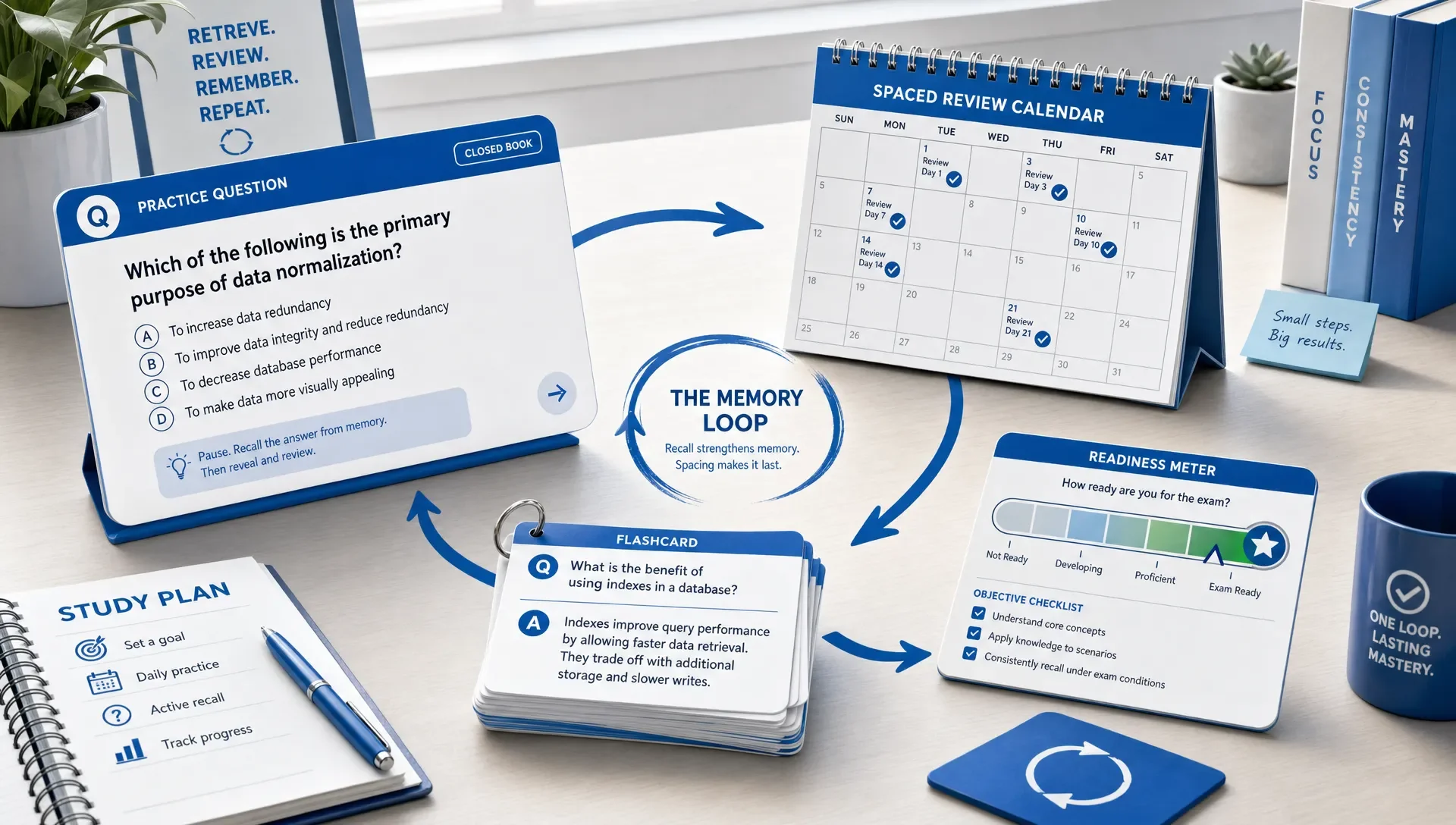
Your goal for exam preparation should be long-term recall, not just short-term recognition. Start each study session by answering questions before you review notes. Schedule repeat reviews before you forget. Treat every missed question as a clue about what your brain can't retrieve yet.
A practical rule for certification prep is this: spend less time making your notes look perfect and more time proving you can use the material without help. This means practicing closed-book recall, using spaced flashcards, working through mixed practice questions, and tracking your progress by exam objective.
Research supports this approach. In a major review, Dunlosky et al. rated practice testing and distributed practice as high-utility learning techniques, making them a strong foundation for any exam study plan (Psychological Science in the Public Interest).
Use Active Recall Before You Review Notes
Active recall means you try to pull information from memory before you look at the answer. It feels harder than just rereading, but that difficulty is the point. If you can only understand a concept while staring at a diagram, command, formula, or definition, you have recognition, not reliable recall.
Roediger and Karpicke found that retrieval practice improved later retention compared with additional study in their test-enhanced learning research (Psychological Science). For exam prep, this means your first move should often be a question, not opening a chapter.
Here's a simple recall loop to use:
- Write one question from memory about the topic you studied yesterday.
- Answer it closed-book, even if your answer is incomplete.
- Check the official concept, explanation, or study guide section.
- Rewrite the answer in clearer language without copying the source.
- Add a follow-up question that targets the part you missed.
For example, if you're studying cloud identity, don't begin by rereading IAM definitions. Instead, ask yourself: What is the difference between a user, group, role, and policy, and when would each be used? Then, check the explanation and correct the weakest part of your answer.
Space Review Sessions Instead of Cramming
Cramming can create a false sense of mastery. The material feels familiar when it's fresh in your mind. Long-term recall needs spacing. You review a topic, wait long enough for retrieval to become effortful, then retrieve it again.
Cepeda et al. reviewed distributed practice research and found that spacing learning episodes across time benefits long-term retention (Psychological Bulletin). You don't need a perfect calendar to use this method. You just need a repeatable rhythm that brings old material back before exam day.
| When to review | What to do | Goal |
|---|---|---|
| Same day | Answer 5 to 10 closed-book questions | Confirm initial understanding |
| Next day | Review flashcards and missed questions | Strengthen retrieval after sleep |
| 3 to 4 days later | Mix the topic with related topics | Prevent single-topic memorization |
| 1 week later | Take a timed mini quiz | Check recall under pressure |
| 2 weeks later | Rework only weak objectives | Keep review efficient |
The exact spacing depends on the exam's difficulty, your background, and your deadline. If you keep missing the same card, shorten the interval. If you answer correctly with confidence, lengthen the interval. For a deeper system, check out MindMesh Academy's guide to master spaced repetition for studying and adapt the timing to your certification path.
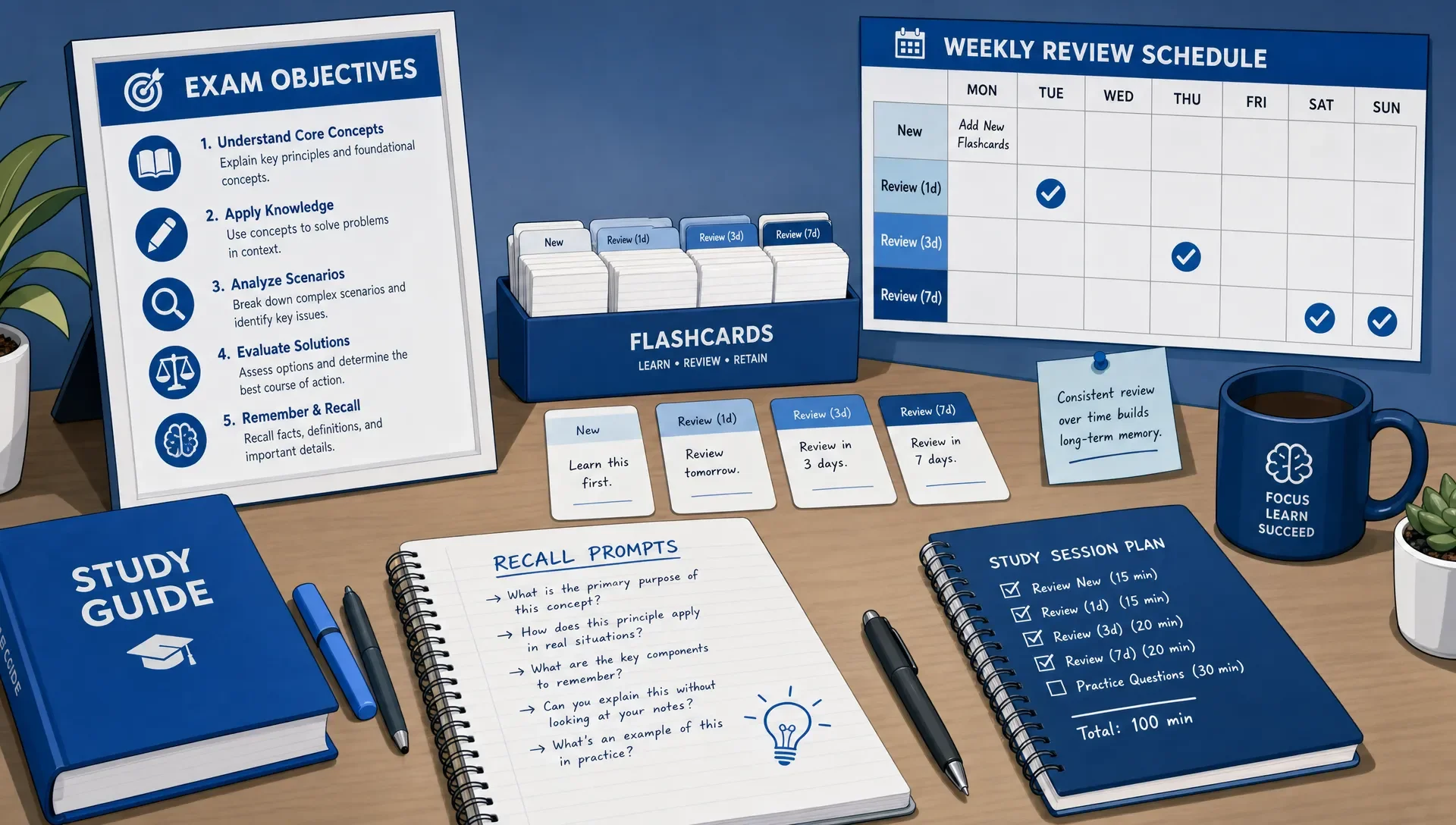
Turn Exam Objectives Into Recall Prompts
Exam objectives aren't just a checklist. They're a map of what you must retrieve under test conditions. Many learners read an objective and think, "I recognize that." Recognition, however, is weak evidence of true understanding.
A better approach converts each objective into prompts that force explanation, comparison, and scenario-based decision-making. If you're preparing for a fundamentals certification, an objective-based resource like the AZ-900 Microsoft Azure Fundamentals study guide can help you organize study by domain instead of jumping randomly between topics.
| Objective style | Weak study question | Better recall prompt |
|---|---|---|
| Define a service | What is object storage? | When would object storage be a better fit than block storage? |
| Identify a security control | What is MFA? | Which risk does MFA reduce, and which risks does it not solve? |
| Understand networking | What is a subnet? | How would subnet design affect traffic flow and access control? |
| Troubleshoot an issue | What does this error mean? | What are the first two checks you would perform and why? |
This technique also reduces overconfidence. If you can't explain when to use a concept, you probably don't know it well enough for scenario questions.
Use Practice Questions as Memory Training, Not Just Scoring
Practice questions aren't only for predicting your score. Used correctly, they're one of the best tools for building durable recall. The key is to answer first, review second, and diagnose third.
If you check explanations too quickly, you train recognition. If you struggle first, commit to an answer, and then review the explanation, you create a stronger memory signal. MindMesh Academy's article on practice examination habits that improve recall goes deeper on using practice exams as retrieval training instead of simple score checks.
After each practice set, sort missed questions by error type. This turns mistakes into a tailored study plan.
| Error type | What it usually means | Recall-focused fix |
|---|---|---|
| Definition gap | You didn't know the core term | Create a flashcard that asks for the meaning and a real example |
| Similar concepts confused | You recognized both options but couldn't choose | Build a comparison table and write when each option applies |
| Scenario misread | You knew the topic but missed a key clue | Underline constraints before answering the next set |
| Process order mistake | You knew the steps but not the sequence | Rebuild the workflow from memory on a blank page |
| Overconfident guess | You answered fast without proof | Require yourself to explain why each wrong option is wrong |
For security-focused learners, a CompTIA Security+ practice exam is most useful when you review explanations by domain and convert missed scenarios into new recall prompts.
Mix Related Topics After You Know the Basics
Studying one topic at a time is useful at the start. If you don't know the basic vocabulary, mixed practice can feel chaotic. But once you have the foundation, you need to mix related topics because real exams rarely announce which mental folder to open.
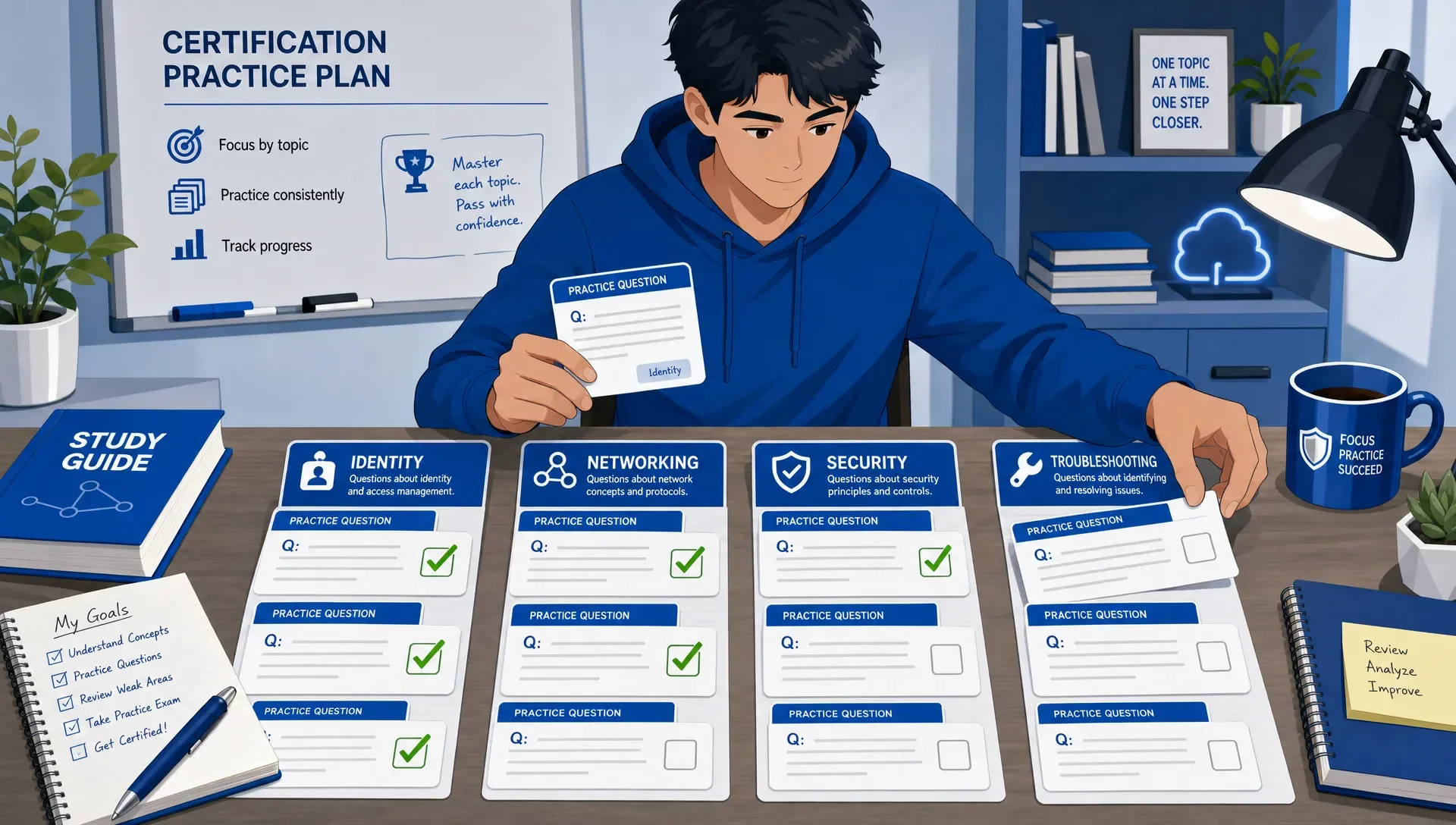
For example, don't only study identity for an hour, then networking for an hour, then monitoring for an hour. After the first pass, create mixed sets where identity, networking, cost, security, and troubleshooting appear together. This forces you to identify the problem type before choosing the solution.
A good mixed practice session has three parts. First, answer questions from multiple objectives without notes. Second, tag every missed question by objective. Third, revisit only the objectives that caused errors. That keeps the session challenging without turning it into random guessing.
Protect Focus Blocks From Context Switching
Long-term recall improves when study sessions are clean and deliberate. You don't need perfect silence, but you do need fewer context switches. Every time you jump from a practice question to messages, admin tasks, or work tools, you make it harder to stay in retrieval mode.
Set a narrow goal for each study block. For example: "I will answer 20 networking questions closed-book, review explanations, and create 5 flashcards from misses." During that block, keep only the materials required for that task open.
If your workday includes checking lead, sales, or community tools, even useful ones like Redditor AI, schedule that admin block outside study time. The point isn't that tools are bad. The point is that recall practice needs uninterrupted attention, especially when you're training yourself to retrieve technical details under pressure.
Build a Weekly Exam Study Plan for Long-Term Recall
A strong weekly plan includes new learning, retrieval, spaced review, mixed practice, and error correction. If your plan only says "study cloud" or "review security," it's too vague to guide your behavior.
Here is a simple structure you can reuse for most certification exams:
| Day | Main task | Recall purpose |
|---|---|---|
| Monday | Learn one objective group and write recall prompts | Build accurate first understanding |
| Tuesday | Answer closed-book questions from Monday's topic | Retrieve before the memory fades |
| Wednesday | Study a second objective group and review old flashcards | Add new knowledge while spacing the old |
| Thursday | Take a mixed mini quiz from both topics | Practice choosing between similar concepts |
| Friday | Rebuild missed questions without notes | Repair weak memory paths |
| Saturday | Complete a timed practice set | Add pressure and pacing |
| Sunday | Review readiness by objective and plan next week | Focus effort where it matters most |
This rhythm is flexible. If you only have four study days, combine new learning with short spaced review. If your exam is close, reduce new material and increase mixed retrieval. The goal isn't to fill every hour. The goal is to make every hour produce usable recall.
Track Readiness by Objective, Not by Confidence
Confidence is useful, but it's not enough on its own. You might feel good about a topic because you just reviewed it, because the questions were easy, or because you recognized familiar wording. Readiness should be based on consistent performance across objectives, especially after time has passed.
Track these signals:
- Can you answer questions correctly after a few days away from the topic?
- Can you explain why wrong answers are wrong?
- Can you handle scenario wording you haven't seen before?
- Are your mistakes concentrated in specific objectives?
- Can you finish timed sets without rushing the final questions?
Frequently Asked Questions
What are the best study tips for exams if I forget material quickly? Use active recall before rereading. Review the same topic across spaced intervals. Turn every missed question into a targeted flashcard or recall prompt. Forgetting quickly usually means you need more retrieval practice and better spacing, not longer passive review sessions.
How many times should I review a topic before an exam? Review it enough times that you can retrieve it after delays, in mixed practice, and under timed conditions. A common starting point is same day, next day, several days later, one week later, and again during final review.
Are flashcards enough for certification exams? Flashcards help with definitions, commands, comparisons, and small facts, but they shouldn't be your only method. Pair them with scenario questions, practice exams, and objective-level review so you can apply concepts, not just recite them.
Should I take notes or answer questions first? If the topic is brand new, take brief notes to understand the basics. After that, answer questions first. Your notes should support recall practice, not replace it.
How do I stop rereading the same material without improving? Set a rule that every rereading session must produce an output. That output could be a closed-book summary, a comparison table, a set of flashcards, or a corrected explanation for missed questions.
How do I know I'm ready for the real exam? Look for consistent performance across objectives, not just one good score. You want to answer mixed questions correctly, explain your reasoning, recover from tricky wording, and show fewer repeat mistakes in your weak areas.
Build a Recall-First Exam Prep Routine
If you want better long-term recall, don't build your study plan around how much content you can consume. Build it around what you can retrieve, explain, and apply after time has passed.
Ready to put these recall-first strategies into practice for your certification? MindMesh Academy helps IT professionals build structured study routines. Explore our resources, including objective-based study guides, practice questions with detailed explanations, and progress tracking by topic to target your weak areas. Build a study plan grounded in proven learning science and prepare effectively for your next exam at MindMesh Academy's certification hub.

Written by
Alvin Varughese
Founder, MindMesh Academy
Alvin Varughese is the founder of MindMesh Academy and an enterprise architecture leader. An electrical engineer by training, he moved from factory automation in South Africa to cloud architecture at GE Appliances and Humana (Fortune 50), and holds 20 professional certifications including AWS Solutions Architect Professional, Azure DevOps Engineer Expert, and Microsoft Agentic AI Business Solutions Architect. He built MindMesh Academy after interviewing too many highly certified candidates who couldn't answer basic questions: the goal is prep that makes you better at the job, not just able to pass the exam.