
Six Sigma Certification Price: A 2026 Cost Guide
You're an IT professional navigating a landscape of certifications, and encountering the Six Sigma market can feel like stepping into a labyrinth. One provider might offer a "belt" for under $100, while another demands thousands, and a university bundle climbs even higher. Each promises enhanced credibility, career advancement, and practical process improvement skills.
This bewildering price disparity isn't irrational once you understand what you're truly investing in. For tech teams, Six Sigma is far more than a manufacturing relic with outdated jargon. Its principles map directly to critical IT challenges: incident reduction, streamlining ticket flow, robust change control, minimizing rework, enhancing release quality, and boosting service reliability. If your role involves managing developers, system administrators, support teams, QA, data scientists, or project delivery, the appeal is clear: you want cleaner handoffs, fewer recurring defects, and a reliable methodology your team can leverage even under pressure.
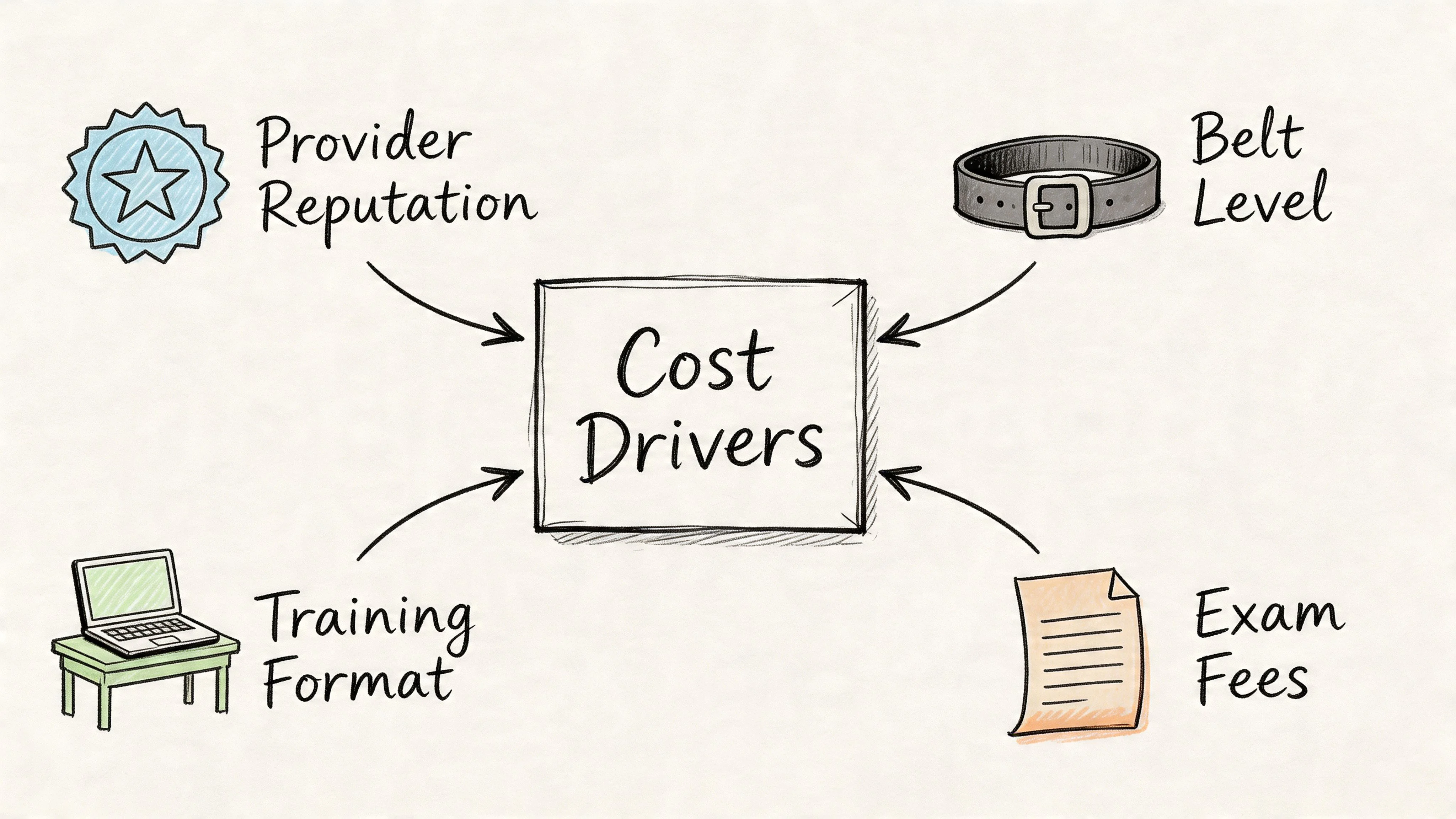
The core challenge is that Six Sigma certification price isn't dictated by a single, standardized market rate. Instead, it's a dynamic reflection of several key factors: the desired belt level, the provider's reputation, the delivery format, the complexity of the exam structure, and how much value-added content—or marketing fluff—is bundled into the offering. Some options are lean and cost-effective for foundational learning, while others command a higher price due to live instruction, university accreditation, or enterprise-specific packaging. It’s about discerning what genuinely serves your educational and career goals.
Why Is Six Sigma Pricing So Confusing for IT Professionals?
Imagine an IT manager searching for "cloud certification." They might find a basic online course, a vendor-specific exam voucher (like for AWS or Azure), or a comprehensive bootcamp with labs and live instructors. Each is a valid path to a credential, but their costs and implications vary wildly. Six Sigma is similar. An IT manager researching Six Sigma training might open multiple tabs and find five distinct products, all claiming to be "certification":
- A standalone exam.
- A bundle of video training and practice tests.
- An offering with live coaching, project review, and a university affiliation.
- A program priced for a corporate cohort, not an individual.
This diversity is the root of the confusion. "Six Sigma certification" isn't a single, standardized product with a consistent market price. The label encompasses a range of purchasing decisions, each with different objectives. You might be aiming for a resume badge to bypass HR filters, seeking structured training to implement in incident management or release quality, or considering a credential for its impressive branding that might offer limited practical value in daily IT operations.
What Usually Influences the Price?
Several factors are the primary drivers behind the varying costs:
- Belt Level: Introductory belts focus on core concepts and vocabulary. Higher belts (Green, Black, Master Black) typically demand deeper statistical analysis, stronger project application, and concrete evidence of leading impactful change. Think of it like a junior developer certification versus an AWS Solutions Architect Professional — the scope and expected expertise differ significantly.
- Provider Credibility: Certain programs carry more weight because employers widely recognize their names, similar to how a PMP or ITIL certification is globally respected. This recognition isn't always a direct reflection of superior material but rather a trusted signal in the job market.
- Delivery Format: Self-paced online courses are inherently cheaper to deliver. Live virtual classes, with instructors, cohort interaction, and scheduled sessions, incur higher overhead. In-person bootcamps represent the highest cost due to facilities, logistics, and more intensive, high-touch delivery.
- Assessment Model: An open-book multiple-choice exam is less expensive to administer than a proctored exam, a rigorous project review, or a combination of both.
- Bundled Inclusions: Items like templates, exam retakes, mentorship, software access, and alumni support can be genuinely helpful, but they can also inflate the price without adding proportionate value to your specific needs.
For IT professionals, the critical question is whether the additional cost directly translates into a better outcome for your career or your team's performance. A low-cost program might be sufficient for a support manager needing a solid Green Belt foundation and a shared vocabulary for their team. Conversely, a higher-priced option could be justified if enterprise HR, procurement, or a consulting engagement specifically expects a credential from a well-known provider and documented project work.
The emergence of affordable certifications and AI-assisted training tools further complicates the landscape. Some are highly efficient for learning the methodology, while others are light on instructor feedback or practical application, marketed as if automation alone makes them equivalent to established programs. In reality, while AI can enhance study efficiency and practice, it cannot replace credible assessment, real-world project coaching, or the nuanced feedback of an experienced mentor.
Reflection Prompt: Before you invest, ask yourself: What specific problem will this Six Sigma certification help me solve in my current IT role? What impact will it have on my team, and how will it position me for my next career move? Use these answers to filter through the noise and assess whether a provider is charging for genuinely useful support or merely attractive packaging.
Decoding the Main Drivers of Six Sigma Prices
To demystify the Six Sigma certification price, let's break down the components that providers typically charge for. Understanding these drivers makes most offerings much clearer.
Belt Level Changes Both Depth and Impact
A Six Sigma belt isn't merely a badge; it's a signal of the level of methodology, statistical proficiency, and project responsibility an individual is expected to manage.
- Yellow Belt: This level typically suits individuals who need to participate in improvement initiatives, understand the core terminology, and support smaller projects. In an IT context, this could be a service desk lead, a scrum master, a QA analyst, or a junior project manager. They learn enough to be effective team members.
- Green Belt: This is where hands-on problem-solving becomes central. Many tech professionals find the Green Belt highly relevant if they aim to lead process improvements in areas like release pipelines, support operations, infrastructure provisioning, or cross-functional delivery. At this level, you're not just learning vocabulary; you're expected to apply tools like DMAIC (Define, Measure, Analyze, Improve, Control) to real-world IT challenges.
- Black Belt and Above: These command higher prices because the expected organizational impact is significantly greater. These paths demand deeper statistical analysis, broader leadership skills, and a more strategic application of Six Sigma across the organization. If your role involves driving enterprise-wide process change or significant transformation, the training burden naturally increases to match the responsibility.
MindMesh Insight: For many IT professionals, the Green Belt offers the strongest return on investment (ROI) by providing practical skills to lead meaningful improvements without the extensive time and cost commitment of a Black Belt, which is often reserved for more specialized roles.
Reputation Affects Employer Trust
The brand of the certification provider often matters more than buyers initially acknowledge.
A recognized body like ASQ (American Society for Quality) carries a market signal akin to a globally recognized university degree or a highly respected professional certification like PMI's PMP. This doesn't automatically mean the content is superior for every learner, but it does mean employers are likely to trust the credential faster due to name recognition.
Budget providers and exam-only options can still be a sensible choice, particularly if you have a strong track record of operational successes on your resume. In such cases, you rely more on your ability to articulate your learned skills and how you've applied them. However, if the certification name itself needs to carry significant weight in formal hiring processes or promotion decisions, provider reputation becomes a crucial part of the overall value proposition.
Format Changes What You Actually Receive
- Self-paced online courses are generally more affordable because they eliminate the costs associated with live instruction and fixed schedules. This format is often an excellent fit for IT professionals who thrive on independent learning, similar to how many excel with labs, detailed documentation, and practice exams for other IT certifications (e.g., AWS, Azure).
- Live virtual classes are more expensive due to the overhead of instructors, cohort management, and scheduled sessions.
- In-person bootcamps represent the highest cost, involving facilities, logistics, and a highly interactive, high-touch delivery model.
When evaluating the format, ask yourself these practical questions:
- Will I genuinely utilize live access? If your calendar is consistently overloaded, you might pay for sessions you never attend.
- Do I need personalized feedback? If areas like statistical analysis or project scoping are challenging for you, live coaching or mentorship can be an invaluable investment.
- Am I buying flexibility or structure? Some individuals excel with the flexibility of self-paced programs, completing them quickly. Others may find themselves stalling without the external motivation of deadlines and scheduled interactions.
Key Takeaway: A higher price point doesn't inherently mean a "better" certification. It often signifies more bundled services, increased live interaction time, or a stronger brand signal. For most IT managers, the optimal choice isn't necessarily the most comprehensive or expensive package, but rather the one their team will realistically complete and effectively apply to real-world IT problems.
How Much You Can Expect to Pay for Each Belt in 2026
An IT manager often confronts this pricing dilemma when a vendor quote arrives. One option might offer a Green Belt for a few hundred dollars, while another promotes a live bootcamp costing more than a high-end laptop. Both are presented as professional certifications.
This significant price spread is genuine. Six Sigma pricing globally ranges from free entry-level options to programs exceeding $15,000 at the highest tiers. The belt level is a key differentiator, but so is the scope of what is being sold alongside it.
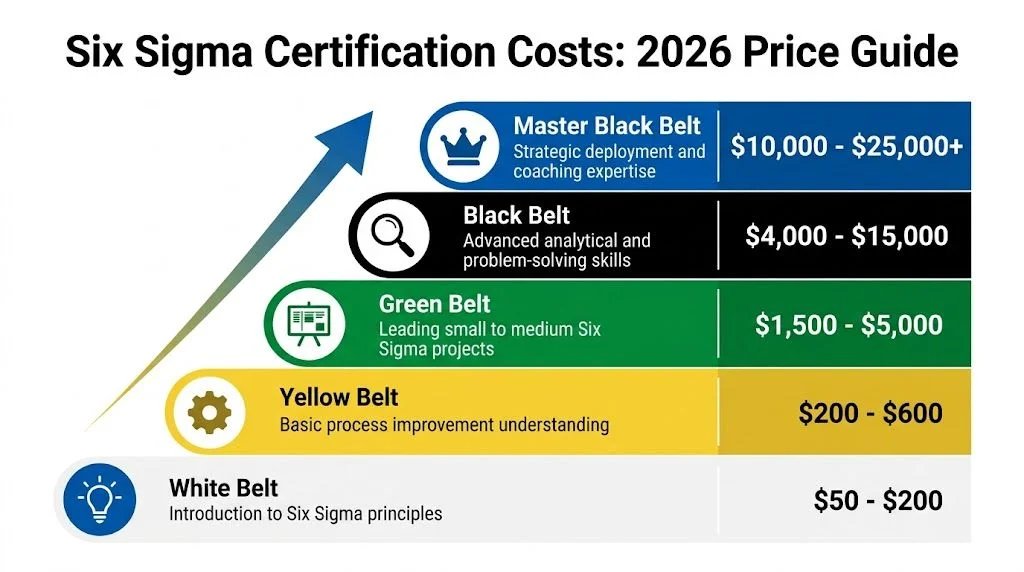
2026 Six Sigma Certification Cost by Belt Level
| Belt Level | Typical Exam-Only Fee | Typical All-Inclusive Training Cost |
|---|---|---|
| White Belt | Free through some providers like ASQ, or $99 through CSSC | Free to low-cost entry options |
| Yellow Belt | $99 through CSSC, $195 through IASSC, $294 to $394 through ASQ | $200 to $1,000 |
| Green Belt | $195 through CSSC, ASQ charges $338 to $438 for members and non-members | $1,000 to $3,000 |
| Black Belt | $295 through CSSC, $450 through IASSC | $3,000 to $7,000 |
| Master Black Belt | $750 through CSSC exam | $7,000 to $15,000 |
What These Prices Mean in Practice for IT Professionals
- White Belt: This is primarily awareness training. In an IT context, it means understanding foundational concepts like variation, defects, root cause analysis, and process waste. It has limited signaling value on its own, so investing significant funds here rarely makes sense.
- Yellow Belt: A reasonable, low-risk entry point for engineers, analysts, service managers, and team leads who need enough Six Sigma knowledge to contribute effectively to improvement initiatives. At this level, exercise caution about paying premium prices for elaborate packaging or AI-generated study assistants; these might save prep time but won't fundamentally alter how hiring managers perceive the credential.
- Green Belt: This is often where the ROI truly begins for tech professionals. It's the belt most relevant for individuals tackling common IT pain points: optimizing ticket flow, resolving incident response bottlenecks, reducing release delays, minimizing QA escapes, and improving handoff inefficiencies between infrastructure, support, and development teams. If your role includes measurable process ownership, a Green Belt often presents a stronger business case than an inexpensive Yellow Belt or a costly Black Belt.
This is also the point where judging low-cost providers becomes more challenging. Some newer programs now integrate AI tutoring, auto-graded quizzes, chatbot coaching, or "fast-track" exam prep. For a self-directed IT professional, these tools can be highly beneficial, potentially cutting study time and simplifying statistical concepts. However, they are not substitutes for genuine instructor feedback, practical project coaching, or broad employer recognition. If a provider is inexpensive because it has stripped out live support and hands-on project review, this trade-off must be clear before you commit.
A similar pricing complexity is observed in other regulated or career-driven credentials. For instance, understanding the Mortgage Loan Originator License Cost: Your Essential Cost Breakdown illustrates how advertised headline prices often diverge from the real total cost once preparation, exams, and compliance requirements are factored in.
The Higher Belts Are Role-Specific
- Black Belt: This makes financial sense when process improvement is a formal and central part of your role, rather than just an additional skill. For IT managers, PMO leaders, operational excellence leads, or senior transformation staff, the higher price can be justified if the certification supports promotion, enhances internal credibility, or enables leadership of larger, cross-functional projects. For an individual contributor in software development or infrastructure, the return is often weaker unless the organization heavily emphasizes Six Sigma.
- Master Black Belt: This is a highly specialized credential, suited for enterprise quality leadership, coaching, and strategic deployment oversight. In a typical IT career path, very few professionals genuinely require it. Pursuing it too early is generally a prestige purchase rather than a practical investment.
The smart budgeting question is straightforward: Pay for the belt that aligns with the level of process responsibility you currently hold, or realistically expect to hold in the near future. For many IT professionals, this means being judicious with spending at the Yellow Belt level, investing more thoughtfully at the Green Belt level, and treating the Black Belt as a role-dependent decision rather than an automatic progression.
Unbundling the Costs: Training vs. Exam Fees and Other Expenses
Many buyers focus solely on the advertised "sticker price" and overlook what's truly included. An "exam-only" option might appear to be a bargain, and sometimes it is. However, if you subsequently need to purchase prep materials, practice exams, or additional statistical support, your total cost can quickly escalate. Conversely, an "all-inclusive" package might initially seem overpriced until you realize it consolidates several purchases you would otherwise make separately.
What the Sticker Price Often Excludes
A clear example comes from the competitive landscape of exam pricing. A cost comparison notes that the Council for Six Sigma Certification (CSSC) often advertises significant discounts compared to IASSC and ASQ averages, with examples including a Black Belt at $295 versus IASSC’s $450 and ASQ’s $568, and a Yellow Belt at $99 versus IASSC’s $250 and ASQ’s $422.
While useful, exam price alone doesn't finalize the budget. Additional costs to consider may include:
- Study Materials: Candidates should budget an additional $200 to $1,000 for textbooks, online courses, practice exams, and other preparation resources, depending on the chosen belt level and provider.
- Software Access: Some Six Sigma learning paths inherently assume the use of statistical analysis tools (e.g., Minitab, JMP, R, or Python libraries). If the course doesn't include licenses or access, you might need to acquire these separately.
- Project Requirements: Many legitimate certifications and training tracks require practical project work. This entails dedicating time from your job, securing manager approval, and sometimes gaining access to internal data, all of which represent an indirect but significant cost.
- Retakes and Support: If the initial support is minimal, you might incur additional costs later trying to fill knowledge gaps before attempting an exam retake.
Why This Matters for IT Buyers
IT professionals are typically familiar with this pattern, as many other certifications operate similarly. The exam fee is just one layer; the real investment lies in preparation, necessary tools, and the practical effort required to achieve certification.
If you've ever budgeted for another regulated or skills-based credential—like a networking certification (CCNA), a cybersecurity certification (CompTIA Security+), or a project management credential (PMP)—the logic is familiar. A helpful comparison is the guide to Mortgage Loan Originator License Cost: Your Essential Cost Breakdown, which effectively illustrates how professional credential costs frequently extend beyond the advertised application or exam fee.
When comparing providers, compartmentalize the costs into three distinct buckets: credential fee, preparation cost, and application effort. This segmented approach allows you to build a transparent and defensible budget.
Comparing Top Six Sigma Certification Providers
The choice of provider is almost as crucial as the belt level itself. This isn't because a single entity "owns" Six Sigma, but because different providers signal distinct values and levels of recognition to employers.
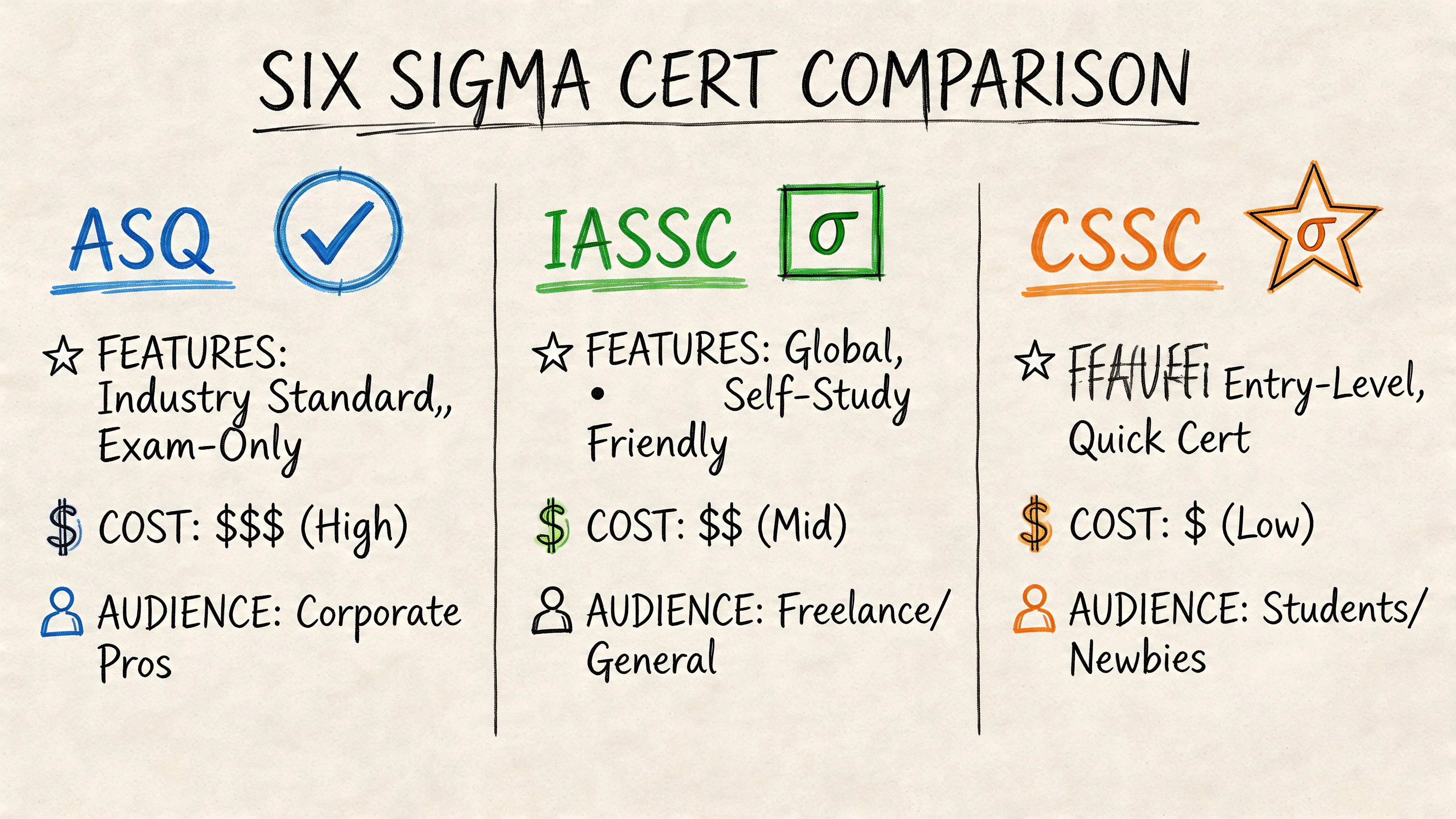
ASQ, IASSC, and CSSC: A Practical Breakdown
| Provider Type | Best Fit for IT Professionals | Strength | Trade-off |
|---|---|---|---|
| ASQ | Those needing strong, established recognition in large enterprises or regulated environments (e.g., healthcare IT, finance IT). | Established reputation; often a gold standard for formal quality programs. | Generally higher cost; exams can be more rigorous. |
| IASSC | Self-motivated candidates who want a recognized, independent exam-centered path without extensive bundled training. | Clear, standardized exam content focused on the Lean Six Sigma Body of Knowledge. | Less bundled training or direct support, requiring disciplined self-study. |
| CSSC | Budget-conscious learners and self-starters, particularly those in smaller organizations or startups where brand prestige is less critical. | Low entry price and high accessibility; good for foundational learning. | Employer perception may vary more; less global recognition than ASQ. |
- ASQ appeals to professionals who need a credential that IT hiring managers, especially in large enterprises, highly regulated environments, or quality-focused organizations, will quickly recognize and trust. Similar to how a certified IT architect might value vendor-agnostic certifications, ASQ represents a broad, respected standard.
- IASSC often suits candidates who prefer a direct exam path without investing in university-level training fees. It serves as a sensible middle ground for IT professionals who are adept at self-study and can independently prepare using diverse resources.
- CSSC often functions as a low-cost disruptor. This can be an excellent option for learners prioritizing affordability who don't require premium branding attached to their certificate, especially if their immediate goal is to gain foundational knowledge and apply it practically within their team.
University Programs and Newer Online Platforms
University-backed programs occupy a different category. They offer not only instruction but also the valuable institutional branding. For some employers, particularly larger organizations or those with strong academic ties, this brand association can significantly enhance the credential's signal. However, for many IT professionals, the premium price is only justifiable if their employer explicitly values or requires a university-affiliated name.
Modern online platforms prioritize flexibility. They frequently utilize shorter modules, recorded instruction, and practical templates, which can align well with the learning preferences of many technical professionals who are used to absorbing information from documentation, tutorials, and hands-on labs.
There's also a crucial career overlap issue. If your role straddles delivery leadership and process improvement, it's wise to compare Six Sigma against adjacent credentials. For many MindMesh Academy readers, a robust project management certification might directly compete with or complement a Six Sigma path, depending on their career trajectory.
MindMesh Perspective: If your employer places high value on formal quality programs and external validation, the provider's brand carries more weight. Conversely, if your employer primarily values execution, tangible outcomes, and problem-solving, your demonstrated ability to apply the Six Sigma methodology effectively will matter more than the logo on the certificate. This distinction is key when balancing cost, recognition, fit, and the amount of structured support you truly need to succeed.
How to Choose the Best Value Certification for Your Tech Career
For an IT professional, the "best value" path is rarely the cheapest or the most expensive option. Instead, it's the one that precisely aligns with the job you're aspiring to, the credibility you genuinely need, and your preferred learning style.
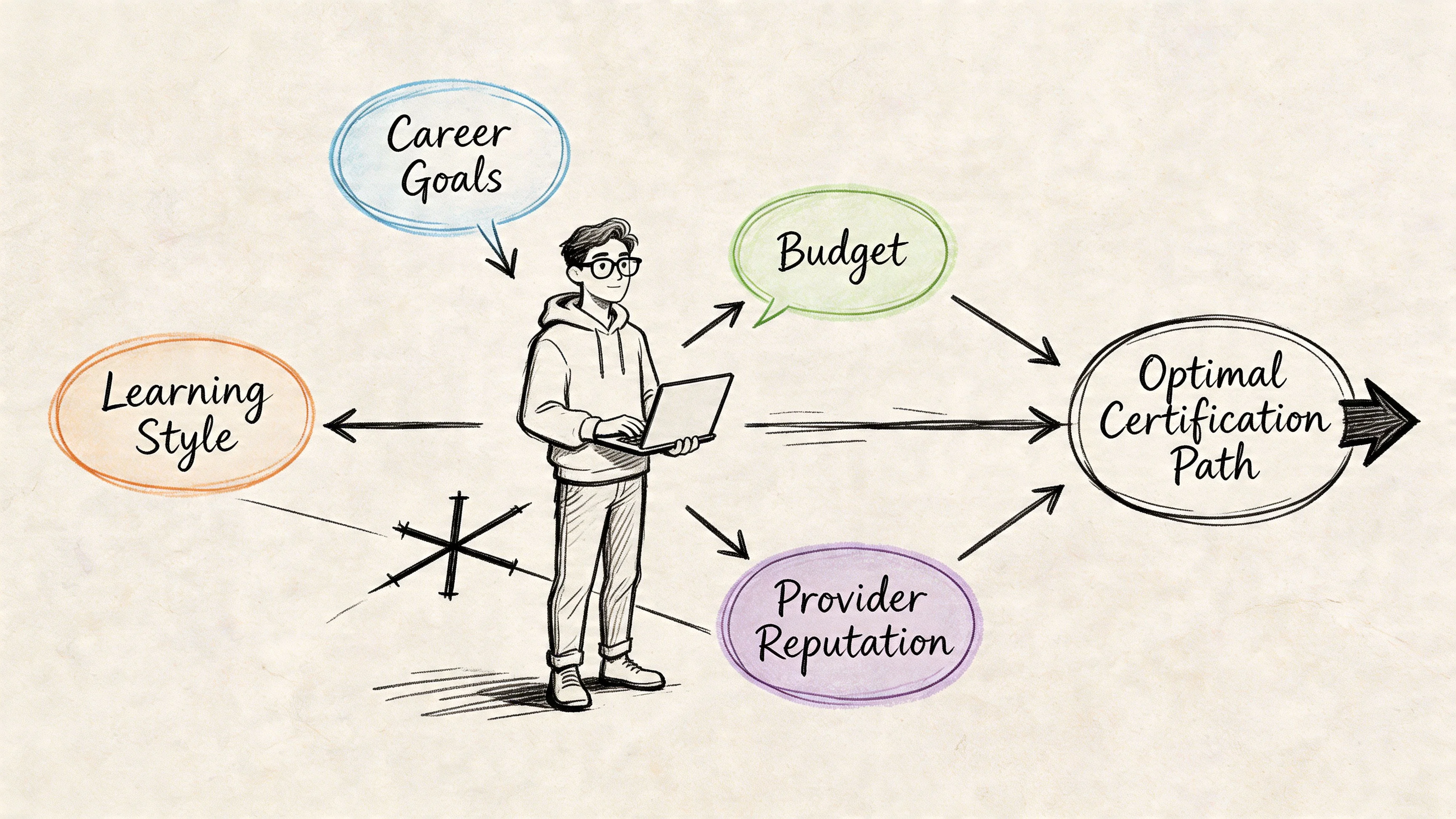
The current market further complicates this decision, with low-cost providers, premium university programs, and AI-assisted training models all vying for attention. Recent market observations note a surge in AI-integrated, subscription-based Six Sigma certifications specifically targeting IT professionals, though comprehensive ROI data for these newer models is still emerging. Furthermore, analysis indicates that low-cost certifications, typically priced from $69 to $499, show 15 to 20% lower employer recognition compared to established bodies like ASQ and Purdue-affiliated programs, while IASSC Green Belt pricing has remained around $295.
When a Low-Cost Certification is Sufficient
A more affordable certification can be the right strategic move if your primary goal is one of the following:
- Internal Literacy: You need to grasp core DMAIC concepts and improve collaboration with process-focused teams (e.g., understanding ITIL processes better).
- Foundational Resume Signaling: You want to demonstrate process improvement awareness on your resume without making it your core specialization, akin to adding a basic cloud practitioner certification to show general cloud understanding.
- Rapid, Practical Exposure: You're exploring whether Six Sigma genuinely fits your role and career interests before committing to a larger investment.
For roles like a systems administrator, support lead, or junior project manager, this can be a perfectly rational choice. If the role doesn't demand premium brand recognition, a lower-cost path can effectively achieve your objectives.
When Paying More is Justified
A higher-cost path typically makes sense under specific conditions relevant to IT career progression:
- Targeting Leadership Roles: You're aiming for senior management or director-level positions where the credential itself will be closely scrutinized by executive leadership or HR.
- Employer Sponsorship: Your employer is reimbursing the training cost, which fundamentally alters your personal value equation.
- Need for Structure and Support: You thrive with live instruction, personalized feedback, or strong assessment support, particularly if you're tackling complex statistical concepts or managing your first large-scale process improvement project.
- Enterprise Environment: You work in a large, often regulated, enterprise where recognized provider names (ee.g., ASQ, university brands) carry significant weight with HR, compliance teams, or senior operations leadership.
This doesn't imply that the premium option is automatically superior. Rather, it means the extra cost may acquire something tangible: enhanced recognition, tailored support, or critical alignment with specific employer expectations.
Here’s a useful benchmark if you’re comparing your broader career path against adjacent credentials in cloud, security, infrastructure, or delivery leadership: our guide to high-paying IT certifications.
What to Make of AI-Integrated Training
AI-enhanced training holds significant promise, especially for technical learners who value instant feedback on statistics, terminology, and quiz performance. However, the current evidence gap is important. While newer AI-backed subscriptions can improve convenience and personalize learning, observations explicitly note the lack of clear ROI data regarding their market value and employer recognition compared to established programs.
Therefore, you should treat AI features as a powerful learning aid, not as inherent proof of market value or an automatic substitute for experience.
MindMesh Guidance: Invest in AI support when it genuinely helps you learn faster, understand complex concepts better, or practice more effectively. Avoid paying a premium simply because a provider has rebranded ordinary course content with an "AI-powered" label without tangible benefits.
A short explainer can help clarify if you're still weighing whether Six Sigma methods fit into your daily IT work:
A Practical Decision Filter for IT Managers
Use this sequence to make an informed decision:
- Define the Role Outcome: Are you aiming for general awareness, specific project leadership capability, or broader organizational leadership credibility? For example, are you enabling a junior admin to identify waste, or empowering a senior engineer to overhaul a critical CI/CD pipeline?
- Check Employer Expectations: If your company's primary concern is improving IT service flow and reducing defects, don't overpay for prestige. Focus on practical application and demonstrable results.
- Choose the Minimum Credible Belt: Many tech professionals achieve substantial value at the Green Belt level. Resist the urge to pursue higher belts unless process improvement is truly central to your role or required for advancement.
- Separate Brand from Delivery: A respected exam path (like IASSC) combined with disciplined self-study using high-quality resources can often yield better results and ROI than an expensive, bloated package you ultimately don't fully utilize.
- Evaluate Subscriptions Carefully: While subscription models can work well for teams, individual learners should rigorously confirm exactly which features they will use and whether the ongoing cost justifies the value.
That's where the true ROI of Six Sigma certification lies for IT professionals – not in the certificate itself, but in choosing a path that aligns precisely with your actual career economics and operational impact.
Making Your Final Decision on Six Sigma Certification
The "right" Six Sigma certification price is entirely contingent on what you need the credential to achieve. A low-cost certificate can be perfectly adequate for establishing baseline process literacy and understanding. Conversely, investing in a stronger provider or a higher belt is justifiable when you require enhanced employer recognition, management credibility, or a formal process-improvement role.
For IT professionals, the smartest choice is almost always the one that aligns with your operational reality. Your team needs better incident handling, cleaner delivery pipelines, fewer recurring defects, and more disciplined problem-solving. If a Six Sigma certification genuinely supports these outcomes and helps you achieve tangible improvements, it holds immense value. If it's merely an expensive badge that sits unused, it's a wasted investment.
If you're looking to brush up on the statistical foundations before committing to a certification, this plain-English guide to what standard deviation means is an excellent primer, as Six Sigma discussions often assume familiarity with core statistical terminology.
Once you've identified the Six Sigma path that best fits your goals, explore available certifications and select a preparation approach that not only helps you pass the exam but, more importantly, ensures you truly understand and can apply the material.
Frequently Asked Questions About Six Sigma Costs
What are the typical recertification costs and requirements?
Recertification policies vary significantly by provider. Some organizations offer "no-renewal" models, while others may require periodic renewal activities (e.g., continuing education units, project work) or an updated standing fee. Because recertification rules are provider-specific and not standardized across the market, it's crucial to check the provider's current policy before you purchase. Don't assume the initial Six Sigma certification price represents the full lifecycle cost.
Can my employer pay for my Six Sigma certification?
Yes, many employers are willing to consider covering the cost, especially if you can directly link your request to a tangible operational problem within your IT department. Frame your request not as simply "training" but as a strategic investment to improve specific team challenges, such as:
- Reducing ticket resolution times.
- Minimizing rework in software deployments.
- Strengthening release quality and predictability.
- Standardizing critical IT service processes.
A compelling request typically includes:
- Business Relevance: Clearly explain which team problem or organizational goal the training will directly address.
- Reasonable Scope: Request the belt level that genuinely matches your intended impact, avoiding over-scoping.
- Application Plan: Outline how you will apply the learned methodologies to a live IT workflow or project immediately after completing the training.
Is Six Sigma still relevant for software development and DevOps in 2026?
Yes, Six Sigma remains highly relevant in software development and DevOps environments when applied intelligently. Its value isn't found in rigid ceremony, but as a disciplined framework for reducing variation, identifying true root causes, and systematically improving repeatable workflows. In modern IT, this translates to:
- Better handoffs between development, operations, and security.
- Fewer recurring incidents and production issues.
- Cleaner and more efficient escalation paths.
- More reliable and predictable delivery processes through CI/CD pipelines.
It should not replace sound engineering judgment, agile principles, or robust observability practices. Instead, Six Sigma should complement and strengthen these existing approaches. Teams that effectively leverage Six Sigma treat it as a powerful improvement toolkit, not an inflexible dogma.
MindMesh Academy empowers IT professionals to prepare for demanding certifications with focused study systems, adaptive practice, and concept-first learning. If you've decided that a Six Sigma path, or any other career-focused credential, aligns with your professional goals, explore MindMesh Academy for practical exam preparation that goes beyond rote memorization to foster true understanding and application.

Written by
Alvin Varughese
Founder, MindMesh Academy
Alvin Varughese is the founder of MindMesh Academy and an enterprise architecture leader. An electrical engineer by training, he moved from factory automation in South Africa to cloud architecture at GE Appliances and Humana (Fortune 50), and holds 20 professional certifications including AWS Solutions Architect Professional, Azure DevOps Engineer Expert, and Microsoft Agentic AI Business Solutions Architect. He built MindMesh Academy after interviewing too many highly certified candidates who couldn't answer basic questions: the goal is prep that makes you better at the job, not just able to pass the exam.