Sec Plus Study Guide: Pass Your Exam on the First Try
CompTIA Security+ Study Guide: Pass Your Exam on the First Try
You're likely here because a familiar phrase keeps appearing in job listings, training plans, and career advice: CompTIA Security+. Perhaps you already have some IT knowledge, a background in help desk or systems administration, or you're looking to transition into cybersecurity. Either way, you need a Security+ study guide that prepares you for practical situations, not just a list of topics.
Many candidates get stuck at this point. They gather videos, flashcards, notes, and practice questions, then study in a way that feels productive but doesn't build true exam-day confidence. Security+ rewards organized preparation, repeated review, and hands-on practice. If your plan is simply “read more,” you're making the exam harder than it needs to be.
Why the Security+ Is Your Next Best Career Move
Imagine reviewing a job posting for a junior SOC analyst role. The tools seem familiar, the responsibilities feel achievable, and then you see that recurring line: Security+ required or Security+ preferred.
For many employers, Security+ acts like a driver's license for entry-level cybersecurity work. It doesn't prove you've mastered every road condition. Instead, it shows you understand the rules, can handle the basics safely, and are ready for supervised real-world tasks. Hiring managers use it as a quick signal that a candidate has studied core security ideas such as threats, controls, authentication, risk, and incident response.
This signal matters beyond just security analyst titles.
If you are coming from help desk, systems administration, networking, cloud support, or even a non-IT role, Security+ provides a recognizable starting point. It helps translate your interest in cybersecurity into something a recruiter can scan in seconds. In many organizations, this distinction can be the difference between getting screened out early and being invited to the first conversation.
Why employers keep asking for it
Security+ occupies a useful middle ground. It's broad enough to cover the security fundamentals employers expect across many junior roles, yet specific enough that earning it still carries weight. You'll study how common attacks occur, which controls reduce risk, and what defenders do when something goes wrong.
Students often ask me a practical question: “Will this only help if I want to become a SOC analyst?” No. Security knowledge is now essential in endpoint administration, identity and access management, cloud operations, compliance support, and general IT roles that include security responsibilities. Security+ helps because modern IT jobs rarely stay in one lane.
Here's the résumé reality. Many employers need a fast filter. A certification gives them one.
That doesn't mean the exam is easy. It means the certification is useful.
The real advantage is how you study
Candidates often assume passing depends solely on reading enough material. Security+ rewards a different approach. You need recall that holds up under pressure, not recognition that feels familiar while reviewing notes. That's why spaced repetition works so well here. It revisits concepts right before you're likely to forget them, which is far more effective than cramming a giant stack of facts into one weekend.
A strong Security+ study guide should also address a common blind spot: performance-based questions (PBQs). Many guides treat PBQs as a small, extra task at the end. This is a mistake. PBQs test whether you can apply security knowledge in context, like matching controls to a scenario, interpreting logs, or choosing the right response steps. If multiple-choice questions check whether you know the playbook, PBQs check whether you can run the play.
That's where platform design matters. If you want to prepare for CompTIA exams, MindMesh Academy offers adaptive study paths that allow you to focus more time on weak areas, rather than reviewing topics you already know. Pair that with scheduled review and targeted labs, and your study plan begins to look less like random effort and more like skills training.
If you need structure and checkpoints, a well-defined plan can help you turn “I should study” into a calendar with milestones.
Security+ is a strong next career move because it accomplishes two goals at once. It boosts your credibility in the job market, and it gives you a framework for learning the security skills employers expect you to use on day one.
Decoding the SY0-701 Exam Objectives
A common mistake appears in the first week of studying. A learner prints the objectives, highlights every domain, and dedicates equal time to each. This feels organized, but it's poor exam strategy.
SY0-701 does not reward equal effort across all topics. It rewards targeted preparation based on what the blueprint asks you to do and how often those tasks appear. As noted earlier, the exam uses scaled scoring, so chasing a raw percentage estimate is less useful than understanding the test's structure.
Here's the visual big picture.
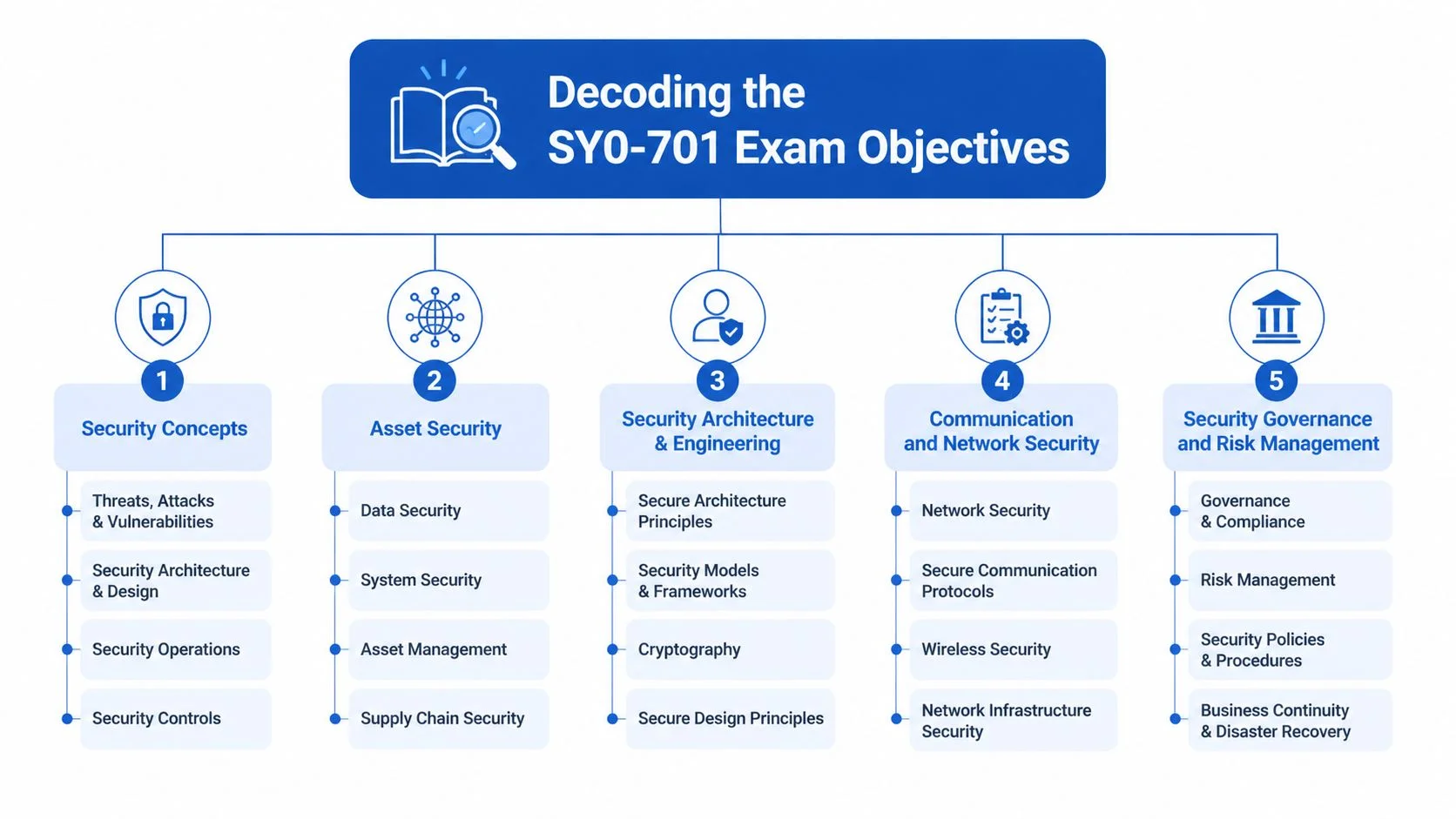
Where your study hours should go
The exam objectives themselves provide your first study schedule. Based on commonly cited SY0-701 coverage guidance, Security Operations and Threats, Vulnerabilities, and Mitigations account for the largest share of the exam. Simply put, a large portion of your score depends on your ability to work through defender-focused scenarios, identify problems, and choose the best next action.
| Domain | Exam Weight | What that usually means in practice |
|---|---|---|
| Security Operations | 28% | Read logs, handle alerts, understand incident response steps, work with common security tools |
| Threats, Vulnerabilities, and Mitigations | 22% | Recognize attack patterns, identify weaknesses, choose sensible mitigations |
| Security Program Management and Oversight | 20% | Apply policy, risk, governance, awareness, and oversight concepts to real situations |
| Security Architecture | 18% | Choose secure designs, protect infrastructure, and understand architectural tradeoffs |
| General Security Concepts | 12% | Use foundational ideas like the CIA triad and control types correctly |
A coach would review this table and adjust practice volume accordingly. You should do the same.
If nearly half your exam comes from two domains, those domains require the most repetitions, practice questions, and review cycles. This is where spaced repetition earns its place in a Security+ study guide. You revisit high-weight material before it fades, instead of rereading everything with the same intensity.
Read the blueprint like a working analyst
The objective list is more than just a reading list; it's closer to a job task sheet.
Consider “Security Operations.” Students often reduce this domain to vocabulary such as SIEM, EDR, or DLP. The exam typically asks for more than definitions. You may need to interpret an alert, infer what a log entry suggests, or choose the correct response order. “Threats, Vulnerabilities, and Mitigations” operates similarly. Memorizing attack names helps, but the core assessment is whether you can connect a scenario to the likely weakness and select a practical control.
This difference explains why some students feel confident while reading yet still miss scenario questions. Recognition is not the same as application.
Use the objectives to build a study system
Here is a practical way to turn the blueprint into a weekly plan:
- Put the two heaviest domains into your schedule more often than the others.
- Break each domain into smaller objective clusters, such as logging, incident handling, malware types, or vulnerability management.
- Review those clusters on a spaced schedule instead of in one long block.
- Pair reading with practice questions that force decisions, not just recall.
- Add lab time early, especially for PBQ-style tasks.
That last point matters more than many guides acknowledge. PBQs are where the skill gap becomes obvious. A student might know what a firewall rule is but freeze when asked to inspect traffic, match controls to a diagram, or place response steps in order. The solution isn't more passive review. The solution is hands-on repetition.
A platform with adaptive study paths can help here because it shifts your study time towards weaker objectives instead of giving every topic equal attention. MindMesh Academy, for example, organizes preparation around targeted skill development, fitting the way Security+ is tested.
What candidates often misunderstand
Students usually overinvest in content that feels tidy. Governance terms are easier to reread than messy operational scenarios. Definitions are simpler than log interpretation. Familiar material creates a false sense of progress.
A better rule is simple. Study by exam weight, then practice by task type.
So if an objective suggests action words such as identify, implement, analyze, configure, or respond, treat that as a sign that you need more than flashcards. You need practice that resembles the exam. A short virtual lab session can teach more than another hour of passive notes review. The same principle applies to advanced certifications, which is why students planning beyond Security+ often benefit from an essential guide for CISSP certification after building this foundation.
One more mental model helps. The exam blueprint functions like a map legend. The domain weight indicates the size of an area. The objective wording describes the kind of terrain you will cross. If you ignore either, your plan becomes lopsided.
For architecture and defense concepts, layered security exemplifies this translation from theory to application. The phrase sounds simple until the exam asks which controls belong at which layer and why. A practical guide to security in layers can clarify that model in a way that supports both multiple-choice questions and PBQs.
Use the blueprint to prioritize your time. Use spaced repetition to keep high-weight domains fresh. Use labs to close the PBQ gap. That's how the SY0-701 objectives stop being a list and start becoming a pass plan.
Mastering Core Security Concepts with Examples
A common Security+ error looks like this: A question describes an employee opening a file they shouldn't have seen, another user changing a setting without approval, and a server outage during payroll processing. The answer choices all sound plausible, and the student realizes too late that three different ideas were being tested at once.
That's why your core concepts need to be sharp, not merely familiar.
The General Security Concepts domain includes the CIA triad and the difference between preventive, detective, and corrective controls, according to the CompTIA Security+ certification page. These are foundational topics, but the exam rarely asks for a plain definition. It wraps them inside incidents, policies, and tool choices.
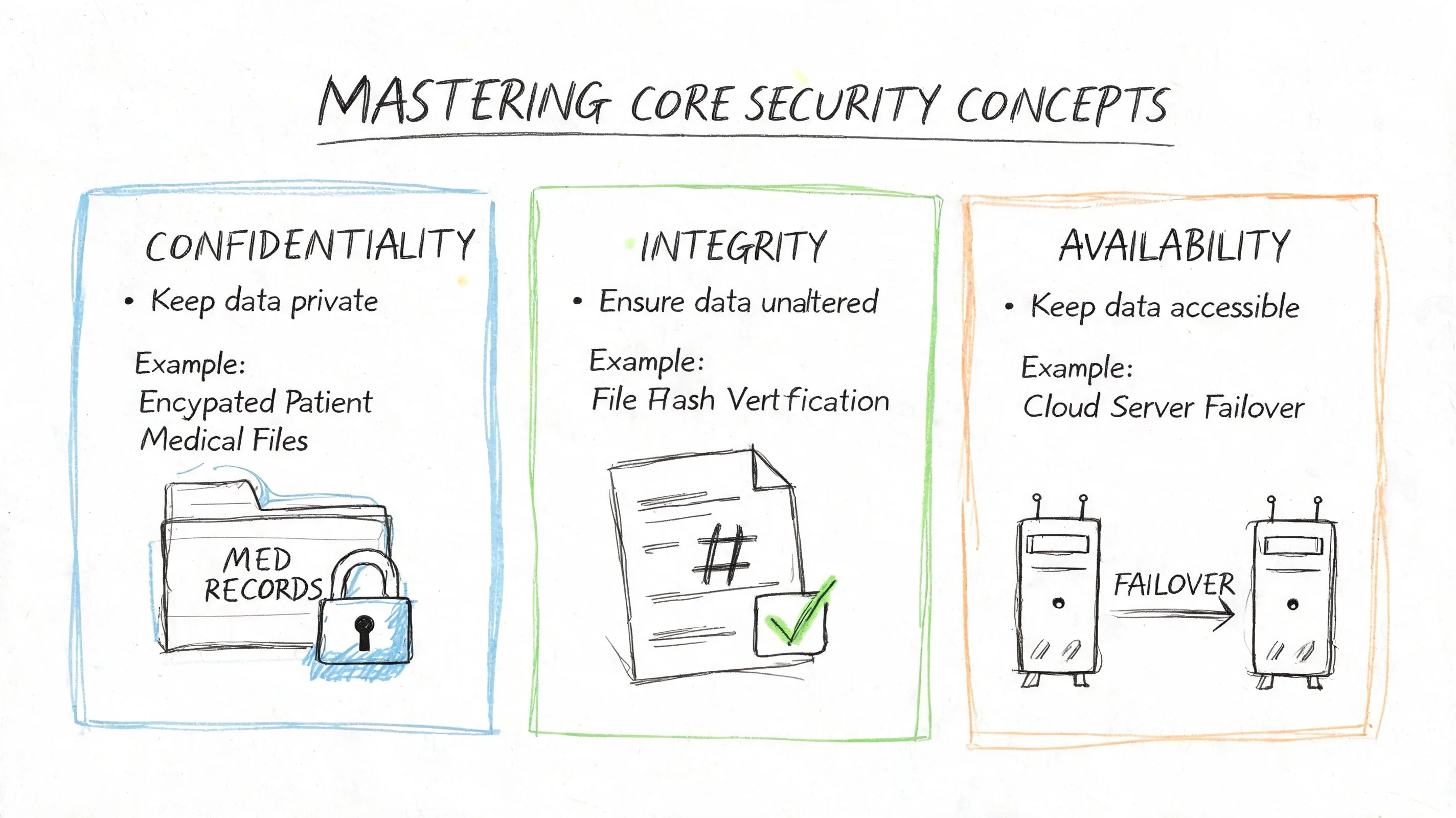
The CIA triad becomes clearer with a records room analogy
A secure records room offers a concrete way to sort the three parts.
- Confidentiality is about who gets to look. In a digital system, that points you toward permissions, encryption, data classification, and access control.
- Integrity is about whether the record remained accurate and unchanged unless an authorized update occurred. Hashing, change control, and audit logs help protect it.
- Availability is about whether authorized users can get what they need when they need it. Redundancy, backups, and fault tolerance support that goal.
Students often mix up confidentiality and integrity because both involve “something bad happened to the data.” Use this quick check. If the problem is exposure, start with confidentiality. If the problem is unauthorized modification, start with integrity. If the problem is downtime or disruption, start with availability.
A short example helps. If payroll files are encrypted by ransomware and no one can open them, availability is the first issue. If an attacker surreptitiously changes direct deposit numbers, integrity is the problem. If a manager downloads salary data for employees outside their department, confidentiality has been violated.
Control types make sense when you place them on a timeline
Many students memorize the names and still miss the question. The solution is simple. Place each control on a timeline of an attack.
| Control type | What it does | Simple example |
|---|---|---|
| Preventive | Tries to stop the problem before it happens | Firewall |
| Detective | Helps you notice the problem | SIEM alerting |
| Corrective | Helps you contain or recover after the problem | Incident response actions |
This distinction is critical on the exam because Security+ often asks for the best next control in a sequence. A firewall may reduce future exposure. A log alert may reveal suspicious behavior sooner. A restore from backup may help the business recover after damage has already occurred.
Here is the coaching point I give students. Do not ask, “Is this a security tool?” Ask, “When does this tool act?” That question cuts through a lot of confusing answer choices.
Zero Trust is continuous verification
Zero Trust sounds advanced until you strip away the jargon. In practice, it means a user or device does not retain trust forever just because it gained network access once. Each request should earn access based on identity, device health, context, and policy.
A high-security office works the same way. Your badge may open one door, but that does not grant access to every floor, server room, or file cabinet. Security+ may test this through concepts like least privilege, segmentation, conditional access, or multifactor authentication.
If you want a plain-English companion read on layered defense, this practical guide to security in layers offers a useful way to think about overlapping protections. That perspective also helps with scenario questions where one control is helpful, but several coordinated controls are better.
Study the concept, then study the contrast, then practice the action
Reading a definition once is rarely enough for Security+. You need recall, discrimination, and application.
Use this three-step pattern:
- Write the concept in one plain sentence. If you cannot explain it clearly, it is not stable yet.
- Attach one real example. Match confidentiality to encryption, integrity to hashing, availability to failover, and so on.
- Pair it with a near neighbor. Compare confidentiality with integrity, preventive with detective, or identification with authentication.
Then add one more layer that many study guides skip. Revisit those same concepts with spaced repetition over several weeks, and test them in short scenario sets instead of isolated flashcards. Platforms with adaptive study paths, such as MindMesh Academy, can help identify weak spots early, allowing you to focus more time on concepts that cause confusion under pressure.
That habit pays off later, especially if you continue into broader security study with the essential guide for CISSP certification, where the same ideas return in wider business and architectural contexts.
One last tactical note. Do not leave these topics in the “easy theory” bucket. They appear in multiple-choice questions, and they also surface inside PBQs where you must classify controls, choose protections, or diagnose what failed. If your foundation is clean, those bigger scenarios stop feeling random.
Your Prioritized 90-Day Security+ Study Plan
A study plan needs to do two things well. It has to keep you moving, and it has to prevent you from studying the wrong things for too long.
The easiest way to build momentum is to split your preparation into three phases. Think of the first month as foundation and orientation, the second as coverage and pressure-testing, and the third as exam simulation plus hands-on polishing.
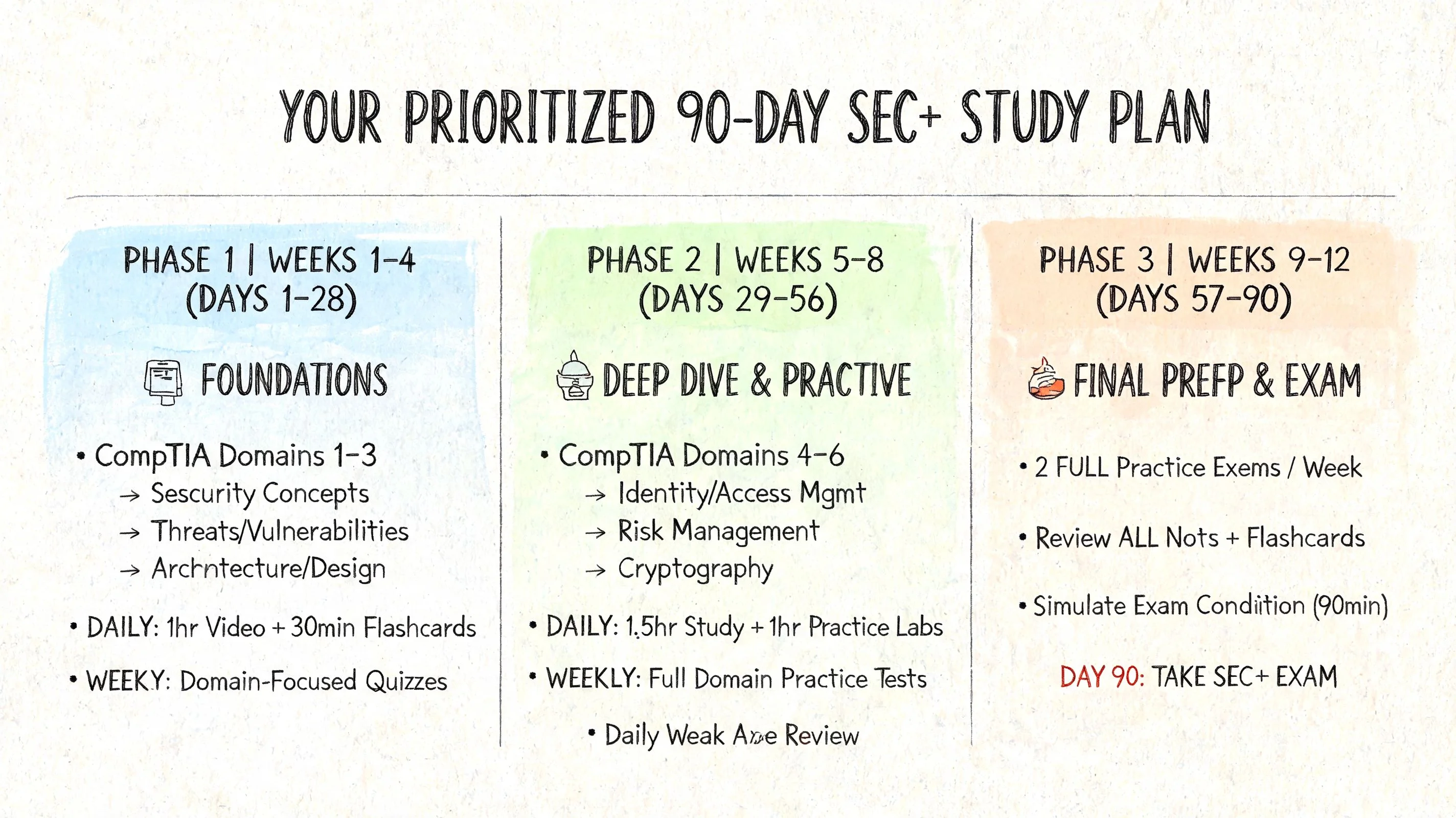
Days 1 to 30 build your map
Your first month isn't about perfection. It's about getting the entire exam scope into your head without getting bogged down in details.
A good rhythm looks like this:
- Read or watch by domain. Start with the high-weight areas, then work outward.
- Create short notes, not transcripts. If your notes look like a textbook, you’re copying, not learning.
- Use spaced repetition from the beginning. Review older material while adding new topics, so nothing disappears after one week.
During this phase, focus on understanding. If you can explain a concept out loud in plain language, you’re on the right track.
Days 31 to 60 turn knowledge into recall
The second month is where the Security+ study guide becomes tactical. You stop consuming and start proving.
Use a weekly pattern:
- Early week: Review one stronger domain and one weaker domain.
- Midweek: Do mixed question sets and review every missed question.
- End of week: Revisit old flashcards or notes using spaced repetition.
This is also the stage where adaptive learning can assist. If a platform notices you keep missing access control scenarios but do well on cryptography terminology, your study path should shift automatically. This approach is more efficient than allocating equal time to every topic.
Don’t ask whether you studied a topic. Ask whether you can retrieve it quickly under pressure.
Days 61 to 90 sharpen exam performance
The final phase focuses on exam behavior. By now, you shouldn't be building your core knowledge from scratch. You should be strengthening weak spots, improving timing, and getting comfortable with PBQs.
Here’s a clean final-month structure:
- Run full practice sessions under realistic timing.
- Review by mistake pattern, not just by domain. Are you missing “best answer” questions? Rushing? Misreading scenario clues?
- Add regular labs. Security+ tests application, not just recognition.
- Trim your notes. By the end, your review sheet should be compact and useful.
What a balanced week can look like
| Day type | Main focus | What to avoid |
|---|---|---|
| Concept day | Learn or refresh one domain deeply | Jumping between too many resources |
| Practice day | Mixed questions and review | Counting score only, without review |
| Lab day | Hands-on tasks and scenario work | Watching labs without doing them |
| Review day | Spaced repetition and weak areas | Re-reading everything from scratch |
If your schedule is busy, keep the pattern and shorten the sessions. Consistency beats heroic weekend cramming every time.
Strategies for Nailing Practice Questions and PBQs
Many candidates use practice questions incorrectly. They treat them like a quiz to measure readiness, not a tool to build judgment.
That mindset leaves points on the table, especially with PBQs. According to guidance on the Security+ PBQ skill gap, candidates scoring 70% on multiple-choice practice tests can dramatically raise their final score by shifting to hands-on lab work, because PBQs test practical application that theory-heavy study often misses.
Multiple-choice success starts with answer discipline
Security+ multiple-choice questions often include one answer that is clearly wrong, two that look plausible, and one that best fits the scenario. Your job is not to find a familiar term. Your job is to choose the most defensible answer.
Use this process:
- Read the last line first, then the full question. That helps you identify what the prompt is asking.
- Watch for qualifier words. “Best,” “most likely,” and “first” all change the answer.
- Eliminate before selecting. Crossing out bad options clears mental clutter.
- Review why the other options are wrong. That’s where the learning happens.
If you only celebrate getting a question right, you miss the deeper lesson. A lucky guess won’t help on exam day.
PBQs reward doing, not recognizing
PBQs intimidate people because they expose shallow understanding. If you’ve only read about firewall rules, logs, and hardening steps, a PBQ makes that obvious quickly.
The solution is simple in principle and uncomfortable in practice. You have to touch the tools.
Build regular PBQ preparation into your week with tasks like:
- Interpreting logs and deciding what happened
- Matching controls to scenarios rather than memorizing definitions
- Working through configuration logic step by step
- Practicing troubleshooting sequences so you stop freezing when a task looks unfamiliar
The exam doesn’t care whether a concept looked familiar in your notes. It cares whether you can use it.
Spaced repetition is how you stop forgetting
Students often believe their problem is understanding. More often, the problem is retention. They understood port security, attack types, and control categories two weeks ago, then forgot them because they never revisited them properly.
Spaced repetition solves that by bringing material back right before you’re likely to forget it. That turns review into memory reinforcement instead of endless re-reading.
A practical setup looks like this:
- Daily short review of older cards or notes
- Weekly revisit of weak concepts
- Mixed recall sessions that force your brain to switch contexts
If you want structured question work as part of that routine, CompTIA Security+ practice for IT professionals offers the kind of resource to use for repeated retrieval, not just one-and-done scoring.
Treat every question set as a workout. The score matters less than the adaptation that happens after review.
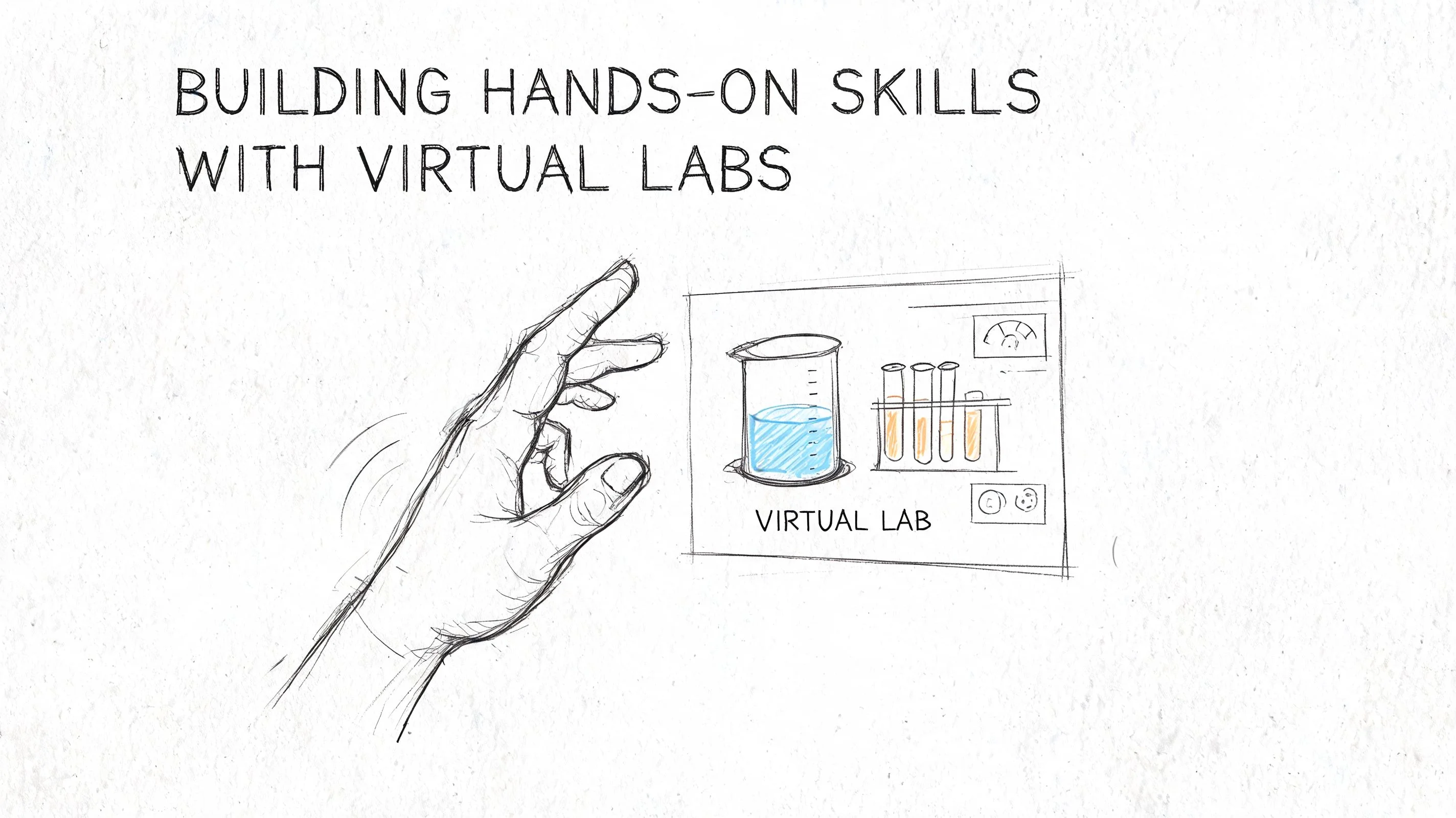
Building Hands-On Skills with Virtual Labs
The strongest Security+ study guide in the world won’t carry you if your preparation remains purely theoretical. Security+ expects you to think like someone who can perform basic defensive tasks, not just define terminology.
That’s especially true in Security Operations, which is the highest-weighted domain at 28% and emphasizes hands-on skills such as firewall configuration, IDS/IPS tuning, and incident management, with PBQs testing implementation ability according to this Security Operations domain guide.
What to practice in a home lab
You do not need an enterprise environment. You need repetition with the kinds of actions the exam expects you to reason through.
A useful starter lab plan includes:
- Firewall rule practice so you understand the logic of allowing, blocking, and narrowing access
- Log analysis exercises where you read events and infer what happened
- System hardening tasks such as reducing unnecessary exposure and improving baseline security
- Basic vulnerability scanning and interpretation so output translates into decisions, not noise
- Incident response walk-throughs where you practice sequence and prioritization
One important point: don’t turn the lab into a research rabbit hole. You’re not trying to build a perfect enterprise stack. You’re building comfort with workflows.
A simple lab beats a fancy lab you never use
Many students overcomplicate the setup phase. They spend days comparing platforms, operating systems, and tooling, then never practice.
Keep the bar low enough that you’ll use it:
| Lab approach | Good for | Watch out for |
|---|---|---|
| Basic home virtual machines | Repetition and control | Setup friction if you keep rebuilding |
| Guided browser labs | Fast practice with less setup | Passive clicking if you don’t reflect |
| Scenario notebooks | Process thinking and review | Not enough by themselves for PBQ confidence |
The right lab is the one you’ll return to several times a week.
How to connect labs to exam success
A lab only helps if you close the loop after each session. When you finish an exercise, ask:
- What security concept did this reinforce?
- What clue would a question writer use to test this?
- Could I explain what I just did to another student?
That third question matters. Teaching forces clarity.
Hands-on practice creates memory with texture. You remember what you clicked, what failed, and what fixed it.
For learners who want a more guided route, tools that combine study content, adaptive paths, and labs reduce setup time. MindMesh Academy is one such platform that uses spaced repetition and adaptive learning paths, connecting concept review with practical reinforcement rather than treating labs as a side activity.
Lab topics that map well to Security+
If you’re wondering where to start this week, start with tasks that mirror common exam thinking:
- Reviewing alerts and deciding priority
- Identifying whether a control is preventive, detective, or corrective
- Walking through a simple incident response sequence
- Comparing secure versus insecure configurations
- Reading short logs and spotting suspicious behavior
That kind of repetition builds two things at once. It improves your PBQ readiness, and it also makes multiple-choice questions easier because the terms now connect to lived actions instead of vague definitions.
Your Final Week Checklist and Exam Day Success
The last week is where students either calm down and consolidate or panic and scramble. The second option feels active, but it usually makes recall worse.
Your final week should feel controlled. You’re not trying to learn the entire exam again. You’re working to keep your strongest material sharp, patch obvious weak spots, and walk into the test with a steady head.
A practical seven-day rhythm
Use the last week like this:
- Seven days out: Take your last full timed practice exam. Review every miss.
- Six to five days out: Revisit weak topics only. Don’t restart strong domains from page one.
- Four days out: Do a short lab session and a mixed question session.
- Three days out: Review compact notes, flashcards, and recurring mistakes.
- Two days out: Light review only. Focus on confidence and clarity.
- One day out: Rest, organize logistics, and stop cramming.
If you keep changing resources in the final week, you create noise. Stick with what already works.
Your final review should be narrow
By the last few days, your review material should be smaller than you think. A tight shortlist is better than a complete binder.
Focus on:
- Concepts you still mix up
- Common scenario patterns
- Control types and security logic
- PBQ-style thinking steps
- Terms that must come to mind instantly
A progress dashboard helps here because it turns vague anxiety into something concrete. If your question history and review trends show stable performance, trust the evidence more than the nerves.
Calm review beats desperate review. The exam rewards clarity, not panic.
Exam-day behavior matters
On the day itself, keep your process simple.
Read carefully. Don’t rush the first few questions just because you’re tense. If a PBQ feels messy at first glance, stay composed and work methodically. Security+ often rewards structured reasoning more than speed.
A few useful reminders:
- Protect your time. Don’t let one stubborn question hijack the exam.
- Use elimination aggressively. Wrong answers often reveal themselves when you compare them to the scenario.
- Trust your preparation. Second-guessing every answer is a fast way to burn energy.
The best exam-day confidence doesn’t come from hype. It comes from seeing that you followed a real plan, practiced under pressure, and turned weak spots into manageable ones. That’s how a good Security+ study guide should leave you feeling.
If you want a structured place to keep studying, MindMesh Academy offers certification preparation built around concept mastery, spaced repetition, adaptive learning paths, and progress tracking. If you learn best with a clear system instead of a pile of disconnected resources, that kind of setup can help you stay consistent and pass your CompTIA Security+ exam with confidence.

Written by
Alvin Varughese
Founder, MindMesh Academy
Alvin Varughese is the founder of MindMesh Academy and an enterprise architecture leader. An electrical engineer by training, he moved from factory automation in South Africa to cloud architecture at GE Appliances and Humana (Fortune 50), and holds 20 professional certifications including AWS Solutions Architect Professional, Azure DevOps Engineer Expert, and Microsoft Agentic AI Business Solutions Architect. He built MindMesh Academy after interviewing too many highly certified candidates who couldn't answer basic questions: the goal is prep that makes you better at the job, not just able to pass the exam.