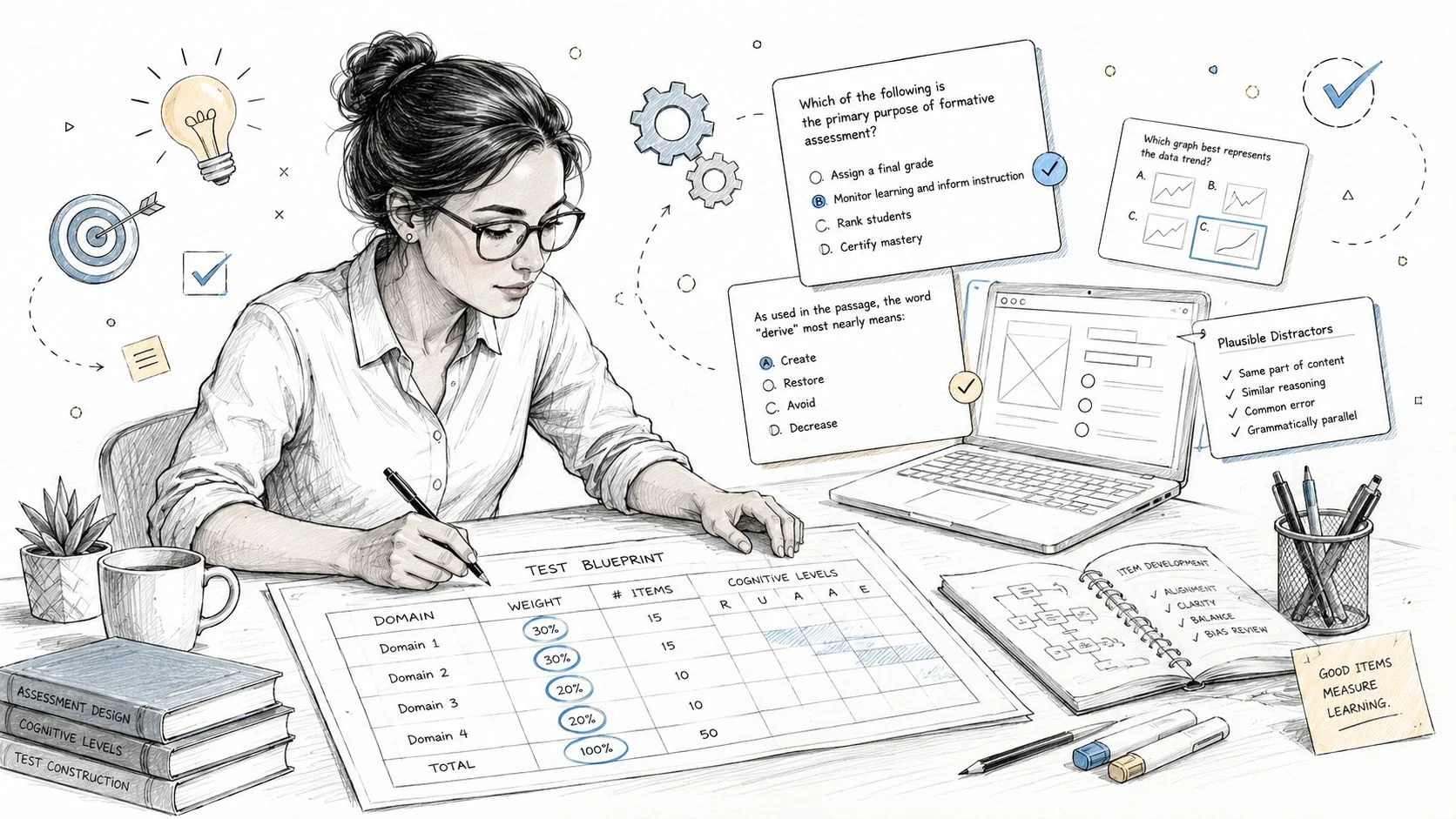
How to Make Practice Tests: Expert Guide 2026
How to Create Effective Practice Tests: A MindMesh Academy Guide
You're probably here because you've seen the same pattern too many times. A learner scores well on random online quizzes, feels ready, sits for the official certification exam, and gets blindsided by the wording, the pacing, or the depth of application required. That gap usually isn't a motivation problem. It's a test design problem.
When creating practice tests, people often build something that looks like assessment but behaves like trivia. A real practice exam for an IT certification has a clearer purpose. It should check coverage, expose weak decisions, create retrieval practice, and assess whether the learner can perform under exam conditions.
That's where good practice tests become more than score generators. They become study tools.
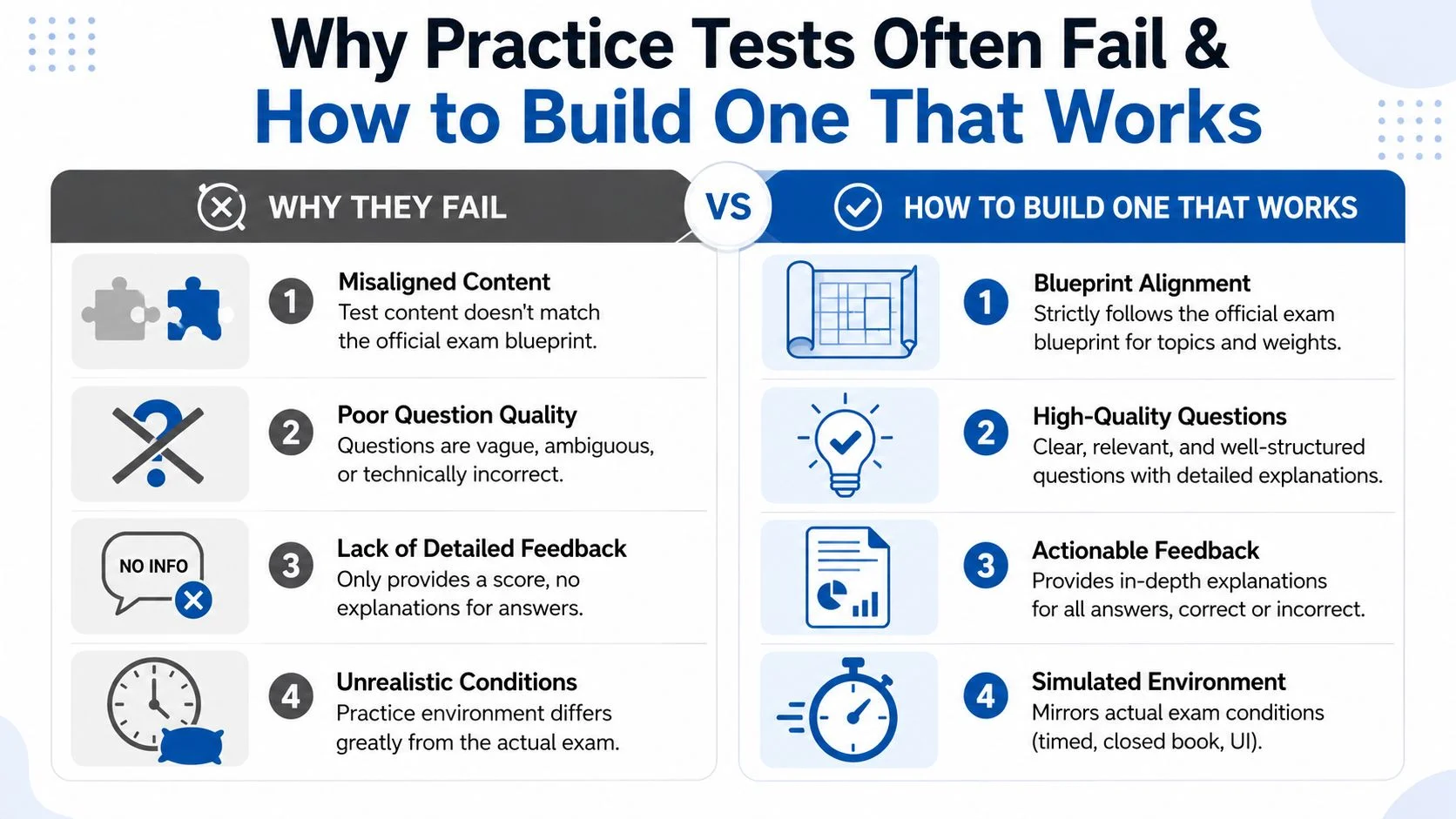
Why Most Practice Tests Fail and How to Build One That Works
Low-quality practice tests fail in predictable ways. They focus too much on definition recall, use vague or sloppy items, ignore the official exam blueprint, and give little useful feedback. Learners can get a comforting score without building the skills the official exam requires.
That's a serious miss, because practice testing isn't just a way to measure learning. Cognitive science strongly supports it as a highly effective study method. The classic testing effect shows that retrieving information from memory improves long-term retention more than restudying it, and a landmark study found that repeated retrieval outperformed repeated study, with the advantage growing as retrieval became more effortful, as summarized in this cognitive science review on retrieval practice.
What weak practice tests usually get wrong
A weak practice test often has one or more of these problems:
- Misaligned scope. It covers what the author knows, not what the exam requires.
- Flat cognitive demand. Every item asks for recall, even though the actual exam asks for choice, diagnosis, or application.
- Bad distractors. Wrong answers are obviously wrong, so the learner never has to discriminate between plausible options.
- No post-test learning loop. The learner sees a score and moves on.
The result is false confidence. That's the most expensive outcome in certification prep.
Practical rule: If a learner can answer from recognition alone, the item is too easy for most certification practice.
What a working practice test actually does
A useful practice test serves four key functions simultaneously:
| Element | Weak version | Strong version |
|---|---|---|
| Coverage | Random topics | Mapped to objectives |
| Questions | Fact recall | Scenario and application |
| Conditions | Casual, untimed | Exam-like and constrained |
| Feedback | Score only | Explanation and next action |
In IT certification work, the distinction matters even more because many domains are full of closely related choices. A learner has to decide between similar cloud services, similar troubleshooting steps, or similar security controls. Passive review doesn't prepare candidates for this. Good practice tests force active discrimination.
If you want your exam to predict success, stop asking, “How many questions should I write?” Start asking, “Does this test behave like the actual decision environment?” That's the standard professionals use.
Start with a Professional Test Blueprint
Writing questions is often the common first step. Professionals start by writing a blueprint.
A blueprint is the control document that defines what the test measures, how much emphasis each area gets, and what level of thinking each item should require. If you skip it, the test becomes a pile of questions instead of an exam.
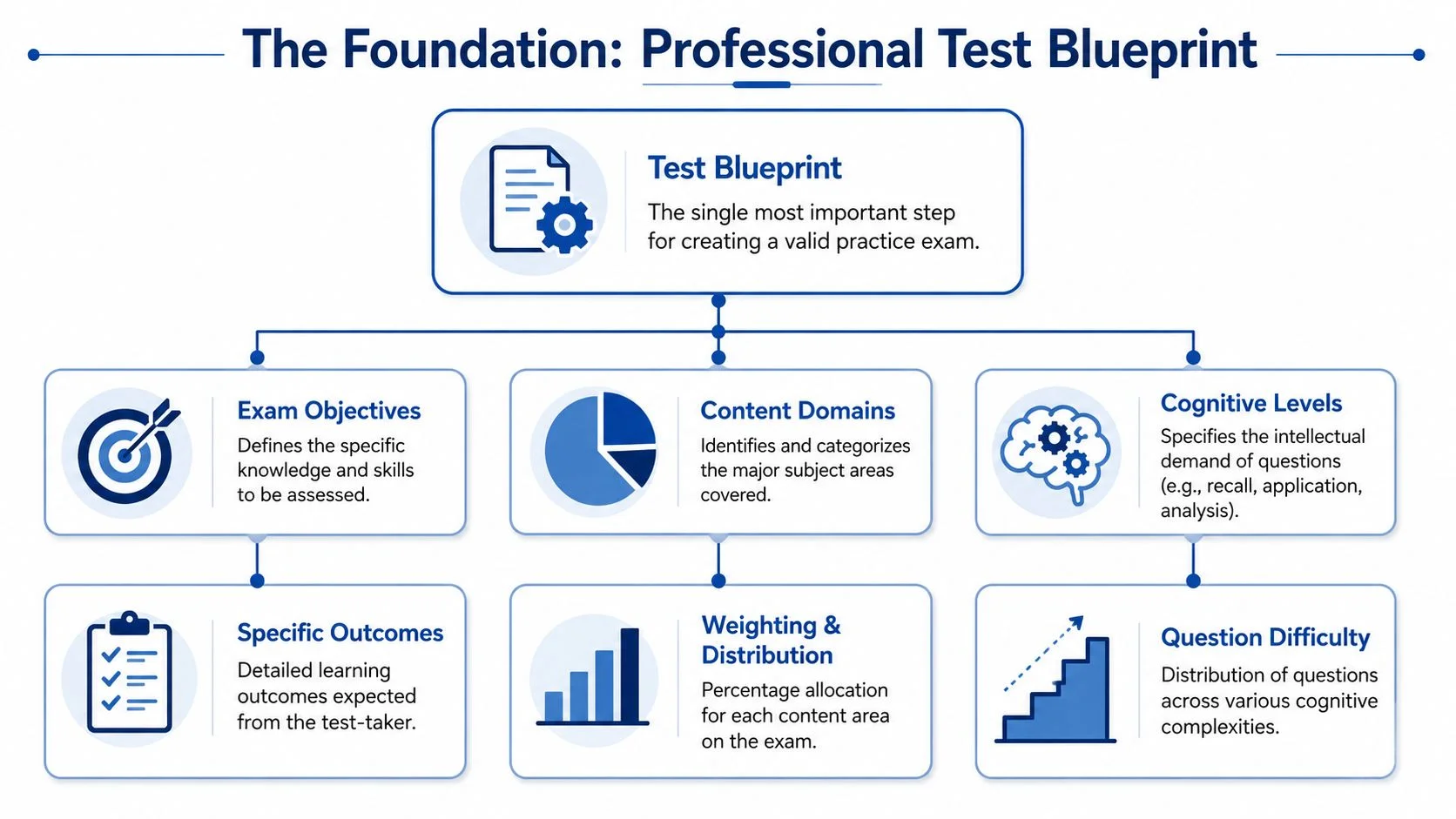
Build from objectives, not from ideas
A rigorous approach to practice test creation is to break the work into two steps: map each objective to a test-design technique, then create item stems for each technique. An LLM-based study described this prompt-only workflow for creating high-level test cases from requirements documents while preserving traceability to source requirements in this research on structured test creation from requirements.
That principle directly applies to certification prep. Don't ask, “What questions can I come up with?” Ask, “What must a qualified candidate be able to do?”
A usable blueprint template
A practical blueprint can fit on one page. It should include these columns:
| Domain | Objective | Priority | Cognitive level | Item type | Notes |
|---|---|---|---|---|---|
| Security | Apply IAM basics | High | Application | Scenario MCQ | Common misconfigurations |
| Networking | Interpret connectivity issue | Medium | Analysis | Troubleshooting MCQ | Include log or symptom |
| Billing | Choose cost-aware option | Medium | Application | Best-answer MCQ | Require trade-off |
| Operations | Select monitoring response | High | Analysis | Scenario MCQ | Focus on next step |
How to fill it out
Use this sequence when creating practice tests for a certification:
- Pull the official objectives from the vendor exam guide or syllabus.
- Group related objectives into stable domains.
- Mark what the learner must do. Recall a term, apply a concept, troubleshoot a failure, compare options.
- Choose the item form that matches the behavior. Scenario-based multiple choice works well for many IT exams.
- Add author notes on likely misconceptions, restrictions, and wording patterns.
A lot of candidates want to accelerate your career with certifications, but speed without blueprint discipline usually creates shallow prep. Fast writing is useful only after the content model is sound.
Later, when you automate item generation or use AI to draft stems, the blueprint ensures accuracy and integrity. It provides a source of truth for coverage and traceability instead of letting the tool develop the curriculum haphazardly.
A short walkthrough can help if you want to see how practitioners think about objective-driven exam design:
The blueprint isn't admin overhead. It's the thing that prevents a practice exam from drifting away from the real exam.
Write Questions That Mimic the Real Exam
Once the blueprint is set, item writing becomes much easier. You're no longer brainstorming. You're translating objectives into decisions.
For technical exam prep, the most effective practice tests mimic the actual exam's style, timing, and answer structure. The ISTQB's official sample exams are explicitly designed to match the style of actual certification questions, and their training materials emphasize one clear expected result per item, unique test-case IDs, and maintainable questions that can be updated when requirements change, as shown in the ASTQB resources and sample exam guidance.
Start with the decision, not the fact
Weak item: Which AWS service stores objects?
Better item: A team needs durable storage for static assets served globally. The assets don't require a traditional file system, and the team wants a service aligned with object storage patterns. Which option best fits the requirement?
The second item does more useful work. It asks the learner to recognize a situation and choose based on fit, not on isolated memory.
Use distractors that target real misconceptions
A good distractor isn't random. It should represent a mistake a partly prepared candidate is likely to make.
Here's what that looks like in practice:
- Close but wrong. The option sounds relevant but fails one requirement in the stem.
- Technically valid in another context. It would solve a related problem, but not this one.
- Common confusion pair. Two services, protocols, or terms that candidates frequently mix up.
- Overkill answer. A more complex choice than the scenario needs.
If every wrong answer is absurd, the item doesn't discriminate well.
A before and after example
| Version | Item quality |
|---|---|
| “What does IAM stand for?” | Recall only |
| “A junior admin gave broad permissions to speed up a deployment. Which response best restores least-privilege access without blocking the workload?” | Application and judgment |
The second version is closer to what certification exams reward. It tests concept recognition, policy intent, and operational reasoning in one move.
Common item-writing flaws to remove
When teams develop practice tests quickly, these flaws show up first:
- Grammatical clues that reveal the answer.
- Inconsistent terminology between stem and answer options.
- Two defensible answers because the stem is under-specified.
- Negative wording that makes the item harder to parse than the concept itself.
- “All of the above” and “none of the above” options, which usually test strategy more than competence.
Write one clear expected result for every item. If reviewers argue about what the answer should be, the question isn't ready.
A final check helps. Read the stem alone and ask, “What exact decision should the learner make here?” Then read each option and ask, “Could a trained candidate defend this choice from the information provided?” If yes for more than one option, revise the item.
Calibrate Difficulty and Define Success
A good practice exam shouldn't feel uniformly easy or uniformly brutal. Real certification exams usually create pressure by mixing straightforward items with items requiring careful judgment. Your practice test should do the same.
That doesn't mean inventing complexity. It means assigning difficulty intentionally.
A simple way to map difficulty
Use three working bands:
- Foundational items check core terminology, baseline concepts, and obvious use cases.
- Application items ask the learner to pick the right option in a realistic scenario.
- Analysis items force trade-offs, troubleshooting, or interpretation of symptoms.
These bands aren't about making traps. They're about matching the decision load of the actual exam.
Timing matters as much as content
Exam prep guidance for AP Statistics recommends taking a first full-length practice exam only after covering most of the material, then repeating timed full exams after reviewing weak areas. That matters because standardized practice exams help learners rehearse timing, question distribution, and decision-making under pressure, as described in this AP Statistics practice exam guidance.
That principle applies directly to IT certifications. Untimed practice is useful early. Predictive practice requires timed conditions.
Define a meaningful pass standard
Many unofficial practice tests use an arbitrary pass mark. That weakens the whole exercise because the score no longer represents readiness.
A better approach is to define success in behavioral terms:
| Signal | What it means |
|---|---|
| Strong score but many guesses | Knowledge is unstable |
| Mid-range score with clear rationale use | Core understanding is developing |
| Consistent performance under time pressure | Readiness is closer to exam level |
Don't treat a single score as the whole story. Look at whether the learner can sustain performance across domains while the clock is running.
What works in certification prep
I'd rather see a shorter, blueprint-faithful, timed exam than a giant question dump. Large banks can help later, but only if the learner first proves they can handle mixed-topic pressure.
A practice test should train stamina, not just recognition.
If you're setting difficulty, think in terms of learner behavior. Where should the candidate move quickly? Where should they pause and reason? That pacing pattern is part of exam fidelity. It's also one of the clearest differences between quiz-making and professional assessment design.
Deliver and Automate Your Practice Test
Once the exam content is strong, delivery determines whether the learner gets a realistic and useful experience. The same question bank can teach well or poorly depending on format, timing, scoring, and feedback.
The biggest mistake here is treating delivery as a publishing problem. It's a learning systems problem.
Comparing delivery options
Here's a common trade-off:
| Format | Good for | Limits |
|---|---|---|
| Timed PDF | Fast launch, low cost | Manual scoring, weak feedback loop |
| Spreadsheet bank | Internal authoring and review | Poor exam simulation |
| LMS quiz | Basic timing and scoring | Often limited exam-style control |
| Dedicated prep platform | Stronger simulation and reporting | More setup and governance |
A timed PDF can work if your goal is basic rehearsal. But if you want item-level diagnostics, rapid retesting, and answer rationale delivery, you'll quickly outgrow it.
Feedback is part of the product
The rationale matters as much as the item. A good explanation should do three things:
- Confirm why the correct answer fits the stem.
- Explain why each tempting distractor is wrong in this context.
- Point the learner back to the underlying concept or objective.
That's what turns a test into instruction.
Where AI helps and where it misleads
A key challenge is how to create practice tests using AI-generated material without sacrificing validity or trust. Recent education guidance shows that AI can quickly turn notes or uploaded documents into quizzes, but it also warns that many tools are paywalled, limited in upload length, or generate questions without ensuring quality. That leaves clear risks regarding question accuracy, answer-key reliability, and alignment to the actual exam blueprint, as discussed in various analyses of AI quiz generation trade-offs.
That means AI is useful for drafting. It is not enough for publishing.
If you want a lightweight authoring aid, a tool such as this quiz creator for educators can help generate a first draft from source material. But every generated item still needs blueprint review, technical validation, and answer-key verification before it goes live.
For learners who want a more exam-like environment with built-in timing and practice workflow, you can also use resources designed around certification prep, such as options to study for AWS Cloud Practitioner.
A workable automation stack
A practical setup usually includes:
- Authoring layer for drafting and review
- Version control so changed objectives trigger item maintenance
- Scoring engine for immediate result calculation
- Feedback layer with rationales and domain tagging
- Retest logic for weak-area follow-up
If any one of those is missing, the learner experience quickly degrades. They either don't trust the content, don't know what to study next, or never get back to their weakest areas.
Turn Test Results into Targeted Learning
The most valuable moment in a practice test comes after submission. A score alone doesn't change much. Diagnosis does.
When learners review performance by domain, objective, and error pattern, the practice test becomes a planning tool. That's where real progress starts.

Read results like an instructional designer
Don't just ask, “What was my score?” Ask better questions:
- Where did I miss repeatedly? Look for domains, not isolated misses.
- What kind of misses were they? Concept confusion, rushed reading, or poor elimination.
- Did timing break down? Late-section drops often signal pacing issues, not content failure.
That review changes what happens next. Instead of rereading everything, the learner can target the exact skill that failed.
Build the feedback loop
A growing trend is AI-assisted quiz generation from lectures, notes, and even visual materials, but recent guidance primarily presents these tools as convenience features for students rather than evidence-based preparation systems. That creates a gap around when AI-generated practice tests help most and how to combine them with spaced repetition and adaptive remediation for better outcomes, as noted in this academic practice-test discussion.
The missing piece is sequencing. A strong remediation loop looks like this:
- Take a mixed practice test under realistic conditions.
- Tag misses by topic and skill type.
- Move only weak topics into short, focused review.
- Revisit those topics using spaced retrieval.
- Re-test with either a parallel form or targeted quiz set.
That's how practice tests stop being events and start becoming systems.
What targeted review should look like
| Result pattern | Best next move |
|---|---|
| Misses spread across all domains | Go back to content coverage |
| Misses clustered in one domain | Focused domain review and retest |
| Good knowledge, poor timing | More timed mixed sets |
| Correct answers with weak confidence | Retrieval practice and explanation review |
A lot of learners skip this step because they want the comfort of “more questions.” But more questions without diagnostic use just repeats the same mistakes faster.
If you need a model for structuring the follow-up work, these exam preparation strategies are the kind of framework worth borrowing: identify weak areas, review deliberately, and validate improvement with another round of retrieval.
The practice test tells you what to study next. If you ignore that signal, you waste the hardest-won data in your prep process.
If you're ready to apply these principles to your certification preparation, MindMesh Academy offers exam resources designed for structured practice, progress tracking, and targeted review. Put your skills to the test and build confidence for your next exam. Start with our AWS AI Practitioner practice exam today.

Written by
Alvin Varughese
Founder, MindMesh Academy
Alvin Varughese is the founder of MindMesh Academy and an enterprise architecture leader. An electrical engineer by training, he moved from factory automation in South Africa to cloud architecture at GE Appliances and Humana (Fortune 50), and holds 20 professional certifications including AWS Solutions Architect Professional, Azure DevOps Engineer Expert, and Microsoft Agentic AI Business Solutions Architect. He built MindMesh Academy after interviewing too many highly certified candidates who couldn't answer basic questions: the goal is prep that makes you better at the job, not just able to pass the exam.