
Master Prompt Engineering Skills for AI Success in 2026
Build Prompt Engineering Skills for AI Success
You're seeing a common pattern right now. Job descriptions mention AI fluency. Teammates use tools like ChatGPT, Claude, or Microsoft Copilot to draft runbooks and summarize tickets. Many IT professionals preparing for certification ask a practical question: Do I need to become an AI specialist now, too?
For most IT professionals, the answer is simpler than it appears. You don't need to abandon your AWS, CompTIA, PMP, ITIL, Azure, or security background. Instead, you need to layer prompt engineering skills on top of what you already know. This ensures AI tools produce work that sounds like it came from someone who understands architecture, controls, risk, and operations.
That difference matters significantly. A generic user might ask for "an AWS design." A certified cloud practitioner, however, asks for a design evaluated against cost optimization, security, reliability, operational excellence, and performance efficiency. Same tool. Better thinking. Better output.
Why Prompt Engineering Matters for Your IT Career
You've likely felt the shift already. A hiring manager still wants solid networking, cloud, security, support, or project delivery skills. But they also expect you to work effectively with generative AI tools. This doesn't mean your core expertise matters less. It means your expertise becomes more valuable when you can direct AI precisely.
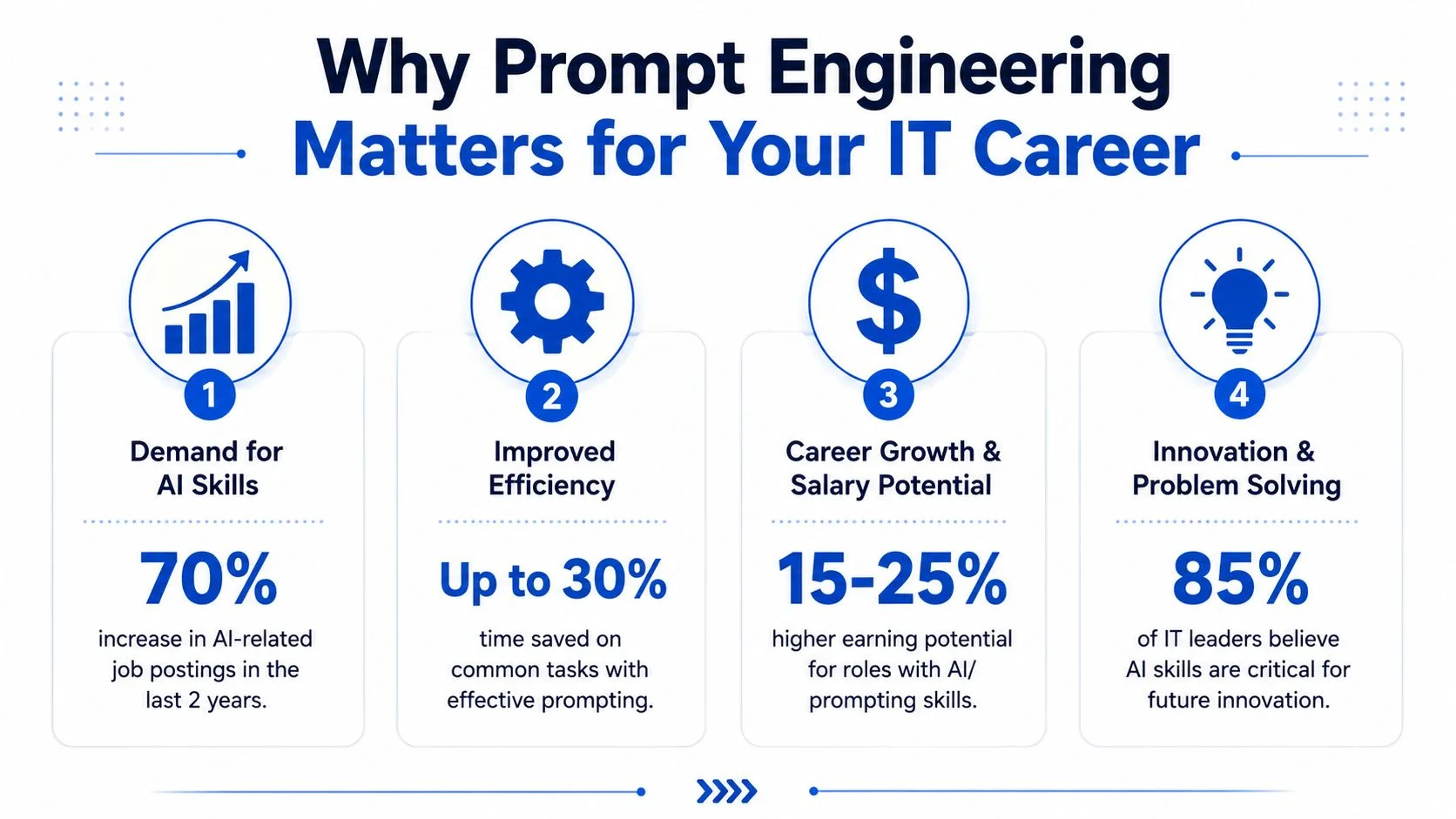
The market signals are clear. One industry analysis projects that the global market for prompt engineering and agent programming tools will reach $6.95 billion by 2025. Separately, job postings for explicitly titled Prompt Engineer roles grew by 135.8% between 2023 and 2024, according to a roundup at SQ Magazine's prompt engineering statistics. Treat those numbers carefully. They don't mean every IT role is becoming a prompt engineer. They do show organizations are formalizing this skill rather than treating it like a novelty.
Your certifications become more useful, not less
If you've spent months learning IAM, subnetting, service management, incident response, or project governance, prompt engineering lets you apply that knowledge faster. AI works best when the user can define the right constraints, the right framework, and the right success criteria.
That's why I tell certification students to stop asking, "How do I compete with AI?" and start asking, "How do I make AI operate at my level of domain understanding?"
Here's what that looks like in daily work:
- For cloud admins: turn rough architecture ideas into structured design reviews
- For support engineers: draft cleaner troubleshooting guides and ticket summaries
- For security staff: produce better control mappings and clearer remediation explanations
- For project managers: create sharper stakeholder communications and risk registers
AI skill is becoming part of professional literacy
Prompt engineering also matters because search, content discovery, and technical knowledge work are changing. If you want a good primer on how AI-generated answers change visibility and information retrieval, MyMentions AEO insights are useful for understanding why clear, structured answers increasingly matter.
Practical rule: Prompt engineering isn't a replacement skill. It's a multiplier for the expertise you already have.
A strong Linux admin with weak prompting will get mixed results from AI. A strong Linux admin with solid prompt engineering skills can turn AI into a fast first-draft machine, an explainer, a study partner, and a structured reviewer. That's the opportunity in front of you.
Building Your Foundation in Prompt Engineering
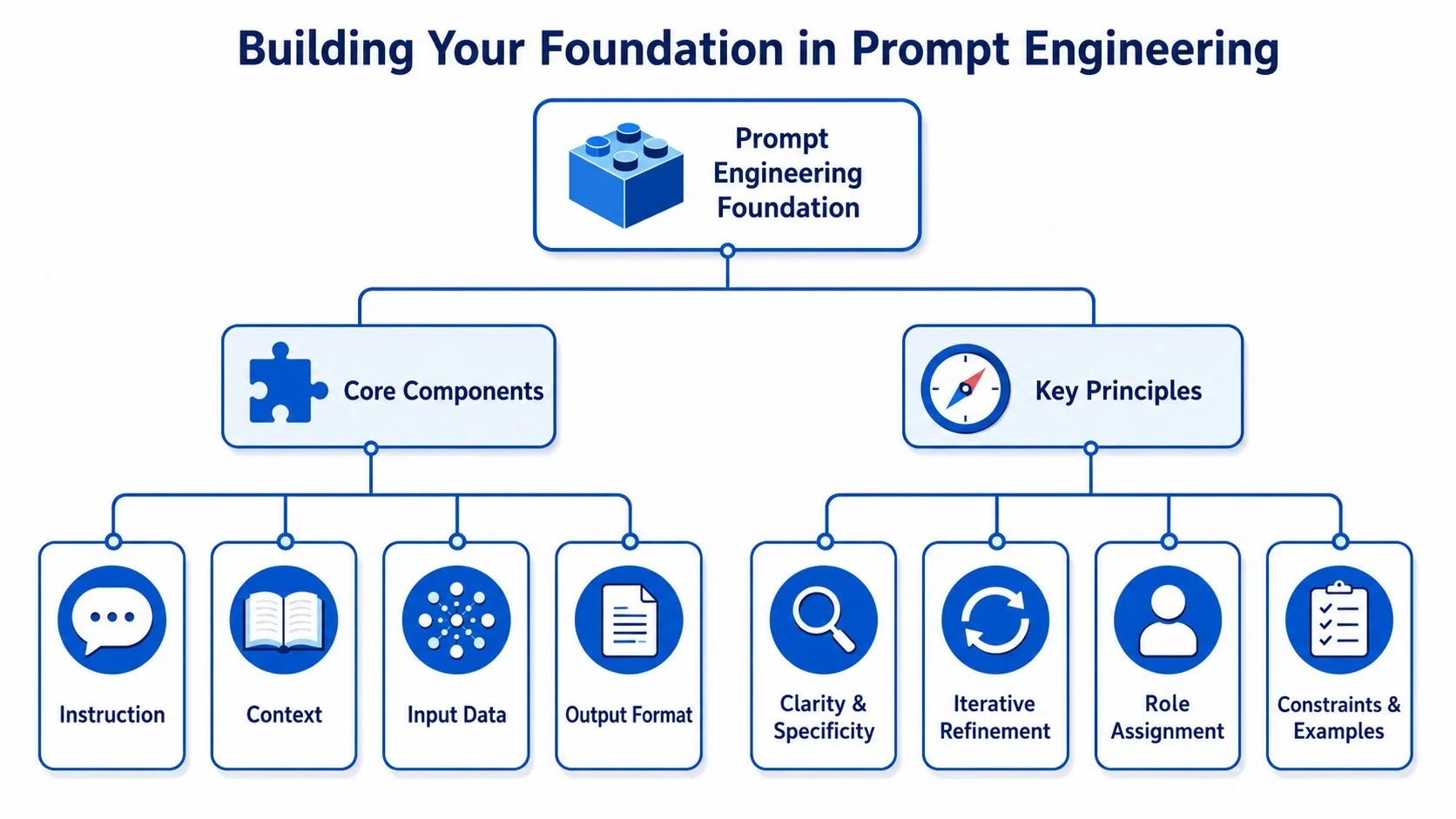
A prompt isn't just a question. In professional use, it's closer to an instruction set. The best prompts tell the model who it should be, what it should do, what context matters, how success should be judged, and what the final output should look like.
That hybrid nature shows up in hiring patterns. Analysis of prompt engineering roles found 22.8% emphasis on AI and ML fundamentals, 18.7% on technical prompt design, and 37.7% combined emphasis on communication and creative problem-solving in the summarized findings from this arXiv job-role analysis. That mix makes sense. Good prompt engineering skills sit between technical knowledge and precise communication.
Use the RTECF model
I teach students a simple structure: Role, Task, Environment or Context, Constraints or Examples, and Format. You can remember it as RTECF.
| Element | What it does | Weak version | Stronger version |
|---|---|---|---|
| Role | sets perspective | “Explain IAM” | “Act as an AWS solutions architect teaching an exam candidate” |
| Task | defines the job | “Tell me about IAM” | “Compare IAM roles and IAM users for a migration scenario” |
| Context | adds domain detail | “for a company” | “for a regulated startup moving from on-prem to AWS” |
| Constraints or Examples | narrows ambiguity | none | “use exam-style reasoning and include one common trap” |
| Format | shapes output | none | “return a table followed by three practice questions” |
Most weak prompts fail because one or more of those pieces is missing.
Why learners get confused
Many people assume the model will "fill in the blanks" correctly. Sometimes it will. Often it won't. If you say, "Write a network troubleshooting guide," the model has to guess:
- Audience: beginner, engineer, manager, exam taker?
- Scope: switching, routing, DNS, firewalls, wireless?
- Depth: checklist, explanation, script, decision tree?
- Goal: pass an exam, resolve an outage, train staff?
That guesswork is where vague output starts.
Strong prompting means removing unnecessary guesswork.
A basic transformation
A weak prompt:
Explain zero trust.
A stronger prompt:
Act as a cybersecurity instructor. Explain zero trust to a CompTIA Security+ student. Use plain language, define the concept, connect it to identity, device posture, least privilege, and continuous verification, then give two scenario-based practice questions. Format the response with short sections and bullet points.
Same topic. Different result.
The real skill isn't wording alone
Prompt engineering skills aren't just about "finding magic words." They come from four habits:
- Knowing the domain: you recognize what details matter
- Defining the output: you specify the deliverable clearly
- Controlling ambiguity: you add constraints before the model guesses wrong
- Reviewing critically: you check whether the answer is accurate, useful, and complete
If you already think in frameworks because of certifications, you're in a strong position. You're used to objectives, controls, scenarios, and structured reasoning. Prompting converts those habits into instructions an AI system can follow.
Core Prompting Patterns and Techniques
Once your foundation is solid, the next step is learning a few repeatable patterns. You don't need dozens. You need a small toolkit you can apply on command.
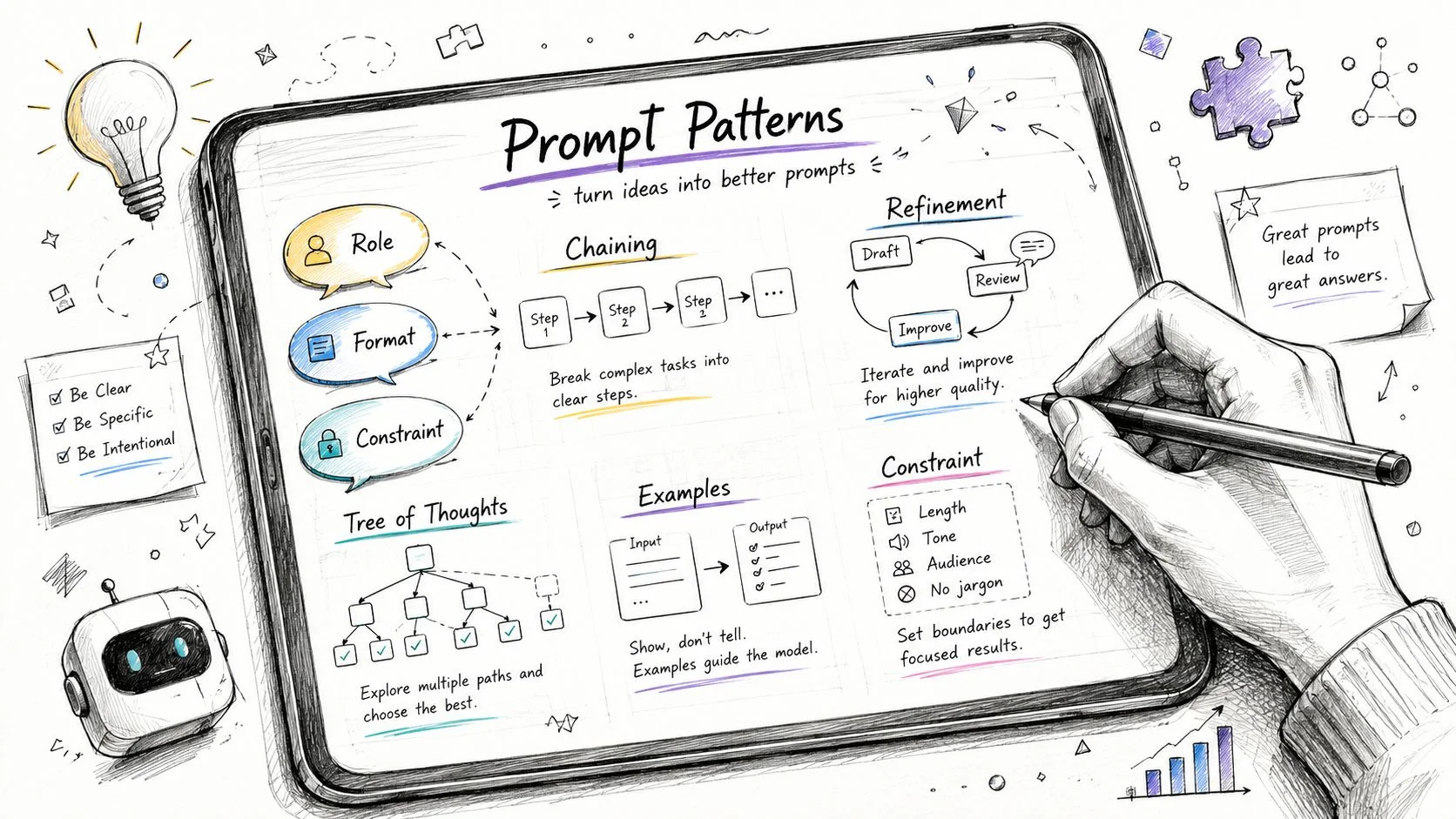
The most useful patterns for certification students and IT pros are zero-shot, few-shot, step decomposition, and positive framing. According to summarized benchmarks in LeewayHertz on prompt engineering, breaking a complex task into explicit steps can reduce hallucinations and improve task success by 25 to 40% compared with a single-shot prompt. The same source reports that few-shot examples can outperform zero-shot prompting by 25 to 40% on complex reasoning tasks, and positive instruction framing can be 15 to 25% more effective than negative framing.
Zero-shot for clean starting points
Zero-shot means you ask for the task directly without examples.
Example:
Explain why a company might choose Amazon S3 lifecycle policies over manual storage management.
This is useful when the task is simple, exploratory, or you want to see the model's default response. I recommend zero-shot first when you're trying to discover what level of detail the model naturally gives you.
It's fast. It's not always reliable for nuanced work.
Few-shot for exam-style consistency
Few-shot prompting gives the model a small number of examples that show the pattern you want.
For certification learners, this is excellent for scenario questions.
Before
Write three Security+ practice questions about access control.
After
Create three Security+ style access control questions. Follow these examples for tone and structure. Example 1: A company needs to limit admin privileges during off-hours while preserving emergency access... Example 2: A remote workforce must authenticate to cloud applications using a method resistant to password reuse... Match the difficulty and explanation style of the examples. After each question, provide the correct answer and a short rationale.
Few-shot works because it teaches the model your preferred pattern instead of making it guess.
Step decomposition for harder tasks
Many professionals see the biggest jump in quality when they ask the model to work through a sequence instead of asking for the final deliverable immediately.
A weak prompt:
Design a cloud migration plan.
A stronger prompt:
- Restate the migration scenario in your own words.
- Identify the main technical and business constraints.
- Propose a target AWS architecture.
- Evaluate it against security, cost, reliability, and operations.
- List migration risks and mitigations.
- Present the final answer as an executive summary plus technical appendix.
That sequence often produces better reasoning because the model isn't trying to solve, justify, and format everything in one move.
If the output matters, don't ask for the final answer first. Ask for the thinking path that should lead to it.
A lot of teams use this same principle when enhancing ChatGPT workflows with reusable templates, especially for repetitive documentation and review tasks.
Positive framing beats warning-only prompts
Many learners write prompts like this:
Don't be vague. Don't miss security risks. Don't forget compliance.
That seems sensible, but it often underperforms. Better:
Be specific. Identify key security risks. Note any compliance considerations. Use concise language.
You're telling the model what to produce, not just what to avoid.
A practical IT comparison
Here's a simple before-and-after set for a cloud study task.
Weak version
Help me study prompt engineering for AWS.
Improved version
Act as an AWS AI tutor for a certification candidate. Explain zero-shot, few-shot, and step-by-step prompting using AWS examples. Include one example for architecture review, one for documentation generation, and one for scenario-based exam prep. End with a short self-test.
If you want a certification-specific reference point, this AWS AI prompt engineering guide from MindMesh Academy is a useful companion for mapping these techniques to AWS exam language.
A short walkthrough helps here before you experiment on your own:
A compact pattern library
Keep these in your back pocket:
- For explanations: assign a role, define the learner level, request analogies, and ask for one misconception
- For troubleshooting: provide symptoms, environment, constraints, and ask for a ranked hypothesis list
- For architecture: specify framework, trade-offs, assumptions, and output format
- For project work: define stakeholder, objective, timeline sensitivity, and tone
You don't need to memorize exotic prompting jargon. You need to apply a few dependable patterns to the tasks you already handle.
Using Your Certifications for Advanced Prompting
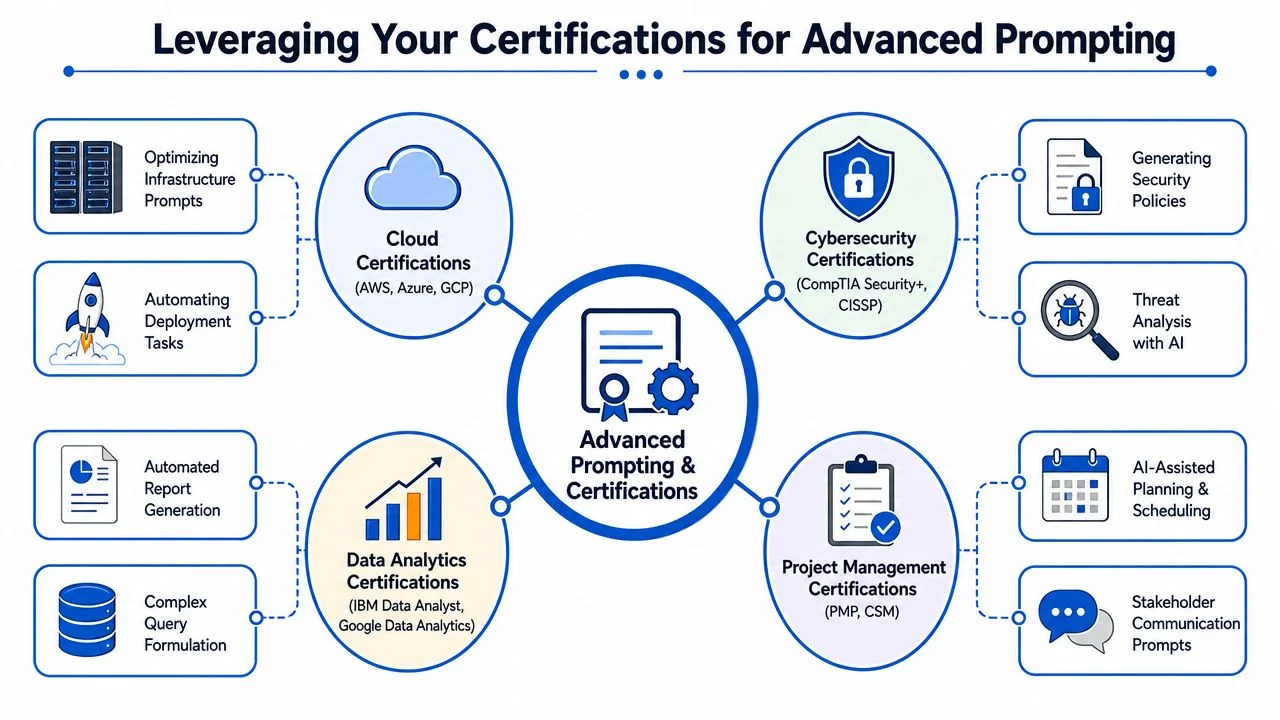
IT professionals pull ahead of general users. Most prompt advice treats everyone as if they're starting from the same place. They aren't. A certified practitioner already has a vocabulary, a framework set, and a way of evaluating answers.
Research summarized in this domain expertise discussion from PMC highlights that specialized knowledge helps learners ask better questions and interpret AI outputs more effectively. In practice, that means a person who knows AWS Well-Architected, NIST, ITIL, or project management process language can guide the model toward answers that are more relevant to real work and exam scenarios.
AWS learners can prompt with architecture lenses
A generic prompt says:
Design a resilient web app in AWS.
A certification-aware prompt says:
Act as an AWS solutions architect. Propose a web application design for a growing e-commerce platform. Evaluate the design using the Well-Architected pillars. Call out trade-offs, likely exam distractors, and one cheaper alternative that sacrifices some resilience. Return the answer as a table plus a short recommendation.
That works better because it tells the model how to think, not just what to talk about.
Security professionals can prompt with control language
A generic security prompt:
Analyze this phishing scenario.
A stronger version:
Act as a security analyst coaching a Security+ student. Analyze this phishing scenario using control categories, detection clues, likely business impact, and immediate containment steps. Then create two multiple-choice questions based on the scenario and explain why the wrong answers are wrong.
That prompt turns AI into a study partner and an analysis assistant at the same time.
Your certification framework is a prompt asset. Use it explicitly.
PMP and service management professionals can structure outputs better
Project and operations professionals often underestimate how useful their frameworks are in prompting. They know phases, stakeholders, dependencies, risks, approvals, and communication paths.
A PMP-style prompt might look like this:
Act as a project manager. Review this migration initiative and produce a stakeholder communication draft, a risk list, and a meeting agenda. Use formal business language. Separate assumptions from confirmed facts. Flag any dependency that could affect schedule or scope.
An ITIL-aware prompt could ask for incident categorization, root cause hypotheses, service impact statements, and post-incident review actions. The result is usually far more operationally useful than a generic "write me a summary" request.
Domain-specific prompting template
You can adapt this to almost any certification:
- Role: “Act as a senior practitioner in [domain]”
- Scenario: “Given this environment or problem”
- Framework: “Use [Well-Architected, NIST, ITIL, PMP process language, etc.]”
- Task: “Analyze, compare, draft, explain, or generate”
- Output: “Return as table, checklist, briefing note, or exam-style Q&A”
If you're building a deeper study plan around cloud and generative AI together, MindMesh Academy AWS certification prep gives you a place to connect formal exam study with these hands-on prompting habits.
From Practice to Portfolio Demonstrating Your Skills
Practice helps you improve. A portfolio proves you can apply what you know. Employers and managers usually don't care that you "played around" with AI tools. They care whether you can produce repeatable, useful outputs for real technical work.
That's why I encourage learners to create visible artifacts. Prompt engineering skills become more credible when someone can inspect your process, your prompt design choices, and your output quality.
Project idea one: a domain-specific prompt library
Build a GitHub repository that contains prompts for one technical area you know well.
Examples:
- AWS architecture review prompts
- Security incident analysis prompts
- Help desk summarization prompts
- PMP communication drafting prompts
Don't just dump prompts into a file. Add notes on when to use each one, what input it expects, what good output looks like, and what common failure modes you've observed.
Project idea two: a prompt comparison write-up
Pick one realistic IT task and compare several prompting strategies.
You might test:
- Zero-shot versus few-shot for scenario-based exam questions
- Single-shot versus step decomposition for migration planning
- Negative versus positive instructions for documentation quality
Write up what changed. Show the original prompt, the revised prompt, and your judgment about output quality. You don't need invented performance numbers to make this persuasive. Clear side-by-side examples are enough.
A hiring manager can learn more from one thoughtful prompt comparison than from a long list of AI buzzwords on a resume.
Project idea three: a small utility for your peers
Create a lightweight tool, template, or workflow that helps others use AI more effectively in your domain.
That could be:
| Project | What it demonstrates |
|---|---|
| Prompt-powered study assistant | exam knowledge, prompt structure, user empathy |
| Architecture review template | cloud expertise, framework thinking, output design |
| Incident summary generator | operations awareness, clarity, consistency |
The point isn't to build a full product. The point is to show judgment.
Document the learning loop
When you publish or present your work, show that you can refine prompts systematically:
- State the goal: what the AI needed to produce
- Show the first attempt: where it fell short
- Explain the revision: what you changed and why
- Present the final version: what improved
That process mindset matters. It tells an employer you can work with AI responsibly rather than treating it like a slot machine.
As your skills develop, keep studying beyond test-day objectives. Resources that help you maintain AWS AI certification knowledge from MindMesh Academy also support the habit that matters most here: continuous iteration.
Your Roadmap for Continued Growth in AI
The strongest professionals in this space won't be the ones who memorize the most prompt tricks. They'll be the ones who combine technical depth, structured prompting, and critical review. That combination is especially powerful for certification students because you already know how to learn frameworks, apply them under constraints, and spot weak reasoning.
Keep your growth loop simple.
A practical ongoing routine
- Read model documentation: product docs from major AI vendors often reveal what a model handles well and where it struggles
- Follow technical communities: Reddit communities for AWS, cybersecurity, project management, and generative AI can surface practical use cases quickly
- Study AI lab blogs: OpenAI, Anthropic, Google, Microsoft, and AWS developer content often shows how prompting advice evolves
- Keep a prompt journal: save good prompts, failed prompts, and revised prompts with notes about what changed
Focus on transfer, not novelty
You don't need a new AI workflow every week. You need a handful that keep paying off.
For example:
- an architecture review prompt you trust
- a troubleshooting prompt for support scenarios
- a study prompt for exam-style questions
- a communication prompt for summaries, risks, and stakeholder updates
Those repeatable assets are what turn prompt engineering skills into a professional advantage.
The IT pros who get ahead with AI usually do one thing well. They bring structure from their domain into the prompt instead of hoping the model will invent it.
Keep building that habit. Ask better questions. Add the framework you already know. Specify the output you need. Then review the result like a practitioner, not a spectator.
Ready to put these prompt engineering skills to work and strengthen your AI certification readiness? Start with our AWS Certified AI Practitioner practice exam at MindMesh Academy.

Written by
Alvin Varughese
Founder, MindMesh Academy
Alvin Varughese is the founder of MindMesh Academy and an enterprise architecture leader. An electrical engineer by training, he moved from factory automation in South Africa to cloud architecture at GE Appliances and Humana (Fortune 50), and holds 20 professional certifications including AWS Solutions Architect Professional, Azure DevOps Engineer Expert, and Microsoft Agentic AI Business Solutions Architect. He built MindMesh Academy after interviewing too many highly certified candidates who couldn't answer basic questions: the goal is prep that makes you better at the job, not just able to pass the exam.