Practice Questions for CCNA Exam: Ace the Test with Focused Prep
IT professionals aiming to earn the CCNA or other rigorous certifications find that success requires high-quality practice questions. These tools connect networking concepts to the practical application needed during the actual test. At MindMesh Academy, we view this method as a vital part of preparing for any technical certification.
Include these questions as a central part of your training rather than a final review. This strategy helps you build problem-solving skills and master timing while you identify specific knowledge gaps before they affect your exam performance. Consistent practice ensures you can apply what you know under pressure and be well-prepared.
Why Practice Questions Are Your Ultimate Study Weapon
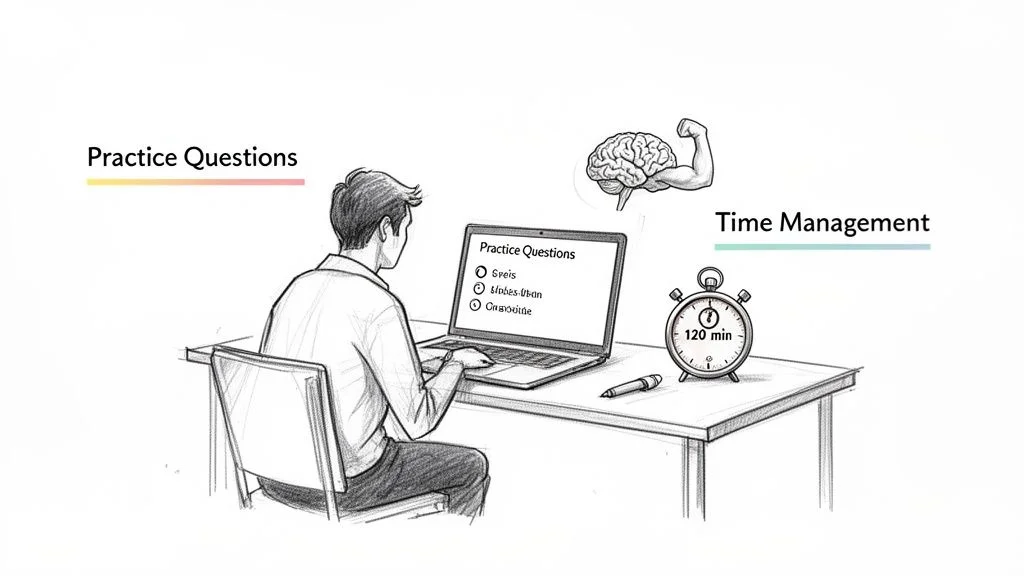 Caption: Effective practice question strategies are crucial for cementing knowledge and building exam-day confidence.
Practice questions serve as active learning instruments rather than simple knowledge checks. Every time you attempt a question, you force your brain to find and pull out information it has stored. This cognitive process is known as active recall. It is a mental workout that is far more effective for long-term memory than passive study methods. When you read a textbook or watch a video lecture, information flows into your mind, but you do not have to work to keep it there. This often creates a false sense of security where you feel you know the material because it looks familiar on the page. Practice questions break that cycle. They simulate the actual mental work you will do on the day of the test. By repeating this process, you build the mental stamina and memory paths needed to perform under pressure. This approach is effective for the CCNA 200-301, AWS certifications, and even the PMP exam.
From Theory to Hands-On Skill
Learning the theory behind networking is the first step. You might understand the basics of OSPF adjacencies or how an ACL is structured. However, knowing the definition of a protocol is not the same as knowing how to use it. In a real technical environment, you have to solve problems. You might need to fix a broken neighbor relationship in a complex network or configure a specific security list while time is running out. The current exam focuses heavily on this practical application. Like the Azure Administrator or ITIL 4 exams, it values your ability to use knowledge over your ability to memorize facts.
High-quality practice questions often use real-world scenarios to test your skills. They do not just ask you what a VLAN is. Instead, they might describe a situation where a user cannot reach a server or a newly configured switch is not passing traffic correctly. These questions require you to look at the whole "blueprint" of the exam and combine different concepts to find a fix. You have to think about how trunking, tagging, and IP routing all work together. This repetitive problem-solving changes how you look at the material. It moves you from being someone who has read about networking to someone who can actually manage a network.
Your goal shouldn't be just getting the right answer. It should be understanding exactly why the other options are wrong. That deeper level of analysis is what separates someone who squeaks by with a pass from someone who aces the exam with confidence.
Reflection Prompt: "Consider your own study habits: Are you merely seeking the correct answer, or are you looking into the 'why' behind every choice? This critical self-assessment can significantly refine your learning process."
Mastering the Clock and Exam Format
The exam has a very specific structure and strict time limits. You will usually have about 120 minutes to answer between 100-120 questions. This means you have roughly one minute for every item on the screen. A major challenge of this exam is that you cannot go back. Once you submit an answer and move to the next screen, that choice is permanent. This "no-review" policy is common in many high-level certifications, and it makes timed practice sessions essential. If you do not practice with a clock, you might spend too much time on a single difficult problem and run out of time for the easier ones at the end.
Consistent practice helps you develop several important skills:
- Optimize Pacing: You learn to quickly find the core of a question. This helps you ignore extra information that is only there to distract you. You become faster at making a decision and moving on.
- Cultivate Mental Stamina: Taking a technical exam for two hours is tiring. It is a mental marathon. Regular practice sessions train your brain to stay focused and sharp from the first question to the last.
- Mitigate Exam-Day Anxiety: If you know exactly how the test looks and how the timer feels, you will be less nervous. Familiarity leads to a calmer mind, which allows you to think more clearly when things get difficult.
Using a practice exam allows you to train your brain for the specific stress of the testing center. This type of preparation is just as important for AWS or Microsoft Azure exams, which also use strict time limits and various question types to test your knowledge.
Find and Fix Your Weak Spots
You cannot fix a problem until you know it exists. Practice questions are the best way to find the gaps in your knowledge. A good question bank does not just tell you if you were right or wrong. It should give you detailed data on your performance across the different domains of the exam. The CCNA is divided into six specific areas. If you find that you are scoring 90% in IP Connectivity but only 55% in Security Fundamentals, you have a clear roadmap for your studies.
This data-driven approach saves you time. Instead of spending hours reading about things you already understand, you can focus on the topics that are actually lowering your score. This is very important for an exam with such a wide range of topics. You must be efficient with your study time to cover everything before your test date.
The table below shows how using practice questions helps you overcome common hurdles:
| Benefit of Practice | How It Helps You Pass | Our Recommended Approach |
|---|---|---|
| Simulates Exam Pressure | The 120-minute limit and the policy that prevents you from reviewing previous answers can cause stress. Timed mocks help you get used to the speed. | Take at least one full-length, timed mock exam each week during the final month of your preparation. |
| Reveals Knowledge Gaps | It is easy to think you understand a topic until you have to apply it. Questions show you exactly what you do not know, similar to the scenario questions in AWS exams. | After every practice session, thoroughly review every incorrect answer and find out exactly why you made the mistake. |
| Builds Problem-Solving Speed | You learn to look at a scenario, throw away the irrelevant details, and find the solution quickly. This is vital for any technical exam with a timer. | Use drills that focus on one topic at a time to get faster at common tasks like subnetting or understanding access list logic. |
| Reinforces Concepts | The act of searching your memory for an answer helps lock that knowledge in place better than just reading it over and over. | Use a method of spaced repetition. Go back and answer questions on your hardest topics a few days after you first struggled with them. |
By using these methods, you stop just looking at study materials and start training for the actual performance. This active approach is what leads to a passing score and a deep understanding of the technology.
How to Spot High-Quality CCNA Practice Questions
Finding quality CCNA practice questions online is a difficult task because the internet is full of resources that are a waste of study time. You must distinguish between low-quality "exam dumps" and study tools that build actual networking skills. A quick word on exam dumps: these are collections of questions and answers taken from real tests by people who memorized them. Using them is unethical and a poor strategy. They encourage memorization without understanding, which leaves you unprepared for the complex scenarios you will face on the actual exam. If you rely on dumps, you might pass the test, but you will likely fail in a real-world technical interview or on the job.
Alignment with the CCNA 200-301 Blueprint
The primary factor for any practice question bank is its direct alignment with the official Cisco CCNA 200-301 exam blueprint. This document is your guide. It lists the specific domains Cisco expects you to master and how much each counts toward your final score. A reliable resource covers all six domains: Network Fundamentals, Network Access, IP Connectivity, IP Services, Security Fundamentals, and Automation and Programmability.
Look for specific topic breakdowns in your practice software. Being able to run drills on subjects like OSPF, VLANs, or Quality of Service (QoS) shows a high level of quality. If a provider does not mention the 200-301 blueprint or uses outdated content from the old 200-125 exam, move on. The current CCNA includes topics like automation and Software-Defined Networking (SDN) that older sets miss. This focus on the blueprint is as vital here as it is for the AWS Certified Solutions Architect - Associate (SAA-C03) or PMI's PMBOK Guide for the PMP. If the practice test does not reflect the current weightings of these domains, you might spend too much time on legacy technologies like Frame Relay and not enough time on modern wireless standards or security protocols.
Rich Explanations for All Answer Choices
A practice question is only useful if it teaches you something, even if you got the answer right. A simple "correct" or "incorrect" flag is not enough to help you grow. You need detailed explanations that show why the right answer is correct and why the distractors are wrong. This is where most free resources fail. They give you the answer but leave you to figure out the "why" on your own.
For example, a question about OSPF neighbor states should do more than identify "Full" as the final answer. A good explanation describes what happens in the "Full" state, such as the routers having synchronized link-state databases. It should also review the steps in "2-Way" or "ExStart," and explain why "Down" or "Init" do not fit the scenario described. This turns every question into a short lesson that reinforces technical concepts. Understanding why three of the options are incorrect is just as important as knowing why one is correct. It builds your troubleshooting skills, which are necessary when you are working on live Cisco hardware.
A Mix of Question Formats and Scenarios
The CCNA is more than just multiple-choice questions. Cisco uses several formats to test how you apply what you know in a virtual environment. Your study materials should reflect this variety to prepare you for the actual testing center experience. For details on what to expect, read our guide on CCNA exam question types for 2025. Your resources should include:
- Multiple-Choice: Standard single-answer and multiple-answer formats that form the base of the exam.
- Drag-and-Drop: These test your knowledge of sequences, like matching protocols to OSI layers or ordering the steps of the DHCP DORA process (Discover, Offer, Request, Acknowledgment).
- Simulations (Simlets) and Testlets: These are vital. They place you in a command-line interface (CLI) or show a network diagram and ask you to fix a specific configuration issue. You might have to use "show" commands to find a masked error. This format is also found in Azure and AWS specialty exams that use labs.
Scenario-based questions provide the most value. Asking for the command to set a static route is too simple and only tests your memory. A better question shows a network diagram with a connectivity failure and asks you to write the exact static route needed to fix it. Solving problems in context is the goal of the Cisco certification program.
Reflection Prompt: "Are your current practice questions truly challenging your ability to apply concepts in a simulated environment, or are they merely testing recall?"
Focus on Updated and Relevant Content
Technology changes fast, and Cisco updates the CCNA to keep pace with the industry. Your practice questions must stay current with the latest version of the exam. The Automation and Programmability domain now makes up 10% of the exam, which is a major shift from previous years. Your materials must cover:
- Controller-Based Networking: Understand Cisco DNA Center and how it differs from traditional device-by-device management.
- REST API Principles: Know HTTP verbs like GET and POST and how to interpret JSON-encoded data.
- Configuration Management: Learn tools like Ansible, Puppet, or Chef and how they help automate repetitive network tasks.
A question bank that focuses only on old-school routing and switching will leave you unprepared for a large part of the test. To see what effective questions look like, you can look at how other professional tests organize their top practice questions resources. Quality depends on relevance and blueprint alignment. By checking your materials against these standards, you ensure your study time builds the skills needed to pass with confidence. If the vendor does not update their questions at least once a year, they likely are not keeping up with Cisco's minor revisions and adjustments to the question pool. Investing time in tools that improve your technical depth is the only way to ensure you are ready for the exam.
Structuring Your Practice for Maximum Skill Building
While theoretical knowledge provides the necessary base, a clear and actionable study plan is what helps you reach the certification goal. This six-week schedule is built for IT professionals who can dedicate 10 to 15 hours each week to their studies. This workload is manageable even for those balancing a full-time job or school requirements. The plan is divided into specific phases, starting with the creation of a solid conceptual base and moving toward full exam readiness. This entire strategy relies on a direct feedback loop: regular practice, honest analysis of your performance, and focused study to fix specific weak areas.
 Caption: The practice-analyze-target feedback loop is essential for continuous improvement in certification preparation.
This repeating cycle is vital for your success. It ensures that your study sessions are not just repetitive tasks but lead to visible, measurable improvement every time you sit down to practice.
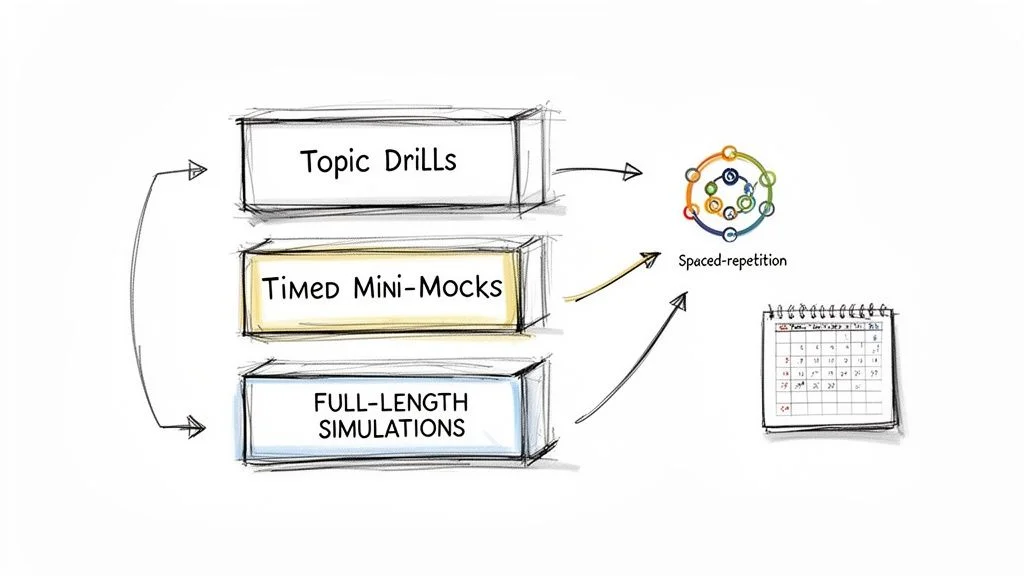
Phase One: Topic-Specific Drills
The first two weeks focus on learning core concepts one at a time. Do not worry about your speed during this stage; your main goal is to understand the material. Avoid taking full-length practice tests right away. Instead, use drills that focus on specific topics to make sure you understand the core material before moving on.
Your Mission for Weeks 1-2:
- The Goal: Reach a score of at least 85% on drills covering Network Fundamentals and Network Access topics.
- The Activity: Complete drills of 20 to 30 questions on specific areas like subnetting, VLANs, trunking, and STP.
- The Review: Spend as much time looking at the explanations as you did answering the questions. Do not just look for the right answer. You must understand why the other three choices are wrong to learn how to identify distractors on the actual test.
This method keeps you from feeling overwhelmed by the volume of information. It builds a knowledge base before you have to worry about a timer, which prepares you for the more difficult CCNA scenarios you will face later.
Phase Two: Timed Mini-Mocks
Once you understand the concepts, you can start adding time limits. Moving straight into two-hour exams can be exhausting and may not be the most effective way to learn. Instead, use shorter sessions to build your speed.
Your Mission for Weeks 3-4:
- The Goal: Get comfortable answering questions at a pace of about one minute per question.
- The Activity: Take three or four timed mini-exams each week. These sessions should have 30 to 40 questions and cover all the CCNA exam domains to test your ability to switch between different topics.
- The Review: Start a "Weakness Matrix" to track your progress. When you miss a question, record it and note why you got it wrong. Was it a lack of knowledge, a misunderstood question, or did you run out of time? Use this data to pick which topics to study before your next mock exam.
This phase helps you build the mental habits needed to use your knowledge quickly and accurately. It also helps you avoid the fatigue that comes from taking full exams too early in your preparation process.
Phase Three: Full-Length Exam Simulations
This is the final part of your preparation. Shift your focus to full exam simulations that mimic the real testing environment. Your goals now are to manage your time, handle mental exhaustion, and build the confidence you need for the actual test. If you find it hard to find enough time for these long sessions, our guide on how long it takes to study for the CCNA offers helpful scheduling tips.
Your Mission for Weeks 5-6:
- The Goal: Consistently get scores higher than the passing grade on at least three different full-length practice tests.
- The Activity: Plan for two full 120-minute simulations each week. Treat these like the real certification exam by using no notes, putting your phone away, and ensuring you have no interruptions.
- The Review: Look over your mock exam results one last time. Use any extra study time to focus on areas where you still struggle. On the day before your exam, only do a light review of your notes. Your priority is resting and being mentally ready for the test.
Integrating Spaced Repetition
During this practice, your review method is your most effective tool. Using spaced repetition is a key part of this. This method is backed by science and helps move facts from short-term to long-term memory. This is necessary for an exam with 120 questions where you must recall a large amount of information. No matter which phase of study you are in, this method helps information stay with you.
When you miss a question, do not just read the answer and move on. Mark it to review later. Look at that question again the next day. If you get it right then, check it again in three days, and then again in one week. This repeat process helps the information stay in your memory.
The CCNA exam is more important than ever, especially with the 200-301 v1.1 update. This version includes automation and security along with traditional networking topics. The standard for passing is high. Recent data shows that people who pass usually score between 80% and 90% in the main domains, while those who fail often score below 50%. Spaced repetition is a great way to close this gap and master the necessary concepts and the latest exam changes. By following this structured plan, you can approach the test with the confidence that you have practiced every major topic.
Analyzing Your Results to Eliminate Weak Spots
When you finish a practice exam, your score is just a starting point. Whether you see a high number or a disappointing one, the real work begins during the review phase. This is where a raw score becomes a clear plan to find and fix your weak spots. Do not just look at a 75% and feel satisfied or see a 58% and give up. That is a wasted opportunity. The percentage shows you what happened, but a close look at the details shows you why. This self-assessment stops you from making the same mistakes and helps you spend your study time on topics that actually help you earn your CCNA certification.
Look Beyond the Final Percentage
It is natural to focus on the big number at the end of the test. Instead, look at the individual sections. A good practice platform provides a breakdown of how you did in each of the official CCNA exam domains. This breakdown acts as your map. If you did well in IP Connectivity but failed Security Fundamentals, you know exactly where to go. You can fix these problems with precision instead of reading a thousand pages of a textbook. This approach is about using your time where it counts most.
To get even better results, look for patterns in the mistakes you made. Most errors fall into three specific categories:
- Knowledge Gaps: Did you miss a question because you forgot the administrative distance of EIGRP? This is a memory problem. You need flashcards and a quick review of that specific protocol to keep the facts fresh.
- Misinterpretation: This happens often. You might see a question asking you to deny traffic, but your brain reads it as 'permit.' This is not about what you know; it is about how you read. You can fix this by slowing down and reading every word of the prompt twice.
- Time-Pressure Errors: Did a subnetting problem take too long, leading to a math error? This means you know the theory but lack the speed. You need timed drills on that specific topic until the math becomes automatic.
Understanding why you missed a point is more useful than just seeing that you were wrong.
Reflection Prompt: "After your next practice session, take 15 minutes to sort your mistakes. You will see patterns that show you exactly what to do next to improve your score."
Build Your "Weakness Matrix"
I suggest that students create a "Weakness Matrix." While it sounds complex, it can be a simple spreadsheet or a page in a notebook. The goal is to record every wrong answer and identify why it happened. This turns you into an investigator of your own performance. You are no longer just guessing why you failed; you are diagnosing the problem. Structure your matrix with columns like these:
| Question Topic | Exam Domain | Reason for Error | Action Item |
|---|---|---|---|
| Specific details (e.g., OSPFv2 Router IDs, Port Security Sticky MAC) | Broad category (e.g., IP Connectivity, Security Fundamentals) | Root cause (e.g., Knowledge Gap, Misread Prompt, Time Pressure) | Specific corrective step (e.g., 'Review OSPF neighbor states,' 'Practice 10 subnetting problems') |
This process makes you an active participant in your learning. You are not just reading; you are analyzing your own habits. You are building a data-driven plan for your own improvement. This habit often separates candidates who fail by a few points from those who pass with confidence.
Putting Your Analysis Into Action
The data supports this method. Analysis of CCNA exam reports shows that the passing threshold, when weighted, usually sits around 61% (verify current passing scores on the Cisco site). Most people who fail do not miss by a huge margin. Scores often cluster between 40% and 60% (verify these ranges on official score reports). It is common to see people get 45-55% in Network Fundamentals or 36–64% in Network Access. These numbers show that fixing just one or two weak areas is often enough to push you over the line. To understand score patterns, you have to look at your own data.
Your Weakness Matrix is now your personal study guide. If you see that you keep mixing up NAT overload and static NAT, you have a clear objective. Find CCNA practice questions for that specific topic and work on them until you have it down. This removes the guesswork from your schedule. You won't have to wonder what to study next because the data tells you. Following this evidence-based plan ensures your work directly leads to success.
Take the data you have gathered and use it to build your next study session. If you focus on the areas that cost you points, your score will go up. This is how you move from a failing grade to a passing one. You are not just studying more; you are studying with a purpose. Each practice test becomes a tool to make you a better technician and a better test-taker. Stick to the data, fix the gaps, and you will be ready for the real exam.
Your Actionable 6-Week CCNA Practice Plan
While knowing the theory is the start, a structured study plan helps you actually reach the certification finish line. This 6-week roadmap works for IT professionals who can dedicate 10-15 hours per week to their studies. This schedule is designed to fit into a busy work or academic life. We have organized the plan into specific stages, starting with core concepts and moving toward total exam-day readiness. The strategy relies on an effective feedback loop: consistent practice, honest analysis of your results, and fixing the specific areas where you struggle.
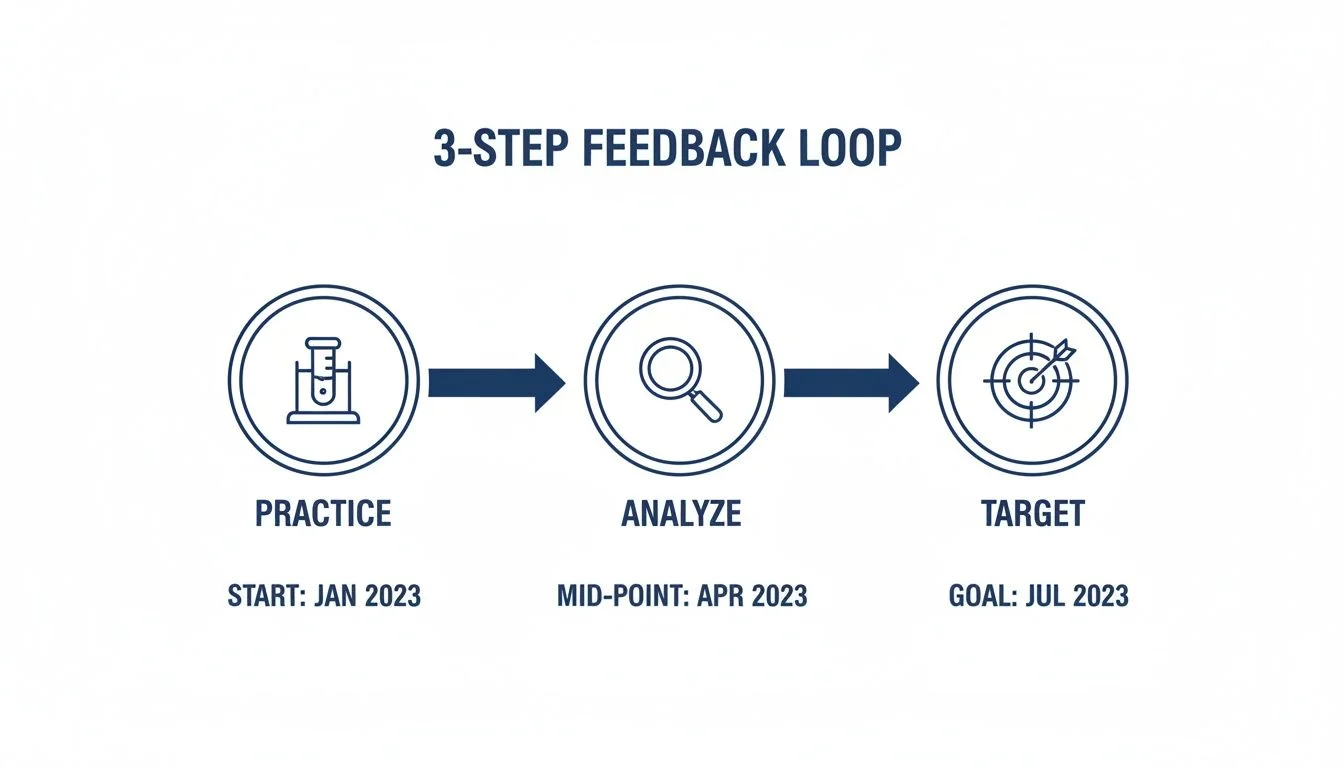 Caption: The practice-analyze-target feedback loop is essential for continuous improvement in certification preparation.
This cycle is vital for your success. It ensures that your study time is productive rather than just repetitive. Each session should lead to clear, measurable progress as you move through the curriculum.
Weeks 1-2: Building Your Foundation
The first two weeks focus on the core topics. You should learn the concepts one by one. Do not worry about the clock yet. The main goal is to understand the logic behind the technology. Avoid full-length exams for now. Use drills that focus on single topics to make sure you have the basics down. Aiming for an 85% score during these early weeks might seem high, but it accounts for the difference between a quiet home environment and the pressure of a testing center. High scores during drills ensure that the basic commands and configurations are second nature.
Your Mission for Weeks 1-2:
- The Goal: Score at least 85% on drills for Network Fundamentals and Network Access. Mastering these essentials early makes advanced routing and security topics much easier to learn later.
- The Activity: Complete drills of 20-30 questions. Focus on subnetting, VLANs, trunking, and STP. These specific subjects appear frequently and require fast, accurate thinking.
- The Review: Spend just as much time reviewing the answers as you spent taking the drill. It is not enough to find the right answer. You must understand why the other three choices were wrong. This habit helps you spot "distractor" answers that Cisco often uses on the test.
This method keeps you from feeling overwhelmed. It builds a strong knowledge base before you start working against a timer. It prepares you for the specific CCNA scenarios you will see.
Weeks 3-4: Ramping Up Speed and Stamina
Now that you understand the concepts, you need to work on your speed. Moving straight to a two-hour exam simulation can lead to burnout. Instead, use shorter timed sessions to build your endurance.
Your Mission for Weeks 3-4:
- The Goal: Learn to answer questions at a pace of about one minute each. This pace leaves you enough time for difficult labs or complex troubleshooting questions during the real exam.
- The Activity: Take three to four timed mini-mock exams every week. Each session should have 30-40 questions. These questions should cover all parts of the CCNA exam domains to test your ability to switch between different topics quickly.
- The Review: Create a "Weakness Matrix" to track your progress. For every wrong answer, record the question topic and the reason for the error. Note if the mistake came from a lack of knowledge, misreading the diagram, or rushing because of the clock. If you miss several questions on STP because of port states, you know exactly what to study before the next mock.
This phase builds the mental habits you need to apply your knowledge quickly. It helps you stay sharp without the exhaustion of taking full exams too early in your preparation.
Weeks 5-6: Full Exam Simulation
This is the final stage of your preparation. You should focus entirely on full-length exam simulations. These sessions help you get used to the actual testing environment. You need to practice your pacing, handle mental tiredness, and build the confidence to pass the test. If you need help with your schedule, check the guide on how long it takes to study for the CCNA for better scheduling ideas.
Your Mission for Weeks 5-6:
- The Goal: Get scores higher than the passing mark on at least three different full-length mock exams. Consistent passing scores are the best indicator that you are ready for the real thing.
- The Activity: Set aside time for two 120-minute exam simulations each week. You must treat these like the real certification exam. Do not use notes, turn off your phone, and ensure you have no interruptions for the full two hours.
- The Review: Perform a final check of all your mock exam data. If you still have trouble with specific topics like OSPF or IP services, use your remaining study hours for targeted drills. On the day before your exam, do only a light review. Your priority is getting enough sleep and being mentally ready for the test.
Your Top CCNA Practice Questions Answered
How Many Practice Questions Should I Do?
Success does not depend on one specific number, but a solid target involves completing 1,000 to 1,500 unique, high-quality questions. Focus strictly on finding unique questions. It is better to encounter 1,500 different problems once than to cycle through the same 500 questions multiple times. This high volume ensures you see everything on the CCNA blueprint, from basic connectivity scenarios to complex edge cases. Large question sets help you spot recurring patterns and force you to use active recall. Recognizing these patterns helps you make faster decisions under the pressure of the exam clock. Instead of just memorizing a specific answer, you learn to identify the logic Cisco expects. Covering all six exam domains through varied questions builds a level of comfort that prevents surprises on the actual test day. The goal is to internalize the logic behind the networking principles rather than just memorizing answers.
What Score Should I Aim For on Mock Exams?
Consistently scoring between 85% and 90% on full-length, timed mock exams is a strong sign that you are ready. Cisco does not publish a static passing score, so this range provides a safety net for exam-day stress or surprisingly difficult questions.
A critical caveat: Scoring high once might be a fluke. You should hit that 85-90% mark on at least three different, high-quality mock exams before you book your testing slot. Consistency shows you truly understand the networking material and can reproduce those results under pressure, which is far better than having one lucky day.
My Practice Scores Aren't Improving—What Should I Do?
If your scores stop rising, do not panic. Finding yourself at a plateau is a standard part of any difficult study plan. It is a sign that your current methods need an adjustment to get you to the next level. If your scores are flat, stop taking full-length mock exams for about a week. Instead, look at the core concepts with a more surgical approach:
- Analyze Your Errors: Go through your most recent tests with care. Do not just mark the answer as wrong; figure out exactly why you missed it. Did you lack the specific knowledge, did you misread the question, or did you make a simple error because you were rushing? Create a spreadsheet to track these mistakes by topic and error type.
- Perform Targeted Drills: Use your error log to focus on specific weak spots. If OSPF configuration questions are always a problem, spend an entire study session only on OSPF questions. Do this until the logic of the protocol feels natural and you can answer without hesitation.
- Examine All Explanations: Read the descriptions for every question in your drills, including the ones you answered correctly. Understanding why the wrong answers are incorrect is often just as useful as knowing why the right one is correct. This helps you avoid traps on the actual exam.
This analytical process stops the cycle of just hoping for better luck and gives you control over your study path.
How Long Should I Spend Reviewing Each Practice Test?
Follow this simple but effective rule: spend as much time reviewing a test as you spent taking it. If you finish a 120-minute mock exam, plan for at least two hours of review afterward. If you skip this step, you waste half the value of the practice exam itself. Reviewing results is an essential habit for growth in the tech industry, where troubleshooting and problem-solving are daily tasks. It helps you identify technical blind spots that you might otherwise ignore. These analytical habits also help when you prepare for technical interviews, much like the logic needed for the Top 10 Software Engineer Interview Questions. The goal is to turn practice into measurable progress.
Are you ready to move past the guesswork and start targeting your weaknesses in CCNA preparation? MindMesh Academy offers an extensive bank of high-quality practice questions, paired with detailed analytics that show you exactly where to improve. Our adaptive learning paths and spaced repetition technology help you study smarter to maximize your retention. Start your path to CCNA success today!
Free CCNA Practice Questions (With Answers)
5 real questions from the CCNA bank, with the full explanation for each answer. No sign-up needed to read them.
- Question 1IP Services [DHCP/DNS]
A helpdesk technician is troubleshooting a workstation that can't obtain an IP address. To diagnose where the DHCP process fails, the technician needs to understand the correct message sequence. What is the correct order of DHCP messages?
- A.Discover, Request, Offer, Acknowledge
- B.Offer, Discover, Request, Acknowledge
- C.Request, Discover, Offer, Acknowledge
- D.Discover, Offer, Request, Acknowledge
Show answer and explanation
Correct answer: D
Correct. DORA: Discover (client broadcasts 'I need an IP'), Offer (server proposes an address), Request (client accepts the offer), Acknowledge (server confirms the lease). Understanding this sequence is key to troubleshooting — if you see Discovers but no Offers, the server isn't reachable; if you see Offers but no Requests, the client may be rejecting the configuration.
Why the other options are wrong
A. Incorrect. The server must Offer before the client can Request. The Offer contains the proposed IP, subnet mask, gateway, and lease duration — the client needs this information before it can make a Request.
B. Incorrect. The client must initiate by broadcasting a Discover first — it doesn't know any DHCP servers exist yet. A server can't Offer an address until it receives a Discover requesting one.
C. Incorrect. A client can't Request a specific address until a server has Offered one. The Request step formally accepts a particular Offer, which is important when multiple DHCP servers respond.
- Question 2Security Fundamentals [Concepts]
What is the difference between a vulnerability and an exploit?
- A.A vulnerability is a weakness; an exploit is code that takes advantage of it
- B.Vulnerabilities only affect software; exploits affect hardware
- C.They are the same thing — both refer to a software flaw
- D.An exploit is a weakness; a vulnerability is code that takes advantage of it
Show answer and explanation
Correct answer: A
Correct. Vulnerabilities are flaws; exploits are the methods used to attack those flaws.
Why the other options are wrong
B. Incorrect. This option relies on the misconception that physical hardware is immune to vulnerabilities. In truth, both hardware (like CPU microcode) and software can have vulnerabilities, and exploits can target either medium.
C. Incorrect. It is common to conflate these terms because they are closely related. However, a vulnerability is the passive security flaw itself, whereas an exploit is the active tool or code used to take advantage of that flaw.
D. Incorrect. This option reverses the actual definitions of the two terms. A vulnerability is the underlying weakness or gap in security, while an exploit is the specific vehicle, script, or technology used to target that weakness.
- Question 3Automation and Programmability [Controller-Based Networking]
An enterprise IT director is evaluating Cisco Catalyst Center (formerly DNA Center) for a campus network with both wired and wireless infrastructure. Which description best fits Catalyst Center?
- A.A firewall appliance to inspect and block traffic
- B.A routing protocol to exchange topology information
- C.A wireless access point
- D.A network management and automation platform
Show answer and explanation
Correct answer: D
Correct. Cisco Catalyst Center (formerly Cisco DNA Center) is an intent-based networking platform that serves as the centralized management, automation, and assurance system for enterprise networks. It provides: automated device provisioning (zero-touch deployment), AI/ML-driven analytics for proactive troubleshooting, policy-based network segmentation (Software-Defined Access), and a single pane of glass for managing campus, branch, and WAN infrastructure. It communicates with network devices through NETCONF/YANG southbound.
Why the other options are wrong
A. Incorrect. Catalyst Center is a management and automation platform, not a security appliance. While it can define and enforce security policies through network segmentation, the actual traffic filtering happens on the managed network devices.
B. Incorrect. Catalyst Center is not a protocol — it's a comprehensive network management platform. Protocols (like OSPF or OpenFlow) handle specific communication tasks; Catalyst Center orchestrates the entire network management lifecycle.
C. Incorrect. Catalyst Center manages wireless access points (through integration with Cisco WLC), but it's not an access point itself. It's the management layer that sits above the entire network infrastructure.
- Question 4Security Fundamentals [ACL - Show Command Output]
What does this tell you about traffic filtering?
show ip interface Gi0/0
Router# show ip interface Gi0/0
GigabitEthernet0/0 is up, line protocol is up
  Inbound access list is 101
  Outgoing access list is not set
- A.ACL 101 filters outbound traffic leaving the router on interface Gi0/0 to secure the network
- B.All traffic is blocked on Gi0/0 by the ACL
- C.ACL 101 filters traffic entering the router on Gi0/0; outbound is not filtered
- D.No filtering is applied; the ACL is defined but not active
Show answer and explanation
Correct answer: C
Correct. Inbound ACL filters ingress traffic; no outbound ACL means egress is unrestricted.
Why the other options are wrong
A. Incorrect. This option confuses the direction of the applied filter. The output shows that ACL 101 is explicitly bound as an inbound access list, meaning it only inspects traffic entering the router through this interface.
B. Incorrect. This option assumes an overly restrictive behavior. Only traffic entering the interface is subject to the rules of ACL 101, while outbound traffic remains completely unfiltered because no outgoing access list is configured.
D. Incorrect. This option assumes the ACL is dormant. However, the output explicitly lists ACL 101 under the inbound access list field, confirming that the filter is active and actively processing incoming packets on this interface.
- Question 5Network Fundamentals [ARP - Show Command Output]
What does 'Incomplete' for 192.168.1.30 indicate?
show ip arp
Router# show ip arp
Protocol  Address          Age (min)  Hardware Addr   Type   Interface
Internet  192.168.1.1             -   0001.0001.0001  ARPA   Gi0/0
Internet  192.168.1.10           5   0011.2233.4455  ARPA   Gi0/0
Internet  192.168.1.20          15   0022.3344.5566  ARPA   Gi0/0
Internet  192.168.1.30           -   Incomplete      ARPA   Gi0/0
- A.The entry is a static ARP configured by an administrator
- B.The MAC address is being learned
- C.The entry is being deleted
- D.ARP request was sent but no reply received
Show answer and explanation
Correct answer: D
Correct. Incomplete means the router sent ARP but the host hasn't responded (may be offline).
Why the other options are wrong
A. Incorrect. This option confuses unresolved dynamic entries with static configurations. A static ARP entry is manually defined with a valid MAC address and would display that hardware address rather than showing as incomplete.
B. Incorrect. This option assumes active learning is in progress. While the router is waiting for a response, the term 'Incomplete' means the resolution process has not succeeded, rather than indicating a normal learning state.
C. Incorrect. This option mistakes a pending resolution for an aging-out process. An entry being deleted would simply be removed from the table, whereas 'Incomplete' indicates an active, unanswered ARP request.
Those are 5 of the 40 questions in the free sample exam. Sign up to take the remaining 35 under exam conditions, get scored, and see which topics are holding you back.

Written by
Alvin Varughese
Founder, MindMesh Academy
Alvin Varughese is the founder of MindMesh Academy and an enterprise architecture leader. An electrical engineer by training, he moved from factory automation in South Africa to cloud architecture at GE Appliances and Humana (Fortune 50), and holds 20 professional certifications including AWS Solutions Architect Professional, Azure DevOps Engineer Expert, and Microsoft Agentic AI Business Solutions Architect. He built MindMesh Academy after interviewing too many highly certified candidates who couldn't answer basic questions: the goal is prep that makes you better at the job, not just able to pass the exam.