
Choosing PMP Exam Study Materials for First-Time Success
Preparing for the Project Management Professional (PMP) exam is a serious commitment that demands more than just dedication. You need a strategy to identify the right study materials. For IT professionals, earning the PMP requires the same precision a solutions architect uses when designing a stable cloud infrastructure. Success depends on selecting the correct tools and following a clear plan. This guide from MindMesh Academy helps you choose the resources needed to pass with confidence and reach this career milestone.
Why Your Choice of Study Materials Matters for Certification Success
The PMP exam is well-known for its difficulty. It evaluates your ability to apply project management concepts to real-world situations, moving far beyond mere fact recall. A frequent error is relying solely on the PMBOK® Guide for rote memorization. Success requires a versatile set of resources that clarifies core concepts, sharpens your logic for situational questions, and readies you for the high-pressure environment of the actual test.
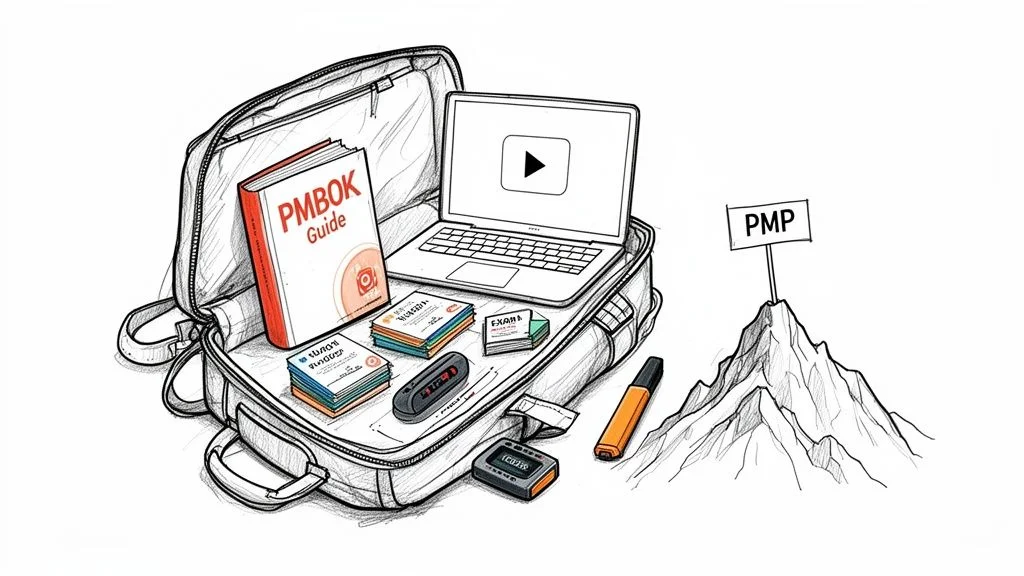 Successful PMP preparation involves using various resources to handle the difficult nature of the exam.
Studying for the PMP requires a large commitment of time and energy, but the professional rewards are significant. This certification acts as a global benchmark for your leadership skills. It tells employers you have the expertise to manage projects from the first step to the final delivery. This applies to software development, hardware rollouts, and any other technical field. Organizations value this credential because it proves you understand the frameworks used to control budgets, schedules, and team dynamics.
The Tangible Value of PMP Certification in the IT World
Professional recognition is just one part of the story. The financial incentives are just as strong. Investing in quality PMP exam study materials helps you secure a better salary. A PMI survey found that certification holders earn a median salary 17% higher than non-certified professionals across 21 countries. This is a clear indicator of how the credential affects your career growth. You can view the details in these PMP salary findings from PMI (verify current data on the PMI site).
Reflection Prompt: Consider your career path. How might PMP status change your trajectory? Imagine moving into a lead architect position, managing larger engineering teams, or overseeing critical infrastructure deployments. Think about the specific projects you want to lead in the next three years.
A Strategic Approach to PMP Exam Preparation
To create a study plan that produces results, you have to accept the challenge. The exam is hard. However, staying focused on the professional growth ahead keeps you motivated. This perspective turns your study sessions into a strategic investment in your own future. The right resources provide technical information while building the confidence you need to enter the test center ready to pass.
Decoding the Modern PMP Exam Blueprint
To choose the right PMP exam study materials, you must first understand the logic of the test itself. The current PMP exam does not reward rote memorization. Instead, it serves as a rigorous assessment of your ability to apply project management principles within unpredictable, real-world scenarios. To succeed, you need an approach that prioritizes situational judgment, especially since the exam now heavily features agile and hybrid methodologies.
Think about this from the perspective of an IT operations manager. You do not simply memorize a set of static runbooks. You learn to recognize exactly when to run a specific procedure, how various systems depend on one another, and how to fix a service when a deployment fails. The PMP exam follows this same logic. It tests your capacity to integrate technical knowledge with leadership skills across three specific areas.
The Three Pillars of the PMP Exam
The exam identifies three interconnected domains that define the work of a project manager. You cannot study these in isolation because they overlap constantly throughout the life of a project.
- The People Domain (42% of the exam): This section covers the human side of the job. You will answer questions about leading diverse teams, managing stakeholders—ranging from junior developers to executive sponsors—and resolving internal conflicts. Success here requires showing that you can build a collaborative environment. Can you lead a team through a difficult software release while keeping morale high? The exam wants to see your leadership skills in action.
- The Process Domain (50% of the exam): This domain tests the technical mechanics of the role. It includes everything from initial planning and scheduling to budgeting, risk management, and quality control. You must demonstrate that you know the practical steps required to take a project from an idea to a finished product. This might involve managing change requests during a critical system upgrade or maintaining a clean sprint backlog.
- The Business Environment Domain (8% of the exam): This domain looks at the strategic side of project management. You are tested on how well you align a project with the goals of the organization. This involves managing compliance, delivering actual business value, and helping the company adapt to change. You must show that you understand how your project fits into the larger corporate strategy.
Once you see this structure, you realize that memorizing definitions is a waste of time. You will rarely be asked to define a "risk register." You are much more likely to face a complex scenario where you must choose the best next step while balancing team morale, budget constraints, and business goals.
The Agile and Hybrid Revolution in PMP
The most significant change to the exam is the total adoption of agile and hybrid methodologies. Currently, approximately 50% of the questions involve these adaptive styles. This change reflects how work actually happens in the modern IT world, where teams must be flexible and move fast.
Before 2021, the exam was roughly 85% predictive, or Waterfall-based. The shift to a format that is half agile makes finding current PMP exam study materials a requirement for passing. For example, an AWS cloud migration might start with a predictive plan for the hardware phase but switch to agile sprints for the software implementation. You must know how to handle that transition. You can read more about the evolution of PMP exam pass rates and content.
The modern PMP exam is not a test of your ability to list the 49 processes in the PMBOK® Guide. It tests whether you know which process to use, or if an agile, hybrid, or predictive approach is the right tool for the specific problem you are facing.
What This Means for Your Study Strategy
This blueprint requires a study strategy built on logic rather than memory. Your resources must do more than list facts; they must help you develop situational judgment.
The exam consists of 180 questions, and almost all of them are situational. They present a project problem and ask, "What should the project manager do next?" To be well-prepared, you must practice this specific type of thinking. You need materials that explain the "why" behind the correct answer and the "how" of the process. This training allows you to analyze a difficult situation and make the right decision, which is the exact skill the PMP certification is meant to validate.
Building Your Arsenal of PMP Study Materials
Now that you understand the PMP exam blueprint, you need to assemble your study toolkit. Selecting the right PMP exam study materials is a strategic decision that determines how you prepare for the test. Think of this process as equipping a team for a high-stakes IT deployment. Every piece of hardware and software must serve a specific, functional purpose.
Your goal is not to collect every book or subscription you find online. You should instead curate a balanced set of tools that address all required competencies. This includes foundational texts that act as your architectural plans and dynamic simulators that offer a realistic testing environment. Each element is necessary. We will look at the primary categories of resources to help you choose tools that fit your learning habits, your budget, and your preparation schedule.
Foundational Texts: Your Official Project Documentation
Foundational texts sit at the center of any effective PMP study plan. These are your primary sources of information. They define the vocabulary and the frameworks used by the Project Management Institute (PMI).
- The PMBOK® Guide (A Guide to the Project Management Body of Knowledge): This is the official reference provided by PMI. It functions as an encyclopedic record of project management standards, detailing processes, inputs, tools, and techniques. It is important to treat this as a guide rather than a traditional textbook. A frequent mistake among candidates is trying to memorize the PMBOK® Guide in isolation. While it explains what the standards are, it rarely explains how to apply those standards to the situational questions you will face on the exam. It operates like API documentation; it is essential for reference, but it is not a step-by-step tutorial for beginners.
- PMP Prep Books: These books act as your systems integrators. Authors such as Rita Mulcahy or Andrew Ramdayal write these guides to translate the technical language of the PMBOK® Guide into exam-focused lessons. They take dry definitions and turn them into practical examples. For instance, a good prep book will show you how to handle scope creep during a software development cycle rather than just defining what scope is. These books provide specific strategies for answering questions and are a vital part of your collection.
These texts create the baseline for your study. They ensure you speak the same language as the exam writers before you move on to more interactive methods of learning.
Online Courses: Structured Training for Certification
Online PMP courses provide a logic-driven path through the vast amount of exam content. They offer expert instruction and a clear syllabus. Most importantly, these courses provide the 35 contact hours of project management education that you must earn before you can submit your exam application to PMI.
A high-quality course organizes its curriculum around the three exam domains: People, Process, and the Business Environment. These programs use video lessons, practice quizzes, and files you can download to study offline. One major benefit of an online course is the structure. It prevents you from having to design a study schedule from nothing. This is similar to how a structured training program helps someone prepare for a technical certification like those offered by AWS or Microsoft Azure.
The following diagram shows the distribution of topics across the three core domains of the exam.
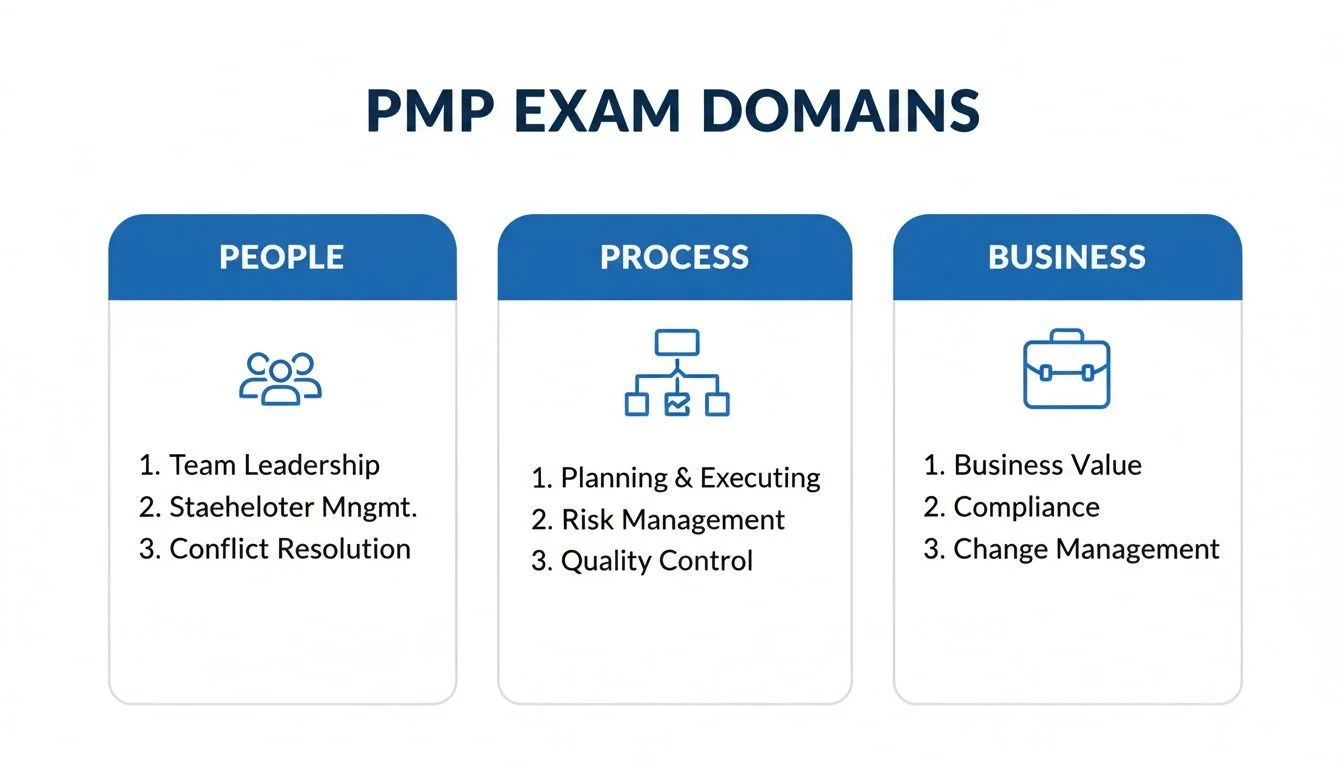 The PMP exam is heavily weighted towards People and Process domains.
The data shows that the Process and People domains make up a combined 92% of the total exam score. Because of this, your study materials must be very strong in these specific areas. If a course focuses too much on administrative business environment tasks and ignores team leadership or methodology, it will not prepare you for the bulk of the test.
Exam Simulators: Real-World Testing Environments
A high-quality exam simulator is the most important tool you can use. This is where you get used to the speed, the pressure, and the specific phrasing of PMP questions. Reading about project management is different from applying those rules under a strict time limit. You must practice in an environment that looks and feels like the actual exam.
A good simulator does more than check if your answers are right. It builds your mental stamina and helps you find the gaps in your knowledge. Using a simulator is like load testing an application before it goes live. It provides a way to experience the testing center environment while you are still at home.
When you look for a simulator, check the size of the question bank. It should have hundreds of situational questions. It must also provide a clear explanation for every answer choice. Knowing why an answer is wrong is often more helpful than knowing why one is right. The most useful simulators track your performance and show you your scores by domain. This data allows you to see exactly where you are struggling. You can then spend your time fixing those specific weaknesses instead of reviewing topics you already know well.
Reflection Prompt: Recall a time when a system failed at your job. How did you handle the pressure? An exam simulator trains you to make decisions quickly when the clock is ticking, much like responding to a high-priority IT incident.
Supplemental Tools: Reinforcing Your Knowledge Base
Core resources get you most of the way there, but supplemental tools help lock that knowledge in place. They are useful for quick study sessions or for memorizing specific facts.
- Flashcards: These are great for learning formulas, vocabulary, and the order of processes. They work well with spaced repetition, which is a method of reviewing information at increasing intervals to improve memory. They are the project management version of quick reference cards used for network protocols or command-line arguments.
- Study Groups: Joining a group of other people taking the PMP can keep you motivated. It provides accountability and gives you a place to ask questions when you get stuck. Discussing a problem with a peer is often the best way to understand a complex topic, much like a code review helps a developer see a bug they missed.
- Mobile Apps: Many developers offer PMP apps that include flashcards and short quizzes. These allow you to study during small windows of time throughout the day. You can review a few questions while waiting for a meeting to start or during your morning commute.
Comparison of PMP Exam Study Material Types
The table below breaks down the different types of study resources. It lists their purpose, their benefits, and their drawbacks to help you build a plan that works for you.
| Material Type | Primary Purpose | Pros | Cons | Best For |
|---|---|---|---|---|
| PMP Prep Books | Explaining official concepts through an exam-focused lens. | Detailed explanations; very organized; usually affordable. | No interactive feedback; reading can be slow. | Creating a solid knowledge base, similar to reading a technical manual for a new language. |
| Online Courses | Providing a guided path and earning the 35-hour requirement. | Clear schedule; teacher support; includes required hours. | Costs more than books; quality varies by instructor. | Students who want a clear path and need to fulfill the mandatory education hours. |
| Exam Simulators | Mimicking the test environment to find weaknesses. | Realistic practice; data on your performance; builds endurance. | Requires long blocks of time; can be a separate expense. | Testing your readiness for the 180-question format and improving time management. |
| Flashcards | Memorizing specific terms, math formulas, and flows. | Easy to carry; good for quick drills; low cost. | Only helps with memory; does not help with complex scenarios. | Quick review sessions to keep basic facts fresh in your mind. |
| Study Groups | Learning through peer interaction and shared advice. | High motivation; multiple viewpoints; social support. | Can lose focus; depends on the quality of the group members. | Solving difficult problems and staying committed to a long study schedule. |
Using a mix of these PMP exam study materials creates a layered approach to learning. You start with the facts in the books, get the structure from a course, and then prove your skills in a simulator. This variety ensures that you are ready for any question the exam might ask. For more information on how to combine these tools into a single schedule, see our PMP Study Guide.
Crafting Your Personalized PMP Study Plan: A Project Management Approach
*Learn how to build an effective and personalized PMP study plan.*You have acquired your PMP exam study materials, which is a vital first step. However, owning the right resources is not the same as using them effectively. To see a return on your investment, you must transform these books, videos, and practice questions into a functional strategy.
The most logical way to do this is to treat your preparation as your first official project. You are about to use the same principles you are studying—initiation, planning, execution, and monitoring—to manage your own learning. This approach changes a daunting, massive task into a sequence of organized sprints. It ensures that every hour you spend at your desk moves you closer to passing the exam.
Phase 1: Initiation and Baselining Your Knowledge
Every project requires a defined starting point. In the context of the PMP, this means establishing an honest baseline of what you currently know. Before you read a single chapter or watch a tutorial, take a full-length diagnostic exam.
Do not worry about the results. It is normal and expected for this first score to be low. Your goal here is not to pass the test but to gather data. This initial exam acts as a reconnaissance mission. It reveals where you have natural strengths and, more importantly, shows which domains and knowledge areas are your weakest. These results provide the data needed to build a targeted plan that ignores what you already know and focuses on what you don't.
Phase 2: Planning Your Study Sprints
Once you have your diagnostic results, you can move into the planning phase. This is where you allocate your most limited resource: time. Instead of reading through a 600-page guide at a uniform pace, you can prioritize the topics that require the most attention. You may also find it helpful to look at general proven study strategies to improve how you absorb technical information.
Open your calendar and create a schedule that includes daily and weekly goals. Be realistic about your professional and personal obligations.
- Block Your Time: Dedicate specific hours in your week exclusively to studying. Treat these blocks as mandatory appointments. Consistency is much more effective than trying to cram for ten hours straight on a Sunday.
- Assign Your Resources: Determine which PMP exam study materials you will use for every session. For example, you might decide that Monday is for reading a specific chapter, while Tuesday is for answering practice questions on that same topic.
- Set Clear Milestones: Define what success looks like for the week. This might involve finishing a specific module or increasing your score in the "People" domain by 10%.
Your study schedule functions as your project plan. A vague goal like "studying for the PMP" often leads to procrastination. A specific, time-bound objective such as "I will finish the Risk Management section and score 75% on the practice quiz by Friday" provides a clear target and keeps you accountable.
Phase 3: Execution with Smart Techniques
This phase involves the actual work of learning and remembering information. As you work through your plan, avoid passive reading, which rarely leads to long-term retention. You must interact with the material to ensure you can apply it in a testing environment. Rote memorization is rarely enough for this exam; you need to understand the logic behind the processes.
Two effective methods for learning technical material are Spaced Repetition and the Feynman Technique.
Spaced Repetition helps you move information into your long-term memory. Instead of looking at a topic once, you review it at increasing intervals—one day later, then three days later, then a week later. This method fights the natural tendency of the brain to forget new data. It is particularly useful for memorizing formulas, definitions, and specific process inputs, similar to how an IT professional might review security protocols or network settings.
The Feynman Technique is a method for confirming you actually understand a concept. After you study a topic, try to explain it out loud in simple language, as if you were talking to someone with no project management experience. If you find yourself using complicated jargon or struggling to explain a step, you have found a gap in your understanding. Go back to your books, clarify that point, and try the explanation again. This is like debugging code; you keep simplifying the logic until the explanation is clear and accurate.
Phase 4: Monitoring and Controlling Your Progress
A project manager does not create a plan and then walk away. You must track your progress and adjust your schedule based on your performance. This creates a feedback loop similar to the iterations found in agile project management.
Take a full-length practice exam every one or two weeks. This acts as your status report. Use the results to see if your scores are improving in your weak areas or if new problem areas have appeared.
By analyzing these results, you can adjust your upcoming study sprints to focus on the areas that need the most work. This cycle of testing and adjusting ensures that you are always spending your time where it will have the biggest impact on your final score. For more details on this process, you can read our guide on building a PMP certification study plan. Taking this active approach turns your study time into a system designed for a single goal: being ready to pass the exam on your first attempt.
Mastering PMP Practice Exams with Strategic Precision
Practice exams serve as your most effective tool for PMP preparation. They function like final dry runs before a high-stakes system cutover. These simulations provide the closest experience you will have to the actual exam day. However, simply finishing a test does not ensure success. Real improvement happens when you use these tests strategically to turn every attempt into a specific learning opportunity.
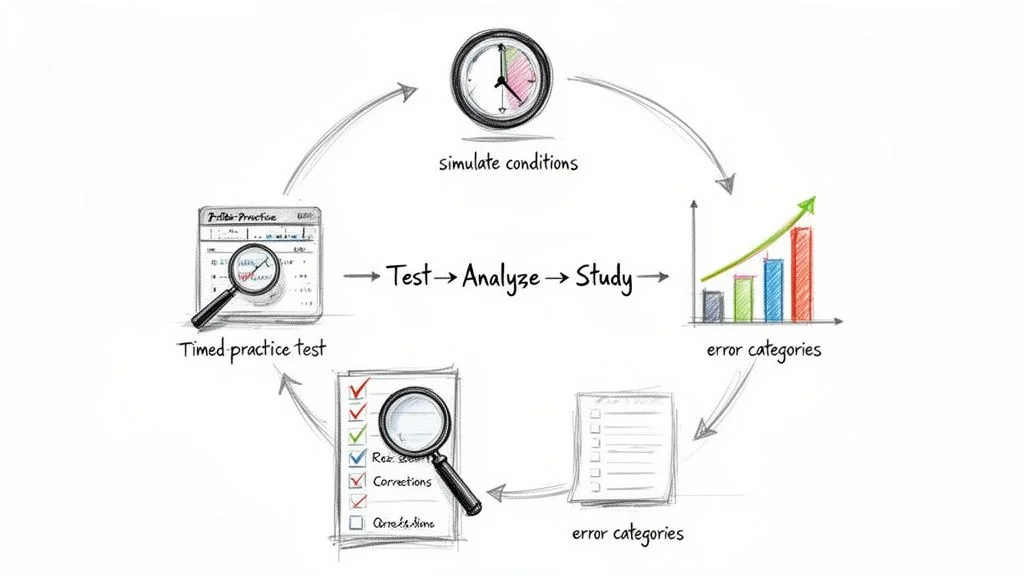 The Test-Analyze-Study loop is essential for maximizing the value of PMP practice exams.
This method focuses on more than just achieving a high score. It requires a disciplined Test-Analyze-Study loop. This cycle ensures you are not guessing. Instead, you are identifying and fixing specific gaps in your project management knowledge.
Simulating the Real Exam Experience
Treat every full-length practice exam as the actual PMP test. This practice involves more than just selecting right or wrong answers. It is a necessary workout to build the mental stamina needed to stay focused for nearly four hours.
Follow these steps to make your simulation authentic:
- Time Yourself Strictly: Set a timer for 230 minutes and let it run. Do not pause the clock or add extra minutes. This is a requirement for practicing effective time management (verify current exam duration on the PMI website).
- Eliminate Distractions: Take the exam in a quiet, private space. Turn off your phone and put it in another room. Close all browser tabs and background applications on your computer.
- Complete it in One Sitting: The PMP exam is a marathon. You need to train for the full duration. Resist the urge to split the test into smaller chunks across several days.
Sticking to this process builds your confidence. It gets you used to the pressure and the clock. On the day of your actual appointment, the testing environment will feel like a routine task rather than a stressful event.
The Power of the Test-Analyze-Study Loop
The real work starts after you finish the test and see your score. This is when you carefully examine your results to guide your next study session.
Your practice exam score is a useful data point, but the real value is found in the analysis of your mistakes. Every wrong answer acts as a signpost. It points directly to a weakness you can fix before you sit for the official exam.
This approach moves you from taking tests passively to using them as diagnostic tools. Your goal goes beyond seeing that you missed a question; you must identify the cause.
Analyzing Your Results with Precision
To get the most out of your practice exams, you must break down every error. This creates a personal roadmap that shows exactly where you are struggling. It prevents you from wasting time on topics you already understand.
Categorize your incorrect answers using these three criteria:
- Domain and Task: Determine if the question belongs to the People, Process, or Business Environment domain. Identify the specific task, such as "manage conflict," "support virtual teams," or "plan and manage schedule," that caused the error. Understanding which task you missed helps you link your failure back to the Exam Content Outline (ECO).
- Question Type: Did you struggle with a situational judgment scenario, a math-based formula problem, or a question about Inputs, Tools, Techniques, and Outputs (ITTO)? Identifying the format of the question helps you recognize if you struggle with logic or raw memorization.
- Root Cause of Error: Why did you miss it? Did you lack the knowledge of the project management concept? Did you misread the question? Did you fall for a distractor answer that looked correct but was not the "best" choice? This determines if you need to study theory or practice reading comprehension.
As you track this data, patterns will appear. You might see that you perform well with predictive project management but struggle with agile leadership. This insight tells you exactly where to spend your study hours to see the biggest improvement.
High-quality exam simulators automate this systematic analysis. Instead of tagging questions by hand, a good simulator gives you immediate performance analytics. It highlights your weak spots and saves you hours of manual work. You can find several PMP practice exam options that provide this specific, actionable feedback.
The PMP exam is a difficult test. The global pass rate for first-time candidates usually ranges between 60-70% (verify current statistics through PMI chapters or annual reports). This range shows why high-quality PMP exam study materials are so important. By following the Test-Analyze-Study approach, you remove your weaknesses, stop making the same mistakes, and build the understanding needed to be well-prepared for the certification.
Reflection Prompt: Consider how you analyze technical errors in your current IT role, such as reviewing logs or conducting a root cause analysis. Use that same data-driven strategy when you review your practice exam results.
Your Top PMP Study Questions, Answered by Experts
Selecting the right PMP exam study materials often feels like managing a high-stakes project before the actual work begins. You want a study plan that produces results, but the sheer volume of available resources can create confusion. Which books are strictly necessary? How many hours should you spend on practice tests? How do you know when you are actually ready for the testing center?
Many candidates struggle at this stage, trying to balance multiple study aids without a clear sense of priority. We can simplify this process by providing direct, experience-based answers to the most frequent questions. This clarity helps you focus your energy on the materials that move the needle and provides the confidence required to proceed with your certification goals.
How Many Practice Questions Should I Really Do for the PMP?
While no single figure ensures a pass, a specific range has proven effective for most successful candidates. Aim to complete between 1,500 and 2,500 high-quality practice questions during your preparation. This volume is usually enough to cover the various tasks and enablers found in the official exam outline without leading to total burnout.
The most important factor is that quality must take precedence over the raw number of questions completed.
Working through 1,500 questions with a thorough analysis of your mistakes is far better than clicking through 3,000 questions without stopping to learn. Most of your growth happens during the review phase. You must understand the logic that makes the correct answer right and identify the specific reasons why the other three options are incorrect. This analytical process builds the situational judgment and logic-based thinking needed to handle the actual exam's wording.
The primary objective is more than just answering questions correctly. You should aim to consistently achieve scores between 75-85% on full-length mock exams from reputable providers. View these scores as a diagnostic tool, similar to a network performance report. They highlight specific technical gaps or logic errors, allowing you to focus your remaining study time on the areas where your performance is lagging.
Can I Pass the PMP Just by Reading the PMBOK® Guide?
The short answer is no. Relying exclusively on the PMBOK® Guide is a frequent mistake that can lead to failure on exam day.
The PMBOK® Guide functions as a formal reference library for professional standards and frameworks. It is an authoritative source for identifying official terminology and the structure of project management processes. However, it was never written as a textbook or a teaching tool. It does not explain how to apply these theoretical concepts in high-pressure, real-world scenarios—which is exactly what the exam tests.
To be well-prepared, you need a dedicated PMP prep book or a structured online course. These resources act as a bridge between the formal, dry language of the PMBOK® Guide and the practical knowledge required for the test. They provide necessary context and offer concrete examples, such as how to facilitate an agile sprint retrospective or resolve a resource conflict. These prep materials also provide specific strategies for managing agile and hybrid methodologies, which now account for 50% of the test content.
How Do I Pick the Best PMP Exam Simulator?
Investing in a high-quality exam simulator is the most impactful decision you will make during your preparation. It is the only tool that converts your reading and note-taking into actual test-taking ability. A high-tier simulator bridges the gap between knowing a definition and applying a concept under a time limit.
When evaluating simulators, check for these four specific characteristics:
- It’s Aligned with the ECO: The questions must strictly follow the current PMP Examination Content Outline (ECO). If a simulator is based on outdated versions of the exam, you will waste time learning concepts that are no longer tested or missing new topics that are critical for success.
- The Questions Feel Real: Look for a simulator that recreates the difficulty and the intentional ambiguity of the actual exam. The PMP uses situational questions that ask what a project manager should "do first" or "do next." If the simulator only asks for simple definitions, it is not preparing you for the real experience.
- It Explains Everything Thoroughly: A quality simulator provides a detailed rationale for every single answer choice. This includes explaining why the "distractor" answers were tempting but ultimately wrong. Learning why a specific option is a trap is just as vital as learning the correct path.
- You Can Track Your Performance Accurately: The platform should provide data-driven insights into your progress. You need to see your scores broken down by the three primary domains: People (42%), Process (50%), and Business Environment (8%). This data allows you to stop guessing about your readiness and start using your study hours efficiently.
Choosing your PMP exam study materials with a clear strategy is the first step toward a passing score. By answering these foundational questions now, you can stop searching for resources and start the actual work of mastering the material.
At MindMesh Academy, we build our PMP training tools specifically to meet these standards. Our platform offers a complete solution for candidates, featuring a high-fidelity exam simulator and the detailed performance analytics needed to identify and fix your weak points. Visit our PMP courses and tools to see how our resources can help you pass the PMP exam with confidence and move forward in your professional career.

Written by
Alvin Varughese
Founder, MindMesh Academy
Alvin Varughese is the founder of MindMesh Academy and an enterprise architecture leader. An electrical engineer by training, he moved from factory automation in South Africa to cloud architecture at GE Appliances and Humana (Fortune 50), and holds 20 professional certifications including AWS Solutions Architect Professional, Azure DevOps Engineer Expert, and Microsoft Agentic AI Business Solutions Architect. He built MindMesh Academy after interviewing too many highly certified candidates who couldn't answer basic questions: the goal is prep that makes you better at the job, not just able to pass the exam.