
Official Study Guide Checklist Before You Commit
Official Study Guide Checklist Before You Commit
Before you spend weeks with an official study guide, check if it actually matches the exam you're taking, how you'll be tested, and the time you have available. A guide can carry an official label and still be incomplete for your situation, especially if the exam includes hands-on tasks, scenario judgment, or performance-based questions.
Use this checklist before you invest money or study hours. Your goal isn't to find the thickest book or the most polished PDF. Instead, aim for a resource that tracks the current exam objectives, helps you practice recall, explains mistakes clearly, and shows you that you're getting closer to exam readiness.
What a Good Study Guide Does
A good official study guide should provide a clear path from the exam blueprint to test-day performance. At a minimum, it should explain the topics listed in the vendor's exam objectives, organize them logically, and indicate the level of understanding the exam expects.
For many certification exams, the vendor's exam objectives or skills outline is the primary source of truth, not the study guide itself. Microsoft, for example, publishes official skills measured pages for exams like AZ-900 through Microsoft Learn. These pages detail the current topic areas candidates should know. Similarly, AWS certification pages publish exam guides describing domains, task statements, and recommended knowledge for each certification.
This distinction matters. A study guide teaches and organizes information. Exam objectives define what can be tested. Always compare any guide against the current vendor outline before you commit to it.
If you're preparing for a specific certification, a structured resource like the AZ-900 Microsoft Azure Fundamentals study guide can help connect vendor objectives, explanations, and practice workflows, preventing your notes from scattering across different tools.
Study Guide Checklist Before You Start
The fastest way to evaluate a guide is to score it against the elements that truly affect exam readiness. Use the table below before you buy, download, or build your study plan around any resource.
| Checklist item | What to look for | Why it matters |
|---|---|---|
| Current exam version | The guide names the exact exam code, version, and latest objective set. | Old material can waste hours on retired topics or miss new domains. |
| Objective mapping | Chapters or lessons map directly to official domains and subtopics. | You can track coverage instead of guessing what you've studied. |
| Domain weighting | The guide reflects which areas carry more exam weight. | High-value domains get the study time they deserve. |
| Explanation depth | Concepts are explained with examples, not just definitions. | Scenario questions test judgment, not vocabulary alone. |
| Practice questions | Questions include rationales for correct and incorrect answers. | Explanations turn mistakes into study targets. |
| Hands-on relevance | Labs, simulations, or task-based examples match the exam style when needed. | Many IT exams test applied skill, not passive recognition. |
| Review system | The guide supports spaced review, flashcards, or scheduled recall. | Memory fades when you only read once. |
| Progress evidence | You can see weak topics, accuracy trends, or readiness by objective. | A final exam date should be based on evidence, not hope. |
| Update process | The publisher or platform states how content is reviewed or refreshed. | Certification vendors update exams over time. |
| Fit for your schedule | Lessons are structured enough for your available weekly study hours. | Even a strong guide fails if you can't use it consistently. |
Don't treat this as a nice-to-have list. If a study guide misses the current exam version, objective mapping, and practice explanations, it shouldn't be your primary resource.
Check Exam Objectives Before You Trust the Guide
Start with the vendor's official exam page. Look for the exam code, domain names, skill statements, and percentage weights. Then, compare those items to the table of contents in your study guide.
For AWS exams, candidates can review the certification's official exam guide from the AWS Certification pages. For Microsoft exams, the skills measured section on Microsoft Learn is the reference point. CompTIA publishes exam objectives for certifications like Security+ through its certification pages, and Cisco lists exam topics for certifications like CCNA through the Cisco Learning Network.
When you compare the guide to the objectives, don't stop at chapter titles. A chapter called "Networking Basics" might not cover subnetting depth, security groups, routing behavior, or troubleshooting scenarios at the level your exam expects. Use the actual verbs in the objective statements—such as configure, identify, troubleshoot, compare, or implement—to judge whether the guide teaches the task or only names the topic.
A practical audit looks like this:
- Match every official domain to at least one chapter, lesson, or study section.
- Mark objectives that receive only a short definition or glossary entry.
- Identify objectives that require hands-on practice or scenario reasoning.
- Flag any topic in the guide that doesn't appear in the current objective list.
- Check whether the guide reflects the latest exam code and retirement notices.
If you find large objective gaps, don't assume you can fix them later. Most learners underestimate how long gap-filling takes once they've already built their study plan around a weak resource.
Look for Practice Questions With Useful Explanations
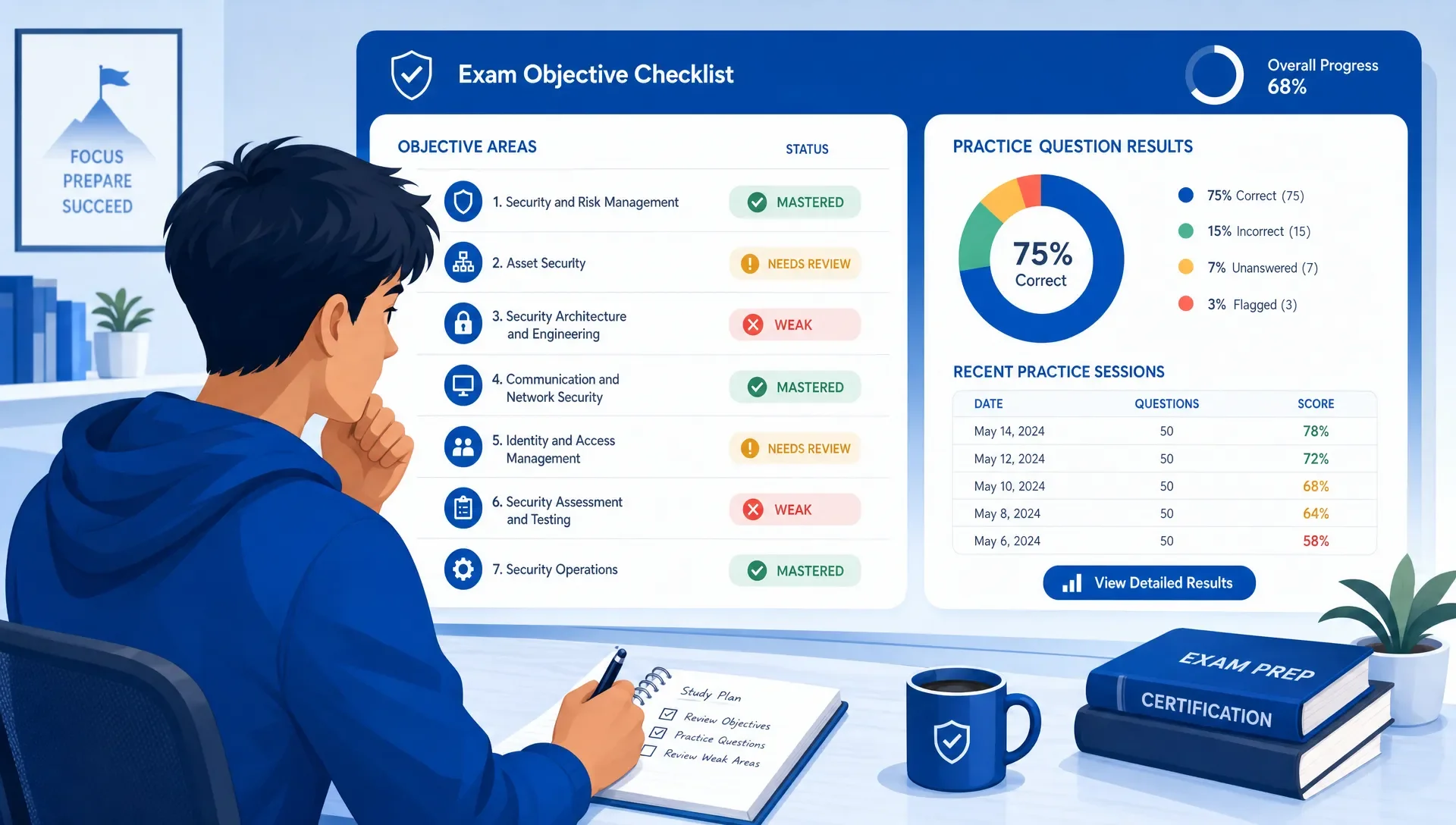
Practice questions aren't just a score check. They are one of the best ways to expose what you don't understand yet, especially when the explanations clarify why an answer is correct and why the distractors are wrong.
The learning science behind this isn't new. Henry Roediger and Jeffrey Karpicke's research on retrieval practice found that testing yourself can improve long-term retention compared with repeated study alone, as described in their paper on test-enhanced learning. For certification prep, this means your guide should push you to recall, apply, and explain, not just reread.
A weak question bank often gives you a letter answer and a one-line explanation. A useful one explains the principle, points back to the objective, and makes the trap visible. This matters because certification exams often use plausible distractors, including answers that are technically true but wrong for the scenario.
For example, if you're studying security concepts, a question should help you understand why one control fits a business requirement better than another. If you're preparing with a resource like the CompTIA Security+ practice exam, focus less on memorizing the answer pattern and more on reading each explanation until you can restate the rule in your own words.
Make Sure the Guide Matches the Exam Format
A guide can cover the topics and still fail to prepare you for how the exam asks questions. This is common with IT certifications because many exams use scenarios, multi-select questions, drag-and-drop items, or performance-based tasks.
Before you commit, check the exam format on the official vendor page. Then, ask whether the study guide gives you matching practice. A cloud fundamentals exam may emphasize terminology, service selection, and shared responsibility. A networking exam may require troubleshooting from command output or topology details. A project management exam may test judgment in stakeholder, risk, or schedule scenarios.
| Exam feature | Study guide should include | Warning sign |
|---|---|---|
| Multiple-choice concepts | Clear definitions plus examples and contrasts. | Long vocabulary lists with no context. |
| Scenario questions | Case-style practice with decision reasoning. | Questions that only ask for memorized terms. |
| Multi-select items | Practice that explains complete and partial logic. | Explanations that don't discuss distractors. |
| Performance-based tasks | Labs, simulations, or step-by-step applied exercises. | Pure reading for a hands-on exam. |
| Domain-weighted scoring | More practice in heavier domains. | Equal time spent on every chapter regardless of weight. |
This is where "official" can be misleading. An official book may be accurate, but it may not include enough exam-style practice. If the exam includes applied work, pair the guide with labs, practice questions, or performance-based formats that match the test experience.
Evaluate Whether the Study Plan Supports Memory
A study guide that only tells you what to read leaves too much work on your plate. You need a way to bring older material back before it fades.
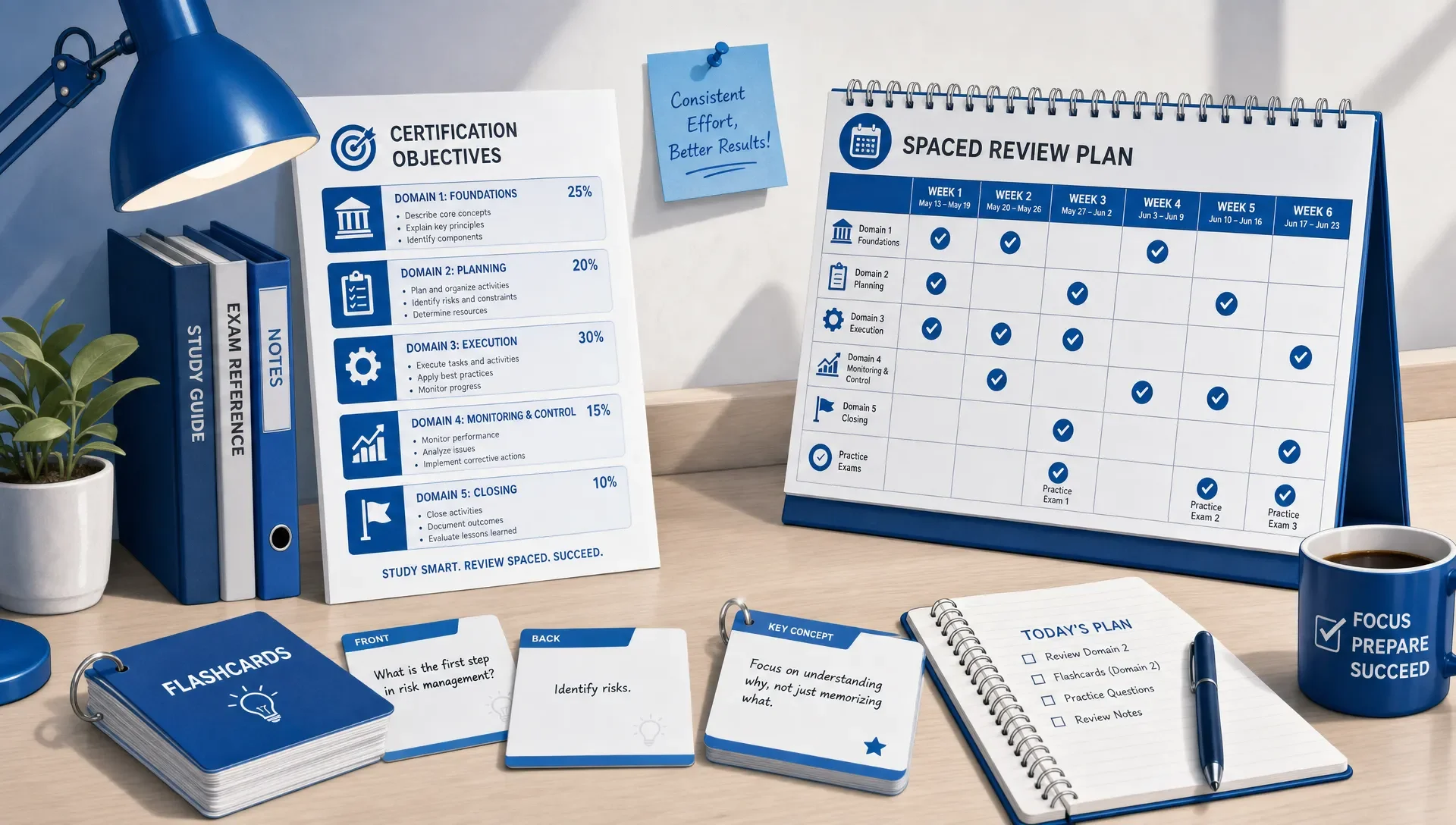
Spaced practice has strong evidence behind it. The Institute of Education Sciences practice guide on organizing instruction and study to improve student learning recommends spacing learning over time rather than concentrating it into one session. For certification candidates, this means your official study guide should help you revisit cloud services, ports, commands, frameworks, or formulas across multiple weeks.
Look for built-in review checkpoints, end-of-chapter recall prompts, flashcards, mixed quizzes, or a schedule that revisits older domains. If the guide only moves forward chapter by chapter, build your own review loop before you start.
A good weekly pattern includes reading or watching for understanding, answering questions without notes, reviewing missed explanations, and returning to weak flashcards several days later. MindMesh Academy's connected workflow is built around study guides, practice questions, spaced-repetition flashcards, and readiness tracking, which can help if you don't want your review system split across separate tools.
For a broader way to audit all your resources, the exam material checklist for certification candidates expands this idea beyond study guides into objectives, labs, notes, and practice exams.
Check Author Credibility and Update Signals
You don't need a celebrity author. You do need signs that the guide was written or reviewed by people who understand the exam, the technology, and common learner mistakes.
Look for named contributors, technical reviewers, version history, and alignment with the vendor's current exam page. If a guide references outdated service names, old screenshots, or retired exam codes, treat that as a serious warning. In cloud and cybersecurity especially, outdated examples can create bad habits.
Update signals are more important than polish. A beautiful PDF from three exam versions ago is less useful than a plain but current guide that tracks objectives accurately. If you're comparing two resources, choose the one that tells you exactly which exam version it supports and how recently it was reviewed.
You should also check whether the guide distinguishes between foundational awareness and production-level depth. Some exams require you to recognize a service or process. Others expect you to choose the best configuration in a scenario. If the guide doesn't make that level clear, you'll have trouble deciding when a topic is "done."
Red Flags Before You Commit to an Official Study Guide
Some problems are easy to spot before you invest time. Pause if you see any of these signs:
- The guide doesn't name the current exam code or objective version.
- The table of contents doesn't map clearly to official domains.
- Practice questions have answers but no meaningful explanations.
- The guide relies heavily on memorized definitions for a scenario-based exam.
- There is no review plan, flashcard support, or spaced recall structure.
- The author or publisher gives no update history.
- The guide promises a pass without measuring your readiness by topic.
The biggest red flag is a guide that makes you feel busy but doesn't show what you've mastered. Certification prep should create evidence: which objectives you know, which ones you miss under pressure, and which topics need another pass.
How to Decide If This Study Guide Is Enough
After your audit, put the guide into one of three categories.
| Decision | When it fits | What to do next |
|---|---|---|
| Use as primary resource | Current, objective-mapped, clear explanations, and strong practice. | Build your weekly plan around it. |
| Use as secondary resource | Accurate but weak in practice, labs, or review. | Pair it with questions, flashcards, or hands-on work. |
| Skip it | Outdated, incomplete, or poorly explained. | Choose a better guide before spending study hours. |
Don't expect one resource to do everything. For most candidates, the strongest prep system combines official objectives, a structured guide, active recall, practice questions, and spaced review. If your guide handles only one of those jobs, that's fine, but don't mistake it for a complete plan.
If you already know your certification path, compare your guide against a working exam-prep flow. For AWS candidates, the AWS Certified Cloud Practitioner practice exam shows how objective-based practice and explanations can support readiness checks after you've studied the fundamentals.
Frequently Asked Questions
Is an official study guide always the best resource? Not always. An official study guide is usually a trustworthy starting point, but it may not include enough practice, hands-on work, or spaced review. Compare it against the current exam objectives and the exam format before making it your main resource.
What is the difference between exam objectives and an official study guide? Exam objectives define what can be tested. A study guide teaches those topics. If the two conflict, trust the current objectives from the certification vendor and update your study plan accordingly.
How do I know if my study guide is outdated? Check the exam code, publication date, version notes, and references to vendor services or processes. Then, compare the guide's chapters to the current official exam outline. Missing domains or retired topic names are warning signs.
Should I buy a study guide before scheduling my exam? You can, but don't schedule the exam based only on owning a guide. Schedule when your practice results, weak-topic reviews, and objective coverage show that you're close to ready.
Do I still need practice exams if I have an official study guide? Yes, in most cases. Practice exams help you apply knowledge under test-like conditions and reveal weak objectives. A study guide helps you learn; practice questions help you prove what you can recall and apply.
How many study resources should I use? Use enough resources to cover the exam objectives, practice the exam format, and review weak areas, but not so many that your plan becomes scattered. A good core stack is official objectives, one structured guide, practice questions, and a spaced review method.
Build Your Study Plan Around Readiness, Not Guesswork
Before you commit to an official study guide, make it earn the role. Check the exam version, map it to the current objectives, inspect the explanations, confirm the practice format, and decide how you'll review weak topics over time.
MindMesh Academy provides IT professionals with a structured approach to exam prep, including comprehensive study guides, realistic practice questions with detailed explanations, and spaced repetition flashcards. If you're looking for an organized study workflow to build confidence and track your progress, explore our resources. Start with the AZ-900 Microsoft Azure Fundamentals practice exam to test your knowledge against the latest objectives.

Written by
Alvin Varughese
Founder, MindMesh Academy
Alvin Varughese is the founder of MindMesh Academy and an enterprise architecture leader. An electrical engineer by training, he moved from factory automation in South Africa to cloud architecture at GE Appliances and Humana (Fortune 50), and holds 20 professional certifications including AWS Solutions Architect Professional, Azure DevOps Engineer Expert, and Microsoft Agentic AI Business Solutions Architect. He built MindMesh Academy after interviewing too many highly certified candidates who couldn't answer basic questions: the goal is prep that makes you better at the job, not just able to pass the exam.